Plant Profile & Key Characteristics
Overview: The Calabash Tree (Crescentia cujete) is an evergreen tropical tree growing 5–10 m (15–30 ft) tall, with a broad, spreading crown. It is grown as an ornamental and medicinal tree and for its large, hard-shelled gourd-like fruit.
Quick Specifications
| Specification | Attribute |
|---|---|
| Plant Type / Life Cycle | Perennial evergreen tree |
| Foliage Type | Evergreen |
| Mature Size | 5–10 m (15–30 ft) tall |
| Growth Rate | Moderate |
| Hardiness | USDA zone 13+ |
Growth Form & Structure
- Height & Spread: 5–10 m (15–30 ft) tall with a wide, low, spreading canopy; a large tree best suited to open tropical gardens rather than pots.
- Growth Habit & Form: Small to medium evergreen tree with long, spreading branches; flowers and fruit are borne directly on the trunk and main branches (cauliflory).
- Lifespan & Maturity: Long-lived tropical tree.
Anatomy & Physical Features
- Leaves & Foliage: Green oval leaves clustered along the branches.
- Flower Characteristics: Bell- to mouth-shaped flowers in green, orange, pink or brown, borne on the trunk and branches and opening mainly at night, year-round.
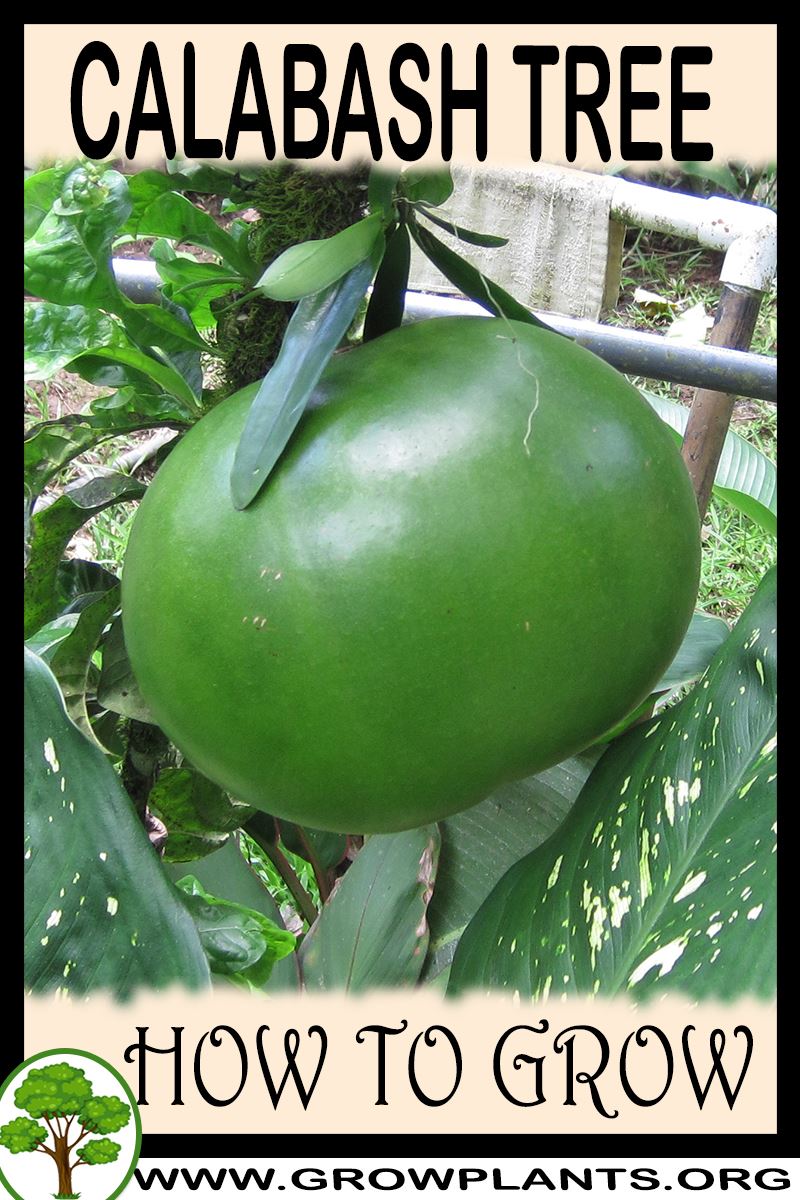
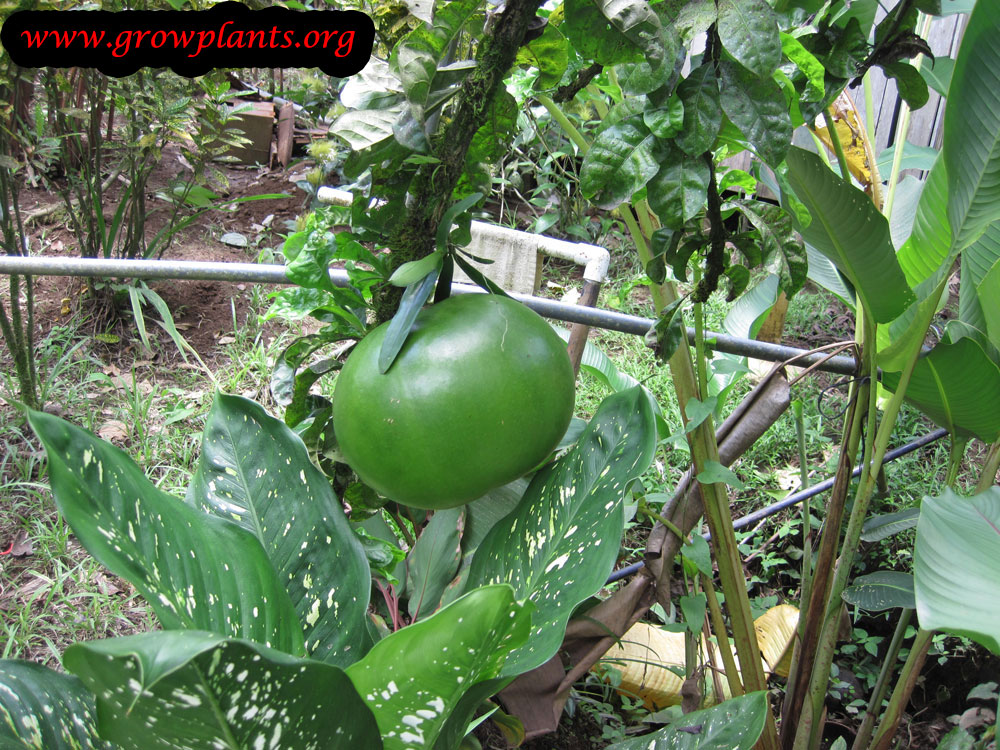
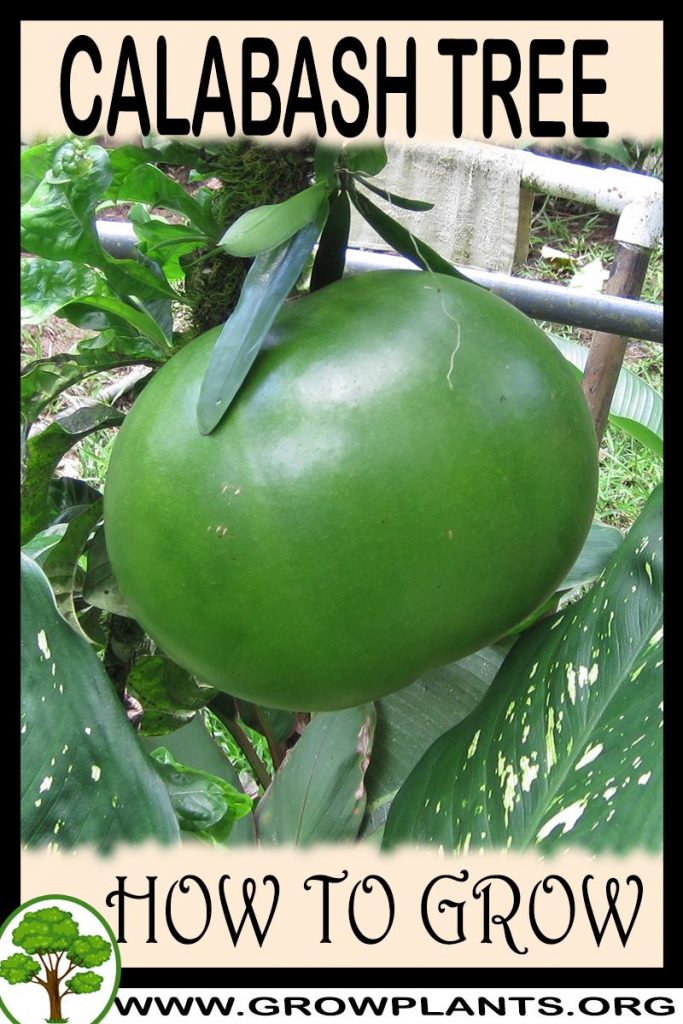
- Fruit Profile: Large, round, green gourd-like fruit with a hard woody shell; not edible.
Primary Uses & Landscape Value
- Functional & Ornamental Roles: Ornamental and shade tree; the hollowed fruit shells are traditionally made into bowls, cups and utensils, and the plant is used medicinally.
Note: Safety note: the fruit pulp is toxic if eaten (it contains hydrocyanic-acid precursors) – this is not a food fruit, unlike some other gourds. The large, heavy, hard-shelled fruit also hangs directly beneath the branches, so consider where you site the tree.
Care Guide: Planting, Soil & Watering
Overview: Calabash Tree (Crescentia cujete) is a tropical tree that wants full sun and consistently moist, fertile soil, and it drinks heavily to support its lush growth. Keep the soil reliably moist and never let it dry out for long.
Quick Care Requirements
| Requirement | Ideal Condition |
|---|---|
| Planting Season | Year-round within its frost-free tropical range |
| Growth Rate | Moderate |
| Soil Type | Fertile, moisture-retentive soil that still drains |
| Water Need | High — keep the soil consistently moist |
Planting & Establishment
- Best Planting Season: In its tropical range it can be planted at any time of year; choose an open, sunny site with room for a tree that reaches 5–10 m.
- How to Plant:
- Hole Preparation: Dig a hole wider than the root ball in a sunny position, loosening the surrounding soil so roots spread freely.
- Soil Amendments: Blend organic matter into the backfill to hold moisture while keeping the ground from becoming stagnant.
- Planting Depth: Set the tree at the same depth it grew previously, keeping the trunk base at soil level.
- Growth Speed & Expectations: Growth is moderate; give it space, as it develops into a spreading tree with heavy fruit.
Soil, Watering & Drainage Care
- Soil Mix & Drainage Needs: Provide deep, fertile soil that stays moist yet drains after heavy tropical rain; the tree naturally grows where water is plentiful. It is not suited to container culture at maturity.
- Watering Schedule & Technique:
- Young / Newly Planted: Keep the soil evenly moist while the young tree establishes, watering whenever the surface begins to dry.
- Established: Water generously and regularly; this species prefers steady moisture and does not like to dry out.
- Seasonal Adjustments: Water most during warm, dry spells and ease back during cooler or wetter periods.
Climate, Light & Hardiness
The calabash tree is a strictly tropical evergreen that needs full sun and consistently warm, essentially frost-free conditions; it has one of the narrowest cold tolerances among trees in this collection. Outside truly tropical climates it is best grown indoors as a houseplant with bright light.
Quick Climate Specifications
| Climate Zones | Tropical |
|---|---|
| USDA Hardiness Zones | 13+ |
| Frost Tolerance | Very Low |
| Light Conditions | Full Sun |
Sunlight & Light Exposure
Optimal Light Setup
Needs full sun outdoors for good growth and flowering; when grown indoors as a houseplant, the brightest available light (such as a sunny south-facing window) is important.
Temperature Extremes & Hardiness
USDA Hardiness & Regional Limits
Suited to outdoor culture only in USDA zone 13 and warmer - among the most tropical, cold-sensitive hardiness ratings in this group, meaning it is unsuited to outdoor winters in almost any temperate or subtropical climate.
Cold Damage & Winter Protection
Because it has essentially no cold tolerance, gardeners outside true tropical zones should grow it in a container that can be brought indoors before any cool weather arrives.
Frost Sensitivity
Frost-sensitive with no meaningful ability to withstand freezing temperatures; even a light frost is likely to cause serious damage.
Extreme Heat Tolerance
Well adapted to hot, humid tropical conditions.
Wind, Humidity & Microclimate
Humidity Preferences
Favors consistently moist soil and the higher humidity typical of tropical climates; indoor growers should avoid the dry air common near heating or air conditioning.
Rainfall & Seasonal Moisture
Prefers generous, consistent water and always-moist soil rather than a pronounced dry season.
Growing in Pots, Balconies & Indoors
The calabash tree eventually reaches 5-10 m, so it is not a long-term container plant – the grower marks pots as not recommended. He does, however, note it can be kept indoors, which realistically applies only while it is young or trained as a specimen; a mature tree needs the open ground and full sun.
Quick Details
- Container Size: A large tub only while young; it outgrows pots in time
- Indoor Suitability: The grower says it can be kept indoors – practical only for young plants in a very bright, warm spot
- Best Spot: Full sun; warm, frost-free conditions
- Soil & Drainage: Rich, free-draining mix
- Watering in Pots: Generous – it likes plenty of water in active growth
Indoors & On the Windowsill
- What the grower says: He marks it as possible to grow indoors, but this suits a young plant in a bright, warm, humid room rather than a mature tree.
- Reality of size: It becomes a substantial tropical tree, so treat indoor growing as a temporary or juvenile stage.
- Warmth: Keep it above cold thresholds year-round; it is a true tropical.
On a Balcony or Patio
- While young: A large, warm, sunny patio tub works for a few years; give it the brightest spot and shelter from cold.
- Practicalities: The heavy fruit is a hazard on a mature tree, another reason it belongs in open ground long term.
Choosing the Pot, Soil & Long-Term Care
- Pot & drainage: A large tub for young plants only – use a container with strong drainage holes; skip a standing-water saucer to avoid root rot.
- Pot material: Terracotta breathes and dries fast (good where you tend to overwater); glazed or plastic pots hold moisture longer.
- Potting mix: a light, aerated potting mix – peat or coir blended with perlite or vermiculite, plus some organic matter/compost.
- Feeding: Potted plants exhaust their feed faster because water washes nutrients out, so feed a little more often than plants in open ground during active growth.
- Repotting: Refresh the top of the mix each growing season and pot up or divide roughly every couple of years, trimming crowded roots.
- Long term: The grower does not recommend permanent container culture – plan to move it to the ground in a suitable warm climate.
Fertilizing & Feeding
A moderate feeder overall: young trees benefit from steady feeding to build size, while an established, evergreen tree in consistently moist soil generally needs only light, ongoing feeding to stay healthy.
Quick Fertilizing Specs
| Feeding Level | Moderate feeder while establishing, lighter once mature |
|---|---|
| Main Nutrient Priority | Balanced feeding with adequate nitrogen for steady foliage and canopy growth |
| Best Feeding Period | Through the warm, active growing season |
| Organic Options | Compost, well-rotted manure, and other organic matter worked into the root zone |
| Reduce/Stop Feeding | Ease off feeding if growth slows or during any cooler, drier stretch |
| Micronutrients | Usually met by a complete fertilizer and organic matter; correct only a diagnosed deficiency |
| Soil pH | Tolerates a wide range; performs best in fertile, evenly moist soil |
Feeding by Growth Stage
Establishment after planting
Help a newly planted calabash tree build roots and settle into the site.
| Nutrient direction | A balanced, nitrogen-forward fertilizer supports steady root and canopy establishment. |
|---|---|
| Timing | The first growing season after planting. |
| Frequency | Light, regular feedings through the first season, tapering off as the tree settles in. |
| Fertilizer types | A balanced complete fertilizer, Compost or well-rotted organic matter worked into the planting area |
| Routine trace nutrients | iron, manganese |
| Precautions | Keep new roots evenly moist and avoid concentrating fertilizer against the trunk or root ball. |
Established tree, ongoing growth
Maintain steady canopy growth and flowering on an established, evergreen tree.
| Nutrient direction | Light, balanced feeding sustains foliage and flowering without pushing soft, weak growth. |
|---|---|
| Timing | Through the warm, active growing season on an established tree. |
| Frequency | An occasional light feeding is usually enough, tapering back if growth slows. |
| Fertilizer types | A balanced complete fertilizer, A top-dressing of compost or organic mulch |
| Routine trace nutrients | iron, manganese |
| Precautions | Avoid overfeeding in constantly moist soil, which can encourage nutrient leaching and weak growth; feed sparingly if the tree already looks vigorous. |
Nutrient Deficiency Signs & Corrections
Older leaves fade to pale green or yellow and overall canopy growth slows.
| Possible causes | low available soil nitrogen, nitrogen leaching from consistently moist or heavy watering, competition from surrounding vegetation or turf |
|---|---|
| Appears first on | older, lower leaves |
| What to check | recent feeding history, soil organic matter levels, drainage and watering pattern |
| Possible correction | Apply a nitrogen-containing balanced fertilizer and refresh organic matter, then monitor new growth for improvement. |
New leaves turn yellow between distinctly green veins.
| Possible causes | high soil pH tying up available iron, waterlogged or poorly drained soil limiting root uptake, naturally low soil iron |
|---|---|
| Appears first on | newest growth at branch tips |
| What to check | soil drainage and pH, how consistently the site stays wet, overall root health |
| Possible correction | Improve drainage where possible, correct pH toward neutral if testing warrants it, and apply a chelated iron product per its label. |
Interveinal yellowing on younger leaves, generally milder and less sharply defined than iron chlorosis.
| Possible causes | high soil pH reducing manganese availability, overly wet, poorly aerated soil, low native soil manganese |
|---|---|
| Appears first on | younger leaves |
| What to check | soil pH and drainage, recent rainfall or irrigation pattern, whether nearby plants show similar symptoms |
| Possible correction | Improve soil aeration and drainage, and apply a chelated manganese product per its label if a deficiency is confirmed. |
Pruning, Training & Seasonal Maintenance
Calabash tree tolerates light shaping year-round in its frost-free tropical range and needs very little structural intervention once its form is set. The main objective is a clean, safe canopy shape — pruning does not meaningfully affect flowering or fruiting, because unlike most trees this species flowers and fruits directly on the trunk and older branches (cauliflory), not on new shoot tips.
Quick Pruning & Maintenance Specs
| Pruning Tolerance | Low to Moderate — shaping and safety cuts only |
| Primary Pruning Window | Any time in frost-free climates; light touch year-round |
| Main Objective | Shape, clearance, and removing fruit that overhangs walkways |
| Young Plant Priority | Establish a single trunk and basic branch structure |
| Mature Plant Priority | Preserve trunk and major-limb bark (where flowers/fruit form); manage fruit placement for safety |
| Best Tool Type | Bypass secateurs and loppers; pruning saw for larger limbs |
| Avoid Heavy Pruning During | While trunk/branches are actively flowering or carrying developing fruit |
Pruning by Plant Age & Size
Newly Established
Remove only damaged or dead growth; allow the young tree to establish its own branching pattern before any formative cuts.
Young / Formative
Select and retain a single trunk and a well-spaced set of main branches. Avoid heading cuts on the trunk or major limbs, since this is exactly the surface next season’s flowers and gourds will emerge from.
Mature / Established
Limit pruning to removing dead or crossing wood and thinning fruit set in areas over paths, seating, or parking where a falling gourd (which can be heavy) is a hazard.
Structural Pruning & Training
Because flowers and fruit form on the trunk and older branches rather than on new terminal growth, structural pruning should protect and expose that older bark surface (avoid crowding it with dense secondary growth) rather than routinely cutting it back. Remove crossing or rubbing branches to prevent bark damage in the very areas where cauliflorous flowers develop.
Special Growth to Remove
Where fruit sets low over foot traffic, walkways, or parking, thin or remove some of the developing gourds while still small — mature fruit is heavy and a documented injury risk if it falls. This is fruit-safety thinning rather than routine pruning, and should target location, not simply crop load.
Tools
Bypass secateurs for small shoots, loppers for medium branches, and a pruning saw for any larger structural or deadwood cuts.
Tool Hygiene & Disease Risk
Routine: no significant transmissible disease is documented for this species. Clean, sharp tools are sufficient for ordinary maintenance cuts.
Cut Placement & Technique
Cut just outside the branch collar, never flush, and take particular care not to bark-strip the trunk or main limbs when removing nearby growth, since that bark is where next season’s flowers form.
Heavy Pruning & Rejuvenation
Not routinely needed or well-documented for this species; because flowering wood is the permanent trunk and branch structure itself, hard rejuvenation pruning would remove the very surface the tree flowers and fruits from and is not recommended.
Post-Pruning Care
No feeding is needed after light pruning. After any fruit-safety thinning, monitor remaining fruit for size and position through the season, since fruit continues to enlarge and add weight.
Common Pruning Mistakes
Heading back or scraping the trunk and main limbs (removes the surface flowers/fruit emerge from); leaving heavy low-hanging fruit over walkways or seating areas.
When NOT to Prune
Avoid cutting into the trunk or main limbs while they are actively flowering or carrying young fruit, to avoid damaging developing flower and fruit sites.
Recommended Tools (by task)
- bypass_secateurs — small shoots and light shaping.
- loppers — medium branches during formative training.
- pruning_saw — larger structural or deadwood cuts on an established tree.
Propagation Guide
Calabash tree is most easily started from the numerous seeds embedded in its hard gourd-like fruit, which germinate readily in warm, consistently moist conditions. Vegetative propagation by cuttings or air layering is not required but is sometimes used to preserve the fruit shape of a particular tree; overall difficulty is easy.
Quick Propagation Specs
| Best Propagation Method | Seed |
| Alternative Methods | Semi-hardwood cuttings; air layering |
| Propagation Difficulty | Easy |
| Seed True-to-Type | Usually true-to-type, though fruit shape can vary between seedlings |
| Vegetative True-to-Type | Yes – reproduces the exact fruit shape of the parent tree |
| Best Propagation Season | Warm months; can be sown year-round in frost-free areas, matching the site’s all-year planting season |
| Seed Germination Time | Typically a few weeks |
| Germination Temperature | Warm, roughly 24–30°C (75–86°F) |
| Seed Sowing Depth | Shallow, about 1cm (0.4in) |
Growing from Seed
Seed Handling & Viability
Seeds are extracted from the pulp inside the hard fruit shell; clean off the surrounding pulp before sowing, and sow reasonably fresh for the best germination.
Sowing Season
Warm weather; can be sown year-round where frost-free.
Sowing Depth & Orientation
Sow shallowly, about 1cm (0.4in) deep.
Germination Conditions
Warm temperatures with consistently moist soil, matching the site’s always-moist soil preference for this tree.
Germination Time
Usually within a few weeks.
Seedling Care
Keep young seedlings warm, frost-free, and evenly moist; they can be grown on in containers before planting out.
Stem Cuttings
Cutting Type
Semi-hardwood cuttings.
Best Timing
Warm growing season.
Cutting Preparation
Take firm side-shoot sections and remove lower leaves.
Rooting Setup
Warm, humid, free-draining propagating mix.
Rooting Hormone
Beneficial for improving an otherwise moderate rooting rate.
Rooting Time
Several weeks.
Air & Ground Layering
Air layering on a firm, moderately mature branch can be used to preserve the exact fruit shape and size of a particularly desirable individual tree, useful since fruit shape is used for calabash crafts. Wound or girdle the branch, wrap with moist sphagnum moss, and keep consistently humid; rooting takes some months, after which the rooted section is severed and potted on.
Bloom & Flower Guide
Quick Details
- Bloom Season: Year-round in the tropics
- Time to First Bloom: Usually begins flowering several years after planting
- Flower Appearance: Bell- to mouth-shaped flowers in muted green, orange, pink or brown, borne directly on the trunk and branches
- Edibility: Ornamental and medicinal tree – the flowers are not eaten
Detailed Blooming Overview
The calabash tree flowers in a curious way known as cauliflory: the blooms emerge straight from the woody trunk and older branches rather than among the leaves. The muted, bell-shaped flowers open in the evening and are pollinated by bats, which visit through the night.
Flower Characteristics
- Bell- to mouth-shaped, in green, orange, pink or brown, with a slightly fleshy texture.
- Carried directly on the trunk and branches, opening after dark.
Bloom Care & Thinning
- Care: Minimal – a warm, frost-free climate is the main requirement for flowering.
- Pollination: The night-opening flowers are bat-pollinated.
Pests, Diseases & Troubleshooting
Overview: The calabash tree is a tough, low-maintenance tropical tree with remarkably few serious pests or diseases in cultivation. What problems occur are the general ones of warm-climate broadleaf trees: sap-sucking scale and mealybug with their attendant sooty mould, occasional fungal leaf spot in wet humid weather, and root problems on waterlogged or cold soils. Manage it culturally – good drainage, warmth and sensible sanitation – and it largely looks after itself.
Quick Troubleshooting Overview
| Issue / Pest | Main Symptom | Primary Solution |
|---|---|---|
| Scale insects | Brown/grey bumps on stems and leaves; honeydew, sooty mould | Prune-out; horticultural oil on crawlers |
| Mealybug | White cottony masses at leaf joints and shoot tips | Wash off; insecticidal soap / horticultural oil |
| Sooty mould | Black soot-like film on leaves over honeydew | Control the sap-sucker underneath; rinse foliage |
| Leaf spot | Brown/black spots or blotches on leaves in wet weather | Improve airflow; remove affected leaves; copper if needed |
| Root rot | Wilting, yellowing, dieback in wet or cold soil | Improve drainage; reduce watering; do not plant in sumps |
Common Pests & Management
- Scale insects (Coccidae / Diaspididae):
- Symptoms: Small, immobile brown, grey or waxy bumps fixed to twigs, leaf veins and undersides. Soft scales exude honeydew that fuels black sooty mould; heavy colonies weaken shoots and dull the foliage.
- Prevention & Control: Prune out and destroy badly-encrusted twigs, and rub off light infestations. Horticultural oil smothers scale, applied to target the vulnerable crawler stage. Preserve natural enemies (ladybirds, parasitic wasps) by avoiding broad-spectrum insecticides on this otherwise resilient tree.
- Mealybug (Pseudococcus / Planococcus spp.):
- Symptoms: White, cottony, waxy insects clustered in leaf axils, on shoot tips and along veins, with sticky honeydew and sooty mould. Growth may be checked where colonies are dense.
- Prevention & Control: Dislodge with a firm jet of water, and treat persistent colonies with insecticidal soap or horticultural/neem oil, repeating to catch successive generations. Keep the tree unstressed and avoid excess soft nitrogen-fed growth.
- Aphids (Aphididae):
- Symptoms: Soft green or dark aphids on the tenderest new shoots, causing minor curling and honeydew; usually a transient, seasonal nuisance rather than a real threat.
- Prevention & Control: Hose off, encourage predators, and use insecticidal soap only if a young tree is heavily colonised.
Diseases & Fungal Issues
- Fungal leaf spot (various leaf-spotting fungi):
- Symptoms: Brown, black or tan spots and blotches on the leaves, sometimes with a yellow halo, mostly in prolonged warm wet or humid weather and on crowded, poorly-ventilated foliage.
- Treatment & Management: Improve air movement by thinning crowded growth, avoid overhead watering, and rake up and destroy fallen affected leaves. Spotting is usually cosmetic; a copper-based fungicide is only warranted in a persistent, damaging outbreak.
- Sooty mould (Capnodium etc.):
- Symptoms: A superficial black, soot-like film coating leaves and stems. It does not attack the plant directly but grows on the honeydew dropped by scale, mealybug or aphids, and blocks light from the leaf.
- Treatment & Management: Control the sap-sucking insect producing the honeydew and the mould gradually weathers away; wipe or rinse leaves of valued specimens to speed recovery.
- Root & collar rot (Phytophthora / Pythium):
- Symptoms: Wilting, yellowing and branch dieback where the tree stands in waterlogged, poorly-drained or cold soil that suffocates and rots the roots.
- Treatment & Management: Plant on free-draining ground and never in a wet hollow; ease off watering. There is no spray cure for an established root rot, so the fix is cultural – correct the drainage and let the root system recover.
Growing Difficulties & Abiotic Problems
- Waterlogging & poor drainage:
- Cause & Symptoms: Roots in saturated soil suffocate, leading to yellowing, wilting and dieback – the tree tolerates seasonal flooding in the wild but resents constant sog in a pot or heavy garden soil.
- Correction Strategy: Grow in free-draining soil, raise the planting position if the ground is heavy, and let the soil dry somewhat between waterings.
- Cold damage:
- Cause & Symptoms: A true tropical tree; temperatures near or below freezing scorch and blacken foliage and can kill young wood.
- Correction Strategy: Grow only in frost-free conditions or protect/overwinter under cover in marginal climates; site in a warm, sheltered spot.
- Nutrient deficiency / chlorosis:
- Cause & Symptoms: Pale or yellowing leaves with green veins can appear on poor or very alkaline soils where iron and other micronutrients are locked up.
- Correction Strategy: Feed with a balanced fertiliser and, for iron chlorosis on alkaline ground, apply a chelated-iron supplement and mulch to build soil health.
What Helps – Products & Tools
Care is mostly cultural – good drainage, warmth, and clearing fallen leaves. Where a product is needed, use horticultural or neem oil and insecticidal soap for scale, mealybug and aphids; a copper-based fungicide only for a persistent leaf spot; and a chelated-iron feed to correct chlorosis on alkaline soil. Because documented pests of this species are sparse, monitor and identify any new problem before treating. Spray oils in the cool evening to protect pollinators.