




Plant Profile & Key Characteristics
Overview: Fast-growing evergreen shrub reaching 1-3 m, grown as an ornamental hedge or specimen for its long season of purple-blue flowers. A member of the nightshade family with poisonous fruit.
Quick Specifications
| Specification | Attribute |
|---|---|
| Plant Type / Life Cycle | Perennial (evergreen shrub) |
| Foliage Type | Evergreen |
| Mature Size | 1-3 m (3-10 ft) |
| Growth Rate | Fast to moderate |
| Toxicity | Toxic – fruit poisonous (Solanaceae) |
| Hardiness | USDA zone 8+ |
Growth Form & Structure
- Height & Spread: 1-3 m; can be grown in large containers or trained as a standard.
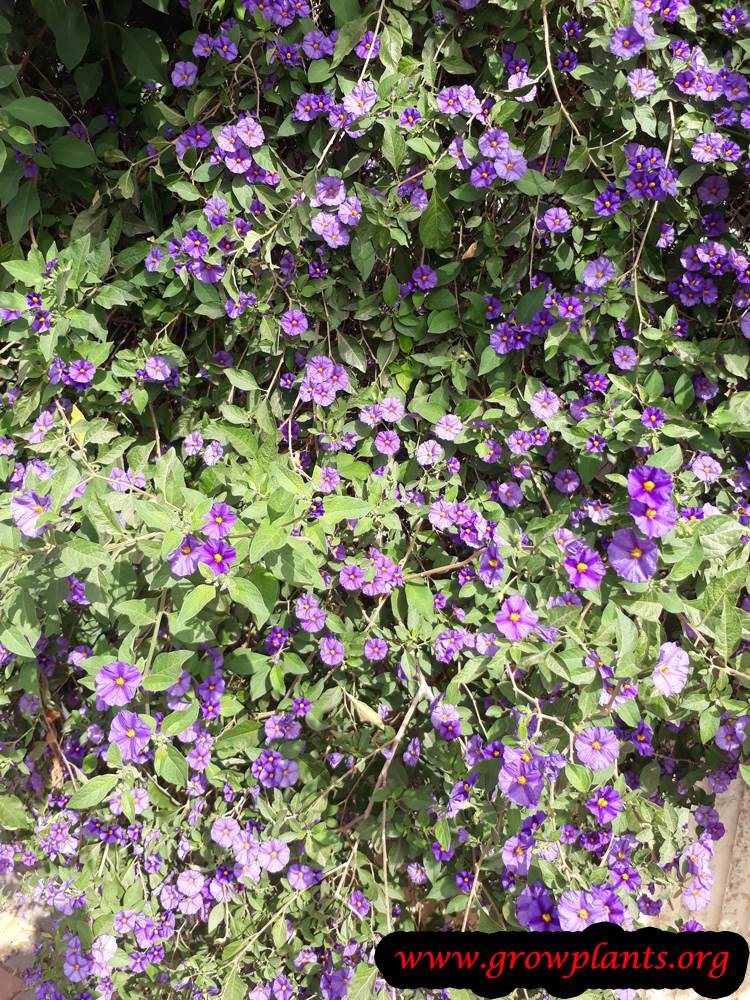
- Growth Habit & Form: Rounded, somewhat lax evergreen shrub, often used for informal hedging.
- Lifespan & Maturity: Short-lived perennial shrub that fills out fast.
Anatomy & Physical Features
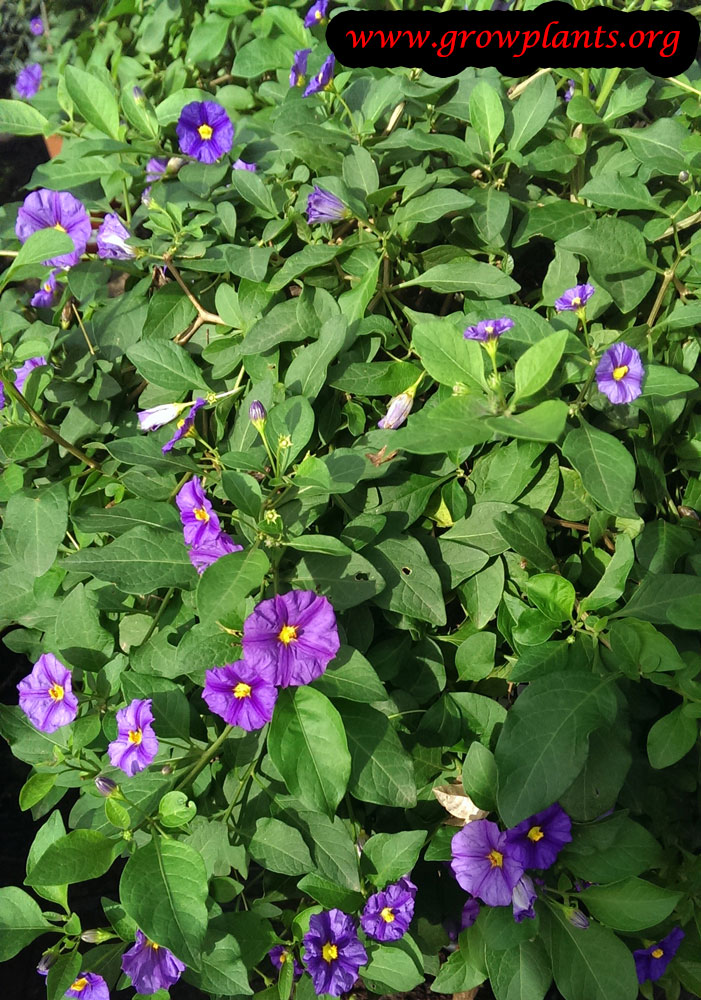
- Leaves & Foliage: Green, elliptic leaves.
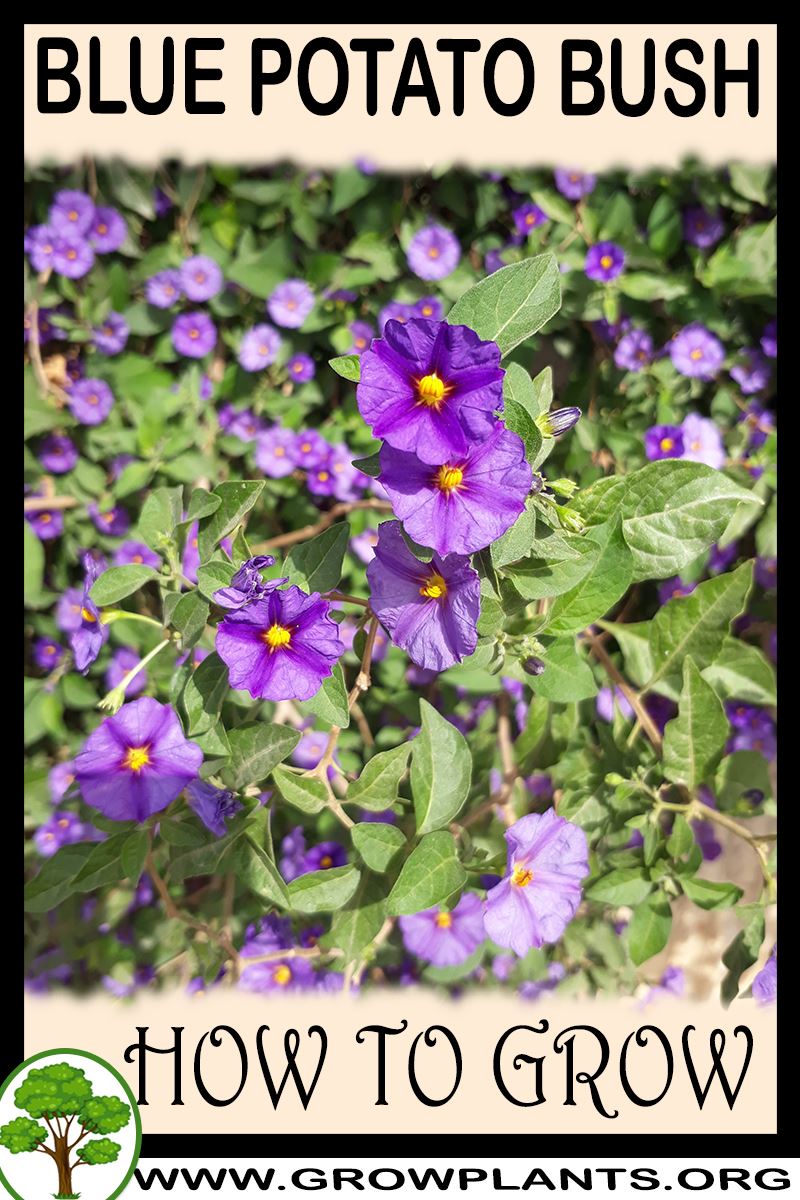
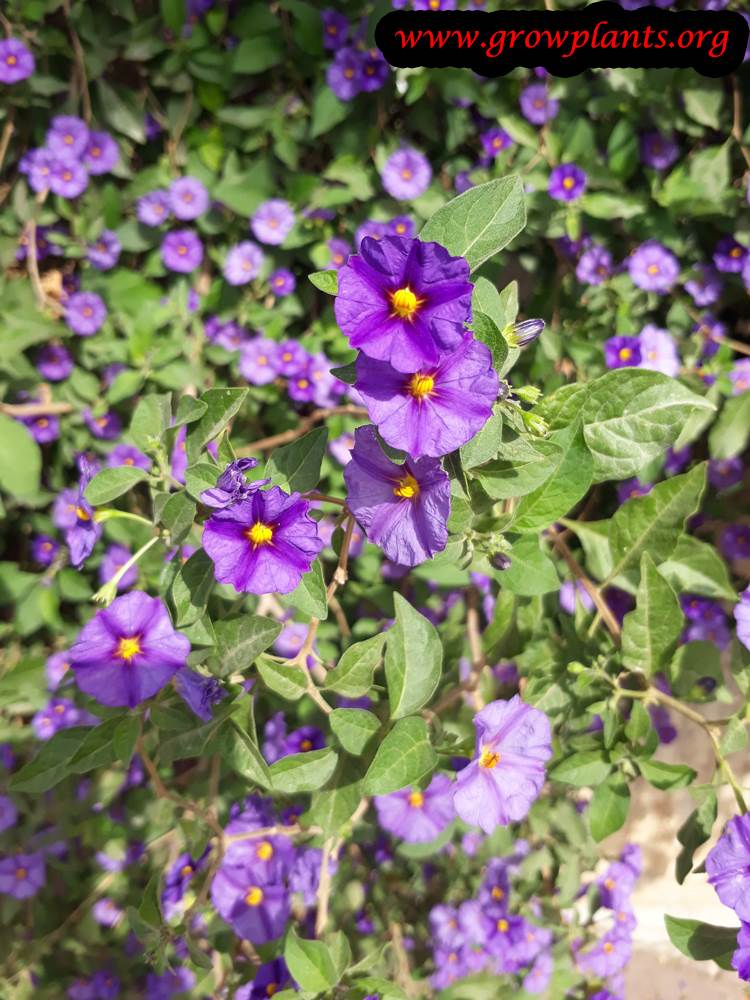
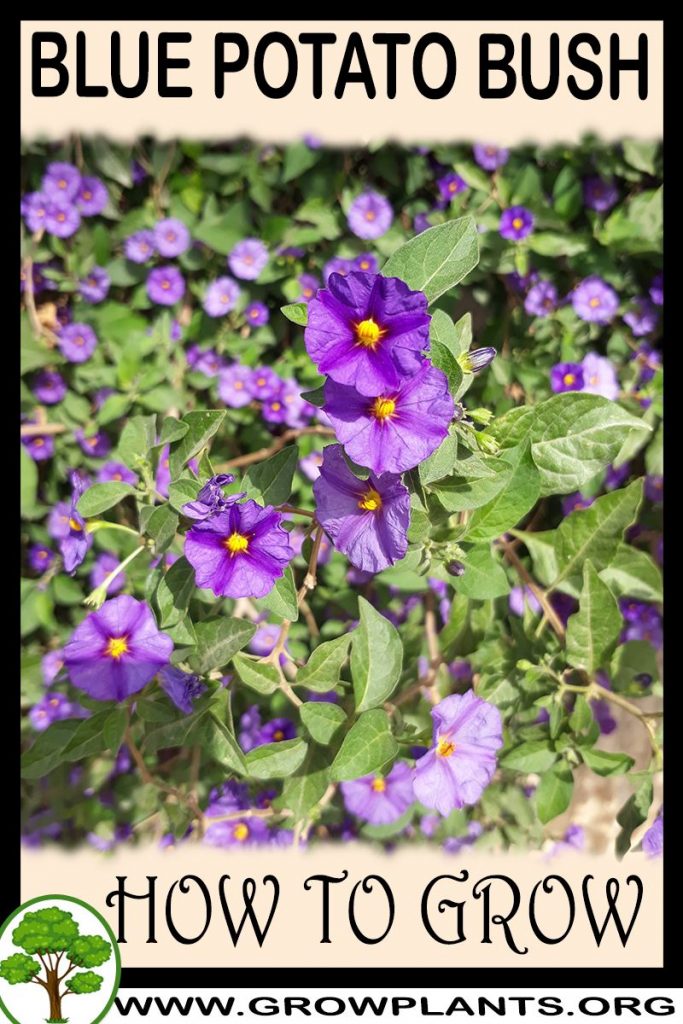
- Flower Characteristics: Funnel-shaped purple-blue flowers with a yellow centre, over a long season.
- Fruit Profile: Small berry – poisonous, not for eating.
Primary Uses & Landscape Value
- Functional & Ornamental Roles: Ornamental flowering shrub used for hedging, containers or as a trained standard.
Care Guide: Planting, Soil & Watering
Overview: Blue potato bush (Lycianthes rantonnetii) is a fast-growing evergreen shrub for frost-free gardens (zone 8+) in full sun to part shade. It performs best in rich, moist, well-drained soil with steady moderate watering through the long warm season.
Quick Care Requirements
| Requirement | Ideal Condition |
|---|---|
| Planting Season | Warm season, spring to autumn |
| Growth Rate | Moderate to fast |
| Soil Type | Rich, moist, well-drained |
| Water Need | Moderate – keep evenly moist |
Planting & Establishment
- Best Planting Season: Through the warm season, from spring to autumn, in a frost-free spot (hardiness zone 8+).
- How to Plant:
- Hole Preparation: Dig a hole about as deep as the root ball and roughly twice as wide, loosening the sides so the roots can spread.
- Soil Amendments: Blend generous compost or well-rotted organic matter into the backfill to enrich the soil and support free drainage.
- Planting Depth: Set the root ball so its top is level with the surrounding soil; keep the stem base clear.
- Growth Speed & Expectations: A vigorous shrub that grows at a moderate to fast pace, quickly filling out for hedging or a flowering feature.
Soil, Watering & Drainage Care
- Soil Mix & Drainage Needs: Fertile, moisture-retentive soil that drains freely; in containers use a rich, free-draining mix with drainage holes to prevent root rot.
- Watering Schedule & Technique:
- Young / Newly Planted: Water every few days for the first weeks so the root zone never dries out completely.
- Established: Water deeply once the top few centimetres dry, keeping the soil evenly moist but never waterlogged.
- Seasonal Adjustments: Cut back in winter and water more often during hot, dry spells.
Climate, Light & Hardiness
Blue potato bush is a fast, tender evergreen shrub for tropical, subtropical, Mediterranean, desert and warm-temperate climates, flowering almost continuously in warm weather. It grows in full sun to partial shade and needs an essentially frost-free position, with the site rating it at hardiness zone 8 and warmer.
Quick Climate Specifications
| Climate Zones | Tropical, subtropical, Mediterranean, desert, warm-temperate |
|---|---|
| USDA Hardiness Zones | Approximately 8 and warmer (site data) |
| Optimal Temp Range | Warm, roughly 18–28°C (64–82°F) |
| Cold Damage Begins | Foliage and soft growth damaged by frost near 0°C (32°F) |
| Approx. Survival Minimum | Top growth killed by hard frost; established plants often resprout from the base |
| Frost Tolerance | Low |
| Light Conditions | Full sun to partial shade |
Sunlight & Light Exposure
Optimal Light Setup
Full sun gives the heaviest, longest flowering and the densest habit for a hedge; partial shade is tolerated with somewhat fewer flowers.
Temperature Extremes & Hardiness
USDA Hardiness & Regional Limits
Site data lists zone 8 and warmer; the lower edge of zone 8 corresponds to winter lows around −12 to −7°C (10 to 20°F). Cold tolerance varies with plant age and conditions, mature plants being tougher than young ones.
Cold Damage & Winter Protection
Frost burns the leaves and soft tips; a hard freeze cuts the shrub back, though established plants commonly resprout from the base or lower wood in spring. Mulch protects the crown, and container plants can be moved under cover in the coldest zones.
Extreme Heat Tolerance
Good – it flowers freely through hot subtropical, Mediterranean and desert summers given adequate moisture.
Wind, Humidity & Microclimate
Wind Tolerance
Moderate; the loose, fast growth can be beaten about by strong wind, so a sheltered site keeps it tidy and encourages flowering.
Microclimate Recommendations
A warm, sheltered, sunny position – ideally frost-free – maximises the near year-round bloom in mild climates.
Growing in Pots, Balconies & Indoors
The blue potato bush (Lycianthes rantonnetii) is a tender evergreen shrub (1-3 m / 3-10 ft) with blue, potato-family flowers. It is not a houseplant, but it makes an excellent large-container plant for a sunny patio or balcony, and potting it lets you move it under cover to overwinter where winters are cold.
Quick Details
- Container Size: A roomy pot sized to the plant; pot up as the root ball fills
- Indoor Suitability: Not a houseplant – too light-hungry for a room; pot it mainly so it can be overwintered frost-free
- Best Spot: Full sun to half shade
- Soil & Drainage: Well-aerated, organic-rich mix (potting mix, or peat with perlite); must drain freely
- Watering in Pots: Average and evenly moist – pots dry faster than open ground; let water drain away
Indoors & On the Windowsill
- Houseplant limits: Grown for its flowers, it needs strong sun and will not thrive deep indoors.
- Overwintering: This is the main reason to pot it – in cold climates move the container somewhere bright and frost-free over winter and water sparingly until growth restarts.
- Safety: Like other nightshades its berries and foliage are toxic if eaten – keep it away from children and pets.
On a Balcony or Patio
- Light & wind: Give it the sunniest spot; it can grow tall, so shelter it from strong wind and stake if needed. Walls and paving reflect heat, so pots dry quickly – check moisture daily in warm weather.
- Practicalities: A large filled pot is heavy – make sure the balcony can take the weight and that drainage runoff will not be a nuisance below.
Choosing the Pot, Soil & Long-Term Care
- Pot & drainage: A roomy pot with strong drainage holes; skip a standing water saucer to avoid root rot. Terracotta breathes and dries faster, while glazed or plastic pots hold moisture longer.
- Potting mix: Aerated and organic-rich – potting mix, or peat with perlite.
- Feeding: Potted shrubs need feeding more often than those in the ground, as nutrients wash out with each watering – a balanced feed through the growing season.
- Repotting: Pot up as the roots fill the container, and every couple of years refresh the mix and lightly prune the root ball and top growth.
Growing this plant in a greenhouse
A greenhouse can give blue potato bush frost protection and cold protection. In the right climate it may also be kept growing through winter, depending on how much warmth and light are provided.
Greenhouse at a glance
| Greenhouse suitability | Conditional - depends on your climate |
|---|---|
| Main benefits | frost protection, cold protection |
| Season extension | earlier spring & later autumn |
| Outdoor protection advisable below | about 5°C |
| Maintain greenhouse minimum | around 5°C for active growth |
| Suitable types | unheated greenhouse, polycarbonate greenhouse, lean-to |
| Heating | Heating is optional - useful mainly for winter growing in cold areas. |
Related greenhouse guides
- Greenhouses: How to Choose the Right Greenhouse
- Best Lean-To Greenhouses
- Polycarbonate Greenhouses: What to Look for Before Buying
Fertilizing & Feeding
A steady, light feeder: a balanced complete fertilizer through the growing and blooming season keeps flowering ornamentals healthy without forcing soft growth.
Quick Fertilizing Specs
| Feeding Level | moderate |
|---|---|
| Main Nutrient Priority | A balanced complete fertilizer with steady nitrogen; extra phosphorus is not needed for bloom. |
| Best Feeding Period | Through the active growing and flowering season. |
| Organic Options | Compost and other organic matter improve the soil and supply gentle, steady nutrition. |
| Soil pH | Slightly acidic to near neutral suits most flowering ornamentals. |
| Reduce/Stop Feeding | Ease off feeding as growth slows heading into the cool, dormant rest period. |
Feeding by Growth Stage
Spring growth flush
Support healthy new shoots and leaf growth as the plant wakes up.
| Nutrient direction | A complete, balanced fertilizer with steady nitrogen to build strong foliage and stems. |
|---|---|
| Timing | As new growth begins in spring and the weather warms. |
| Frequency | Light, regular feedings through the active growing season. |
| Fertilizer types | A balanced complete garden fertilizer, A slow-release complete fertilizer worked into the soil, Compost or other organic matter to enrich the soil |
| Precautions | Feed lightly and avoid overfeeding with nitrogen, which pushes soft leafy growth at the expense of flowers. |
Flowering period
Fuel abundant, well-colored flowers while keeping the plant vigorous.
| Nutrient direction | A balanced complete fertilizer with adequate nitrogen; balanced feeding, not extra phosphorus, drives good bloom. |
|---|---|
| Timing | Through the blooming season. |
| Frequency | Steady, light feeding maintained across the flowering period. |
| Fertilizer types | A balanced complete flowering-plant fertilizer, A water-soluble complete fertilizer for container plants |
| Precautions | Skip high-phosphorus ‘bloom booster’ products; they are rarely needed and excess phosphorus can harm the soil. Container plants need even feeding to avoid salt buildup. |
Repeat bloom and rebound
Keep long-blooming plants flushing new flowers after deadheading or shearing.
| Nutrient direction | A balanced complete fertilizer to refuel growth and encourage the next wave of flowers. |
|---|---|
| Timing | After each flush of bloom or a mid-season trim, while the plant is still actively growing. |
| Frequency | Resume light, regular feeding as new growth pushes. |
| Fertilizer types | A balanced water-soluble complete fertilizer, A balanced complete garden fertilizer |
| Precautions | Feed sparingly in heat; combine feeding with consistent watering so nutrients stay available. |
Dormancy or cool-season rest
Let the plant rest through cold or low-light conditions without forcing new growth.
| Nutrient direction | None – withhold fertilizer while the plant is resting. |
|---|---|
| Timing | During cold winter weather or the plant’s low-light dormant rest. |
| Frequency | No feeding at this stage. |
| Fertilizer types | No feeding at this stage – resume only when active growth returns. |
| Precautions | Do not fertilize until active growth resumes; feeding a resting plant risks salt buildup and root injury. |
Nutrient Deficiency Signs & Corrections
Older, lower leaves fade to pale green or yellow and overall growth is weak.
| Possible causes | Low nitrogen in the soil, Nutrients leached out by heavy rain or frequent watering, Cold, wet roots slowing nutrient uptake |
|---|---|
| Appears first on | Older, lower leaves |
| What to check | Recent feeding history, Soil drainage and how often it is watered, Whether roots are healthy and warm enough |
| Possible correction | Apply a balanced complete fertilizer and improve drainage; correct soil pH if it is far off so nutrients stay available. |
Newest leaves turn yellow between green veins (interveinal yellowing) while older leaves stay greener.
| Possible causes | High soil pH locking up iron, Waterlogged or poorly aerated roots, Genuinely low available iron |
|---|---|
| Appears first on | Youngest, newest leaves |
| What to check | Soil pH, Drainage and root health, Whether only new growth is affected |
| Possible correction | Correct soil pH and improve drainage; where iron is truly short, apply a chelated iron product per its label. |
Lush leaves but few flowers, or pale weak blooms.
| Possible causes | Excess nitrogen driving leafy growth over flowers, Too little light for good flowering, A pest or cultural problem rather than a nutrient shortage |
|---|---|
| Appears first on | Flower buds and flowering shoots |
| What to check | How much nitrogen was applied, Hours of direct light, General plant health and pest pressure |
| Possible correction | Ease off nitrogen, move the plant to brighter light, and keep feeding balanced rather than reaching for high-phosphorus products. |
Pruning, Training & Seasonal Maintenance
Blue potato bush (Lycianthes rantonnetii, formerly Solanum rantonnetii) is a fast, rather lax evergreen shrub grown for its near-continuous warm-season display of purple-blue flowers, and it both tolerates and rewards hard pruning. Crucially it flowers on the current season’s new growth, so cutting it back stimulates fresh flowering wood rather than sacrificing bloom – the main hard prune is best in late winter or early spring before the flush, with light shaping and deadheading through the season. Vigorous and potentially weedy, it needs regular pruning to stay dense and to curb self-seeding, and all parts (especially the berries) are poisonous, so glove up.
Quick Pruning & Maintenance Specs
| Pruning Tolerance | High – responds vigorously, tolerates hard renovation |
| Primary Pruning Window | Late winter / early spring, before the main flush (frost permitting) |
| Secondary Maintenance Window | Light shaping and deadheading after each bloom flush through the season |
| Typical Frequency | One main cut-back a year plus ongoing tidying |
| Main Objective | Dense, floriferous habit; contain size and self-seeding |
| Young Plant Priority | Pinch tips to build a bushy framework and avoid a bare, leggy base |
| Mature Plant Priority | Cut back to shape, renew old stems, remove spent flower and berry clusters |
| Best Tool Type | Bypass secateurs; loppers for old basal stems |
| Avoid Heavy Pruning During | Autumn into frost – new growth is frost-tender in its marginal zones |
Pruning by Plant Age & Size
Newly Established
Remove only damaged shoots in the first season and let it root in. A few early tip pinches start branching, but there is no need for hard cutting yet.
Young / Formative
This is a lax shrub with no rigid framework, so training is by repeated tip-pinching for density, or by tying in a few stems if you want a standard, wall shrub or informal hedge. Pinch early and often to prevent the bare, woody base these plants drift towards.
Mature / Established
Give one firm cut-back in late winter to reshape and thin congested or old woody stems, then shear or tip lightly after each flush to keep new flowering wood coming. Remove berry clusters to limit seeding.
Seasonal Pruning Schedule
Late winter / early spring (main prune): cut back the previous year’s growth to shape and reduce size, and thin out the oldest stems. Because bloom comes on new growth, this drives the coming season’s flowering rather than removing it.
Through the growing season: deadhead and lightly tip after flushes to keep the plant compact and repeat-blooming; remove developing berries to curb self-seeding.
Autumn: avoid hard cutting where frost follows – soft regrowth is easily damaged in this shrub’s marginal (zone 8+) range.
Flowering & Fruiting Wood
Blue potato bush flowers on the current season’s new shoots, so the timing rule is simple: prune hard before the flush (late winter / early spring) and you multiply the flowering wood; prune off the soft new growth just as it is about to bloom and you lose that display until it regrows. Deadheading through summer keeps flushes coming and, usefully, reduces the poisonous berries that would otherwise self-seed the plant around the garden.
Structural Pruning & Training
Left alone the plant sprawls and bares its base, so thinning and renewal matter: take out the oldest, woodiest stems at or near the base to force fresh growth, and shorten over-long whippy shoots to outward buds. It trains readily against a wall or as a lollipop standard if you select and tie in a leader or two and clear the lower growth.
Special Growth to Remove
Remove spent flower trusses and the poisonous berry clusters that follow – this both tidies the plant and limits its tendency to self-seed and become weedy. Cut out any dead or weak twiggy growth in the congested interior. There are no grafts, suckers or runners to manage.
Container & Small-Space Pruning
It grows and flowers well in a large pot and makes a good patio standard. Keep it in shape with harder annual cutting than an in-ground plant would need, since containers exaggerate legginess; cut back the top and root-prune when you refresh the soil. Consistent tip-pinching keeps a container plant full to the base.
Tools
Bypass secateurs handle almost all cuts on this soft-wooded shrub. Use loppers for the occasional thick old stem removed at the base, and precision snips for deadheading. A saw is rarely needed at this stem size.
Tool Hygiene & Disease Risk
Routine. There is no notable tool-borne disease on this shrub; simply keep blades clean and sharp for clean cuts. The one hygiene point is personal: wear gloves and wash up afterwards, because the sap and berries are poisonous.
Cut Placement & Technique
Cut to an outward-facing bud or node to keep the centre open and the habit spreading rather than congested. Remove old stems right at the base with a clean thinning cut; avoid leaving long stubs that die back.
Heavy Pruning & Rejuvenation
Renovation is well tolerated: a leggy, bare-based plant can be cut hard back to a low framework in late winter and will regrow strongly and flower the same season, since bloom is carried on the new wood. Time such hard cuts for the end of frost so the tender regrowth is not caught out.
Post-Pruning Care
Water in after a hard spring cut-back and give a light feed then to fuel the vigorous flowering regrowth. Keep gloves on while clearing prunings and berries. Watch soft new shoots for aphids, and protect regrowth if a late frost threatens.
Common Pruning Mistakes
- Cutting off the soft new growth just before it blooms, throwing away the current flush of flowers.
- Never pruning, which leaves a leggy, bare-stemmed plant flowering only at the tips.
- Leaving the berries on, so the poisonous, weedy plant self-seeds around the garden.
- Hard-pruning in autumn where frost follows, so tender regrowth is damaged.
When NOT to Prune
Do not make hard cuts going into autumn or winter in frost-prone areas – wait for late winter’s end. Avoid shearing a freshly transplanted or drought-stressed plant until it is growing away.
Recommended Tools (by task)
- bypass_secateurs – the workhorse for shaping cuts and shortening the soft flowering stems.
- loppers – for removing the occasional thick, old woody stem at the base during renewal.
- precision_snips – for quick deadheading and removing berry clusters through the season.
Pruning Troubleshooting
| Problem | Possible Cause | What to Check | Corrective Action |
| Few flowers | New growth cut off just before bloom, or too much shade | Prune timing and light | Prune before the flush, not into it; move to full sun / half shade |
| Bare, leggy base | Under-pruned, never renewed | Age of basal stems | Thin oldest stems to the base and tip-pinch to rebuild density |
| Frost dieback of new growth | Hard pruning too late in autumn | Timing versus first frost | Shift hard cuts to late winter; protect regrowth from late frost |
| Seedlings coming up everywhere | Berries left to ripen and drop | Presence of berry clusters | Deadhead and remove berries before they mature |
Propagation Guide
Blue potato bush is easiest from softwood or semi-hardwood cuttings, which root readily and are the usual nursery method; it can also be grown from seed cleaned out of the ripe berries. Propagation is easy overall.
The berries are poisonous — wear gloves when cleaning seed.
Quick Propagation Specs
| Best Propagation Method | Stem cuttings |
| Alternative Methods | Seed |
| Propagation Difficulty | Easy |
| Seed True-to-Type | Variable |
| Vegetative True-to-Type | Yes |
| Best Propagation Season | Warm season |
| Cutting Rooting Time | Several weeks under warmth and humidity |
Stem Cuttings
Cutting Type & Timing
Softwood to semi-hardwood cuttings taken in the warm growing season.
Rooting Setup & Hormone
Root in a moist, free-draining mix under high humidity; a rooting hormone is beneficial but not essential.
Rooting Time
Expect rooting over several weeks.
Growing from Seed
Clean seed from ripe fruit and sow into a warm, moist mix; keep in a warm, bright place. Seedlings are variable, so cuttings are preferred where a particular plant is to be reproduced.
Bloom & Flower Guide
Quick Details
- Bloom Season: Spring, summer and autumn; nearly year-round in frost-free climates
- Time to First Bloom: Blooms freely once established, over a long warm season
- Flower Appearance: Purple to blue funnel-shaped flowers with a bright yellow centre
- Edibility: None – this is a nightshade; the berries and plant are poisonous, so no part should be eaten
Detailed Blooming Overview
The blue potato bush flowers almost continuously through warm weather, carrying loose clusters of violet-blue, yellow-eyed blooms much like small potato flowers. Bees work the flowers for pollen.
Flower Characteristics
- Funnel- to star-shaped flowers in purple to blue with a yellow centre.
- Produced over many months in warm weather.
Bloom Care & Thinning
- Keeping it flowering: A light trim and removal of spent blooms keeps it tidy and encourages further flushes.
- Pollination: Worked by bees for pollen.
- Safety: The berries and foliage are toxic – site it away from where children or pets might nibble.
Pests, Diseases & Troubleshooting
Overview: The blue potato bush is a nightshade relative, so it draws the usual Solanaceae sap-feeders – aphids, whitefly, spider mites, mealybugs and scale – that disfigure foliage and spread honeydew, while its real diseases are minor and mostly tied to overwatering. Keep it in sun with steady but not soggy soil and it flowers freely with little trouble.
Quick Troubleshooting Overview
| Issue / Pest | Main Symptom | Primary Solution |
|---|---|---|
| Whitefly | Clouds of tiny white flies; sticky honeydew | Yellow sticky traps; insecticidal soap; encourage Encarsia |
| Aphids | Curled shoots, honeydew, sooty mould | Hose off; predators; insecticidal soap |
| Spider mites | Stippling and webbing in hot dry air | Raise humidity; hose foliage; horticultural oil |
| Mealybugs & scale | White fluff / brown bumps on stems | Alcohol swab; horticultural oil |
| Powdery mildew | White coating on leaves in still air | Airflow; base watering; sulfur |
| Root rot | Wilting, yellowing in wet soil | Improve drainage; ease off water |
Common Pests & Management
- Whitefly (Trialeurodes vaporariorum / Bemisia tabaci):
- Symptoms: Tiny white flies rise in a cloud when the bush is brushed; they suck sap from leaf undersides, causing yellowing, honeydew and sooty mould, and can vector viruses.
- Prevention & Control: Hang yellow sticky traps, hose foliage undersides, and spray insecticidal soap or neem, treating repeatedly; encourage the parasitic wasp Encarsia and avoid over-feeding nitrogen.
- Aphids (Aphis / Myzus spp.):
- Symptoms: Soft green or black insects cluster on new shoots and flower buds, distorting growth and leaving sticky honeydew.
- Prevention & Control: Blast off with water, encourage ladybirds and lacewings, and use insecticidal soap for heavy colonies; pinch out badly infested tips.
- Two-spotted spider mite (Tetranychus urticae):
- Symptoms: Fine pale stippling, bronzing and webbing on leaves during hot, dry spells, with early leaf drop.
- Prevention & Control: Raise humidity, hose the foliage undersides, keep the plant watered, and use horticultural oil or insecticidal soap; conserve predatory mites.
- Mealybugs & scale (Pseudococcus spp. / Coccus spp.):
- Symptoms: White cottony tufts in leaf axils (mealybugs) or brown limpet-like bumps on stems (scale), both sucking sap and producing honeydew.
- Prevention & Control: Dab mealybugs with dilute alcohol, scrape off scale, and treat with horticultural oil to smother juveniles; inspect regularly and isolate new plants.
Diseases & Fungal Issues
- Powdery mildew (Erysiphe / Leveillula):
- Symptoms: White powdery patches on leaves and stems in warm, still, humid conditions, causing yellowing and leaf drop.
- Treatment & Management: Space plants and prune for airflow, water at the base, remove affected leaves, and apply sulfur or potassium-bicarbonate if it spreads.
- Grey mould (Botrytis cinerea):
- Symptoms: Fuzzy grey mould and browning on flowers and soft growth in cool damp weather.
- Treatment & Management: Deadhead spent flowers, remove affected tissue, improve ventilation and reduce humidity around the plant.
- Root & stem rot (Phytophthora / Pythium):
- Symptoms: Wilting, yellowing and dark rot at the stem base and roots in soggy soil or poorly drained pots.
- Treatment & Management: Grow in free-draining soil or mix, let the surface dry between waterings, avoid waterlogged pots, and remove severely affected plants.
Growing Difficulties & Abiotic Problems
- Overwatering / root rot:
- Cause & Symptoms: Yellowing lower leaves, wilting despite wet soil, and root decline when the plant is kept too wet.
- Correction Strategy: Water thoroughly then let the top of the soil dry; ensure pots drain freely and never leave the plant standing in water.
- Frost & cold damage:
- Cause & Symptoms: Blackened, wilted shoots and leaf loss after cold; this is a tender, frost-sensitive subtropical shrub.
- Correction Strategy: Protect from frost, grow in a container to move under cover in cold spells, or site in a warm, sheltered position; prune out cold-damaged wood in spring.
- Nutrient deficiency / poor bloom:
- Cause & Symptoms: Pale leaves and sparse flowering from starvation, or lush leaf-only growth from excess nitrogen.
- Correction Strategy: Feed regularly through the growing season with a balanced, slightly potassium-rich fertiliser to support its long bloom, and correct iron chlorosis on alkaline soil with chelated iron.
What Helps – Products & Tools
A gentle Solanaceae toolkit works well: yellow sticky traps and insecticidal soap or neem for whitefly and aphids, horticultural oil for mites, mealybugs and scale, and sulfur for powdery mildew. Good drainage and regular feeding keep this long-blooming shrub vigorous and largely disease-free.