Plant Profile & Key Characteristics
Overview: Yellow oleander (Cascabela thevetia) is an evergreen shrub to small tree of 1-4 m (3-12 ft), grown as a fragrant, drought-tolerant ornamental and hedge that attracts pollinators. It is highly toxic and can be invasive, with poisonous fruit and seeds.
Quick Specifications
| Specification | Attribute |
|---|---|
| Plant Type / Life Cycle | Perennial (shrub / small tree) |
| Foliage Type | Evergreen |
| Mature Size | 1-4 m tall (3-12 ft) |
| Growth Rate | Moderate to fast |
| Toxicity | Highly toxic (all parts, especially the seeds; cardiac glycosides) |
| Hardiness | USDA zone 9+ |
Growth Form & Structure
- Height & Spread: Reaches 1-4 m (3-12 ft) in the ground and grows well in containers.
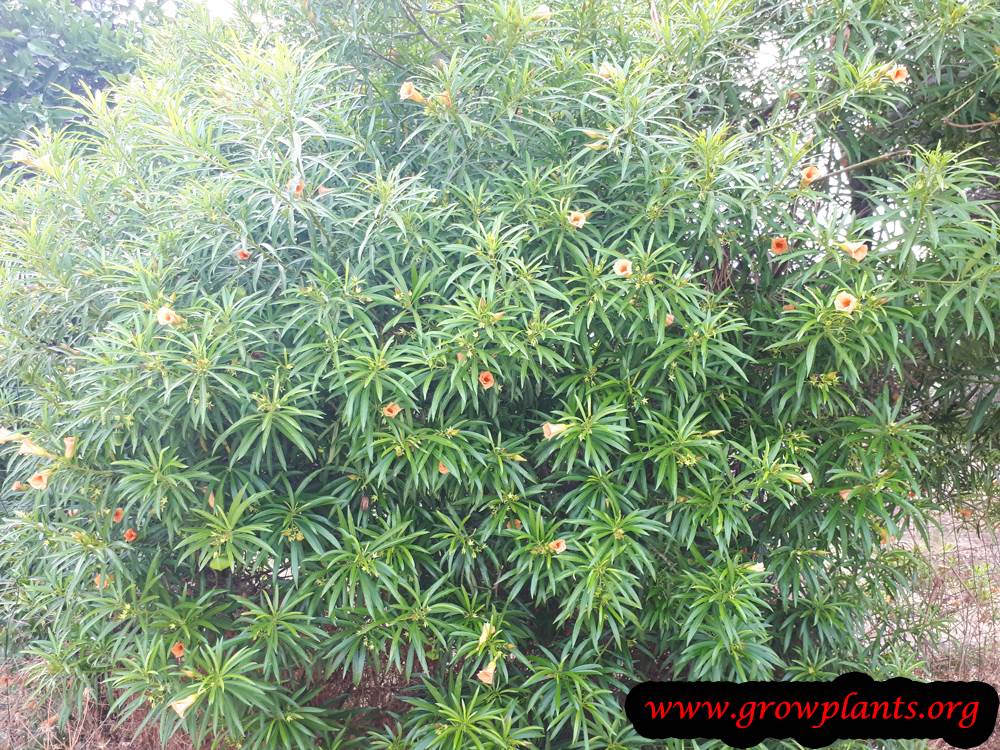
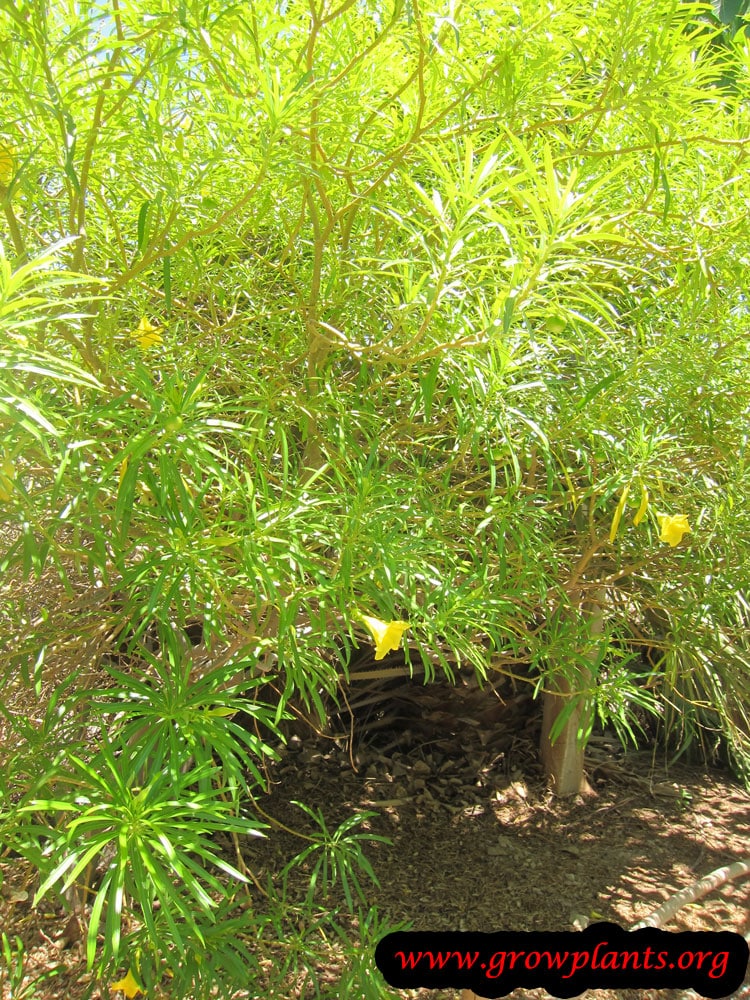
- Growth Habit & Form: Rounded, densely leafy shrub or small tree, easily shaped into a hedge.
- Lifespan & Maturity: Long-lived, heat- and drought-tolerant, and can self-seed aggressively.
Anatomy & Physical Features
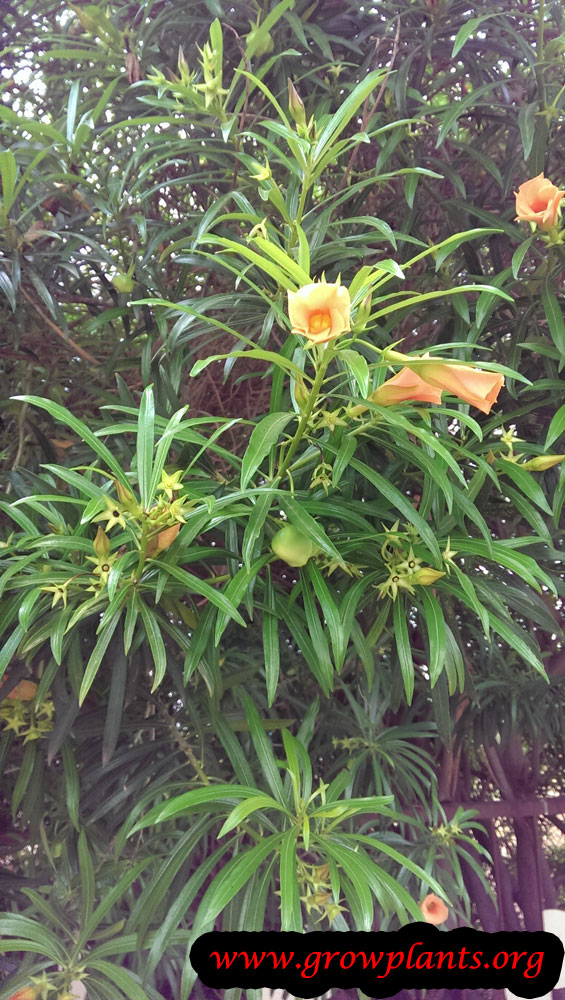
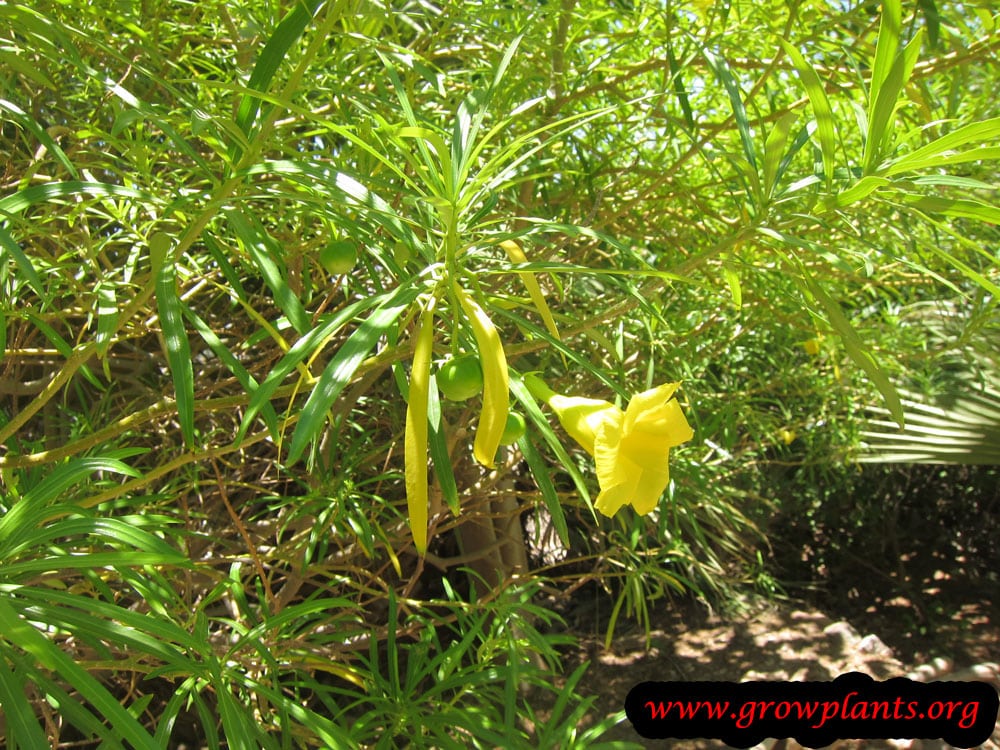
- Leaves & Foliage: Narrow, linear glossy green leaves.
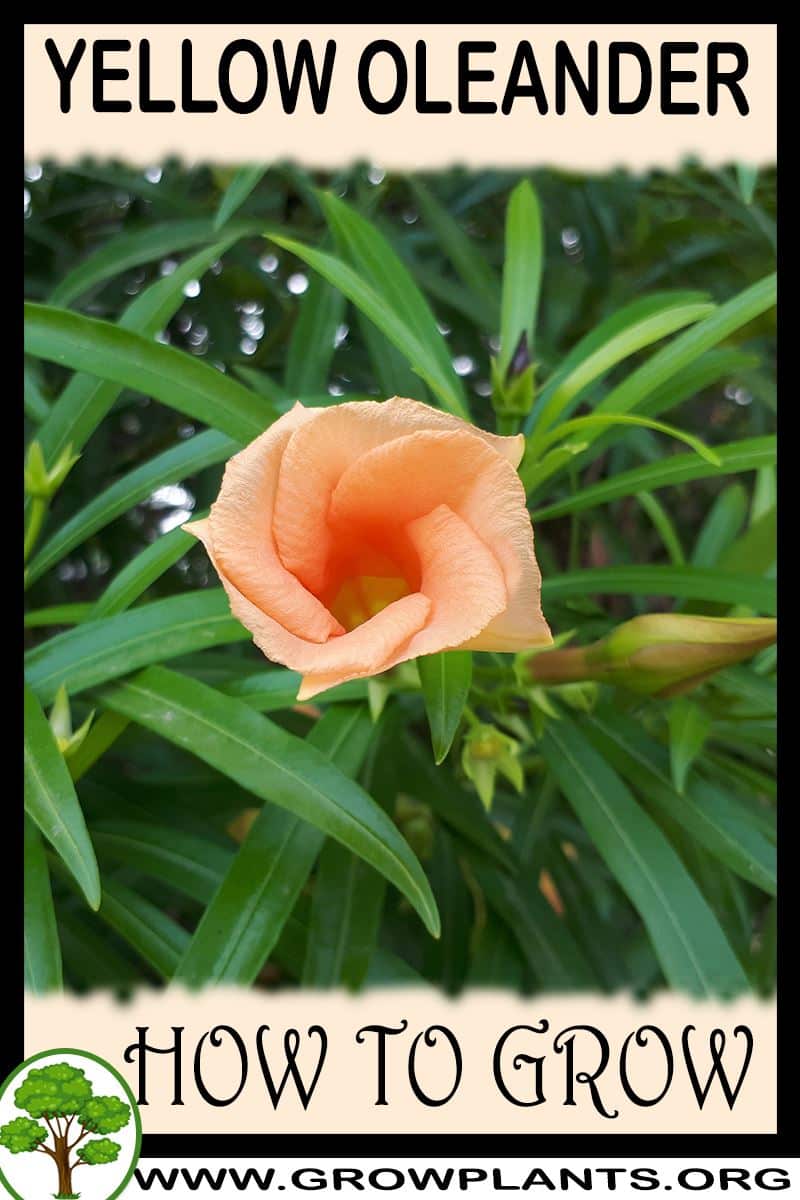
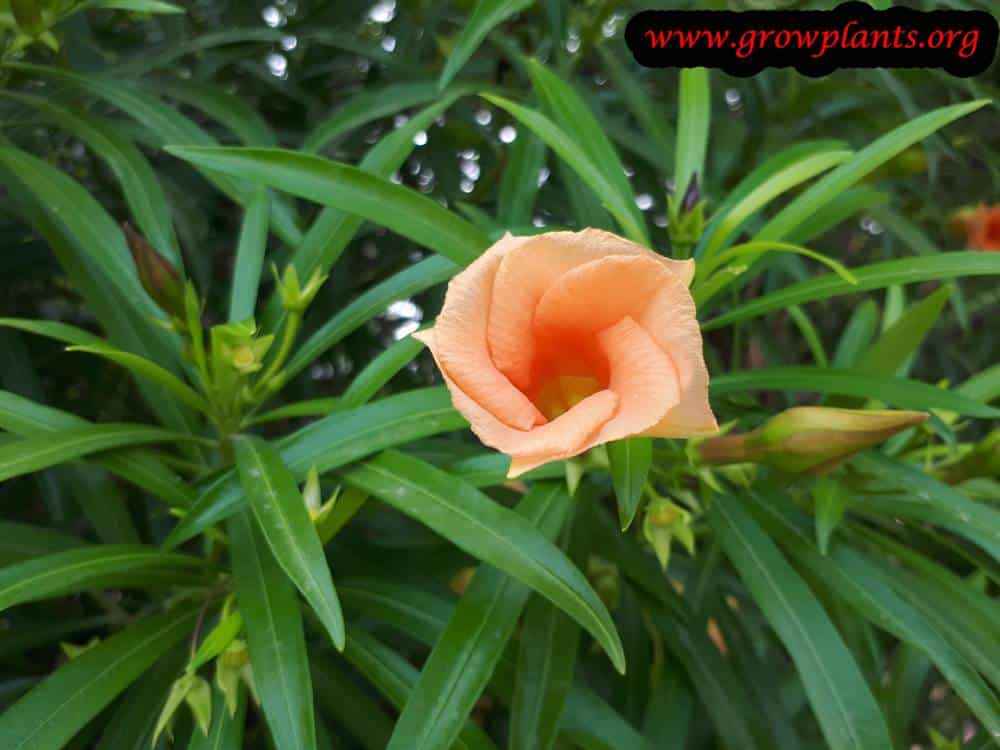
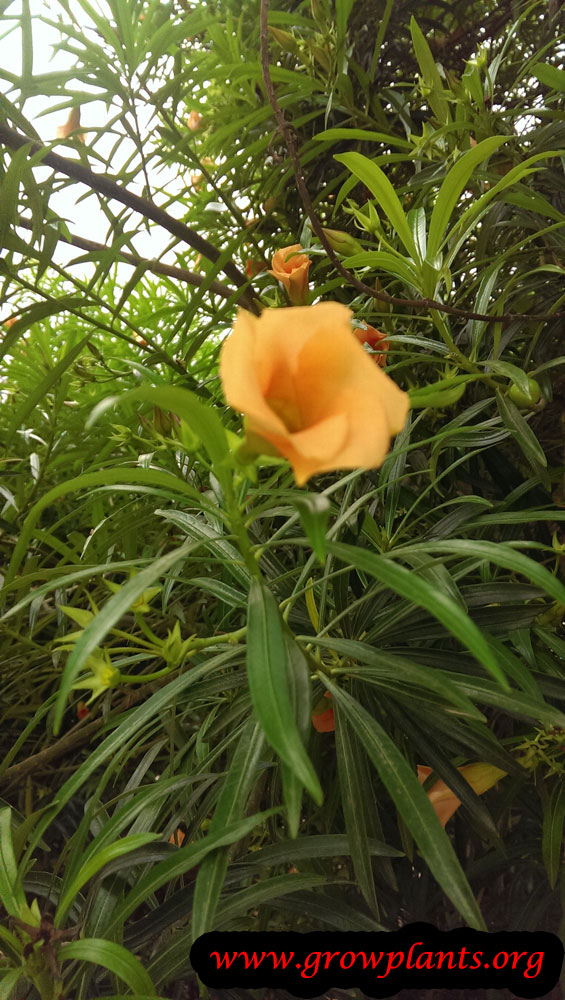
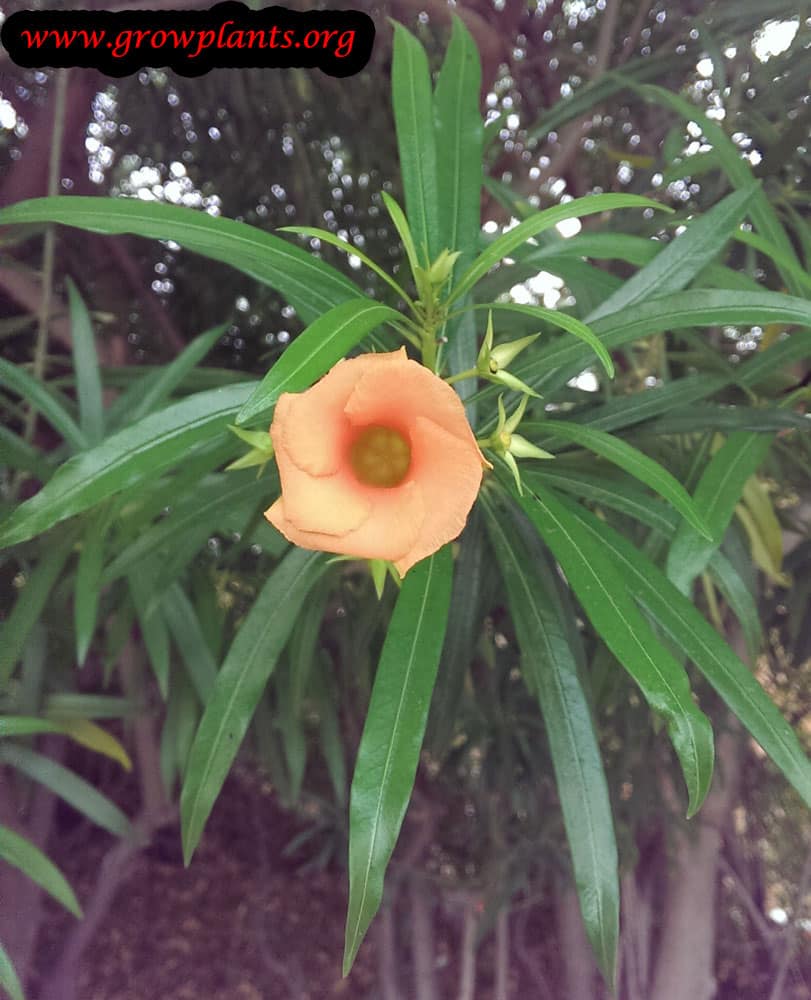
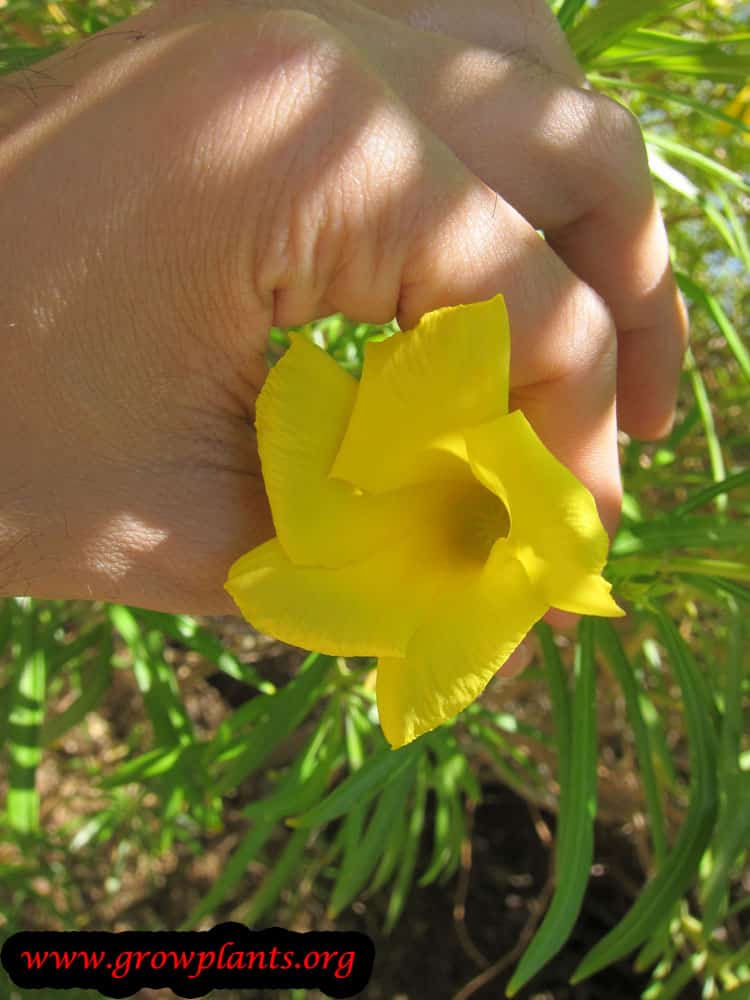
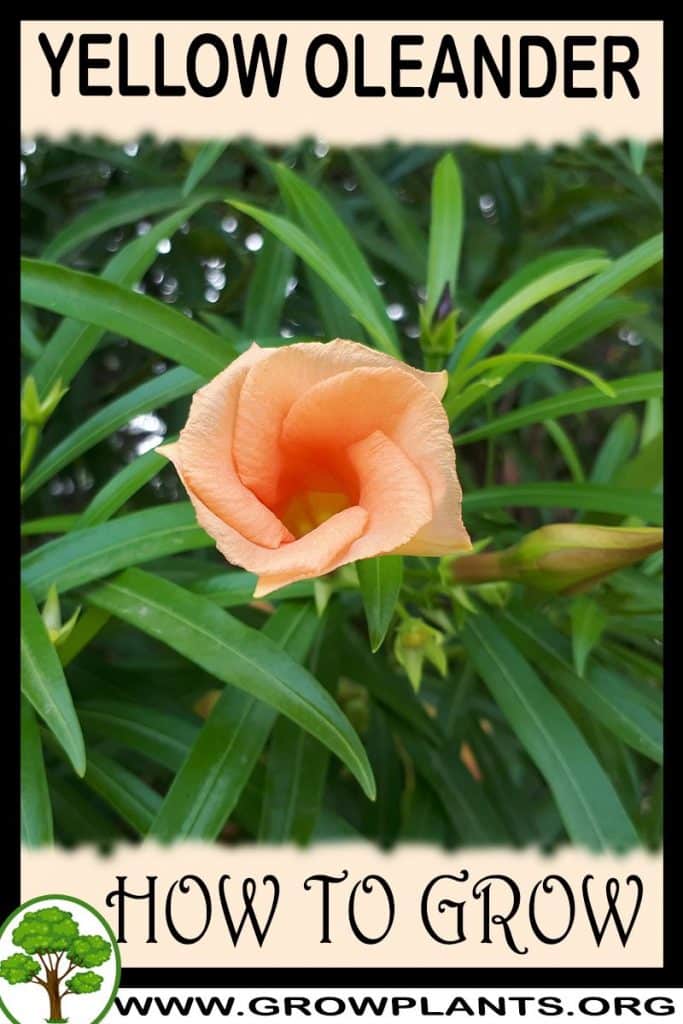
- Flower Characteristics: Fragrant yellow to orange trumpet-shaped flowers with petals fused at the base.
- Fruit Profile: Fleshy pepper-like fruit ripening black or red, containing highly poisonous seeds; not edible.
Primary Uses & Landscape Value
- Functional & Ornamental Roles: Drought-tolerant ornamental, flowering hedge and pollinator plant for warm climates.
Care Guide: Planting, Soil & Watering
Overview: Yellow oleander is a drought-tolerant evergreen shrub or small tree for warm climates, thriving in full sun and well-drained soil. It needs only low to moderate water and tolerates cold no lower than about -5C.
Quick Care Requirements
| Requirement | Ideal Condition |
|---|---|
| Planting Season | Spring or autumn in warm weather |
| Growth Rate | Moderate to Fast |
| Soil Type | Well-drained soil, adaptable |
| Water Need | Low to Moderate – drought-tolerant once established |
Planting & Establishment
- Best Planting Season: Plant in spring or autumn while the weather is warm; it is hardy only to about -5C (zone 9+).
- How to Plant:
- Hole Preparation: Dig a hole about twice the width of the root ball on free-draining ground.
- Soil Amendments: Undemanding; ensure drainage rather than adding rich soil.
- Planting Depth: Set at the original soil level with the root collar at the surface.
- Growth Speed & Expectations: A moderate-to-fast grower reaching 1-4 m and flowering spring through autumn.
Soil, Watering & Drainage Care
- Soil Mix & Drainage Needs: Tolerant of poor, dry soils that drain freely and suitable for large containers. Avoid waterlogging.
- Watering Schedule & Technique:
- Young / Newly Planted: Water regularly to establish.
- Established: Water sparingly once established; it is drought-tolerant.
- Seasonal Adjustments: More in summer drought, little in winter.
Climate, Light & Hardiness
Yellow oleander is a warm-climate evergreen shrub to small tree for tropical, subtropical, Mediterranean and desert gardens, thriving in full sun with excellent heat and drought tolerance. It is frost sensitive, with the site limiting cold exposure to no colder than about −5°C (23°F).
Quick Climate Specifications
| Climate Zones | Tropical, subtropical, Mediterranean, desert, warm temperate |
|---|---|
| USDA Hardiness Zones | 9+ (site data) |
| Optimal Temp Range | Approx. 22–35°C (72–95°F) |
| Cold Damage Begins | Around light frost, near 0°C (32°F); foliage and buds first |
| Approx. Survival Minimum | About −5°C (23°F) for an established plant (site data) |
| Frost Tolerance | Low |
| Light Conditions | Full sun |
| Wind Tolerance | Moderate to High |
| Salt / Coastal Tolerance | Moderate to High |
Sunlight & Light Exposure
Optimal Light Setup
Full sun is preferred and delivers the best flowering and compact form.
Direct Sun Requirement
Direct sun is important; in shade it becomes sparse and flowers poorly.
Shade & Heat Management
Handles intense heat and reflected warmth without protection.
Best Exposure / Orientation
An open, hot, south- or west-facing site suits it well.
Temperature Extremes & Hardiness
USDA Hardiness & Regional Limits
Site data rates it hardy to zone 9. Cold tolerance varies with plant age, exposure duration and conditions; young plants are more sensitive than established ones.
Cold Damage & Winter Protection
Light frost damages foliage and flower buds; the site sets a practical floor of about −5°C (23°F), below which serious dieback or loss is likely. Mulch and a warm exposure help in cold-margin areas.
Frost Sensitivity
Low frost tolerance - it survives light frost briefly but not a hard freeze.
Extreme Heat Tolerance
Excellent; a strong performer in hot, dry climates.
Wind, Humidity & Microclimate
Humidity Preferences
Adaptable from dry to humid, favouring warm conditions.
Dry-Air Tolerance
High - naturally drought and dry-air tolerant.
Wind Tolerance
Moderate to high; useful as a screen in warm regions.
Coastal / Salt Tolerance
Moderate to high tolerance of coastal and salt-spray exposure.
Microclimate Recommendations
A warm, sheltered, sunny site improves winter survival at its cold margin.
Growing in Pots, Balconies & Indoors
Yellow oleander is a sun-loving tropical shrub, 1-4 m, with fragrant yellow flowers – not a houseplant, but a fine large-container plant for a hot patio or balcony that can be overwintered under cover in cold climates. All parts are highly poisonous, the seeds especially.
Quick Details
- Container Size: A large tub, roughly 20-50 L (5-13 gal) (general guide)
- Indoor Suitability: Not a houseplant – large, sun-loving and toxic
- Best Spot: Full sun; loves heat
- Soil & Drainage: Free-draining mix; drought-tolerant
- Watering in Pots: Water sparingly to moderately once established
Indoors & On the Windowsill
- Houseplant: No – it needs full sun and is far too toxic for a living space.
- Windowsill growing: Not suitable as a sill plant.
- Overwintering: A key reason to pot it – in cold climates keep it in its tub and overwinter it in a cool, bright, frost-free place, kept nearly dry.
On a Balcony or Patio
- Light & wind: Give it the hottest, sunniest spot; it thrives on heat, drought and reflected wall warmth and flowers best in full sun.
- Practicalities: A heavy tub is best moved with a trolley for winter; site it away from children and pets.
Choosing the Pot, Soil & Long-Term Care
- Pot & drainage: A large tub with strong drainage; Use a pot with strong drainage holes and skip a standing-water saucer to avoid root rot; terracotta breathes and dries out faster, while glazed or plastic pots hold moisture longer.
- Potting mix: Fill with a well-aerated, organic-rich medium – a quality potting mix, or peat/coir blended with perlite or vermiculite for free drainage.
- Feeding: Potted plants use up their soil quickly because watering leaches nutrients away, so feed a little more often than plants in open ground through the growing season.
- Repotting: Pot up or refresh the mix every couple of years and prune to shape after flowering (wear gloves).
- Safety: Highly poisonous – all parts are dangerous if eaten and the seeds can be lethal; the milky sap irritates skin and eyes. Never grow it where children or pets could reach it, and wash your hands after handling.
Growing this plant in a greenhouse
A greenhouse can give yellow oleander frost protection and cold protection. In the right climate it may also be kept growing through winter, depending on how much warmth and light are provided.
Greenhouse at a glance
| Greenhouse suitability | Conditional - depends on your climate |
|---|---|
| Main benefits | frost protection, cold protection |
| Season extension | earlier spring & later autumn |
| Outdoor protection advisable below | about 0°C |
| Suitable types | unheated greenhouse, polycarbonate greenhouse, lean-to |
| Heating | Heating is optional - useful mainly for winter growing in cold areas. |
Related greenhouse guides
- Greenhouses: How to Choose the Right Greenhouse
- Best Lean-To Greenhouses
- Polycarbonate Greenhouses: What to Look for Before Buying
Fertilizing & Feeding
A moderate feeder: balanced feeding through spring and the bloom season supports flowering, with feeding eased off during cool-season rest. Balanced nutrition beats high-phosphorus bloom boosters.
Quick Fertilizing Specs
| Feeding Level | Moderate feeder |
|---|---|
| Main Nutrient Priority | Balanced feeding with adequate nitrogen and potassium; not high phosphorus |
| Best Feeding Period | Spring through the flowering season |
| Organic Options | Compost and other organic matter |
| Reduce/Stop Feeding | Ease off feeding during cool-season rest |
| Micronutrients | Usually met by a complete fertilizer; correct only diagnosed issues such as iron chlorosis in alkaline soil |
| Soil pH | Slightly acidic to near neutral; tolerates a range |
Feeding by Growth Stage
Spring flush of growth
Fuel the spring flush of stems and foliage that will carry the season’s flowers.
| Nutrient direction | A balanced complete fertilizer with adequate nitrogen to build healthy growth ahead of bloom. |
|---|---|
| Timing | As new growth resumes in spring. |
| Frequency | A feeding as growth begins, repeated lightly as the flush continues. |
| Fertilizer types | A balanced complete fertilizer, Compost or other organic matter worked into the root zone |
| Precautions | Favor steady, balanced feeding over pushing lush growth, which can come at the expense of flowers. |
Flowering period
Support a long, healthy bloom without forcing soft growth.
| Nutrient direction | Continue balanced feeding; adequate nitrogen and potassium support flowering better than a high-phosphorus bloom booster. |
|---|---|
| Timing | Through the main flowering period in the warm season. |
| Frequency | Light, steady feedings across the bloom period. |
| Fertilizer types | A balanced complete fertilizer, A light organic top-dressing |
| Precautions | Skip high-phosphorus bloom products; balanced nutrition and good light drive flowering. |
Cool-season rest
Let the plant rest through cool weather without pushing tender growth.
| Nutrient direction | None – withhold fertilizer while the plant is not in active growth. |
|---|---|
| Timing | During cool-season dormancy or slowed winter growth. |
| Frequency | No feeding at this stage. |
| Fertilizer types | No feeding at this stage; hold off fertilizing until active growth resumes. |
| Precautions | Do not fertilize a resting plant; wait until active growth returns in spring. |
Nutrient Deficiency Signs & Corrections
Older, lower leaves fade to pale green or uniform yellow and overall growth slows.
| Possible causes | low available soil nitrogen, nitrogen leaching from heavy watering or rain, thin, low-organic-matter soil |
|---|---|
| Appears first on | older, lower leaves |
| What to check | recent feeding history, soil organic matter, watering and drainage |
| Possible correction | Apply a nitrogen-containing complete fertilizer and build soil organic matter, then water evenly. |
The youngest leaves turn pale or yellow between green veins while older leaves stay greener.
| Possible causes | high or alkaline soil pH locking up iron, waterlogged or poorly aerated roots, genuinely low available iron |
|---|---|
| Appears first on | new, youngest leaves |
| What to check | soil pH, drainage and root health, whether symptoms favor the newest growth |
| Possible correction | Correct soil pH toward the plant’s preferred range and apply a chelated iron product per its label. |
Leaf margins brown or scorch and growth stalls despite adequate watering.
| Possible causes | fertilizer salt buildup in the root zone, under-watering that concentrates salts, excessive or too-frequent feeding |
|---|---|
| Appears first on | leaf margins and tips |
| What to check | recent fertilizer amounts, watering consistency, drainage, especially in containers |
| Possible correction | Ease off feeding, water thoroughly to flush accumulated salts, then return to lighter feeding. |
Pruning, Training & Seasonal Maintenance
Yellow oleander is a fast, evergreen shrub-to-small-tree that tolerates shaping and cutting back and flowers on the current season’s new growth from spring into autumn. Prune to shape or to lift it into a small multi-trunk tree, and deadhead or remove the fruit — the black-to-red “lucky nuts” are extremely poisonous and the plant is invasive, so stopping seed matters. Wear gloves; the milky sap and all parts are toxic.
Quick Pruning & Maintenance Specs
| Pruning Tolerance | High — fast grower, tolerates cutback |
| Primary Pruning Window | Late winter / early spring to shape |
| Secondary Maintenance Window | After flowering, to remove toxic fruit |
| Typical Frequency | Annual shaping plus fruit removal |
| Main Objective | Shape and size control; prevent toxic self-seeding |
| Young Plant Priority | Select one or a few trunks; tip to bush |
| Mature Plant Priority | Shape, thin, remove fruit and deadwood |
| Best Tool Type | Bypass secateurs, loppers, small saw for trunks |
| Avoid Heavy Pruning During | Before frost (tender below about -5°C) |
Pruning by Plant Age & Size
Newly Established
Remove damaged shoots only and let it build; being fast-growing it fills out quickly.
Young / Formative
Decide on form: leave low-branched as a dense shrub, or select one to three trunks and clear lower shoots to make a small tree. Tip-pinch for bushiness on shrub forms.
Mature / Established
Shape to keep it in scale, thin crossing and inward wood, remove deadwood, and clear the poisonous fruit. As a screen or informal hedge it takes regular light cutting.
Seasonal Pruning Schedule
Late winter / early spring: main shaping and size control before the flush; it reflowers on the new growth.
After flowering: remove the developing fruit to prevent poisoning hazards and self-seeding.
Ongoing sanitary: deadhead, remove dead twigs, but avoid hard cuts heading into cold weather.
Flowering & Fruiting Wood
Flowers are carried on the current season’s new shoots, so pruning in late winter drives fresh flowering wood rather than removing bloom. Because it flowers on new growth you can shape freely; the follow-up task is stripping the toxic fruit that follows the flowers.
Structural Pruning & Training
Remove crossing and rubbing stems, thin the interior, and control height and spread. For a tree form, progressively raise the canopy by removing the lowest branches.
Special Growth to Remove
- Poisonous fruit (“lucky nuts”): the priority removal for safety and to curb its invasiveness.
- Dead and crossing wood; lower shoots when training a standard.
Container & Small-Space Pruning
Containable in a large pot, where regular shortening keeps it compact and helps limit its spread; the same light-to-moderate cuts apply, and fruit removal is still essential.
Tools
Bypass secateurs for shoots, loppers for older stems, and a small pruning saw for trunks on a tree-form plant. Selective cuts suit it better than shearing.
Tool Hygiene & Disease Risk
Pruning-disease risk is routine — clean sharp blades suffice. The dominant concern is human toxicity: gloves, careful disposal of the poisonous fruit and prunings, and no burning. Wash sap from tools.
Cut Placement & Technique
Cut to an outward bud for shrubs; for tree forms remove whole lower limbs back to the trunk just outside the collar. Use thinning cuts to open the canopy.
Heavy Pruning & Rejuvenation
Tolerated — an overgrown plant can be cut back hard in late winter and will resprout strongly, with a temporary loss of bloom until the new wood matures.
Post-Pruning Care
Water the regrowth; no feeding is needed simply because it was cut. Dispose of the toxic fruit and clippings as hazardous waste, never composted near edibles.
Common Pruning Mistakes
- Leaving the poisonous fruit in reach of children or pets, and letting it self-seed.
- Hard pruning just before frost on a cold-tender plant.
- Handling sap and fruit without gloves.
When NOT to Prune
Avoid heavy cuts before frost, and do not prune off the developing bloom during the flowering period unless you are deliberately removing fruit afterwards.
Recommended Tools (by task)
- bypass_secateurs — shaping, deadheading and fruit removal on current shoots.
- loppers — older stems and canopy-raising cuts.
- pruning_saw — for trunks when trained as a small tree.
Pruning Troubleshooting
| Problem | Possible Cause | What to Check | Corrective Action |
| Vigorous leafy regrowth, sparse bloom | Hard cut removed flowering shoots | How recently and how hard it was pruned | Expected; flowers return as new wood matures — prune late winter |
| Self-sown seedlings / poisoning risk | Fruit left to ripen | Whether fruit was removed after bloom | Strip fruit after flowering; dispose safely |
| Dieback of shoots | Cold damage below tolerance | Recent low temperatures | Cut back to live wood after frost risk passes |
Propagation Guide
Yellow oleander is readily grown from its large seed, which germinates well, and equally from semi-hardwood stem cuttings; both are easy and grafting is not needed. Handle the highly poisonous seeds and sap with care, and note that self-sown seedlings can become invasive.
Quick Propagation Specs
| Best Propagation Method | Seed |
| Alternative Methods | Semi-hardwood stem cuttings |
| Propagation Difficulty | Easy |
| Seed True-to-Type | Mostly uniform (species comes fairly true) |
| Vegetative True-to-Type | Yes |
| Best Propagation Season | Warm months (spring/autumn) |
| Germination Temperature | Warm, about 25–30°C (77–86°F) |
| Cutting Rooting Time | Several weeks in warm, humid conditions |
| Seed Sowing Depth | About 1–2 cm |
Growing from Seed
Seed Handling & Viability
Extract the seed from the fleshy fruit — both are highly poisonous, so wear gloves — and sow the large seed while fresh.
Dormancy & Pre-Sowing Treatment
An optional soak can soften the hard seed and aid uptake; no cold treatment is needed.
Sowing Depth & Orientation
Cover the seed about 1–2 cm deep.
Germination Conditions
Warm, around 25–30°C (77–86°F), and moist.
Germination Time
Can be slow or erratic; be patient.
Stem Cuttings
Cutting Type
Semi-hardwood shoots.
Cutting Preparation
Let the milky sap dry at the cut; handle with gloves.
Rooting Setup
Warm, humid, in a free-draining medium.
Rooting Hormone
Optional.
Rooting Time
Usually several weeks.
Bloom & Flower Guide
Quick Details
- Bloom Season: Spring, summer and autumn
- Time to First Bloom: Once the shrub is established (evergreen perennial)
- Flower Appearance: Fragrant yellow-to-orange trumpet-shaped flowers, petals fused at the base
- Edibility: ⚠️ Not edible – highly poisonous; the fruit and especially the seeds are extremely toxic
Detailed Blooming Overview
Yellow oleander is grown for its fragrant, trumpet-shaped yellow-to-orange flowers, borne across spring, summer and autumn on a neat evergreen shrub.
Flower Characteristics
- Appearance & habit: Trumpet flowers with petals merged at the base, softly fragrant.
- Safety: All parts are highly toxic; the pepper-like fruits and their seeds are especially dangerous – keep away from children and pets.
Bloom Care & Pollination
- Pollination: Insects, drawn by the fragrance.
Pests, Diseases & Troubleshooting
Overview: Yellow oleander (Cascabela thevetia, formerly Thevetia peruviana, ‘lucky nut’) is a tropical Apocynaceae shrub-tree that shares oleander’s pest profile: oleander aphid, scale, mealybugs and whitefly, with sooty mould over their honeydew. It is otherwise robust and drought-hardy. Its notorious feature is extreme toxicity – the seeds especially are deadly.
Quick Troubleshooting Overview
| Issue / Pest | Main Symptom | Primary Solution |
|---|---|---|
| Oleander aphid | Yellow aphids on new shoots, honeydew | Water jet, beneficials, insecticidal soap |
| Scale | Bumps on stems/leaves, honeydew, sooty mould | Prune out, horticultural oil |
| Mealybugs | White cottony tufts in axils | Alcohol swab, oil/soap |
| Spider mites | Stippled, bronzed leaves, webbing | Raise humidity, hose foliage, oil/soap |
| Sooty mould | Black film over honeydew | Control sap-suckers, wash off |
| Root rot | Wilt/yellowing in wet soil | Free-draining soil, avoid waterlogging |
Common Pests & Management
- Oleander / Milkweed Aphid (Aphis nerii):
- Symptoms: Dense colonies of bright yellow-orange aphids with black legs on new shoots, buds and flower stalks; sticky honeydew and black sooty mould. Almost universal on Apocynaceae.
- Prevention & Control: Blast off with water and encourage ladybirds, lacewings and parasitic wasps (mummified brown aphids show they are working). Insecticidal soap or horticultural oil for heavy colonies; avoid excess nitrogen that fuels soft growth.
- Scale Insects (Aspidiotus nerii, Saissetia spp.):
- Symptoms: Brown, grey or white limpet-like bumps encrusting stems and leaf undersides; yellow spotting, honeydew (soft scales) and sooty mould, and slow decline.
- Prevention & Control: Prune out heavily encrusted wood, encourage parasitic wasps and lady beetles, and wash off honeydew. Horticultural oil smothers crawlers – repeat to catch successive hatches; treat in cool conditions.
- Mealybugs (Planococcus, Pseudococcus spp.):
- Symptoms: White cottony tufts in leaf axils, shoot tips and among roots of potted plants; honeydew, sooty mould and stunted, distorted growth.
- Prevention & Control: Dab with an alcohol-tipped swab, drench roots if infested, and isolate affected plants. Horticultural oil or insecticidal soap repeated at intervals; quarantine new arrivals.
- Spider Mites (Tetranychus urticae):
- Symptoms: Fine pale stippling turning leaves dull bronze, with delicate webbing beneath in hot, dry air; heavy attack scorches and drops leaves.
- Prevention & Control: Raise humidity and hose down foliage, conserve predatory mites, and treat hot-spots with insecticidal soap or horticultural oil on the undersides.
- Whiteflies (Bemisia, Trialeurodes spp.):
- Symptoms: Tiny white flies on leaf undersides with honeydew and sooty mould; clouds rise when disturbed.
- Prevention & Control: Yellow sticky traps, encourage parasitoids, and spray insecticidal soap or horticultural oil under the leaves.
Diseases & Fungal Issues
- Sooty Mould (Capnodium and allied fungi):
- Symptoms: A black, soot-like film coating leaves and stems, growing on the honeydew excreted by aphids, scale, mealybugs and whitefly; blocks light and disfigures.
- Treatment & Management: It is a symptom, not the cause – control the sap-sucking insects producing the honeydew and the mould weathers away. Wash off heavy deposits with soapy water.
- Fungal Leaf Spot (Cercospora, Alternaria, Phyllosticta spp.):
- Symptoms: Brown or grey rounded spots, sometimes with yellow halos, on leaves in warm, humid, wet-leaf conditions; heavy spotting causes leaf drop.
- Treatment & Management: Improve airflow, avoid overhead watering, and remove spotted and fallen leaves. A copper fungicide protects new growth under persistent wet pressure.
- Root Rot (Phytophthora, Pythium):
- Symptoms: Yellowing, wilting and dieback with dark, rotted roots in heavy, waterlogged soil.
- Treatment & Management: Plant in free-draining soil, water deeply but infrequently, and avoid waterlogging; it is drought-tolerant once established.
Growing Difficulties & Abiotic Problems
- Cold / Frost Sensitivity:
- Cause & Symptoms: A tropical species damaged by frost; soft growth blackens and dies in cold snaps.
- Correction Strategy: Grow in a warm, sheltered position or as a container plant under cover in cold areas; prune out cold-damaged wood afterwards.
- Extreme Toxicity (handling caution):
- Cause & Symptoms: Every part, and above all the seeds (‘lucky nuts’), is intensely poisonous if eaten; sap can irritate skin.
- Correction Strategy: Site away from children, pets and livestock, remove and dispose of fallen seeds safely, and wear gloves when pruning.
- Yellowing from Overwatering:
- Cause & Symptoms: Constantly wet, poorly drained soil yellows the foliage and rots roots.
- Correction Strategy: Improve drainage and water less; this is a drought-hardy plant that resents sogginess.
What Helps – Products & Tools
As for oleander: horticultural oil for scale and mealybugs, insecticidal soap for aphids and mites, yellow sticky traps for whitefly, and a copper fungicide for leaf spot. Controlling the sap-suckers removes the sooty mould. Handle the highly toxic seeds and sap with care and gloves.