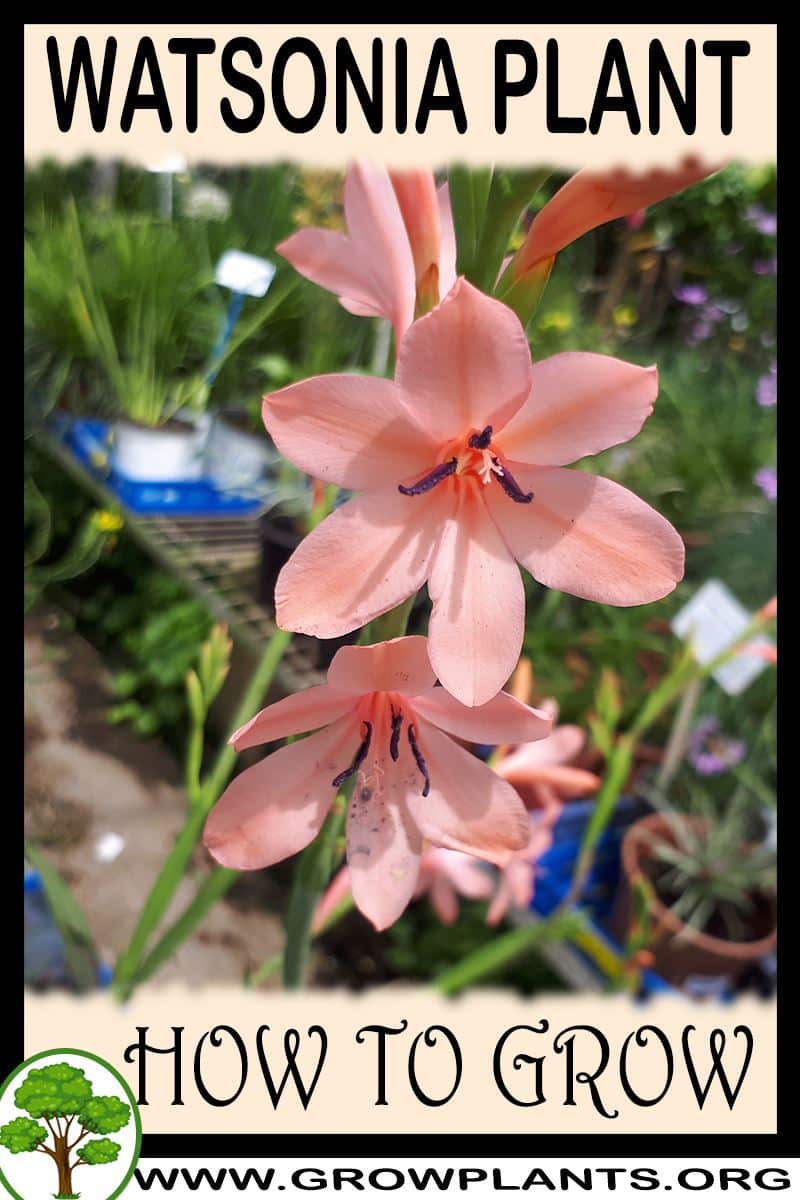



Plant Profile & Key Characteristics
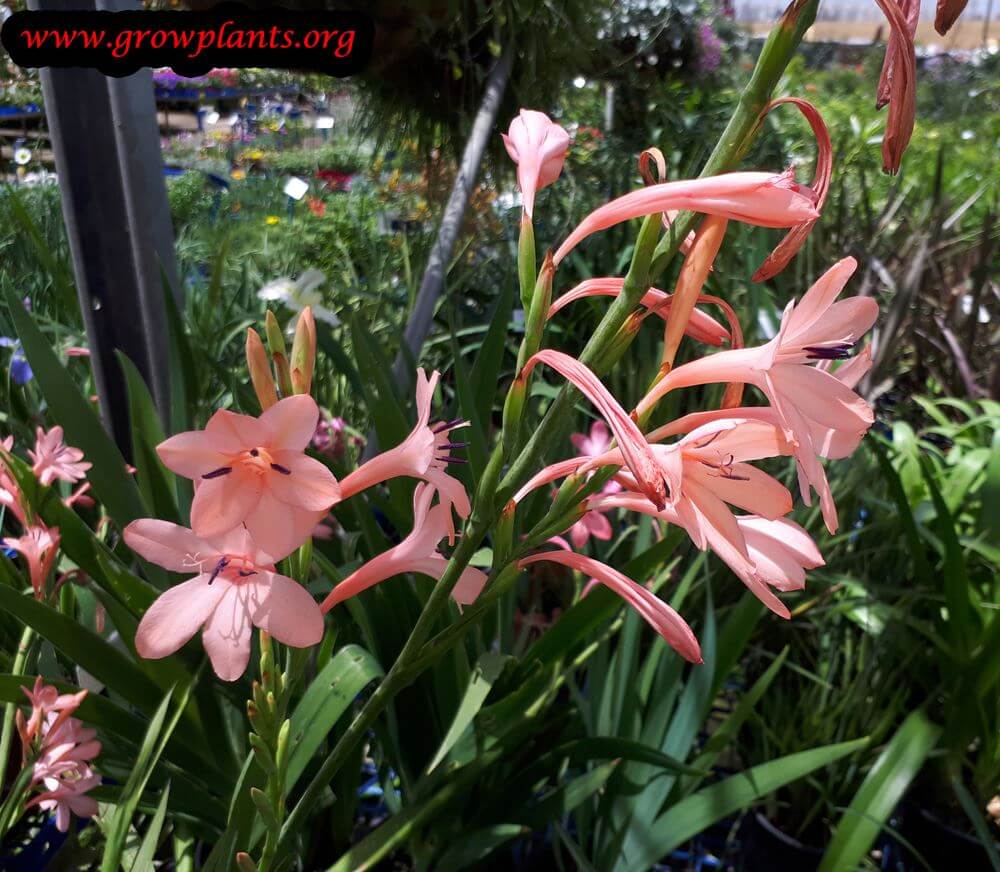
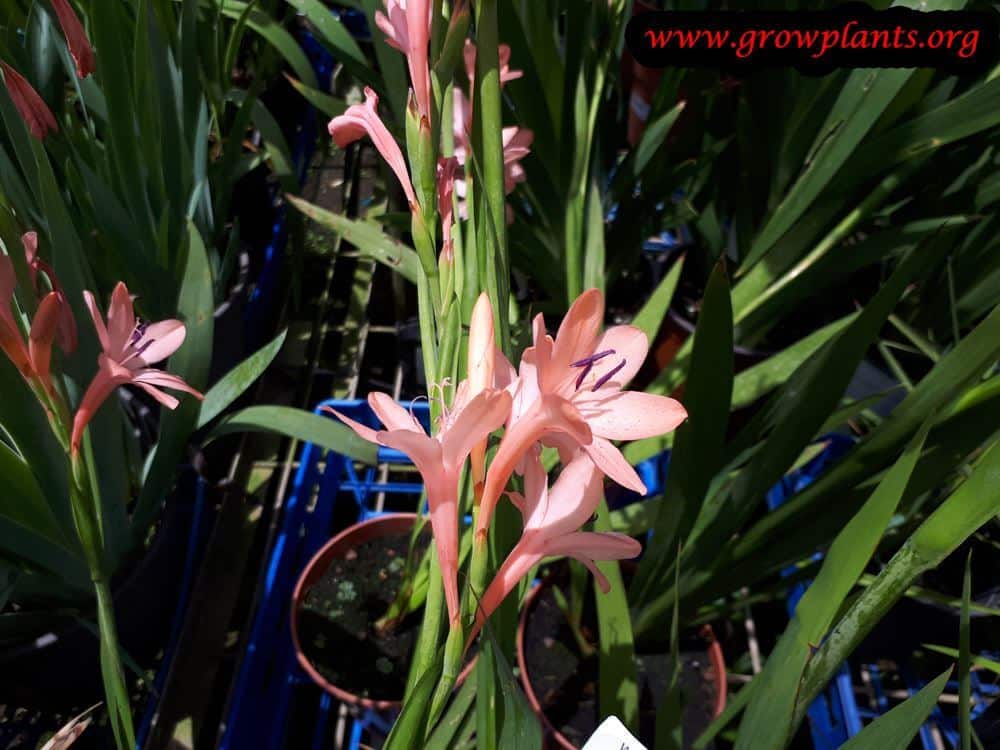
Overview: Watsonia (bugle lily) is a deciduous perennial geophyte 0.3–2 m tall, grown as an ornamental and cut flower. It rises from an underground corm and bears tall spikes of trumpet-shaped flowers.
Quick Specifications
| Specification | Attribute |
|---|---|
| Plant Type / Life Cycle | Perennial (geophyte) |
| Foliage Type | Deciduous |
| Mature Size | 0.3–2 m (12–80 in) tall |
| Growth Rate | Moderate to Fast |
| Root System | Cormous geophyte (underground corm) |
| Hardiness | USDA zones 8–10 (lift corms to overwinter in colder areas) |
Growth Form & Structure
- Height & Spread: Upright clump 0.3–2 m tall; a single corm grows well in a 5 L (1.3 gal) container of free-draining mix.
- Growth Habit & Form: Clump-forming corm plant with fans of sword-shaped leaves and tall flower stems, dying back after flowering.
- Lifespan & Maturity: Perennial regrowing each season from its corm; corms multiply over time.
Anatomy & Physical Features
- Leaves & Foliage: Green sword-shaped (linear) leaves in upright fans; sap may cause skin irritation.
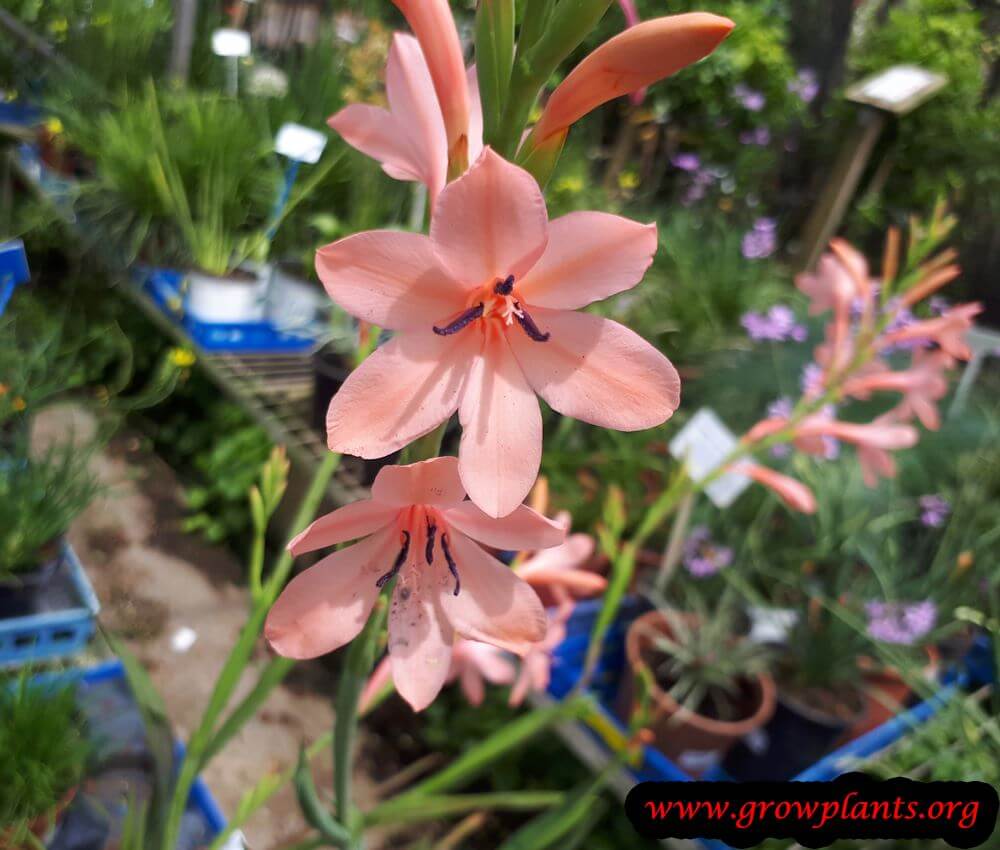
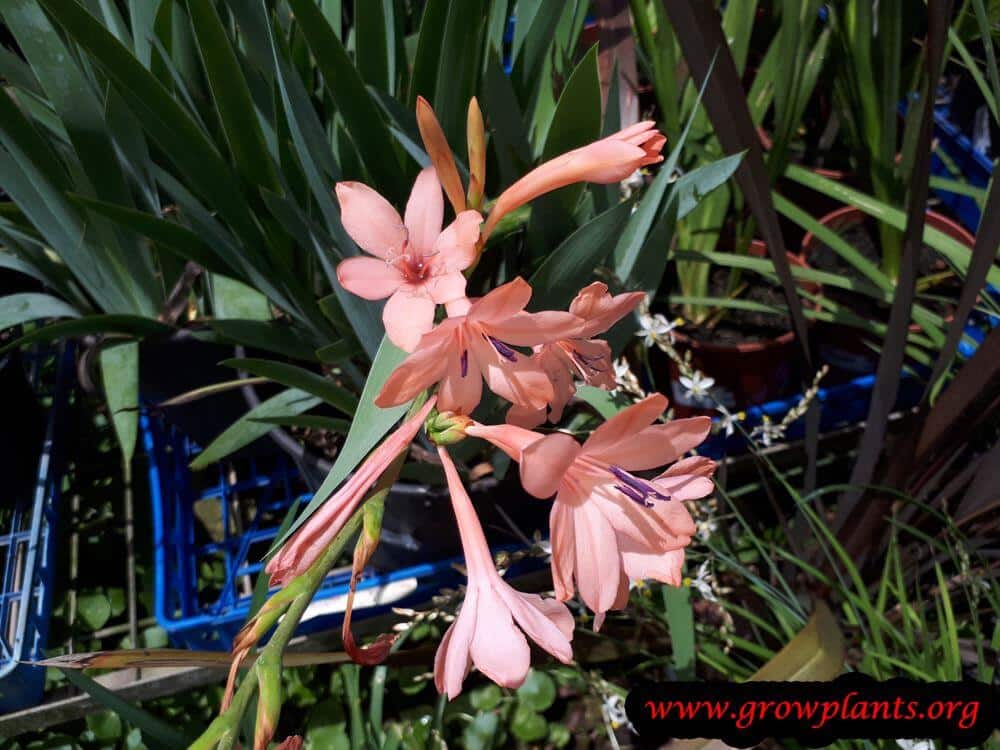
- Flower Characteristics: Trumpet-shaped flowers on tall stems in pink, red, orange, white, yellow, purple or blends.
Primary Uses & Landscape Value
- Functional & Ornamental Roles: Vertical accent for borders and a long-stemmed cut flower; grown in beds or containers.
Care Guide: Planting, Soil & Watering
Overview: Watsonia is a vigorous cormous perennial that enjoys full sun and rich, moisture-retentive but well-draining soil. It likes steady water through the growing season and should never be allowed to dry out while in active growth.
Quick Care Requirements
| Requirement | Ideal Condition |
|---|---|
| Planting Season | Zone-dependent: spring in cooler areas (zones 8–10a), autumn to winter in zone 10b, autumn in zone 11+ |
| Growth Rate | Moderate to Fast |
| Soil Type | Rich, moist, well-draining soil |
| Water Need | Moderate to High — keep evenly moist during growth and do not let it dry out |
Planting & Establishment
- Best Planting Season: Plant corms in spring in cooler climates (zones 8–10a); in warmer zones plant in autumn (autumn to winter in 10b, autumn in 11). Corms may stay in the ground year-round only in zones 8–10; elsewhere lift and store them over winter.
- How to Plant:
- Hole Preparation: Set corms roughly 20–30 cm apart in a sunny, well-drained bed of rich soil.
- Soil Amendments: Enrich the soil with organic matter and feed in spring; good drainage keeps the corms from rotting in wet ground.
- Planting Depth: Plant corms about two to three times their own depth, with the growing tip pointing up.
- Growth Speed & Expectations: Growth is fast to moderate, sending up tall flower spikes (0.3–2 m) within a single season.
Soil, Watering & Drainage Care
- Soil Mix & Drainage Needs: Give rich, free-draining soil; in containers use a good potting mix in at least a 5 L pot per corm and ensure water drains away freely.
- Watering Schedule & Technique:
- Young / Newly Planted: Water in well and keep the soil consistently moist as growth begins.
- Established: Water regularly through the growing and flowering season, never letting the soil dry out completely.
- Seasonal Adjustments: Reduce watering as the foliage dies back after flowering and while corms are dormant; increase during active growth and heat.
Climate, Light & Hardiness
Bugle lily is a South African cormous perennial suited to subtropical and temperate climates with full sun. Its corms generally overwinter in the ground within USDA zone 8–10, while gardeners outside that range lift and store the corms to sidestep both hard freezes and, in the hottest climates, insufficient winter dormancy.
Quick Climate Specifications
| Climate Zones | Subtropical, temperate |
|---|---|
| USDA Hardiness Zones | 8–10 in the ground; can be grown colder or hotter if the corms are lifted seasonally |
| Frost Tolerance | Low to Moderate – foliage is frost-tender, though corms in zone 8–10 typically survive average winters underground |
| Light Conditions | Full sun |
Sunlight & Light Exposure
Optimal Light Setup
Full sun is required for strong flowering; site data does not support part-shade siting for this plant.
Best Exposure / Orientation
An open, unshaded bed or border gives the best bloom on tall flowering stems.
Temperature Extremes & Hardiness
USDA Hardiness & Regional Limits
Corms are considered hardy in the ground across USDA zones 8–10. Below zone 8, the corms are typically lifted in autumn and stored over winter rather than left to freeze in the soil.
Cold Damage & Winter Protection
Foliage dies back with cold and frost is damaging to top growth; in zone 8–10 the dormant corm itself generally rides out an average winter underground, but colder snaps than usual can still kill unlifted corms.
Frost Sensitivity
Foliage and flowers have low frost tolerance; treat any hard freeze as a reason to mulch heavily or lift the corms.
Extreme Heat Tolerance
In the hottest climates (zone 11 and above), site data notes growers sometimes lift and refrigerate the corms - a way of supplying the winter dormancy the plant expects when the local climate stays too warm to trigger it naturally.
Wind, Humidity & Microclimate
Rainfall & Seasonal Moisture
Comes from a winter-rainfall, summer-growing background typical of South African corms; site care notes call for consistently moist soil through the growing season rather than a pronounced dry dormancy above ground.
Microclimate Recommendations
A warm, open, sunny position with reliable moisture in the growing season suits it best; in marginal zones, extra mulch over the dormant corm improves winter survival odds.
Growing in Pots, Balconies & Indoors
Watsonia is a tall, full-sun cormous plant with spikes of colourful flowers, much like a bugle lily. The grower says it is not a houseplant but confirms container growing; it makes a fine large-pot plant for a sunny balcony or patio, with one corm happy in about 5 L and clumps building up over the years.
Quick Details
- Container Size: About 5 L (1.3 gal) per corm; a larger pot for a clump
- Indoor Suitability: Not a houseplant – the tall flower spikes need full sun and open air
- Best Spot: Full sun – an open, sunny balcony, patio, or border
- Soil & Drainage: Well-drained soil – potting mix or similar; keep it from staying wet and rotting the corms
- Watering in Pots: Average to plenty of water in growth (do not let it dry out); ease off as the foliage dies down for the corms’ rest
Indoors & On the Windowsill
- Not a houseplant: The grower says no. The tall flowering spikes demand full sun and open air that a room cannot supply, so grow it outdoors in pots or beds.
- Why a sill will not do: It is too tall and too sun-hungry for a windowsill; indoors it grows drawn and will not flower well.
- Overwintering the corms: In cold-winter areas the corms are tender – lift and store them dry and frost-free, or move the pot into a bright, frost-free place and keep it dry until growth restarts.
On a Balcony or Patio
- Light & wind: Give it the sunniest spot; the tall spikes may need staking on an exposed balcony and shelter from strong wind. Keep the pot evenly moist in growth.
- Practicalities: A pot of flowering corms is top-heavy – use a stable, weighted container with free drainage so the corms never sit waterlogged.
Choosing the Pot, Soil & Long-Term Care
- Pot & drainage: A well-drained pot with strong holes and no standing-water saucer; wet, stagnant soil rots the corms.
- Potting mix: A free-draining mix – potting mix or similar; corms want moisture in growth but sharp drainage overall.
- Feeding: Feed through the growing and flowering season for strong spikes; potted corms leach nutrients.
- Refreshing & dividing: As the grower advises, check the soil every few years and replace it if it has lost vitality by washing off the old soil; if the roots fill the pot, thin the clump or pot up, or flowering will suffer.
Grower’s Container Tip
- One corm per 5 L, and keep them from crowding (grower’s method): The grower grows a single corm in about 5 L (1.3 gal) of well-drained potting mix. Every few years he checks the soil is still viable, refreshing it if not; and because a planter packed full of corms stops flowering, he thins the clump or moves up to a bigger container to keep the blooms coming.
Fertilizing & Feeding
A moderate feeder while leaves and flower spikes are actively growing; feeding should stop as soon as the foliage begins its natural die-back.
Quick Fertilizing Specs
| Feeding Level | Moderate feeder during active leaf growth, tapering off through bloom. |
|---|---|
| Main Nutrient Priority | Balanced feeding shifting toward potassium as flower spikes form. |
| Best Feeding Period | From new leaf emergence through the bloom period. |
| Reduce/Stop Feeding | Stop feeding once flowering ends and the foliage begins dying back. |
Feeding by Growth Stage
Active Leaf Growth
Fuel the leaf growth that builds the bulb’s energy reserves for next season’s bloom.
| Nutrient direction | A balanced feeding supports vigorous leaf growth, which in turn builds up the bulb for future flowering. |
|---|---|
| Timing | As new leaves emerge and through the main growing season. |
| Frequency | A light feeding as growth begins, repeated occasionally through the growing season, is enough for this fast grower. |
| Fertilizer types | A balanced fertilizer worked into the soil around the emerging shoots, Well-rotted compost added at planting time |
| Precautions | Keep the soil evenly moist when feeding – this plant does not tolerate drying out, and fertilizer applied to dry soil can damage the roots. |
Bud Set and Bloom
Support the trumpet-shaped flower spikes without diverting energy purely into leaves.
| Nutrient direction | Shift toward a fertilizer that supports flowering rather than just leafy growth, while keeping overall feeding light. |
|---|---|
| Timing | As flower spikes form and through the bloom period. |
| Frequency | A single feeding as buds form is usually enough to carry the plant through bloom. |
| Fertilizer types | A balanced to potassium-leaning fertilizer to support flower spikes |
| Precautions | Avoid heavy nitrogen during bloom, which can produce excess leaf growth at the expense of flowers. |
Post-Bloom Die-Back
Let the foliage die back naturally and the bulb enter dormancy without pushing new growth once flowering is finished.
| Nutrient direction | None – withhold fertilizer once flowering ends and the foliage begins dying back. |
|---|---|
| Timing | After flowering, as the deciduous foliage yellows and dies back. |
| Frequency | No feeding at this stage. |
| Fertilizer types | No feeding at this stage; feeding resumes only when new leaf growth begins again next season. |
| Precautions | Do not fertilize a dying-back or dormant bulb – nutrients applied now are wasted and can encourage rot in the resting bulb. |
Nutrient Deficiency Signs & Corrections
Healthy leaves but few or no flower spikes.
| Possible causes | Excess nitrogen favoring leaf growth over flowering, A bulb not yet mature enough to flower, Overcrowded bulbs competing for nutrients and space |
|---|---|
| Appears first on | Whole-plant flowering pattern rather than an individual leaf |
| What to check | Review recent fertilizer nitrogen levels, Check how long the bulb has been established, Assess whether bulbs have become overcrowded |
| Possible correction | Reduce nitrogen and shift toward a more balanced or potassium-leaning feed; divide overcrowded bulb clumps at the appropriate season. |
Leaves yellowing earlier than expected, outside the normal post-bloom die-back.
| Possible causes | Nutrient deficiency in depleted soil, Waterlogged soil causing root stress, Natural seasonal die-back being mistaken for a deficiency |
|---|---|
| Appears first on | Older leaves first |
| What to check | Compare timing to the expected bloom and die-back schedule, Check soil drainage, Assess overall soil fertility |
| Possible correction | If die-back is genuinely premature, improve drainage and consider a light balanced feeding during the next active growth period. |
Soft, rotting bulbs or weak emergence in spring.
| Possible causes | Fertilizer or organic matter applied too close to the resting bulb, encouraging rot, Poorly drained soil holding excess moisture around the bulb, Fungal or bacterial rot unrelated to feeding |
|---|---|
| Appears first on | The bulb itself and the base of emerging shoots |
| What to check | Inspect bulbs for softness or rot, Check soil drainage around the planting site, Review whether fertilizer was applied during the dormant period |
| Possible correction | Improve drainage, avoid feeding during dormancy, and remove and discard any rotted bulbs. |
Pruning, Training & Seasonal Maintenance
Watsonia is a deciduous, corm-forming perennial with no woody growth, so there is no structural pruning to speak of. The two real tasks are deadheading the spent flower stem after bloom, and removing the strap-shaped foliage in winter once it has died back completely on its own. Cutting the leaves back while they are still green is the single most damaging mistake, since the corm relies on that foliage to recharge itself for next year’s flowers.
Quick Pruning & Maintenance Specs
| Pruning Tolerance | Low (deadheading and dead-leaf removal only) |
| Primary Pruning Window | Winter, once foliage has fully died back |
| Secondary Maintenance Window | Immediately after flowering — deadhead spent stems |
| Typical Frequency | Once per bloom cycle |
| Main Objective | Prevent seed-set draining the corm; tidy fully dead foliage without cutting the recharge cycle short |
| Best Tool Type | Precision snips or bypass secateurs |
| Avoid Heavy Pruning During | Any time the foliage is still green |
Pruning by Plant Age & Size
Newly Established
Leave foliage untouched through its first full growth cycle to let the corm build up reserves.
Young / Formative
No training system applies — there is no framework to build on a bulb/corm plant.
Mature / Established
Deadhead each spent flower stem after bloom, and remove the season’s foliage only once it has fully yellowed or browned.
Special Growth to Remove
- Spent flower stems — cut down at the base once flowering has finished, to stop energy going into seed production.
- Fully dead, yellowed or brown leaves — remove in winter once die-back is complete; never cut green leaves.
Container & Small-Space Pruning
In containers, top growth is handled the same as in the ground — deadhead and remove only fully dead foliage. The more important container task is watching the corm clump itself: once roots fill the pot, flowering declines, at which point the fix is repotting into a larger container or reducing the number of corms, not pruning the foliage harder.
Tools
- Precision snips for deadheading individual flower stems.
- Bypass secateurs for clearing the fuller mass of dead foliage in winter.
Tool Hygiene & Disease Risk
Routine — clean, sharp tools are sufficient; no specific disease-transmission risk is noted for this species.
Cut Placement & Technique
Cut the flower stem down at its base after bloom. Remove dead leaves individually at the base once they are fully brown, rather than shearing the whole clump while any green remains.
Heavy Pruning & Rejuvenation
Not applicable. There is no woody framework to renew by hard pruning; an overcrowded, poor-flowering clump is refreshed by lifting and dividing corms, which is a propagation task, not a pruning one.
Post-Pruning Care
No special aftercare is needed beyond normal watering; do not feed specifically in response to a routine deadhead or winter leaf clean-up.
Common Pruning Mistakes
- Cutting back green foliage right after flowering finishes — this starves the corm and reduces next year’s bloom.
- Leaving spent flower stems to set seed instead of deadheading, which diverts energy from the corm.
When NOT to Prune
Never remove foliage while any of it is still green, even once flowering has clearly ended — wait until it has fully yellowed or browned in winter.
Propagation Guide
Watsonia is most reliably propagated by dividing the offset cormlets that form around the mature corm (loosely called a bulb on this site), which flowers sooner and keeps the parent’s flower colour; seed is also usable and generally true-to-type for the species, but takes longer to reach flowering size. Overall propagation is easy, and grafting or vegetative propagation is not required.
Quick Propagation Specs
| Best Propagation Method | Corm division (offset cormlets) |
| Alternative Methods | Seed |
| Propagation Difficulty | Easy |
| Seed True-to-Type | Usually true-to-type for the species |
| Vegetative True-to-Type | Yes |
| Best Propagation Season | Corms: spring in hardiness zone 8-10a and in colder climates; autumn in zone 10b and zone 11 (corms can stay in the ground year-round only in zone 8-10). Seed: spring to summer in zone 8-11, possible year-round in zone 12+ |
| Seed Germination Time | 2-8 weeks |
| Seed Sowing Depth | 0.5-1cm (0.25-0.5in) |
Growing from Seed
Seed Handling & Viability
Store seed in a dry, dark place; refrigerate before sowing and give at least 6°C (43°F) of chilling.
Dormancy & Pre-Sowing Treatment
Seed needs cold treatment before sowing – at least 6°C (43°F) of chilling hours.
Sowing Season
Spring to summer in hardiness zone 8-11; possible year-round in zone 12+.
Sowing Depth & Orientation
Sow at 0.5-1cm (0.25-0.5in) deep; nursery spacing around 20x30cm (8x12in). Site notes vermiculite as a good sowing medium, kept moist.
Germination Conditions
Moist soil with light humidity, in a sunny, well-drained spot.
Germination Time
2-8 weeks.
Seedling Care
Full sun, watered regularly, keeping the soil moist.
Rhizomes, Tubers, Bulbs & Corms
Watsonia grows from a corm (called a bulb on this site). Established clumps produce offset cormlets that can be separated and replanted. Timing follows the same zone-based schedule as planting: spring in hardiness zone 8-10a and in colder climates, autumn in zone 10b, and autumn in zone 11; only in zone 8-10 can the corm stay in the ground year-round. Outside zone 8-10, lift the corm and its offsets and keep them refrigerated over the off-season before replanting. Handle the plant with care, as it can cause skin irritation.
Bloom & Flower Guide
Quick Details
- Bloom Season: Broadly spring to summer in cooler zones (occasionally autumn), and autumn to winter in the warmest zones, depending on the species
- Flower Appearance: Trumpet-shaped flowers in pink, red, orange, white, yellow, purple or bicolours, carried up tall spikes
- Edibility: Ornamental — grown for cut flowers; not eaten
Detailed Blooming Overview
Watsonia is a cormous relative of the gladiolus that sends up tall spikes packed with tubular, trumpet-shaped flowers. The colour range is wide — from pink and red to orange, yellow, white and purple — and the long stems make excellent cut flowers.
Flower Characteristics
- Trumpet-shaped flowers in a broad colour range, sometimes multi-coloured.
- Borne along tall, upright spikes above sword-shaped foliage.
Bloom Care & Thinning
- Managing the bloom: Cut spikes for the vase or remove them once flowering finishes, then let the foliage die back naturally to feed the corm.
- Pollination: The tubular flowers are visited by birds (sunbirds in their native South Africa) as well as insects.
- Note: In mild climates Watsonia can naturalise readily, so remove spent flower spikes before they set seed if self-seeding is a concern.
Pests, Diseases & Troubleshooting
Overview: Watsonia is a robust, sun-loving cormous perennial in the iris family, and like its relative the gladiolus its main concerns are thrips and aphids on the foliage and flowers, sap-spread viruses, and corm rots in wet or poorly stored conditions. In a sunny, well-drained bed it is tough and largely self-reliant.
Quick Troubleshooting Overview
| Issue / Pest | Main Symptom | Primary Solution |
|---|---|---|
| Thrips | Silvery streaked leaves and flowers | Blue sticky traps; remove weeds; spinosad |
| Aphids | Sticky, curled growth; virus spread | Water blast; insecticidal soap |
| Spider mites | Stippling in hot, dry conditions | Hose foliage; horticultural oil |
| Corm rot | Soft, rotten corms; failure to sprout | Dry storage; sharp drainage; discard soft corms |
| Mosaic virus | Yellow streaking, distorted growth | Control aphids; remove infected plants |
Common Pests & Management
- Thrips (Thrips / Frankliniella spp.):
- Symptoms: Silvery-white streaking and flecking on leaves and petals, browning of flower buds, and distorted blooms; tiny slender insects and black frass specks are visible on close inspection. Thrips are the signature pest of the iris family.
- Prevention & Control: Monitor with blue sticky traps, remove nearby weeds and grassy hosts, and clear spent foliage where they overwinter. Spinosad or insecticidal soap, applied in the evening to spare pollinators, controls heavy populations.
- Aphids (Aphis / Myzus spp.):
- Symptoms: Soft green or black insects on new growth and flower stems, curling leaves and leaving sticky honeydew; they are important mainly as vectors of mosaic viruses.
- Prevention & Control: Blast off with water, encourage ladybirds and lacewings, and treat persistent groups with insecticidal soap. Prompt control limits the spread of virus through the planting.
- Spider mites (Tetranychus urticae):
- Symptoms: Fine stippling and a dull, bronzed appearance with light webbing during hot, dry weather.
- Prevention & Control: Hose foliage and keep plants watered and unstressed; encourage predatory mites. Horticultural oil or insecticidal soap treats stubborn colonies.
- Mealybugs (Pseudococcus spp.):
- Symptoms: White cottony clusters at leaf bases and on corms, weakening growth and leaving honeydew; ants often tend them.
- Prevention & Control: Wipe off colonies, control ants, and use horticultural oil or insecticidal soap. Inspect stored corms and discard heavily infested ones.
- Slugs & snails (Deroceras / Helix spp.):
- Symptoms: Ragged holes and slime trails on young shoots and leaves, worst in damp, mulched, shaded conditions.
- Prevention & Control: Hand-pick at night, clear damp hiding places, and use grit or copper barriers. Iron-phosphate bait helps where pressure is high.
Diseases & Fungal Issues
- Corm rot (dry & soft rot) (Fusarium oxysporum / Botrytis / Penicillium spp.):
- Symptoms: Corms fail to sprout or produce yellowing, wilting plants; lifted corms show dark, sunken dry rot or soft, mushy decay, often from wet soil or poor storage.
- Treatment & Management: Grow in free-draining soil, avoid overwatering, and lift and cure corms in a dry, airy place for storage where needed. Discard soft or spotted corms and dust or store only clean, firm ones.
- Botrytis / gray mold (Botrytis cinerea):
- Symptoms: Grey fuzzy mold and water-soaked spots on leaves and flowers in cool, damp, crowded conditions, with flower and leaf collapse.
- Treatment & Management: Space plants for airflow, remove spent flowers and debris, and avoid overhead evening watering. A fungicide is rarely needed where sanitation and drainage are good.
- Rust (Uromyces / Puccinia spp.):
- Symptoms: Orange to brown powdery pustules on leaf undersides with yellow blotches above, in humid weather.
- Treatment & Management: Remove infected leaves, improve air movement, and avoid wetting foliage. Sulfur or an appropriate fungicide controls chronic rust.
- Mosaic & ornithogalum viruses (potyviruses / mosaic viruses):
- Symptoms: Yellow mottling, streaking, or breaking of color, with stunting and distortion; spread by aphids and by division of infected corms.
- Treatment & Management: There is no cure. Control aphid vectors, buy clean stock, rogue out symptomatic plants, and never propagate from infected corms.
Growing Difficulties & Abiotic Problems
- Waterlogging / corm rot from wet soil:
- Cause & Symptoms: Yellowing, failure to thrive, and rotting corms where soil stays wet, especially in the dormant season.
- Correction Strategy: Plant in sharply drained soil or raised beds, ease off water during dormancy, and avoid heavy, soggy ground. In wet climates lift and store corms dry.
- Poor flowering:
- Cause & Symptoms: Sparse or no blooms from too much shade, overcrowded clumps, or exhausted soil.
- Correction Strategy: Grow in full sun, divide congested clumps periodically, and feed lightly during active growth for strong flowering spikes.
- Frost damage:
- Cause & Symptoms: Blackened foliage and damaged corms after hard frost in the growing season; hardiness varies by species.
- Correction Strategy: Match species to climate, mulch corms in borderline areas, and grow tender types in containers that can be protected.
What Helps – Products & Tools
The practical toolkit is blue sticky traps and spinosad or insecticidal soap for thrips and aphids, horticultural oil for mites and mealybugs, iron-phosphate bait for slugs, and sulfur for rust; plus sharp drainage and dry corm storage to prevent the rots that do most damage. Buy clean corms and remove virus-suspect plants. Apply sprays in the evening to spare pollinators and follow the label.