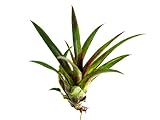



Plant Profile & Key Characteristics
Also known as: Vriesia plant, Vriisea, Flaming sword plant
Overview: Vriesea (genus) is an evergreen perennial epiphytic bromeliad forming a compact leaf rosette 20–60 cm tall and wide. It is grown as an ornamental for its patterned foliage and long-lasting colourful flower spike, outdoors in the tropics or as a houseplant.
Quick Specifications
| Specification | Attribute |
|---|---|
| Plant Type / Life Cycle | Perennial (evergreen epiphyte) |
| Foliage Type | Evergreen |
| Mature Size | 20–60 cm (12–24 in) tall and wide |
| Growth Rate | Slow |
| Root System | Epiphytic – roots mainly anchor the plant rather than feed it |
| Toxicity | Non-toxic (bromeliad) |
| Hardiness | USDA zone 11+ (10b with overwinter care) |
Growth Form & Structure
- Height & Spread: Symmetrical rosette 20–60 cm across; as a natural epiphyte it grows best in a small free-draining pot or mounted on bark rather than in heavy soil.
- Growth Habit & Form: Stemless rosette that holds a central water-filled ‘tank’; the main rosette flowers once, then is replaced by offset ‘pup’ daughter plants.
- Lifespan & Maturity: Slow-growing; each rosette lives several years, blooming once at maturity before offsets take over.
Anatomy & Physical Features
- Leaves & Foliage: Green to variegated leaves, sometimes striped, spotted or dotted with white, red or purple. Leaves are strap-like and elliptic, arranged in a spreading rosette with pointed tips.
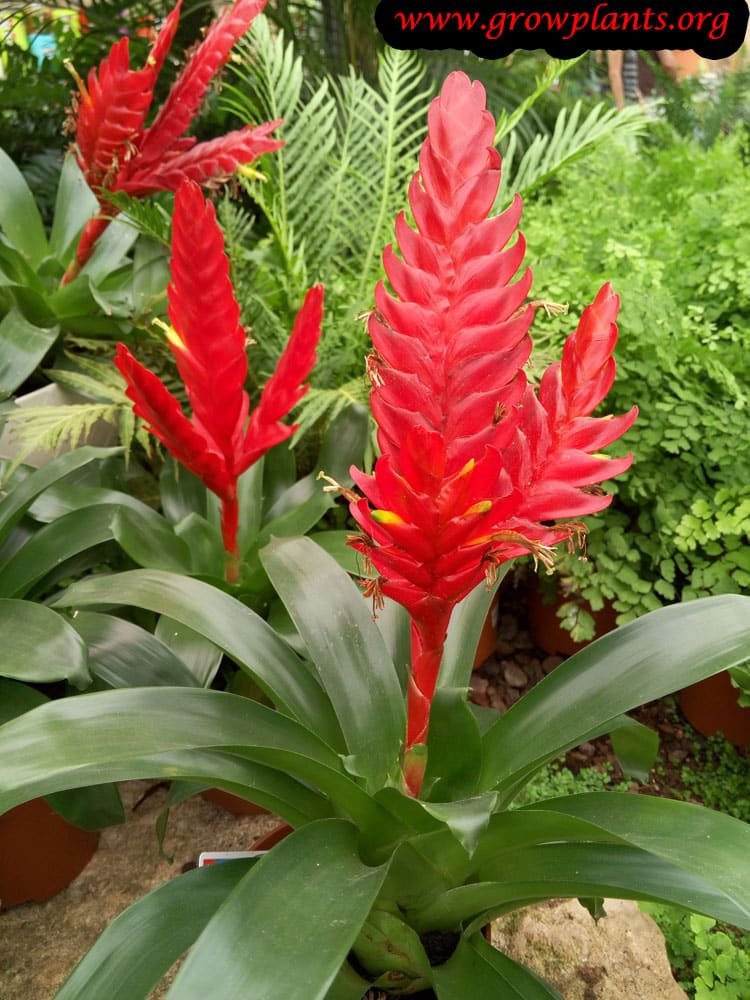
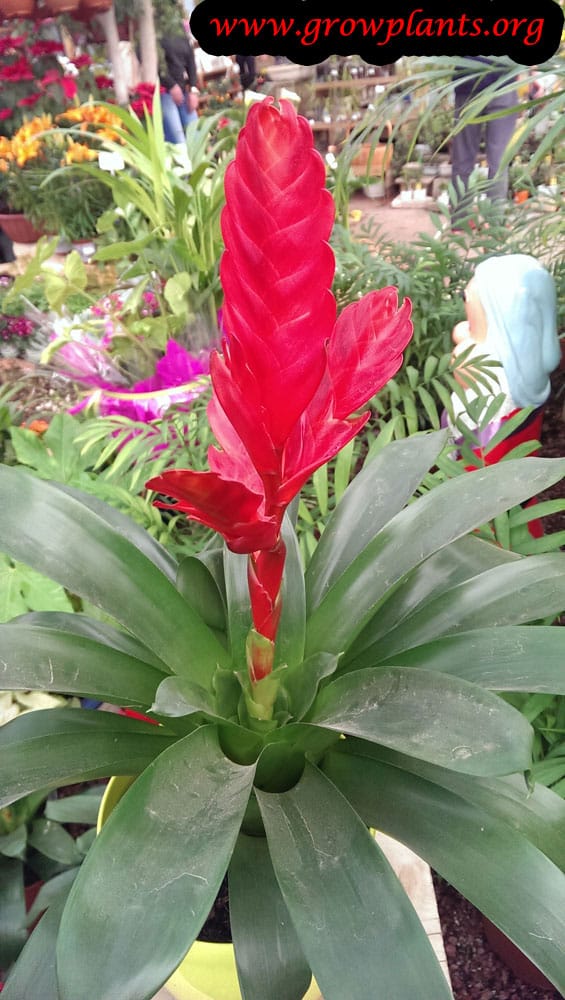
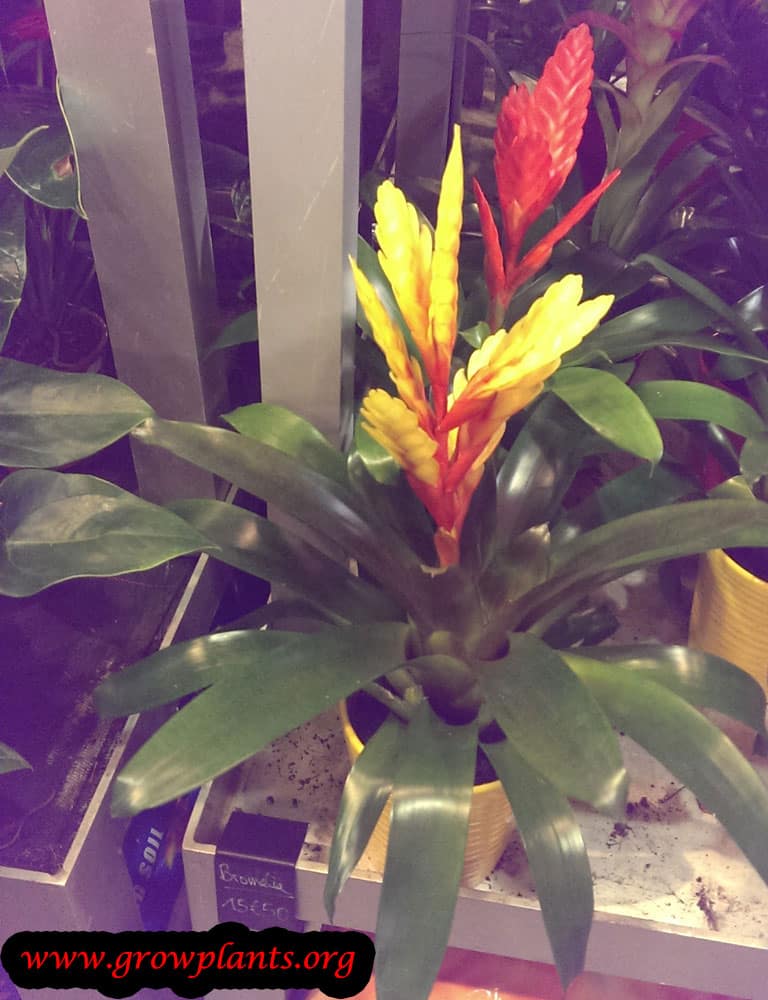
- Flower Characteristics: Small green to yellow flowers emerge from a flattened sword-like spike of showy bracts (red, pink, yellow, orange, light-green or white).
Primary Uses & Landscape Value
- Functional & Ornamental Roles: Ornamental foliage-and-flower accent for shaded tropical plantings, and a popular low-light houseplant.
Care Guide: Planting, Soil & Watering
Overview: Vriesea are epiphytic bromeliads that thrive in warm, humid, brightly lit but shaded conditions, growing best in a light, airy, fast-draining medium — or mounted on bark — rather than in ordinary soil. They need steady moisture, famously watered into the central rosette ‘cup’, yet resent soggy roots and hard tap water, so rain or purified water suits them best.
Quick Care Requirements
| Requirement | Ideal Condition |
|---|---|
| Planting Season | Year-round in frost-free warmth; in cooler areas (zone 10b) plant in spring to summer |
| Growth Rate | Slow |
| Soil Type | Light, airy, very free-draining epiphytic mix (orchid bark, sphagnum, perlite) — or mounted on cork/bark |
| Soil pH | Slightly acidic (around 5.0–6.0); lime-sensitive, so water with rain or purified water |
| Water Need | Moderate — keep the central rosette topped up and the medium lightly moist, never waterlogged |
Planting & Establishment
- Best Planting Season: Plant at any time of year in a warm, frost-free spot; where winters are cooler (zone 10b) start them in the warmth of spring to summer.
- How to Plant:
- Hole Preparation: Rather than a planting hole, settle the plant into a small pot of loose bark mix or fix it onto a slab of cork or bark, keeping the base airy so the roots never sit wet.
- Soil Amendments: Blend in extra orchid bark, sphagnum moss and perlite for maximum aeration; the source describes a light, open medium that mimics the leaf litter and tree bark these plants cling to in the wild.
- Planting Depth: Set the plant shallow so the base of the rosette sits right at the surface — never bury the crown, which rots if kept buried and wet.
- Growth Speed & Expectations: Expect slow, steady growth; a rosette takes its time to reach full size (20–60 cm) and flowers just once before offsetting.
Soil, Watering & Drainage Care
- Soil Mix & Drainage Needs: Use an open, fast-draining epiphyte mix or mount the plant on bark so air reaches the roots; standard potting soil holds too much water and causes rot. If mounted, wrap the roots in a little moss to hold humidity.
- Watering Schedule & Technique:
- Young / Newly Planted: Keep newly potted or mounted plants humid and lightly moist, misting the roots and filling the central cup, but avoid letting the medium stay saturated.
- Established: Water into the central rosette and keep the medium just moist with good airflow at all times; empty and refresh the cup periodically to keep it clean.
- Seasonal Adjustments: Ease off in cooler weather — these plants dislike cold, wet conditions below about 15°C — and raise humidity during hot, dry spells.
Note: The water-holding cup formed by the leaves can breed mosquitoes. Flush it out with a hose weekly to clear out any eggs/larvae.
Climate, Light & Hardiness
Vriesea (flaming sword) is a tropical, epiphytic bromeliad grown for its patterned leaves and bright bracts, needing warm, humid, frost-free conditions and bright light without direct sun. It is cold-sensitive: it prefers temperatures above about 15 °C (59 °F) and only briefly tolerates around 5 °C (41 °F), with no frost tolerance.
Quick Climate Specifications
| Climate Zones | Tropical, subtropical or Mediterranean (frost-free), or indoor |
|---|---|
| USDA Hardiness Zones | 11 and warmer; about 10b with good overwinter care |
| Optimal Temp Range | Warm, above about 15 °C (59 °F) |
| Cold Damage Begins | Below about 15 °C (59 °F) |
| Approx. Survival Minimum | Briefly about 5 °C (41 °F); not recommended |
| Frost Tolerance | None |
| Light Conditions | Bright, indirect; partial to full shade (no direct sun) |
| Wind Tolerance | Low (keep away from drafts) |
Sunlight & Light Exposure
Optimal Light Setup
Give plenty of bright, indirect light but no direct sun, which scorches the leaves and flowers. A well-lit spot out of the sun's direct beam is ideal.
Shade & Heat Management
Partial to full shade with good light suits it; deeper shade is tolerated at the cost of colour. In heat, more shade plus humidity protects the foliage.
Best Exposure / Orientation
A bright position shielded from direct sun - for example near a bright but not sun-struck window - works best.
Temperature Extremes & Hardiness
USDA Hardiness & Regional Limits
Hardy outdoors only in warm, frost-free climates - roughly USDA zone 11 and warmer, or about 10b with careful overwintering. Grow it indoors in colder regions.
Cold Damage & Winter Protection
It prefers to stay above about 15 °C (59 °F). A brief dip toward 5 °C (41 °F) may be tolerated but is not recommended; keep it warm and frost-free.
Frost Sensitivity
Frost tolerance is none - freezing damages the leaves and central water-holding cup.
Extreme Heat Tolerance
It takes warmth well when humidity and airflow are good; in hot, dry air raise humidity and improve ventilation to avoid leaf stress.
Wind, Humidity & Microclimate
Humidity Preferences
Coming from humid tropical forests, it prefers moderate to high humidity around the leaves.
Dry-Air Tolerance
It tolerates average indoor air but colours and grows better with added humidity; very dry air dulls and crisps the foliage.
Wind Tolerance
Keep it away from ventilators, heaters and air-conditioning drafts, which dry the leaves and the central cup.
Rainfall & Seasonal Moisture
It is adapted to steady tropical humidity and rain; the leaf cup should hold water, but cold, wet winter conditions invite rot, so keep it drier and warmer when cool.
Microclimate Recommendations
A warm, humid, sheltered, well-lit spot out of direct sun and drafts gives the best leaf colour and health.
Growing in Pots, Balconies & Indoors
Vriesea (Vriesea) is an epiphytic bromeliad and an easy, rewarding houseplant. In the wild it perches on tree branches rather than rooting in the ground, so indoors it is happiest in a small pot of very free-draining mix – or mounted on cork or bark – kept in bright, indirect light. The grower finds it is actually easier to grow indoors than out.
Quick Details
- Container Size: A small pot is plenty, with excellent drainage – or grow it mounted on cork or bark.
- Indoor Suitability: A genuine houseplant – one of the best bromeliads for indoors.
- Best Spot: Bright shade, best without direct light – direct sun scorches the leaves and flower.
- Soil & Drainage: Open, airy epiphyte mix (orchid bark, perlite, some coir); never dense, wet soil.
- Watering in Pots: Keep the central rosette cup topped up with water and the mix only barely moist; it wants humidity but sharp drainage.
Indoors & On the Windowsill
- A real houseplant: The grower keeps this one indoors, where there is no wind and humidity is easy to manage. Water into the central rosette cup, keep the air a little humid, and keep the plant away from heaters, air-conditioning and fans. A bright bathroom or kitchen suits its humidity – then water more sparingly.
- Windowsill growing: A bright sill with no scorching midday sun is ideal; strong direct sun marks the leaves and flower.
- Overwintering: This is a tender tropical – keep it warm, above about 10-13 C (50-55 F). Indoors it is comfortable year round; if summered outdoors, bring it in before cold nights.
On a Balcony or Patio
- Light & wind: It can spend the warm season outdoors in bright shade, sheltered from wind and hot midday sun. Pots dry quickly against warm walls, so check moisture and keep the cup topped up.
- Practicalities: Refresh the water in the cup every so often so it stays clean, and make sure drainage water can run away freely. Bring it back indoors before the first cold nights.
Choosing the Pot, Soil & Long-Term Care
- Pot & drainage: A small pot with strong drainage holes and no standing saucer, so the roots never sit in water. Alternatively, mount it on cork or bark and, as the grower advises, wrap the roots in moist moss or bark to hold humidity.
- Potting mix: An open epiphyte blend – orchid bark with perlite and a little coir – not heavy potting soil.
- Feeding: Feed only lightly – a very dilute bromeliad feed added to the mix or misted on; these plants are easily harmed by too much fertiliser salt.
- Repotting & pups: Each rosette flowers once, then produces offsets (pups) around the base. Pot the pups on into fresh, airy mix rather than repotting the spent parent.
Growing this plant in a greenhouse
A greenhouse can give vriesea frost protection, cold protection, humidity control and extra warmth. In the right climate it may also be kept growing through winter, depending on how much warmth and light are provided.
Greenhouse at a glance
| Greenhouse suitability | Good - clearly useful |
|---|---|
| Main benefits | frost protection, cold protection, humidity control, extra warmth |
| Season extension | earlier spring & later autumn |
| Outdoor protection advisable below | about 15°C |
| Maintain greenhouse minimum | around 15°C for active growth |
| Suitable types | heated greenhouse, polycarbonate greenhouse |
| Heating | Heating is recommended in cold climates for continuous growth. |
Related greenhouse guides
- Greenhouses: How to Choose the Right Greenhouse
- Best Greenhouse Heaters
- Greenhouse Climate Control: Temperature, Ventilation and Humidity
- Polycarbonate Greenhouses: What to Look for Before Buying
Fertilizing & Feeding
A light feeder: bromeliads take most of their nutrition from a lean, airy epiphytic mix and dilute feeding through the warm season, with feeding paused while growth is slow.
Quick Fertilizing Specs
| Feeding Level | Light feeder |
|---|---|
| Main Nutrient Priority | Dilute balanced feeding for healthy foliage and colorful bracts |
| Best Feeding Period | Warm active growing season |
| Organic Options | A lean, airy epiphytic mix with occasional weak organic feed |
| Reduce/Stop Feeding | Pause feeding in cool weather, low light, and just after potting or dividing |
| Micronutrients | Iron and manganese are usually supplied by a complete fertilizer; correct only diagnosed chlorosis |
| Soil pH | Slightly acidic and low in minerals; rain or purified water preferred |
Feeding by Growth Stage
Settling in after potting or dividing
Let a newly potted, divided, or newly bought plant settle and root before any feeding.
| Nutrient direction | None – withhold fertilizer until the plant is established and back in active growth. |
|---|---|
| Timing | Right after potting up, dividing off a pup, or bringing a new plant home. |
| Frequency | No feeding during this settling-in period. |
| Fertilizer types | No feeding at this stage; do not fertilize until the plant is established and actively growing. |
| Precautions | Do not fertilize a freshly potted or stressed plant; wait until new growth appears. |
Warm-season active growth
Support healthy rosette leaves and colorful bracts through the warm active season.
| Nutrient direction | A dilute balanced complete fertilizer, applied lightly to the foliage and around the roots, keeps growth steady. |
|---|---|
| Timing | Through the warm active growing season. |
| Frequency | Light feeding through the active growing season; these are not hungry plants. |
| Fertilizer types | A dilute balanced complete fertilizer, A foliar spray feed misted onto the leaves and into the central rosette tank, Occasional weak feeding, suited to an epiphyte adapted to lean conditions |
| Routine trace nutrients | iron, manganese |
| Precautions | Feed sparingly and at dilute strength; bromeliads are easily harmed by strong fertilizer and by salt building up in the leaf tank. |
Cool or low-light slowdown
Let the plant rest through cool, dim conditions without pushing weak growth.
| Nutrient direction | None – withhold fertilizer while growth is slow in cool or low-light conditions. |
|---|---|
| Timing | During cool weather, short winter days, or extended low light indoors. |
| Frequency | No feeding while the plant is resting. |
| Fertilizer types | No feeding at this stage; do not fertilize until brighter, warmer conditions return. |
| Precautions | Do not fertilize a resting plant; feeding now wastes nutrients and raises salt levels in the tank and mix. |
Nutrient Deficiency Signs & Corrections
Older, lower leaves fade to pale green or uniform yellow and the whole plant grows slowly.
| Possible causes | low available nitrogen in a lean epiphytic mix, nitrogen leaching from frequent watering and tank flushing, thin, low-organic-matter growing medium |
|---|---|
| Appears first on | older, lower leaves |
| What to check | recent feeding history, richness of the growing mix, watering and flushing frequency |
| Possible correction | Apply a dilute balanced complete fertilizer and improve the growing medium, then keep feeding light. |
Newest leaves yellow between the veins while the fine veins stay green.
| Possible causes | alkaline, high-pH water or mix locking up iron, cold or waterlogged roots limiting uptake, hard tap water high in minerals |
|---|---|
| Appears first on | youngest leaves |
| What to check | water and mix pH, drainage and root-zone temperature, whether hard tap water is being used |
| Possible correction | Switch to rain or purified water, correct pH, and apply a chelated iron product per its label. |
Leaf tips and margins brown or scorch and a crust may form in the central tank.
| Possible causes | fertilizer salt buildup in the tank and mix, hard-water minerals accumulating, overfeeding or feeding at too-strong a strength |
|---|---|
| Appears first on | leaf tips and margins |
| What to check | feeding strength and frequency, water hardness, how often the tank is flushed |
| Possible correction | Flush the tank and mix with rain or purified water to rinse out salts, then feed more lightly. |
Pruning, Training & Seasonal Maintenance
Vriesea is a rosette-forming bromeliad, usually grown as an epiphyte on bark/cork or in a very free-draining pot, so it tolerates almost no true pruning – there is a single growing point, and once a rosette matures it flowers once and then gradually declines while offsets (“pups”) take over. Maintenance is limited to removing dead or browning leaves and the spent flower/bract spike, which can be done year-round without affecting future flowering, since the next bloom comes from a new offset rather than regrowth of the same rosette.
Quick Pruning & Maintenance Specs
| Pruning Tolerance | Low (sanitary only, no structural pruning) |
| Primary Pruning Window | Year-round, as needed |
| Typical Frequency | Occasional – whenever a leaf browns or the bract spike fades |
| Main Objective | Remove dead tissue and the spent flower/bract spike; let offsets develop |
| Young Plant Priority | Leave alone while establishing; do not remove green leaves |
| Mature Plant Priority | Remove the flower/bract spike once fully faded; manage offsets (“pups”) |
| Best Tool Type | Precision snips |
| Avoid Heavy Pruning During | Always – this plant has no heavy-pruning stage |
Pruning by Plant Age & Size
Newly Established
Remove only visibly dead or damaged leaf tissue from transport or handling; otherwise leave the rosette untouched while it settles onto its mount or into its pot.
Young / Formative
No structural training applies – Vriesea grows as a single rosette and cannot be shaped, staked, or trained to a framework.
Mature / Established
Trim off lower leaves as they brown naturally, and cut the flower/bract spike out at its base once its colour has fully faded. As the mother rosette slowly declines after flowering, let offsets develop at its base; leave them to form a clump or separate them once they have their own roots.
Special Growth to Remove
- Dead or browning leaves – cut close to the base without nicking living tissue
- Spent flower/bract spike – remove once colour has fully faded; the mother rosette will not rebloom
- Offsets (“pups”) – leave in place to naturalize, or separate for propagation once they have developed their own roots
Container & Small-Space Pruning
Vriesea stays compact (20–60 cm) and grows slowly, and is usually grown in a small pot or mounted on bark/cork rather than planted in soil, so there is no canopy or height to control – maintenance stays limited to the sanitary trims above regardless of container size.
Tools
- Precision snips – the only tool needed, for clean removal of dead leaf tips and spent flower spikes
Tool Hygiene & Disease Risk
Routine: clean, sharp snips are enough. Because cuts are often made close to the water-holding rosette “cup,” avoid dropping soil or plant debris into it, which can encourage rot.
Cut Placement & Technique
Cut dead leaf tissue back to just above the healthy, living portion rather than pulling it, and cut the spent flower/bract stalk down to its base. Keep all cuts away from the central rosette cup.
Heavy Pruning & Rejuvenation
Not applicable and not tolerated – Vriesea has a single growing point, so there is no canopy to rejuvenate by hard pruning. Renewal happens biologically through offsets after the mother rosette flowers and declines, not through cutting back the plant.
Post-Pruning Care
No special aftercare is needed beyond normal watering (keeping the central cup topped up with soft or rain water); the small sanitary cuts involved do not warrant feeding or wound treatment.
Common Pruning Mistakes
- Cutting into the living rosette cup or healthy green leaf tissue
- Trying to “revive” a rosette that has finished flowering by cutting it back – the decline is natural and that rosette will not regrow
- Separating offsets before they have rooted
When NOT to Prune
Avoid removing healthy green leaves for size control – it will not keep the plant smaller and only stresses the single growing point. There is no other seasonal restriction for the sanitary trims described above.
Recommended Tools (by task)
- precision_snips – for removing dead leaf tips and spent flower/bract spikes; the fine, clean cut needed near the rosette cup rules out anything larger
Propagation Guide
Vriesea is most reliably increased from the offsets (pups) it forms around the base, and because the rosette flowers only once and then slowly declines, these pups are how a plant is carried on. Seed is possible from fresh seed but is slow and the many named colour selections do not come true from it, so pups are preferred — overall Moderate.
Quick Propagation Specs
| Best Propagation Method | Offsets (pups) after flowering |
| Alternative Methods | Seed (species and for breeding) |
| Propagation Difficulty | Moderate |
| Seed True-to-Type | Species mostly uniform; named colour hybrids variable — do not come true |
| Vegetative True-to-Type | Yes — a pup is a clone of the parent |
| Best Propagation Season | Pups once well grown (warm season); seed end of spring to early autumn |
| Seed Germination Time | About 1–2 months |
| Germination Temperature | 25–30°C (77–86°F) by day, cooler at night |
| Seed Sowing Depth | Surface-sown, not covered |
Growing from Seed
Seed Handling & Viability
Use fresh seed no more than a few months old; store it dry and dark until sowing, but viability falls off quickly, so sow promptly.
Sowing Season
Sow from the end of spring to early autumn.
Sowing Depth & Orientation
Surface-sow onto damp sphagnum (or peat) moss and do not cover the seed. Space seedlings about 3×2 cm (1.5×1 in) as they are grown on.
Germination Conditions
Keep the moss moist with high humidity and plenty of bright light at 25–30°C (77–86°F) by day and cooler at night; water only lightly and never let it stay waterlogged.
Germination Time
Seedlings usually appear in about 1–2 months.
Seedling Care
Young plants need the same conditions as adults; grow them on and move them to a clean, algae-free spot once established.
Division, Offsets, Pups & Suckers
After the rosette flowers it gradually dies back while sending up offsets (pups) from the base. Let a pup reach roughly one-third to one-half the size of the parent and form a few of its own roots before cutting it away cleanly. Because Vriesea is epiphytic, settle the pup into a very open, airy medium (bark-based mix) or mount it on cork or bark, keeping the roots humid rather than wet and supporting it until it anchors. Pups are the practical way to keep a particular leaf or bract colour.
Bloom & Flower Guide
Quick Details
- Bloom Season: Much of the year in warm conditions or indoors; in cooler climates mainly autumn and spring
- Time to First Bloom: Once the rosette is mature (usually a few years); each rosette flowers only once
- Flower Appearance: Small green, yellow or white flowers set within a flat, sword-like bract – the bract is the real show, in red, pink, yellow, orange, light green or white
- Edibility: Ornamental houseplant – not eaten
Detailed Blooming Overview
The famous “flaming sword” is not a flower at all but a flattened, brightly coloured bract that rises from the centre of the rosette. The true flowers are the small green, yellow or white ones that emerge in turn along its edges. A bromeliad rosette blooms just once; afterwards it slowly declines while producing offsets (pups) around its base that carry the plant on.
Flower Characteristics
- Small green, yellow or white true flowers tucked into the bract.
- The showy bract can be red, pink, yellow, orange, light green or white.
- The bract is long-lasting, holding colour for weeks or months.
Bloom Care & Thinning
- Encouraging bloom: Bright, indirect light and a little water kept in the central cup suit a mature plant; a ripe apple sealed in a bag with the plant for a few days (the ethylene it gives off) is a well-known nudge to bring a stubborn one into flower.
- After flowering: Once the bract fades, let the pups grow on and separate them to start fresh plants.
Pests, Diseases & Troubleshooting
Overview: Vrieseas are epiphytic bromeliads with a central water-holding cup, so their problems are largely those of warm, humid, indoor or greenhouse life: soft scale and mealybugs on the smooth leaves, and rot of the central cup or roots when they are kept too cold and wet. As a genus, Vriesea shares one core profile – smooth-leaved bromeliads prone to scale and mealybugs and to heart rot when cold and wet. They are otherwise remarkably pest-resistant; good light, warmth, and clean, fresh water in the cup prevent most trouble.
Quick Troubleshooting Overview
| Issue / Pest | Main Symptom | Primary Solution |
|---|---|---|
| Bromeliad scale | Round white/brown flecks on leaf undersides | Wipe/scrape off; light horticultural oil |
| Mealybugs | White cottony tufts in leaf axils and cup | Alcohol swab; oil/soap; ant control |
| Aphids | Sticky, clustered on flower spike | Rinse off; insecticidal soap |
| Crown / heart rot | Central rosette pulls out, foul smell | Empty cup in cold; warmth; drench with copper |
| Fungal leaf spot | Water-soaked to brown spots on leaves | Improve airflow; avoid cold water on foliage |
Common Pests & Management
- Bromeliad / boisduval scale (Diaspis boisduvalii):
- Symptoms: Small round white (male) and brownish (female) armored scales on leaf undersides and in protected bases; heavy infestations yellow the leaves and leave pale, sunken feeding spots. This is the classic bromeliad pest.
- Prevention & Control: Wipe or gently scrape off scales with a soft cloth, isolate infested plants, and improve air movement. Light horticultural oil smothers them – test on one leaf first, as some bromeliads are oil-sensitive, and avoid leaving oil pooled in the cup.
- Mealybugs (Pseudococcus / Planococcus spp.):
- Symptoms: White, cottony clusters tucked into leaf axils and the central cup, sometimes with root mealybugs at the base; growth weakens and honeydew appears. Ants often move them about.
- Prevention & Control: Dab colonies with an alcohol-dipped swab, control ants, and repeat every week or two since they hide deep in the rosette. Insecticidal soap or a very light oil helps, kept out of the central cup.
- Aphids (Aphis / Myzus spp.):
- Symptoms: Soft green or black insects clustered mainly on the emerging flower spike and tender bracts, leaving sticky honeydew; they rarely bother the tougher leaves.
- Prevention & Control: Rinse them off the flower spike with lukewarm water and wipe the rest away. Insecticidal soap treats persistent groups; avoid strong chemicals near the delicate inflorescence.
- Spider mites (Tetranychus urticae):
- Symptoms: Fine stippling and a dull look on leaves in hot, dry, low-humidity air; uncommon on these humidity-loving plants but possible in dry indoor heat.
- Prevention & Control: Raise humidity, mist and rinse the foliage, and keep the plant away from dry heat sources. Wipe leaves and use insecticidal soap only if mites persist.
Diseases & Fungal Issues
- Crown / heart rot (Erwinia / Fusarium / Phytophthora spp.):
- Symptoms: The central rosette softens, browns, and the heart leaves pull out easily with a foul smell; caused by cold combined with stagnant water sitting in the cup, or by overwatering the crown.
- Treatment & Management: In cool conditions keep the central cup empty or barely moist, water at the base, and provide warmth and airflow. Once the heart rots the plant rarely recovers; act early by draining the cup and drenching with a copper fungicide.
- Fungal leaf spot (Helminthosporium / Colletotrichum spp.):
- Symptoms: Water-soaked spots enlarging to tan or dark-brown lesions, sometimes with yellow halos, favored by cold water splashed on leaves and stagnant, humid air.
- Treatment & Management: Improve air circulation, avoid wetting the foliage with cold water in the evening, and remove badly spotted leaves. Copper fungicide checks spread where spotting is chronic.
- Root rot (Pythium / Phytophthora spp.):
- Symptoms: Soft, brown, mushy roots and a loose, wilting plant when grown in a dense, waterlogged, or airless potting mix.
- Treatment & Management: Pot in a very open, fast-draining epiphyte or orchid-type mix, water sparingly, and never leave the pot standing in water. Repot rotted plants into fresh, airy media.
Growing Difficulties & Abiotic Problems
- Cold damage:
- Cause & Symptoms: Brown, water-soaked patches and general collapse after exposure to cold; these are warm-growing, frost-tender tropicals.
- Correction Strategy: Keep them warm and out of cold drafts, move indoors or under cover before cold weather, and keep the cup dry in cool spells to avoid rot.
- Sunburn / leaf scorch:
- Cause & Symptoms: Bleached, tan, or scorched patches on leaves suddenly exposed to strong direct sun.
- Correction Strategy: Provide bright, filtered light rather than harsh midday sun, and acclimate gradually if moving a plant into brighter conditions.
- Hard-water spotting & salt buildup:
- Cause & Symptoms: White mineral crust and pale spots on leaves and in the cup from hard tap water or fertilizer salts.
- Correction Strategy: Use rainwater or filtered water in the cup, flush the rosette periodically with clean water, and feed only very lightly and dilute.
What Helps – Products & Tools
For bromeliads the safest tools are a soft cloth and cotton swabs with rubbing alcohol for scale and mealybugs, insecticidal soap for aphids, and – used cautiously and tested first – light horticultural oil kept out of the central cup. Copper fungicide addresses leaf spot and heart rot, and clean rain or filtered water prevents mineral spotting. Warmth, airflow, and a dry cup in the cold do more than any spray. Follow the label and protect pollinators.