Plant Profile & Key Characteristics
Overview: A fast-growing annual trailing or climbing vine reaching 1–3 m, grown for its edible flowers and peppery leaves as well as ornamental colour. Used as a groundcover or trained up supports, it self-seeds freely and can become aggressive.
Quick Specifications
| Specification | Attribute |
|---|---|
| Plant Type / Life Cycle | Annual (self-seeding; may persist in mild zones) |
| Foliage Type | Herbaceous (annual) |
| Mature Size | 1–3 m trailing/climbing (3–10 ft); mounded height 20–40 cm |
| Growth Rate | Fast |
| Root System | Fibrous, shallow |
| Toxicity | Non-toxic / edible (flowers and leaves) |
| Hardiness | USDA zones 4–10a as a spring annual; 10b–11 for autumn planting |
Growth Form & Structure
- Height & Spread: Sprawls 1–3 m across but mounds only 20–40 cm high as a groundcover; in containers start in a pot of at least 10 L and check roots monthly as it grows fast.
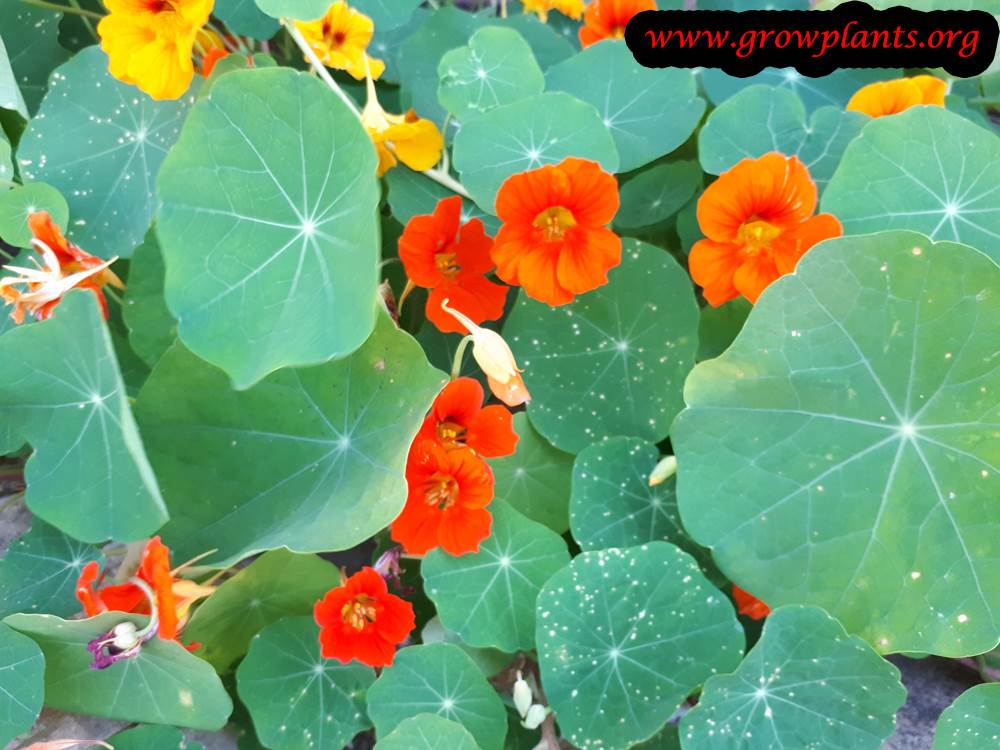
- Growth Habit & Form: Vigorous trailing and climbing vine used as groundcover or trained on trellis.
- Lifespan & Maturity: Grows and flowers within a single season; germinates in 2–3 weeks and often reseeds itself.
Anatomy & Physical Features
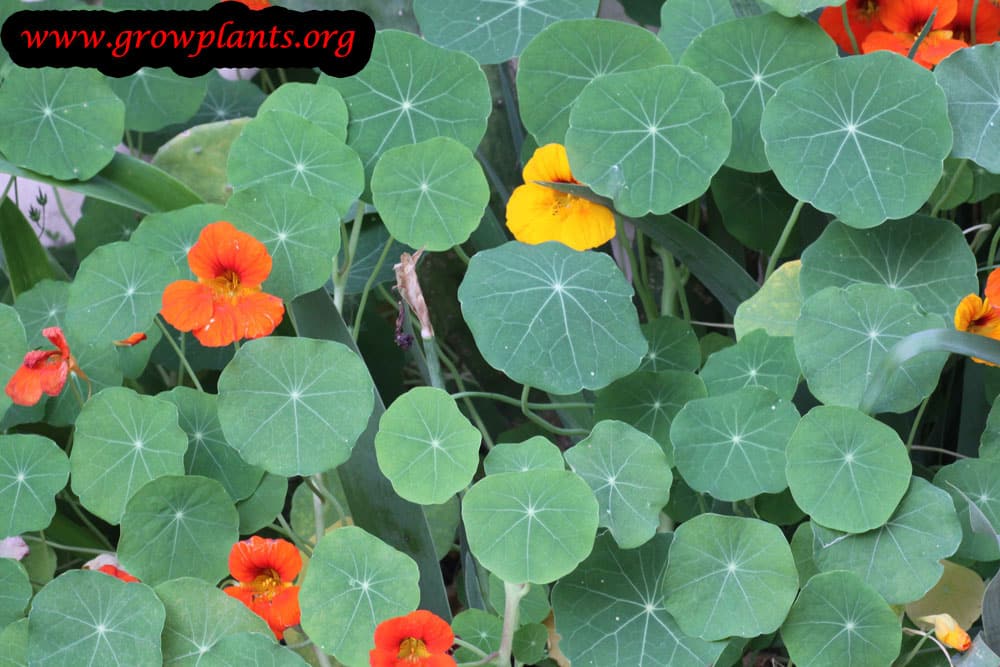
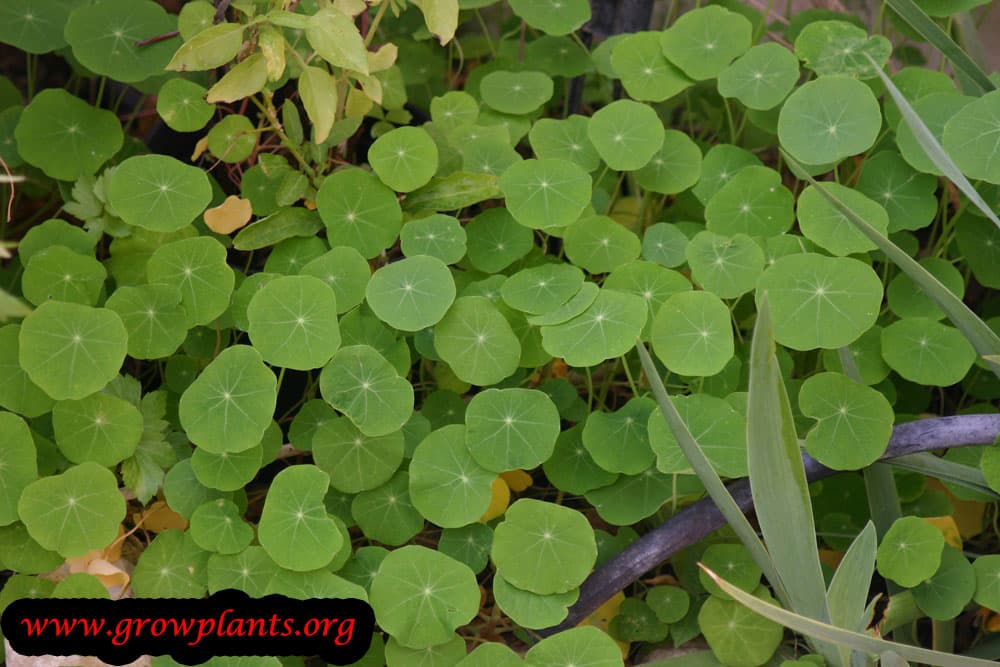
- Leaves & Foliage: Round, plate-like green (sometimes white-variegated) leaves with a peppery, watercress-to-mustard flavour.
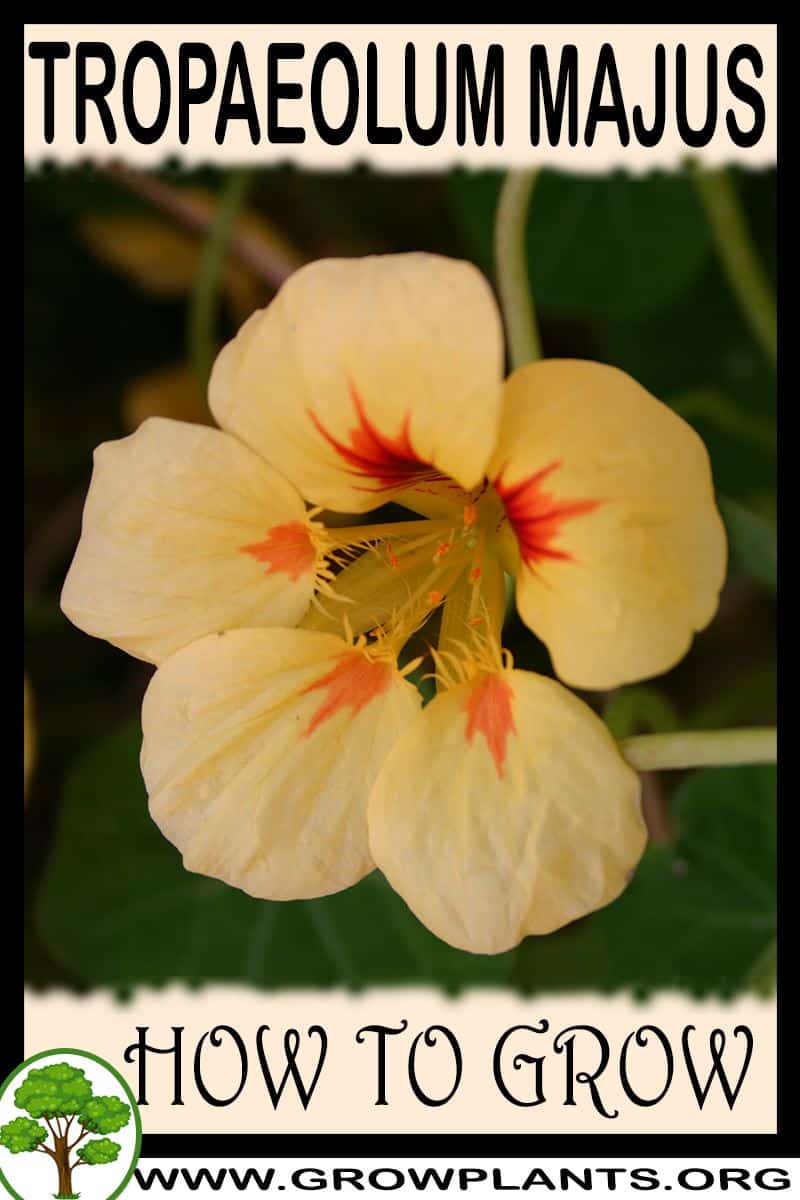
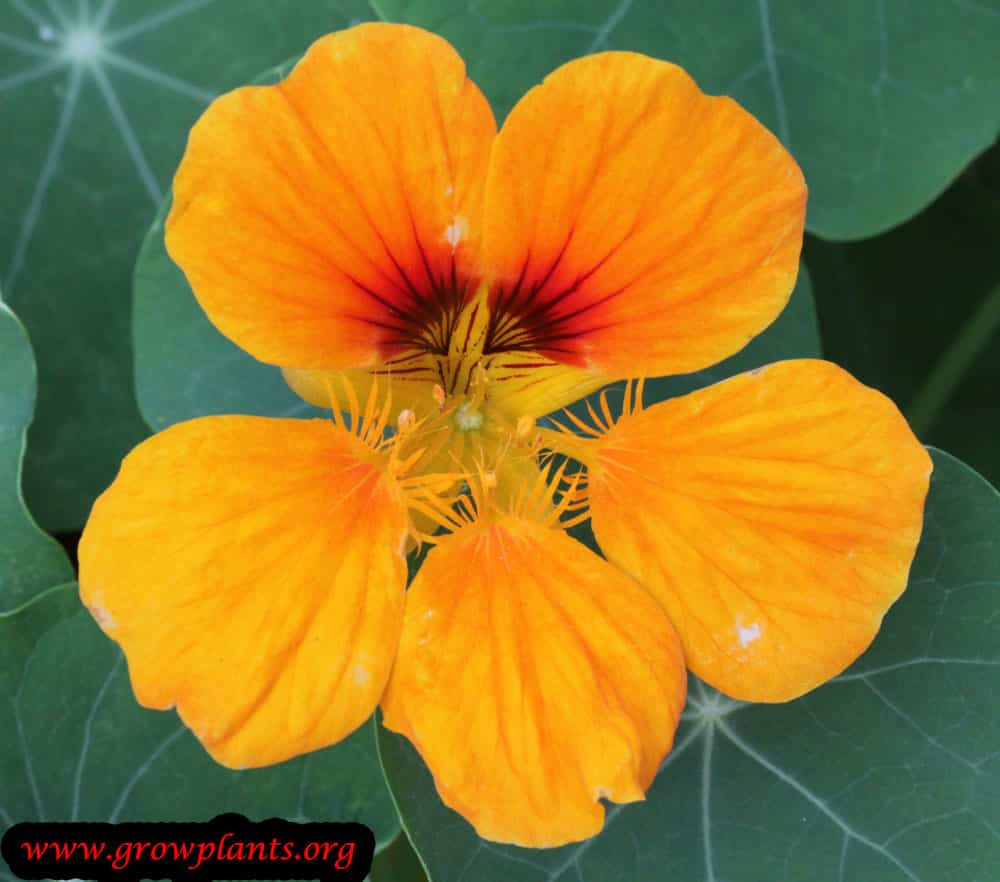
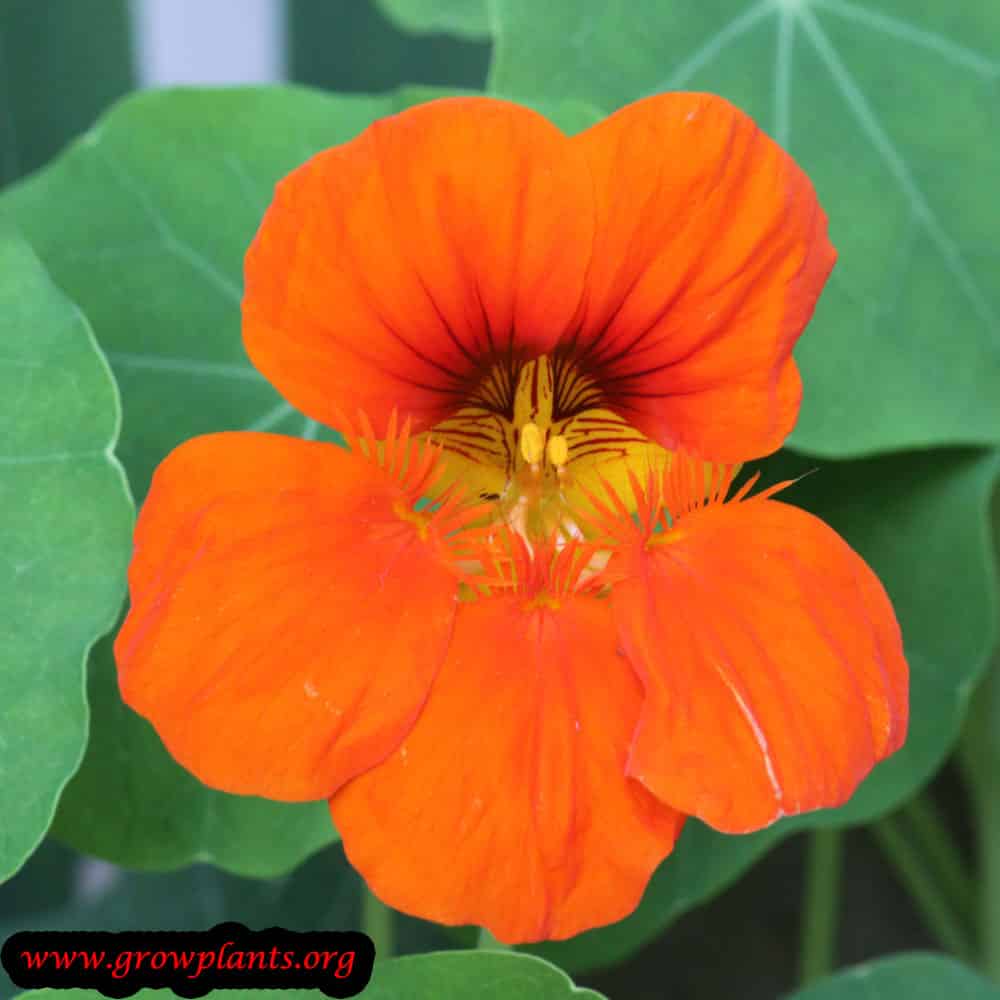
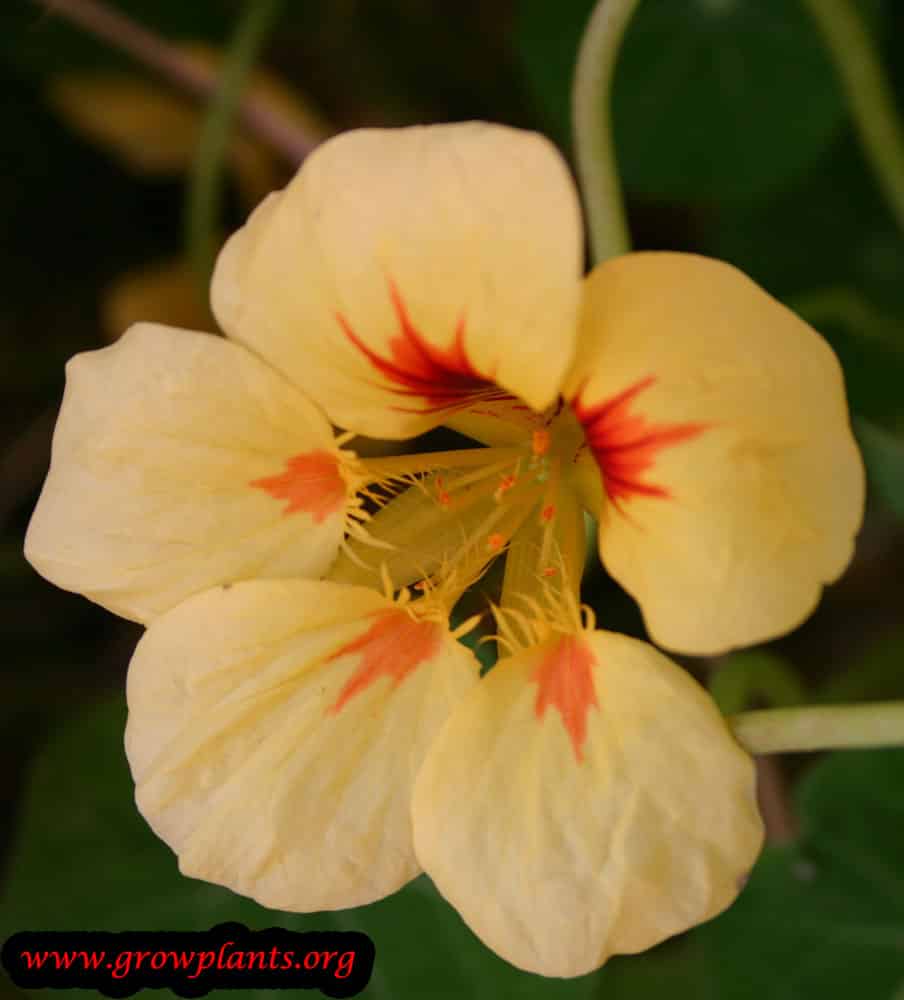
- Flower Characteristics: Spurred, funnel-shaped edible flowers in yellow, red, orange, purple or pink, often multicoloured (full detail in the Bloom accordion).
Primary Uses & Landscape Value
- Edible Uses: Peppery flowers and leaves eaten raw, in salad, stir-fried or cooked; immature seeds can be pickled as a caper substitute.
- Functional & Ornamental Roles: Ornamental flowering groundcover, climber and edible-flower plant; also grown in containers and at pond edges.
Care Guide: Planting, Soil & Watering
Overview: Garden nasturtium is a fast, easygoing annual that grows in full sun and average-to-rich soil kept lightly moist. It tolerates lean ground but foliage and flowers are lushest in fertile, evenly moist soil topped with a mulch.
Quick Care Requirements
| Requirement | Ideal Condition |
|---|---|
| Planting Season | In spring after the last frost; autumn to winter in frost-free zones (10b-11) |
| Growth Rate | Moderate to Fast |
| Soil Type | Rich, moisture-retentive, well-draining |
| Water Need | Moderate; keep evenly moist for the best growth |
Planting & Establishment
- Best Planting Season: Sow or plant in spring once frost has passed in cooler zones; in hot-summer or frost-free areas (zone 10b-11) plant in autumn to winter so the plant is not lost to summer heat.
- How to Plant:
- Hole Preparation: Dig a shallow hole and set the seedling or seed in place.
- Soil Amendments: Enrich the bed with organic matter and humus for the richest growth.
- Planting Depth: Cover lightly, no deeper than a couple of centimetres, and top with mulch to hold moisture.
- Growth Speed & Expectations: A vigorous grower that sprawls quickly as a ground cover or scrambles up a trellis; note it can be aggressive and self-seed freely.
Soil, Watering & Drainage Care
- Soil Mix & Drainage Needs: Use rich, moisture-retentive soil that still drains freely. In a container use potting mix or peat with perlite blended with humus, and mulch the surface to keep it moist.
- Watering Schedule & Technique:
- Young / Newly Planted: Keep consistently moist while the plant establishes.
- Established: Water regularly; it grows and flowers best with steady moisture and needs more in heat.
- Seasonal Adjustments: Cut back on watering in cool weather and where growth naturally slows.
Climate, Light & Hardiness
Garden nasturtium is a fast, tender annual climber and ground cover for Mediterranean, subtropical, temperate and (with care) desert gardens, flowering best in full sun but appreciating light shade where summers are fierce. It has little frost tolerance and also struggles in extreme heat, so in hot climates it is timed for the mild shoulder seasons and reseeds freely in frost-free zones.
Quick Climate Specifications
| Climate Zones | Mediterranean, desert, subtropical, temperate |
|---|---|
| USDA Hardiness Zones | Grown as an annual: about 4–10a for spring planting, 10b–11 for autumn planting; self-seeds in zones 9–11 |
| Optimal Temp Range | Approximately 13–24 °C (55–75 °F) |
| Cold Damage Begins | At or near frost |
| Approx. Survival Minimum | Killed by frost (may reseed from fallen seed) |
| Frost Tolerance | None to Very Low |
| Light Conditions | Full sun to half shade |
| Wind Tolerance | Moderate |
Sunlight & Light Exposure
Optimal Light Setup
Full sun gives the most flowers; in desert and zone 10b–11 conditions, half or afternoon shade prevents scorching.
Direct Sun Requirement
At least about four to six hours of sun; more sun means more bloom in mild climates.
Shade & Heat Management
Light shade and a cooler aspect carry it through hot spells, while prolonged extreme heat can kill it outright.
Temperature Extremes & Hardiness
USDA Hardiness & Regional Limits
Grown as an annual - spring-sown in zones 4–10a, and autumn-sown in zones 10b–11 where summers are too hot for spring planting. It reseeds itself in zones 9–11, so cold, not the plant's nature alone, ends each generation.
Cold Damage & Winter Protection
Frost kills top growth; a heavy mulch helps fallen seed survive winter in zones 9–10a.
Frost Sensitivity
High.
Extreme Heat Tolerance
Poor - in hot-summer and desert areas the plant declines or dies through summer, which is why it is grown from autumn to spring there.
Frost-Free Growing Season
A warm but not scorching, frost-free window suits it best; it dislikes both hard frost and prolonged extreme heat.
Wind, Humidity & Microclimate
Humidity Preferences
Enjoys moderate humidity and moist air.
Wind Tolerance
Soft, trailing stems take moderate wind, but exposed sites can shred the foliage.
Microclimate Recommendations
A sheltered, bright spot with cool roots (mulch or containers) is ideal; note that containers dry out and overheat faster than open ground.
Growing in Pots, Balconies & Indoors
Nasturtium (Tropaeolum majus) is a fast, edible trailing plant that grows beautifully in pots, spilling over the rim of a balcony box or basket. It is not a true houseplant, but a bright, sunny windowsill suits a trailing plant well, and it flowers freely in full sun on any balcony or patio. Every part – leaves, flowers and buds – is edible.
Quick Details
- Container Size: Start at 10 L (2.6 gal) minimum; roots fill a pot fast
- Indoor Suitability: Not a true houseplant, but good trailing from a bright, sunny sill
- Best Spot: Full sun for most bloom; light shade in desert heat or zones 10b-11
- Soil & Drainage: Aerated mix rich in humus and organic matter – potting mix or peat with perlite
- Watering in Pots: Flexible: it survives on little but grows and flowers far better with average to generous water
Indoors & On the Windowsill
- Houseplant limits: The grower does not rate it as an indoor plant; in low light it makes all leaf and few flowers.
- Windowsill growing: On a bright, sunny sill it trails and flowers happily – let the stems spill over the edge, and pick leaves and flowers for the kitchen.
- Overwintering: Usually grown as an annual, but a favourite plant can be kept over winter on a bright, frost-free sill.
On a Balcony or Patio
- Light, support & wind: A sunny balcony or patio is where this climber shines – give it a trellis, railing or strings to climb and shelter it from strong wind, which shreds the soft growth. Reflected heat from walls dries the pot fast, so check moisture daily in warm weather. A drip irrigation kit with a timer can take over that watering check automatically.
- Practicalities: Make sure the filled pot and its support are stable and that drainage runoff can escape freely without pooling below.
Choosing the Pot, Soil & Long-Term Care
- Pot & drainage: A 10 L pot or larger with strong drainage holes; skip a standing water saucer so the roots never sit wet. Terracotta breathes and dries faster, while glazed or plastic holds moisture longer.
- Potting mix: Well-aerated and organic-rich – a general potting mix, or peat/coir with perlite or vermiculite.
- Feeding: Potted plants need feeding more often than those in the ground because nutrients leach out with each watering – feed lightly through the growing season.
- Repotting: Refresh the mix or pot up about every couple of years; for perennials, lightly prune the root ball and top growth at the same time.
Grower’s Container Tip
- Start small, then watch the roots: Begin with a pot of at least 10 L (2.6 gal). Because the plant grows very fast and fills the pot with roots, check the roots about once a month and pot on before it becomes crowded.
- Mix & mulch: Use a potting mix or peat with perlite, blended with humus and organic matter, and lay chopped mulch over the surface to keep the soil moist.
- Water at the base: Let the bottom of the pot fill with water, but allow it to dry out from time to time rather than staying constantly wet.
Fertilizing & Feeding
Nasturtium is a classic low-feeder: it flowers best in lean soil, and too much nitrogen produces lush leaves with few blooms, so feed only sparingly. A fertilizer formulated for tomatoes and vegetables supports that feeding pattern through harvest.
Quick Fertilizing Specs
| Feeding Level | Light |
|---|---|
| Main Nutrient Priority | Keep nitrogen low; lean soil gives more flowers. |
| Best Feeding Period | A light feed at establishment; little more is needed. |
| Organic Options | A little compost only if soil is very poor. |
| Micronutrients | Rarely needed; correct iron only if new leaves yellow. |
| Soil pH | Thrives in lean, well-drained soil across a wide pH range. |
| Reduce/Stop Feeding | Feed sparingly; rich soil gives leaves instead of flowers. |
Feeding by Growth Stage
Spring growth flush
Support fresh shoots and leaves as the plant wakes up in spring.
| Nutrient direction | A balanced complete feed with adequate nitrogen fuels healthy new growth. Keep nitrogen modest. |
|---|---|
| Timing | As new growth begins in spring. |
| Frequency | Feed sparingly as growth begins; light feeding is usually enough. |
| Fertilizer types | A balanced complete fertilizer, Compost or well-rotted organic matter |
| Precautions | This is a lean, drought-adapted plant that rarely needs much feeding. Avoid heavy nitrogen, which drives leaves at the expense of flowers. |
Flowering
Sustain flowering without pushing excess foliage.
| Nutrient direction | A balanced feed supports steady bloom; adequate nitrogen, not high phosphorus, drives flowering. |
|---|---|
| Timing | Through the flowering season. |
| Frequency | Feed sparingly through the flowering period. |
| Fertilizer types | A balanced complete fertilizer |
| Precautions | High-phosphorus ‘bloom booster’ feeds are unnecessary; a balanced feed and full sun give better flowering. Avoid heavy nitrogen, which drives leaves at the expense of flowers. |
Nutrient Deficiency Signs & Corrections
Older, lower leaves fade to pale green or yellow overall and growth slows.
| Possible causes | Low soil nitrogen or thin organic matter, Nitrogen leached out by heavy watering or rain on light soils, Cold, waterlogged roots limiting uptake |
|---|---|
| Appears first on | older, lower leaves |
| What to check | soil organic matter and recent feeding, whether heavy rain or irrigation may have leached nutrients, overall plant vigor and colour |
| Possible correction | Topdress with compost or apply a balanced complete fertilizer at label strength; keep watering steady but not excessive so nutrients are not washed away. |
Youngest leaves yellow between the veins while the veins stay green.
| Possible causes | High or alkaline soil pH locking up iron, Cold or waterlogged soil slowing root uptake, Genuinely low available iron |
|---|---|
| Appears first on | newest leaves at the shoot tips |
| What to check | soil pH and drainage, whether the soil is cold or saturated, overall root health |
| Possible correction | Correct soil pH and improve drainage first; if the youngest growth stays chlorotic, apply a chelated iron product following its label. |
Lush leafy growth but few flowers.
| Possible causes | Too much nitrogen from over-feeding, Overly rich soil relative to light levels, Insufficient sunlight for the demand created by heavy feeding |
|---|---|
| Appears first on | new leafy shoots at the expense of buds |
| What to check | recent feeding rate and fertilizer type, light exposure, balance of leaf growth versus budding |
| Possible correction | Ease back on nitrogen and switch to a balanced feed; ensure full sun so the plant channels energy into flowering rather than foliage. |
Pruning, Training & Seasonal Maintenance
Nasturtium is a fast, soft-stemmed annual that can be grown either as a low groundcover (20–40 cm) or trained as a climbing vine over a trellis or hedge (reaching 1–3 m) – its own care notes mention trellising directly. Cutting can happen all season and, by its own guidance, is not needed except for shaping: the main jobs are guiding or trimming the vigorous stems, harvesting the edible leaves and flowers, and keeping its noted aggressive, self-seeding habit from taking over.
Quick Pruning & Maintenance Specs
| Pruning Tolerance | High – soft, fast-growing stems; cutting is optional, for shape/harvest only |
| Primary Pruning Window | All season, as needed |
| Main Objective | Guide or trim vine growth; harvest leaves/flowers; control spread |
| Best Tool Type | Precision snips; soft ties for trellised stems |
Pruning by Plant Age & Size
Newly Established
Trim just the leaf tips if harvesting while the plant is young; avoid cutting whole stems until it is established.
Young / Formative
If trained as a climber, tie young stems loosely to the trellis or hedge as they extend, since this vine climbs by twining leaf stalks rather than tendrils and benefits from early guidance; if grown as groundcover, no training is needed – just let it spread.
Mature / Established
Once established, whole stems can be cut for harvest or to redirect growth; trim back runners that are spreading past their intended area, given the plant’s documented aggressive, self-seeding habit.
Special Growth to Remove
- Runners/trailing stems that have spread beyond their bed, to manage the species’ noted aggressive spread.
- Spent flowers, if reseeding is not wanted – removing them before they set seed helps prevent the plant naturalizing more than intended (it reseeds readily on its own, especially in warm zones).
Container & Small-Space Pruning
Nasturtium fills a container fast enough that its own care guidance recommends checking the roots monthly; regular trimming of trailing stems both keeps growth in scale for the pot and reduces how quickly the roots need attention, since less top growth means less root pressure on the container.
Tools
- Precision snips – for harvesting leaves/flowers and trimming trailing stems; the soft growth needs nothing heavier.
- Soft ties/stakes – for guiding stems onto a trellis or hedge support when grown as a climber.
Tool Hygiene & Disease Risk
Routine hygiene; no elevated disease-transmission risk noted for this species.
Cut Placement & Technique
Cut stems at a node rather than mid-internode, which keeps the trailing growth tidy and encourages branching from that point.
Common Pruning Mistakes
- Leaving all spent flowers to set seed and letting the plant self-sow well beyond where it was wanted, given its documented aggressive/invasive tendency.
- Growing it against a trellis without any guidance ties and then needing to hard-cut a tangled mass later, instead of directing growth as it climbs.
When NOT to Prune
- No strict restriction – the plant tolerates trimming throughout its growing season; the main timing consideration is removing spent flowers before they set seed if self-sowing is not wanted.
Recommended Tools (by task)
- precision_snips – harvesting and trimming trailing growth.
- soft_ties_stakes – guiding stems onto a trellis or hedge when trained as a climber.
Propagation Guide
Garden nasturtium is easiest from its large seed, which is simple to handle and self-sows where winters are mild, so seed is the usual method for the species and mixed strains. To keep the exact colour of a named cultivar — especially the double-flowered forms that set little seed — take stem cuttings or layer a stem instead; overall an Easy plant.
Quick Propagation Specs
| Best Propagation Method | Seed (species and mixes) |
| Alternative Methods | Stem cuttings (water or soil); ground layering — to keep a named colour |
| Propagation Difficulty | Easy |
| Seed True-to-Type | Mostly uniform for the species/old mixes; named and double cultivars are variable or sterile — keep them vegetatively |
| Vegetative True-to-Type | Yes — a cutting or layer reproduces the parent, including flower colour |
| Best Propagation Season | Spring (cool zones); autumn to winter in the warmest zones |
| Seed Germination Time | 2–3 weeks |
| Seed Sowing Depth | Surface with mulch, or about 1 cm (0.4 in) |
Growing from Seed
Seed Handling & Viability
Store the seed in a dry, dark place. It is large and easy to handle, and in mild zones (roughly 9–11) plants reseed themselves; where winters are cooler, a thick mulch helps keep fallen seed viable.
Dormancy & Pre-Sowing Treatment
The seed has a hard coat; soaking it overnight before sowing softens the coat and can speed and even out germination.
Sowing Season, Depth & Spacing
Sow in spring in zones 4–10a, or in autumn to winter in zones 10b–11. Sow on the surface and cover with mulch, or about 1 cm (0.4 in) deep. Space about 30–40 cm (12–16 in) apart as ground cover, or 15×20 cm (6×8 in) when trained as a climber.
Germination Conditions & Time
Keep the soil moist with high humidity, in at least four hours of sun (half shade in desert heat); seedlings emerge in about 2–3 weeks.
Stem Cuttings
Cutting Type & Rooting
Root cuttings either in a glass of water, changing the water every few days, or in soil kept constantly moist. This reproduces a plant of exactly the same flower colour. Rooting hormone is optional — the soft stems root readily on their own.
Air & Ground Layering
To strengthen a plant or make more of the same colour, bend a trailing branch down, cover a section with soil and keep it moist; it roots where buried and can then be separated from the parent.
Bloom & Edible Flower Guide
Quick Details
- Bloom Season: Spring to summer; in hot climates autumn to spring
- Time to First Bloom: Within the first season, often about 5-7 weeks from sowing
- Flower Appearance: Bright spurred flowers in yellow, red, orange, purple or pink, often multi-coloured
- Edibility: Edible – the flowers are edible with a peppery flavour reminiscent of watercress, radish or mustard
Detailed Blooming Overview
Nasturtium is one of the classic edible-flower plants and a joy to grow: it flowers quickly, generously and in warm, glowing colours. Both flowers and leaves are edible and carry the same peppery bite, making the blooms a favourite for salads and garnishes.
Flower Characteristics
- Spurred, funnel-shaped flowers in yellow, red, orange, purple or pink, often more than one colour to a bloom.
- Peppery and crisp, echoing watercress, radish or mustard.
Bloom Care & Thinning
- Managing the bloom: Grow in full sun and lean soil – too much nitrogen gives lush leaves and few flowers. Deadheading keeps new blooms coming.
- Pollination: Visited by bees and butterflies.
- Using the flowers: Pick freshly opened blooms and use them raw in salads, as a garnish, or lightly cooked in stir-fries.
Bloom Health & Protection
- Aphids (blackfly) famously cluster on nasturtium buds and flower stalks. What helps: a strong jet of water or an insecticidal soap or neem oil – and since nasturtium is often used as a trap crop, a few aphids can be tolerated to draw them away from other plants.
Fruit & Uses
Garden nasturtium is grown as much for its edible flowers and leaves as for ornament – both have a peppery, watercress/radish/mustard-like bite and are eaten raw or lightly cooked. No fruit or seed use is recorded for this plant on the site.
Quick Edible Specs
| Edible Parts | Flowers; leaves |
|---|---|
| Main Use(s) | Edible-flower garnish and salad green |
| Eaten Raw or Cooked | Raw (salads), or briefly cooked (stir-fry) |
| Preparation Required | None – rinse before eating |
| Harvest Season | Spring to summer (autumn to spring in hot climates), matching the bloom season |
| Time to First Harvest | Leaves can be trimmed while the plant is young; flowers picked once blooming begins |
| Storage | Best used fresh, soon after picking |
| Safety/Toxicity Caveat | None known; the peppery flavour is normal for this plant (mustard-oil compounds), not a sign of toxicity |
Leaves & Greens
The round, plate-shaped leaves (sometimes green-and-white variegated) taste similar to watercress, radish or mustard. Young plants can be trimmed of just the leaves; once established, leaves can be cut along with stems. Used raw in salads, stir-fried, or cooked.
Flowers & Flower Buds
The flowers – yellow, red, orange, purple or pink, sometimes multicoloured – share the same peppery flavour as the leaves. They are picked through the spring-to-summer bloom season and used raw in salads, stir-fried, or cooked, often as an edible garnish.
Preparation, Uses & Safety
No special preparation is needed beyond rinsing; both leaves and flowers are used straight from the plant. No toxicity is recorded for this species – the peppery taste is characteristic, not a warning sign.
Pests, Diseases & Troubleshooting
Overview: Nasturtium is a fast, easy edible annual famous for two things: attracting black bean aphids in swarms (which is exactly why gardeners use it as a sacrificial trap crop) and feeding the caterpillars of cabbage white butterflies. It gets few diseases, and most problems are managed by tolerance, handpicking and encouraging natural enemies rather than spraying.
Quick Troubleshooting Overview
| Issue / Pest | Main Symptom | Primary Solution |
|---|---|---|
| Black bean aphid | Dense black colonies on stems and buds | Blast off, encourage lady beetles, soap if heavy |
| Cabbage white caterpillars | Chewed, skeletonised leaves; green larvae | Handpick, netting, Bt spray |
| Flea beetles | Tiny shot-holes in leaves | Row cover, keep plants vigorous |
| Cabbage moth / armyworm | Ragged holes, frass, night feeding | Handpick at night, Bt |
| Mosaic virus | Mottled, distorted leaves | Remove plants, control aphids |
Common Pests & Management
- Black bean aphid (Aphis fabae):
- Symptoms: Dense black colonies smothering shoot tips, flower buds and leaf undersides, with sticky honeydew, sooty mould and distorted growth; nasturtium is a magnet for them.
- Prevention & Control: Use this to your advantage as a trap crop away from beans and brassicas. Blast colonies off with water, encourage lady beetles, lacewings, hoverflies and parasitic wasps, and only if overwhelmed spray insecticidal soap or neem on undersides in the evening to protect pollinators.
- Cabbage white caterpillars (Pieris rapae / Pieris brassicae):
- Symptoms: Green or yellow-and-black caterpillars chewing large holes and skeletonising leaves, with green-black frass; nasturtium is a favoured host laid on by the white butterflies.
- Prevention & Control: Inspect leaf undersides and rub off egg clusters, handpick caterpillars, net plants where practical, encourage birds and parasitic wasps, and spray Bacillus thuringiensis (Bt) onto young larvae if needed.
- Flea beetles (Phyllotreta spp.):
- Symptoms: Tiny beetles that jump when disturbed, peppering leaves with small round shot-holes, worst on seedlings in warm dry weather.
- Prevention & Control: Protect seedlings with floating row cover, keep plants vigorous and well watered to outgrow damage, and use yellow sticky traps; established plants usually tolerate feeding.
- Cabbage moth and armyworms (Mamestra brassicae / Spodoptera spp.):
- Symptoms: Night-feeding caterpillars chewing ragged holes and boring into foliage, leaving frass; these are the true identity behind the source’s mistranslated ‘Prodenia’.
- Prevention & Control: Handpick after dark, encourage predators and birds, and apply Bt to actively feeding larvae; keep the surrounding area weed-free to reduce egg-laying.
- Slugs, snails and mealybugs (Gastropoda / Pseudococcidae):
- Symptoms: Molluscs shred seedlings and leave slime trails, while mealybugs form white cottony tufts on stems in sheltered or indoor plantings.
- Prevention & Control: Handpick slugs at night with grit barriers and iron-phosphate bait; wipe mealybugs with alcohol and spray insecticidal soap or neem, repeating for crawlers.
Diseases & Fungal Issues
- Mosaic virus (Cucumber mosaic virus / relatives):
- Symptoms: Yellow mottling, mosaic patterning and puckered, distorted leaves with reduced flowering, spread mainly by aphids.
- Treatment & Management: There is no cure. Remove and destroy affected plants, control aphids that vector it, disinfect tools, and avoid siting near other virus-prone crops.
- Bacterial wilt and leaf spot (Xanthomonas / Pseudomonas spp.):
- Symptoms: Sudden wilting of shoots, or angular water-soaked leaf spots that turn brown, in warm wet conditions.
- Treatment & Management: Remove affected growth, water at the base to keep foliage dry, avoid overcrowding, rotate plantings, and clear debris; a copper spray gives some protection under wet pressure.
- Powdery mildew (Erysiphe / Podosphaera spp.):
- Symptoms: White powdery coating on leaves late in the season or in crowded, dry-rooted plants, causing yellowing and decline.
- Treatment & Management: Improve airflow and spacing, keep roots evenly moist, and apply sulphur, potassium bicarbonate or a milk spray if it becomes unsightly.
Growing Difficulties & Abiotic Problems
- All leaves and no flowers:
- Cause & Symptoms: Rich, high-nitrogen soil produces lush foliage at the expense of the flowers; nasturtium flowers best on lean ground.
- Correction Strategy: Grow in poor to average soil, avoid nitrogen feeding, and give full sun to encourage abundant blooms.
- Heat stress and drought:
- Cause & Symptoms: Hot, dry spells cause wilting, leaf scorch and flower drop, while soggy soil rots the roots.
- Correction Strategy: Water steadily in heat, mulch to conserve moisture, provide light afternoon shade in hot climates, and ensure free drainage.
What Helps – Products & Tools
For nasturtium, cultural tolerance goes a long way: use it as an aphid trap crop, then reach for insecticidal soap or neem for heavy aphid or mealybug loads, Bt for cabbage-white and armyworm caterpillars, floating row cover for flea beetles, and iron-phosphate bait for slugs. Keep sulphur or potassium bicarbonate only for late-season mildew, and control aphids to limit mosaic virus.
Varieties & Cultivars
- Black velvet: Deep maroon flower, velvety aspect, almost black. Flowering season is from spring to autumn. — Shop Black velvet on Amazon
- Cherry rose jewel: Flower color is hot pink. Grows up to 30 to 45cm (12 to 18 inches). Blooming season is summer to autumn.
- Empress of India: Shiny single crimson red-vermillion flowers and dark, blue-purplish foliage. Grows up to 30cm (12 inches). Flowering season is spring to autumn. — Shop Empress of India on Amazon
- Jewel of Africa: Produces double and semi-double flowers mixed with shades of yellow, red and orange; foliage creamy to green, climbing and variegated. Grows up to 15 to 30cm (6 to 12 inches). Blooms summer to autumn.
- Moonlight: Grows up to 1.8 to 2.4m (70 to 95 inches), flowers light creamy yellow with bright green foliage.
- Peach Melba: Semi-double yellow to coral flowers with a red-orange throat; dwarf plant, grows well in containers, up to 30cm (12 inches). — Shop Peach Melba on Amazon
- Purple emperor: Blooms summer to autumn; flower color red cherry becoming more pastel lavender-purple with age, yellow throat.
- Red emperor: Also known as Tropaeolum majus lobbianum; flower color is bright red.
- Salmon baby: Compact with deep coral to salmon pink flowers, grows up to 30cm (12 inches), blooms mid-summer to mid-autumn, leaves are small.
- Tom Thumb series: Also known as Tom Thumb mix. Mix of colors: red, dark red, burgundy, orange, yellow, pink flowers with light green foliage. Grows up to 20 to 28cm (8 to 11 inches).
- Vesuvius: Shiny deep orange flowers with blue-green leaves on compact plants, grows up to 30cm (12 inches) and as wide; leaves and flowers are edible; flowering season summer to autumn.
- Whirlybird series: Compact, mid-green plants (9-12 inches) with semi-double flowers in shades of orange, yellow, salmon, deep mahogany and rose; ruffled flowers lack the typical spur so sit flat atop the stems.
- Lobbianum: Blooming season is summer to autumn; flowers can be red, purple, white, yellow, cream or pink, with a yellow throat.