Plant Profile & Key Characteristics
Overview: Titanopsis calcarea is a small evergreen clump-forming succulent (ice-plant family) only 5-15 cm (2-6 in) high, grown as an ornamental and easy houseplant. It is a slow, drought-tolerant perennial with distinctive warty, camouflaged leaves.
Quick Specifications
| Specification | Attribute |
|---|---|
| Plant Type / Life Cycle | Perennial (evergreen succulent) |
| Foliage Type | Evergreen (succulent) |
| Mature Size | 5-15 cm x low clump (2-6 in) |
| Growth Rate | Slow |
| Hardiness | USDA zones 10-12a |
Growth Form & Structure
- Height & Spread: Stays a low 5-15 cm (2-6 in) rosette, slowly spreading into a small clump; well suited to a shallow pot or houseplant dish
- Growth Habit & Form: Low, clump-forming succulent that hugs the ground as a rosette of thick leaves
- Lifespan & Maturity: Slow-growing but long-lived perennial that gradually builds a mounded clump
Anatomy & Physical Features
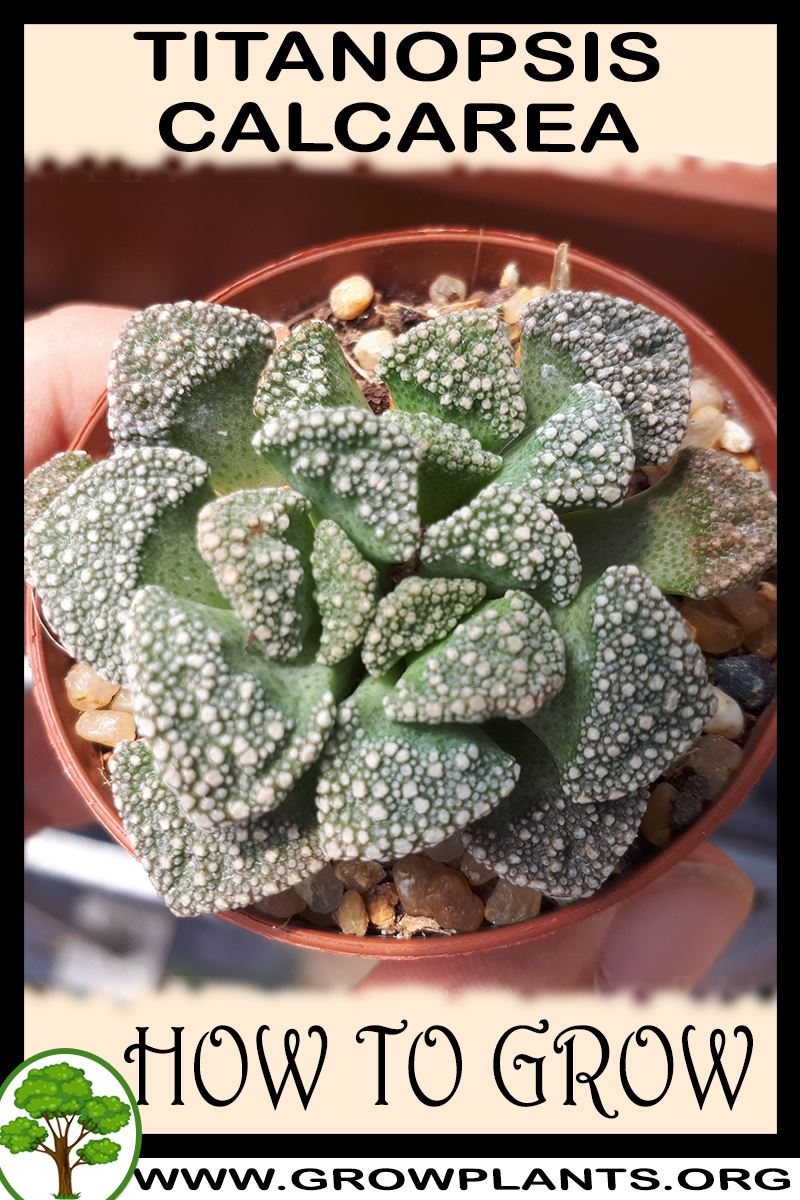
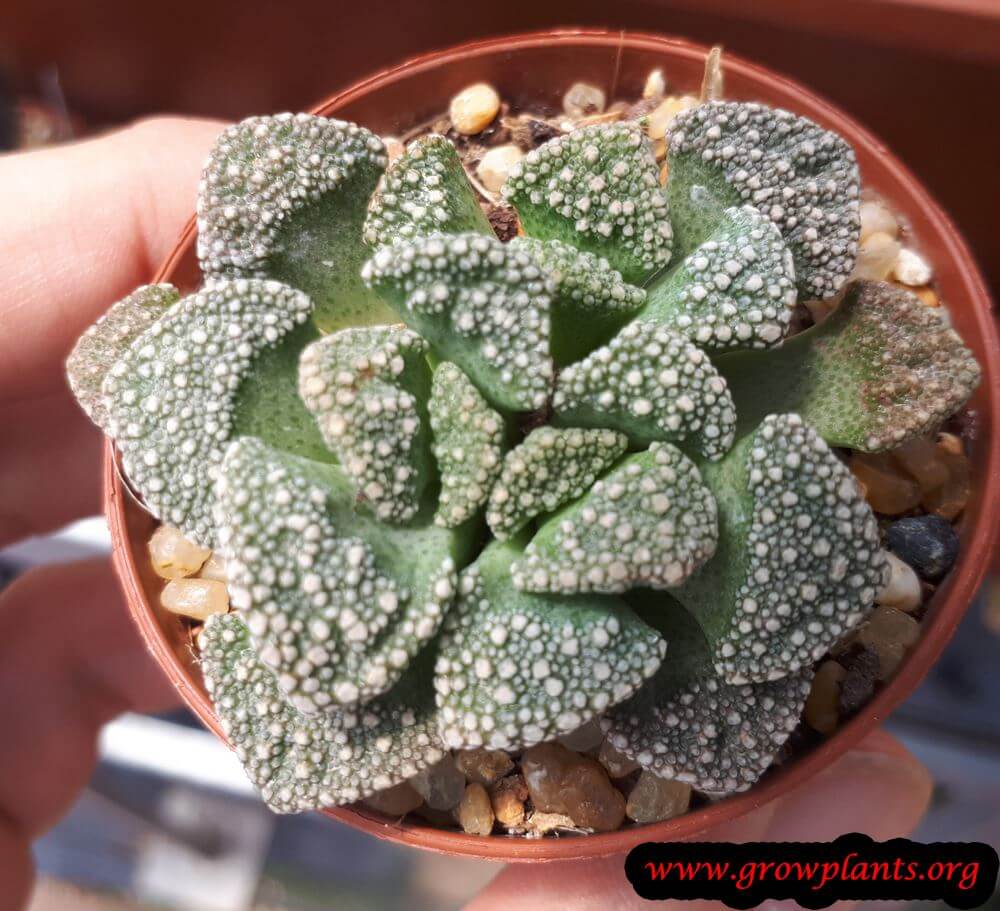
- Leaves & Foliage: Thick, triangular to wedge-shaped succulent leaves, green (red or purple in some forms) and covered in raised warty bumps that camouflage it among stones
- Flower Characteristics: Many-petalled yellow daisy-like flowers, sometimes darker in the centre
Primary Uses & Landscape Value
- Functional & Ornamental Roles: Ornamental succulent for rock gardens, troughs, dish gardens and windowsills; valued as a drought-tolerant novelty
Care Guide: Planting, Soil & Watering
Overview: Titanopsis calcarea is a small, slow-growing succulent from arid limestone country, forming low clumps of warty blue-grey leaves. It needs sharply drained, gritty mineral soil, plenty of light and only occasional water, and tolerates heat, poor limey ground and light frost down to about -2°C.
Quick Care Requirements
| Requirement | Ideal Condition |
|---|---|
| Planting Season | In the warm growing season, from spring through autumn |
| Growth Rate | Slow |
| Soil Type | Gritty, sharply draining mineral or sandy soil; tolerates poor, limey ground |
| Water Need | Low; water sparingly and let the soil dry out completely between waterings |
Planting & Establishment
- Best Planting Season: Plant during the warm growing season, from spring through autumn, while it is actively growing.
- How to Plant:
- Hole Preparation: Loosen a hole slightly wider than the root system in gritty, fast-draining ground or a raised bed.
- Soil Amendments: Blend plenty of coarse sand, grit or pumice into the soil for drainage – this succulent prefers lean, mineral soil over rich, moisture-holding mixes.
- Planting Depth: Set the plant so the crown sits at or just above soil level and top-dress with grit to keep the base dry.
- Growth Speed & Expectations: A slow grower forming low clumps only about 5-15 cm across, with yellow daisy-like flowers in summer.
Soil, Watering & Drainage Care
- Soil Mix & Drainage Needs: Fast, gritty drainage is critical; in pots use a cactus/succulent mix cut with extra pumice or perlite in a container with drainage holes, as standing moisture quickly rots the roots.
- Watering Schedule & Technique:
- Young / Newly Planted: Water lightly to settle it in, then let the soil dry out.
- Established: Water sparingly, letting the soil dry out fully between waterings – it stores water in its leaves and shrugs off drought.
- Seasonal Adjustments: Give a little more during active summer growth and keep nearly dry in winter, protecting it from hard frost below about -2°C.
Climate, Light & Hardiness
This mimicry succulent suits subtropical, Mediterranean and desert climates or indoor growing, needing sharp drainage above all else. Unusually for a succulent it does best with some shade rather than baking sun, and it is only lightly frost-tolerant, needing protection whenever temperatures approach freezing.
Quick Climate Specifications
| Climate Zones | Subtropical, Mediterranean, desert; also grown indoors as a houseplant |
|---|---|
| USDA Hardiness Zones | 10–12a |
| Approx. Survival Minimum | Site data indicates it needs to stay above about −2°C (28°F) |
| Frost Tolerance | Low |
| Light Conditions | Half shade to full shade |
Sunlight & Light Exposure
Optimal Light Setup
Unlike most succulents, site data favors half shade to full shade over full sun - consistent with its natural habit of growing tucked among rocks in dappled light.
Shade & Heat Management
Handles desert and Mediterranean summer heat well provided it isn't also given full, unshaded exposure - some shade protects the fleshy, bumpy leaves from scorch.
Best Exposure / Orientation
A partly shaded rockery position, or bright but indirect indoor light, mimics its natural rocky, sheltered habitat.
Temperature Extremes & Hardiness
USDA Hardiness & Regional Limits
Suited to USDA zones 10–12a - essentially frost-free to very mild-winter climates; outside this range it is best grown as a protected container or houseplant.
Cold Damage & Winter Protection
Site data puts its cold limit at approximately −2°C (28°F); keep it warmer than this and off wet, cold soil, since combined cold-and-wet is far more damaging than cold alone for this type of succulent.
Frost Sensitivity
Low frost tolerance - even brief freezing is a risk, so move containers under cover or provide frost cloth whenever temperatures near 0°C (32°F).
Extreme Heat Tolerance
Good heat tolerance in dry desert and Mediterranean summers, provided watering stays minimal and drainage is excellent.
Wind, Humidity & Microclimate
Dry-Air Tolerance
Very good – it is adapted to arid, low-humidity conditions and dislikes prolonged damp air around the foliage.
Microclimate Recommendations
A sheltered, partly shaded, excellently drained rockery pocket or a container that can be moved to protection in winter best matches this species' needs.
Growing in Pots, Balconies & Indoors
This is a tough little mat-forming succulent that the grower confirms grows both indoors and in containers. Its tiny size (5-15 cm (2-6 in)) makes it a natural pot and windowsill plant; give it the brightest light you can and a gritty, free-draining mix, and go easy on water.
Quick Details
- Container Size: A small, shallow pot – only a little larger than the plant; these succulents like tight quarters
- Indoor Suitability: A good houseplant for the brightest windowsill you have; weak light makes it stretch and soften
- Best Spot: As much bright light as possible – full sun to light shade; a sunny sill indoors
- Soil & Drainage: A very free-draining gritty succulent mix – A free-draining cactus/succulent mix – potting mix or sandy soil opened up with coarse sand, perlite, or fine gravel; a layer of gravel, pebbles, or lava rock at the base helps drainage. A ready-made cactus and succulent soil is a reliable shortcut to this mix.
- Watering in Pots: Water sparingly and let it dry between waterings; the grower calls for only a small amount of water, and wet feet rot it
Indoors & On the Windowsill
- A real houseplant: The grower confirms indoor growing. It thrives on a bright sill in a gritty mix, watered lightly – an easy, drought-tolerant little houseplant.
- Give it strong light: The brighter the better – a sunny window keeps the rosettes tight and coloured; in dim light it etiolates and loses its form. A grow light can prevent that when natural light falls short.
- Go dry in winter: Keep it cool and nearly dry over the low-light season to prevent rot and keep it compact.
On a Balcony or Patio
- Light & heat: It loves a hot, sunny, sheltered spot on a balcony or patio and shrugs off reflected wall heat; just ensure the pot drains instantly after rain.
- Practicalities: Shelter it from prolonged wet and cold; a small pot in the open can waterlog in downpours, so keep it under cover in wet spells.
Choosing the Pot, Soil & Long-Term Care
- Pot & drainage: A shallow pot with strong drainage holes and no standing-water saucer; a gravel or grit layer at the base keeps roots dry.
- Potting mix: A free-draining cactus/succulent mix – potting mix or sandy soil opened up with coarse sand, perlite, or fine gravel; a layer of gravel, pebbles, or lava rock at the base helps drainage.
- Feeding: Feed only lightly and occasionally in the growing season – these lean-living succulents need very little.
- Repotting: Repot only every few years when it outgrows the pot or the mix breaks down; let it settle before watering.
Fertilizing & Feeding
A light feeder – like most succulents, this slow-growing, small mesemb needs only occasional, diluted feeding and is easily harmed by over-fertilizing.
Quick Fertilizing Specs
| Feeding Level | Light feeder – a slow-growing succulent that needs very little supplemental feeding. |
|---|---|
| Main Nutrient Priority | Low-nitrogen feeding to avoid soft, rot-prone growth. |
| Best Feeding Period | During active growth in the warmer months. |
| Reduce/Stop Feeding | Stop feeding entirely during the dormant or slow-growing period. |
Feeding by Growth Stage
Active Growth
Support slow, steady growth of this small mesemb-type succulent without encouraging the soft, watery growth that leads to rot.
| Nutrient direction | A light, low-nitrogen feeding supports steady growth; too much nitrogen produces soft tissue that is prone to rot in this slow grower. |
|---|---|
| Timing | During the active growing months, alongside its normal watering rhythm. |
| Frequency | A light feeding now and then during active growth is plenty; this slow-growing succulent rarely needs more. |
| Fertilizer types | A diluted, low-nitrogen fertilizer formulated for cacti and succulents |
| Precautions | Feed sparingly – this small, slow-growing succulent is easily overfed, and excess fertilizer promotes soft growth that is more vulnerable to rot and pests. |
Dormant / Rest Period
Let the plant rest through its natural slowdown without pushing growth it isn’t ready to make.
| Nutrient direction | None – withhold fertilizer during the rest period. |
|---|---|
| Timing | During the plant’s natural slow or dormant period, typically the cooler months. |
| Frequency | No feeding at this stage. |
| Fertilizer types | No feeding at this stage; resume light feeding only once active growth resumes. |
| Precautions | Do not fertilize while the plant is dormant or resting – the roots cannot use nutrients efficiently and excess fertilizer salts can accumulate and damage them. |
Nutrient Deficiency Signs & Corrections
Stretched, pale growth reaching toward the light.
| Possible causes | Insufficient light causing the plant to stretch rather than a nutrient issue, Excess nitrogen encouraging soft, elongated growth, Overwatering encouraging weak, watery growth |
|---|---|
| Appears first on | New growth at the growing point |
| What to check | Assess light levels first, Review recent fertilizer nitrogen content, Check watering frequency |
| Possible correction | Increase light first; if growth stays soft after correcting light, reduce nitrogen and ease off watering. |
Mushy, discolored base or leaves despite otherwise adequate feeding.
| Possible causes | Root rot from overwatering or poorly draining soil limiting nutrient uptake, Fertilizer salt buildup damaging fine roots, Fungal or bacterial rot unrelated to nutrition |
|---|---|
| Appears first on | Base of the plant and lower leaves |
| What to check | Inspect roots for rot, Check soil drainage and potting mix, Review recent watering and feeding history |
| Possible correction | Address drainage and watering first – nutrient adjustments won’t help if the roots are rotting; repot into fresh, well-drained mix if rot is present. |
Dull coloration and stalled growth persisting across growing seasons.
| Possible causes | Long-term lack of feeding in an old, depleted potting mix, Low light reducing the plant’s ability to use available nutrients, Root-bound conditions restricting nutrient uptake |
|---|---|
| Appears first on | Overall plant color and growth rate |
| What to check | Check how long it has been since repotting or feeding, Assess light levels, Check whether the plant is root-bound |
| Possible correction | Refresh the potting mix and resume light, low-nitrogen feeding during the next active growth period. |
Pruning, Training & Seasonal Maintenance
Titanopsis calcarea is a tiny, slow-growing rosette-forming succulent with no woody structure and no tolerance for structural pruning. “Pruning” here means only removing individual leaves once they have fully dried and shriveled, which can happen at any time of year as older leaves are naturally shed and replaced from the center of the rosette. There is no season, framework, or size-control cutting to apply — the plant should otherwise be left alone.
Quick Pruning & Maintenance Specs
| Pruning Tolerance | Low (removal of dead leaves only) |
| Primary Pruning Window | Any time — as individual leaves fully dry out |
| Typical Frequency | Occasional, as needed |
| Main Objective | Sanitation — remove fully dead leaf tissue to reduce rot and pest shelter |
| Best Tool Type | Precision snips or a clean fingernail; a small sterile blade for stubborn attachments |
| Avoid Heavy Pruning During | Always — this species has no heavy-pruning tolerance at any time |
Pruning by Plant Age & Size
Newly Established
Leave entirely alone while the plant settles in; do not remove any leaf that is not fully dry.
Young / Formative
No structural training applies — this is a small clumping rosette succulent with no framework to build.
Mature / Established
Periodically remove fully shriveled, papery lower leaves as the rosette naturally renews itself from the center.
Special Growth to Remove
- Fully dry, shriveled dead leaves — the only routine removal this species needs.
- Spent flower stems once bloom has completely finished.
Container & Small-Space Pruning
This species is well suited to shallow pots and often grown indoors. No root or top pruning is used for size control — its naturally slow, compact growth keeps it in scale with a small container. After removing any dead leaf, hold off watering briefly (see Post-Pruning Care) rather than watering right away as one might with a leafy houseplant.
Tools
- Precision snips or bare fingers for lifting away fully dry leaves.
- A small sterile blade only where a stubbornly attached dead leaf needs a clean cut rather than a tear.
Tool Hygiene & Disease Risk
Increased — succulent tissue is vulnerable to rot entering through fresh wounds, so any cut (as opposed to simply lifting away a fully dry leaf) should be made with a clean, sharp edge, and the cut allowed to dry rather than be watered immediately.
Cut Placement & Technique
Remove a dead leaf with a clean pull or cut close to its point of attachment, without tearing into adjacent living tissue. Let any cut surface dry and callus before the next watering.
Heavy Pruning & Rejuvenation
Not tolerated. Titanopsis calcarea has no capacity for hard structural or rejuvenation pruning — it is a small, slow-growing rosette succulent, not a shrub, and should never be cut back hard.
Post-Pruning Care
Withhold water for a day or two after removing any leaf by cutting (rather than simply lifting a fully dry one), to let the wound dry and reduce rot risk, consistent with this species’ preference for only small amounts of water.
Common Pruning Mistakes
- Pulling a dead leaf hard enough to tear healthy rosette tissue instead of lifting or cutting it cleanly.
- Watering immediately after removing a leaf, inviting rot into the fresh wound.
- Mistaking a plump, water-storing leaf for a dead one and removing living tissue.
When NOT to Prune
Avoid removing any leaf that still has any green or plumpness to it — wait until it is fully dry and papery. Avoid cutting while the plant is freshly watered and turgid, or in prolonged wet conditions, since both raise rot risk at the wound.
Recommended Tools (by task)
- grafting_knife — a small, sterile fine blade for the occasional clean cut on succulent tissue, minimizing rot risk versus tearing.
Propagation Guide
Titanopsis calcarea is a low, clump-forming succulent that is easiest to increase by dividing offsets from an established plant, though it also grows well from seed. Propagation is generally easy, and site data confirms vegetative reproduction is helpful but not required to grow this species.
Quick Propagation Specs
| Best Propagation Method | Division of offsets/clumps |
| Alternative Methods | Seed; stem/head cuttings |
| Propagation Difficulty | Easy |
| Seed True-to-Type | Usually true-to-type (species) |
| Vegetative True-to-Type | Yes |
| Best Propagation Season | Spring, summer or autumn |
Growing from Seed
Site data does not detail a seed protocol for this species. As with related clumping mesemb succulents, seed is typically surface-sown on a gritty, well-drained mix and kept lightly moist and warm; germination can be slow, so treat timing as approximate until confirmed for this species specifically.
Leaf & Root Cuttings
Individual heads or short stem sections can be removed, left to callus for a few days in a dry, shaded spot, then set onto a gritty, well-drained mix and watered sparingly until rooted – standard practice for clumping mesemb succulents, described cautiously here since site data does not confirm this method for the species specifically.
Division, Offsets, Pups & Suckers
As the plant forms multiple rosettes/heads, established clumps can be divided; separate offsets that already carry some roots, let cut surfaces callus briefly, then pot into a well-drained, sandy or gritty mix and water lightly until established.
Bloom & Flower Guide
Quick Details
- Bloom Season: Summer
- Flower Appearance: Many-petalled yellow daisy-like flowers, the petals sometimes darker toward the centre
- Edibility: Grown as an ornamental succulent; the flowers are not eaten
Detailed Blooming Overview
This little limestone-loving succulent hides a surprise: from its cluster of stubby, jewel-like leaves it produces bright, many-petalled yellow flowers in summer. Like other mesembs, the flowers open in bright sunshine and close again in dull weather or toward evening, so a sunny day shows them at their best.
Flower Characteristics
- Yellow, many-petalled, daisy-like flowers.
- Petals may be marked with a darker colour toward the middle.
Bloom Care & Thinning
- Managing the bloom: Give it full sun and sharp drainage; the flowers will open on bright days and close when it is dull.
Pests, Diseases & Troubleshooting
Overview: Titanopsis is a small, slow-growing mesemb succulent from arid, limey ground, and like most succulents it is nearly pest-free; its problems are overwhelmingly cultural, with overwatering and rot the great danger. When pests occur they are the usual succulent trio – mealybugs, scale and the occasional mite – plus slugs and snails after soft new growth. Lean soil, careful watering and strong light keep it sound.
Quick Troubleshooting Overview
| Issue / Pest | Main Symptom | Primary Solution |
|---|---|---|
| Root / basal rot | Soft translucent mushy leaves, collapse at soil line | Cut watering hard; gritty mix; sharp drainage |
| Mealybugs (incl. root) | White cottony tufts on leaves or in roots, weak growth | Alcohol swab; systemic/oil; check roots at repotting |
| Scale insects | Small brown bumps on leaves | Scrape off; horticultural oil |
| Slugs & snails | Chewed, ragged holes in soft new growth | Hand-pick at night; grit barrier; iron-phosphate bait |
| Fungus gnats | Small flies over damp soil; larvae in roots | Let soil dry; sticky traps; top-dress with grit |
| Etiolation | Pale, stretched, loose growth | Increase light; move to full sun gradually |
Common Pests & Management
- Mealybugs (Pseudococcidae (incl. root mealybugs)):
- Symptoms: White cottony tufts nestled between the tubercled leaves, with sticky residue and slow, weak growth; root mealybugs form white waxy deposits on the roots and are found when repotting.
- Prevention & Control: Swab foliar mealybugs with a cotton bud dipped in dilute alcohol and isolate the plant. At repotting, wash the roots and treat root mealybugs by soaking or with a soil drench of horticultural oil or an appropriate systemic. Keep plants unstressed and check regularly.
- Scale Insects (Diaspididae / Coccidae):
- Symptoms: Small immobile brown or tan bumps on the leaves, sometimes with sticky honeydew; heavy infestations dull and weaken the plant.
- Prevention & Control: Scrape off with a soft brush or fingernail and isolate. Smother with horticultural oil, coating the leaves, and repeat as needed.
- Spider Mites (Tetranychus urticae):
- Symptoms: Fine pale stippling and a dull, dusty cast to the leaves with faint webbing, mainly in hot, dry, still indoor air; uncommon but possible.
- Prevention & Control: Rinse the plant, raise humidity a little, and treat with insecticidal soap or horticultural oil if it persists.
- Slugs & Snails (Gastropoda):
- Symptoms: Ragged holes and chewed patches in soft new growth and flowers, with slime trails, mostly at night or in damp conditions.
- Prevention & Control: Hand-pick after dark, encircle plants with a grit or diatomaceous-earth barrier, remove daytime hiding places, and use iron-phosphate bait where pressure is high.
- Fungus Gnats (Sciaridae):
- Symptoms: Small dark flies over persistently damp soil; the larvae can nibble fine roots of a plant already kept too wet.
- Prevention & Control: Let the mix dry thoroughly between waterings, top-dress with grit or sand, and use yellow sticky traps for the adults. Correcting the overwatering usually ends the problem.
Diseases & Fungal Issues
- Root & Basal Rot (Pythium / Phytophthora / Fusarium spp.):
- Symptoms: The classic mesemb killer: leaves turn soft, translucent, yellow-brown and mushy, and the plant collapses at the soil line, its roots black and rotten. It follows overwatering, poor drainage or watering during dormancy.
- Treatment & Management: Prevention is essential – use a very gritty, free-draining mineral mix, water sparingly and only in active growth, and keep the plant nearly dry when dormant. There is no cure once rot reaches the base; if caught very early, cut away all soft tissue, dust with sulfur, and let the plant callus and re-root in dry grit.
- Fungal Leaf Rot / Spot (various fungi):
- Symptoms: Soft brown or black rotting spots on leaves in humid, stagnant or over-wet conditions.
- Treatment & Management: Improve airflow and light, water only at the base and early in the day, and remove affected tissue. Keep humidity low around the plant.
Growing Difficulties & Abiotic Problems
- Overwatering & Rot:
- Cause & Symptoms: The dominant cause of death – soggy or poorly drained soil rots the roots and base, showing as soft, translucent, collapsing leaves.
- Correction Strategy: Grow in a gritty, mostly-mineral mix in a well-drained pot, water only when the soil is fully dry and the plant is in growth, and withhold water during dormancy. Terracotta and bright warmth speed drying.
- Etiolation (Insufficient Light):
- Cause & Symptoms: In low light the compact rosette stretches, pales and loosens, losing its tight, pebble-like form.
- Correction Strategy: Give the brightest light available – full sun to very bright indirect light – introducing stronger sun gradually to avoid scorch.
- Edema & Splitting:
- Cause & Symptoms: Erratic heavy watering after drought makes cells swell and burst, causing corky patches or split leaves.
- Correction Strategy: Water evenly and modestly in the growing season and avoid sudden deluges after dry spells.
- Wrong Dormancy Watering:
- Cause & Symptoms: Watering while the plant is resting is a common route to rot, as the inactive roots cannot use the moisture.
- Correction Strategy: Learn the plant’s growth rhythm and keep it dry through its dormant period, resuming light watering only when new growth appears.
What Helps – Products & Tools
This succulent needs very little intervention. The key inputs are a gritty mineral mix and grit top-dressing for drainage, dilute alcohol and horticultural oil or insecticidal soap for mealybugs and scale, a sulfur powder for treating cut rot, iron-phosphate slug bait and diatomaceous earth for gastropods, and yellow sticky traps for fungus gnats. Restraint with the watering can is worth more than any spray.