Plant Profile & Key Characteristics
Overview: A vigorous, twining herbaceous vine climbing 1-5 m (3-18 ft), perennial in warm climates and grown as an annual where cold. It is planted as an ornamental screening climber for its large blue-to-purple trumpet flowers.
Quick Specifications
| Specification | Attribute |
|---|---|
| Plant Type / Life Cycle | Herbaceous perennial vine (grown as an annual in cold climates) |
| Foliage Type | Evergreen where mild; annual where frosted |
| Mature Size | 1-5 m (3-18 ft) climbing |
| Growth Rate | Fast |
| Hardiness | USDA zones 9+ as a perennial, 5+ as an annual |
Growth Form & Structure
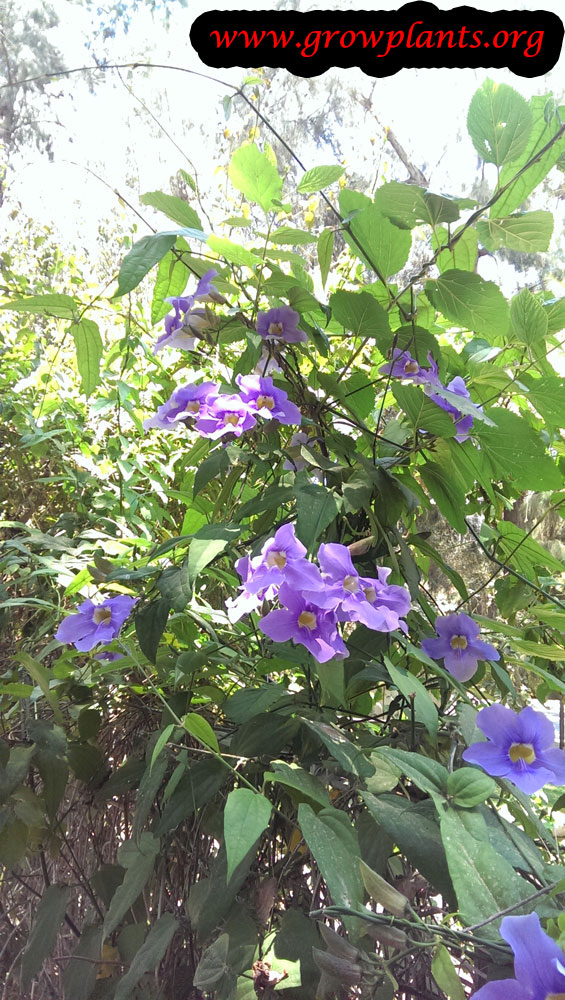
- Height and Spread: Twines 1-5 m (3-18 ft) over a sturdy support; also grown in large containers with a trellis.
- Growth Habit and Form: Strong twining climber needing solid trellising; described as aggressive and invasive, so it wants regular pruning.
- Lifespan and Maturity: A fast, vigorous grower that quickly covers its support and flowers over a long season.
Anatomy & Physical Features
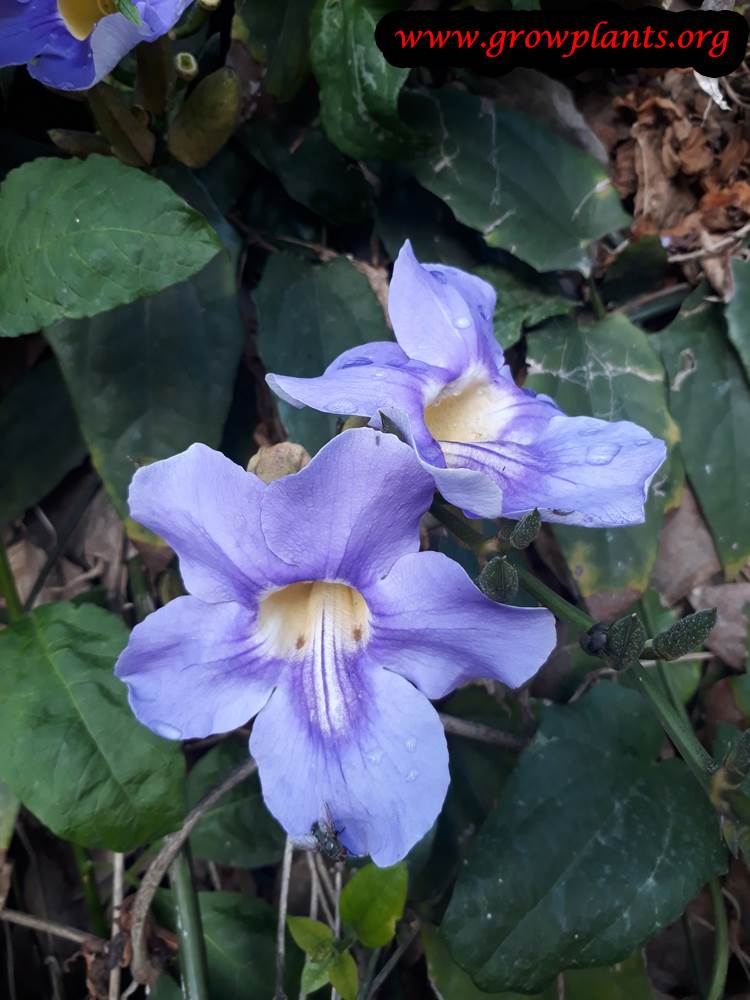
- Leaves and Foliage: Green, triangular-to-elliptic leaves with wavy margins on twining stems.
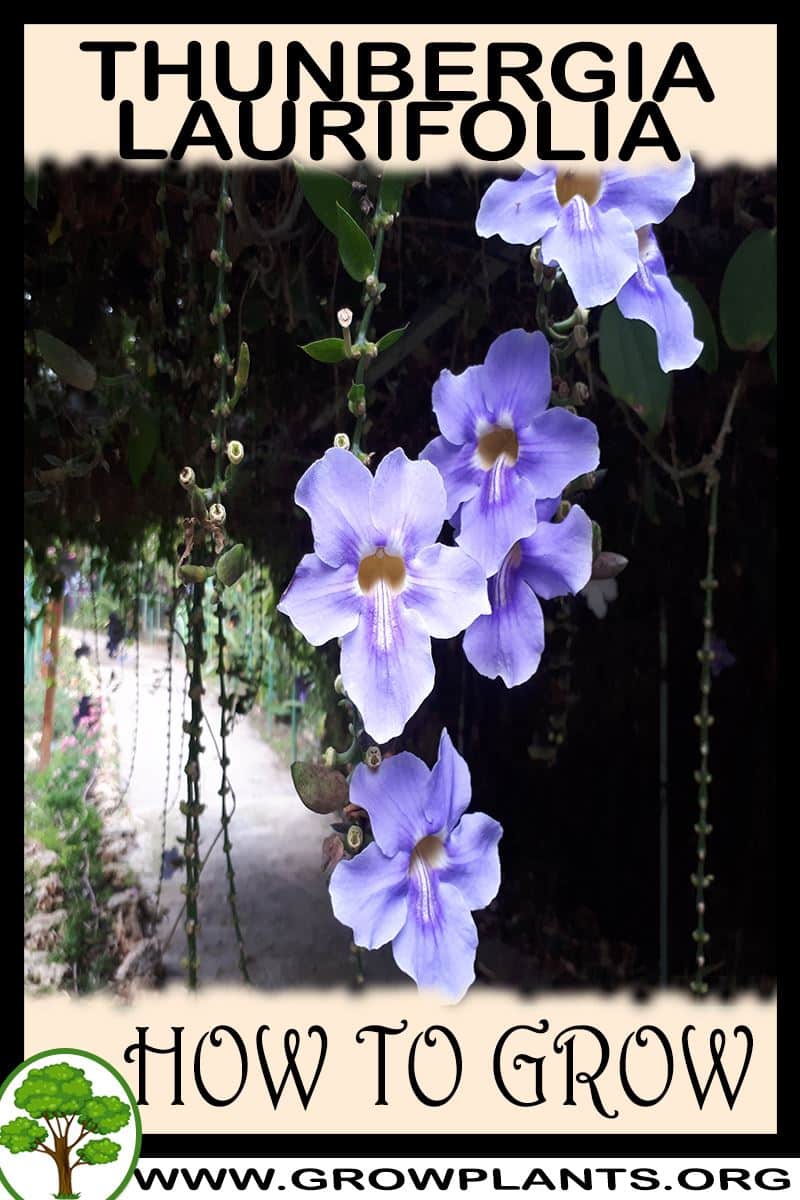
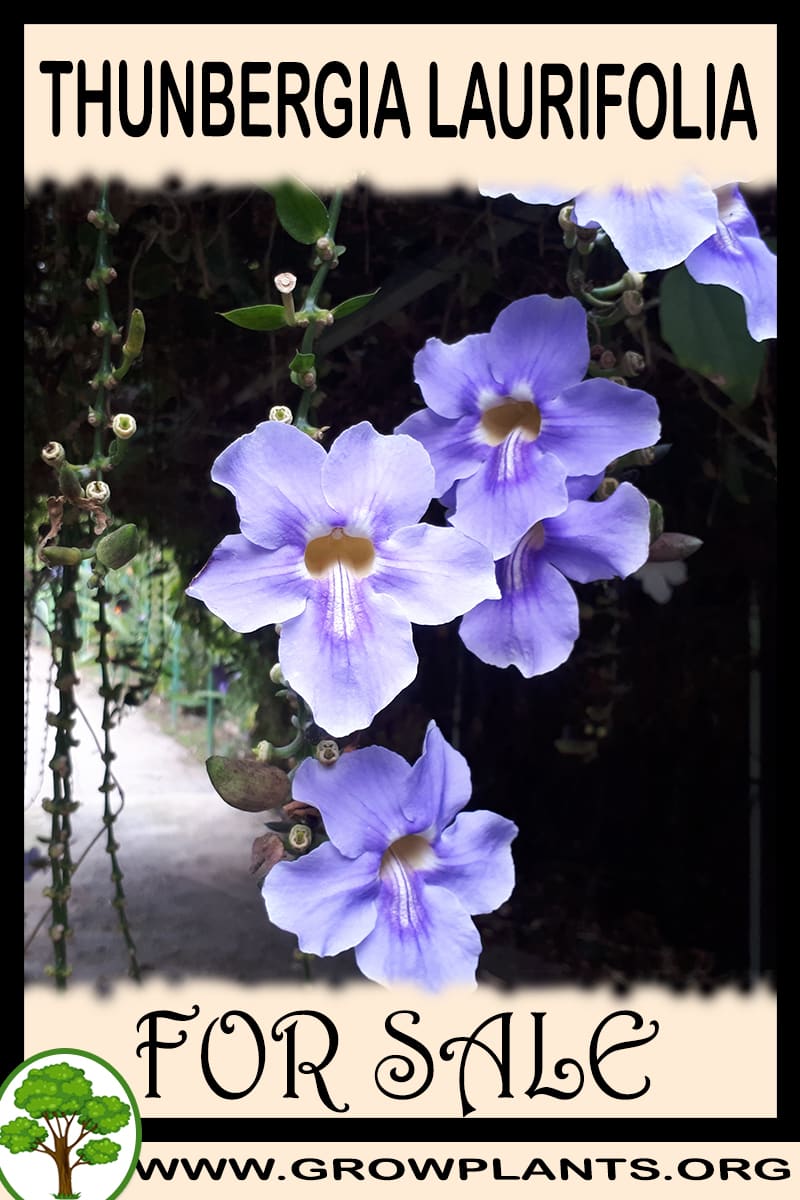
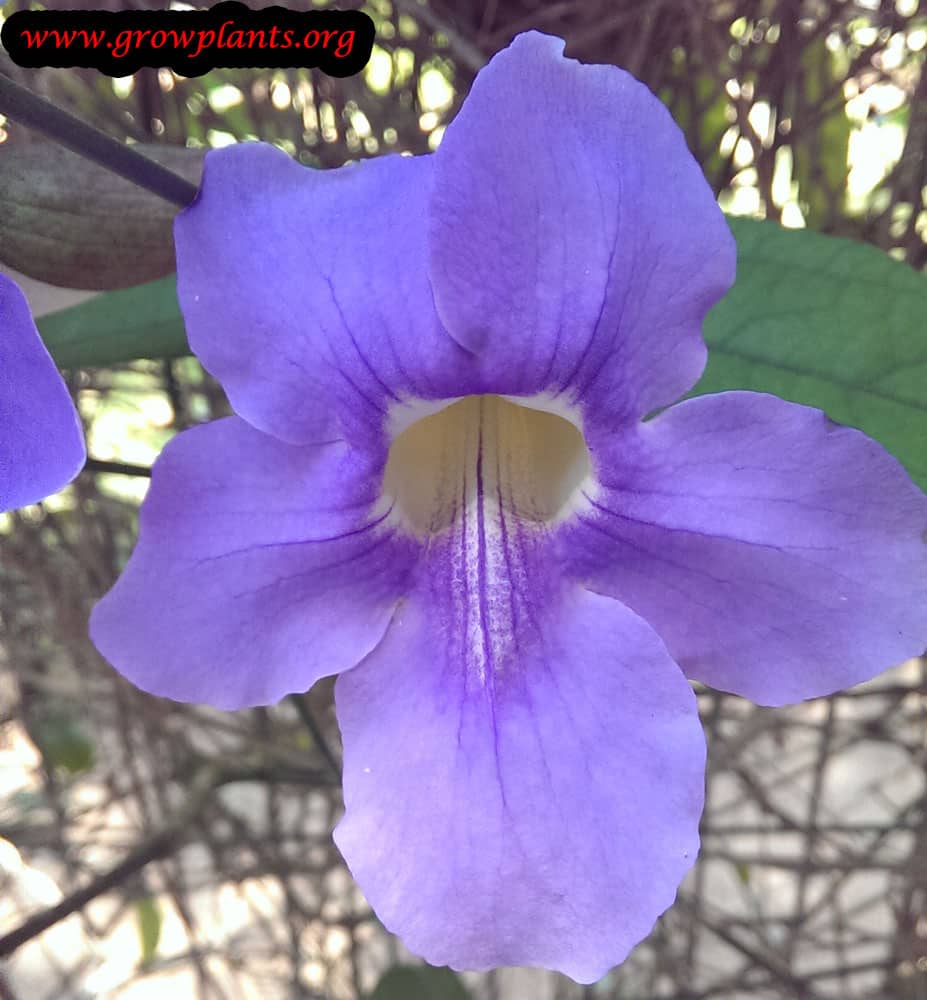
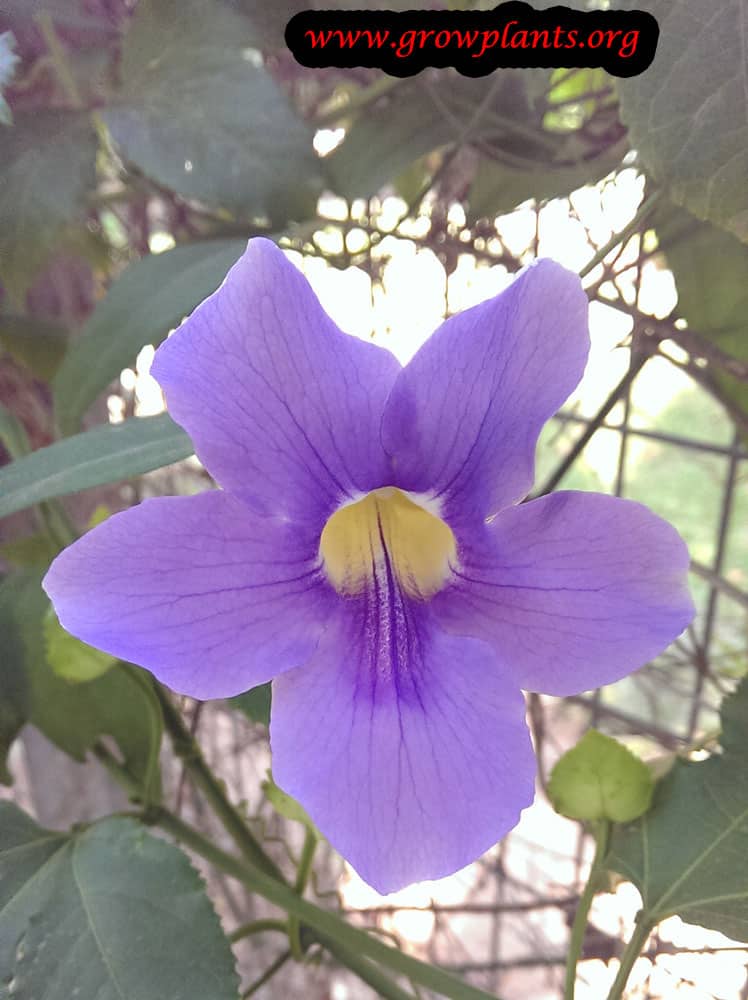
- Flower Characteristics: Large blue-to-purple five-petalled trumpet flowers.
Primary Uses & Landscape Value
- Functional and Ornamental Roles: Ornamental screening and hedge climber for pergolas, fences and large trellises in warm climates; vigorous, so give it room and keep it pruned.
Care Guide: Planting, Soil & Watering
Overview: Blue trumpet vine is a fast-growing evergreen climber for warm climates (hardiness zone 9 and up, or a summer annual in colder zones), thriving in full sun to part shade with moist, well-drained soil. It is vigorous, needs a strong support, and takes steady moderate watering.
Quick Care Requirements
| Requirement | Ideal Condition |
|---|---|
| Planting Season | Spring, summer or autumn |
| Growth Rate | Fast |
| Soil Type | Rich, moist, well-drained soil |
| Water Need | Moderate — keep evenly moist |
Planting & Establishment
- Best Planting Season: Plant through the warm season from spring to autumn in a frost-free spot; grow as a warm-season annual where winters are cold.
- How to Plant:
- Hole Preparation: Dig a hole about twice the width of the root ball beside a sturdy trellis or pergola and loosen the surrounding soil.
- Soil Amendments: Enrich the backfill with compost or organic matter for a rich, moisture-retentive but free-draining bed.
- Planting Depth: Set the root ball level with the surrounding soil, keep the stem base clear, and provide strong support for the heavy, vigorous stems.
- Growth Speed & Expectations: Grows very fast and can become large and invasive (1–5 m), so give it a robust structure and prune to keep it contained.
Soil, Watering & Drainage Care
- Soil Mix & Drainage Needs: Rich, moist, well-drained soil or a free-draining potting mix in containers suits it; consistent moisture with good drainage keeps it lush.
- Watering Schedule & Technique:
- Young / Newly Planted: Keep the soil evenly moist while the vine establishes.
- Established: Water regularly to maintain steady soil moisture, more so in containers and heat.
- Seasonal Adjustments: More water in summer heat and less in cool weather.
Climate, Light & Hardiness
Thunbergia laurifolia is a vigorous, fast-growing twining vine that persists as a perennial in warm, frost-free climates but is treated as a warm-season annual where winters freeze; it prefers full sun to half shade and needs a warm climate to perform its aggressive growth. Frost readily damages its top growth.
Quick Climate Specifications
| Climate Zones | Mediterranean, desert, subtropical, temperate, tropical |
| USDA Hardiness Zones | 9+ as a perennial; 5+ as a warm-season annual (per site data) |
| Cold Damage Begins | Foliage and stems suffer as temperatures approach freezing |
| Frost Tolerance | Low |
| Light Conditions | Full Sun / Half Shade |
Sunlight & Light Exposure
Optimal Light Setup
Full sun to half shade; a warm, bright spot supports its vigorous, aggressive growth habit.
Temperature Extremes & Hardiness
USDA Hardiness & Regional Limits
Persists as a perennial vine only in essentially frost-free zone 9+ climates, needing consistent warmth. In zone 5–8, frost kills the top growth each winter and it is grown as a warm-season annual.
Cold Damage & Winter Protection
Frost blackens and kills stems and leaves; roots may survive a mild winter under heavy mulch in borderline zones even where top growth is lost.
Frost Sensitivity
Low frost tolerance.
Extreme Heat Tolerance
Thrives in warm-to-hot climates with regular moisture, consistent with its fast, aggressive growth habit.
Wind, Humidity & Microclimate
Wind Tolerance
Moderate; needs a sturdy trellis or fence since it climbs vigorously and can become heavy.
Microclimate Recommendations
Warm, sheltered, sunny sites suit it best; given its noted invasive/aggressive tendency, site it where its spread can be managed.
Growing in Pots, Balconies & Indoors
Thunbergia laurifolia is a fast, sun-loving climber, not a houseplant – the grower confirms it will not grow indoors as one. In a large pot with a support, though, it is a superb container plant, quickly covering a trellis or trailing from a basket on a sunny balcony or patio.
Quick Details
- Container Size: A large pot of about 10-20 L (2.6-5 gal) to fuel its fast growth; add a trellis or obelisk
- Indoor Suitability: Not a houseplant – it needs full sun and room to climb, which indoors cannot give
- Best Spot: Full sun (light shade in very hot climates), with a support to climb or a basket to trail from
- Soil & Drainage: Rich, free-draining potting mix kept evenly moist
- Watering in Pots: Water regularly – a fast, leafy climber in a pot dries out quickly
Indoors & On the Windowsill
- Houseplant limits: The grower marks it as not an indoor plant; deep in a room the light is far too weak for this sun-lover to flower.
- Overwintering: It is a tender perennial usually grown as an annual; in cold climates it can be cut back and overwintered in a frost-free, bright spot, or simply resown each year.
On a Balcony or Patio
- Light, support & wind: Give it the sunniest spot and a trellis, obelisk or railing to climb; on an exposed balcony shelter it from strong wind and keep the pot well watered, as reflected heat dries it fast.
- Trailing option: It also looks great tumbling from a hanging basket where there is nothing to climb.
Choosing the Pot, Soil & Long-Term Care
- Pot & drainage: A large 10-20 L pot with strong drainage supports vigorous climbing growth. Use strong drainage holes and skip a standing water saucer, which invites root rot; terracotta breathes and dries fast, while glazed or plastic pots hold moisture longer.
- Potting mix: A light, aerated mix – potting compost, or peat/coir with added perlite or vermiculite for drainage.
- Feeding: Feed regularly through the growing season to keep a fast climber flowering, as pots leach nutrients quickly.
- Repotting: Pot on or refresh the mix each season; if kept as a perennial, cut back hard and top up with fresh mix at the start of growth.
Fertilizing & Feeding
A vigorous, fast-growing and reportedly invasive vine – a moderate feeder that responds well to light, steady feeding through its active season, but heavy nitrogen feeding is best avoided since it only adds to the plant’s aggressive spread.
Quick Fertilizing Specs
| Feeding Level | Moderate – light, regular feeding through the active season |
|---|---|
| Main Nutrient Priority | Balanced feeding, with a nitrogen-forward lean early in the growth flush to support fast climbing growth |
| Best Feeding Period | The warm active growing season while the vine is climbing and blooming |
| Organic Options | Compost or well-rotted organic matter worked into the soil supports steady, season-long nutrition |
| Reduce/Stop Feeding | Reduce and stop feeding as growth slows going into the cool season, or through winter where grown as an annual |
Feeding by Growth Stage
Establishment After Planting
Support root and stem establishment as the vine settles into its new spot and begins climbing a trellis or support in warm conditions
| Nutrient direction | Balanced, light feeding to encourage steady root and shoot establishment |
|---|---|
| Timing | During the first growing season after planting, as trellising begins |
| Frequency | Feed lightly through the establishment period |
| Fertilizer types | A balanced, complete fertilizer formulated for flowering vines or general garden plants |
| Precautions | Avoid heavy feeding on a newly planted vine; over-fertilizing can push soft growth before the root system is established |
Active Growth and Bloom
Fuel the vine’s fast twining growth and blue-to-purple trumpet flower production through the warm season
| Nutrient direction | A nitrogen-forward feeding early in the growth flush, shifting toward balanced feeding as flowering ramps up |
|---|---|
| Timing | Through the warm active growing season while the vine is climbing and blooming, which can extend most of the year in favorable climates |
| Frequency | Feed on a light, regular schedule through the growing season |
| Fertilizer types | A balanced or nitrogen-leaning complete fertilizer suited to flowering vines and hedge plants |
| Precautions | This species spreads aggressively and is considered invasive in some regions – keep feeding light rather than nitrogen-heavy, and manage spread with regular pruning rather than fertilizer alone |
Cool-Season Rest
Let growth slow naturally as temperatures drop and light levels fall
| Nutrient direction | None – withhold fertilizer while the vine is resting |
|---|---|
| Timing | During the cool season when growth slows, or through winter where the vine is grown as an annual |
| Frequency | No feeding at this stage |
| Fertilizer types | No feeding at this stage – withhold fertilizer entirely until active growth begins again. |
| Precautions | Do not fertilize a resting or cold-stressed vine; wait for active spring growth before feeding again. |
Nutrient Deficiency Signs & Corrections
Older leaves turn pale green to yellow while overall vine growth slows
| Possible causes | Insufficient nitrogen availability in the soil, Compacted or waterlogged soil limiting root uptake, Prolonged leaching from heavy irrigation or rainfall |
|---|---|
| Appears first on | Older, lower leaves first |
| What to check | Review recent feeding history and soil drainage, Check for root stress from waterlogged or compacted soil |
| Possible correction | Apply a balanced, complete fertilizer suited to flowering vines and correct any drainage issue |
New leaves turn yellow between the veins while the veins stay green
| Possible causes | High soil pH limiting iron availability, Waterlogged or poorly drained soil stressing the roots, Naturally low iron content in the soil |
|---|---|
| Appears first on | Newest growth at the shoot tips |
| What to check | Check soil drainage and moisture levels, Consider a soil pH test through a local extension lab |
| Possible correction | Correct soil pH toward a more favorable range and apply a chelated iron product per its label if a pH test confirms the cause |
Lush, dense foliage but comparatively few flowers
| Possible causes | Excess nitrogen favoring leafy growth over flowering, Insufficient light for the plant’s full-sun to half-shade preference, Overcrowded, unpruned growth shading out flowering wood |
|---|---|
| Appears first on | Whole-plant flowering response rather than a specific leaf location |
| What to check | Review recent feeding balance and light exposure, Check whether the vine has become dense and overgrown |
| Possible correction | Shift toward balanced rather than nitrogen-heavy feeding and prune to open up the canopy to more light |
Pruning, Training & Seasonal Maintenance
Thunbergia laurifolia shares the same fast, twining growth habit as its Thunbergia relatives, but its own care notes flag it as aggressive and invasive, not merely vigorous, and it blooms almost year-round rather than in a defined season – both push this entry toward more frequent, more assertive control pruning than a typical ornamental vine. Because it stays in growth for most or all of the year in warm climates, size-control pruning is genuinely a year-round task, with a heavier structural renewal cut best timed to cooler months when growth naturally slows, resetting the framework before the next season’s surge.
Quick Pruning & Maintenance Specs
| Pruning Tolerance | High – this vigorous, invasive-tendency vine needs regular cutting back, not light shaping |
| Primary Pruning Window | Year-round control pruning as it spreads |
| Secondary Maintenance Window | A heavier renewal/restrictive cutback in cooler months (autumn–winter), when growth slows |
| Typical Frequency | Frequent – several control cuts per year, given continuous growth and near-year-round bloom |
| Main Objective | Contain spread and prevent it escaping its support or bed, on top of basic training |
| Young Plant Priority | Guide leading stems onto a support immediately, given how fast this species establishes |
| Mature Plant Priority | Repeated hard cutting back through the year to keep it in bounds, plus a cooler-season renewal cut |
| Best Tool Type | Bypass secateurs and loppers for the heavier, more frequent cutting this vine requires |
| Avoid Heavy Pruning During | N/A – this species tolerates cutting at essentially any time given its continuous growth |
Pruning by Plant Age & Size
Newly Established
Guide young stems onto their support as soon as possible – this species establishes and spreads quickly, so early training prevents it from sprawling into surrounding ground instead.
Young / Formative
Training is by guiding leading twining stems onto a trellis or fence; because the plant is markedly vigorous, expect to control side growth earlier and more often than with a milder-growing Thunbergia.
Mature / Established
Mature plants need ongoing, fairly hard cutting back through the growing season simply to stay within their space, reflecting the “aggressive, invasive” habit recorded for this species, plus a heavier renewal cut in cooler months to reset a framework that will otherwise become a dense, tangled mass.
Seasonal Pruning Schedule
Ongoing (year-round): cut back extending growth as it reaches beyond its allotted space; near-continuous bloom means this rarely removes more than a small fraction of current flowers at any one time.
Renewal Cutback (cooler months, autumn–winter): a harder structural cut back, timed to when growth naturally slows, resets a framework that has become congested over the year and controls the vine’s tendency to spread before the next season’s growth surge.
Flowering & Fruiting Wood
Flowers form on current-season growth almost year-round, not on old wood, so both the routine control cuts and the cooler-season renewal cutback are followed by fresh flowering growth rather than a lasting loss of bloom.
Structural Pruning & Training
Beyond guiding leading stems onto a support, the main structural task is restraining spread – this species roots readily where trailing stems touch soil, so controlling how far growth is allowed to trail is as important as any overhead shaping.
Special Growth to Remove
Cut back any trailing stem that has rooted into the ground away from its intended support, since this is exactly how the species spreads as a weed. Individual flowers are not practically deadheaded given how profuse and continuous the bloom is.
Container & Small-Space Pruning
Containing this species in a pot is one of the more effective ways to manage its invasive tendency, since it removes the option of trailing stems rooting into open ground; still expect to cut back hard and often to keep it within the container’s support.
Tools
Bypass secateurs for routine control cuts; loppers for the thicker growth built up between cuts on this vigorous species; hedge shears where it is grown and clipped as a hedge/screen, per its own recorded use.
Tool Hygiene & Disease Risk
Routine. No notable tool-borne disease; its recorded pest, mites, is not spread by pruning. The greater risk from cutting this species is ecological rather than pathological.
Cut Placement & Technique
Cut just above a node so regrowth is directed rather than left to resprout randomly along a stem. Cut trailing stems back before they reach the ground and root, rather than after.
Heavy Pruning & Rejuvenation
Tolerated very well – this species can be cut back hard at almost any time and regrows rapidly, which is exactly why regular hard cutting back, not gentle shaping, is the appropriate approach for keeping it controlled.
Post-Pruning Care
Dispose of cut material carefully rather than leaving it on the ground or composting it loosely – stem sections of this species can root where they fall, which is part of how it spreads as an invasive plant in warm, humid regions. No special feeding is needed after cutting.
Common Pruning Mistakes
- Under-pruning and letting it establish beyond its intended area, given its documented aggressive/invasive spread.
- Leaving cut stem sections on damp ground or in a compost pile where they can root and re-establish.
- Treating it like a gentle ornamental climber that only needs occasional light shaping, when it actually needs regular, assertive cutting back.
When NOT to Prune
There is little reason to withhold pruning on this species – the greater risk is under-pruning and allowing it to spread, not cutting at the wrong time.
Recommended Tools (by task)
- bypass_secateurs – routine control cuts on new and semi-mature growth.
- loppers – thicker stems that build up on this vigorous, fast-regrowing vine between cuts.
- hedge_shears – where grown and maintained as a hedge/screen, per its own recorded use.
Propagation Guide
Thunbergia laurifolia is most easily and quickly increased from stem cuttings, which root readily in this vigorous vine; seed is used less often ornamentally, and in warm climates the plant can also spread and be propagated from rooted pieces of its running roots and root suckers – part of why the site flags it as aggressive and invasive. Overall difficulty is easy.
Quick Propagation Specs
| Best Propagation Method | Stem cuttings |
| Alternative Methods | Seed; rooted root suckers/root pieces where the plant has spread |
| Propagation Difficulty | Easy |
| Seed True-to-Type | Variable – open-pollinated seed can show some variation |
| Vegetative True-to-Type | Yes |
| Best Propagation Season | Spring through autumn, per the site’s recommended planting season |
| Cutting Rooting Time | Typically a couple of weeks in warm, humid conditions |
| Germination Temperature | Warm, roughly 21–24°C (70–75°F) if raising from seed |
| Seed Sowing Depth | Shallow, just covered |
Stem Cuttings
Cutting Type
Softwood or semi-hardwood nodal cuttings.
Best Timing
During active growth in the warmer months.
Cutting Preparation
Take cuttings a few nodes long and remove the lower leaves.
Rooting Setup
Moist potting mix or water, kept warm and humid.
Rooting Hormone
Optional – not required, as this vine roots readily.
Rooting Time
Typically a couple of weeks.
Division, Offsets, Pups & Suckers
In warm climates this species spreads via underground roots and root suckers, which is part of the basis for the site’s own aggressive/invasive note. Rooted sucker shoots, or sections of spreading root already bearing a shoot, can be dug and transplanted; only take pieces with their own developing roots rather than bare root fragments. Given its spreading habit, confirm local rules before planting it where invasiveness is a concern.
Bloom & Flower Guide
Quick Details
- Bloom Season: Most of the year in a warm climate
- Time to First Bloom: Within its first season under warm conditions
- Flower Appearance: Blue to purple, trumpet-shaped flowers with five petals
- Edibility: Grown as an ornamental, not as a food plant
Detailed Blooming Overview
Blue trumpet vine is a strong, evergreen climber in the tropics and subtropics, flowering over most of the year. The soft blue to purple trumpets hang in loose clusters and stand out well against the large green leaves.
Flower Characteristics
- Trumpet-shaped flowers with five petals.
- Colour ranges from blue to purple.
Bloom Care & Thinning
- Management: This is a vigorous vine; regular trimming after flushes of bloom keeps it tidy and encourages fresh flowering wood.
Bloom Health & Protection
- Spider mites and whiteflies: In hot, dry spells these sap-suckers can reduce flowering – rinsing the foliage and, if needed, insecticidal soap or neem oil helps.
Fruit & Uses
Safety note first: this plant is not a food crop – it has no fruit, seed or other part grown for eating. The one established edible-adjacent use is a traditional Thai herbal tea made from the leaves, and it should be approached as an occasional folk beverage, not a everyday food, with caution around dose and frequency. The leaves are dried and steeped/boiled into a bitter tea rather than eaten fresh.
Quick Edible Specs
| Edible Parts | Leaves (as a brewed tea only) |
|---|---|
| Main Use(s) | Traditional/medicinal-note – folk herbal tea, historically used in Thailand as a detoxifying drink (e.g. after alcohol or suspected toxin exposure); not a culinary food use |
| Eaten Raw or Cooked | Not eaten raw or as a vegetable – leaves are dried and brewed as tea (boiled/steeped in water) |
| Preparation Required | Cook/brew – leaves are dried then boiled or steeped in hot water; not consumed as raw fresh leaf |
| Harvest Season | Leaves can generally be picked whenever the vine is in active growth; no specific tea-harvest season is established in this plant’s records |
| Time to First Harvest | Not applicable in the usual bearing-age sense – leaves can be taken once the vine is established and has enough foliage to spare |
| Storage | Leaves are typically air-dried before storage for later use as tea |
| Safety/Toxicity Caveat | This is a traditional folk-medicine beverage with limited formal safety data, not a conventional food; it should be used cautiously, in moderation, and is not a substitute for medical treatment. This section makes no health or dosing claims. |
Leaves & Greens
Only the leaves have any established edible-adjacent use, and only as a brewed tea, not as a fresh salad or cooked green. Mature, healthy leaves are picked, dried, and then boiled or steeped in hot water to make a bitter herbal tea, traditionally consumed in Thailand as a folk remedy for perceived toxin or alcohol intoxication. This is a functional/traditional beverage use rather than a culinary one, and the plant is not otherwise grown as a food source – it is primarily an ornamental and hedging vine.
Preparation, Uses & Safety
Preparation is limited to drying the leaves and brewing them as a tea; the leaves are not eaten as a vegetable and no other part of the plant (flower, stem, root) has an established edible or traditional use. Because this use is traditional/folk rather than clinically established, treat it cautiously: use in moderation, be aware that safety data for regular or high-dose consumption is limited, and do not rely on it in place of medical care for actual poisoning or intoxication. No health or dosing claims are made here beyond noting the traditional use.
Pests, Diseases & Troubleshooting
Overview: Laurel clock vine (Thunbergia laurifolia) is a rampant tropical climber, robust and largely pest-free; its occasional troubles are the same genus sap-suckers – spider mites, whitefly, aphids, scale and mealybugs – with root rot the risk in wet soil. Its vigour means the main ‘problem’ is often keeping it in bounds.
Quick Troubleshooting Overview
| Issue / Pest | Main Symptom | Primary Solution |
|---|---|---|
| Spider mites | Stippled, webbed leaves in heat | Hose, insecticidal soap/oil |
| Whiteflies | White cloud on disturbance | Sticky traps, soap/oil |
| Aphids | Sticky, curled new tips | Water jet, insecticidal soap |
| Scale / mealybug | Bumps or white fluff | Alcohol dabs, oil |
| Root rot | Wilting in wet soil | Improve drainage |
Common Pests & Management
- Spider Mites (Tetranychus urticae):
- Symptoms: Fine pale stippling or bronzing of leaves, with delicate silken webbing on undersides and between stems; worst in hot, dry, dusty conditions. Heavily fed leaves dry, curl and drop.
- Prevention & Control: Raise humidity and hose foliage regularly to break the dry microclimate mites favour. Remove and destroy the worst leaves, and conserve predatory mites and other natural enemies. Treat with insecticidal soap or horticultural/neem oil, thoroughly wetting leaf undersides and repeating every 5-7 days to catch new hatchlings.
- Whiteflies (Trialeurodes vaporariorum / Bemisia spp.):
- Symptoms: Tiny white moth-like insects that fly up in a cloud when foliage is disturbed; nymphs and adults suck sap from leaf undersides, causing yellowing, weakness and honeydew with sooty mould.
- Prevention & Control: Hang yellow sticky traps to monitor and reduce adults, and clear weeds that host them. Encourage parasitic wasps (Encarsia) and lacewings. Spray insecticidal soap or horticultural/neem oil to the leaf undersides, repeating to break the life cycle.
- Aphids (Aphidoidea):
- Symptoms: Clusters of tiny soft-bodied green, black or grey insects on new shoots, flower buds and leaf undersides. Feeding causes puckered, curled or yellowing young growth, and a sticky honeydew that fosters sooty mould and attracts ants.
- Prevention & Control: Knock colonies off with a firm jet of water and pinch out badly infested tips. Encourage ladybirds, lacewings and hoverflies, and avoid excess nitrogen that pushes soft sappy growth. For persistent outbreaks apply insecticidal soap or a light horticultural/neem oil, coating leaf undersides and spraying in the cool of evening to protect pollinators.
- Scale Insects (Coccoidea):
- Symptoms: Small immobile brown, tan or waxy white bumps clamped to stems, twigs and leaf undersides. They exude honeydew that blackens with sooty mould; heavy infestations cause yellowing, dieback and reduced vigour.
- Prevention & Control: Scrub off light infestations with a soft brush or a cotton bud dipped in dilute alcohol, and prune out badly encrusted twigs. Conserve predatory ladybirds and parasitic wasps. Smother the vulnerable crawler stage with horticultural oil, timing repeat sprays for when young scales are active.
- Mealybugs (Pseudococcidae):
- Symptoms: White cottony masses tucked in leaf axils, growing points and along veins; feeding weakens the plant and leaves sticky honeydew followed by sooty mould. Some species also attack roots.
- Prevention & Control: Dab visible colonies with a cotton bud dipped in dilute alcohol and isolate affected plants. Avoid over-feeding with nitrogen. Encourage predators such as the mealybug destroyer ladybird, and treat with insecticidal soap or horticultural/neem oil, repeating until clear.
Diseases & Fungal Issues
- Fungal Leaf Spot (Cercospora / Colletotrichum spp.):
- Symptoms: Brown, tan or black spots, often with a yellow halo or concentric rings, that enlarge and merge in warm humid weather; severe spotting causes leaves to yellow and fall.
- Treatment & Management: Remove and destroy spotted leaves and fallen litter to reduce spores, and avoid overhead watering. Improve spacing and airflow. Copper-based fungicides can protect new growth if the problem recurs each season.
- Powdery Mildew (Erysiphales):
- Symptoms: A white to greyish powdery coating on leaves and shoots, usually starting on the upper surface; affected leaves may yellow, distort and drop. Worst in crowded plantings with warm days, cool nights and poor airflow.
- Treatment & Management: Space and prune for good air movement and sun, and avoid wetting foliage late in the day. Remove affected leaves and clear fallen debris. Where needed, apply a sulphur or potassium-bicarbonate fungicide, or a horticultural oil, at first signs and repeat per label.
- Root & Crown Rot (Phytophthora / Pythium spp.):
- Symptoms: Wilting despite moist soil, yellowing lower leaves, and dark, soft, decayed roots or a rotted stem base; a slow decline or sudden collapse in heavy, wet ground follows.
- Treatment & Management: Prevention is decisive: plant in free-draining soil (or raised beds), never let the crown sit wet, and water only when the topsoil dries. Remove and destroy badly affected plants and improve drainage before replanting; biological drenches (Trichoderma) can help protect healthy roots.
Growing Difficulties & Abiotic Problems
- Overwatering & Root Rot:
- Cause & Symptoms: Yellowing lower leaves, wilting despite wet soil, and a soft, foul-smelling root ball or stem base result from waterlogged, airless soil that suffocates and rots the roots.
- Correction Strategy: Let the soil dry appropriately between waterings, plant in free-draining media, and ensure pots have working drainage holes. Ease off water in cool or dormant periods and never leave the plant standing in a saucer of water.
- Nutrient Chlorosis:
- Cause & Symptoms: Yellowing leaves with green veins (interveinal chlorosis), often on new growth, signalling iron or manganese lock-out, commonly in alkaline, cold or waterlogged soils rather than a true shortage.
- Correction Strategy: Correct the underlying soil condition first: improve drainage, avoid overwatering, and acidify high-pH soil with organic matter or elemental sulphur. A foliar or soil application of chelated iron gives a quicker green-up while the soil is corrected.
- Frost & Cold Damage:
- Cause & Symptoms: Blackened, water-soaked, limp new growth and leaf tips after a cold snap; this tender or tropical plant is damaged or killed by frost and by prolonged cold.
- Correction Strategy: Site in a warm, sheltered spot, delay planting until the cold has passed, and protect with fleece or bring container plants under cover when frost threatens. Avoid feeding late so growth hardens off before cold weather.
What Helps – Products & Tools
These fast tropical vines are easy to keep clean: hose and oil-spray spider mites in dry heat, use yellow sticky traps and soap/oil for whitefly and aphids, and dab scale and mealybug with alcohol. Copper fungicide is only for recurring leaf spot; the main structural point is free-draining soil to avoid root rot.