


Plant Profile & Key Characteristics
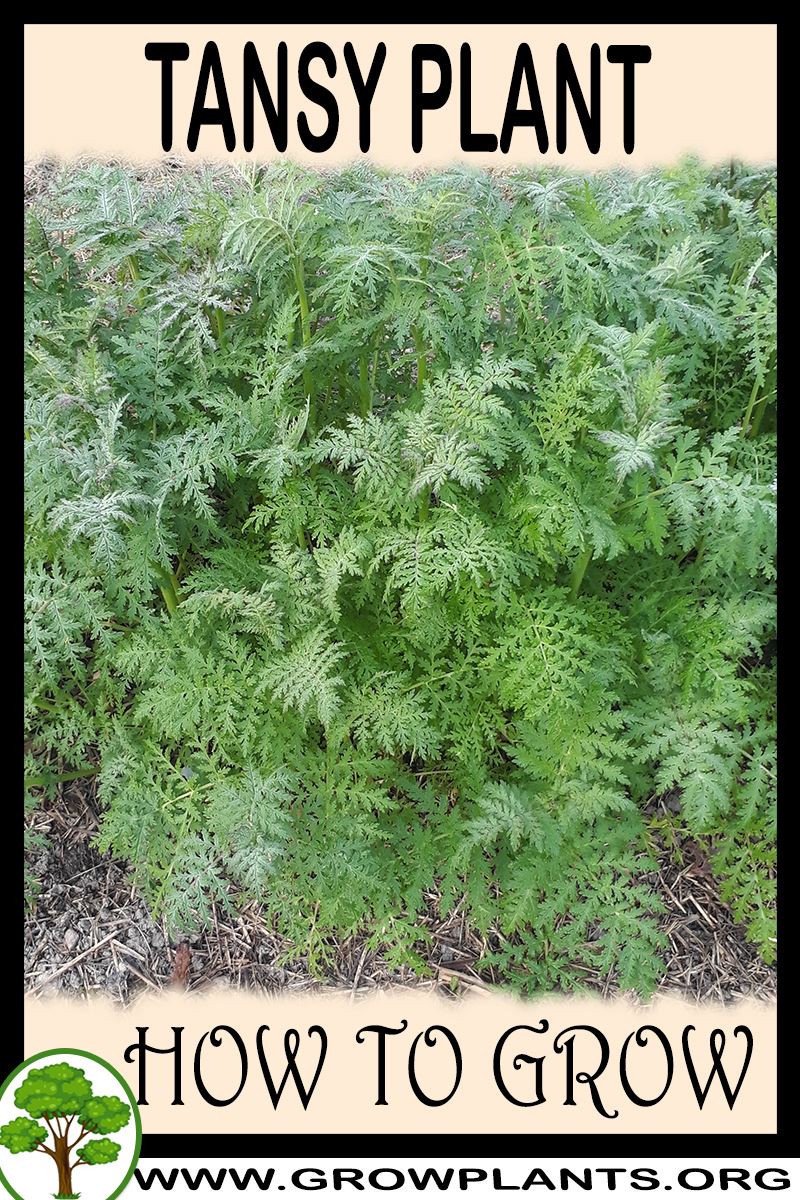
Overview: An aromatic herbaceous perennial reaching 0.6-1.5 m (2-5 ft), grown for its fern-like foliage and flat clusters of button-like yellow flowers. It is valued as a traditional medicinal and insect-repelling herb as well as a drought-tolerant ornamental.
Quick Specifications
| Specification | Attribute |
|---|---|
| Plant Type / Life Cycle | Herbaceous perennial (dies back in cold winters, evergreen where mild) |
| Foliage Type | Semi-evergreen |
| Mature Size | 0.6-1.5 m (2-5 ft) tall |
| Growth Rate | Fast to moderate |
| Root System | Creeping rhizomes that let the clump spread readily (it can become invasive) |
| Toxicity | Contains thujone; the foliage is toxic in quantity and the essential oil should not be taken internally |
| Hardiness | USDA zones 3-8 |
Growth Form & Structure
- Height and Spread: Upright clumps of 0.6-1.5 m (2-5 ft) that widen steadily by rhizomes; also grown in containers, which usefully limits its spread.
- Growth Habit and Form: Erect, clump-forming herb with stiff leafy stems rising from a spreading rootstock.
- Lifespan and Maturity: A vigorous, long-lived perennial that reaches flowering size quickly and returns each year from the rootstock.
Anatomy & Physical Features
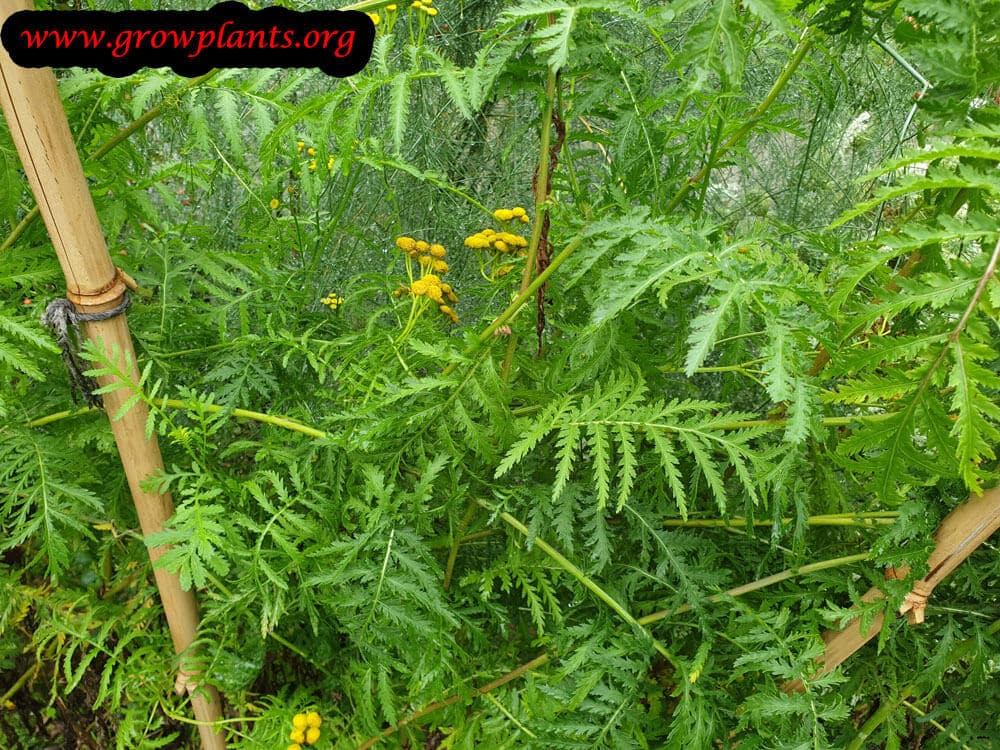
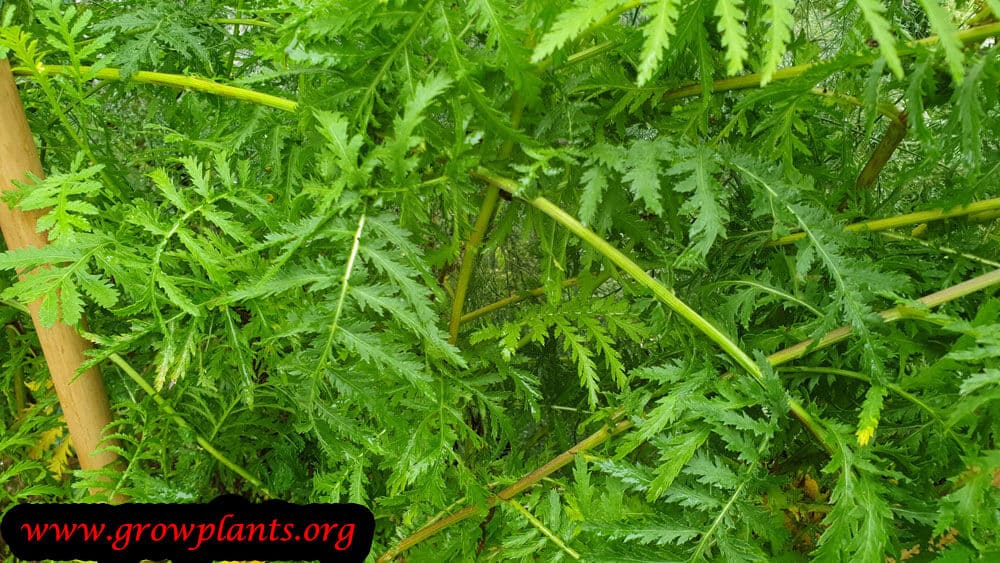
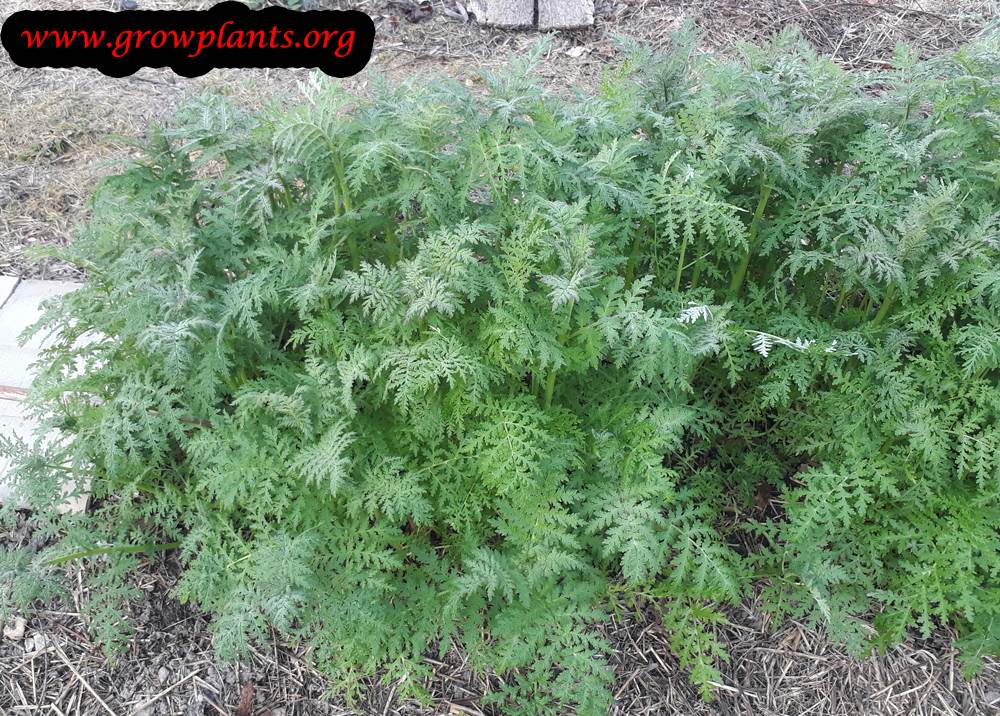
- Leaves and Foliage: Green, elliptic, deeply toothed leaves arranged in a pinnate, fern-like pattern; strongly aromatic when crushed.
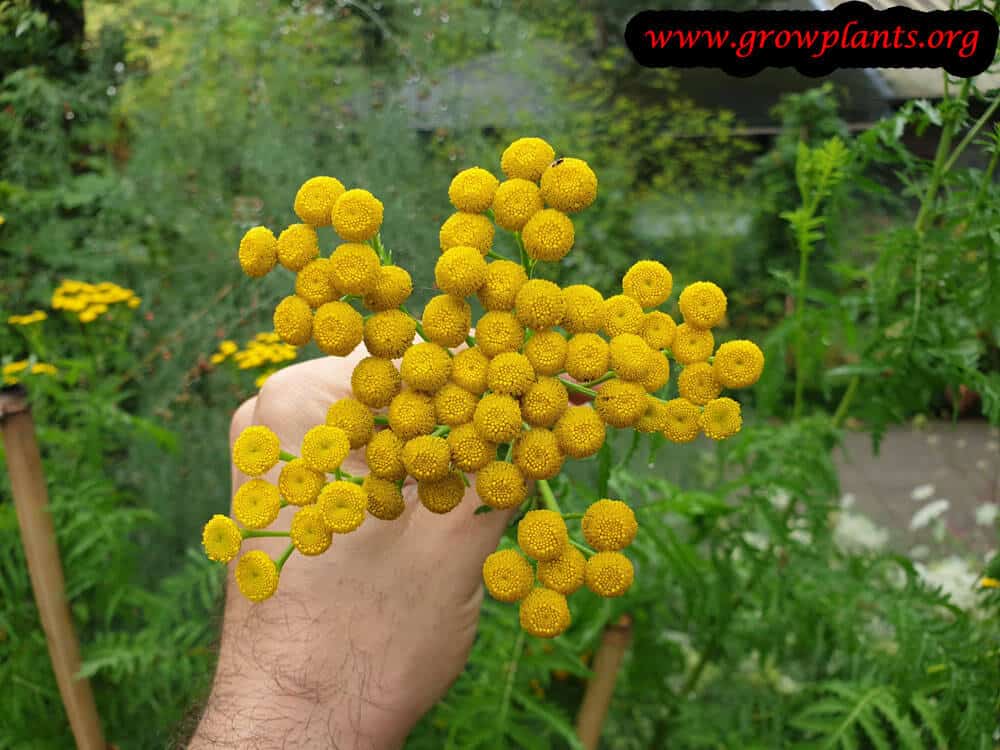
- Flower Characteristics: Flat-topped clusters of small, button-like yellow flowers borne at the stem tips.
Primary Uses & Landscape Value
- Functional and Ornamental Roles: Traditional medicinal and insect-repellent herb, and a drought-tolerant ornamental for borders and cottage plantings. Best sited where its spreading habit can be contained.
Care Guide: Planting, Soil & Watering
Overview: Tansy (Tanacetum vulgare) is a hardy herbaceous perennial for full sun to part shade (hardiness zone 3–8). It is drought-tolerant and easy-going, thriving in well-drained soil with only low to moderate water.
Quick Care Requirements
| Requirement | Ideal Condition |
|---|---|
| Planting Season | Spring to summer, once the soil warms |
| Growth Rate | Moderate to Fast |
| Soil Type | Well-drained soil |
| Water Need | Low to Moderate — water when the top few cm dry; drought-tolerant once established |
Planting & Establishment
- Best Planting Season: Plant in spring to summer once the soil has warmed, giving it time to establish before winter.
- How to Plant:
- Hole Preparation: Make a hole a little wider than the root ball in loosened, free-draining soil.
- Soil Amendments: It is not a hungry plant — a little compost in well-drained soil is enough; avoid rich, wet ground.
- Planting Depth: Set the crown at soil level, firm gently and water in; do not bury the stem base.
- Growth Speed & Expectations: Moderate to fast growth — it spreads readily and fills a border quickly in a sunny spot.
Soil, Watering & Drainage Care
- Soil Mix & Drainage Needs: Well-drained soil is the main requirement; it copes with poor, dry ground and dislikes waterlogging. Containers need free-draining mix and drainage holes.
- Watering Schedule & Technique:
- Young / Newly Planted: Keep the soil lightly moist while young plants establish.
- Established: Once established it is drought-tolerant — water only when the top few centimetres dry.
- Seasonal Adjustments: A little more in summer heat; little to none in cool, damp weather.
Climate, Light & Hardiness
Tansy is a very cold-hardy, drought-tolerant herbaceous perennial for temperate and subtropical gardens, grown in full sun to half shade. It tolerates hard winter cold well and needs no special protection within its stated range.
Quick Climate Specifications
| Climate Zones | Temperate, subtropical |
|---|---|
| USDA Hardiness Zones | Zones 3–8 |
| Frost Tolerance | High |
| Light Conditions | Full sun / half shade |
Sunlight & Light Exposure
Optimal Light Setup
Full sun to half shade both work; full sun gives the most compact, floriferous growth.
Temperature Extremes & Hardiness
USDA Hardiness & Regional Limits
Very cold-hardy, reliable through zones 3–8; foliage dies back naturally each winter and the plant resprouts vigorously from its rootstock in spring.
Growing in Pots, Balconies & Indoors
Tansy (Tanacetum vulgare) is a tall, aromatic herb with flat gold button-flowers and ferny leaves – an outdoor border and large-pot herb, not a houseplant; note it is toxic if eaten, so site it thoughtfully.
Quick Details
- Container Size: A large, contained pot, about 15-30 L (4-8 gal), for a plant of 0.6-1.5 m (24-60 in); a pot also checks its spreading roots
- Indoor Suitability: Not a houseplant (the grower marks it “No”) – a tall, sun-loving aromatic herb
- Best Spot: Full sun to half shade
- Soil & Drainage: Any free-draining mix; it thrives even in poor soil
- Watering in Pots: Low to moderate – drought-tolerant once established; let the surface dry between waterings
Indoors & On the Windowsill
- Houseplant limits: The grower marks it as not suitable indoors. It is a large, spreading herb that needs full sun and open air, and is too big and vigorous for a windowsill.
- Containment: Its roots run, so keeping it potted helps stop it spreading through a garden.
- Overwintering: Hardy – it dies back and reshoots each spring; the pot stays outdoors.
On a Balcony or Patio
- Light & wind: A tough, aromatic plant for a sunny balcony pot; the tall stems may need light support in wind. Its strong scent is said to deter some insects.
- Practicalities: Stand the pot off bare soil so roots cannot escape, and keep it away from where children or pets might nibble it.
Choosing the Pot, Soil & Long-Term Care
- Pot & drainage: A contained 15-30 L pot with strong drainage holes, stood off the ground; skip a standing water saucer to avoid root rot.
- Potting mix: Any free-draining general mix; it is not fussy.
- Feeding: Feed sparingly – it is vigorous enough without much help, and lean growing keeps it in check.
- Repotting: Refresh the mix and divide the clump every couple of years to keep it contained.
A Note on Safety
- Toxic if eaten: Tansy contains thujone and related compounds that are poisonous in quantity, and the foliage can irritate skin – keep it away from children and pets and never eat any part of it.
Fertilizing & Feeding
A light-feeding aromatic herb: a modest balanced feeding at planting and sparse feeding through the growing season are enough, with nothing needed once it dies back for winter.
Quick Fertilizing Specs
| Feeding Level | Light feeder |
|---|---|
| Main Nutrient Priority | Light, balanced feeding – avoid excess nitrogen that dilutes aromatic oils |
| Best Feeding Period | At planting and through spring-summer active growth |
| Organic Options | Compost or organic matter worked in at planting |
| Reduce/Stop Feeding | Withhold once the plant dies back for winter |
| Micronutrients | Rarely an issue in average garden soil; correct only if diagnosed |
| Soil pH | Tolerates a wide range of well-drained soils |
Feeding by Growth Stage
Establishment after planting
Help new plants root in without forcing lush, diluted growth in an aromatic herb valued for its essential oils.
| Nutrient direction | A light, balanced feeding at planting is enough; rich feeding is not needed to get this tough herb going. |
|---|---|
| Timing | At planting, in spring or early summer. |
| Frequency | A light feeding at planting is usually enough. |
| Fertilizer types | A balanced complete fertilizer used sparingly at planting, Compost or organic matter worked into the planting area |
| Precautions | Keep feeding light; this is an easy-to-grow, sometimes invasive herb that spreads readily without extra encouragement. |
Active growth through the growing season
Support steady stem and foliage growth up through the yellow, pompom-like flower clusters.
| Nutrient direction | Feed sparingly; like most aromatic herbs, tansy grown in average garden soil rarely needs more than an occasional light, balanced feeding. |
|---|---|
| Timing | Through spring and summer active growth. |
| Frequency | Minimal feeding is usually enough for this low-demand herb. |
| Fertilizer types | An occasional light, balanced fertilizer only if growth looks weak |
| Precautions | Avoid heavy nitrogen feeding, which can dilute the essential oils behind this herb’s scent and insect-repellent qualities. |
Autumn dieback and winter dormancy
Let top growth die back and the plant rest through winter without pushing new growth.
| Nutrient direction | None – withhold fertilizer as the plant dies back for winter. |
|---|---|
| Timing | In autumn as growth declines and through winter dormancy. |
| Frequency | No feeding at this stage; resume only when spring growth restarts. |
| Fertilizer types | No feeding at this stage; hold off fertilizing until spring growth resumes. |
| Precautions | Do not fertilize dormant plants; cut back dead top growth instead. |
Nutrient Deficiency Signs & Corrections
Pale, undersized leaves and noticeably slower stem growth.
| Possible causes | low available soil nitrogen, nitrogen leaching from sandy or heavily watered soil, thin, low-organic-matter soil |
|---|---|
| Appears first on | older, lower leaves |
| What to check | recent feeding history, soil organic matter, watering and drainage |
| Possible correction | Apply a light, balanced fertilizer with nitrogen and work in organic matter. |
Interveinal yellowing on older leaves while the veins themselves remain green.
| Possible causes | low soil magnesium, heavy potassium feeding competing with magnesium uptake, leaching in light, sandy soils |
|---|---|
| Appears first on | older, lower leaves |
| What to check | soil magnesium status, how potassium-heavy recent feeding has been, soil texture and leaching |
| Possible correction | Apply a labeled magnesium source such as Epsom salt or a dolomitic amendment and rebalance overall feeding. |
New leaves emerge pale yellow with veins that stay distinctly green.
| Possible causes | high soil pH limiting iron availability, waterlogged or compacted soil restricting root function, naturally iron-poor alkaline soil |
|---|---|
| Appears first on | newest leaves |
| What to check | soil pH, drainage and recent watering, root health |
| Possible correction | Correct soil pH or drainage first, then apply a chelated iron product per its label if new growth stays pale. |
Pruning, Training & Seasonal Maintenance
Tansy is a coarse, upright herbaceous perennial that dies back to a basal crown, so it takes a full cutback without harming its long-term structure. Its own bloom window is spring/summer, so the autumn/winter cutback in the data is a genuine post-bloom clean-up – and because this species is documented as invasive/weedy in many regions, the timing of deadheading and cutback also doubles as seed-set control, which is the real driving objective here rather than just tidiness.
Quick Pruning & Maintenance Specs
| Pruning Tolerance | High – resprouts freely from the crown |
| Primary Pruning Window | Autumn/Winter, after bloom and seed heads have finished |
| Secondary Maintenance Window | Summer, for deadheading before seed drops |
| Typical Frequency | Deadhead through summer bloom; one full cutback in autumn/winter |
| Main Objective | Prevent unwanted self-seeding, keep the tall clump from flopping, seasonal clean-up |
| Young Plant Priority | None needed in the first season beyond removing damaged growth |
| Mature Plant Priority | Summer deadheading + autumn/winter cutback; divide congested clumps periodically |
| Best Tool Type | Bypass secateurs (stems are coarser and more fibrous than a typical aster) |
| Avoid Heavy Pruning During | Active bloom, if seed heads are being deliberately left briefly for pollinators before deadheading |
Pruning by Plant Age & Size
Newly Established
In the first season, remove only damaged or dead stems and let the clump establish; no cutback needed yet.
Young / Formative
No formal training system applies – tansy doesn’t need pinching for bushiness the way a mound-forming perennial does. If flopping is a concern in a fertile bed, an early-summer cut-back of the stem tips by a third can shorten and stiffen the clump before bud set.
Mature / Established
Deadhead through the spring/summer bloom to intercept seed formation on a plant flagged invasive here, then cut the whole clump back near the crown once it browns in autumn/winter.
Seasonal Pruning Schedule
Spring – Summer (bloom): objective is controlling self-seeding; remove spent yellow pompom flower heads before they set seed; don’t cut into the green foliage below; response is a tidier clump with reduced volunteer seedlings the following year.
Autumn/Winter (post-bloom): objective is seasonal clean-up; cut all top growth back near the crown once it has browned; don’t disturb the crown or roots; fresh growth resumes from the base next spring with no effect on next year’s bloom, since flowering is on new seasonal growth.
Special Growth to Remove
Spent flower heads – the single most important removal task on this species, given its documented tendency to spread aggressively/become a noxious weed by seed in parts of its range; cutting flower heads before they brown and shatter is more consequential here than on a purely ornamental, non-invasive perennial.
Container & Small-Space Pruning
In a container, deadhead promptly for the same seed-control reason, and expect to cut the clump back harder and more often than an in-ground planting, since restricted roots combined with this plant’s naturally vigorous, spreading habit can otherwise crowd a pot quickly.
Tools
Bypass secateurs for both deadheading and the seasonal cutback – tansy’s stems are more fibrous at the base than a typical soft-stemmed perennial, so precision snips alone are less suited to the autumn cutback.
Tool Hygiene & Disease Risk
Routine – no disease is flagged for this species in the available data. The tansy beetle (Chrysolina graminis) is a genuine, species-specific pest, so inspect foliage while pruning but it doesn’t require tool disinfection between cuts.
Cut Placement & Technique
Deadhead by cutting the flowering stem back to the next leaf or side-shoot. The autumn cutback should leave a short stub above the crown rather than cutting flush into it.
Heavy Pruning & Rejuvenation
The annual autumn/winter cutback is itself the routine hard prune, and the plant resprouts fully from the crown; if a clump becomes sparse in the centre, division in spring is the more effective fix.
Post-Pruning Care
No feeding is needed after the autumn cutback. Dispose of or compost hot rather than leaving seed-bearing cuttings in the bed, given this species’ weedy reputation. Water new growth normally in spring.
Common Pruning Mistakes
Leaving spent flower heads to dry and shatter seed in place on a plant already flagged invasive/aggressive; skipping the autumn cutback and leaving tall dead stalks that flop over winter; composting cut flower heads where seed can still spread.
When NOT to Prune
No hard restriction is flagged; the main judgement call is whether to deadhead promptly (recommended, given this species’ weedy tendency) versus leaving a few late-season heads briefly for pollinators before removing them.
Recommended Tools (by task)
- Summer deadheading before seed-set: bypass_secateurs – clean cuts on semi-fibrous flowering stems.
- Autumn/winter cutback of the whole clump: bypass_secateurs – handles the coarser base growth better than fine snips.
Propagation Guide
Tansy spreads by creeping underground rhizomes and is most easily increased by dividing an established clump, which is also how it naturally becomes weedy in a bed; it also grows readily from seed, which germinates freely and often self-sows on its own. Propagation is easy by either method.
Quick Propagation Specs
| Best Propagation Method | Division of the rhizomatous clump |
| Alternative Methods | Seed |
| Propagation Difficulty | Easy |
| Seed True-to-Type | Usually true-to-type – grown as the species, not typically sold as named cultivars |
| Vegetative True-to-Type | Yes |
| Best Propagation Season | Spring |
| Seed Germination Time | Usually a few weeks at room temperature |
| Germination Temperature | Around 18–21°C (65–70°F) |
| Seed Sowing Depth | Surface-sow or barely cover – the fine seed benefits from light |
Growing from Seed
Sowing Season
Sow in spring; tansy also self-sows readily where established.
Sowing Depth & Orientation
Surface-sow or press lightly into the soil without deep covering.
Germination Conditions
Keep the seed bed moist at cool room temperature; germination is generally reliable and can be uneven in timing.
Seedling Care
Grow on in good light and transplant once seedlings are large enough to handle.
Rhizomes, Tubers, Bulbs & Corms
Rhizome Division – Lift and divide clumps in spring or autumn. Cut or pull the spreading rhizomes into sections, each with visible shoots or growth points, and replant promptly since rhizome pieces do not tolerate drying out. Because tansy spreads aggressively by this same rhizome growth, keep divisions contained if invasiveness is a concern.
Bloom & Flower Guide
Quick Details
- Bloom Season: Spring to summer
- Flower Appearance: Flat-topped clusters of small, button-like yellow flowers at the tops of the stems
- Edibility: Not edible – tansy contains thujone and is toxic in quantity; despite old culinary uses it is no longer considered safe to eat
Detailed Blooming Overview
Tansy blooms through spring and summer, holding its flat-topped clusters of tight, rayless yellow buttons well above the ferny foliage. The blooms are cheerful and long-lasting, and the whole plant carries a strong scent that has long given it a reputation as an insect repellent.
Flower Characteristics
- Small, button- or pompom-like yellow flowers, gathered into flat clusters at the stem tips.
Bloom Care & Thinning
- Deadheading: Cut back spent flower heads to keep the plant tidy and limit its vigorous self-seeding.
- Handling: The foliage can irritate skin for some people, and the plant is toxic if eaten, so keep it out of reach of children and pets.
Pests, Diseases & Troubleshooting
Overview: Tansy is a vigorous, aromatic perennial herb whose pungent foliage deters many insects, so it is rarely troubled; its notable specialist is the tansy leaf beetle, with occasional aphids, mildew or aster yellows. Manage it culturally in full sun with good airflow, dividing clumps to keep them healthy.
Quick Troubleshooting Overview
| Issue / Pest | Main Symptom | Primary Solution |
|---|---|---|
| Tansy leaf beetle | Holes chewed in foliage | Hand-pick beetles and grubs |
| Aphids | Sticky, curled new tips | Water jet, insecticidal soap |
| Powdery mildew | White coating in humid, crowded spots | Improve airflow, sulphur if needed |
| Aster yellows | Distorted, greenish flowers | Remove infected plants |
| Root rot | Collapse in wet soil | Improve drainage |
Common Pests & Management
- Aphids (Aphidoidea):
- Symptoms: Clusters of tiny soft-bodied green, black or grey insects on new shoots, flower buds and leaf undersides. Feeding causes puckered, curled or yellowing young growth, and a sticky honeydew that fosters sooty mould and attracts ants.
- Prevention & Control: Knock colonies off with a firm jet of water and pinch out badly infested tips. Encourage ladybirds, lacewings and hoverflies, and avoid excess nitrogen that pushes soft sappy growth. For persistent outbreaks apply insecticidal soap or a light horticultural/neem oil, coating leaf undersides and spraying in the cool of evening to protect pollinators.
- Tansy Leaf Beetle (Chrysolina graminis):
- Symptoms: Rounded, metallic green-bronze beetles and their grubs chew holes in the aromatic foliage; a genuine specialist feeder on tansy, though populations are usually local and rarely devastating.
- Prevention & Control: Hand-pick the conspicuous adults and grubs, which are easy to spot on the foliage, and tolerate light feeding on this vigorous plant. Encourage ground beetles and birds; sprays are seldom warranted for such a robust perennial.
- Thrips (Thysanoptera):
- Symptoms: Silvery-white flecking and stippling on leaves and petals, often with tiny black faecal specks; slender pale insects hide in buds and folds. Distorted new growth results, and some thrips spread viruses.
- Prevention & Control: Use blue or yellow sticky traps to monitor, and remove spent flowers and debris that shelter them. Encourage predatory mites and minute pirate bugs. Where needed, apply insecticidal soap or horticultural/neem oil, targeting buds and shoot tips and repeating at short intervals.
- Spider Mites (Tetranychus urticae):
- Symptoms: Fine pale stippling or bronzing of leaves, with delicate silken webbing on undersides and between stems; worst in hot, dry, dusty conditions. Heavily fed leaves dry, curl and drop.
- Prevention & Control: Raise humidity and hose foliage regularly to break the dry microclimate mites favour. Remove and destroy the worst leaves, and conserve predatory mites and other natural enemies. Treat with insecticidal soap or horticultural/neem oil, thoroughly wetting leaf undersides and repeating every 5-7 days to catch new hatchlings.
Diseases & Fungal Issues
- Powdery Mildew (Erysiphales):
- Symptoms: A white to greyish powdery coating on leaves and shoots, usually starting on the upper surface; affected leaves may yellow, distort and drop. Worst in crowded plantings with warm days, cool nights and poor airflow.
- Treatment & Management: Space and prune for good air movement and sun, and avoid wetting foliage late in the day. Remove affected leaves and clear fallen debris. Where needed, apply a sulphur or potassium-bicarbonate fungicide, or a horticultural oil, at first signs and repeat per label.
- Aster Yellows (Candidatus Phytoplasma):
- Symptoms: Distorted, stunted growth with greenish, deformed flowers and yellowing foliage, caused by a phytoplasma spread by leafhoppers; infected plants do not recover.
- Treatment & Management: There is no cure, so remove and destroy infected plants promptly to stop spread, and control leafhopper vectors and weedy reservoirs. Buy and plant clean stock and keep plantings vigorous.
- Rust (Pucciniales):
- Symptoms: Powdery orange, brown or rusty pustules on leaf undersides with yellow flecks above; heavy infection causes early leaf yellowing and drop.
- Treatment & Management: Remove and destroy infected leaves and avoid wetting foliage. Space plants for airflow and choose resistant types where available. Sulphur fungicides applied early can check spread when the disease is recurrent.
Growing Difficulties & Abiotic Problems
- Overwatering & Root Rot:
- Cause & Symptoms: Yellowing lower leaves, wilting despite wet soil, and a soft, foul-smelling root ball or stem base result from waterlogged, airless soil that suffocates and rots the roots.
- Correction Strategy: Let the soil dry appropriately between waterings, plant in free-draining media, and ensure pots have working drainage holes. Ease off water in cool or dormant periods and never leave the plant standing in a saucer of water.
- Woodiness & Legginess:
- Cause & Symptoms: Sprawling, bare-based stems with sparse leaves and fewer flowers as the plant ages, especially if left unpruned or grown in too much shade.
- Correction Strategy: Shear or prune lightly and regularly to keep growth dense and young, grow in full sun, and avoid over-rich feeding. Hard renovation pruning of old woody plants is best done cautiously, as some resent cutting into bare wood.
- Sunscald / Leaf Scorch:
- Cause & Symptoms: Bleached, tan or brown dead patches on the most exposed leaves or bark, appearing after a sudden move into strong sun, intense heat, or reflected heat, especially on soft or previously shaded growth.
- Correction Strategy: Acclimatise plants gradually to stronger light, provide light shade during fierce afternoon heat, and keep roots evenly moist so the plant can transpire. Site sensitive plants where they escape the harshest midday and reflected sun.
What Helps – Products & Tools
A strongly aromatic, insect-repellent herb that needs little chemical help; for the rare aphid flush use insecticidal soap or neem oil, and a sulphur fungicide only if mildew or rust becomes persistent. Hand-picking beetles and dividing clumps to keep them young are the main tools.