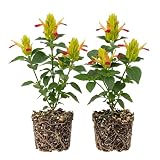


Plant Profile & Key Characteristics
Overview: Justicia brandegeana (shrimp plant) is an evergreen shrub 50–90 cm (20–36 in) tall, grown for its arching, shrimp-like flower bracts held over a long season. It is a popular ornamental and houseplant that attracts pollinators.
Quick Specifications
| Specification | Attribute |
|---|---|
| Plant Type / Life Cycle | Perennial (grown as an annual in cold zones) |
| Foliage Type | Evergreen |
| Mature Size | 50–90 cm tall (20–36 in) |
| Growth Rate | Moderate |
| Toxicity | Non-toxic |
| Hardiness | USDA zones 8b–11 (perennial); 5–8 as an annual |
Growth Form & Structure
- Height & Spread: A soft-stemmed shrub 50–90 cm (20–36 in) tall; excellent in containers and indoors.
- Growth Habit & Form: Bushy, arching evergreen shrub.
- Lifespan & Maturity: Moderate-growing tender perennial that flowers over a long season, spring through autumn.
Anatomy & Physical Features
- Leaves & Foliage: Green, elliptic leaves about 4–8 cm long.
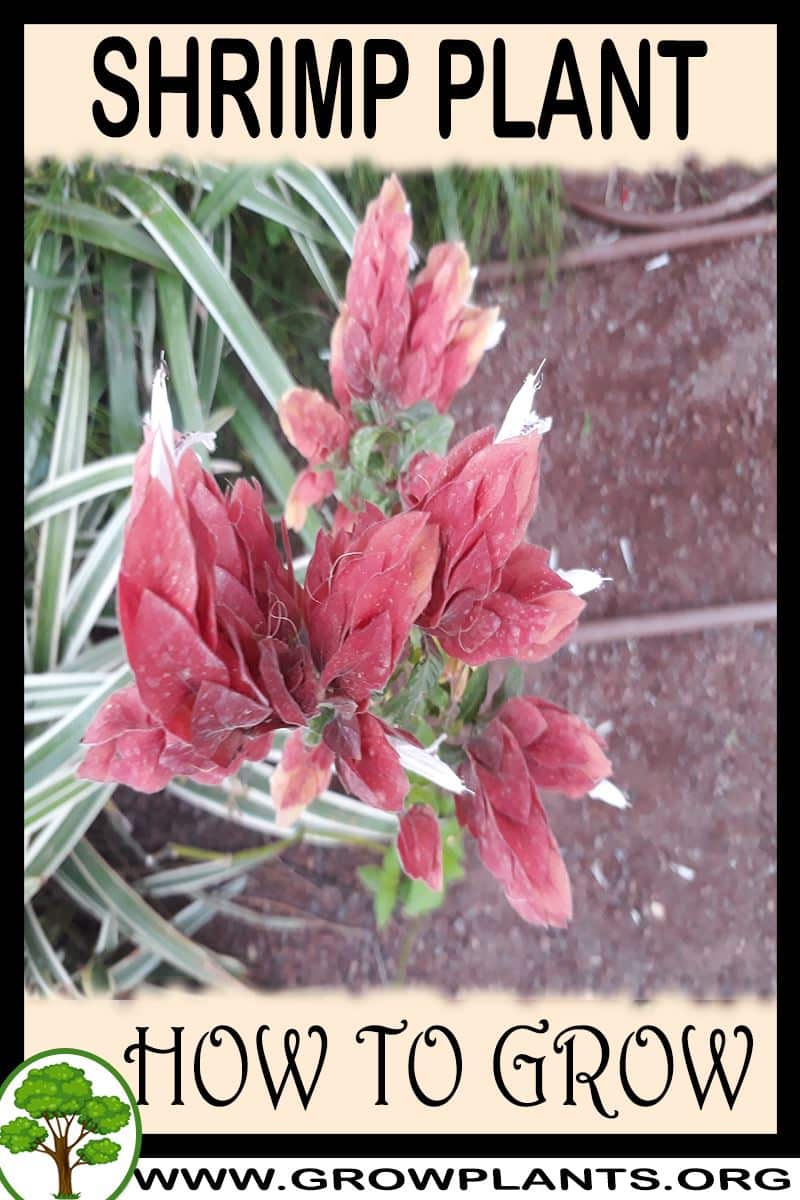
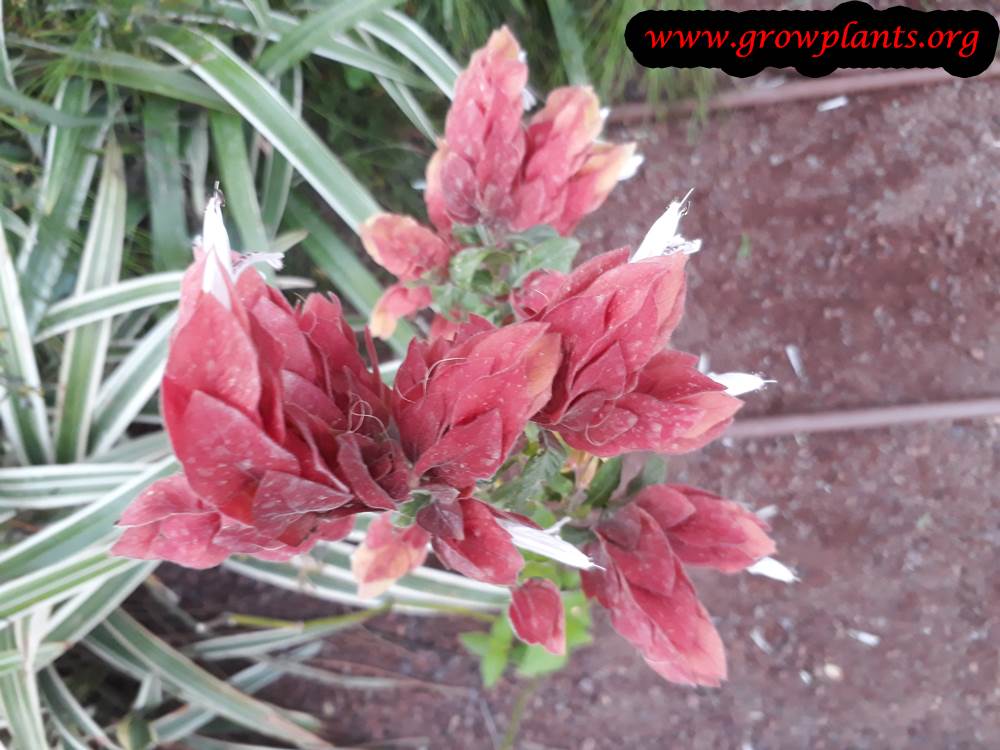
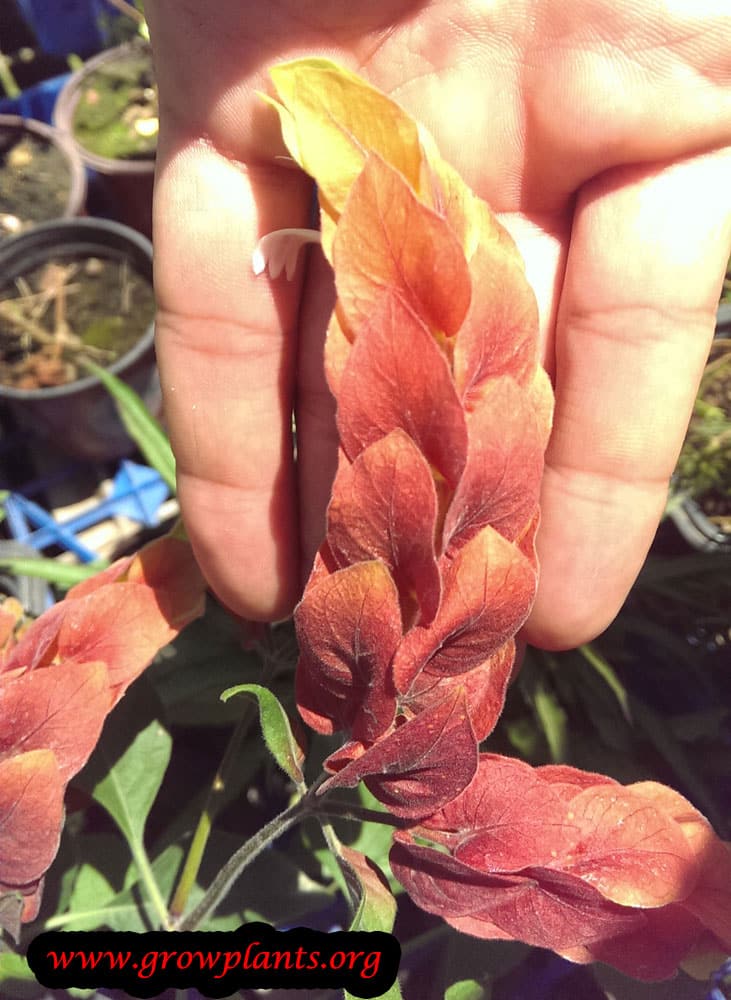
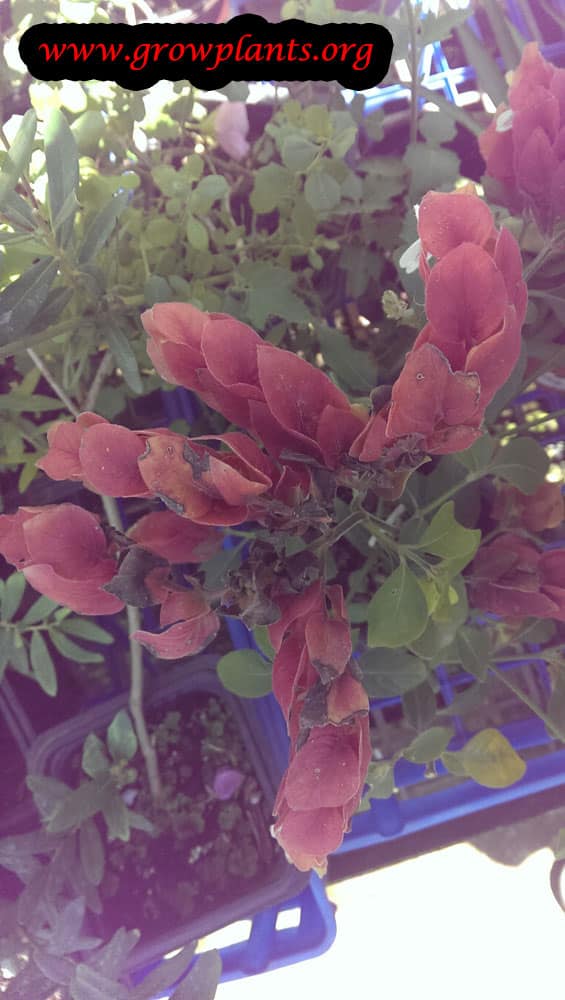
- Flower Characteristics: Small red or white tubular flowers emerging from overlapping, shrimp-like bracts that colour red-brown, yellow, white or other shades – the bracts are the showy feature.
Primary Uses & Landscape Value
- Functional & Ornamental Roles: Ornamental flowering shrub, container and houseplant; attracts hummingbirds and other pollinators.
Care Guide: Planting, Soil & Watering
Overview: The shrimp plant is a frost-tender evergreen shrub (roughly hardy in zones 8b to 11) that grows in tropical to mediterranean conditions, in full sun through to shade. It likes a rich, well-drained soil and steady, moderate moisture, blooming over a long warm season.
Quick Care Requirements
| Requirement | Ideal Condition |
|---|---|
| Planting Season | In spring, summer or autumn during the warm season, avoiding frost |
| Growth Rate | Moderate |
| Soil Type | Rich, well-draining soil |
| Water Need | Moderate – keep lightly moist, letting the surface dry slightly between waterings |
Planting & Establishment
- Best Planting Season: Plant during the warm season, from spring through autumn, in frost-free conditions so it establishes before any cold.
- How to Plant:
- Hole Preparation: Dig a hole about twice the width of the root ball and the same depth, loosening the surrounding soil for easy rooting.
- Soil Amendments: Enrich the backfill with compost or well-rotted organic matter, and ensure the ground drains freely.
- Planting Depth: Set the top of the root ball level with the soil surface, keeping the stem base at grade.
- Growth Speed & Expectations: Moderate; it bushes out steadily and can be pinched to stay full and encourage bracts.
Soil, Watering & Drainage Care
- Soil Mix & Drainage Needs: It wants a rich but free-draining mix so roots never sit wet; in pots use good potting soil with ample drainage.
- Watering Schedule & Technique:
- Young / Newly Planted: Water newly planted shrimp plants regularly to keep the root zone evenly moist while they establish.
- Established: Water when the surface begins to dry, giving a deep drink rather than frequent light sips.
- Seasonal Adjustments: Water more in summer heat and cut back in the cool season when growth slows.
Climate, Light & Hardiness
Shrimp plant is a tropical/subtropical evergreen shrub grown as a perennial in mild climates and as an annual in colder regions, adaptable from full sun to full shade with enough light. It is frost sensitive overall but established plants can briefly withstand light freezes.
Quick Climate Specifications
| Climate Zones | Tropical, Mediterranean, Subtropical |
|---|---|
| USDA Hardiness Zones | 8b–11 as a perennial; grown as an annual in zones 5–8 |
| Approx. Survival Minimum | Established plants can briefly survive down to about −3°C (27°F) |
| Frost Tolerance | Low |
| Light Conditions | Full Sun / Half Shade / Full Shade (with plenty of light) |
Sunlight & Light Exposure
Optimal Light Setup
Very adaptable, growing in full sun through full shade provided overall light levels stay reasonably bright.
Temperature Extremes & Hardiness
USDA Hardiness & Regional Limits
Reliable as a perennial in zones 8b through 11; in colder zones 5–8 it is commonly grown as a warm-season annual rather than left to overwinter outdoors.
Cold Damage & Winter Protection
Best kept frost free for continuous growth and flowering; foliage and stems suffer well before the plant's outer survival limit is reached.
Frost Sensitivity
Frost sensitive, though the site notes an established plant may briefly survive short dips to around −3°C (27°F) – treat this as a survival minimum, not a safe growing temperature, and expect damage to top growth even if the plant recovers.
Wind, Humidity & Microclimate
Microclimate Recommendations
A warm, sheltered spot (or container that can be moved under cover) helps it persist through occasional cold snaps at the cooler edge of its range.
Growing in Pots, Balconies & Indoors
Shrimp plant (Justicia brandegeana) is a tender, bushy sub-shrub (50-90 cm) grown for its shrimp-shaped flower bracts. The grower confirms it is both a houseplant and a container plant – it flowers happily indoors in good light and makes an excellent patio pot plant that is overwintered indoors in cold climates.
Quick Details
- Container Size: A medium pot; pot up as it fills out
- Indoor Suitability: A good houseplant – blooms indoors in bright light
- Best Spot: Full sun to half shade (even full shade with plenty of light)
- Soil & Drainage: Rich, free-draining mix
- Watering in Pots: Average amount – keep lightly moist, not waterlogged
Indoors & On the Windowsill
- A true houseplant: The grower confirms it grows indoors. Give it the brightest spot you can for the best flowering, and pinch stems to keep it bushy.
- Windowsill: A bright sill is ideal; more light means more of the shrimp-like bracts.
- Overwintering: It is frost-tender – in cold climates bring it indoors over winter and it will keep going.
On a Balcony or Patio
- Light, wind & heat: Give it the brightest spot it will tolerate; walls and railings reflect heat and dry pots quickly, so check moisture often and shelter or stake exposed growth.
- Warmth & light: A warm, bright, sheltered spot suits it; it can take some sun but appreciates shelter from harsh midday heat and wind.
Choosing the Pot, Soil & Long-Term Care
- Pot & drainage: A medium pot with strong drainage holes; pot up as it grows. Use strong drainage holes and skip a standing-water saucer to avoid root rot. Terracotta breathes and dries faster; glazed or plastic holds moisture longer.
- Potting mix: A well-aerated, organic-rich mix – potting soil or peat/coir with perlite or vermiculite for free drainage.
- Feeding: Potted plants use up their soil faster as nutrients leach out with watering – feed lightly and regularly through the growing season.
- Repotting: Refresh the mix and pot up about every two years; for perennials, lightly root- and top-prune the plant when you do.
Fertilizing & Feeding
A moderate feeder: this frost-tender evergreen shrub flowers over a long season from spring through autumn, so it appreciates balanced, repeat feeding through that whole window, tapering off as cooler weather slows it down.
Quick Fertilizing Specs
| Feeding Level | Moderate feeder |
|---|---|
| Main Nutrient Priority | Balanced feeding with adequate nitrogen to sustain repeat flushes of bracts and flowers |
| Best Feeding Period | Spring through the summer-into-autumn bloom season |
| Organic Options | Compost or another organic matter worked into rich, well-drained soil |
| Reduce/Stop Feeding | Ease off as cooler weather approaches and stop while the plant rests over winter |
| Micronutrients | Usually supplied by a complete fertilizer; correct only a diagnosed deficiency |
| Soil pH | Prefers rich, well-drained soil; tolerant of typical garden or container mixes |
Feeding by Growth Stage
Spring growth restart
Support fresh leafy growth as the shrub comes out of its winter rest and prepares for its long bloom season.
| Nutrient direction | A balanced, nitrogen-forward feeding builds the leafy framework that will carry the coming bracts and flowers. |
|---|---|
| Timing | As new growth resumes in spring. |
| Frequency | A light feeding as growth resumes, increasing gradually as new shoots extend. |
| Fertilizer types | A balanced complete fertilizer with available nitrogen, Compost or other organic matter worked into the soil |
| Precautions | Build up feeding gradually; a hard hit of fertilizer on cool, still-slow spring growth can do more harm than good. |
Repeat flushes of bracts and flowers
Sustain the shrub’s showy, repeat-blooming bracts and tubular flowers across its long spring-through-autumn display.
| Nutrient direction | Consistent, balanced feeding with adequate nitrogen keeps successive flushes of bracts coming without burning the plant out. |
|---|---|
| Timing | Through the extended spring-into-summer-and-autumn bloom season. |
| Frequency | Regular light feedings support the repeat bloom cycle through the season. |
| Fertilizer types | A balanced complete fertilizer, An organic feed such as compost tea between applications |
| Precautions | Resist switching to a high-phosphorus product for more bracts; balanced feeding with adequate nitrogen is what sustains repeat bloom. |
Cool-season rest
Let the shrub rest through cooler weather when growth and bloom naturally slow, ahead of its winter shaping prune.
| Nutrient direction | None – withhold fertilizer while growth has slowed for the cool season. |
|---|---|
| Timing | Through cooler weather and into the winter pruning period. |
| Frequency | No feeding at this stage; resume only once active spring growth returns. |
| Fertilizer types | No feeding at this stage; hold off fertilizing until active growth resumes in spring. |
| Precautions | Do not fertilize while the plant is resting; unused nutrients can leach away or push frost-tender growth right before cold snaps. |
Nutrient Deficiency Signs & Corrections
Older leaves fade to pale green or yellow and bract production drops off.
| Possible causes | low available soil nitrogen, nitrogen leached by heavy watering or rain, root stress limiting nutrient uptake |
|---|---|
| Appears first on | older, lower leaves |
| What to check | recent feeding history, soil organic matter, root health and drainage |
| Possible correction | Apply a nitrogen-containing complete fertilizer and build soil organic matter, then water evenly. |
Interveinal yellowing on older leaves while the veins themselves stay green.
| Possible causes | low soil magnesium, heavy potassium-leaning feeding competing with magnesium uptake, leaching in light, well-drained soils |
|---|---|
| Appears first on | older, lower leaves |
| What to check | soil magnesium status, how the recent feeding mix has been balanced, soil texture and leaching |
| Possible correction | Apply a labeled magnesium source and rebalance the overall feeding mix. |
Wilting, leaf drop, or blackened stems despite otherwise adequate care.
| Possible causes | cold damage in a frost-tender plant, waterlogged, poorly drained soil, root or stem rot following cold or wet stress |
|---|---|
| Appears first on | stem tips and youngest leaves |
| What to check | recent low temperatures, soil drainage and moisture, signs of blackened or mushy stem tissue |
| Possible correction | Improve drainage, protect from cold, and remove damaged growth once conditions stabilize before resuming feeding. |
Pruning, Training & Seasonal Maintenance
Shrimp plant flowers on its current season’s new growth, and left alone it quickly turns leggy and sparse at the base, so pruning is essential rather than optional. A hard late-winter cutback rejuvenates the plant and sets up a full flush of the colorful bracts through spring, summer and autumn, while regular pinching during the growing season keeps it compact and bushy rather than long and floppy.
Quick Pruning & Maintenance Specs
| Pruning Tolerance | High – tolerates and needs an annual hard cutback |
| Primary Pruning Window | Late winter, before the new growing season |
| Secondary Maintenance Window | Ongoing tip pinching through spring–summer growth |
| Typical Frequency | One hard annual cutback plus pinching every few weeks in season |
| Main Objective | Prevent legginess; force bushy new growth that carries the bracts |
| Young Plant Priority | Pinch early and often to build a multi-branched framework |
| Mature Plant Priority | Annual hard cutback to renew flowering wood and shape |
| Best Tool Type | Precision snips/bypass secateurs (soft to semi-woody stems) |
| Avoid Heavy Pruning During | Any cold snap near or below its frost tolerance (around -3C) |
Pruning by Plant Age & Size
Newly Established
Pinch out the growing tip once the young plant has a few sets of leaves to force the first branching, rather than letting it grow as a single stem.
Young / Formative
No formal training system – simply pinch repeatedly through the first season(s) to build a multi-branched, bushy framework close to the base.
Mature / Established
Cut the whole plant back by roughly a third to half in late winter to renew vigorous, bract-bearing growth and control size, whether grown as a garden shrub or a container plant.
Seasonal Pruning Schedule
| Dormant/Winter | Main hard cutback before spring growth resumes; removes leggy, spent growth; strong new shoots follow that will carry the season’s flowers/bracts. |
| Summer Canopy Management | Pinch new shoot tips periodically through the growing season to keep the plant dense and to encourage more flowering side-shoots rather than a few long stems. |
Flowering & Fruiting Wood
The showy bracts and flowers form on the current season’s new growth, so pruning timing controls, rather than sacrifices, the display: a late-winter cutback removes only old, already-spent wood and results in more new flowering shoots than an unpruned plant, while pinching through the season multiplies flowering tips further.
Structural Pruning & Training
No formal framework needed; the objective is simply density – regularly remove or shorten any single stem that has outgrown the rest to keep an even, rounded shape.
Special Growth to Remove
Pinch out overly long, thin stems that flop under the weight of their own bract clusters; deadhead spent flower/bract clusters if seed set or a tidy look is wanted, though this is optional rather than essential to rebloom.
Container & Small-Space Pruning
Very well suited to pot culture; keep the annual cutback slightly harder than an in-ground plant to hold a compact size, and pinch more frequently indoors or in a container where light may be lower and growth can stretch.
Tools
- Precision snips – routine pinching and light shaping
- Bypass secateurs – the annual hard cutback of thicker old stems
Tool Hygiene & Disease Risk
Routine care is sufficient – keep tools clean and sharp; aphids are the only notable pest and are not spread by pruning cuts.
Cut Placement & Technique
Pinch or cut just above a leaf node/bud pair so the plant branches from that point; avoid leaving bare stubs above the last live node.
Heavy Pruning & Rejuvenation
Tolerates a hard annual cutback as its standard maintenance rather than an occasional rescue measure; even a badly leggy, overgrown plant typically regrows fully and reflowers within one growing season after being cut back hard.
Post-Pruning Care
Water in after a hard cutback to support the regrowth flush; protect from any near-frost conditions right after a hard prune, since fresh cuts and new soft growth are more cold-sensitive than established wood.
Common Pruning Mistakes
- Never cutting back, leaving a sparse, leggy plant with flowers only at the stem tips
- Pinching stops partway through the season, so later growth reverts to long, floppy stems
- Hard-pruning right before a cold snap when the plant is only marginally frost-tolerant
When NOT to Prune
Avoid a hard cutback immediately before an expected frost, since fresh growth stimulated by pruning is more cold-tender than mature stems.
Recommended Tools (by task)
- precision_snips – routine tip pinching through the growing season
- bypass_secateurs – the annual late-winter hard cutback
Propagation Guide
Shrimp plant is best propagated from stem cuttings, which root very easily and, per the site, are needed only if you want to keep a specific bract colour true; seed is a workable alternative for the general species but bract colour is not guaranteed to match the parent. This is an easy plant to propagate.
Quick Propagation Specs
| Best Propagation Method | Stem cuttings |
| Alternative Methods | Seed |
| Propagation Difficulty | Easy |
| Seed True-to-Type | Usually true-to-type for the species; bract colour in named forms is variable from seed |
| Vegetative True-to-Type | Yes – the reliable way to keep a specific bract colour |
| Best Propagation Season | Spring to summer |
| Seed Germination Time | Generally a few weeks under warm conditions |
| Cutting Rooting Time | Often just a couple of weeks under warm, humid conditions |
| Germination Temperature | Around 21–27°C (70–80°F) |
| Seed Sowing Depth | Shallow – just covered |
Growing from Seed
Sowing Season
Spring, once conditions are warm.
Sowing Depth & Orientation
Sow shallowly in a free-draining seed mix.
Germination Conditions
Keep warm and evenly moist in bright light.
Germination Time
Typically a few weeks.
Seedling Care
Pot on once established and grow in full sun to half shade, or bright shade with plenty of light as the site notes for mature plants.
Stem Cuttings
Cutting Type
Softwood tip cuttings.
Best Timing
Spring through summer during active growth; this plant is frost-tender, so avoid taking or rooting cuttings outdoors when frost is possible.
Cutting Preparation
Take a cutting a few nodes long, remove the lower leaves, and trim just below a node.
Rooting Setup
Cuttings root readily in a free-draining, rich mix, or even in water; keep humidity moderate to high.
Rooting Hormone
Not necessary – this plant is known for rooting easily from cuttings without it.
Rooting Time
Often just a couple of weeks under warm, humid conditions.
Bloom & Flower Guide
Quick Details
- Bloom Season: Spring through autumn, and nearly year-round in warm, frost-free conditions
- Time to First Bloom: Blooms readily on young plants, often within the first year
- Flower Appearance: Slender white (sometimes red) tubular flowers that emerge from showy, overlapping bracts; the arching bract clusters – in bronze-red, yellow, chartreuse, white and other shades – give the plant its shrimp-like look
- Edibility: Not eaten – grown as an ornamental
Detailed Blooming Overview
The eye-catching part of a shrimp plant is not really the flower but the arching cluster of colored bracts; the true white or red tubular flowers peek out from between them. It flowers over a very long season and is a favorite of hummingbirds.
Flower Characteristics
- The showy, overlapping bracts range from bronze-red to yellow, green, white and purple-blue tints.
- The true flowers are white or red and tubular, cone-shaped, emerging from within the bracts.
Bloom Care & Thinning
- Keeping it full: Pinch back regularly to keep the plant bushy and covered in bracts.
- Color and vigor: Bright light deepens the bract color; a light feed in the growing season keeps the display going.
Pests, Diseases & Troubleshooting
Overview: The shrimp plant is a soft-stemmed tropical grown for its showy bracts and flowers, and like most tender flowering shrubs it mainly attracts sap-sucking insects – aphids, whiteflies, spider mites, mealybugs and scale – with fungal leaf spot and root rot in humid or overwet conditions. Bright light, steady moisture, airflow and regular inspection keep it looking its best.
Quick Troubleshooting Overview
| Issue / Pest | Main Symptom | Primary Solution |
|---|---|---|
| Aphids | Sticky, distorted new shoots and bracts | Water jet; insecticidal soap |
| Whiteflies | Clouds of white flies, yellowing leaves | Yellow sticky traps; insecticidal soap |
| Spider mites | Stippled, dull leaves, webbing in dry heat | Raise humidity; hose foliage; miticidal oil |
| Mealybugs & scale | White fluff / brown bumps, sticky leaves | Wipe off / prune; horticultural or neem oil |
| Leaf spot | Brown spots, leaf drop in humid stagnant air | Airflow, base watering; copper if persistent |
| Leaf drop / legginess | Dropped lower leaves, bare stems | Even moisture, bright light, pinch to bush out |
Common Pests & Management
- Aphids (Aphis spp.):
- Symptoms: Soft green or black insects massed on tender shoots, flower stalks and bracts, with sticky honeydew, curled new leaves and following sooty mold.
- Prevention & Control: Dislodge with a water jet, pinch heavily infested tips, and encourage ladybirds; use insecticidal soap for persistent colonies, coating the growing points.
- Whiteflies (Trialeurodes vaporariorum):
- Symptoms: Tiny white flies that rise in a cloud when the plant is disturbed; yellowing, sticky leaves and sooty mold, especially under cover.
- Prevention & Control: Hang yellow sticky traps, encourage parasitic wasps, and spray insecticidal soap on leaf undersides where the nymphs feed; repeat to catch new hatches.
- Spider mites (Tetranychus urticae):
- Symptoms: Fine pale stippling, a dull bronzed look and fine webbing under the leaves in warm, dry indoor air.
- Prevention & Control: Raise humidity and rinse the foliage; treat with insecticidal soap or a miticidal horticultural oil and keep the plant from drying out.
- Mealybugs (Planococcus citri):
- Symptoms: Cottony white tufts in leaf axils and along stems, sticky residue and stunted, distorted shoots.
- Prevention & Control: Dab with an alcohol swab, hose the plant, and treat lingering colonies with insecticidal soap or neem oil; ease off high-nitrogen feed.
- Scale insects (Coccus / Saissetia spp.):
- Symptoms: Fixed brown or black bumps on stems and leaf undersides, sticky foliage and sooty mold.
- Prevention & Control: Prune the worst wood, scrape off light infestations, and smother the rest with horticultural or neem oil applied in the evening.
Diseases & Fungal Issues
- Fungal leaf spot (Cercospora / Colletotrichum spp.):
- Symptoms: Brown or dark spots, sometimes with yellow halos, that spread and cause leaf drop in warm, humid, crowded, poorly ventilated conditions.
- Treatment & Management: Remove affected leaves, water at the base to keep foliage dry, improve spacing and airflow, and use a copper fungicide only if spotting keeps advancing.
- Powdery mildew (Erysiphe / Oidium spp.):
- Symptoms: White powdery patches on leaves and stems in stagnant, humid air with poor circulation.
- Treatment & Management: Increase airflow and light, avoid crowding, remove affected leaves, and treat with a sulfur or potassium-bicarbonate fungicide if it persists.
- Root & stem rot (Pythium / Phytophthora spp.):
- Symptoms: Wilting despite wet soil, blackening at the base and collapse, caused by waterlogged, poorly drained mix.
- Treatment & Management: Use a free-draining mix, let the surface dry between waterings, never leave it standing in water, and discard plants rotted at the base; take cuttings from healthy stems to renew.
Growing Difficulties & Abiotic Problems
- Leaf drop:
- Cause & Symptoms: Lower leaves yellow and fall after drying out, cold drafts, or a sudden change in position or temperature.
- Correction Strategy: Keep evenly moist (not wet), warm and out of drafts, and acclimate gradually after moving; the plant is frost-tender.
- Legginess & poor flowering:
- Cause & Symptoms: Stretched, bare stems and few bracts in low light or without pruning.
- Correction Strategy: Give bright, indirect to filtered light, pinch and prune regularly to force branching, and feed lightly during active growth for better bract color.
- Leaf-tip scorch / salt stress:
- Cause & Symptoms: Browning leaf margins from fertilizer salt build-up, hard water, or dry air.
- Correction Strategy: Flush the pot occasionally with clean water, feed at moderate strength, and raise humidity around the plant.
What Helps – Products & Tools
Keep The shrimp plant healthy with cultural basics – bright light, even moisture, airflow and pinching – then use insecticidal soap, neem or horticultural oil for aphids, whiteflies, mites, mealybugs and scale, backed by yellow sticky traps for whitefly. Copper fungicide handles leaf spot, sulfur or potassium bicarbonate handles powdery mildew, and sharp drainage prevents root rot. Spray oils in the evening to protect pollinators.