




Plant Profile & Key Characteristics
Overview: A large, single-trunked evergreen fan palm reaching 10-20 m (30-60 ft), grown as a long-lived ornamental and street tree. It is a tough, drought-tolerant perennial valued for its bold silhouette and its small edible fruits.
Quick Specifications
| Specification | Attribute |
|---|---|
| Plant Type / Life Cycle | Evergreen palm (long-lived perennial tree) |
| Foliage Type | Evergreen |
| Mature Size | 10-20 m (30-60 ft) tall |
| Growth Rate | Slow to moderate |
| Root System | Fibrous, non-invasive root ball (no taproot, typical of palms) |
| Toxicity | Non-toxic — the ripe fruit is edible |
| Hardiness | USDA zone 8 and warmer |
Growth Form & Structure
- Height & Spread: In the ground a tall solitary palm of 10-20 m (30-60 ft), the crown formed by a rounded head of large fronds; not suited to permanent pot culture and grown in the open ground.
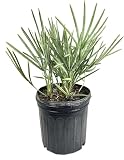
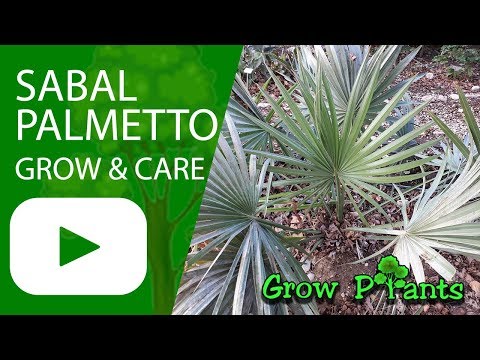
- Growth Habit & Form: Upright single-stemmed palm with an unbranched trunk topped by a dense crown of costapalmate (fan-shaped) leaves 1-2 m across.
- Lifespan & Maturity: Very long-lived and slow to build height; from seed it takes roughly 7-10 years before it begins to fruit.
Anatomy & Physical Features
- Trunk & Bark: Stout grey unbranched trunk, often skirted with old leaf-base “boots” on younger palms before it self-cleans to a smoother column.
- Leaves & Foliage: Large green fan-shaped fronds 1-2 m wide, the blade split into narrow sword-like segments with thread-like fibres between the tines.
- Flower Characteristics: Long branched sprays of small yellow-white flowers, borne in showy clusters of hundreds.
- Fruit Profile: Small round purple-black fruits, dry-fleshed and sweet.
Primary Uses & Landscape Value
- Edible Uses: Ripe fruits are eaten raw and made into cakes, juice, jam or dried and frozen.
- Functional & Ornamental Roles: A signature specimen, avenue and coastal palm, prized for drought tolerance and salt hardiness in warm-climate landscapes.
Care Guide: Planting, Soil & Watering
Overview: Sabal palmetto (cabbage palm) is a hardy, evergreen fan palm grown as an ornamental and street tree, thriving in warm climates from hardiness zone 8 upward. It grows in full sun to part shade in warm, well-draining soil and, once established, is notably drought- and salt-tolerant.
Quick Care Requirements
| Requirement | Ideal Condition |
|---|---|
| Planting Season | Warm season – spring to summer (year-round in zone 10b and warmer) |
| Growth Rate | Slow to Moderate |
| Soil Type | Well-draining; warm site |
| Water Need | Low to moderate; let the soil dry between waterings once established |
Planting & Establishment
- Best Planting Season: Plant in spring to summer while the soil is warm in cooler areas; in zone 10b and warmer it can be planted year-round. Warmth at establishment speeds rooting.
- How to Plant:
- Hole Preparation: Dig a hole a little wider than the root ball and loosen the surrounding soil so the deep roots can spread.
- Soil Amendments: Work some organic matter into the backfill on poor soils and ensure free drainage; palms establish best in warm, well-aerated ground.
- Planting Depth: Set the palm at the depth it grew in its container, keeping the base of the trunk at the soil surface and never burying it.
- Growth Speed & Expectations: A slow to moderate grower ultimately reaching 10-20 m; expect patient, steady growth, especially in the early years before the trunk lifts.
Soil, Watering & Drainage Care
- Soil Mix & Drainage Needs: Give it well-draining soil so water never pools around the roots; it is adaptable and salt-tolerant but resents constant wet. Best grown in the ground rather than long-term in pots.
- Watering Schedule & Technique:
- Young / Newly Planted: Water regularly through the first seasons to establish the deep root system, keeping the soil moist but not waterlogged.
- Established: Once established it is drought-tolerant; water occasionally and deeply, letting the soil dry between waterings.
- Seasonal Adjustments: Water more through summer heat while young, and reduce watering in cool weather and over winter.
Climate, Light & Hardiness
Sabal palmetto (cabbage palm) is one of the more cold-hardy palms, suited to subtropical, tropical, Mediterranean, desert, and warm temperate climates. It needs full sun to half shade, tolerates strong coastal wind and salt exposure, and is hardy from USDA zone 8.
Quick Climate Specifications
| Climate Zones | Subtropical, tropic, mediterranean, desert, temperate |
|---|---|
| USDA Hardiness Zones | 8+ |
| Light Conditions | Full sun to half shade |
| Frost Tolerance | Moderate to high for an established palm |
| Wind Tolerance | High |
| Salt / Coastal Tolerance | High |
Sunlight & Light Exposure
Optimal Light Setup
Full sun to half shade both suit this palm, with full sun giving the fullest, most upright crown.
Extreme Heat Tolerance
Very heat-tolerant, suited to the full range of warm-summer climates listed, including desert conditions.
Temperature Extremes & Hardiness
USDA Hardiness & Regional Limits
Hardy from zone 8 upward, which is unusually cold-tolerant for a palm, allowing it to succeed in warm temperate as well as subtropical and tropical climates.
Cold Damage & Winter Protection
Established trees at the colder edge of their range tolerate occasional hard freezes better than most palms; young palms are more cold-sensitive and benefit from a sheltered site until established.
Wind, Humidity & Microclimate
Wind Tolerance
High – its flexible fronds and sturdy trunk make it well suited to windy, hurricane-prone coastal regions.
Coastal / Salt Tolerance
High – it is a common native of coastal habitats and tolerates salt spray and coastal conditions well.
Growing in Pots, Balconies & Indoors
The cabbage palmetto is a large palm reaching 10-20 m, and the grower marks it as suitable neither as a houseplant nor as a long-term container plant. At most a young specimen can be held in a big tub for a few years before it needs the open ground.
Quick Details
- Container Size: Only a temporary large tub while young; not a long-term pot plant
- Indoor Suitability: Not a houseplant – far too large and sun-hungry
- Best Spot: Full sun to half shade, outdoors
- Soil & Drainage: Free-draining mix; tolerates a wide range including sandy, salty soils
- Watering in Pots: Average while young; drought-tolerant once established in the ground
Indoors & On the Windowsill
- Houseplant limits: The grower says no – it is a full-size palm that needs strong sun and, ultimately, open ground. Indoors it cannot get the light or the room it needs.
- Not a long-term pot plant: The grower also advises against containers for the long run. A young palm may spend a few years in a large tub, but plan to plant it out – it will outgrow any pot.
On a Balcony or Patio
- While young only: A young palmetto can decorate a sunny, sheltered patio in a big tub for a season or two. It is wind- and salt-tolerant, which suits coastal balconies, but it is a short-term arrangement.
- Practicalities: A filled pot is heavy once watered – check the balcony can take the load, and stand it where drainage runoff will not be a nuisance. A large palm in a tub is top-heavy and very heavy to move.
Choosing the Pot, Soil & Long-Term Care
- Pot & drainage: If holding one temporarily, use the largest stable tub you can with strong drainage holes and never leave it standing in a saucer of water, or the roots rot. Terracotta breathes and dries faster; glazed or plastic holds moisture longer.
- Potting mix: A free-draining, sandy potting mix; palms dislike sitting wet.
- Feeding: Feed with a palm fertiliser in the growing season while it is potted.
- Moving on: Plan to plant it in the ground before it becomes pot-bound – it is built to be a landscape tree, not a container subject.
Fertilizing & Feeding
Cabbage palms need steady, season-long feeding with a dedicated palm fertilizer – this genus is notably prone to potassium and magnesium shortages that generic landscape fertilizers do not address.
Quick Fertilizing Specs
| Feeding Level | Moderate – palms have ongoing potassium and magnesium needs that generic fertilizers often miss. |
|---|---|
| Main Nutrient Priority | A palm-specific balanced fertilizer with meaningful potassium and magnesium, not just nitrogen. |
| Best Feeding Period | The warm growing season, tapering off through cooler months. |
| Micronutrients | Manganese and magnesium deficiencies are common in palms and can become serious if left uncorrected. |
Feeding by Growth Stage
Establishment After Planting
Help a newly planted, young cabbage palm establish a strong root system before it settles into steady long-term growth.
| Nutrient direction | A balanced palm-specific fertilizer formulated to supply magnesium and potassium alongside nitrogen – generic landscape fertilizers often fall short on what palms need most. |
|---|---|
| Timing | During the first few growing seasons after planting, through the warm season. |
| Frequency | Light, regular feeding through the warm growing season supports steady establishment; ease off during cooler months. |
| Fertilizer types | Palm-specific granular fertilizer with balanced nitrogen, potassium, and magnesium, Controlled-release palm fertilizer |
| Routine trace nutrients | manganese, magnesium |
| Precautions | Keep fertilizer away from the trunk and root-initiation zone, and avoid high-nitrogen turf fertilizer nearby, which can worsen potassium deficiency in palms. |
Established Palm Maintenance
Maintain steady long-term nutrition for a mature, established cabbage palm, with emphasis on the potassium and magnesium this genus depends on heavily.
| Nutrient direction | A palm-specific fertilizer with balanced nitrogen and meaningful potassium and magnesium keeps older fronds from showing the deficiency symptoms palms are prone to. |
|---|---|
| Timing | Through the warm growing season, tapering off in cooler months. |
| Frequency | Routine seasonal feeding with a dedicated palm fertilizer is usually enough to keep a mature, established palm healthy. |
| Fertilizer types | Palm-specific granular fertilizer with balanced nitrogen, potassium, and magnesium, Controlled-release palm fertilizer |
| Routine trace nutrients | manganese, magnesium |
| Precautions | Do not substitute a generic high-nitrogen lawn fertilizer near palms – the nitrogen-heavy, potassium-poor ratio common in turf products can accelerate potassium deficiency. |
Nutrient Deficiency Signs & Corrections
Yellow-orange spotting on older fronds that progresses to necrotic, frizzled leaflet tips.
| Possible causes | Potassium deficiency, very common in palms especially near turf areas fertilized with high-nitrogen products, Magnesium deficiency causing a related but distinct banding pattern, Natural aging of the oldest fronds |
|---|---|
| Appears first on | The oldest fronds |
| What to check | Whether the pattern is confined to the oldest fronds, Nearby turf fertilization practices, History of routinely removing older, slightly spotted fronds |
| Possible correction | Switch to a palm-specific fertilizer with adequate potassium and magnesium applied per its label, and avoid routinely removing older fronds that show only mild spotting, since the palm draws potassium back out of them. |
Broad yellow banding along the margins of older fronds while the center of the frond stays green.
| Possible causes | Magnesium deficiency, common in palms grown in sandy, well-leached soil, Potassium deficiency, which produces a related but distinguishable pattern, Natural aging of older fronds |
|---|---|
| Appears first on | Older fronds |
| What to check | Exact banding pattern and which fronds are affected, Soil type and leaching potential, Recent fertilizer history |
| Possible correction | Use a palm-specific fertilizer that supplies magnesium, or apply a magnesium sulfate product per its label if the palm-specific product does not fully correct the pattern. |
Newly emerging fronds appear weak, frizzled, or streaked with yellow, sometimes looking scorched.
| Possible causes | Manganese deficiency, common in high-pH or heavily leached soils and serious for palms, Root stress from poor drainage limiting nutrient uptake, Cold or transplant stress temporarily weakening new growth |
|---|---|
| Appears first on | The newest emerging fronds |
| What to check | Soil pH, Type of fertilizer recently used, Drainage around the root zone |
| Possible correction | Apply a manganese sulfate product or a manganese-inclusive palm fertilizer promptly per its label, since this deficiency can seriously damage or kill a palm if left uncorrected. |
Pruning, Training & Seasonal Maintenance
Sabal palmetto (Cabbage palm) is a single-trunk palm with one growing point, so its “pruning” is limited to removing fully dead, brown fronds – it does not tolerate structural cutting, shaping, or rejuvenation of any kind, and living green fronds should never be removed. Work can be done any time of year, though it is generally easiest and least stressful to the plant in autumn. Frond removal has no meaningful effect on the palm’s size or its summer flower/fruit clusters, which form among the crown on current growth regardless of frond-trimming schedule – the one exception is that stripping too many living green fronds reduces the leaf area the palm needs to produce and ripen its flowers and fruit.
Quick Pruning & Maintenance Specs
| Pruning Tolerance | Low (dead-frond removal only) |
| Primary Pruning Window | Autumn (facts note this as the better general timing), though dead-frond removal can be done any time |
| Typical Frequency | As fronds fully die and brown, a few times a year on a mature palm |
| Main Objective | Remove hazard/dead material only – never to shape or size-control the palm |
| Young Plant Priority | Leave nearly all fronds, including declining ones, to feed trunk development |
| Mature Plant Priority | Remove only fully brown, dead fronds; retain the fibrous leaf-base “boot” until it sheds naturally |
| Best Tool Type | Pruning saw or pole pruner (fronds are tough and, on a mature trunk, out of hand-tool reach) |
| Avoid Heavy Pruning During | Always – there is no season where removing green fronds or topping the crown is appropriate |
Pruning by Plant Age & Size
Newly Established
Leave the palm largely untouched; remove only fronds that are completely dead. Removing yellowing-but-still-green fronds on a young palm slows trunk and root establishment.
Young / Formative
No structural training applies – a palm has a single growing point (the apical bud) and cannot be shaped, headed, or trained to a framework the way a branching tree can.
Mature / Established
As the trunk lengthens, periodically remove fully dead, brown fronds from the lower crown; leave a full, rounded head of green fronds above – over-thinning the crown is a common and damaging mistake on mature specimens.
Special Growth to Remove
Only fully dead, brown fronds. Do not cut the fibrous leaf-base (“boot”) off flush with the trunk when removing a frond – on Sabal palmetto the persistent boots protect the trunk and are best left to loosen and shed on their own over time rather than being pried or cut off early.
Tools
A pruning saw handles the tough, fibrous frond bases; on a mature trunk that has grown well above reach, a pole pruner or pole saw is needed to safely remove dead fronds from the ground rather than climbing.
Tool Hygiene & Disease Risk
Increased – facts flag Rhynchophorus ferrugineus (red palm weevil) as a pest risk for this species, and fresh pruning wounds on palms are a well-documented entry point and attractant for palm weevils and other trunk pests/pathogens. Use clean, sharp tools, avoid unnecessary wounding of the trunk or crown, and disinfect blades between palms in areas where weevil or disease pressure is known.
Cut Placement & Technique
Cut fronds well clear of the trunk, leaving the leaf base (boot) intact rather than cutting flush to the trunk; never cut into or nick the trunk itself, and never remove or damage the central bud/growing point – a palm has only one growing point, and injuring it is fatal to the palm.
Heavy Pruning & Rejuvenation
Not tolerated. There is no rejuvenation pruning for a palm – heavy removal of green fronds (sometimes called “hurricane cutting” or over-pruning) weakens the palm, reduces its nutrient reserves, and increases its susceptibility to pests such as red palm weevil and to cold/heat stress. Never top the crown.
Post-Pruning Care
No feeding or special watering is needed after routine dead-frond removal. After any pruning, monitor the crown and trunk for signs of weevil entry (boring holes, oozing, wilting fronds) given the documented pest risk for this species.
Common Pruning Mistakes
Removing living green fronds to “tidy” the palm or to pre-empt storm damage, which weakens the plant and increases weevil/disease susceptibility; stripping the fibrous boot off the trunk early, removing the protection it gives the trunk; damaging or nicking the growing point while working near the crown.
When NOT to Prune
Never remove living green fronds, regardless of season. Avoid unnecessary crown work during periods of known weevil activity in the area, since every cut is a potential entry point.
Recommended Tools (by task)
- Mature palm, tall trunk – dead frond removal out of hand-tool reach: pole_pruner – removes dead fronds safely from the ground on a tree that reaches 10–20m at maturity.
- Young to mid-size palm – dead frond removal within reach: pruning_saw – cuts through the tough, fibrous frond base cleanly.
- Any age – between-palm tool cleaning given weevil risk: blade_disinfectant – reduces the chance of spreading red palm weevil or pathogens on cutting tools.
Pruning Troubleshooting
| Problem | Possible Cause | What to Check | Corrective Action |
| Sparse, thin-looking crown | Over-pruning of still-green fronds | How many green fronds remain versus a full, rounded head | Stop removing anything but fully dead fronds; allow the crown to regrow fully over successive seasons |
| Boring holes, oozing, or sudden frond collapse | Red palm weevil (Rhynchophorus ferrugineus) exploiting a pruning wound | Trunk and crown near recent cut sites for holes, frass, or odor | Contact a certified arborist/pest professional promptly; avoid further unnecessary wounding |
| Trunk damage near old frond bases | Boots pried or cut off too early | Whether leaf bases were forcibly removed rather than left to shed | Leave remaining boots in place; do not attempt to strip them |
Propagation Guide
Sabal palmetto is propagated primarily from seed. Routine propagation by suckers, pups, division, stem cuttings or leaf cuttings is not appropriate for this solitary palm.
Quick Propagation Specs
| Primary Method | Seed |
| Offshoots / Suckers | Not a routine method for this solitary palm |
| Stem or Leaf Cuttings | Not recommended |
Growing from Seed
Use mature, viable seed. Remove fleshy fruit material where present, clean the seed, and sow it in a clean, well-drained propagation medium. Keep the medium evenly moist but not waterlogged and provide warm conditions while germination and early root growth occur.
Seedling Care
Move seedlings carefully once they are established, protect young roots from damage, and increase light gradually as the young palm develops.
Bloom & Flower Guide
Quick Details
- Bloom Season: Summer
- Time to First Bloom: Only once the palm is well matured – often ten years or more from a young plant
- Flower Appearance: Small, fragrant, creamy yellow to white flowers carried in large, branching clusters
- Edibility: The flowers are not eaten; note that the edible “heart of palm” is the growing bud, a different part of the plant
Detailed Blooming Overview
In summer a mature cabbage palm sends out long, branching flower stalks that arch out among the fronds. Each stalk can carry hundreds of tiny creamy-white flowers, and a plant in full bloom is very showy. The flowers are fragrant and rich in nectar, which makes them a favourite of bees – this is the source of the well-known “palmetto honey.”
Flower Characteristics
- Small flowers in shades of yellow to white.
- Borne in large, much-branched clusters – hundreds of flowers per stalk.
- Fragrant and nectar-rich; each flower is perfect (carrying both parts).
Bloom Care & Thinning
- Managing the bloom: Very little is needed. Leave the flower stalks for pollinators and fruit, or trim spent stalks once flowering is over for a tidier look.
- Patience: Palms only flower once they reach maturity, so a young plant will grow for several years before its first bloom.
- Pollination & wildlife: Bees work the fragrant flowers heavily; leaving them to bloom supports local pollinators.
Fruit & Uses
Sabal palmetto (Cabbage-palm) produces small, round, purple-black fruits that are dry and sweet and can be eaten raw or processed. The palm’s growing tip, or ‘heart,’ is also edible and gives the tree its common name, though harvesting it kills the palm.
Quick Edible Specs
| Edible Parts | Fruit; terminal bud/heart (occasional, destructive harvest) |
|---|---|
| Main Use(s) | Culinary – fruit eaten raw or made into cakes, dried fruit, juice, jam; heart used as a vegetable (‘heart of palm’) |
| Eaten Raw or Cooked | Fruit: raw or processed; Heart: raw or cooked |
| Preparation Required | None for fresh fruit eaten raw; cooking/processing (drying, juicing, jam-making) optional for storage and other uses; peeling of outer layers for the heart |
| Harvest Season | Fruit: Autumn |
| Time to First Harvest | Takes several years of establishment before the palm bears fruit (see Fruit section below) |
| Storage | Fruit can be dried or frozen for longer storage |
| Safety/Toxicity Caveat | No toxicity noted for the ripe fruit or heart; competition from birds and bats for ripe fruit is common |
Fruit
The fruit is round, ripening to a purple-black color, with a dry, sweet flesh. It ripens in autumn and can be eaten straight off the tree (raw), or processed into cakes, dried fruit, juice, jam, or frozen for later use. Birds and bats readily feed on the ripe fruit, so timely picking helps secure a harvest. Fruit is easiest to pick while the palm is still young and the fruiting clusters are within reach; as the tree matures and grows taller, harvesting becomes progressively harder. The site notes the palm typically takes about 7-10 years to begin bearing fruit.
Pseudostem / Cane / Sap
The soft, pale terminal bud at the crown of the palm – often called the ‘heart’ or ‘cabbage,’ the source of the common name Cabbage-palm – is edible raw or cooked, similar to heart of palm from other palm species. Because Sabal palmetto is a single-trunked palm with one growing point, cutting out the heart kills the tree; this is not a renewable harvest and is generally not advisable for a garden or landscape specimen grown for its ornamental and fruiting value.
Harvesting
Fruit ripens over the autumn and is best gathered promptly once colored, both to catch it before birds and bats take it and because access gets harder as the palm grows taller each year.
Preparation, Uses & Safety
Ripe fruit needs no special preparation to eat raw and can also be dried, juiced, made into jam, baked into cakes, or frozen for storage. The palm heart can be eaten raw or cooked as a vegetable, but taking it is a one-time, destructive harvest for this single-trunk species, so it should be treated as an occasional-use part rather than a repeatable crop.
Pests, Diseases & Troubleshooting
Overview: The cabbage palm is remarkably resilient, and healthy specimens shrug off most insects; its serious problems are the incurable trunk and bud rots, a spreading phytoplasma disease, and classic palm nutrient deficiencies. Manage it by keeping wounds to a minimum, feeding with a proper palm fertiliser, and never over-mulching or wounding the trunk.
Quick Troubleshooting Overview
| Issue / Pest | Main Symptom | Primary Solution |
|---|---|---|
| Palmetto weevil | Wilting/collapsing crown, oozing, chewed bud | Keep palm vigorous; avoid trunk wounds and stress |
| Ganoderma butt rot | Conk at trunk base, general decline | No cure – remove; never wound the base |
| Lethal bronzing | Fruit/flower drop, bronzing fronds top-down | Remove infected palms; manage planthopper vector |
| Frizzle top | New fronds weak, frizzled, scorched | Correct manganese deficiency; palm fertiliser |
| Potassium deficiency | Older fronds yellow/orange-spotted | Slow-release K + Mg palm feed |
Common Pests & Management
- Palmetto weevil (Rhynchophorus cruentatus):
- Symptoms: North America’s largest weevil; adults lay eggs in the crown of stressed, wounded or recently transplanted palms, and the large grubs bore through the bud, causing the newest fronds to wilt and the whole crown to collapse. Damage is usually fatal by the time it shows.
- Prevention & Control: Prevention is the only real control: keep palms unstressed and well-watered, avoid cutting or wounding the trunk and crown (fresh wounds attract egg-laying females), and do not over-prune green fronds. Remove and destroy dying palms promptly so they do not breed more weevils.
- Palm aphid (Cerataphis brasiliensis):
- Symptoms: Flat, dark, disc-like aphids ringed with a white fringe, clustered on new spear leaves and flower stalks; they excrete honeydew that blackens fronds with sooty mould.
- Prevention & Control: Usually kept in check by ladybirds and lacewings. Hose off colonies, wash away sooty mould, and use insecticidal soap or horticultural oil on reachable young growth if numbers are heavy.
- Scale insects (Diaspididae & soft scales):
- Symptoms: Small immobile brown, white or oyster-shaped bumps along fronds and stems; heavy infestations cause yellow spotting, honeydew and sooty mould.
- Prevention & Control: Prune out badly encrusted fronds; encourage natural predators; treat accessible growth with horticultural oil, which smothers scale, repeating as needed. Systemic products are a last resort on large palms.
- Palm leaf skeletonizer (Homaledra sabalella):
- Symptoms: Caterpillars feed in colonies under a mat of frass and silk on the frond surface, skeletonising the tissue and leaving brown, tattered patches, often on the shadier lower fronds.
- Prevention & Control: Brush off the frass webbing and larvae; remove and destroy the worst fronds. A Bacillus thuringiensis (Bt) or spinosad spray directed at the feeding colonies controls heavy outbreaks; keeping palms healthy limits damage.
Diseases & Fungal Issues
- Ganoderma butt rot (Ganoderma zonatum):
- Symptoms: An incurable rot of the lower trunk; the first sign is often general decline and wilting, followed by a shelf-like reddish-brown ‘conk’ (bracket fungus) forming on the lower trunk. The internal wood is destroyed and the palm eventually falls.
- Treatment & Management: There is no cure and no effective fungicide. Remove and destroy infected palms including as much of the stump and root as possible, and do not replant another palm in the same spot. Avoid wounding the trunk base, which gives the fungus entry.
- Lethal bronzing (phytoplasma) (Candidatus Phytoplasma):
- Symptoms: A bacterial-type disease spread by planthoppers; premature fruit and flower drop is often first, then the oldest fronds bronze and die from the bottom up, the spear leaf collapses, and the palm dies within months.
- Treatment & Management: No cure once infected – remove and destroy affected palms to reduce spread. Preventive antibiotic (oxytetracycline) trunk injections are used to protect high-value palms in outbreak areas; manage the planthopper vector and buy clean nursery stock.
- Bud (heart) rot (Phytophthora / Thielaviopsis spp.):
- Symptoms: The spear and newest fronds turn brown, wilt and pull out easily with a foul smell after storm damage, cold injury or crown wounding; if the growing point is killed, the palm dies.
- Treatment & Management: Improve drainage and avoid water sitting in the crown; protect from mechanical and cold damage. A copper fungicide drenched into the bud can save a palm caught very early, but an established bud rot is usually fatal.
- Leaf spots & false smut (Graphiola phoenicis & leaf-spot fungi):
- Symptoms: Small black wart-like spore bodies (false smut) or brown/grey spots scattered on fronds, mainly cosmetic and worse in humid, crowded, poorly drained sites.
- Treatment & Management: Rarely needs treatment. Improve airflow, avoid overhead watering, remove the worst fronds, and keep the palm well fed; a copper fungicide can be used if spotting is severe.
Growing Difficulties & Abiotic Problems
- Manganese deficiency (frizzle top):
- Cause & Symptoms: New fronds emerge weak, yellowish and ‘frizzled’ with dead, scorched, curled leaflets, and the growing point can die. Common in alkaline or cold, wet soils that lock up manganese.
- Correction Strategy: Apply manganese sulphate to soil and correct the growing conditions; use a complete palm fertiliser with micronutrients. Act early – severe cases kill the bud.
- Potassium deficiency:
- Cause & Symptoms: The commonest deficiency in palms: oldest fronds show translucent yellow-orange spotting and necrotic, frizzled tips, working up the canopy as potassium is moved to new growth.
- Correction Strategy: Feed with a slow-release palm fertiliser carrying potassium plus magnesium (never potassium alone, which can trigger magnesium deficiency). Do not remove discoloured fronds prematurely – the palm is drawing nutrients from them.
- Transplant stress:
- Cause & Symptoms: Newly moved cabbage palms often sit still, brown off old fronds and are vulnerable to weevils and bud rot while re-rooting.
- Correction Strategy: Plant at the correct depth, keep evenly moist (not waterlogged) while establishing, tie up the remaining fronds to reduce water loss, and avoid fertiliser burn until roots recover.
- Cold & salt exposure:
- Cause & Symptoms: Hardy and salt-tolerant, but hard freezes can burn fronds and damage the bud, and extreme salt spray browns leaflet tips.
- Correction Strategy: Site with some shelter in the coldest zones, avoid pruning green fronds that protect the bud, and rinse heavy salt off after storms. Most cold-burnt fronds recover if the bud survives.
What Helps – Products & Tools
Care for this palm mainly through nutrition and sanitation: a slow-release palm fertiliser with manganese, magnesium and potassium prevents the frizzle-top and yellowing problems, while horticultural oil and insecticidal soap handle aphids and scale. Keep a copper fungicide on hand for bud rot and leaf spots, use Bt or spinosad for the leaf skeletonizer, and above all avoid wounding the trunk.


