


Plant Profile & Key Characteristics
Overview: Common rue, an aromatic evergreen subshrub 40-80 cm (16-32 in) tall with distinctive blue-green foliage. It is grown as an ornamental, medicinal and traditional culinary herb, but is strongly aromatic and toxic if misused.
Quick Specifications
| Specification | Attribute |
|---|---|
| Plant Type / Life Cycle | Evergreen perennial subshrub |
| Foliage Type | Evergreen |
| Mature Size | 40-80 cm (16-32 in) tall |
| Growth Rate | Fast |
| Toxicity | Toxic in quantity; sap is phototoxic and can cause skin blistering in sunlight — use only in tiny culinary amounts and handle with care |
| Hardiness | USDA zones 9-11 |
Growth Form & Structure
- Height & Spread: A rounded, woody-based mound 40-80 cm (16-32 in) tall and about as wide; grows well in a container.
- Growth Habit & Form: Bushy evergreen subshrub, woody at the base with soft aromatic shoots above; releases allelopathic compounds that can suppress nearby plants.
- Lifespan & Maturity: Long-lived perennial, fast to reach full size; leaves harvestable year-round.
Anatomy & Physical Features
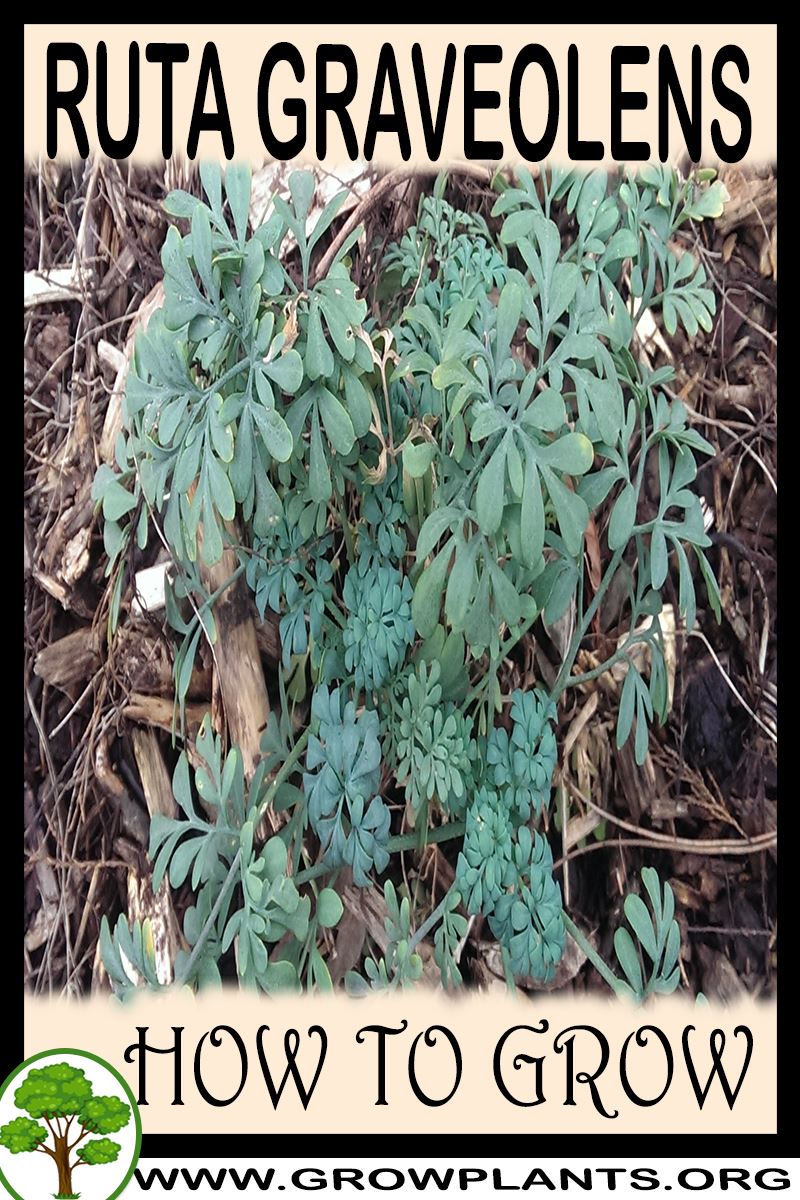
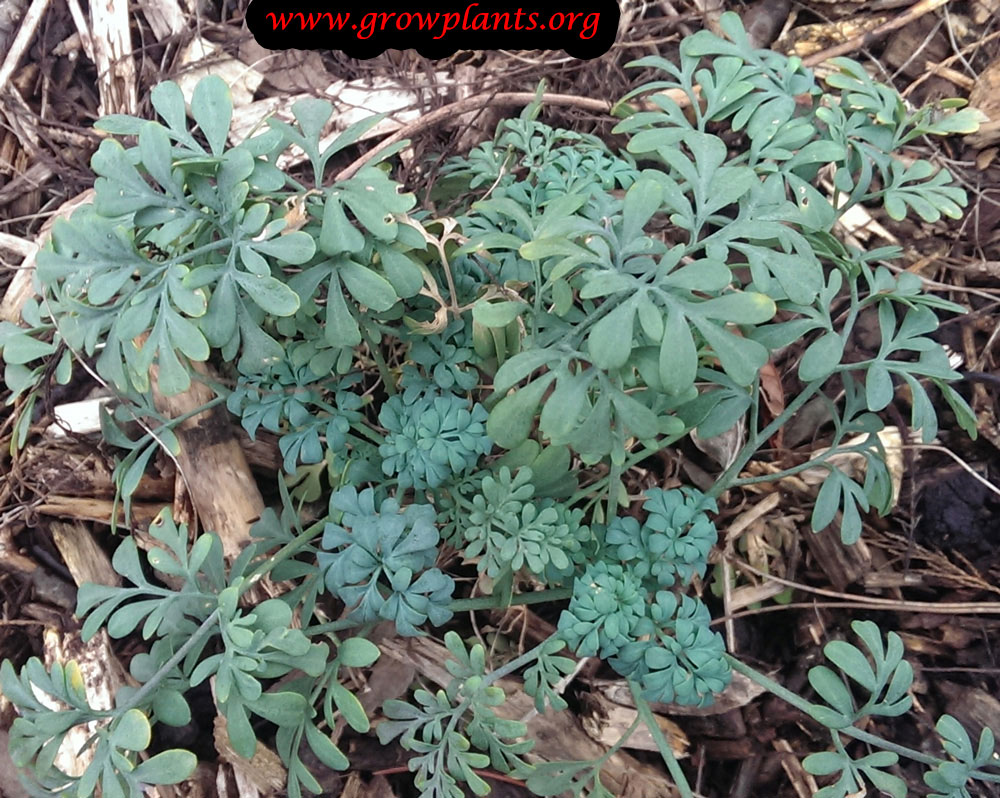
- Leaves & Foliage: Distinctive blue-green, lobed leaves in an odd-pinnate arrangement, strongly and pungently aromatic.
- Flower Characteristics: Yellow five-petalled flowers borne in clusters.
Primary Uses & Landscape Value
- Edible Uses: Used very sparingly as a bitter culinary herb and spice; potent, so only tiny amounts are used.
- Functional & Ornamental Roles: Grown as an aromatic blue-foliage ornamental, a medicinal herb and for stabilising ground; its allelopathy also suppresses weeds.
Care Guide: Planting, Soil & Watering
Overview: Common rue (Ruta graveolens), also known as rue, is an aromatic, evergreen sub-shrub grown as an ornamental and medicinal herb, suited to Mediterranean and subtropical climates (hardiness zones 9-11). It thrives in full sun in well-draining soil and, being drought-tolerant, needs only light watering.
Quick Care Requirements
| Requirement | Ideal Condition |
|---|---|
| Planting Season | Cool to warm season – spring or autumn |
| Growth Rate | Fast |
| Soil Type | Well-draining |
| Water Need | Low; let the soil dry between waterings |
Planting & Establishment
- Best Planting Season: Plant in the milder parts of the year – spring or autumn – once hard frost has passed.
- How to Plant:
- Hole Preparation: Dig a hole a little wider than the root ball and loosen the soil so the roots settle in easily.
- Soil Amendments: Little enrichment is needed; ensure sharp drainage, which this drought-tolerant herb values over rich soil.
- Planting Depth: Set the plant at the depth it grew in its pot, keeping the crown at the soil surface.
- Growth Speed & Expectations: A fast grower reaching about 40-80 cm, forming a rounded, woody-based clump of blue-green aromatic foliage.
Soil, Watering & Drainage Care
- Soil Mix & Drainage Needs: Give it well-draining soil so the roots never sit wet; it tolerates poor, dry ground and grows well in containers. Note it is allelopathic, so keep it away from plants it may suppress.
- Watering Schedule & Technique:
- Young / Newly Planted: Water regularly after planting to establish the roots, keeping the soil lightly moist at first.
- Established: Once established it is drought-tolerant and needs only small amounts of water; let the soil dry between waterings.
- Seasonal Adjustments: Water a little more in extended heat and very sparingly in cool or wet weather.
Climate, Light & Hardiness
Ruta graveolens (Rue) grows in mediterranean or subtropical climates and prefers full sun to half shade. Per the site's own data it is rated to approximately zone 9–11.
Quick Climate Specifications
| Climate Zones | Mediterranean and subtropical climates |
|---|---|
| USDA Hardiness Zones | Approximately 9–11 |
| Frost Tolerance | Low to Moderate |
| Light Conditions | Full Sun to Half Shade |
Sunlight & Light Exposure
Optimal Light Setup
Full sun to half shade both work for this drought-tolerant Mediterranean subshrub.
Temperature Extremes & Hardiness
USDA Hardiness & Regional Limits
Reliable outdoor culture is rated to approximately zone 9–11 on this site.
Cold Damage & Winter Protection
Well-drained soil is important through winter, since cold combined with wet roots is typically more damaging to this drought-adapted plant than cold alone.
Frost Sensitivity
At the cooler edge of its rated range, protect from hard freezes; a sheltered, well-drained site improves winter survival.
Wind, Humidity & Microclimate
Dry-Air Tolerance
As a Mediterranean-scrub-type subshrub, it is generally well suited to dry-air, drought-prone conditions once established.
Growing in Pots, Balconies & Indoors
Rue is not a houseplant – the grower marks it unsuitable indoors – but this compact, sun-loving evergreen (40-80 cm / 16-32 in) grows neatly in a pot on a patio or balcony, and can sit on a very sunny sill. Handle it with care: the sap is a strong skin and eye irritant, made worse by sunlight.
Quick Details
- Container Size: A pot of about 10-15 L (3-4 gal)
- Indoor Suitability: Not a room houseplant; a bright, sunny windowsill only
- Best Spot: Full sun to light shade
- Soil & Drainage: Free-draining, not-too-rich mix; it dislikes wet feet
- Watering in Pots: Water modestly and let the top dry between – it prefers things on the dry side
Indoors & On the Windowsill
- Safety first: Rue is toxic if eaten and its sap can cause painful blistering in sunlight – keep it well away from children and pets, and wear gloves when handling or pruning.
- Houseplant limits: Too light-hungry to thrive in a room; it needs strong direct sun.
- Windowsill growing: A sunny sill keeps its blue-grey foliage dense – but site it out of reach given the irritant sap.
On a Balcony or Patio
- Light & wind: Give it a hot, sunny spot; it is drought-tolerant, so let pots dry a little between waterings.
- Practicalities: Site it where people won’t brush past – the foliage can irritate skin on a warm day.
Choosing the Pot, Soil & Long-Term Care
- Pot & drainage: A 10-15 L pot with strong drainage holes; skip a standing-water saucer to avoid root rot. Terracotta breathes and dries faster; glazed or plastic holds moisture longer.
- Potting mix: A light, aerated, organic-rich mix – potting compost or peat/coir with added perlite or vermiculite for drainage.
- Feeding: Nutrients wash out of pots faster than open ground, so feed potted rue more often – a balanced liquid feed through the active growing season.
- Repotting: Refresh the top layer of mix each year and renew it or pot up every couple of years; lightly trim the roots and top growth when you do.
Fertilizing & Feeding
A drought-tolerant, fast-growing Mediterranean shrub, rue asks little of the soil; light, infrequent feeding keeps the blue-gray foliage healthy without encouraging weak, overly soft growth.
Quick Fertilizing Specs
| Feeding Level | Light feeder |
|---|---|
| Main Nutrient Priority | Balanced feeding with modest nitrogen for steady foliage growth |
| Best Feeding Period | Spring into the warm active growing season |
| Organic Options | A light compost top-dressing worked into well-drained soil |
| Reduce/Stop Feeding | Ease off as growth naturally slows in cooler months |
| Micronutrients | Usually adequate from soil; correct only diagnosed deficiencies |
| Soil pH | Tolerates a wide range provided drainage is good |
Feeding by Growth Stage
Establishment after planting
Root a new rue plant into well-drained soil and build a sturdy, bushy framework.
| Nutrient direction | A light, balanced feeding supports steady rooting without pushing soft, disease-prone growth. |
|---|---|
| Timing | At planting, in spring or autumn. |
| Frequency | A single light feeding at planting is usually enough. |
| Fertilizer types | A balanced, light-strength complete fertilizer, A light compost top-dressing |
| Precautions | Avoid rich soil or heavy feeding; rue is adapted to lean, well-drained conditions. Handle the foliage with gloves, as the sap can irritate skin in sunlight. |
Active growth
Keep the aromatic, blue-gray foliage full for ongoing use as an herb and to support the yellow flower clusters.
| Nutrient direction | Occasional light, low-nitrogen feeding is enough; this fast-growing shrub thrives without rich fertilizing. |
|---|---|
| Timing | Through spring and summer while the plant is actively growing. |
| Frequency | Feed only occasionally through the growing season; this shrub rarely needs more. |
| Fertilizer types | A balanced, light-strength complete fertilizer, A light compost top-dressing renewed occasionally |
| Precautions | Keep nitrogen modest; heavy feeding produces weak, sprawling stems and reduces the plant’s natural compact habit. |
Nutrient Deficiency Signs & Corrections
Overall pale, thin foliage and slower growth than expected for this typically fast grower.
| Possible causes | low available soil nitrogen, poor, sandy soil low in organic matter, nutrients leached by heavy watering or rain |
|---|---|
| Appears first on | older, lower leaves first |
| What to check | feeding history, soil organic matter, drainage and watering |
| Possible correction | Apply a light, balanced fertilizer and work in a little organic matter. |
New leaves emerge pale yellow while the veins stay green.
| Possible causes | high soil pH limiting iron availability, compacted or waterlogged roots, cold, wet soil slowing nutrient uptake |
|---|---|
| Appears first on | newest growth |
| What to check | soil pH and drainage, root health, recent watering |
| Possible correction | Improve drainage and aeration, and apply a chelated iron product per its label if soil is alkaline. |
Leaf tips brown or scorch on container-grown plants despite regular watering.
| Possible causes | fertilizer salt buildup in a pot with limited leaching, under-watering that concentrates salts, feeding more often than this light feeder needs |
|---|---|
| Appears first on | leaf tips and margins |
| What to check | recent feeding amounts, container drainage, watering consistency |
| Possible correction | Pause feeding, flush the pot thoroughly with plain water, then resume with lighter, less frequent feeding. |
Pruning, Training & Seasonal Maintenance
Rue is a fast-growing, woody-based mediterranean subshrub grown for its aromatic blue-gray foliage and clusters of small yellow flowers; it tolerates fairly frequent light shaping and, given its fast growth rate, recovers quickly from an annual tidy, best done in autumn/winter. The one point that overrides ordinary pruning technique for this species is safety, not horticulture: rue’s sap contains compounds that cause a phototoxic skin reaction – redness and blistering similar to a bad sunburn – where sap contacts skin that is then exposed to sunlight. Pruning this plant is therefore as much about protecting the person doing the cutting as about the plant itself.
Quick Pruning & Maintenance Specs
| Pruning Tolerance | Moderate–High |
| Primary Pruning Window | Autumn / Winter, for shaping and removal of infected leaves |
| Secondary Maintenance Window | Light summer deadheading of spent flower clusters, if a tidier look is wanted |
| Typical Frequency | One annual shaping cut, plus prompt removal of infected leaves whenever noticed |
| Main Objective | Compact aromatic mound; prompt removal of diseased foliage; safe handling of sap |
| Young Plant Priority | Light pinching for a bushy base – use the same skin protection as with mature plants |
| Mature Plant Priority | Annual within-leafy-growth shaping; prompt removal of infected leaves |
| Best Tool Type | Precision snips or bypass secateurs, plus gloves and covered arms as essential handling protection |
| Avoid Heavy Pruning During | Bright, strong midday sun with bare skin exposed – prune in early morning, evening, or overcast conditions instead |
Pruning by Plant Age & Size
Newly Established
Prune minimally, and use the same skin protection (gloves, covered arms) as for a mature plant – the phototoxic sap is present even in young growth.
Young / Formative
Pinch growing tips lightly to build a bushy, compact base on this naturally mounding subshrub; no formal training system or leader is needed.
Mature / Established
Give the plant one annual shaping cut that stays within leafy growth, and remove infected leaves promptly whenever they’re noticed rather than waiting for the next scheduled tidy.
Seasonal Pruning Schedule
Dormant / Winter (Autumn–Winter)
Objective: shape and renew. Remove dead, infected, and weak growth; avoid cutting into old, bare wood. Response: fresh, compact, aromatic growth the following spring.
Summer (optional deadheading)
Objective: tidiness only – not essential. Spent yellow flower clusters can be trimmed off if a neater look is wanted, but there is no crop or major bloom display being protected by leaving or removing them.
Structural Pruning & Training
Shape lightly each year to prevent the bare, woody center that mediterranean subshrubs like this tend toward if left unpruned; thin congested growth occasionally, since the plant’s fast growth rate can make it dense quickly.
Special Growth to Remove
Remove infected, diseased-looking leaves promptly – this is the plant’s own specific pruning guidance. Distinguish that from butterfly caterpillar feeding damage: rue is a well-known larval host plant for swallowtail-type butterflies, and caterpillar-chewed foliage is generally best left alone (it’s temporary and the plant recovers) unless defoliation becomes severe, since removing it would undo the very reason many gardeners grow this plant.
Container & Small-Space Pruning
The same shaping principles apply in a container, but sap-contact caution matters even more in small spaces such as near paths or patio seating, where skin is more likely to brush against the foliage – site and prune accordingly.
Tools
Precision snips or bypass secateurs are sufficient for this small subshrub (40–80 cm); no saw or loppers are needed. Gloves and long sleeves are essential handling gear for every pruning session on this plant, not just a nice-to-have.
Tool Hygiene & Disease Risk
Increased, not routine: since the plant’s own guidance specifically calls for removing infected leaves, clean or wipe down blades between cuts on diseased foliage (and between plants) so a leaf infection isn’t spread through the planting by the pruning tool itself.
Cut Placement & Technique
Remove infected leaves back to clean, healthy tissue as soon as they’re noticed. For routine shaping, use light heading cuts within leafy growth and avoid cutting into bare wood. Always wear gloves, since even a light trim brings skin into contact with the sap-bearing foliage.
Heavy Pruning & Rejuvenation
Avoid a hard rejuvenation cut into old, bare wood – like other woody mediterranean subshrubs, rue does not reliably resprout from leafless stems. If a plant becomes leggy and woody at the base, propagating fresh cuttings for replacement is more reliable than forcing a hard renovation cut.
Post-Pruning Care
Wash hands and forearms thoroughly after pruning, and change or wash any clothing that contacted sap before further sun exposure – this is the single most important aftercare step for this species. If infected leaves were removed, monitor the plant over the following weeks to confirm the issue hasn’t spread to new growth.
Common Pruning Mistakes
Pruning in bright midday sun with bare arms or no gloves, risking a phototoxic skin reaction; confusing butterfly-caterpillar feeding damage with disease and cutting off foliage that’s simply hosting desirable swallowtail larvae; and cutting into old bare wood expecting it to resprout.
When NOT to Prune
Avoid pruning in strong midday sun without protective clothing; avoid a hard structural cut into bare wood; and hold off removing caterpillar-chewed foliage if attracting swallowtail butterflies is a garden goal, unless defoliation is severe enough to threaten the plant’s health.
Recommended Tools (by task)
- precision_snips – for routine shaping and removal of infected leaves on this small subshrub.
- bypass_secateurs – for slightly thicker stems during the annual shaping cut.
- blade_disinfectant – to wipe down tools when removing infected leaves, given this plant’s specific susceptibility to leaf infection called out in its own care guidance.
Pruning Troubleshooting
| Problem | Possible Cause | What to Check | Corrective Action |
| Yellowing or spotted leaves needing removal | Fungal leaf infection, often worse in humid conditions | Inspect for lesion or spotting patterns on the foliage | Remove infected leaves promptly with a clean blade; thin growth lightly to improve airflow |
| Chewed or skeletonized foliage | Swallowtail-type butterfly caterpillars feeding (a desirable form of herbivory on this host plant) | Look for caterpillars before assuming the damage needs pruning | Leave caterpillar-fed foliage in place unless defoliation is severe – the plant recovers and the damage is temporary |
| Bare, leggy growth at the base | Delayed annual shaping, or a past cut made into old bare wood | Review pruning history and check for live leafy tissue lower on the stems | Resume annual shaping within leafy growth going forward; propagate cuttings for replacement if the base is already bare |
Propagation Guide
Rue grows readily from either seed or stem cuttings, so the choice comes down to speed and certainty: seed is fine since this is a straight species and not a hybrid cultivar, while semi-hardwood cuttings give a faster, guaranteed clone. Propagation is easy overall.
Quick Propagation Specs
| Best Propagation Method | Seed or semi-hardwood stem cuttings |
| Alternative Methods | Whichever of seed or cuttings is not used first |
| Propagation Difficulty | Easy |
| Seed True-to-Type | Yes (species) |
| Vegetative True-to-Type | Yes |
| Best Propagation Season | Seed: spring; Cuttings: late spring to summer |
| Seed Germination Time | Roughly 2–3 weeks, sometimes longer |
| Cutting Rooting Time | A few weeks |
| Germination Temperature | Warm, roughly 18–24°C (64–75°F) |
| Seed Sowing Depth | Shallow, lightly covered |
Growing from Seed
Seed Handling & Viability
Seed stores normally under cool, dry conditions; no special short-lived or recalcitrant behavior is noted for this species.
Sowing Season
Sow in spring once frost risk has passed, or start indoors earlier and transplant out after hardening off.
Sowing Depth & Orientation
Sow shallow, just lightly covered.
Germination Conditions
Keep warm and evenly moist.
Germination Time
Usually around 2–3 weeks, though it can take longer.
Seedling Care
Harden off and transplant once seedlings have several true leaves; rue also self-sows readily where the climate suits it.
Stem Cuttings
Cutting Type
Softwood or semi-hardwood tip cuttings.
Best Timing
Late spring through summer.
Cutting Preparation
Take a few centimetres of stem and remove the lower leaves. The foliage sap is a known skin irritant that can cause photosensitivity (phytophotodermatitis) in some people, so wear gloves when taking cuttings and avoid letting sap-contacted skin be exposed to strong sun afterward.
Rooting Setup
A well-drained cutting mix kept warm and humid.
Rooting Hormone
Optional – not required, but it can speed and even up rooting.
Rooting Time
Typically a few weeks.
Bloom & Flower Guide
Quick Details
- Bloom Season: Summer
- Flower Appearance: Yellow four- to five-petalled flowers with wavy edges, borne in loose clusters
- Edibility: Not edible – rue is a toxic plant, and the flowers should not be eaten
Detailed Blooming Overview
Rue (Ruta graveolens) flowers in summer, carrying clusters of bright yellow blooms with distinctive frilled, cupped petals above its blue-green foliage. It is a handsome and long-flowering herb, but very much an ornamental and traditional plant rather than a culinary one.
Flower Characteristics
- Yellow flowers with four to five ruffled petals.
- Borne together in loose clusters at the tops of the stems.
Bloom Care & Thinning
- Safety first: Rue is toxic if eaten, and its sap is phototoxic – contact with skin followed by sunlight can cause serious blistering burns. Wear gloves when handling or deadheading, and keep the flowers and foliage off the plate.
- Pollination: Worked by bees and butterflies.
- Managing the bloom: No thinning is needed; trim spent flower heads (with gloves) to tidy the plant or limit self-seeding.
Fruit & Uses
Common rue is grown mainly for its blue-gray, aromatic, deeply lobed leaves, which are used as a strong bitter herb rather than a vegetable. The leaves are used fresh or cooked, but only in small, occasional amounts – this is a flavoring herb, not a salad green.
Quick Edible Specs
| Edible Parts | Leaves (used sparingly as a bitter herb) |
|---|---|
| Main Use(s) | Herb / spice in small quantities; traditionally used medicinally |
| Eaten Raw or Cooked | Either, but always in very small (a few leaves) quantity |
| Preparation Required | None beyond harvesting a small sprig; avoid skin contact with sap/foliage in bright sun |
| Harvest Season | All year, once the plant is established |
| Time to First Harvest | After the plant is established and has enough foliage to spare (see Propagation for establishment time) |
| Storage | Best used fresh; can be dried for later use as a seasoning |
| Safety/Toxicity Caveat | Rue foliage and sap are phototoxic – contact with skin followed by sun exposure can cause burning and blistering (phytophotodermatitis). Eating more than a small, occasional amount is discouraged; rue is traditionally avoided in pregnancy. Wear gloves when handling and harvest with care. |
Leaves & Greens
The blue-gray, lobed leaves are picked by trimming a stem section once the plant is established; harvest is possible year-round. Only a few leaves are used at a time as a pungent, bitter seasoning in some Mediterranean and Ethiopian dishes, cheeses, and infused spirits – never as a bulk cooked green, since the flavor is intense and the plant is only safe to eat in small amounts.
Preparation, Uses & Safety
Use rue the way a strong bitter herb is used: a few fresh or dried leaves to flavor a dish, cheese, or infusion, not a handful eaten on its own. Always handle the fresh plant with care and avoid prolonged bare-skin contact in strong sunlight, since the sap can cause phototoxic skin reactions. Because rue is toxic in larger doses and is traditionally avoided during pregnancy, keep any culinary use occasional and in trace amounts, and do not treat it as a everyday leafy vegetable. Rue has a long history of traditional medicinal use, but no dosing or health claims are made here – anyone considering internal use beyond a light culinary pinch should treat it with caution.
Pests, Diseases & Troubleshooting
Overview: Common rue / Herb-of-grace (Ruta graveolens) is a strongly aromatic, resinous Mediterranean herb that is famously pest-repellent and largely disease-free – its bitter, pungent oils deter most insects. The classic culinary/medicinal rue, strongly scented and reliably pest-repellent. Genuinely few creatures trouble it: the striking exception is the caterpillars of swallowtail butterflies, which feed on rue as a host plant, plus the odd aphid, whitefly or spider mite on stressed plants; its main real danger is root rot in wet soil. Note a key human-safety issue – rue sap causes blistering skin burns in sunlight.
Quick Troubleshooting Overview
| Issue / Pest | Main Symptom | Primary Solution |
|---|---|---|
| Swallowtail caterpillars | Green/black-banded caterpillars eating leaves | Hand-pick and relocate (beneficial butterflies) |
| Aphids (rare) | Curled tips, honeydew on soft growth | Water jet, beneficials, insecticidal soap |
| Whiteflies / spider mites | Sticky leaves or stippling on stressed plants | Insecticidal soap/oil, rinse foliage |
| Root rot | Yellowing, wilting, blackened base in wet soil | Improve drainage, reduce watering |
| Phytophotodermatitis (human) | Blistering skin burns after sap + sun | Wear gloves/long sleeves; handle in shade |
Common Pests & Management
- Swallowtail butterfly caterpillars (Papilio spp. (e.g. P. machaon)):
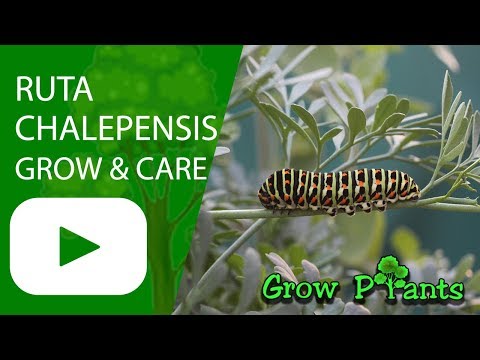
- Symptoms: Boldly banded green, black and yellow (or dark) caterpillars chew the leaves and can defoliate stems; rue is a natural larval host plant, so their presence is expected rather than a true infestation.
- Prevention & Control: These become beneficial pollinating butterflies, so the kindest control is simply to hand-pick and relocate caterpillars to a spare plant, or tolerate the modest feeding on established rue. Grow an extra plant to share if you wish to support the butterflies; avoid spraying, which needlessly kills them.
- Aphids (uncommon) (Aphis / Myzus spp.):
- Symptoms: Occasional small clusters on the softest new tips, with slight distortion and honeydew; rue’s strong oils usually keep numbers low.
- Prevention & Control: Blast off with water and support lady beetles and lacewings; insecticidal soap handles the rare stubborn colony. Avoid excess nitrogen that softens growth.
- Whiteflies and spider mites (minor) (Trialeurodes vaporariorum / Tetranychus urticae):
- Symptoms: Tiny white flies or fine stippling and webbing appear only on stressed, sheltered or greenhouse plants in hot, dry, still air.
- Prevention & Control: Improve airflow and light, rinse foliage and reduce stress, and use yellow sticky traps for whitefly; treat any hot-spot with insecticidal soap or light horticultural oil.
Diseases & Fungal Issues
- Root and crown rot (Phytophthora / Pythium / Rhizoctonia spp.):
- Symptoms: Yellowing, wilting and a soft, blackened base in heavy, waterlogged or overwatered soil; this drought-loving Mediterranean herb is very intolerant of wet feet, which is its commonest cause of death.
- Treatment & Management: Plant in gritty, free-draining soil in full sun, water sparingly and only when dry, and never let it sit wet; raised beds or pots suit it well. Remove and destroy rotted plants – there is no cure once the crown rots, so drainage is everything.
- Leaf spot / stem blight (minor) (Cercospora / Alternaria spp.):
- Symptoms: Occasional brown spots or dieback on shoots in unusually humid, crowded or overhead-watered conditions; rare on a plant that prefers dry, airy sites.
- Treatment & Management: Space plants, water at the base, and prune out affected growth for airflow; hygiene is enough and fungicides are essentially never needed.
Growing Difficulties & Abiotic Problems
- Phytophotodermatitis – sap-and-sun skin burns (SAFETY):
- Cause & Symptoms: Rue’s sap contains furanocoumarins that, on skin exposed to sunlight, cause painful redness, blistering and long-lasting brown staining – a genuine hazard when pruning or handling in sun.
- Correction Strategy: Always wear gloves, long sleeves and eye protection when cutting or handling rue, prune in the shade or evening, and wash skin promptly and keep it out of sun afterward; site the plant away from paths where people brush against it.
- Root rot from overwatering / heavy soil:
- Cause & Symptoms: Yellowing, collapse and base decay in wet, poorly drained ground – the main way rue is lost.
- Correction Strategy: Grow lean and dry: gritty free-draining soil, full sun, and sparing water; avoid rich, wet ground and mulch piled on the crown.
- Legginess and winter dieback:
- Cause & Symptoms: Old plants grow woody, sparse and leggy, and soft growth can be cut back by hard frost.
- Correction Strategy: Trim lightly in the growing season to keep the plant bushy (wearing gloves), avoid cutting hard into old wood, and give a sheltered spot or light protection where winters are severe.
What Helps – Products & Tools
Rue barely needs any inputs: hand-picking (or sharing) swallowtail caterpillars, insecticidal soap or light horticultural/neem oil for the rare aphid, whitefly or mite, and – most importantly – gritty, free-draining soil to prevent root rot. Keep protective gloves and long sleeves on hand for safe pruning. Fungicides are essentially never required. Apply any oil in the evening to protect pollinators.