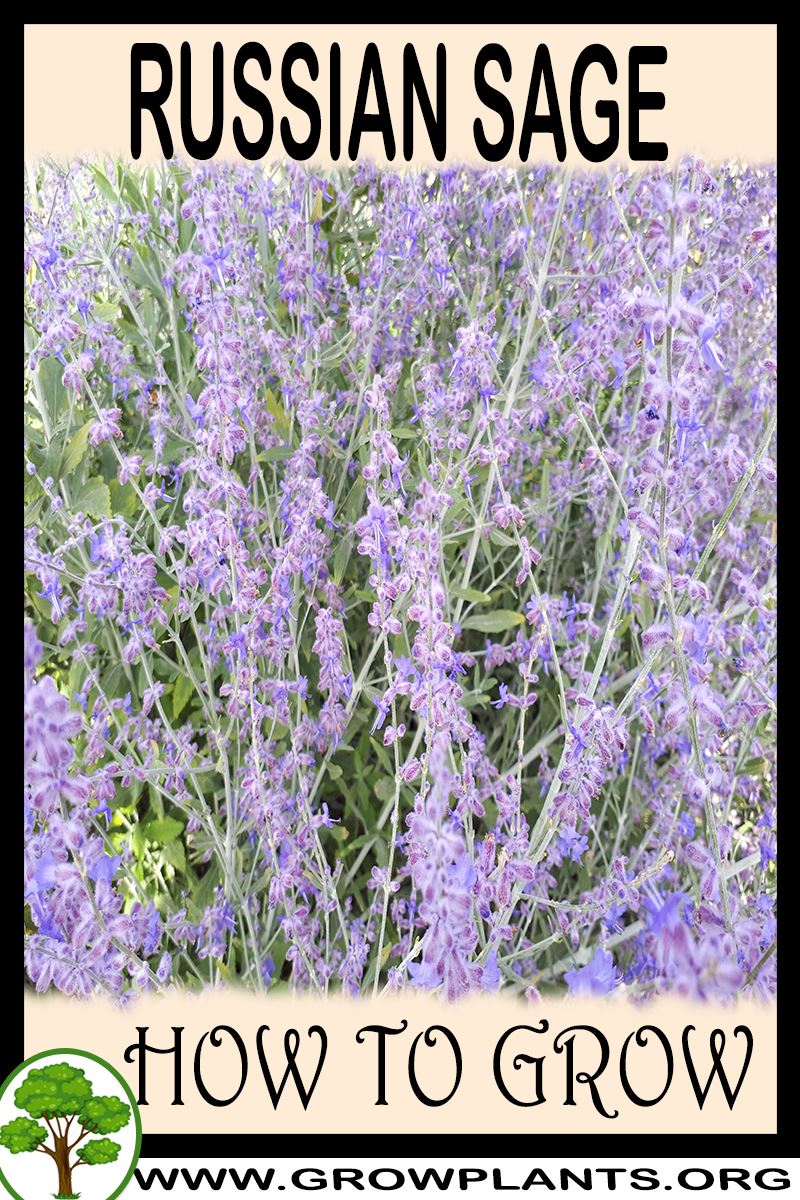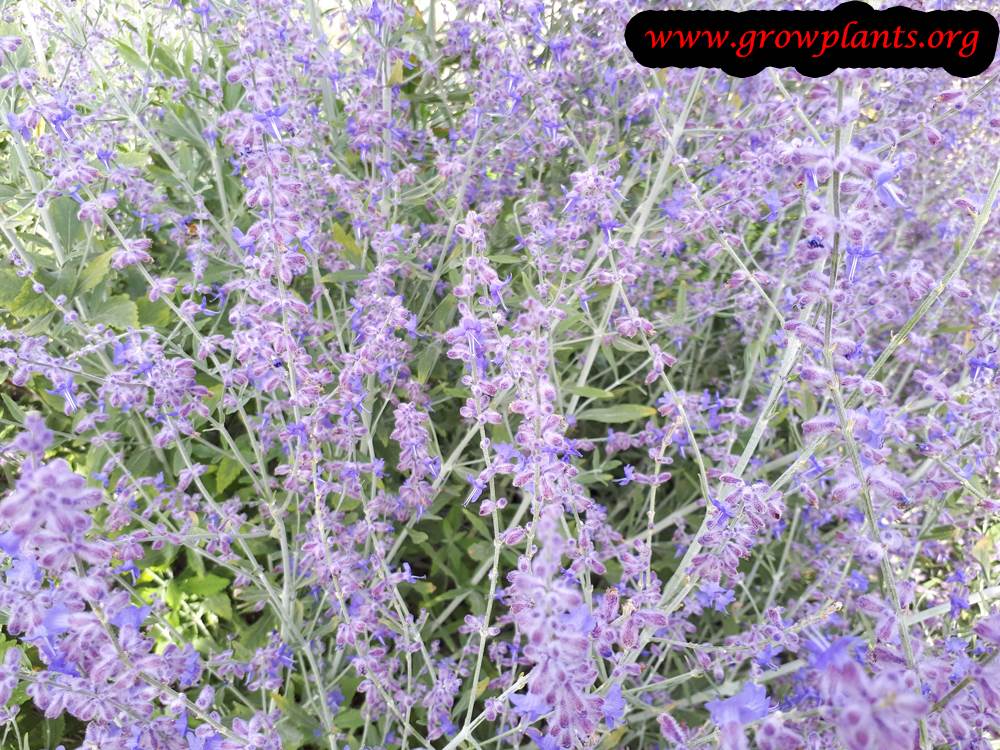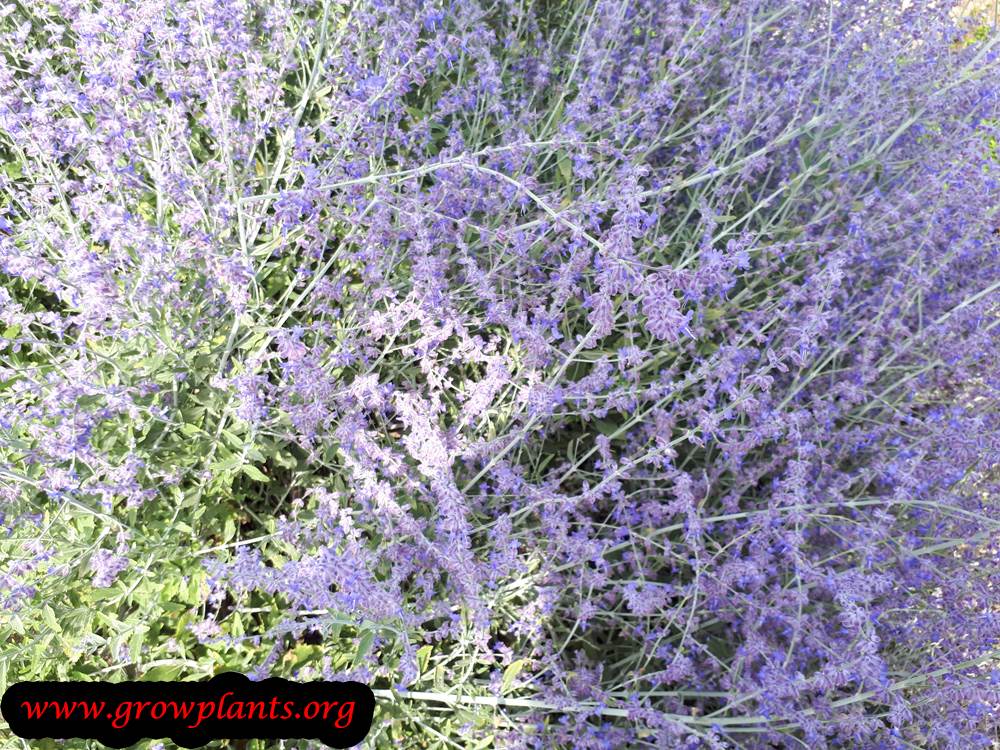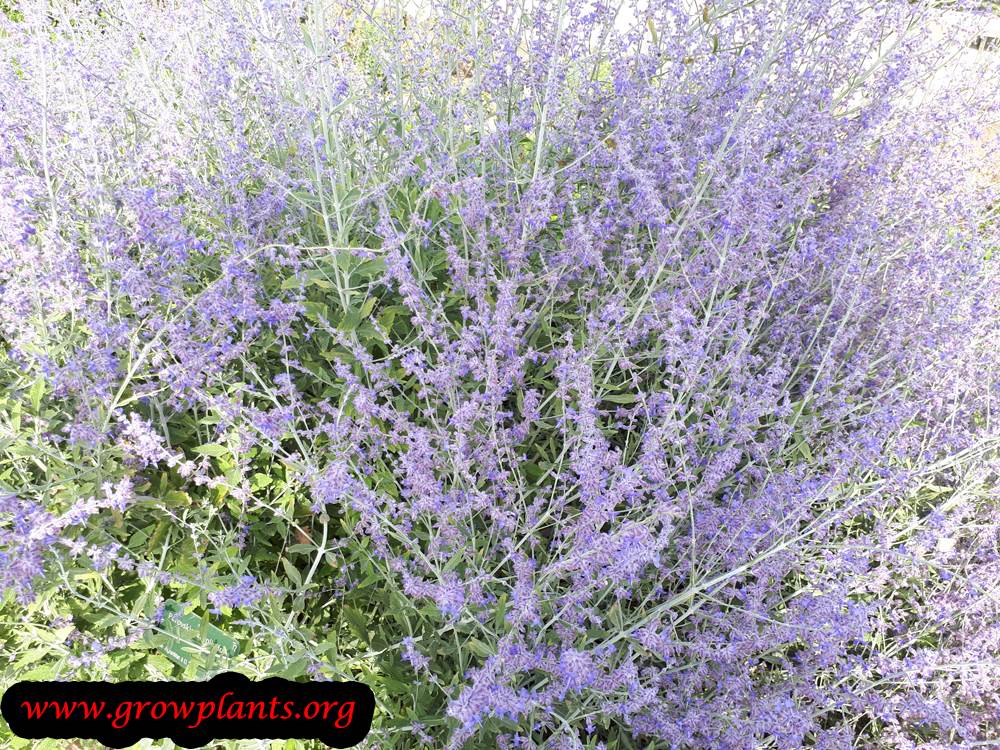
Plant Profile & Key Characteristics
Overview: A woody-based deciduous (semi-evergreen where mild) subshrub reaching about 0.3-1 m (1-3 ft), grown for its aromatic silvery foliage and long haze of blue-purple flowers. It is a drought-tolerant, pollinator-friendly ornamental.
Quick Specifications
| Specification | Attribute |
|---|---|
| Plant Type / Life Cycle | Woody-based herbaceous subshrub (perennial) |
| Foliage Type | Deciduous (semi-evergreen in warm climates) |
| Mature Size | 0.3-1 m (1-3 ft) tall |
| Growth Rate | Fast to moderate |
| Toxicity | Non-toxic — the flowers are edible and used as a flavouring |
| Hardiness | USDA zones 4-10 |
Growth Form & Structure
- Height & Spread: Forms an airy, upright clump 0.3-1 m (1-3 ft) tall in the ground; also grows well in a container.
- Growth Habit & Form: An open, upright subshrub with slender grey-white stems; hard-pruned in late winter to keep it dense and floriferous.
- Lifespan & Maturity: A hardy perennial that reaches full size quickly each season and is long-lived where summers are not warm and humid.
Anatomy & Physical Features
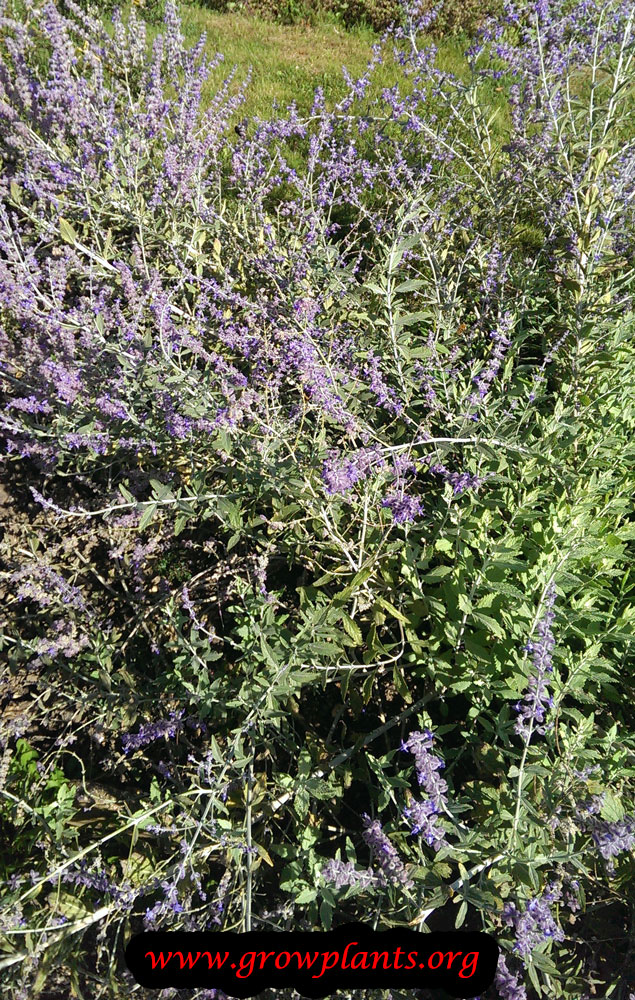
- Leaves & Foliage: Aromatic, grey-green, lance-shaped leaves with lobed margins that release a sage-like scent when brushed.
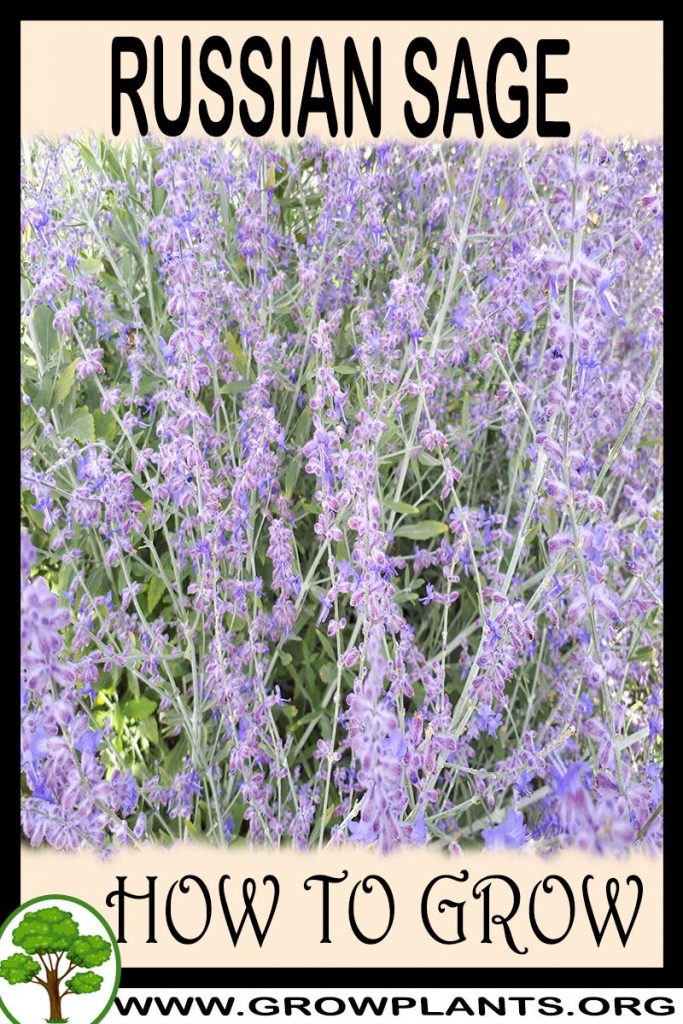
- Flower Characteristics: Tiny blue to purple flowers borne in a long, branching haze on the upper stems, attracting bees.
Primary Uses & Landscape Value
- Edible Uses: The flowers are edible — used raw in salads and as a flavouring.
- Functional & Ornamental Roles: A drought-tolerant border, gravel-garden and mass-planting ornamental valued for its aromatic silvery foliage, airy late-season colour and value to pollinators.
Care Guide: Planting, Soil & Watering
Overview: Perovskia atriplicifolia (Russian sage) is a sun-loving, aromatic woody perennial for temperate to subtropical zones (4–10). It needs full sun and sharply drained soil, and once established is notably drought-tolerant while disliking warm, humid, wet conditions.
Quick Care Requirements
| Requirement | Ideal Condition |
|---|---|
| Planting Season | Cool season through spring, from winter to early summer |
| Growth Rate | Moderate to Fast |
| Soil Type | Sharply drained, lean; tolerates poor, dry soil |
| Water Need | Low to Moderate – let the soil dry well between waterings |
Planting & Establishment
- Best Planting Season: Plant in the cool season through spring – from winter to early summer – while the soil is workable.
- How to Plant:
- Hole Preparation: Dig a hole about twice the width of the root ball and no deeper than its height, loosening the sides so young roots can spread easily.
- Soil Amendments: Add grit or coarse sand to improve drainage rather than rich, moisture-holding amendments; it thrives in lean soil.
- Planting Depth: Set the plant so the root collar sits level with the surrounding soil – never bury the stem – then firm gently and water in.
- Growth Speed & Expectations: A quick grower that forms an airy, upright clump within a season or two.
Soil, Watering & Drainage Care
- Soil Mix & Drainage Needs: Demands sharp drainage and tolerates lean, dry, even poor soils; heavy, wet ground – especially in warm, humid summers – is its main enemy. Improve drainage with grit rather than moisture-holding matter.
- Watering Schedule & Technique:
- Young / Newly Planted: Water regularly through the first season to establish a deep root system.
- Established: Once established it is highly drought-tolerant – water sparingly and let the soil dry well between waterings.
- Seasonal Adjustments: Give occasional deep drinks in prolonged summer drought and keep it dry over winter; avoid warm, wet, poorly drained conditions.
Climate, Light & Hardiness
Russian sage is a tough, drought-tolerant subshrub suited to temperate and subtropical climates, growing deciduous in cold winters and semi-evergreen where conditions stay mild. It demands full sun and is reliably cold-hardy from USDA zone 4 through 10.
Quick Climate Specifications
| Climate Zones | Temperate, subtropical |
|---|---|
| USDA Hardiness Zones | 4–10 |
| Light Conditions | Full sun |
| Frost Tolerance | High |
Sunlight & Light Exposure
Direct Sun Requirement
Needs full sun for its characteristic upright, silvery growth and best flowering; shade leads to floppy, sparse plants.
Temperature Extremes & Hardiness
USDA Hardiness & Regional Limits
Cold-hardy from zone 4 through 10, dying back to woody or semi-woody stems in cold winters and regrowing vigorously each spring.
Growing in Pots, Balconies & Indoors
Russian sage (Perovskia atriplicifolia) is a hardy, sun-loving, aromatic sub-shrub – not a houseplant, but a fine container plant for a hot, sunny balcony or patio. The grower confirms it grows well in pots; indoors the light is far too weak, so keep it outdoors where its silvery foliage and airy blue spikes can bask in full sun.
Quick Details
- Container Size: A roomy pot for a 0.3-1 m shrub – around 15-30 L so the woody roots have space and the pot stays stable
- Indoor Suitability: Not a houseplant; a sun-lover that needs to be outdoors
- Best Spot: Full sun – the hotter and brighter, the better
- Soil & Drainage: Lean, gritty, sharply drained mix – it hates wet, rich soil
- Watering in Pots: Modest – drought-tolerant once established; water when the mix dries, never keep it soggy
Indoors & On the Windowsill
- Not a houseplant: The grower marks it ‘no’, and indoors it would starve for light and sulk in still, humid air. Keep it outside.
- Overwintering: It is very cold-hardy, so it does not need to come indoors; in a pot it simply dies back and reshoots from the base. Cut it back hard at the end of the dormant season.
On a Balcony or Patio
- Light & wind: Give it the sunniest spot; the airy stems shrug off wind and reflected wall heat suits it well. Pots dry faster than open ground, so check moisture in prolonged heat.
- Weight: Use a stable pot – the tall, wiry stems can catch the wind once in full growth.
Choosing the Pot, Soil & Long-Term Care
- Pot & drainage: A stable pot with strong drainage holes; add grit for sharp drainage. Terracotta breathes and dries quickly (good for plants that dislike wet feet); glazed or plastic pots hold moisture longer. Skip a standing saucer – it loathes wet feet.
- Potting mix: Lean and gritty rather than rich – a free-draining mix with added sand or grit suits its Mediterranean-steppe roots.
- Feeding & repotting: Feed only lightly – too much richness makes it flop. Refresh the top few centimetres of mix each year and pot up (or root-prune and return with fresh mix) about every two years.
Fertilizing & Feeding
Russian sage is adapted to lean, well-drained soil and generally performs best with minimal feeding; rich fertilizing tends to produce weak, floppy growth in this fragrant sub-shrub.
Quick Fertilizing Specs
| Feeding Level | Light – a drought- and lean-soil-adapted perennial that resents rich feeding |
|---|---|
| young_feeding | Light, balanced feeding while a young plant builds its root system |
| mature_feeding | Minimal feeding once established; lean soil keeps growth sturdy and upright |
| Main Nutrient Priority | Balanced feeding is enough – heavy nitrogen produces weak, floppy stems |
| Best Feeding Period | Early in the growing season, as new growth emerges in spring |
| Organic Options | A light topdressing of compost in spring is usually sufficient |
| Micronutrients | No routine micronutrient program is needed for this tough, adaptable perennial |
| Soil pH | Tolerates a wide range of soil pH and prefers lean, well-drained soil |
| Reduce/Stop Feeding | Feeding is unnecessary once the plant enters winter dormancy |
Feeding by Growth Stage
Spring Growth Flush
Support the flush of new stem and leaf growth as the plant breaks winter dormancy.
| Nutrient direction | A light, balanced feeding at the start of new growth is enough for this lean-soil-adapted perennial. |
|---|---|
| Timing | As new growth emerges in spring. |
| Frequency | A single light feeding at the start of the season is usually all this plant needs. |
| Fertilizer types | A balanced, complete fertilizer applied lightly at the start of spring growth, A light topdressing of compost worked around the base |
| Precautions | Avoid heavy or frequent feeding, which encourages soft, floppy stems that tend to sprawl later in the season. |
Bloom Period
Sustain flowering and pollinator-attracting bloom from summer into autumn.
| Nutrient direction | Established plants rarely need supplemental feeding to sustain bloom; steady growth on minimal fertilizer input is normal for this species. |
|---|---|
| Timing | Through the summer-to-autumn bloom period. |
| Frequency | Feeding is rarely necessary once the plant is established and flowering. |
| Fertilizer types | A light, balanced feeding only if growth looks weak or pale – otherwise minimal feeding is standard at this stage |
| Precautions | Rich feeding during bloom tends to reduce flowering and promote leafy, floppy growth instead. |
Winter Dormancy
Let the plant rest through winter dormancy ahead of its hard cut-back and next season’s growth.
| Nutrient direction | None – withhold fertilizer while the plant is dormant. |
|---|---|
| Timing | Through winter dormancy. |
| Frequency | No feeding at this stage. |
| Fertilizer types | No feeding at this stage – the dormant plant has no active growth to support |
| Precautions | Do not fertilize a dormant plant; wait until new growth resumes in spring. |
Nutrient Deficiency Signs & Corrections
Foliage looks pale and undersized, with slow, weak new growth.
| Possible causes | Nitrogen deficiency, Very poor, depleted soil with little organic matter, Root stress from waterlogged or compacted soil |
|---|---|
| Appears first on | New growth and overall plant vigor. |
| What to check | Soil organic matter and overall fertility, Drainage and compaction around the root zone, Recent feeding history and plant age |
| Possible correction | A light, balanced feeding at the start of the growing season is usually enough to correct mild nitrogen deficiency. |
New leaves turn yellow between the veins while the veins themselves stay green.
| Possible causes | Iron deficiency (chlorosis), High soil pH limiting iron availability, Waterlogged or poorly aerated soil restricting root uptake |
|---|---|
| Appears first on | Newest leaves. |
| What to check | Soil pH, especially in alkaline garden soil, Drainage around the root zone, Whether yellowing is specific to new growth |
| Possible correction | Correct soil pH toward a more favorable range and apply a chelated iron product per its label if chlorosis is confirmed. |
Older leaf margins develop a scorched, dry brown edge and stems can feel weak or thin.
| Possible causes | Potassium deficiency, Drought stress or inconsistent watering, Sandy or fast-draining soil that leaches nutrients quickly |
|---|---|
| Appears first on | Older, lower leaves and leaf margins. |
| What to check | Watering consistency and recent drought stress, Soil type and drainage, Whether scorch follows a leaf-margin pattern |
| Possible correction | A balanced feeding with adequate potassium, along with consistent watering, typically resolves mild scorch. |
Pruning, Training & Seasonal Maintenance
Russian sage is a woody-based subshrub that dies back to a low framework of woody stems in cold winters and behaves as a fast-rebounding perennial the rest of the year, so it tolerates hard, once-a-year pruning very well. The main objective is to cut the previous year’s growth back to a compact woody base before new shoots emerge, since flowers form on the current season’s new growth – a hard early-spring cutback shapes the plant and drives vigorous flowering wood rather than reducing bloom. The safest window is late winter to early spring, once the coldest weather has passed but before new basal growth is well underway.
Quick Pruning & Maintenance Specs
| Pruning Tolerance | High – resprouts readily from a hard annual cutback |
| Primary Pruning Window | Late winter–early spring, before new basal growth is well underway |
| Secondary Maintenance Window | Light deadheading in summer/early autumn if a tidier look is wanted |
| Typical Frequency | Once annually (hard cutback); optional light deadheading through summer |
| Main Objective | Rejuvenate the woody framework, keep a compact habit, maximize flowering wood |
| Young Plant Priority | Let the plant establish in its first year; pinch tips to build a bushier base |
| Mature Plant Priority | Annual hard cutback to a low woody framework each spring |
| Best Tool Type | Bypass secateurs for individual stems; hedge shears for the once-a-year mass cutback |
| Avoid Heavy Pruning During | Autumn (removes winter structure) and mid-summer bloom |
Pruning by Plant Age & Size
Newly Established
Minimal – in its first year let the plant put on root and stem growth; avoid a hard cutback before the woody base is established.
Young / Formative
No formal training system is needed for this free-standing subshrub. Pinching the soft tips once or twice in the first growing season encourages more branching from the base, producing a fuller, less leggy plant going into its first winter.
Mature / Established
From the second year on, the priority is the annual hard cutback of all of last year’s growth down to a low woody framework in early spring, which keeps the plant compact, upright and floriferous instead of sprawling and woody-legged.
Seasonal Pruning Schedule
Dormant/Winter
Leave the previous season’s stems standing through winter rather than cutting back in autumn – the dry stems add winter interest and give the crown some physical protection from cold. Do not remove them yet.
Pre-Growth/Early-Spring
This is the main pruning event: once the hardest cold has passed but before new growth is well developed, cut all of last year’s stems back hard to a low woody framework roughly 15–30 cm (6–12 in) above ground, cutting just above the lowest visible live buds. This forces a flush of new growth that carries the season’s flowers.
Summer Canopy Management
Optional light deadheading of spent flower spikes back to the first set of leaves can tidy the plant and encourage some rebloom, but it is not required for the plant’s health.
Ongoing Sanitary
Remove any winter-killed or broken stems as noticed; this is minor compared with the single annual hard cutback.
Flowering & Fruiting Wood
Russian sage flowers on current-season (new) growth, not on old wood. Because of this, the hard early-spring cutback does not remove the coming season’s flowers – it stimulates the vigorous new shoots that will carry them, typically blooming through summer into autumn. Pruning too late, after new growth is already well developed, wastes some of that new growth and delays the display; pruning in autumn removes winter structure for no flowering benefit, since next year’s flowering shoots have not yet formed.
Structural Pruning & Training
The main structural lever is the annual hard cutback itself: cutting all stems back to a uniform low framework each spring is what keeps this fast-growing subshrub compact and upright rather than sprawling, floppy and bare at the base. No canopy thinning or multi-tier framework is needed – it is a mass renewal cut, not selective branch architecture.
Special Growth to Remove
- Dead or winter-damaged stems: remove at any time noticed.
- Spent flower spikes: optional deadheading for tidiness or light rebloom, not essential to plant health.
Container & Small-Space Pruning
Russian sage grows well in containers, and the same annual hard cutback is even more important there to keep the plant in proportion to the pot rather than becoming top-heavy and woody. In containers, water moderately after cutback rather than heavily – this plant prefers lean, well-drained conditions and a pot holds moisture longer than open ground, raising rot risk if overwatered.
Tools
Bypass secateurs for precise cuts on individual stems and for deadheading; hedge shears are a genuine time-saver for the once-a-year uniform cutback of the many pencil-thin stems to a single low height, since this is a non-selective mass cut rather than branch-by-branch shaping.
Tool Hygiene & Disease Risk
Routine – Russian sage has no notable graft-transmissible or tool-spread disease risk documented; clean, sharp tools are sufficient for the annual cutback and any deadheading.
Cut Placement & Technique
When cutting back in spring, cut just above a pair of visible live buds low on the woody stems – check that the stem is green/pliable at the cut point, since cutting into fully bare, dead wood below the lowest live buds leaves a stub that will not resprout. For deadheading, cut the spent flower spike back to the first set of healthy leaves below it.
Heavy Pruning & Rejuvenation
Well tolerated and, in fact, routine: the annual hard cutback to a low woody framework is the standard maintenance practice for this plant, not an occasional rejuvenation measure. An older plant that has become leggy or sparse at the base can be cut back this hard every year without harming flowering, since bloom comes from the resulting new growth.
Post-Pruning Care
Water moderately after the spring cutback to support the new flush of growth, but avoid heavy or frequent watering – this species is documented as sensitive to warm, moist conditions and prone to crown or root problems in soggy soil, so err on the dry side, especially in humid climates. No extra feeding is needed; lean, well-drained soil is what it prefers.
Common Pruning Mistakes
- Cutting back hard in autumn instead of spring, which removes the winter structure and crown protection for no benefit.
- Delaying the spring cutback until new growth is already well developed, wasting new shoots and delaying bloom.
- Cutting into completely bare, dead wood below the lowest live buds, leaving stubs that fail to resprout.
- Overwatering after a hard cutback, which raises the risk of crown or root rot in this rot-prone, warm-humidity-sensitive plant.
When NOT to Prune
Avoid cutting back in autumn (removes winter interest and crown protection for no gain). Avoid a hard cutback during a stretch of warm, wet or humid weather, since this plant is documented as sensitive to warm, moist conditions and freshly cut stems are more vulnerable to rot in those conditions.
Recommended Tools (by task)
- bypass_secateurs – precise cuts on individual woody stems above live buds, and for deadheading spent flower spikes.
- hedge_shears – fast, uniform cutback of the many thin stems to one low height during the single annual spring renewal cut, where selecting each stem individually is not necessary.
- precision_snips – pinching soft new tips on young plants to build a bushier base.
Pruning Troubleshooting
| Problem | Possible Cause | What to Check | Corrective Action |
| Floppy, leggy growth | Not cut back hard enough the previous spring, or insufficient sun | Height of last cutback; hours of direct sun | Cut closer to the low woody framework next spring; ensure full sun |
| Cut stems fail to resprout | Cut made into bare, dead wood below any live buds | Presence of green/live tissue at and below the cut | Next time, cut higher, just above the lowest visible live buds |
| Dieback or rot after cutback | Warm, humid or waterlogged conditions following pruning | Soil drainage and recent rainfall/irrigation | Improve drainage, water moderately, avoid cutting back right before wet weather |
| Reduced flowering | Old, un-renewed woody framework with weak new growth | Whether the annual hard cutback has been skipped in recent years | Resume the annual early-spring hard cutback |
Propagation Guide
Russian sage is most reliably propagated from softwood stem cuttings taken in late spring to early summer, which root readily and preserve the exact look of the parent plant; seed is possible (the site notes vegetative reproduction is not strictly necessary) but germinates more slowly and unevenly and will not reproduce named cultivars true to type. Propagation is generally Easy by cuttings, though slower and less predictable from seed.
Quick Propagation Specs
| Best Propagation Method | Softwood stem cuttings |
| Alternative Methods | Seed; division of self-rooted basal shoots |
| Propagation Difficulty | Easy |
| Seed True-to-Type | Usually true-to-type for the species; cultivar-dependent for named selections |
| Vegetative True-to-Type | Yes |
| Best Propagation Season | Late spring to early summer for cuttings; site lists winter, spring or summer as the general planting season |
| Cutting Rooting Time | Typically a few weeks under warm, humid conditions |
Growing from Seed
Sowing Season
Seed can be started in spring.
Germination Conditions
Germination tends to be slow and irregular; consistent warmth and light, even soil moisture improve results.
Seedling Care
Give seedlings full sun; avoid keeping them constantly wet, since the site notes this plant is sensitive to warm, moist summer conditions.
Stem Cuttings
Cutting Type
Softwood or semi-hardwood tip cuttings, taken from non-flowering shoots.
Best Timing
Late spring to early summer, within the site’s spring/summer planting window.
Cutting Preparation
Take a cutting a few centimetres/inches long, remove the lower leaves, and cut just below a node.
Rooting Setup
Insert into a free-draining, gritty or sandy mix; keep humidity up but avoid waterlogging, since the site notes the plant is sensitive to warm, moist conditions and prefers well-drained soil.
Rooting Hormone
Optional – cuttings generally root well without it, though a light dip can speed and even out rooting.
Rooting Time
Usually a few weeks.
Division, Offsets, Pups & Suckers
Where the woody base has produced separate rooted shoots at ground level, these can be lifted with roots attached and replanted in spring; the mature woody clump itself is not well suited to being cut apart.
Bloom & Edible Flower Guide
Quick Details
- Bloom Season: Summer to autumn
- Time to First Bloom: Usually from its second year, as the subshrub establishes
- Flower Appearance: Airy spikes of small blue-purple flowers held on silvery stems
- Edibility: Edible – the blue-purple flowers can be eaten raw, scattered in salads or used to flavor dishes
Detailed Blooming Overview
Russian sage is grown for its long, hazy season of bloom: from summer into autumn its silvery stems carry clouds of small blue-purple flowers that hum with bees. The whole plant is aromatic, and the flowers can be used sparingly in the kitchen. Left standing, the flowering stems also look good into winter before their spring cut-back.
Flower Characteristics
- Small blue-purple flowers strung along branching, spike-like inflorescences.
- Carried on silvery-white, aromatic stems.
- Very attractive to bees and other pollinators.
Bloom Care & Thinning
- Managing the bloom: Deadhead lightly to tidy the plant; leave the main cut-back until late winter or early spring to protect the crown.
- Pollination: By bees.
- In the kitchen: Use the flowers sparingly, raw, as a flavoring or garnish.
Fruit & Uses
Only the flowers of Russian sage are documented as edible; they are used raw, mainly as a decorative, lightly flavorful garnish rather than a food in their own right. This is a minor, ornamental-plant bonus, not a cultivated crop.
Quick Edible Specs
| Edible Parts | Flowers only |
|---|---|
| Main Use(s) | Culinary garnish / flavoring |
| Eaten Raw or Cooked | Raw |
| Preparation Required | None (rinse before use) |
| Harvest Season | Summer / Autumn (bloom season) |
| Safety/Toxicity Caveat | No toxicity documented; edible use is limited to the flowers — leaves, though aromatic, are not confirmed as edible on this page |
Flowers & Flower Buds
Small blue or purple flowers grow in loose clusters (inflorescences) and are a strong draw for bees. Once open, individual flowers can be picked and eaten raw as a light, flavorful garnish scattered over salads. Because they are also valuable to pollinators, take only a modest amount at a time.
Harvesting
Pick flowers during the summer-to-autumn bloom period; use them the same day, as edible flowers wilt quickly and are not intended for storage.
Preparation, Uses & Safety
Flowers are used raw, straight from the plant, as a garnish or flavoring in salads — no cooking or processing is involved. No toxicity is documented. Because Russian sage is grown chiefly as an ornamental, drought-tolerant landscape shrub and pollinator plant, treat the edible flower use as a minor bonus rather than a reliable food source, and avoid stripping blooms that pollinators depend on.
Pests, Diseases & Troubleshooting
Russian sage (now classified as Salvia yangii) is one of the most pest- and disease-resistant perennials you can grow. Its aromatic, silvery, drought-loving foliage is left alone by deer, rabbits and most insects; the only real risk is root and crown rot in wet, heavy soil, with rare cases of leafhoppers, spider mites, powdery mildew or fungal leaf/stem problems in poor conditions. Grow it hot, sunny and dry and it is essentially trouble-free.
Quick Troubleshooting Overview
| Issue / Pest | Main Symptom | Primary Solution |
|---|---|---|
| Root / crown rot | Wilting, blackening base, collapse in wet soil | Plant in lean, fast-draining soil; never overwater |
| Leafhoppers | Pale stippling and flecking on leaves (rare) | Tolerate; hose off; insecticidal soap only if severe |
| Spider mites | Fine bronzing and webbing in extreme drought/heat | Hose foliage; rarely needs treatment |
| Powdery mildew | Light powdery film in humid, crowded shade (rare) | Improve airflow and sun; avoid overhead water |
Common Pests & Management
- Leafhoppers (Cicadellidae):
- Symptoms: Small wedge-shaped insects that hop away when disturbed, causing faint pale stippling or flecking; damage is usually cosmetic and minor.
- Prevention & Control: Almost never needs action—hose them off or tolerate light feeding; use insecticidal soap only in the rare event of heavy numbers.
- Spider mites (Tetranychidae):
- Symptoms: Fine stippling, dull bronzing and faint webbing that can appear only under extreme heat and drought stress.
- Prevention & Control: Hose the foliage to dislodge them and relieve severe stress; treatment is seldom necessary on this drought-adapted plant.
- Whiteflies / aphids (Aleyrodidae / Aphidoidea):
- Symptoms: Very occasional sap-suckers on lush, over-fed or shaded soft growth, leaving honeydew.
- Prevention & Control: Grow lean and sunny to keep growth firm and unattractive to them; a jet of water or insecticidal soap handles rare outbreaks.
Diseases & Fungal Issues
- Root and crown rot (Phytophthora / Pythium / Rhizoctonia spp.):
- Symptoms: Wilting, yellowing, a blackening stem base and collapse in wet, heavy or poorly drained soil—the main way Russian sage is lost.
- Treatment & Management: Grow in lean, gritty, fast-draining soil in full sun, avoid overwatering and winter wet, and never mulch heavily against the crown.
- Powdery mildew (Erysiphaceae):
- Symptoms: A light white powdery film on leaves and stems in humid, crowded or shaded conditions—uncommon on well-sited plants.
- Treatment & Management: Give it full sun and airflow, avoid overhead watering and over-feeding, and apply sulfur only in the rare case it takes hold.
- Fungal leaf / stem spot (Cercospora / Septoria spp.):
- Symptoms: Occasional dark spots or stem lesions on plants grown too wet or crowded.
- Treatment & Management: Improve spacing and drainage and remove affected growth; fungicide is very rarely needed.
Growing Difficulties & Abiotic Problems
- Root rot from wet, heavy soil:
- Cause & Symptoms: This is Russian sage’s one real weakness—soggy or clay soil, especially over winter, rots the roots and crown.
- Correction Strategy: Plant in sharply drained, even gravelly soil in full sun on the dry side; amend clay with grit and raise the planting if drainage is poor.
- Flopping / legginess:
- Cause & Symptoms: Too much shade, water or rich feeding makes the stems weak and floppy and reduces the silvery look and bloom.
- Correction Strategy: Grow in full sun on lean soil with little or no feeding, and cut back hard in late dormancy to promote strong, upright new stems.
- Slow spring start / winter dieback:
- Cause & Symptoms: It leafs out late and can suffer stem dieback in cold, wet winters.
- Correction Strategy: Be patient in spring, leave old stems over winter for protection, and prune back to low buds once new growth appears.
What Helps – Products & Tools
Russian sage barely needs a spray cabinet. The real ‘product’ is sharp drainage and full sun. Keep insecticidal soap on hand only for the rare aphid, whitefly or leafhopper flare, and sulfur fungicide for the unusual powdery-mildew episode; otherwise lean, dry, sunny conditions do all the work.