Plant Profile & Key Characteristics
Overview: A statuesque herbaceous perennial reaching 1-2.5 m (3-7.5 ft), grown mainly as a bold ornamental for its huge palmate leaves and tall flower spikes. It dies back to a rhizome each winter.
Quick Specifications
| Specification | Attribute |
|---|---|
| Plant Type / Life Cycle | Herbaceous perennial (rhizomatous) |
| Foliage Type | Deciduous (dies back in winter) |
| Mature Size | 1-2.5 m (3-7.5 ft) tall in flower |
| Growth Rate | Fast to moderate |
| Root System | Thick rhizome with fleshy roots |
| Toxicity | Leaves poisonous (high oxalic acid); stalks edible |
| Hardiness | USDA zones 5-9 |
Growth Form & Structure
- Height & Spread: A large clump 1-2.5 m (3-7.5 ft) tall in flower in the ground, or a large container.
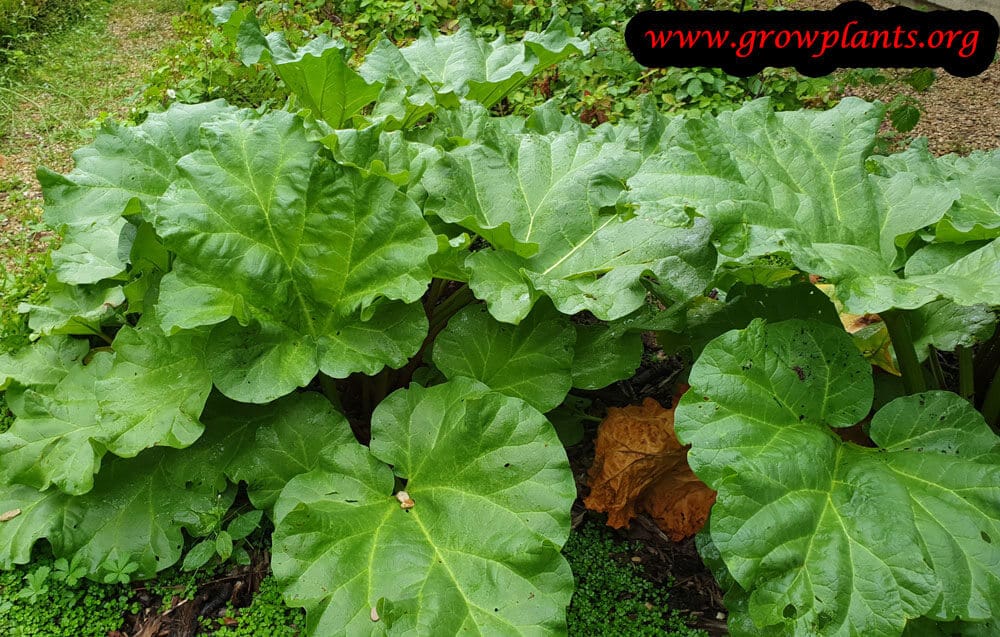
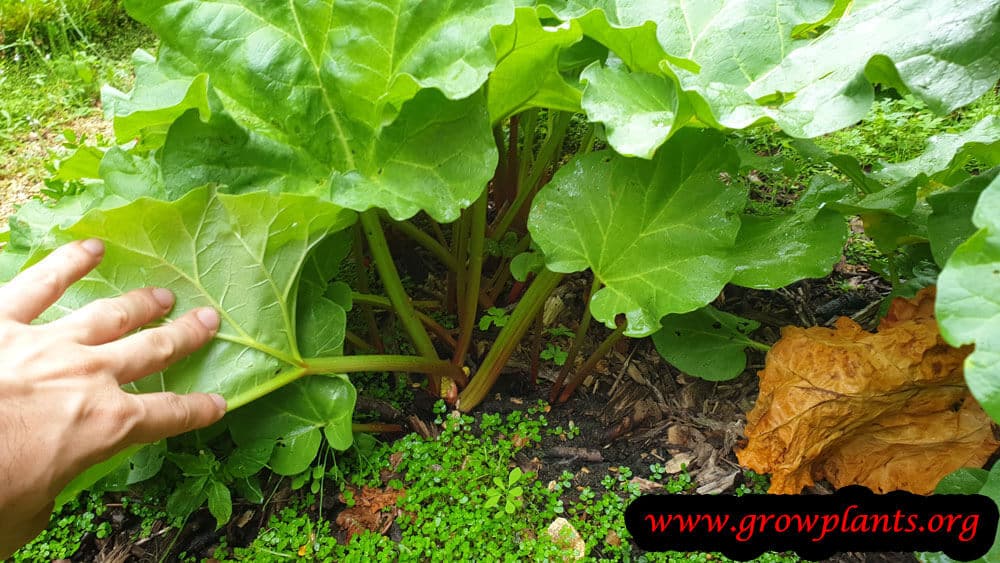
- Growth Habit & Form: Clump-forming herbaceous perennial rising from a stout rhizome, with towering flower spikes.
- Lifespan & Maturity: Long-lived; the crown returns and enlarges over many years.
Anatomy & Physical Features
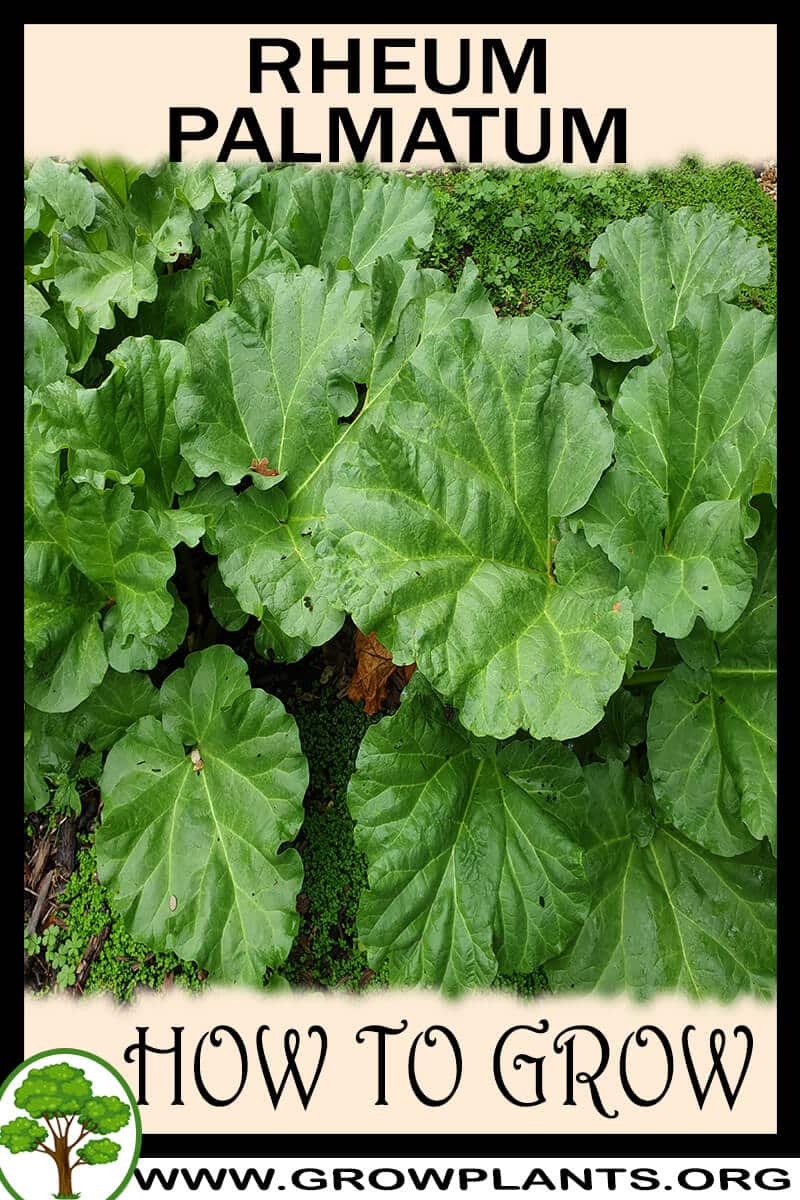
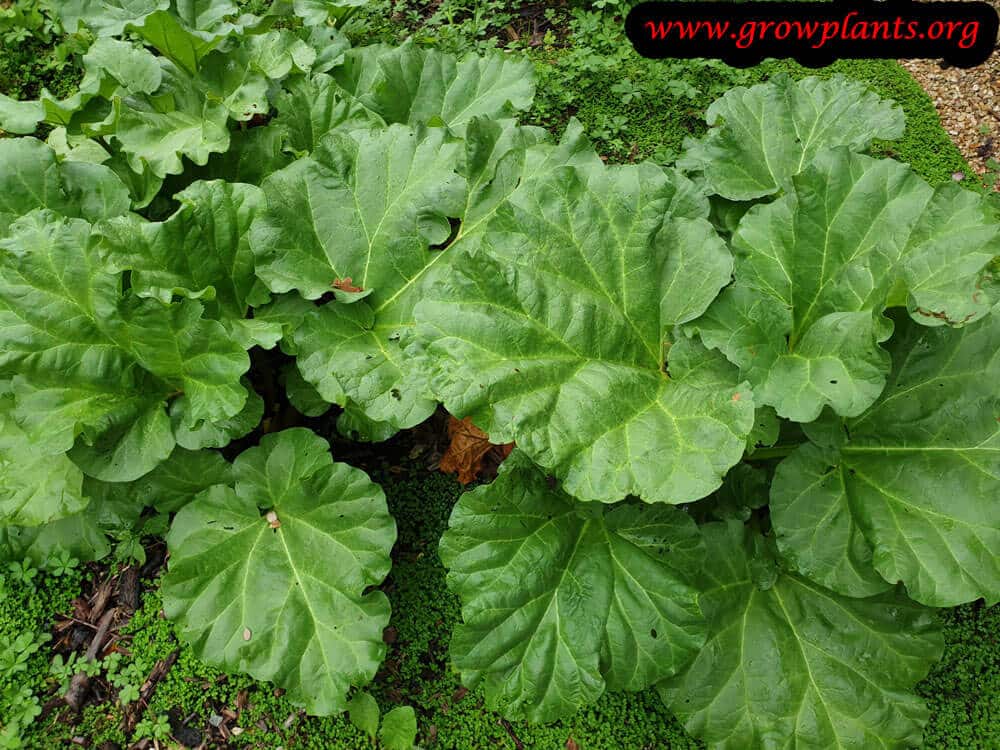
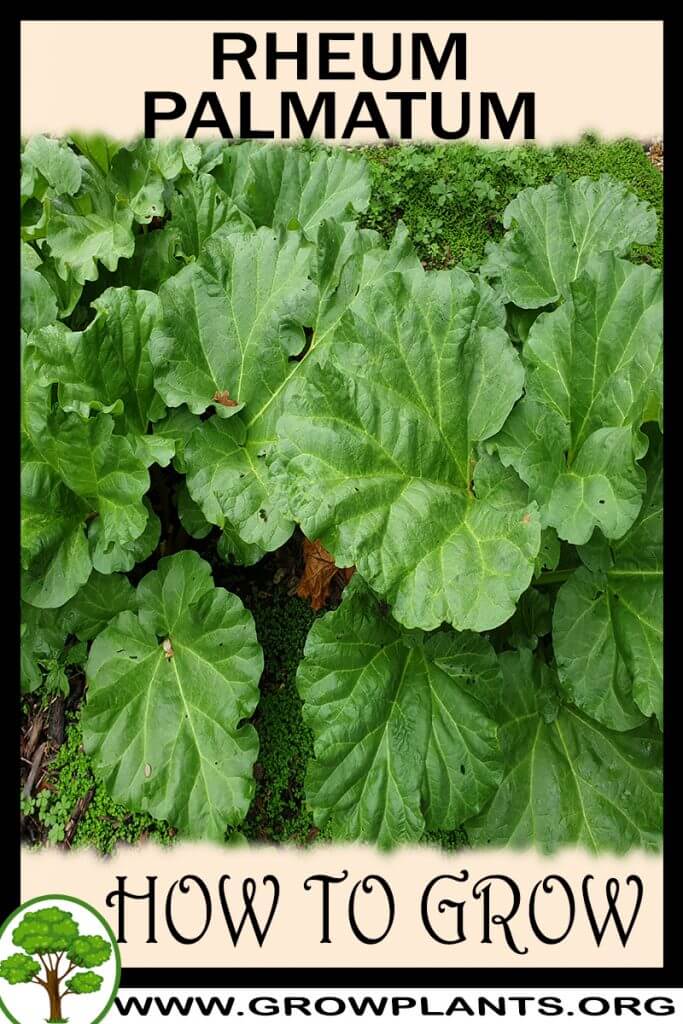
- Leaves & Foliage: Large, deeply cut green leaves, sometimes with red veins, up to about 0.5 m across.
- Flower Characteristics: Tall spikes of small pink flowers held well above the foliage.
Primary Uses & Landscape Value
- Edible Uses: Leaf stalks cooked into sweets and jams; the leaves are NOT eaten.
- Functional & Ornamental Roles: Grown chiefly as a dramatic architectural foliage specimen for borders and waterside plantings.
Care Guide: Planting, Soil & Watering
Overview: Rheum palmatum (ornamental Chinese rhubarb) is a hardy, long-lived perennial grown from crowns that thrives in full sun to part shade in deep, rich, moisture-retentive soil. It is a hungry, thirsty plant that grows best in cool climates and moist, slightly acidic ground.
Quick Care Requirements
| Requirement | Ideal Condition |
|---|---|
| Planting Season | Spring, summer or autumn (plant crowns while dormant, in cool weather) |
| Growth Rate | Moderate to Fast |
| Soil Type | Deep, rich, moisture-retentive, well-draining |
| Soil pH | Slightly acidic (about 6.0–6.8) |
| Water Need | Moderate to High — keep consistently moist |
Planting & Establishment
- Best Planting Season: Plant crowns in the cooler part of the year — early spring or autumn are ideal — while the plant is dormant, so it establishes before summer heat. It needs a cold winter to break dormancy and perform well.
- How to Plant:
- Hole Preparation: Dig a generous hole, wider than the crown, and enrich the surrounding soil deeply, as the plant will occupy the spot for many years.
- Soil Amendments: Work in plenty of well-rotted manure, compost or organic matter — rhubarb is a heavy feeder that rewards rich, humus-laden soil.
- Planting Depth: Set the crown so the growing buds sit just at or slightly below (about 2–3 cm) the soil surface; planting too deep can rot the crown.
- Growth Speed & Expectations: Moderate to fast once established, sending up large leaves each season; allow a year or two before harvesting heavily so the crown builds strength.
Soil, Watering & Drainage Care
- Soil Mix & Drainage Needs: It wants rich, deep soil that stays moist yet never waterlogged; improve heavy or thin soils with organic matter and mulch well to hold moisture. A slightly acidic soil suits it best.
- Watering Schedule & Technique:
- Young / Newly Planted: Keep newly planted crowns consistently moist while they establish, never letting the soil dry out.
- Established: Water regularly and deeply, especially in dry weather — steady moisture drives lush, tender stalks; mulch to conserve it.
- Seasonal Adjustments: Water generously through the warm growing season; reduce in winter when the plant dies back and rests.
Climate, Light & Hardiness
Rheum palmatum is a robust, cold-hardy temperate perennial that dies back to a thick rootstock in winter and resprouts vigorously each spring. It grows best in full sun to half shade with consistently moist, rich soil, and tolerates severe winter cold across USDA zones 5–9.
Quick Climate Specifications
| Climate Zones | Temperate |
|---|---|
| USDA Hardiness Zones | 5–9 |
| Approx. Survival Minimum | Root/crown hardy to approximately −29°C (−20°F) at the zone 5 boundary; top growth dies back naturally well before this each autumn |
| Frost Tolerance | High for the dormant root/crown; foliage is frost-tender and dies down with the first hard frosts |
| Light Conditions | Full sun to half shade |
Sunlight & Light Exposure
Optimal Light Setup
Full sun suits it in cooler, temperate climates; in the hotter parts of its range, half shade helps prevent leaf scorch.
Direct Sun Requirement
Tolerates full sun well where summers are mild to warm and soil stays consistently moist; in hot, dry summer regions some afternoon shade is beneficial.
Shade & Heat Management
In warmer zones (toward zone 9), afternoon shade and reliably moist soil help the large leaves avoid scorching during intense summer heat.
Best Exposure / Orientation
A sheltered site with rich, moisture-retentive soil suits it best; avoid hot, dry, exposed positions.
Temperature Extremes & Hardiness
USDA Hardiness & Regional Limits
A very cold-hardy perennial across zones 5–9; the crown and roots survive severe winter freezes in dormancy while the foliage dies back naturally each autumn.
Cold Damage & Winter Protection
Foliage dying down with autumn frost is normal dormancy, not damage; in the coldest parts of its range a mulch layer over the crown gives extra winter protection.
Frost Sensitivity
Newly emerging spring shoots are vulnerable to damage from late spring frosts, even though the dormant crown itself is very cold-hardy.
Extreme Heat Tolerance
Prefers cooler temperate summers; prolonged intense heat combined with dry soil can cause leaf scorch or early dieback, so consistent moisture and part shade help in warmer areas.
Wind, Humidity & Microclimate
Dry-Air Tolerance
Performs best in cool, humid temperate climates rather than hot, dry conditions; heat combined with low humidity increases the risk of leaf scorch.
Wind Tolerance
The large, soft leaves can tear or tatter in strong, exposed wind, so a sheltered spot is preferable to an open, windy site.
Rainfall & Seasonal Moisture
Adapted to climates with reliable rainfall or irrigation through the growing season; it does not suit regions with prolonged summer drought.
Microclimate Recommendations
A cool, sheltered position with rich, consistently moist soil suits it best, with part shade in hot-summer areas and a protective mulch over the crown where winters are severe.
Growing in Pots, Balconies & Indoors
Chinese ornamental rhubarb is a bold, architectural perennial that throws up huge leaves and towering flower spikes (1-2.5 m / 3-7.5 ft). The grower is clear it is not a houseplant – it needs full sun to part shade, cool winters and room to spread – but it can be grown in a large container on a patio.
In a pot it is a striking, short-season feature plant rather than an indoor subject; give it a big, heavy container so it does not dry out or blow over.
Quick Details
- Container Size: A large, heavy pot (the plant is big and thirsty); the bigger the better.
- Indoor Suitability: Not a houseplant – too large, sun-hungry and needs a cool winter rest.
- Best Spot: Full sun to half shade, outdoors on a patio or terrace.
- Soil & Drainage: Deep, rich, moisture-retentive but free-draining mix.
- Watering in Pots: Water generously – it is thirsty and a big leaf area dries a pot fast – but avoid waterlogging.
Indoors & On the Windowsill
- Not for indoors: The grower says no – it is simply too big and needs full sun plus a cold winter dormancy that a warm room cannot give.
- Safety: The large leaf blades are toxic (high in oxalic acid); keep the plant away from children and pets and never eat the foliage.
On a Balcony or Patio
- Light & space: Give it the sunniest, most open spot; it is large and its leaves catch the wind, so shelter it and use a stable, heavy pot.
- Overwintering: It dies back and needs a cold rest – leave the pot outside in a sheltered spot over winter, keeping the mix barely moist.
Choosing the Pot, Soil & Long-Term Care
- Pot & drainage: A large, heavy, deep pot to support the big rootstock and stop it drying or toppling. Give it strong drainage holes and skip a standing-water saucer to avoid root rot; terracotta breathes and dries faster, while glazed or plastic pots hold moisture longer.
- Potting mix: A light, aerated, organic-rich mix – potting soil, or peat/coir with perlite, enriched with a little humus or compost.
- Feeding: Potted plants use up their food faster because nutrients wash out with every watering, so feed lightly but more regularly than plants growing in open ground.
- Repotting: Refresh the mix and pot up or divide every couple of years while dormant; feed generously in growth as it is a hungry plant.
Fertilizing & Feeding
A moderate feeder: steady balanced feeding through spring and summer fuels its large leaves and stalks, then feeding stops as it dies back for winter.
Quick Fertilizing Specs
| Feeding Level | Moderate feeder |
|---|---|
| Main Nutrient Priority | Balanced feeding with good nitrogen to fuel large leaf and stalk growth |
| Best Feeding Period | Spring through summer as new growth and the flower stem develop |
| Organic Options | Compost, well-rotted manure, and organic mulch worked around the crown |
| Reduce/Stop Feeding | Feeding tapers off and stops as the plant dies back for winter |
| Micronutrients | Usually met by rich, organic soil; correct only diagnosed deficiencies |
| Soil pH | Slightly acidic |
Feeding by Growth Stage
Establishing new crowns or divisions
Help newly planted crowns or divisions root in before asking them to support top growth.
| Nutrient direction | A modest balanced feeding paired with organic matter worked into the planting area. |
|---|---|
| Timing | At planting, whenever crowns or divisions go into the ground. |
| Frequency | A single light feeding at planting is usually enough to start. |
| Fertilizer types | A balanced complete fertilizer at a gentle strength, Compost or well-rotted manure worked into the planting hole |
| Precautions | Avoid heavy feeding at planting; overly rich conditions can encourage soft growth before roots are established. |
Spring through summer active growth
Fuel the large deltoid leaves, stalks, and summer flower spike with steady nutrition.
| Nutrient direction | A balanced, nitrogen-forward fertilizer supports vigorous leaf and stalk production. |
|---|---|
| Timing | From the spring growth flush through the summer bloom period. |
| Frequency | Periodic light feedings through the active growing season support strong growth. |
| Fertilizer types | A balanced complete fertilizer with good nitrogen content, Compost or aged manure as a top-dressing around the crown |
| Precautions | Keep fertilizer away from direct contact with the crown to avoid burn, and water it in well. |
Autumn dieback and winter dormancy
Let the plant die back and rest without pushing new growth into cold weather.
| Nutrient direction | None – withhold fertilizer as the plant enters dormancy. |
|---|---|
| Timing | Autumn as foliage dies back, through winter dormancy. |
| Frequency | No feeding during dormancy. |
| Fertilizer types | No feeding at this stage; hold off fertilizing until new growth resumes in spring. |
| Precautions | Do not fertilize a dormant crown; feeding now wastes nutrients and can encourage tender growth that frost will damage. |
Nutrient Deficiency Signs & Corrections
Leaves emerge smaller and paler than usual and overall growth slows.
| Possible causes | low available soil nitrogen, nutrient leaching from moist soil, competition from surrounding plants for available nutrients |
|---|---|
| Appears first on | older, lower leaves |
| What to check | recent feeding history, soil organic matter, watering and drainage |
| Possible correction | Apply a nitrogen-containing balanced fertilizer and build soil organic matter around the crown. |
New leaves turn pale to yellowish while the veins stay greener.
| Possible causes | soil pH that has drifted too alkaline for this acid-preferring plant, waterlogged or compacted soil reducing root function, general root stress from poor drainage |
|---|---|
| Appears first on | newest leaves |
| What to check | soil pH, drainage around the crown, watering consistency |
| Possible correction | Correct soil pH toward acidic and apply a chelated iron product per its label. |
Leaf margins on older leaves scorch or brown and stalks stay weak.
| Possible causes | low soil potassium, leaching in light or sandy soil, feeding that has been heavily nitrogen-weighted without balance |
|---|---|
| Appears first on | older, lower leaves |
| What to check | soil potassium status, recent fertilizer balance, soil texture and leaching |
| Possible correction | Switch to a balanced fertilizer with adequate potassium and correct any leaching issues. |
Pruning, Training & Seasonal Maintenance
Rheum palmatum is a large herbaceous, rhizome-forming perennial grown for its bold leaves and edible leaf stalks (the leaves themselves are poisonous). It carries no persistent wood, so “pruning” here means seasonal leaf and flower-stalk management rather than shaping a framework: removing spent or damaged leaves keeps the crown healthy, and removing flowering stems redirects the plant’s energy back into stalk and leaf growth. The safest, most productive period to cut is once the crown is actively growing in spring through summer; cutting everything back hard just before or during winter dormancy is unnecessary since frost naturally collapses the top growth.
Quick Pruning & Maintenance Specs
| Pruning Tolerance | Moderate – tolerates regular leaf/stalk removal once established |
| Primary Pruning Window | Spring through summer, alongside active growth and stalk harvest |
| Secondary Maintenance Window | Autumn/winter clean-up after frost collapses the foliage |
| Typical Frequency | Ongoing through the growing season, plus one autumn clean-up |
| Main Objective | Remove damaged leaves, harvest stalks, and remove flower stems to conserve crown vigour |
| Young Plant Priority | Let the crown build leaf mass; avoid heavy stalk harvest in the first year or two |
| Mature Plant Priority | Routine stalk harvest, prompt flower-stem removal, and post-frost tidy-up |
| Best Tool Type | Bypass secateurs or a sharp knife for thick leaf stalks |
| Avoid Heavy Pruning During | The plant’s first establishment year, and while it is actively flowering if seed is not wanted later |
Pruning by Plant Age & Size
Newly Established
Remove only clearly dead or damaged leaves; do not harvest stalks or remove significant foliage while the crown is still building reserves from its rhizome/crown division.
Young / Formative
No structural training applies to this clump-forming herbaceous crown; the priority is simply letting enough leaves remain to build a strong root and rhizome system before stalks are harvested for use.
Mature / Established
Once established, routinely remove ageing or damaged leaves, harvest leaf stalks from the outside of the clump, and cut out flowering stems promptly at the base as they appear to keep the crown’s energy in stalk and leaf production rather than seed.
Seasonal Pruning Schedule
Pre-Growth/Early-Spring: objective is a clean start – clear away the previous year’s collapsed, frost-killed foliage before new growth pushes through, so emerging shoots are not shaded or tangled in old debris. Do not disturb the crown/rhizome itself.
Ongoing Sanitary (spring–summer): remove yellowing or damaged leaves and any flower stalks as they arise (bloom season is summer); do not strip more than a portion of the healthy leaves at any one time, since remaining foliage is what recharges the rhizome for next year.
Dormant/Winter: once frost has collapsed the leaves, cut the blackened remains back to the crown; this is tidy-up rather than a growth-shaping cut, and has no effect on next season’s flowering since flower stems arise fresh from the crown each year.
Special Growth to Remove
- Spent or damaged leaves – remove at the base of the leaf stalk.
- Flowering stems – best cut out at the base as soon as they are noticed, unless seed is wanted, since flowering diverts energy away from stalk and leaf production.
- Frost-collapsed foliage – clear away in late winter before new shoots emerge.
Container & Small-Space Pruning
Rheum palmatum grows large (up to roughly 2.5 m) even in a large container, so container specimens need more frequent leaf thinning to control crowding than an in-ground planting, and will need dividing and repotting sooner as the rhizome fills the pot.
Tools
A sharp knife or bypass secateurs for cutting the thick, fleshy leaf stalks at the base; loppers, saws and hedge shears have no role on this herbaceous plant.
Tool Hygiene & Disease Risk
Routine: keep tools clean and sharp. The main pest noted is weevil rather than a wound-spread disease, so no special disinfection routine is required – standard hygiene is enough. Because the leaves are poisonous, wash hands/tools after handling and keep leaf waste away from edible-stalk harvest areas.
Cut Placement & Technique
Cut leaf stalks close to their point of attachment at the crown rather than leaving long stubs; cut flower stems right down at the base as soon as they are spotted, before buds open, to stop them drawing further energy from the plant.
Heavy Pruning & Rejuvenation
This species is not rejuvenated by hard pruning in the woody sense — an ageing, overcrowded clump is renewed by lifting and dividing the rhizome/crown (typically in the dormant season) rather than by cutting the top growth harder.
Post-Pruning Care
Keep the moist, slightly acidic soil this plant favours consistently damp after leaf/stalk removal; avoid feeding immediately after a heavy leaf harvest and instead let the plant recover with normal watering before the next flush.
Common Pruning Mistakes
- Stripping too many leaves at once when harvesting stalks, which weakens the crown’s ability to recharge the rhizome.
- Letting flower stems bloom and set seed instead of removing them early, which reduces stalk vigour.
- Composting the poisonous leaf blades where they may be mistaken for edible material.
When NOT to Prune
Avoid heavy stalk harvesting in the plant’s first year or two while the crown is still establishing. Avoid stripping the majority of leaves at any single time during the growing season, since the plant needs a good leaf canopy to recharge its rhizome for the following year.
Recommended Tools (by task)
- bypass_secateurs – clean cuts through thick, fleshy leaf and flower stalks at the base.
- blade_disinfectant – sensible given the toxic sap/leaves, to keep cutting tools clean between harvest sessions and other garden work.
Pruning Troubleshooting
| Problem | Possible Cause | What to Check | Corrective Action |
| Weak or thin stalk production | Over-harvesting leaves/stalks, or a young, still-establishing crown | How many healthy leaves remain on the clump; crown age | Leave more leaves in place between harvests; hold off heavy harvest until the second or third year |
| Excessive flowering (bolting) | Mature, stressed, or heat-exposed crown | Look for emerging flower stems in early summer | Cut flower stems out at the base as soon as seen |
| Soft rot at a cut stalk base | Wet, ragged cuts or waterlogged soil | Inspect the crown around recent cuts for softness or discolouration | Make clean cuts, avoid cutting in waterlogged conditions, improve drainage |
Propagation Guide
Rheum palmatum is propagated almost exclusively by dividing its crown and rhizome, which is quick, reliable, and guarantees identical leaf and stalk coloring to the parent plant. Seed is a slower alternative that produces more variable plants, especially in leaf-vein and stalk color, so division is the preferred method and this is an easy plant to propagate.
Quick Propagation Specs
| Best Propagation Method | Crown/Rhizome Division |
| Alternative Methods | Seed |
| Propagation Difficulty | Easy (division); Moderate (seed) |
| Seed True-to-Type | Variable – leaf-vein and stalk color especially can differ from the parent |
| Vegetative True-to-Type | Yes |
| Best Propagation Season | Division: while dormant, early spring or autumn. Seed: spring |
| Seed Germination Time | Typically a few weeks, sometimes slower and uneven |
| Germination Temperature | Roughly 15–20°C (59–68°F) |
| Seed Sowing Depth | Shallow – barely cover the seed |
Growing from Seed
Seed Handling & Viability
Best results come from reasonably fresh seed; avoid long-term storage in warm or humid conditions.
Dormancy & Pre-Sowing Treatment
No pretreatment is usually required, though a short period of cold stratification can improve germination uniformity if seed is slow or erratic to sprout.
Sowing Season
Sow in spring, consistent with the plant’s spring planting season.
Sowing Depth & Orientation
Sow shallowly, just barely covering the seed.
Germination Conditions
Cool to moderate temperatures, roughly 15–20°C (59–68°F), with the soil kept consistently moist.
Germination Time
Usually a few weeks, though timing can be slower and uneven.
Seedling Care
Grow seedlings on in moist, acidic soil as for the mature plant; seed-grown plants may not reproduce the parent’s red leaf-vein coloring exactly, so gardeners wanting a specific color form should divide the crown instead.
Rhizomes, Tubers, Bulbs & Corms
Crown/Rhizome Division: divide the dormant crown in early spring before new growth starts, or in autumn. Each division should include at least one healthy growth bud (an eye) along with a portion of root and rhizome — larger divisions establish faster. Replant promptly into moist, acidic soil and keep consistently watered until new growth appears.
Bloom & Flower Guide
Quick Details
- Bloom Season: Summer
- Flower Appearance: Tiny pink flowers massed into a tall, plume-like spike on a stout stalk
- Edibility: Not edible – this ornamental rhubarb contains oxalic acid and is toxic
Detailed Blooming Overview
Chinese or ornamental rhubarb (Rheum palmatum) throws up a dramatic flower spike in summer – a towering plume of countless tiny pink flowers on a stout stalk that can rise well above the huge leaves. It is one of the plant’s boldest features and a genuine draw for pollinators.
Flower Characteristics
- Very small pink flowers, massed in a tall, branching plume.
- Held on a thick, upright stalk high above the foliage.
Bloom Care & Thinning
- To flower or not: Some growers leave the spike for its dramatic look and for pollinators; others cut it early to steer energy back into the bold foliage.
- Pollination: The plume is worked by bees, butterflies and other insects.
- Safety: The leaves contain oxalic acid and are toxic – the flowers are for display, not eating.
Fruit & Uses
Safety note first: only the leaf stalks (petioles) of Rheum palmatum are eaten – the leaf blades are poisonous and must always be removed and discarded. The stalks are cooked with sugar (not eaten raw) and used for jams, cooked desserts and alcoholic beverages, much like culinary rhubarb, though this ornamental/medicinal rhubarb species is less commonly grown as a food crop than garden rhubarb.
Quick Edible Specs
| Edible Parts | Leaf stalks (petioles) only – never the leaf blade |
|---|---|
| Main Use(s) | Culinary (jams, cooked dishes, alcoholic beverages); root has a traditional medicinal reputation (see Preparation & Safety) but is not documented here as a food part |
| Eaten Raw or Cooked | Cooked (traditionally stewed with sugar, as with other rhubarbs) |
| Preparation Required | Remove toxic part – strip and discard the leaf blade completely; cook the stalk |
| Harvest Season | All year, per site data |
| Time to First Harvest | Take stalks once young growth is fully developed; see Propagation for how long establishment takes |
| Storage | Best used fresh soon after cutting, as with other rhubarb stalks |
| Safety/Toxicity Caveat | Leaves (blades) are poisonous – do not eat under any circumstances; only the stalk is the edible part |
Shoots & Stems
The edible part is the leaf stalk, which can be green or red and comes from leaves that grow up to about 50 cm across in a deltoid to irregular shape. Take young, fully grown stalks from the base of the plant at ground level, leaving the leaf blade behind. The stalks are used for jams, alcoholic beverages, and general cooked preparations – not eaten raw.
Harvesting
Harvest is possible all year per site data, taking individual stalks as they reach full size rather than as a single one-time harvest. Choose young stalks that are fully grown but still tender; older, tougher stalks are less palatable. Cut or pull the stalk close to the base and immediately discard the attached leaf blade.
Preparation, Uses & Safety
The leaf blades of Rheum palmatum are toxic (as in all rhubarbs, from concentrated oxalic acid) and must never be eaten – always trim them away and use only the stalk. The stalk itself is cooked, typically with sugar, and used for jams, cooked desserts, and alcoholic beverages. Because this species is primarily grown as an ornamental and, historically, as a medicinal plant (one alternative name is “Turkey rhubarb”), its stalks are eaten less often and are generally regarded as more marginal for the table than cultivated garden rhubarb – use in moderation and always cook before eating. The root has a long traditional reputation in herbal use, but no dosing or health claims are made here, and the site data does not describe the root as a food part.
Pests, Diseases & Troubleshooting
Rhubarb (Rheum) is a robust, long-lived perennial that suffers few pests; its serious threats are crown and root rots in wet or poorly drained soil, plus the rhubarb curculio weevil and slugs on young growth. Healthy, well-drained soil, careful watering and good hygiene prevent nearly all problems – and the source note is correct that the leaves are poisonous.
Quick Troubleshooting Overview
| Issue / Pest | Main Symptom | Primary Solution |
|---|---|---|
| Rhubarb curculio | Sap oozing from punctures in stalks and crown | Handpick the weevils; remove nearby wild docks |
| Slugs & snails | Holes and slime on emerging leaves and stalks | Traps, barriers, iron-phosphate bait, evening handpicking |
| Aphids | Curled young leaves, sticky honeydew | Water jet, insecticidal soap, encourage beneficials |
| Crown / root rot | Wilting, blackened, foul crown; stalks collapse | Improve drainage; never plant in wet soil; remove rotted crowns |
| Leaf spot | Brown/white spots with dark margins on leaves | Remove affected leaves, improve airflow, copper if severe |
| Poisonous leaves | Oxalic acid – leaf blades toxic to eat | Eat only the stalks; discard or compost the leaves |
Common Pests & Management
- Rhubarb curculio (Lixus concavus):
- Symptoms: A large rusty, yellow-dusted weevil that bores into stalks, crowns and roots; feeding punctures ooze sap and weaken the plant. This is the ‘weevil’ correctly noted in the source and the main insect pest of rhubarb.
- Prevention & Control: Handpick the conspicuous weevils in the morning when they are sluggish and drop them into soapy water. Remove nearby curly dock and wild rhubarb, their alternate breeding hosts, and clear crop debris. Chemical control is rarely warranted.
- Slugs & snails (Deroceras / Cornu spp.):
- Symptoms: Ragged holes chewed in emerging leaves and tender young stalks, with silvery slime trails; worst in cool, wet weather and heavily mulched crowns.
- Prevention & Control: Pull mulch back from the crown in spring, water in the morning, set beer traps or copper barriers, and handpick after dark. Iron-phosphate pellets are a pet-safe bait.
- Aphids (Aphis / Myzus spp.):
- Symptoms: Colonies of soft green or dark aphids on young leaves and flower stems cause curling and sticky honeydew with sooty mould; they can also spread viruses.
- Prevention & Control: Dislodge them with a jet of water and encourage ladybirds and lacewings. Remove flower stalks that draw pests. Insecticidal soap or neem controls heavy colonies; spray in the evening.
Diseases & Fungal Issues
- Crown & root rot (Phytophthora / Pythium spp.):
- Symptoms: Stalks wilt and collapse, the crown turns soft, black and foul-smelling, and the plant may die out in patches; almost always linked to waterlogged, poorly drained soil. The most serious rhubarb disease.
- Treatment & Management: Plant in raised, free-draining soil rich in organic matter and never let crowns sit in water. Set crowns with the buds just at soil level, avoid overwatering, and dig out and destroy rotted crowns rather than replanting the same wet spot.
- Leaf spot (Ramularia / Ascochyta rhei):
- Symptoms: Small spots that enlarge into brown or white lesions with reddish-purple margins, sometimes dropping out to leave holes; heavy spotting reduces vigour.
- Treatment & Management: Pick off and destroy spotted leaves, clear old foliage in autumn, and space plants for airflow. Copper fungicide protects new growth where spotting is severe.
- Powdery & downy mildew (Erysiphe / Peronospora spp.):
- Symptoms: White powdery patches (powdery mildew) or yellow blotches with greyish down beneath (downy mildew) on the large leaves in crowded, humid plantings.
- Treatment & Management: Space and divide congested clumps for airflow, avoid overhead watering, and remove affected leaves. Sulfur or potassium bicarbonate helps against powdery mildew.
- Verticillium / crown wilt (Verticillium dahliae):
- Symptoms: Progressive wilting and yellowing with browning of the vascular tissue inside the crown and stalks; a soil-borne wilt that shortens the plant’s life.
- Treatment & Management: There is no cure – remove affected plants, avoid replanting susceptible crops in the same ground, and start new crowns from clean stock in fresh, well-drained soil.
Growing Difficulties & Abiotic Problems
- Poisonous leaf blades:
- Cause & Symptoms: The leaf blades are high in oxalic acid and other compounds and are toxic if eaten – a handling and safety issue, not a disease.
- Correction Strategy: Harvest and eat only the leaf stalks; cut off and discard or compost the blades, and keep them away from people and pets.
- Bolting (running to seed):
- Cause & Symptoms: Heat, age, drought or stress trigger tall flower stalks that drain the crown’s energy.
- Correction Strategy: Cut out flower stalks as soon as they appear, keep plants watered and mulched, and divide old, congested crowns every few years to rejuvenate them.
- Thin, spindly stalks:
- Cause & Symptoms: Overcrowded crowns, poor soil fertility, too much shade, or harvesting too hard weaken the plant.
- Correction Strategy: Feed with well-rotted manure or compost, grow in full sun, divide crowded clumps, and never strip more than a third to a half of the stalks at once.
- Winter/frost crown damage:
- Cause & Symptoms: Waterlogged soil combined with freezing can rot or heave shallow crowns.
- Correction Strategy: Ensure sharp drainage, mulch the crown in cold climates, and avoid low spots where water collects.
What Helps – Products & Tools
Rhubarb needs very little: iron-phosphate slug bait and simple barriers for young growth, insecticidal soap or neem for occasional aphids, and copper or sulfur fungicide only if leaf spot or mildew becomes troublesome. The real ‘products’ are well-drained, fertile soil and sharp hygiene – removing rotted crowns and old foliage – which head off the rots that actually threaten the crop.