

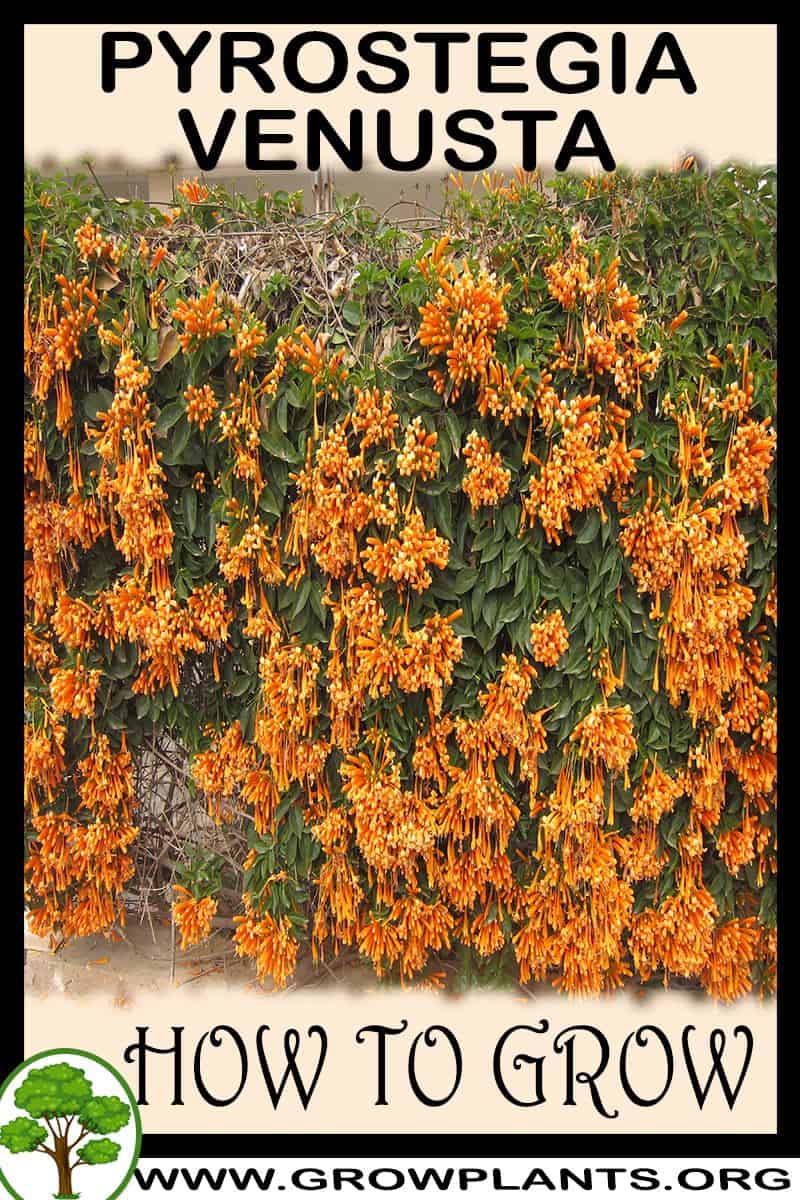
Plant Profile & Key Characteristics
Overview: A vigorous evergreen climber reaching 3-15 m (10-45 ft), grown as an ornamental for the sheets of brilliant orange trumpet flowers it produces in winter and spring. It is used to cover fences, pergolas and walls and to attract pollinators in warm climates.
Quick Specifications
| Specification | Attribute |
|---|---|
| Plant Type / Life Cycle | Evergreen perennial vine |
| Foliage Type | Evergreen |
| Mature Size | 3-15 m (10-45 ft) |
| Growth Rate | Moderate to fast |
| Hardiness | USDA zones 9+ |
Growth Form & Structure
- Height & Spread: A large woody climber reaching 3-15 m (10-45 ft) on a support; can be grown in a container with trellising but is not an indoor plant.
- Growth Habit & Form: A fast, tendril-climbing evergreen vine that forms a dense curtain of growth over fences, pergolas and walls.
- Lifespan & Maturity: A long-lived perennial vine that establishes quickly and flowers heavily once mature.
Anatomy & Physical Features
- Leaves & Foliage: Green, ovate to elliptic leaves.
- Flower Characteristics: Masses of tubular orange flowers with four to five petals fused into a trumpet shape, borne profusely in winter and spring and highly attractive to pollinators.
Primary Uses & Landscape Value
- Functional & Ornamental Roles: Grown as an ornamental flowering climber for hedges, screens, fences and pergolas and to draw pollinators; vigorous enough to need regular control.
Care Guide: Planting, Soil & Watering
Overview: Flame vine (Pyrostegia venusta) is a vigorous evergreen climber for tropical, subtropical and mediterranean climates (hardiness zone 9+), grown for its blazing orange winter-to-spring flowers. It wants full sun to part shade and well-draining soil, takes moderate water, and needs a strong support to scramble over.
Quick Care Requirements
| Requirement | Ideal Condition |
|---|---|
| Planting Season | In the cooler, milder half of the year – autumn, winter or spring |
| Growth Rate | Fast to moderate |
| Soil Type | Well-draining, fertile |
| Water Need | Moderate |
Planting & Establishment
- Best Planting Season: Plant in the milder part of the year – autumn, winter or spring – avoiding the peak of summer heat, and give it a sturdy trellis, pergola or fence to climb.
- How to Plant:
- Hole Preparation: Loosen a hole a little larger than the root ball at the base of a strong support in a sunny, well-drained spot.
- Soil Amendments: Work compost or organic matter into free-draining soil to get the vine growing away strongly.
- Planting Depth: Set the plant at the level it was growing, keeping the crown at the surface, and firm gently.
- Growth Speed & Expectations: A fast, vigorous climber reaching 3-15 m; it can be aggressive, so prune after flowering to keep it in shape and within bounds.
Soil, Watering & Drainage Care
- Soil Mix & Drainage Needs: Give it fertile, well-draining soil; it dislikes waterlogging, so ensure good drainage, and in containers use a free-draining mix with drainage holes.
- Watering Schedule & Technique:
- Young / Newly Planted: Water regularly to establish the young vine, keeping the soil evenly moist but not soggy.
- Established: Once established, water moderately, letting the surface dry slightly between waterings; it is fairly tolerant but flowers best with steady moisture.
- Seasonal Adjustments: Water more in summer heat and less in cool, wet weather; keep it frost-free.
Climate, Light & Hardiness
Pyrostegia venusta (orange trumpet/flame vine) is a vigorous tropical-to-Mediterranean evergreen flowering vine, growing best in full sun to half shade. It is a warm-climate plant with only light frost tolerance, best suited to zone 9 and above.
Quick Climate Specifications
| Climate Zones | Tropical, Subtropics, Mediterranean |
|---|---|
| USDA Hardiness Zones | 9+ |
| Frost Tolerance | Low |
| Light Conditions | Full Sun / Half Shade |
Sunlight & Light Exposure
Optimal Light Setup
Full sun to half shade both suit this vine; full sun typically produces the heaviest winter-spring bloom.
Temperature Extremes & Hardiness
USDA Hardiness & Regional Limits
Reliable as a perennial evergreen from zone 9 upward; not suited to climates with regular hard freezes.
Frost Sensitivity
Only lightly frost tolerant; hard or prolonged frost is likely to cause significant damage or dieback.
Wind, Humidity & Microclimate
Microclimate Recommendations
A warm, sheltered, trellised site near the cold edge of zone 9 will give the best results and reduce winter dieback.
Growing in Pots, Balconies & Indoors
Flame vine (Pyrostegia venusta) is a very vigorous evergreen climber (3-15 m) that blazes with orange tubular flowers. The grower says it is not a houseplant but can be grown in a container – a large pot with a strong support helps contain this aggressive, invasive climber. Note it is poisonous.
Quick Details
- Container Size: A large, heavy, sturdy pot with a strong support
- Indoor Suitability: Not a houseplant – a vigorous outdoor climber
- Best Spot: Full sun to half shade, outdoors
- Soil & Drainage: Free-draining mix
- Watering in Pots: Average amount – steady moisture in warm growth
Indoors & On the Windowsill
- Not a houseplant: The grower confirms it will not grow indoors; it is a large outdoor climber.
- Windowsill: Far too vigorous for a sill – grow it outdoors on a sturdy support.
On a Balcony or Patio
- Light, wind & heat: Give it the brightest spot it will tolerate; walls and railings reflect heat and dry pots quickly, so check moisture often and shelter or stake exposed growth.
- Contain & support: Give it a big pot, a strong trellis and a sunny spot; prune hard after flowering to keep this fast climber under control.
Choosing the Pot, Soil & Long-Term Care
- Pot & drainage: A large, heavy pot with a strong support or trellis. Use strong drainage holes and skip a standing-water saucer to avoid root rot. Terracotta breathes and dries faster; glazed or plastic holds moisture longer.
- Potting mix: A well-aerated, organic-rich mix – potting soil or peat/coir with perlite or vermiculite for free drainage.
- Feeding: Potted plants use up their soil faster as nutrients leach out with watering – feed lightly and regularly through the growing season.
- Repotting & pruning: Refresh the mix every couple of years and prune hard to control it.
- Safety: The plant is poisonous – keep it away from children and pets and never treat any part as edible.
Fertilizing & Feeding
A vigorous, self-sufficient evergreen vine that flowers heavily on its own; light feeding while establishing is enough, since rich feeding mainly accelerates its already fast, aggressive growth.
Quick Fertilizing Specs
| Feeding Level | Light feeder |
|---|---|
| Main Nutrient Priority | Balanced, restrained feeding – this vine grows and flowers well without rich feeding |
| Best Feeding Period | Spring at planting, and lightly ahead of the winter-into-spring bloom flush |
| Organic Options | Compost worked into the planting area |
| Reduce/Stop Feeding | Feeding is usually skipped on established plants once they are climbing and flowering well |
| Micronutrients | Rarely an issue; correct only a diagnosed deficiency |
| Soil pH | Tolerates a wide range of soil pH |
Feeding by Growth Stage
Establishment after planting
Help young vines root in before they take off climbing.
| Nutrient direction | A balanced fertilizer with modest nitrogen helps new plantings establish. |
|---|---|
| Timing | At planting and through the first season. |
| Frequency | A light feeding at planting is usually sufficient. |
| Fertilizer types | A balanced complete fertilizer used lightly, Compost worked into the planting area |
| Precautions | Keep feeding light from the start; this vine is naturally aggressive and rich soil only adds to that. |
Established vigorous growth
Keep the vine healthy while favoring flowering over runaway vegetative growth.
| Nutrient direction | Little to no supplemental feeding usually gives the best balance of growth and bloom; skip nitrogen-heavy products. |
|---|---|
| Timing | Through the growing season once established. |
| Frequency | Feeding is rarely needed beyond the first year or two. |
| Fertilizer types | Established vines often need no additional fertilizer, A light balanced feeding only if growth looks weak or pale |
| Precautions | Avoid nitrogen-rich feeding; it tends to produce vigorous foliage and fewer flowers. |
Winter-into-spring bloom flush
Support the vine’s heavy winter-into-spring flush of orange trumpet-shaped flowers.
| Nutrient direction | A light balanced feeding as the flower flush approaches helps sustain the display without overdoing leafy growth. |
|---|---|
| Timing | As the winter-to-spring bloom period approaches and continues. |
| Frequency | A single light, well-timed feeding ahead of the bloom flush is usually enough. |
| Fertilizer types | A balanced complete fertilizer used lightly, Organic matter such as compost |
| Precautions | Avoid heavy nitrogen feeding close to bloom time, which can favor foliage over flowers. |
Nutrient Deficiency Signs & Corrections
Older leaves fade to pale green or yellow and overall vigor slows.
| Possible causes | very poor or infertile soil, nutrient leaching from heavy rain, heavy root competition from nearby plants |
|---|---|
| Appears first on | older, lower leaves |
| What to check | soil fertility and organic matter, drainage and recent rainfall, nearby root competition |
| Possible correction | Apply a balanced fertilizer with available nitrogen; usually only needed on very poor soils. |
Flowering is noticeably reduced or flower clusters are smaller than usual despite otherwise healthy foliage.
| Possible causes | low soil potassium, excess nitrogen feeding relative to other nutrients, sandy soil that leaches nutrients quickly |
|---|---|
| Appears first on | flower clusters and new growth |
| What to check | balance of recent feeding, soil texture and drainage, overall vigor versus bloom performance |
| Possible correction | Switch to a balanced fertilizer rather than a nitrogen-heavy one and avoid overfeeding. |
New leaves turn yellow between the veins while the veins themselves stay green.
| Possible causes | high soil pH limiting iron availability, poorly drained or compacted soil, root stress from drought or transplanting |
|---|---|
| Appears first on | newest growth |
| What to check | soil pH, drainage and root health, recent stress or transplanting |
| Possible correction | Correct soil pH where practical or apply a chelated iron product per its label. |
Pruning, Training & Seasonal Maintenance
Pyrostegia venusta (Flame vine) is a vigorous, evergreen woody vine that puts on a heavy winter-into-spring flower display on wood produced during the prior growing season, so timing matters more than severity: it tolerates hard cutting back well, but the safest and most effective time is immediately after flowering ends, not before it. Pruning in autumn, while flower buds are forming for the winter display, removes the coming bloom, whereas a post-flower cutback in late winter/early spring gives a full season for new wood to mature and set next year’s flowers. The main objective is controlling this fast, aggressive grower’s size and spread while protecting next winter’s flowering wood.
Quick Pruning & Maintenance Specs
| Pruning Tolerance | High |
| Primary Pruning Window | Late winter / early spring, immediately after flowering ends |
| Secondary Maintenance Window | Light summer containment trims of non-flowering-wood growth |
| Typical Frequency | One firm annual cutback right after bloom |
| Main Objective | Size/spread control while protecting the wood that will carry next winter’s flowers |
| Young Plant Priority | Establish a strong framework tied to a sturdy support |
| Mature Plant Priority | Post-bloom renewal cutback; control aggressive spread |
| Best Tool Type | Loppers and bypass secateurs; pruning saw for old thick stems |
| Avoid Heavy Pruning During | Autumn into winter, while flower buds are forming and opening |
Pruning by Plant Age & Size
Newly Established
Remove only damaged growth in the first year or two; tie young stems to a sturdy permanent support, since this species climbs by tendrils and becomes heavy with age.
Young / Formative
Select and train the main framework stems onto the support; do not hard-prune young plants right before their first winter bloom, or the display will be lost before it establishes.
Mature / Established
Cut the past season’s flowered growth back firmly right after the winter/spring bloom fades, keeping the permanent woody framework and renewing the outer growth that will flower the following winter.
Seasonal Pruning Schedule
- Post-Flowering (main cutback, late winter/early spring): objective is to renew flowering wood and control size while the plant has the longest possible season ahead to regrow and mature new wood; cut spent flowering shoots back by up to a third to a half; do not remove the permanent framework; response is a strong flush of new growth that matures over spring/summer/autumn and sets next winter’s flower buds; flowering impact is positive, this is the cut that protects next season’s display.
- Summer Canopy Management: objective is light containment of over-reaching growth onto structures or neighboring plants; keep cuts light to avoid removing developing flowering wood; response is manageable regrowth.
Flowering & Fruiting Wood
Flame vine flowers in winter/spring on wood that matured during the previous growing season, so pruning timing directly determines next season’s bloom: cutting right after flowering gives new growth a full year to mature into flowering wood, while pruning in autumn removes wood that is actively forming or about to open its buds, sacrificing that winter’s display.
Structural Pruning & Training
Maintain a strong permanent framework on a sturdy trellis, arbor, wall or fence able to bear its considerable mature weight; firmly control height and spread given its aggressive, invasive habit; thin dense old growth periodically so flowering wood is not shaded out by its own tangled mass.
Special Growth to Remove
- Long unsupported reaching stems – cut back or tie in right after flowering before they tangle with neighboring structures or plants.
- Old, unproductive tangled interior growth – thin out post-bloom to let light into the framework for the next flowering flush.
Container & Small-Space Pruning
In a container, provide a compact but sturdy trellis and prune firmly right after flowering to keep this vigorous grower in scale; expect more frequent light containment trims through summer than an in-ground specimen against a large structure.
Tools
- Loppers – the main post-bloom cutback of flowered stems.
- Bypass secateurs – precise shaping and training cuts.
- Pruning saw – removing old thick stems on a long-neglected or overgrown vine.
Tool Hygiene & Disease Risk
Routine care is sufficient – clean sharp tools between cuts. No major transmissible disease is documented for this species; note it is recorded as poisonous, so wear gloves when handling cut material and avoid contact with sap/broken stems.
Cut Placement & Technique
Use heading cuts back to a healthy bud or side-shoot on flowered stems; remove entire unwanted stems at their point of origin on the framework rather than leaving stubs.
Heavy Pruning & Rejuvenation
Tolerates a hard renovation cutback if overgrown, best done right after flowering so the plant has the full growing season to recover and still set flower buds for the following winter; expect vigorous regrowth.
Post-Pruning Care
Water normally after cutback; no extra feeding needed since regrowth is already vigorous. Watch fresh growth for aphids and spider mites, the species’ noted pests.
Common Pruning Mistakes
- Pruning in autumn while flower buds are forming, which removes the coming winter display – wait until flowering has finished.
- Letting the aggressive, invasive habit go unchecked, allowing it to overwhelm supports or nearby plantings.
When NOT to Prune
Avoid pruning in autumn and through the winter bloom period, since this is exactly when flower buds are forming and opening on the previous season’s wood; the correct window is immediately after flowering ends, not before or during it.
Recommended Tools (by task)
- loppers – the main post-bloom renewal cutback.
- bypass_secateurs – precise training and shaping cuts.
- soft_ties_stakes – securing the framework to its support as it climbs and gains weight.
Propagation Guide
Pyrostegia venusta is propagated mainly by stem cuttings, which root readily and bring the vine into flower much sooner than seed; seed is also a valid option per the site, though pod and seed set can be inconsistent outside the vine’s native pollinator range. Given how easily cuttings root, overall propagation is Easy.
Quick Propagation Specs
| Best Propagation Method | Semi-hardwood stem cuttings |
| Alternative Methods | Seed; ground layering |
| Propagation Difficulty | Easy |
| Seed True-to-Type | Yes |
| Vegetative True-to-Type | Yes |
| Best Propagation Season | Cuttings root best in the warmer months; seed sowing and general planting fit the site’s autumn/winter/spring planting season |
| Cutting Rooting Time | Typically a few weeks under warm, humid conditions |
Growing from Seed
Seed Handling & Viability
Seed pod and seed set can be inconsistent in cultivation, particularly away from the vine’s native range and pollinators, so viability should be checked before relying on seed for propagation.
Sowing Season
Sow in line with the plant’s autumn/winter/spring planting season.
Germination Conditions
Keep the sowing medium warm and moist in a well-drained mix.
Stem Cuttings
Cutting Type
Semi-hardwood cuttings from healthy, non-flowering stems are the standard choice for this vine.
Best Timing
Warmer months, during active growth.
Cutting Preparation
Handle cut material with care, as the site notes this plant is poisonous.
Rooting Setup
A well-drained cutting mix with good humidity; this vine roots readily and doesn’t need special treatment.
Rooting Hormone
Optional – not required given how easily this species roots from cuttings, though it can speed the process.
Rooting Time
Typically a few weeks under warm, humid conditions.
Air & Ground Layering
Trailing or climbing stems in contact with moist soil can be encouraged to root by pinning them down; once rooted, the layer can be severed from the parent plant and transplanted. This is a useful option for a vigorous, well-established vine.
Bloom & Flower Guide
Quick Details
- Bloom Season: Winter to spring
- Time to First Bloom: On established vines
- Flower Appearance: Dense clusters of bright orange, tubular flowers with four to five lobes that flare from a narrow tube
- Edibility: Not eaten – grown as an ornamental
Detailed Blooming Overview
Flame vine lives up to its name, covering itself in a blaze of orange tubular flowers in the cooler months when little else is in bloom – a strong draw for nectar-feeding birds and butterflies.
Flower Characteristics
- Bright orange, tubular flowers with four to five lobes.
- Borne in dense, showy clusters.
Bloom Care & Thinning
- Best display: It blooms most heavily in full sun and needs sturdy support.
- Pruning: Prune after the flowering season to shape the vine and encourage the next flush.
Pests, Diseases & Troubleshooting
Flame vine is a vigorous, largely trouble-free evergreen climber with few serious pests; the ones it does get are the usual sap-suckers — aphids and spider mites on soft growth, plus scale and mealybug on woody stems — and its main real weakness is root rot in wet, poorly drained soil. The management approach is cultural: good drainage, sun, airflow and occasional gentle intervention, since its sheer vigour lets it outgrow most damage. Keep an eye on stressed or pot-grown plants, where sap-suckers concentrate.
Quick Troubleshooting Overview
| Issue / Pest | Main Symptom | Primary Solution |
|---|---|---|
| Aphids | Sticky, curled new shoots and flower buds; insect clusters | Water jet, beneficials, insecticidal soap if heavy |
| Spider mites | Fine stippling, bronzing and webbing in hot, dry air | Rinse foliage, predatory mites, miticidal oil |
| Scale & mealybug | Bumps or white cottony masses on stems; honeydew, sooty mould | Prune, oil/soap, alcohol spot-treat, control ants |
| Whiteflies | Clouds of tiny white flies; honeydew on leaves | Sticky traps, oil/soap, encourage parasitoids |
| Caterpillars | Chewed or holed leaves | Hand-pick, Bt for young larvae |
| Root rot | Yellowing, wilting, dieback in wet or heavy soil | Improve drainage, ease off water, plant high |
Common Pests & Management
- Aphids (Aphis / Myzus spp.):
- Symptoms: Clusters of small green, black or brown insects on the tender new shoots and around flower buds, sucking sap so growth curls and distorts, and leaving sticky honeydew that blackens into sooty mould.
- Prevention & Control: Blast off with a jet of water and encourage ladybirds, lacewings and hoverflies by avoiding harsh sprays; control ants that farm them. Where they persist, insecticidal soap or a light horticultural/neem oil in the evening clears colonies without harming pollinators visiting the flowers.
- Spider mites (Tetranychus urticae):
- Symptoms: Tiny mites that build up in hot, dry, dusty conditions, stippling leaves with pale flecks, dulling and bronzing foliage and spinning fine webs on the growing tips in heavy attacks; worse on drought-stressed or sheltered plants.
- Prevention & Control: Reduce dust and drought stress, rinse foliage, and encourage predatory mites (Phytoseiulus). A light horticultural or neem oil, or a rotated miticide for severe cases, controls them; treat in the cool of the day.
- Scale insects (Coccidae / Diaspididae):
- Symptoms: Brown, grey or waxy limpet-like bumps along stems and leaf veins, sucking sap and weakening growth; soft scales leave honeydew and sooty mould while armoured scales encrust twigs.
- Prevention & Control: Prune out heavily encrusted stems (the vine’s vigour makes this easy), scrub or spot-treat with alcohol, and smother with horticultural oil. Encourage parasitic wasps and predatory beetles; control ants that protect them.
- Mealybugs (Planococcus / Pseudococcus spp.):
- Symptoms: White, cottony, waxy insects tucked into leaf axils, stem joints and flower clusters, sucking sap, stunting growth and fouling the plant with honeydew and sooty mould; most troublesome on pot-grown or sheltered plants.
- Prevention & Control: Dab colonies with an alcohol-soaked bud and treat with insecticidal soap or horticultural oil, repeating to catch the egg cycle; manage ants. Isolate infested container plants until clear and encourage natural predators outdoors.
- Whiteflies (Bemisia / Trialeurodes spp.):
- Symptoms: Tiny white flies that lift in clouds when the foliage is disturbed; nymphs on leaf undersides suck sap and coat leaves with honeydew and sooty mould, mainly a problem on sheltered or greenhouse-grown plants.
- Prevention & Control: Use yellow sticky traps to monitor and reduce adults, conserve Encarsia parasitoids, and spray leaf undersides with insecticidal soap or oil where numbers build; keep plants open and airy.
Diseases & Fungal Issues
- Leaf spots (Cercospora / Colletotrichum / Alternaria spp.):
- Symptoms: Brown or dark spots and blotches, sometimes with yellow halos, appear on leaves in warm, wet, crowded conditions, causing some yellowing and leaf drop; usually cosmetic on such a vigorous plant.
- Treatment & Management: Improve air circulation by thinning the dense growth, avoid overhead watering, and remove affected leaves and debris. A copper or general-purpose fungicide is only needed for persistent severe spotting; sanitation and airflow normally suffice.
- Powdery mildew (Erysiphales):
- Symptoms: A white powdery coating on leaves and young shoots in warm, humid but still conditions, sometimes yellowing and distorting growth; more likely on shaded or crowded portions of the vine.
- Treatment & Management: Site in full sun with good air movement, thin congested growth, and remove affected leaves. Potassium bicarbonate, sulphur or a light horticultural oil controls outbreaks; avoid sulphur in extreme heat.
- Root & collar rot (Phytophthora / Pythium / Rhizoctonia):
- Symptoms: In heavy, waterlogged soil or overwatered pots the roots and stem base rot, so the vine yellows, wilts and shows dieback despite wet soil, and can collapse; the commonest real disease of this otherwise tough plant.
- Treatment & Management: Plant in free-draining soil (raised or on a slope), water deeply but let the soil dry between waterings, and avoid waterlogging. Improve drainage on heavy sites and set plants slightly high; a Trichoderma biofungicide helps protect the roots.
Growing Difficulties & Abiotic Problems
- Root rot from wet / heavy soil:
- Cause & Symptoms: Though drought-tolerant once established, the vine resents waterlogging: in poorly drained or overwatered soil the roots suffocate and rot, showing as yellowing, wilting, poor flowering and dieback.
- Correction Strategy: Grow in full sun in free-draining soil, water established plants only moderately, and improve heavy ground with grit and organic matter; never let it sit in standing water.
- Poor flowering:
- Cause & Symptoms: Too much shade, excess nitrogen or a hard prune at the wrong time gives lush leafy growth but few of the signature orange flowers, since it blooms on mature wood in the cool season.
- Correction Strategy: Site in full sun, avoid high-nitrogen feeding (which favours foliage), and prune after flowering rather than before so you do not remove the flowering wood; a little stress and lean soil encourage bloom.
- Frost & cold damage:
- Cause & Symptoms: As a subtropical/tropical vine it is damaged or cut back by frost, with scorched or blackened growth, though established plants often reshoot from the base.
- Correction Strategy: Grow in a warm, sheltered position or against a warm wall, protect young plants from frost, and in marginal climates be prepared to cut back and let it regrow; container plants can be moved under cover.
- Invasive vigour / structural weight:
- Cause & Symptoms: Its rampant growth can smother nearby plants and overload weak supports; unmanaged, it becomes a dense, heavy mass and is weedy in some warm regions.
- Correction Strategy: Provide a strong support, prune regularly to keep it in bounds and off gutters and other plants, and check local status before planting where it may naturalise.
What Helps – Products & Tools
This vine needs little: cultural care (sun, drainage, airflow) prevents most problems. Keep insecticidal soap and horticultural/neem oil for aphids, mites, scale, mealybug and whitefly, yellow sticky traps for whitefly, and Bt for the odd caterpillar. For the occasional disease keep a sulphur or potassium-bicarbonate spray for powdery mildew, a copper fungicide for leaf spot, and a Trichoderma biofungicide plus good drainage to guard against root rot.

