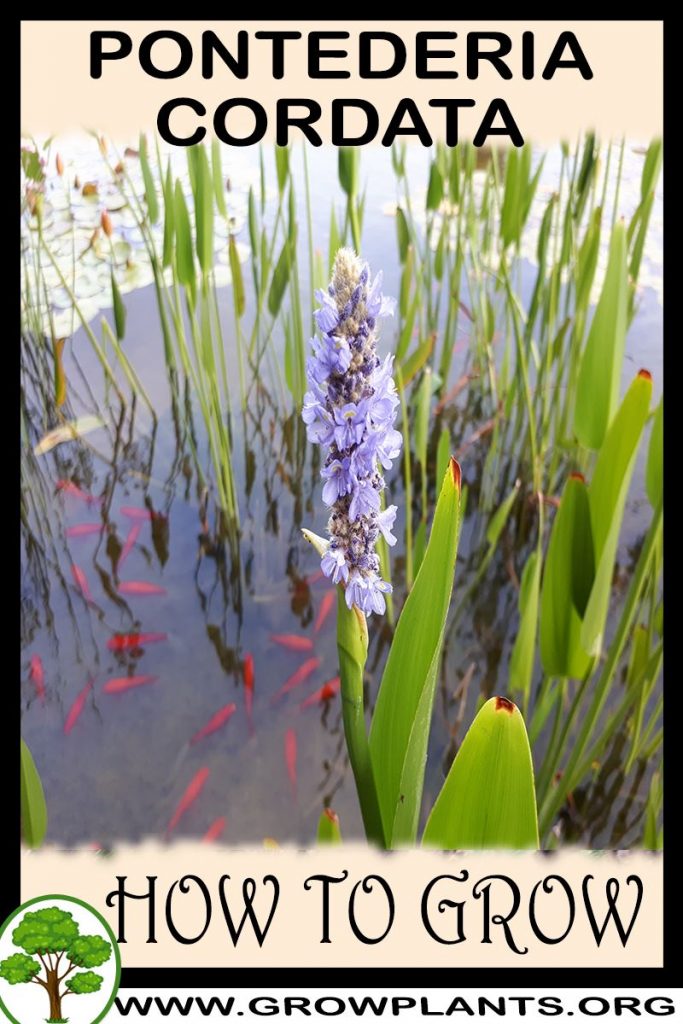
Plant Profile & Key Characteristics
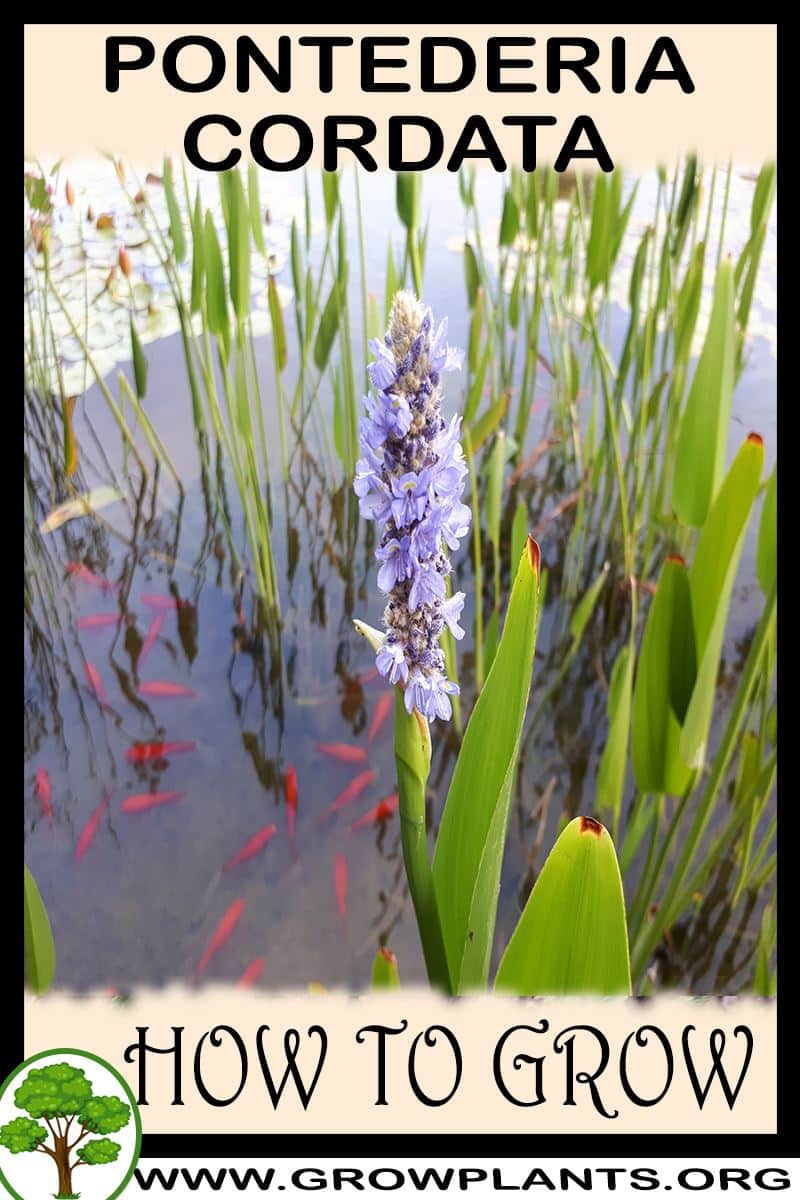
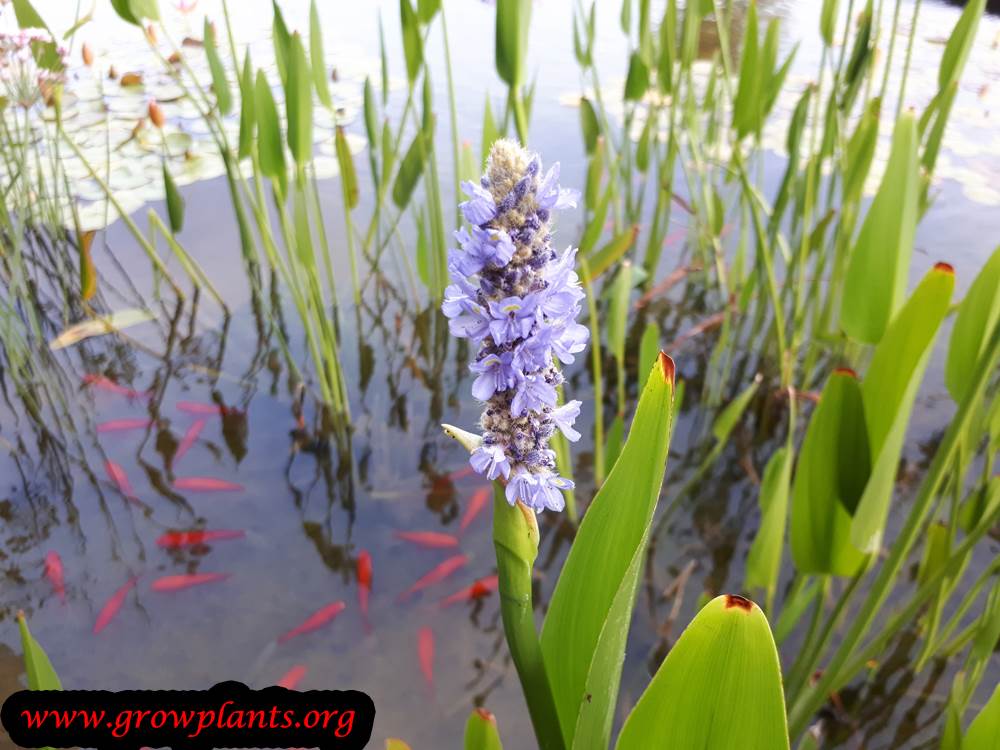
Overview: Pontederia cordata (pickerelweed) is a herbaceous marginal aquatic perennial growing 0.5-1.2 m (20-48 in) tall at the water’s edge. This fast- to moderate-growing plant is grown as an ornamental pond and bog plant for its spikes of blue-purple flowers.
Quick Specifications
| Specification | Attribute |
|---|---|
| Plant Type / Life Cycle | Perennial (herbaceous aquatic) |
| Foliage Type | Evergreen (dies back in cold-winter areas) |
| Mature Size | 0.5-1.2 m tall (20-48 in) |
| Growth Rate | Fast to moderate |
| Hardiness | USDA zone 3+ |
Growth Form & Structure
- Height & Spread: Emergent clumps 0.5-1.2 m (20-48 in) tall standing above shallow water; grows well in submerged containers and pond baskets.
- Growth Habit & Form: Upright, clump-forming marginal aquatic that spreads by rhizome into colonies.
- Lifespan & Maturity: Long-lived; can spread aggressively in favourable wet conditions.
Anatomy & Physical Features
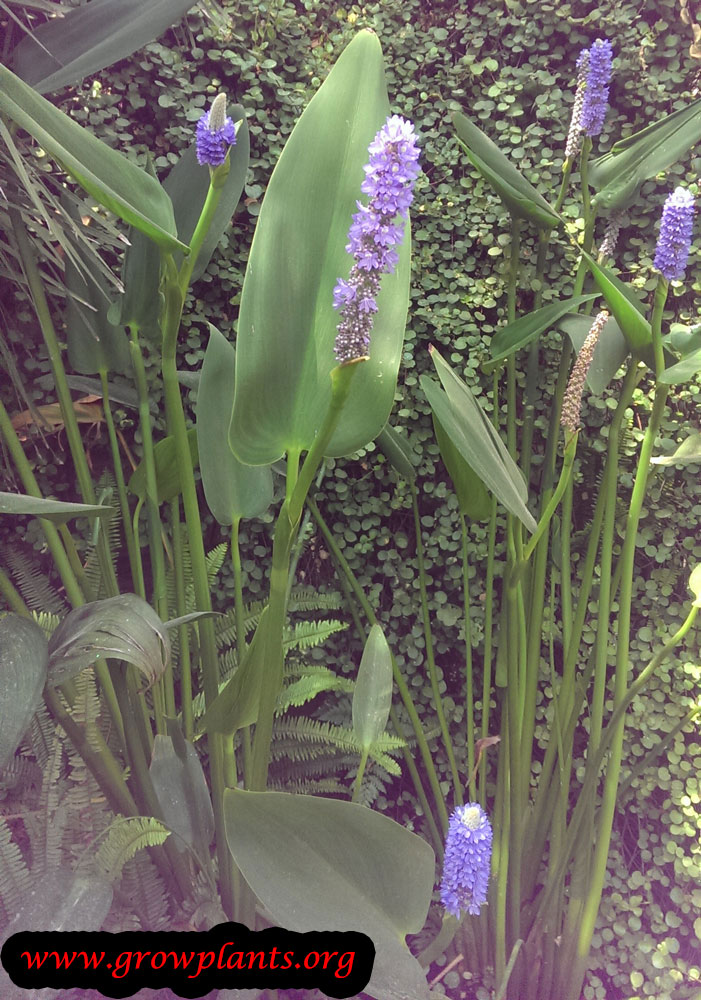
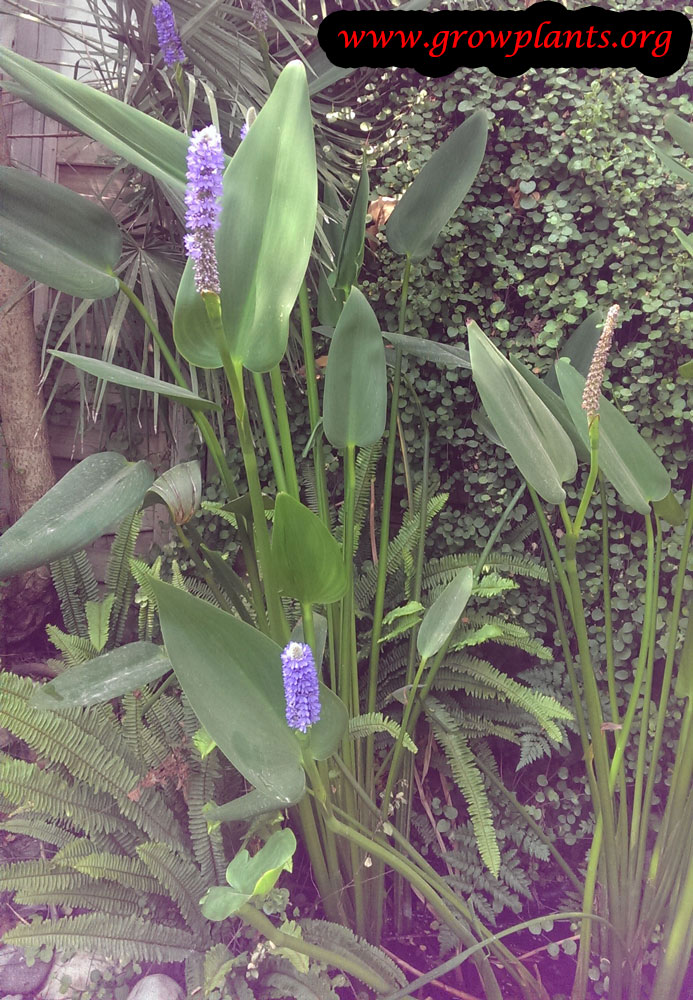
- Leaves & Foliage: Green, glossy leaves in a spoon-to-arrow (heart-based) shape held on long stalks.
- Flower Characteristics: Small purple, blue or white flowers packed on an upright spike, each with five petals and a yellow spot, in spring.
Primary Uses & Landscape Value
- Functional & Ornamental Roles: Ornamental marginal plant for pond edges, bog gardens and water features; useful for wildlife and can be grown in containers.
Care Guide: Planting, Soil & Watering
Overview: Pickerelweed is a marginal aquatic perennial that grows in full sun to shade in rich soil at the water’s edge or in shallow standing water. It needs constantly saturated soil or shallow submersion and cannot be allowed to dry out.
Quick Care Requirements
| Requirement | Ideal Condition |
|---|---|
| Planting Season | Spring through autumn in the warm growing season |
| Growth Rate | Moderate to fast |
| Soil Type | Rich, heavy soil in shallow water or permanently saturated ground |
| Water Need | High — grow in shallow standing water or constantly wet soil |
Planting & Establishment
- Best Planting Season: Plant in the warm season from spring through autumn, setting it into pond margins, a submerged aquatic basket, or boggy ground once the water has warmed.
- How to Plant:
- Hole Preparation: Plant into a heavy aquatic planting basket or directly into rich pond-margin mud, firming the roots so the plant stays anchored.
- Soil Amendments: Use a heavy, rich loam or aquatic planting mix rather than light potting soil, which floats away; top with gravel to keep the soil in place underwater.
- Planting Depth: Set the crown so it sits at or just below the water surface — the roots should be submerged or in saturated mud while the leaves stand above the water.
- Growth Speed & Expectations: A fast, vigorous spreader that forms dense colonies of upright, arrow-shaped leaves — it can be aggressive, so contain it in a basket where space is limited.
Soil, Watering & Drainage Care
- Soil Mix & Drainage Needs: Use dense, nutrient-rich aquatic soil that stays permanently saturated; ordinary free-draining mixes are unsuitable, as this plant lives in water.
- Watering Schedule & Technique:
- Young / Newly Planted: Keep newly planted roots continuously wet or submerged from the outset; never let a new planting dry out.
- Established: Maintain constant water around the roots — in a pond this is automatic; in a container, keep it standing in a tray of water or in shallow submersion at all times.
- Seasonal Adjustments: Keep the roots wet year-round; in cold climates the top dies back for winter while the crown overwinters in the wet soil below.
Climate, Light & Hardiness
Pickerelweed is a cold-hardy evergreen aquatic-margin perennial suited to an unusually wide range of climates, from temperate to full tropics. It tolerates everything from full sun to full shade and can even be grown indoors.
Quick Climate Specifications
| Climate Zones | Temperate, Mediterranean, desert, subtropics, tropics |
|---|---|
| USDA Hardiness Zones | 3+ |
| Frost Tolerance | High |
| Light Conditions | Full Sun / Half Shade / Full Shade |
Sunlight & Light Exposure
Optimal Light Setup
Pickerelweed is unusually flexible on light, growing well from full sun through half shade to full shade, and can even be grown as an indoor houseplant.
Shade & Heat Management
Its zone 3-and-warmer range spanning temperate to tropical climates shows strong general tolerance of both cold winters and hot, sunny summers.
Temperature Extremes & Hardiness
USDA Hardiness & Regional Limits
Pickerelweed is rated from USDA zone 3 upward, one of the broadest ranges among the aquatic-margin plants in this group, reflecting genuine cold hardiness at the rootstock level.
Cold Damage & Winter Protection
Old and dead parts are removed as part of year-round maintenance; in cold-winter areas the crown or rootstock survives beneath the water or mud even where top growth is lost to frost.
Frost Sensitivity
Overall frost tolerance is high given the plant's persistence from USDA zone 3 upward.
Wind, Humidity & Microclimate
Humidity Preferences
Pickerelweed needs consistently wet, rich soil or shallow standing water and does not tolerate drying out.
Microclimate Recommendations
Because it spreads aggressively when happy, site it where its invasive habit in wet ground can be contained, such as in a planting basket at the pond margin.
Growing in Pots, Balconies & Indoors
Pickerelweed is an aquatic plant grown in water rather than soil, and the grower lists it as suitable indoors – in a bright bowl, aquarium or water container it makes an easy indoor water plant, and it also thrives outdoors in a patio water tub.
Quick Details
- Container Size: A watertight tub, bowl, half-barrel or mini-pond – grown in standing water, not soil
- Indoor Suitability: Suitable indoors in a water container with good light
- Best Spot: Full sun, half shade or full shade
- Soil & Drainage: No drainage – the container holds water; root it in aquatic soil topped with grit under the water
- Watering in Pots: Keep the container topped up; it needs a constant, generous body of water
Indoors & On the Windowsill
- Indoors: The grower lists it as suitable indoors; grown in a water container by a bright window it makes an unusual indoor marginal, and it tolerates lower light too.
- Light: Even indoors it is happiest in bright light; near a window keeps growth compact and healthy.
On a Balcony or Patio
- Light & water: Stand the water container where it gets the light levels above; top it up often, as an open tub of water evaporates fast in sun and wind.
- Weight & siting: A full water container is very heavy – make sure the balcony or shelf can take the load before filling it, and site it on a level, stable base.
- Planting depth: As a marginal, sit its pot on bricks so the crown is at the right depth – just at or below the water surface rather than deep under it.
Choosing the Pot, Soil & Long-Term Care
- The container: Any watertight vessel works – a glazed pot with no holes, a half-barrel with a liner, a bowl or a purpose-made mini-pond. No drainage holes here; the point is to hold water.
- Growing it: Plant it in a mesh aquatic basket of heavy loam or aquatic soil topped with grit to stop it clouding the water, then lower it to the right depth.
- Water & feeding: Keep the water topped up with rain or aged tap water; these plants feed from the water, so go easy on fertiliser and remove decaying leaves to keep it clear.
- Upkeep: Divide or thin crowded growth each year to keep it healthy and stop it swamping the container.
Fertilizing & Feeding
Pickerelweed is a marginal aquatic perennial rooted in rich pond-edge soil, so it generally needs only light supplemental feeding – its naturally organic-rich, saturated growing conditions already provide much of what it needs to produce its arrow-shaped leaves and spikes of blue-violet flowers.
Quick Fertilizing Specs
| Feeding Level | Light – rooted in naturally rich, saturated marginal soil |
|---|---|
| young_feeding | A light, balanced feeding at planting helps new divisions or seedlings establish roots |
| mature_feeding | Established clumps usually need only an occasional light feeding as spring growth resumes |
| Main Nutrient Priority | Balanced feeding that supports steady foliage and the spikes of small five-petaled flowers without pushing weak growth |
| Best Feeding Period | As new shoots emerge in spring, tapering off once flower spikes are forming |
| Reduce/Stop Feeding | Ease off feeding as the plant moves toward autumn dieback |
| Organic Options | Well-rotted compost or an aquatic-safe organic feed worked into the wet planting soil suits this plant well |
Feeding by Growth Stage
Establishment of new plantings
Help new divisions or seedlings root into rich, saturated planting soil
| Nutrient direction | A light, balanced feeding worked into the soil at planting |
|---|---|
| Timing | At planting, in spring as growth resumes |
| Frequency | A light feeding at planting is usually enough to establish new plantings |
| Fertilizer types | A balanced, aquatic-safe granular or tablet fertilizer worked into the wet planting soil |
| Precautions | Work fertilizer into the soil at the root zone rather than the open water |
Active growth and flower spikes
Support the spoon-to-arrow-shaped leaves and spikes of blue-violet flowers with their yellow throat marking
| Nutrient direction | Balanced feeding that favors steady foliage and flower spike development |
|---|---|
| Timing | Through the main growing season as flower spikes form and bloom |
| Frequency | Light, occasional feeding through the growing season is usually sufficient |
| Fertilizer types | A balanced aquatic or bog-plant fertilizer applied lightly to the wet soil around the roots |
| Precautions | Avoid heavy feeding, which can push soft leafy growth at the expense of flower spikes and encourage this vigorous, spreading plant further |
Autumn dieback and winter rest
Let the plant wind down naturally as foliage dies back for the season
| Nutrient direction | None – withhold fertilizer as growth slows heading into autumn |
|---|---|
| Timing | From autumn dieback through the winter rest period |
| Frequency | No feeding at this stage; the plant is resting rather than actively growing |
| Fertilizer types | No feeding at this stage – allow the natural dieback and rest period to proceed |
| Precautions | Do not fertilize during dieback or winter rest |
Nutrient Deficiency Signs & Corrections
The arrow-to-spoon-shaped leaves turn pale green instead of rich deep green
| Possible causes | Nutrient-poor planting soil, Too much shade for a plant that prefers full or half-sun exposure, Waterlogged, oxygen-starved soil limiting root uptake, Natural aging of older leaves |
|---|---|
| Appears first on | Older, outer leaves of the clump |
| What to check | Soil richness and organic matter, Sun exposure, Soil drainage and aeration, Overall clump vigor |
| Possible correction | Improve light and confirm the soil isn’t stagnant; a light balanced feeding can help if the site is genuinely nutrient-poor |
Few flower spikes form despite healthy-looking foliage
| Possible causes | Excess nitrogen favoring leafy growth over blooms, Insufficient sun during the flowering season, Overcrowded clumps competing for light and resources, Immature divisions not yet established enough to bloom heavily |
|---|---|
| Appears first on | Whole clump rather than individual shoots |
| What to check | Recent feeding balance, Sun exposure, Clump density and time since division, Overall establishment |
| Possible correction | Favor balanced over nitrogen-heavy feeding, ensure good sun exposure, and divide overcrowded clumps |
Dark spots develop on leaves and affected foliage declines
| Possible causes | Fungal leaf spot favored by crowded, poorly circulating foliage, Water quality decline or pollutant exposure, Excess nitrogen producing soft, disease-prone tissue, Aphid feeding damage opening entry points for disease |
|---|---|
| Appears first on | Lower, shaded leaves within a crowded clump |
| What to check | Aphid presence, Air circulation around the clump, Recent feeding rate, Water quality |
| Possible correction | Thin crowded clumps for better air flow, address aphids if present, and keep feeding light and balanced |
Pruning, Training & Seasonal Maintenance
Pickerelweed is a non-woody marginal aquatic perennial, so there is no structural "pruning" in the woody sense – maintenance means routine deadheading, removal of dead or yellowing foliage, and periodic division to keep its naturally aggressive, spreading rootstock in check. It tolerates cutting back at almost any time of year in warm climates, though the most useful window is the active growing season (spring through autumn) when regrowth is fastest; a harder cutback of top growth is appropriate after frost kills the foliage in colder hardiness zones. None of this maintenance is tied to a fruit or timber crop – it only affects bloom continuity and the plant’s spread.
Quick Pruning & Maintenance Specs
| Pruning Tolerance | High – herbaceous, regrows readily from the crown/rhizome |
| Primary Maintenance Window | Spring–autumn active growth (light, ongoing) |
| Secondary Maintenance Window | Late autumn/winter cutback where foliage dies back with frost (roughly zones 3–7) |
| Typical Frequency | Ongoing (weekly to monthly deadheading/foliage removal); division every 2–3 years |
| Main Objective | Prolong bloom, remove dead tissue, contain invasive spread |
| Mature Plant Priority | Divide and thin the rhizome mat before it escapes its planting basket |
| Best Tool Type | Precision snips/scissors; spade for division |
| Avoid Heavy Cutback During | Peak bloom if flowers are wanted; before the first hard frost in cold zones |
Seasonal Pruning Schedule
Ongoing Sanitary (spring–autumn)
Objective: keep the clump tidy and blooming. Remove: spent flower spikes at their base and any yellowed or damaged leaves. Do not remove: healthy green foliage or unopened spikes. Expected response: continued flower production through the season; no impact on a fruit crop since none is grown.
Dormant/Winter (cold zones only)
Objective: tidy the crown before regrowth. Remove: foliage killed back by frost, cut to just above the crown/water line. Do not remove: green growth in mild-winter zones where the plant stays evergreen. Expected response: fresh shoots emerge from the rhizome in spring.
Special Growth to Remove
- Spent flower stems – deadhead to the base to encourage further bloom.
- Dead/yellowed leaves – remove at the petiole base as routine sanitation.
- Excess rhizome growth – Pickerelweed is noted as aggressive and invasive; lift, divide and thin the clump every 2–3 years and keep it confined to a planting basket rather than letting it root freely in pond substrate.
Container & Small-Space Pruning
Pickerelweed is usually grown in a submerged planting basket even within a larger pond. Lift and divide when roots fill the basket (typically every 2–3 years), trimming the root mass back at division, and pinch/trim foliage to keep the clump proportional in small water features.
Tools
Precision snips or scissors for stems and foliage; a garden spade for lifting and dividing the rootstock. Loppers, saws and hedge shears are not appropriate – this is a soft-stemmed herbaceous plant with no woody wood to cut.
Tool Hygiene & Disease Risk
Routine – clean tools between plants is sufficient; the main pest noted for this species is fish grazing the roots rather than a transmissible pathogen. Because the plant is classed as aggressive/invasive, avoid discarding trimmed foliage or rhizome divisions into open waterways, where fragments can re-root.
Cut Placement & Technique
Deadhead spent flower stalks down to the leaf axil; remove yellow leaves at the base of the petiole rather than mid-blade; when dividing, cut the rhizome mat into sections that each retain healthy roots and at least one growing point.
Post-Pruning Care
Keep the root zone submerged/moist after cutback – this is an aquatic plant and should never be allowed to dry out. Watch new regrowth for aphids. No extra feeding is needed beyond the plant’s normal aquatic fertilizing schedule.
Common Pruning Mistakes
- Letting the clump go too many years without division, so it overgrows its basket and spreads into open water (consistent with its aggressive/invasive habit).
- Cutting back healthy evergreen growth hard in warm climates purely out of habit, which sacrifices bloom for no benefit.
- Discarding cut material or divisions where fragments can root in a natural waterway.
When NOT to Prune
Avoid a hard cutback while flower spikes are actively blooming (it simply removes the display). In cold zones, leave frost-killed top growth in place until after the last hard freeze rather than cutting to the crown mid-winter – the dead foliage offers the crown some insulation.
Recommended Tools (by task)
- precision_snips – deadheading spent spikes and trimming soft foliage.
- garden_spade – lifting and dividing the rhizome/root mass every 2–3 years.
Propagation Guide
Pickerelweed can be grown from seed, but dividing the clumping rhizome is the best practical method since it gives flowering-size plants quickly and is not strictly necessary here only because seed also works reasonably well, per the site. Overall difficulty is Easy by division, Moderate by seed due to slower, less predictable germination.
Quick Propagation Specs
| Best Propagation Method | Rhizome/clump division |
| Alternative Methods | Seed |
| Propagation Difficulty | Easy (division); Moderate (seed) |
| Seed True-to-Type | Usually true-to-type |
| Vegetative True-to-Type | Yes |
| Best Propagation Season | Spring through autumn, per the site’s planting season |
| Seed Germination Time | Several weeks and often uneven |
Growing from Seed
Dormancy & Pre-Sowing Treatment
Seed of this aquatic perennial often benefits from a period of cold, moist stratification before sowing; germination can otherwise be slow and irregular.
Sowing Depth & Orientation
Sow on the surface of constantly wet or shallowly flooded, rich mud rather than burying the seed.
Germination Conditions
Keep seed in saturated to shallowly submerged, sunny conditions; expect staggered emergence over several weeks.
Seedling Care
Grow seedlings on in shallow water until well rooted before setting them at their intended planting depth.
Division, Offsets, Pups & Suckers
Divide established clumps in spring or early autumn, separating the rhizome into sections that each carry roots and at least one growing point. Because the site notes this plant is aggressive/invasive, replant divisions promptly in a contained area or planted basket rather than letting cut pieces drift.
Rhizomes, Tubers, Bulbs & Corms
Rhizome sections with attached roots and a growing point establish quickly when replanted directly into rich, saturated soil at the same depth as the parent clump.
Bloom & Edible Flower Guide
Quick Details
- Bloom Season: Spring, and on through the warm months
- Flower Appearance: Upright spikes of small blue-to-purple (sometimes white) flowers, each with a yellow spot
- Edibility: The young flowers are edible – scattered raw into salads in the foraging tradition; enjoy in moderation
Detailed Blooming Overview
Pickerelweed is a marginal water plant that carries dense, upright spikes of blue-purple flowers above its arrow-shaped leaves through the warm season. Each little flower has five lobes and a small yellow spot at the throat. Beyond its garden value, the young flowers are edible and can be added raw to salads.
Flower Characteristics
- Small flowers in purple, blue, or white
- Five petals, each with a yellow spot in the center
- Massed on an upright spike above the foliage
Bloom Care & Thinning
- Placement: grow in shallow water or saturated soil at the margin for the best flowering.
- Pollination: worked by bees and other insects.
- Using the flowers: if you gather them for the table, pick clean, freshly opened blooms and use them sparingly.
Fruit & Uses
Although grown here as a pond-margin ornamental, pickerelweed has a long history as a wild food plant: its ripe seeds are eaten like a nutty grain, and its young leaf stalks are cooked as a green vegetable. Seeds can be eaten raw or roasted/boiled/ground into flour, while the leaf stalks are normally cooked before eating.
Quick Edible Specs
| Edible Parts | Ripe seeds; young leaf stalks (and young leaves) |
|---|---|
| Main Use(s) | Seeds as a nut-like snack or ground into flour; leaf stalks as a cooked green vegetable |
| Eaten Raw or Cooked | Seeds: raw or cooked (roasted/boiled). Leaf stalks: best cooked; only the youngest leaves are eaten raw |
| Preparation Required | Seeds: none for fresh eating, or roast/grind to flour. Leaf stalks/older leaves: cook before eating |
| Harvest Season | Seeds in late summer to autumn after flowering; leaf stalks in spring while still young and tender |
| Time to First Harvest | Once the colony is established and flowering (see Care/Propagation for how it establishes) |
| Storage | Dried seeds store well like a grain; leaf stalks are best used fresh |
| Safety/Toxicity Caveat | Only harvest from clean water free of pollution; no known toxicity when properly identified and prepared |
Seeds, Pods & Nuts
The flower spikes give way to small starchy achenes (seed-like fruits). Once ripe, they can be eaten fresh, dried and stored like a grain, or roasted and ground into a nutty flour.
Leaves & Greens
The young leaf stalks are harvested while still tender in spring and cooked as a green vegetable; the youngest leaves can also be eaten raw in salads, but older leaves should be cooked.
Harvesting
Pick leaf stalks while young and soft; once leaves mature they become tougher and are better cooked than eaten raw. Collect seed heads once the seeds have matured and dried on the plant, generally after the flowering season has finished.
Preparation, Uses & Safety
Rinse all harvested material well, since it grows directly in water and should only be gathered from a clean, unpolluted water source. Seeds can be eaten out of hand, added to granola or cereal, or ground into flour; leaf stalks are typically cooked and served like a cooked green. No specific toxicity is documented for this species when correctly identified.
Pests, Diseases & Troubleshooting
Overview: Pontederia cordata (pickerelweed) is a robust, largely trouble-free aquatic marginal for pond edges. Its few real pests are the pickerelweed/waterlily borer moth larvae that tunnel the stems and leaves, plus waterlily aphids on the foliage; disease is minor. Because it grows in water, control must be pond-safe — hand-work and biological methods first, never broad chemicals near fish.
Quick Troubleshooting Overview
| Issue / Pest | Main Symptom | Primary Solution |
|---|---|---|
| Pickerelweed borer | Wilting, holed, tunnelled leaves and stems | Cut out infested growth, hand-pick larvae |
| Waterlily aphid | Colonies on leaves/flower spikes; distortion | Hose into water for fish, blast off |
| Caterpillars / leaf beetles | Chewed, holed leaves | Hand-pick, tolerate minor damage |
| Fungal leaf spot | Brown spots on leaves in stagnant conditions | Remove leaves, improve water movement |
| Crown rot / decline | Yellowing, collapse of congested clumps | Divide, refresh, correct planting depth |
Common Pests & Management
- Pickerelweed / waterlily borer (Bellura densa):
- Symptoms: Moth larvae bore into the leaf stalks and stems, causing wilting, collapse and holed, tunnelled tissue; frass and entry holes mark the stems, and clumps can be visibly damaged in late season.
- Prevention & Control: Cut out and destroy infested stems and leaves, and hand-pick the larvae where reachable; encourage birds and predatory insects. Because the plant sits in water, avoid chemical sprays — physical removal is both effective and pond-safe, and the vigorous clump regrows.
- Waterlily aphid (Rhopalosiphum nymphaeae):
- Symptoms: Colonies of small aphids on leaves, stalks and flower spikes cause distortion, stickiness and reduced flowering, spreading across nearby pond plants.
- Prevention & Control: Hose them off into the water where fish and other pond life eat them, or submerge affected foliage briefly; encourage ladybirds and lacewings. Do not use insecticides near fish; a jet of water repeated over a few days usually suffices.
- Caterpillars & leaf beetles (Lepidoptera larvae, Chrysomelidae):
- Symptoms: Irregular holes and grazed patches on the arrow-shaped leaves from assorted chewing insects.
- Prevention & Control: Tolerate minor cosmetic feeding on this vigorous plant, hand-pick where practical, and rely on the pond’s natural predators; avoid chemicals in the water.
- Snails (aquatic Gastropoda):
- Symptoms: Minor grazing of leaves; generally a harmless part of the pond ecosystem unless populations explode.
- Prevention & Control: No action usually needed; remove excess by hand and encourage a balanced pond if grazing becomes heavy.
Diseases & Fungal Issues
- Fungal leaf spot (Cercospora / Alternaria spp.):
- Symptoms: Brown or grey spots and blotches on the emergent leaves, mostly in warm, stagnant, crowded conditions; usually cosmetic.
- Treatment & Management: Remove affected leaves, improve water movement and airflow around the clump, and thin congested growth; chemical fungicides are inappropriate near fish.
- Crown / rhizome rot (secondary rot of damaged or congested crowns):
- Symptoms: Yellowing, softening and collapse of overcrowded or borer-damaged clumps, or plants set too deep.
- Treatment & Management: Divide congested clumps regularly, plant at the correct shallow depth (crown just below water), remove rotted material, and refresh the planting mix.
Growing Difficulties & Abiotic Problems
- Incorrect planting depth:
- Cause & Symptoms: Set too deep the plant sulks and rots; too shallow or dried out it wilts, as it needs its roots in wet mud or shallow water.
- Correction Strategy: Plant with the crown just at or below the water surface in a heavy aquatic loam, in a basket lined to hold soil, in sun; keep water levels appropriate to the growth stage.
- Congestion / reduced flowering:
- Cause & Symptoms: Vigorous clumps become congested over a few seasons, flowering less and pushing out of the basket.
- Correction Strategy: Lift and divide every couple of years in the growing season, replanting healthy rhizome pieces in fresh aquatic soil.
- Cold dormancy:
- Cause & Symptoms: The plant dies back to the rhizome in cold seasons; in hard-freezing climates shallow-set crowns can be killed.
- Correction Strategy: It is hardy where the rhizome does not freeze solid; in very cold areas keep the basket in deeper, non-freezing water or lift and store the rhizome frost-free over winter.
- Chlorosis / poor growth:
- Cause & Symptoms: Pale, weak growth in nutrient-poor water or exhausted planting soil.
- Correction Strategy: Feed with aquatic plant tablets pushed into the basket soil (not broadcast into the water), and refresh the soil at division.
What Helps – Products & Tools
Everything must be pond-safe. Useful items are a strong water jet to knock aphids into the water for fish, hand removal / secateurs for borer-infested stems, aquatic planting baskets and heavy aquatic loam for correct depth, and slow-release aquatic fertilizer tablets for vigor; avoid all insecticides and fungicides near fish and pond life.