


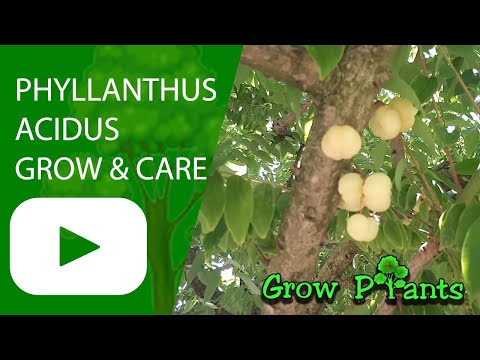
Plant Profile & Key Characteristics
Overview: A small evergreen tropical tree 2-10 m (6-33 ft) tall, grown for its clusters of tart yellow gooseberry-like fruit. It is valued as an edible-fruit, medicinal and ornamental tree, and can be kept small or as a container bonsai, bearing after 3-5 years.
Quick Specifications
| Specification | Attribute |
|---|---|
| Plant Type / Life Cycle | Perennial tree |
| Foliage Type | Evergreen |
| Mature Size | 2-10 m (6-33 ft) tall |
| Growth Rate | Fast to moderate |
| Toxicity | Fruit is edible; grown for its sour, tart berries |
| Hardiness | USDA zones 10+ |
Growth Form & Structure
- Height & Spread: Naturally 2-10 m (6-33 ft), but readily kept as a compact dwarf or bonsai; it will fruit even in a large 40 L (10 gal) container.
- Growth Habit & Form: Bushy small tree with a spreading crown; fruit is borne in dense clusters directly along the branches.
- Lifespan & Maturity: A long-lived tree that begins bearing fruit about 3-5 years from planting.
Anatomy & Physical Features
- Leaves & Foliage: Green elliptic leaflets arranged along the branchlets in a feathery pinnate pattern.
- Flower Characteristics: Small pink-to-red cross-shaped flowers that cluster densely over the branches.
- Fruit Profile: Small round pale-yellow ribbed fruits, crisp, sour and tart.
Primary Uses & Landscape Value
- Edible Uses: Tart fruit eaten raw, juiced, or made into jams and preserves; also used medicinally.
- Functional & Ornamental Roles: Grown as a fruit tree, a flowering ornamental (its coloured flowers cloak the branches), and as a container or bonsai specimen.
Care Guide: Planting, Soil & Watering
Overview: The Otaheite gooseberry is a tropical fruit tree that grows best in full sun in rich, moist, well-drained soil kept mulched. It likes steady moisture and warmth and grows quickly in its ideal frost-free climate.
Quick Care Requirements
| Requirement | Ideal Condition |
|---|---|
| Planting Season | Spring–summer in zone 10a, spring–autumn in zones 10b–11, year-round in zone 12+ |
| Growth Rate | Fast to moderate |
| Soil Type | Rich, moisture-retentive, well-drained |
| Water Need | Moderate — keep the soil consistently moist |
Planting & Establishment
- Best Planting Season: Plant in spring to summer in hardiness zone 10a, spring to autumn in zones 10b–11, and year-round in zone 12 and warmer.
- How to Plant:
- Hole Preparation: Dig a hole about as deep as and a little wider than the root ball; in a container start small and pot up as it fills its container by roughly 30–50% each time.
- Soil Amendments: Enrich the soil generously with compost and organic matter and apply a mulch to hold moisture and feed the roots.
- Planting Depth: Set the root ball level with the surface, keeping the root collar at soil level; do not bury the trunk.
- Growth Speed & Expectations: Expect fast-to-moderate growth to a tree 2–10 m tall; container plants fruit even in a 40 L (5–10 gallon) pot, though bigger is better.
Soil, Watering & Drainage Care
- Soil Mix & Drainage Needs: Rich but well-drained soil is ideal; refresh container soil every few years as it loses vitality. Sharp drainage prevents root rot.
- Watering Schedule & Technique:
- Young / Newly Planted: Keep young trees consistently moist as they establish, especially in heat.
- Established: Water regularly to keep the soil moist; do not let it dry out for long during active growth and fruiting.
- Seasonal Adjustments: Water most through the warm growing and fruiting season and less in cooler weather.
Climate, Light & Hardiness
Phyllanthus acidus (star gooseberry tree) is a frost-tender tropical fruit tree suited to USDA zone 10 and warmer. It needs full sun and consistent warmth to grow and fruit well.
Quick Climate Specifications
| Climate Zones | Tropic, subtropical, mediterranean |
|---|---|
| USDA Hardiness Zones | 10+ |
| Light Conditions | Full sun |
| Frost Tolerance | None to very low |
Sunlight & Light Exposure
Optimal Light Setup
Needs full sun for healthy growth, flowering, and fruiting.
Temperature Extremes & Hardiness
USDA Hardiness & Regional Limits
Reliably grown only in zone 10 and warmer, frost-free climates; in cooler areas it needs container culture with winter protection under cover.
Frost Sensitivity
Frost-tender as a tropical species – young trees are especially vulnerable, and even brief freezing can cause serious dieback or kill the tree; cold tolerance also varies somewhat with tree age and site exposure.
Cold Damage & Winter Protection
In marginal zone-10 sites a warm, sheltered microclimate helps reduce cold-damage risk to foliage and young wood.
Wind, Humidity & Microclimate
Humidity Preferences
Suited to the warm, humid conditions typical of tropical and subtropical climates.
Growing in Pots, Balconies & Indoors
The Otaheite gooseberry is a small tropical fruit tree, reaching 2-10 m in the ground, so it is not a long-term houseplant. The grower does grow it in pots, though – kept as a dwarf tree or bonsai it will still fruit, and a potted specimen can be moved under cover in cold weather.
Quick Details
- Container Size: Will fruit even in a 5-10 gal (about 40 L) container – bigger is better; pot up as it fills each size
- Indoor Suitability: Not a houseplant; a bright greenhouse or conservatory suits a potted, dwarfed specimen
- Best Spot: Full sun
- Soil & Drainage: Peat-based mix with good drainage; lava grit at the base helps
- Watering in Pots: Average; let a saucer of water drain and dry the same day
Indoors & On the Windowsill
- Houseplant limits: A fruiting tropical tree – not a houseplant. It needs full sun that no living room can give, so keep it outdoors in warmth or under glass.
- Under glass / overwintering: Being tender, a potted tree is best kept frost-free; a bright, warm greenhouse or conservatory lets it carry on through a cold season.
On a Balcony or Patio
- Light & warmth: Give it the hottest, sunniest, most sheltered position; it is a warm-climate tree and dislikes cold wind.
- Practicalities: A large fruiting tub is heavy – site it on solid footing with room for the crown, and expect frequent watering in heat.
Choosing the Pot, Soil & Long-Term Care
- Pot & drainage: The grower’s method: match the pot to the plant – pot a small one straight into a container 30-50% wider than the root ball; each time it fills the pot, step up a size until it reaches the tub you want. Make good drainage holes and use a saucer that fills on watering but dries the same day. Give it strong drainage holes; terracotta breathes and dries faster, while glazed or plastic holds moisture longer.
- Potting mix: A peat-based mix with some lava grit in the base for drainage, as the grower advises.
- Soil renewal: Every few years refresh the mix – soil loses its structure over time. When you cannot change it all, replace the soil at the sides and trim those roots; do not be afraid to cut roots.
- Feeding: Potted plants use up their feed quickly as nutrients leach away with each watering, so feed more often than plants in open ground through the growing season.
Grower’s Container Tip
- Keep it small and fruiting: The grower’s advice is to train it as a dwarf tree or as a bonsai – grown this way it still bears fruit even in a 5-10 gal (40 L) pot, and stays a manageable size on a patio or under glass.
Fertilizing & Feeding
A moderate feeder: young trees benefit from nitrogen-forward feeding to build a strong canopy, while trees old enough to fruit do best on balanced feeding that supports both healthy growth and fruit set.
Quick Fertilizing Specs
| Feeding Level | Moderate feeder |
|---|---|
| Main Nutrient Priority | Nitrogen-forward while the young tree builds its canopy, shifting to balanced feeding once it begins bearing |
| Best Feeding Period | Through the warm active growing season |
| Organic Options | Compost, well-rotted manure, or mulch worked into the root zone |
| Micronutrients | Usually supplied by a complete fruit-tree fertilizer; correct specific issues only when diagnosed |
| Soil pH | Prefers rich, moist, well-drained soil |
Feeding by Growth Stage
Newly planted tree
Help a young transplant establish roots without stressing it with heavy feeding.
| Nutrient direction | A light, balanced fertilizer to support root establishment. |
|---|---|
| Timing | The first season after planting. |
| Frequency | Light feeding as new growth appears, worked into moist, well-drained soil. |
| Fertilizer types | A balanced complete fruit-tree fertilizer, Compost or well-rotted organic matter |
| Precautions | Avoid heavy feeding on a newly planted tree; overfeeding can burn tender new roots. |
Young tree, building the canopy
Support vigorous shoot and leaf growth to build a strong framework before the tree begins bearing.
| Nutrient direction | A nitrogen-forward complete fertilizer to encourage steady canopy development. |
|---|---|
| Timing | Through the active growing seasons before the tree matures enough to fruit. |
| Frequency | Regular light feeding through the warm growing months. |
| Fertilizer types | A nitrogen-forward complete fruit-tree fertilizer, Compost or well-rotted manure |
| Routine trace nutrients | iron, manganese, zinc |
| Precautions | Reduce feeding heading into cooler months so new growth has time to harden before any chill. |
Mature, fruit-bearing tree
Support both healthy canopy maintenance and good fruit development once the tree is bearing.
| Nutrient direction | A balanced complete fertilizer, supporting adequate potassium as fruit develops. |
|---|---|
| Timing | Through the active growing season, ahead of and during fruit development and summer harvest. |
| Frequency | Regular light feeding through the growing season, tapering off as fruit matures. |
| Fertilizer types | A balanced complete fruit-tree fertilizer, Compost or well-rotted organic matter as mulch |
| Routine trace nutrients | iron, manganese, zinc |
| Precautions | Avoid heavy nitrogen close to harvest, which can favor leafy growth over fruit quality. |
Nutrient Deficiency Signs & Corrections
Older leaves pale to yellow-green and overall canopy growth is sparse or slow.
| Possible causes | low soil nitrogen, poor soil drainage limiting root uptake, competition from grass or weeds around the root zone |
|---|---|
| Appears first on | older, lower leaves |
| What to check | recent feeding history, soil drainage and mulch coverage, weed or turf competition near the trunk |
| Possible correction | Resume a nitrogen-forward feeding program for young trees, or a balanced one for bearing trees, and clear competing vegetation from the root zone. |
Interveinal yellowing on new leaves while the veins stay green.
| Possible causes | high soil pH limiting iron availability, waterlogged or compacted soil, low soil iron |
|---|---|
| Appears first on | youngest leaves first |
| What to check | soil pH, drainage around the root zone, whether nearby trees show the same pattern |
| Possible correction | Correct soil pH toward neutral and apply a chelated iron product per its label if the pattern persists. |
Abundant flowers but few fruits develop, or fruit drops early.
| Possible causes | nutrient imbalance, especially excess nitrogen relative to potassium, water stress during flowering, inadequate pollination |
|---|---|
| Appears first on | the developing fruit and flower clusters |
| What to check | recent feeding balance, watering consistency during bloom, pollinator activity around the tree |
| Possible correction | Shift toward balanced feeding with adequate potassium during fruit development and keep watering consistent through bloom. |
Pruning, Training & Seasonal Maintenance
Star gooseberry tolerates moderate pruning and, per its own care notes, is trimmed mainly "for design" rather than for a fixed structural system; the safest window is autumn/winter, after the summer fruit harvest, so shaping does not sacrifice the current crop. As a fast-to-medium growing tree that can reach 2-10m in the ground, early structural work keeps it manageable, while hard pruning of a mature tree trades away some of next season’s flowering clusters, which form directly along the branches.
Quick Pruning & Maintenance Specs
| Pruning Tolerance | Moderate |
| Primary Pruning Window | Autumn/winter, after the summer fruit harvest |
| Secondary Maintenance Window | Any time, for dead or damaged wood |
| Typical Frequency | Once yearly shaping; more often while young |
| Main Objective | Manageable size and open, well-shaped canopy ("for design") without stripping flowering wood |
| Young Plant Priority | Build 3-5 well-spaced scaffold branches for an open canopy |
| Mature Plant Priority | Light annual shaping, height/spread control, remove root suckers |
| Best Tool Type | Bypass secateurs and loppers; saw for older wood |
| Avoid Heavy Pruning During | Spring flush into flowering, and just before the summer harvest |
Pruning by Plant Age & Size
Newly Established
Minimal – remove only damaged growth; do not cut a young whip back hard while it is establishing.
Young / Formative
Open-center, multi-leader training: select 3-5 well-angled scaffold branches and remove competing upright growth, building an open canopy that later shows off the branch-clustered flowers and fruit rather than a single dominant leader.
Mature / Established
Light annual shaping after harvest, height and spread control (especially if kept as a landscape tree, or deliberately restrained as a dwarf/bonsai specimen per the plant’s own container notes), and thinning of crowded interior growth.
Seasonal Pruning Schedule
Post-Harvest – objective: shape and control size while there is still time for a flush before the next flowering cycle; what to remove: dead, crossing, or damaged wood, plus modest shaping cuts; what not to remove: large sections of branch-clustered flowering wood in one pass; expected response: a fresh flush from the cut points; flowering/fruiting impact: sets up next season’s flowering wood without a big crop penalty if kept light.
Ongoing Sanitary – remove dead or storm-damaged wood whenever seen, at any time of year.
Flowering & Fruiting Wood
Flowers and then fruit form in dense clusters directly along the branches rather than only at the shoot tips, mostly on the current and prior season’s branch wood. Because the fruiting points are spread along the branch length, light shaping after harvest removes relatively little future crop, but repeated hard heading cuts into a branch strip many of these flowering points at once and can noticeably reduce the next harvest – favor thinning and length reduction over blanket heading.
Structural Pruning & Training
Maintain an open, multi-leader canopy; remove crossing, rubbing, or inward-growing branches; control height and spread, particularly useful since this fast-to-medium grower can reach 10m in the ground or be kept deliberately small as a dwarf/bonsai specimen. Thinning lets light into the fruiting clusters without stripping too much bearing wood at once.
Special Growth to Remove
Root suckers from the base or root zone – this species is noted as potentially invasive in tropical climates, so removing suckers both maintains a clean single trunk and helps prevent unwanted spread; dead or storm-damaged wood at any time; overly vigorous upright shoots shading the interior canopy.
Container & Small-Space Pruning
Explicitly suited to containers down to around 40 liters (10 gallons) and adaptable to dwarf or bonsai form. Pair any canopy trim with the plant’s own root-pruning routine at repotting (cutting back some roots on the side when a full soil change is not practical) to keep top growth in balance with a restricted root zone; expect to prune a compact container specimen more often than an open-ground tree.
Tools
Bypass secateurs for young shoots and finger-thick wood; loppers for thicker branches; a pruning saw for structural cuts on older in-ground trees.
Tool Hygiene & Disease Risk
Routine – no specific transmissible pathogen is documented for this species in the available facts; clean, sharp tools are sufficient, and it is worth wiping blades after cutting out any rotten or damaged wood.
Cut Placement & Technique
Favor thinning cuts back to a lateral or the branch collar over indiscriminate heading, since flowering clusters are distributed along the branch and heading removes many at once; avoid flush cuts and long stubs.
Heavy Pruning & Rejuvenation
Tolerated to a degree – an overgrown or leggy specimen can be cut back harder in the post-harvest window to reduce size, but expect a lighter flower and fruit set the following season while it regrows; spread a larger size reduction over two seasons rather than removing it all at once.
Post-Pruning Care
Water normally; a newly opened canopy interior can expose previously shaded bark to stronger sun, so watch for scorch after a heavier thinning; do not add extra fertilizer simply to push regrowth after a cutback.
Common Pruning Mistakes
Heading cuts that strip the branch-clustered flowering wood instead of thinning; pruning right before the summer harvest instead of after it; leaving root suckers to grow unchecked, worsening this species’ tendency to spread; hard pruning right as the tree starts its spring flush toward flowering.
When NOT to Prune
Avoid pruning during flowering and while fruit is developing toward the summer harvest; avoid pruning during a strong spring growth flush right before flowering.
Recommended Tools (by task)
- bypass_secateurs – for young shoots and finger-thick branch thinning.
- loppers – for thicker branch removal on establishing or mature specimens.
- pruning_saw – for structural cuts on an older in-ground tree.
- pole_pruner – only for height control on a mature, full-sized (near 10m) in-ground tree; not needed for a container or bonsai specimen.
Pruning Troubleshooting
| Problem | Possible Cause | What to Check | Corrective Action |
| Poor fruiting after pruning | Heading cuts removed branch-clustered flowering wood | Whether cuts were heading (indiscriminate) vs. thinning | Switch to thinning cuts; prune only after harvest |
| Excess vigorous upright regrowth | Hard pruning triggered a strong vegetative flush | Thick, upright water-sprout-type shoots | Thin out the most vigorous shoots; leave others to mature into fruiting wood |
| Suckers at the base | Root disturbance or this species’ natural sucker/spread tendency | The base and root zone for new shoots | Remove suckers at their point of origin as soon as seen |
| Thin, sparse canopy | Repeated late or overly heavy pruning delaying recovery | Pruning timing against harvest and flowering | Shift pruning to the post-harvest window and reduce the severity of any single cutback |
Propagation Guide
Phyllanthus acidus is easiest and most commonly started from seed, which the site notes is easy and does not require vegetative propagation; stem cuttings are a practical alternative when a specific tree is wanted more quickly, but they need warmth, high humidity and rooting hormone to succeed. Seed-grown trees are the standard way this species is propagated and overall it is an easy plant to start from seed.
Quick Propagation Specs
| Best Propagation Method | Seed |
| Alternative Methods | Stem cuttings |
| Propagation Difficulty | Easy (by seed) |
| Seed True-to-Type | Usually true-to-type (grown as a species, not a named cultivar) |
| Vegetative True-to-Type | Yes |
| Best Propagation Season | Spring is best for both sowing seed and taking cuttings; sowing is also possible in summer, and year-round in tropical climates |
| Seed Germination Time | 4–8 weeks |
| Seed Sowing Depth | 2–4cm (0.5–1 inch) |
Growing from Seed
Seed Handling & Viability
Store saved seed in a dry, dark location until sowing.
Sowing Season
Best in spring, though summer sowing is also possible; in tropical climates seed can be sown year-round.
Sowing Depth & Orientation
Sow 2–4cm (0.5–1 inch) deep. If seed is plentiful, it can be sown directly in the garden in a sunny spot, or several seeds can be sown together in a hole/pot and thinned to the best seedling; individual pots also work well.
Germination Conditions
Needs moist soil, high humidity and hot weather; water with an average to generous amount during germination.
Germination Time
4–8 weeks.
Seedling Care
Grow seedlings in full sun with moist soil, watered regularly; high humidity is beneficial.
Stem Cuttings
Best Timing
Best started in early spring, or when temperatures are around 26°C (79°F).
Cutting Preparation
Use a peat-based, moist soil mix.
Rooting Setup
Needs high humidity – a greenhouse or a small plastic box with air holes is strongly recommended to hold humidity around the cutting.
Rooting Hormone
Recommended – site notes to use a rooting hormone for best results.
Rooting Time
Not specified on site; expect several weeks under warm, humid conditions typical of woody tropical cuttings.
Bloom & Flower Guide
Quick Details
- Bloom Season: Spring into summer
- Flower Appearance: Tiny pink to red flowers borne in dense clusters, often directly along the woody branches and main stems
- Edibility: Flowers are ornamental – the tree is grown for its tart edible fruit, not its flowers
Detailed Blooming Overview
Star (or Otaheite) gooseberry flowers in a striking way: clouds of tiny pink to red flowers appear in clusters strung along the older branches and trunk, rather than only at the shoot tips. This branch-borne flowering later gives rise to the ribbed, sour fruits the tree is valued for.
Flower Characteristics
- Very small pink to red flowers, cross-shaped, in dense clusters.
- Carried along the branches and main stems, often covering the tree.
Bloom Care & Thinning
- What to expect: Heavy flowering along the branches signals a coming crop; a sunny, warm position supports good bloom.
Fruit & Uses
The Star gooseberry (Otaheite gooseberry) is grown mainly for its round, waxy yellow fruits, which are eaten fresh, juiced, or cooked into jams and pickles. In some regions the young leaves are also cooked and eaten as a leafy green, though this is a minor, secondary use compared with the fruit.
Quick Edible Specs
| Edible Parts | Fruit (primary); young leaves/shoots (minor, cooked) |
|---|---|
| Main Use(s) | Culinary – fresh eating, juice, jam/preserves, pickles; leaves occasionally cooked as a vegetable |
| Eaten Raw or Cooked | Fruit: raw (very tart) or cooked; Leaves: cooked only |
| Preparation Required | None for raw fruit beyond washing; Cook for jam/juice, and for leaves |
| Harvest Season | Summer |
| Time to First Harvest | Several years after planting (see Propagation for the exact bearing age) |
| Storage | Fresh fruit is best used soon after picking; for longer keeping, process into juice, jam or pickles |
| Safety/Toxicity Caveat | Fruit is naturally very sour/tart and, like the leaves, contains oxalic acid, so anyone prone to kidney stones may want to moderate intake; no other toxicity is documented for the fruit or leaves |
Fruit
The main edible part is the round, waxy, pale-yellow fruit, which grows in dense clusters directly along the branches and even on the trunk. Fruits are ready to pick once fully coloured yellow and firm; they are naturally sour and tart, so they are most often eaten raw with a pinch of salt or sugar, or picked while still firm and processed into juice, jams, chutneys or pickles. Harvest by hand-picking the clusters; because birds are drawn to the ripening fruit, picking promptly once fruits colour up helps avoid losing the crop to them.
Leaves & Greens
Young, tender leaves are used as a cooked leafy green in some regional cuisines, added to soups or stir-fries. This is a minor, secondary use of the plant – the fruit remains the main reason it is grown – and leaves should always be cooked rather than eaten raw.
Preparation, Uses & Safety
Fresh fruit needs no preparation beyond washing and is eaten out of hand despite its sharp tartness; larger harvests are commonly turned into juice, jam, syrup, or salted/sugared pickles, which keep far longer than the fresh fruit. Young leaves should be cooked before eating, not eaten raw. Because both fruit and leaves contain oxalic acid, people with a history of kidney stones or oxalate sensitivity may want to eat them in moderation; otherwise no other safety concerns are documented for this plant.
Pests, Diseases & Troubleshooting
Overview: The Otaheite or star gooseberry is a small, hardy tropical fruit tree that is generally undemanding, with no single devastating pest. It is troubled mainly by the sap-sucking insects common to tropical trees – aphids, scale and mealybugs on soft growth – along with fruit flies and birds attacking the abundant tart fruit, and occasional leaf-eating caterpillars. Because published information is limited, treat this as a general tropical-fruit-tree profile and watch for local pests.
Quick Troubleshooting Overview
| Issue / Pest | Main Symptom | Primary Solution |
|---|---|---|
| Fruit flies | Maggots in fruit, premature drop | Bag fruit, traps, collect & destroy fallen fruit |
| Birds | Pecked and eaten ripening fruit | Net branches, harvest promptly |
| Scale & mealybugs | Bumps/white fluff, sooty mould on stems | Prune, horticultural oil, control ants |
| Aphids | Curled sticky new shoots | Water jet, insecticidal soap |
| Caterpillars | Chewed, skeletonised leaves | Hand-pick, Bt if heavy |
| Sooty mould | Black film on honeydew-coated leaves | Control the sap-suckers and ants beneath |
Common Pests & Management
- Fruit flies (Bactrocera / Ceratitis spp.):
- Symptoms: Females sting ripening fruit to lay eggs; maggots tunnel the flesh, causing rot, premature drop and unusable fruit.
- Prevention & Control: Bag developing fruit, hang protein-bait or pheromone fruit-fly traps, and collect and destroy all fallen and infested fruit to break the breeding cycle; harvest promptly as fruit ripens.
- Birds (various):
- Symptoms: Birds peck and strip the clustered, tart fruit as it ripens.
- Prevention & Control: Net accessible branches or bag fruit clusters, and pick promptly; the sheer abundance of fruit usually leaves plenty for the grower.
- Scale insects (Coccidae & Diaspididae spp.):
- Symptoms: Immobile brown or tan bumps along stems and leaf veins, often with sticky honeydew and sooty mould; slow decline and yellowing.
- Prevention & Control: Scrape off light infestations by hand or with a soft toothbrush; prune out heavily encrusted stems. Smother remaining scale with horticultural oil, targeting the mobile crawler stage with repeat applications.
- Mealybugs (Pseudococcidae spp.):
- Symptoms: White cottony masses in leaf axils, on stems and around the crown; feeding causes yellowing, stunting and honeydew with sooty mould.
- Prevention & Control: Dab individual colonies with a cotton bud dipped in surgical spirit; isolate affected plants; keep humidity moderate. For wider spread use insecticidal soap or horticultural oil, repeating every 7–10 days to catch newly hatched crawlers.
- Aphids (Aphidoidea spp.):
- Symptoms: Small soft-bodied green, black or grey insects clustered on soft new shoots and flush; causes curled, distorted foliage, sticky honeydew and sooty mould. Look-alikes: whitefly (which flies up when disturbed).
- Prevention & Control: Encourage ladybirds, lacewings and parasitic wasps; blast colonies off with a firm jet of water; remove badly infested tips. Persistent outbreaks respond to insecticidal soap or a light horticultural oil applied to leaf undersides in the cool of the evening to protect pollinators.
- Leaf-eating caterpillars & beetles (Lepidoptera / Coleoptera spp.):
- Symptoms: Chewed, notched or skeletonised leaves on the soft foliage.
- Prevention & Control: Hand-pick on a small tree and encourage birds and predators; Bacillus thuringiensis (Bt) or neem for heavier caterpillar attacks, applied in the evening.
Diseases & Fungal Issues
- Sooty mould (Capnodium spp.):
- Symptoms: A black sooty film coating leaves and fruit, growing on the honeydew excreted by aphids, scale and mealybugs.
- Treatment & Management: It is a symptom, not a primary disease – control the sap-sucking insects and the ants that farm them, and the mould weathers off; rinse leaves to speed recovery.
- Fungal leaf spot & anthracnose (Colletotrichum / Cercospora spp.):
- Symptoms: Brown or black spots and blotches on leaves and fruit in humid, wet conditions.
- Treatment & Management: Improve airflow with pruning, remove affected leaves and fallen debris, and avoid overhead watering; copper fungicide in persistently wet climates.
- Root rot (Phytophthora / Pythium spp.):
- Symptoms: Yellowing, dieback and decline in waterlogged soil.
- Treatment & Management: Plant in well-drained soil, avoid waterlogging, and water deeply but not constantly.
Growing Difficulties & Abiotic Problems
- Fruit drop:
- Cause & Symptoms: Water stress, sudden drought or heavy rain during fruiting causes flowers and young fruit to abort and drop.
- Correction Strategy: Keep soil evenly moist through flowering and fruiting, and mulch to buffer moisture swings.
- Micronutrient chlorosis:
- Cause & Symptoms: Iron or zinc deficiency, common in alkaline tropical soils, yellows leaves between the veins.
- Correction Strategy: Correct with chelated iron or a micronutrient feed and improve soil with organic matter; check and adjust soil pH.
- Wind & cold damage:
- Cause & Symptoms: Brittle branches break in strong wind, and the tree is sensitive to cold below its tropical comfort zone.
- Correction Strategy: Shelter from strong wind, prune to a strong framework, and protect young trees from cold snaps.
What Helps – Products & Tools
For this tropical fruit tree, the useful tools are fruit-fly traps and fruit or branch bagging/netting against flies and birds, plus horticultural oil for scale and mealybugs (with ant control to stop them being farmed). Insecticidal soap covers aphids, Bt or neem the caterpillars, and copper fungicide any wet-season leaf spot. A micronutrient feed corrects chlorosis on alkaline soil.


