Plant Profile & Key Characteristics
Overview: A low, creeping evergreen perennial only 10-25 cm (4-10 in) tall that roots as it spreads into a dense mat. It is grown as an ornamental and drought-tolerant groundcover and lawn substitute, and has traditional medicinal use.
Quick Specifications
| Specification | Attribute |
|---|---|
| Plant Type / Life Cycle | Perennial (evergreen; grown as an annual in cold zones) |
| Foliage Type | Evergreen in warm climates |
| Mature Size | 10-25 cm (4-10 in) tall, spreading into a mat |
| Growth Rate | Fast to moderate |
| Root System | Creeping stems that root at the nodes (mat-forming) |
| Hardiness | USDA zones 9+ as a perennial; 4-9 grown as an annual |
Growth Form & Structure
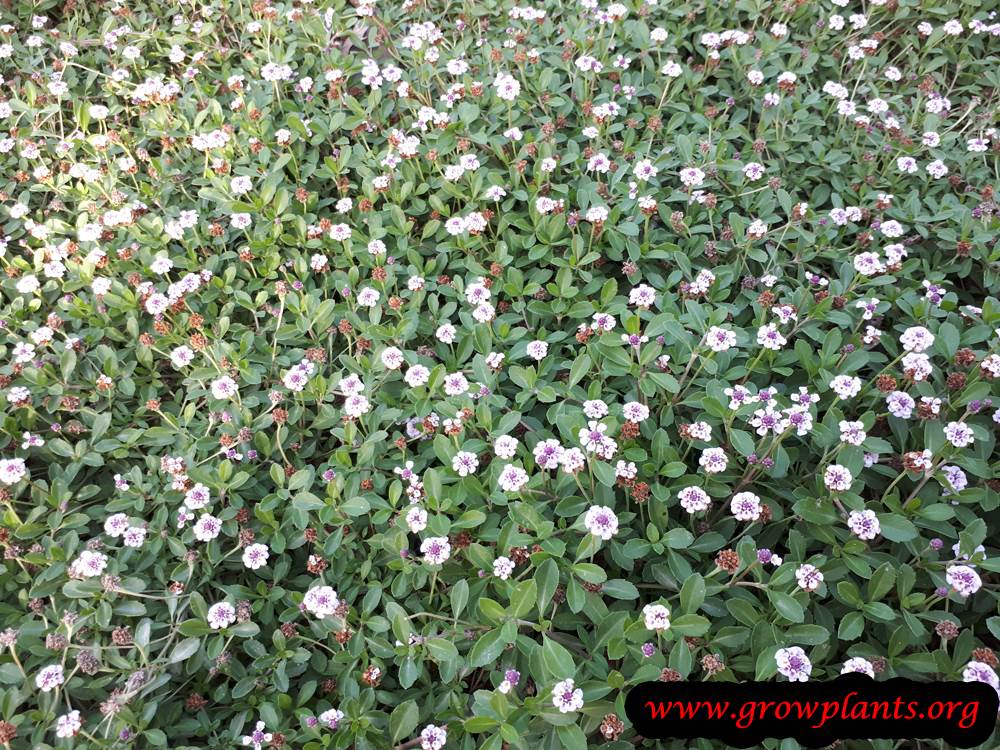
- Height & Spread: Hugs the ground at 10-25 cm (4-10 in) and spreads widely into a tough carpet; excellent between paving, on banks and as a lawn alternative, and useful in containers.
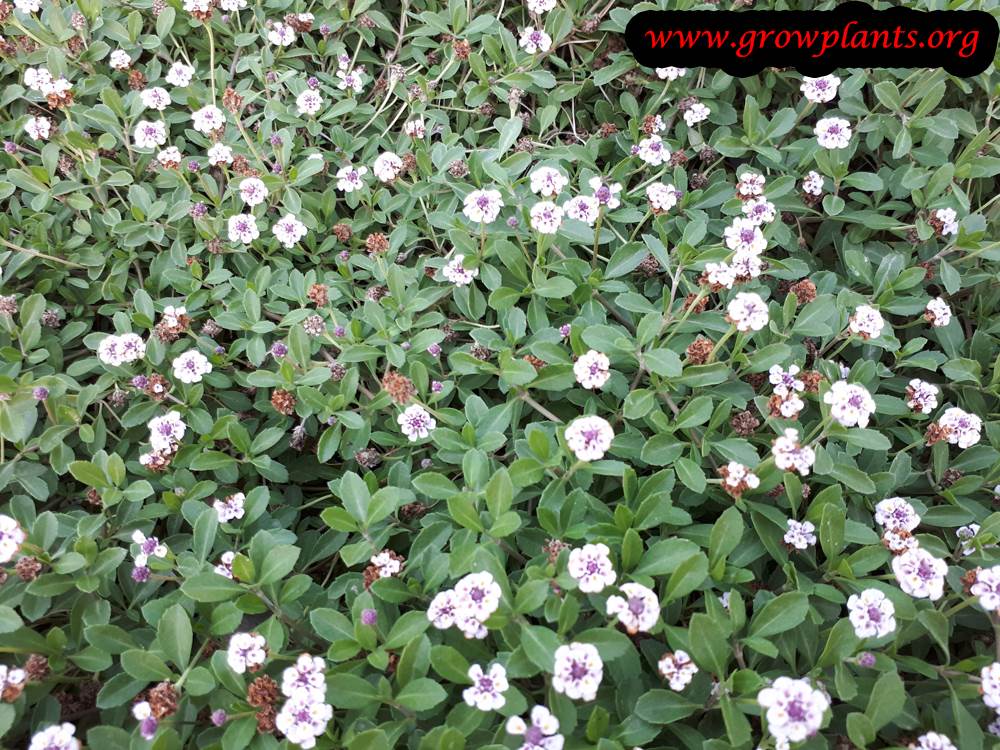
- Growth Habit & Form: Prostrate, mat-forming groundcover; trailing stems root at the nodes to knit into a dense living mat that tolerates light foot traffic.
- Lifespan & Maturity: A quick-establishing perennial that spreads steadily; can become invasive where unchecked.
Anatomy & Physical Features
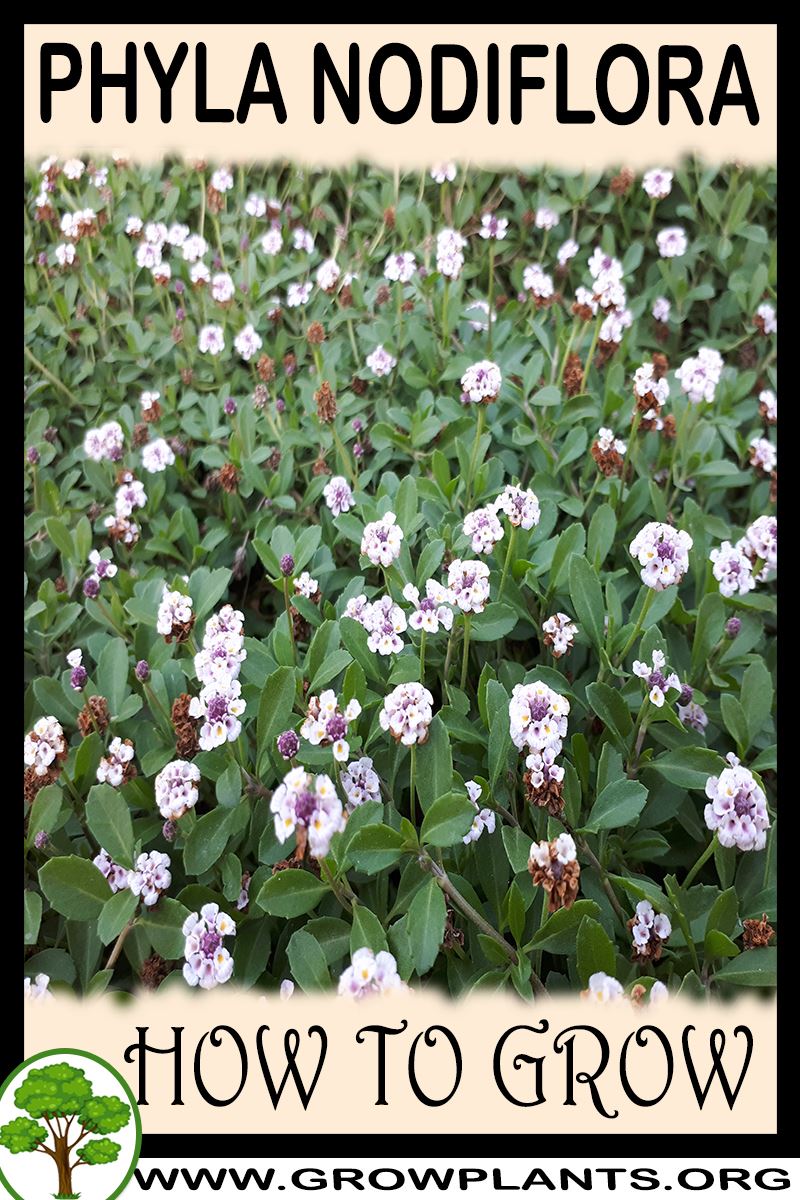
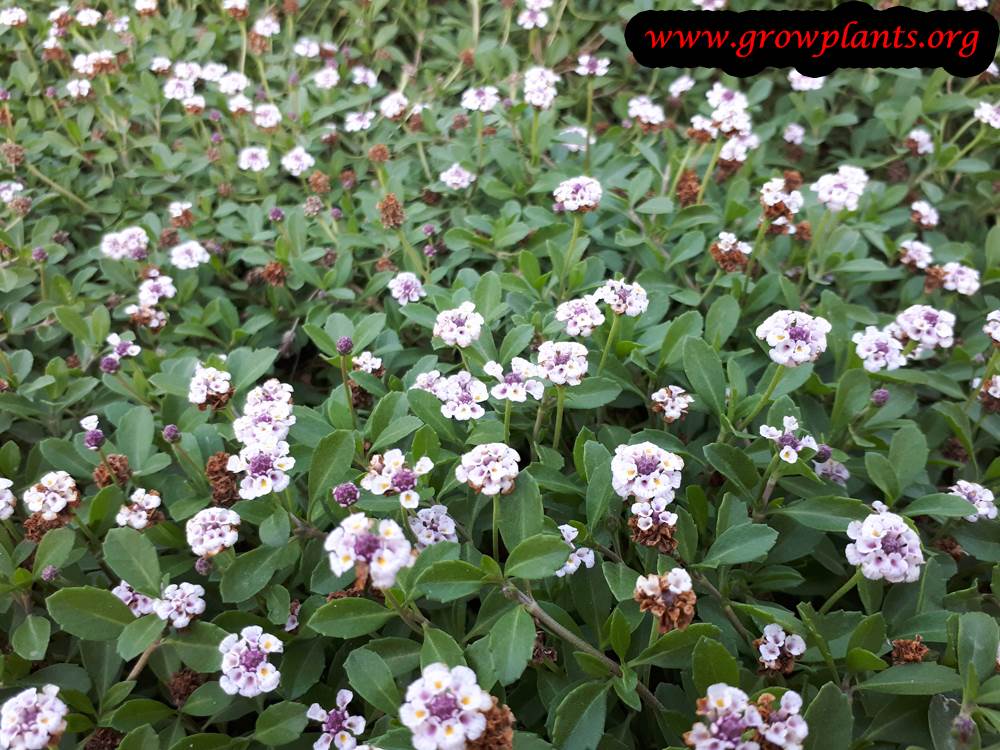
- Leaves & Foliage: Small green obovate leaves with toothed margins, borne in groups along the creeping stems.
- Flower Characteristics: Tiny white-to-pink two-lipped flowers packed into small button-like heads, popular with pollinators.
Primary Uses & Landscape Value
- Functional & Ornamental Roles: A hard-wearing drought-tolerant groundcover, lawn substitute and bank binder for erosion control; a valued pollinator plant with traditional medicinal uses.
Care Guide: Planting, Soil & Watering
Overview: Frogfruit is a low, spreading groundcover that thrives in full sun to part shade in well-drained soil. It is tough and drought-tolerant, needing only modest water, and spreads vigorously to form a dense mat.
Quick Care Requirements
| Requirement | Ideal Condition |
|---|---|
| Planting Season | Spring as an annual, or year-round as a perennial in mild climates |
| Growth Rate | Fast |
| Soil Type | Well-drained; tolerant of poor soil |
| Water Need | Low to moderate — let the soil dry between waterings |
Planting & Establishment
- Best Planting Season: Plant in spring, or year-round where it grows as a perennial in a mild, frost-free climate.
- How to Plant:
- Hole Preparation: Dig a shallow hole as wide as the root ball; space plants out and let the runners knit together into a mat.
- Soil Amendments: Little is needed — it tolerates lean soil; just ensure the ground drains freely.
- Planting Depth: Set the root ball level with the surface so the trailing stems can root down as they spread.
- Growth Speed & Expectations: Expect fast, spreading growth into a dense mat only 10–25 cm tall.
Soil, Watering & Drainage Care
- Soil Mix & Drainage Needs: Well-drained soil is all it asks; it copes with poor ground. In a container use a free-draining mix.
- Watering Schedule & Technique:
- Young / Newly Planted: Keep the soil lightly moist while young plants establish and begin to spread.
- Established: Water sparingly once established; it is drought-tolerant and prefers the soil to dry between waterings.
- Seasonal Adjustments: Give a little more water in summer heat and much less in cool, wet weather.
Climate, Light & Hardiness
Phyla nodiflora (frog fruit) is a drought-tolerant, spreading groundcover perennial suited to a very broad range of climates from tropical to temperate. It grows best in full sun to half shade, behaving as a true perennial in warm zones and as an annual much further north.
Quick Climate Specifications
| Climate Zones | Tropic, mediterranean, desert, subtropical, temperate |
|---|---|
| USDA Hardiness Zones | 9+ as a perennial; 4–9 grown as an annual |
| Light Conditions | Full sun to half shade |
| Frost Tolerance | Low to moderate – top growth is damaged by frost |
Sunlight & Light Exposure
Optimal Light Setup
Full sun to half shade both suit this low groundcover, with full sun giving the densest mat and most flowers.
Extreme Heat Tolerance
Drought-tolerant once established, it handles hot, dry conditions well across its wide climate range.
Temperature Extremes & Hardiness
USDA Hardiness & Regional Limits
Reliably perennial in zone 9 and warmer; in zones 4–9 it is typically grown and treated as an annual since it will not survive a hard winter outdoors there.
Frost Sensitivity
Frost damages or kills top growth; in its perennial range the roots can survive a mild winter and the plant regrows, while in colder zones the whole plant is lost.
Wind, Humidity & Microclimate
Dry-Air Tolerance
Well suited to arid and desert conditions as a drought-tolerant groundcover.
Rainfall & Seasonal Moisture
Adapts to a wide range of rainfall patterns, from dry desert climates to humid subtropical and tropical conditions.
Growing in Pots, Balconies & Indoors
Frogfruit is a low, creeping ground cover – not a houseplant, but it is excellent trailing from a container, hanging basket, or the edge of a mixed pot in full sun.
Quick Details
- Container Size: A basket or wide, shallow pot to let it trail and spread
- Indoor Suitability: Not a true houseplant; grows best outdoors
- Best Spot: Full sun to half shade
- Soil & Drainage: Aerated, organic-rich mix (peat or coir with perlite or vermiculite); must drain freely
- Watering in Pots: Water moderately; it is drought-tolerant once established
Indoors & On the Windowsill
- Houseplant limits: As a sun-loving mat-former it thins and stretches in indoor light; it needs strong outdoor sun.
On a Balcony or Patio
- Light & wind: Let it spill from a raised pot or basket in full sun; it takes reflected heat well and the tiny flowers draw pollinators. Walls and paving reflect heat, so pots dry quickly – check moisture often in hot weather.
- Practicalities: Set the pot where drainage runoff won’t stain, and remember a full, wet container is heavy to move.
Choosing the Pot, Soil & Long-Term Care
- Pot & drainage: A container with strong drainage holes and no standing-water saucer, to avoid root rot; terracotta breathes and dries faster, glazed or plastic holds moisture longer.
- Potting mix: A well-aerated, organic-rich mix – peat or coir with perlite or vermiculite.
- Feeding: Potted plants exhaust their soil quickly – feed a little more often, since watering leaches nutrients away.
- Repotting: Refresh the top of the mix each year and pot on every couple of years, trimming the root ball lightly.
Fertilizing & Feeding
Phyla nodiflora is a drought-tolerant, low-growing groundcover that spreads readily in average soil and generally needs only light, occasional feeding to establish and fill in.
Quick Fertilizing Specs
| Feeding Level | light |
|---|---|
| Main Nutrient Priority | a light, balanced fertilizer mainly to help new plantings establish and fill in |
| Best Feeding Period | while the groundcover is establishing and spreading to cover bare soil |
| Reduce/Stop Feeding | ease off once the groundcover has filled in, since this drought-tolerant species needs little ongoing feeding |
Feeding by Growth Stage
Establishment and Spread
Help new plantings root in and begin spreading to form a groundcover.
| Nutrient direction | A light, balanced fertilizer helps new plantings establish and knit together. |
|---|---|
| Timing | At planting and through the first part of the growing season. |
| Frequency | Light, occasional feeding while the groundcover fills in supports steady establishment. |
| Fertilizer types | A balanced, general-purpose fertilizer applied lightly while the planting establishes |
| Precautions | Keep feeding light; this drought-tolerant species is adapted to average, lean soil and does not need rich feeding to spread well. |
Established Maintenance
Maintain a filled-in groundcover with minimal ongoing input once it is established.
| Nutrient direction | Minimal feeding is typically enough once the groundcover has filled in. |
|---|---|
| Timing | Through the growing season once the planting is established and spreading well. |
| Frequency | This stage rarely needs feeding beyond what the site’s soil already supplies. |
| Fertilizer types | A balanced fertilizer used only sparingly if growth looks notably thin or slow |
| Precautions | Avoid heavy feeding on an established stand, since it is adapted to lean, drought-prone conditions and excess fertility mainly encourages weedy competition. |
Nutrient Deficiency Signs & Corrections
Slow to fill in, with pale, sparse foliage during establishment.
| Possible causes | Very poor or depleted soil at the planting site, Insufficient watering during initial establishment, Heavy weed or turf competition slowing spread |
|---|---|
| Appears first on | New growth at the spreading edges of the planting |
| What to check | Assess soil fertility at the site, Check establishment watering, Look for competing weeds or turf |
| Possible correction | Apply a light, balanced fertilizer during establishment and manage competing vegetation. |
Thinning, yellowing patches despite adequate light and minimal feeding.
| Possible causes | Poor drainage or overwatering stressing roots of this drought-tolerant species, Compacted soil limiting root spread, Excess feeding compounding stress on a lean-soil-adapted plant |
|---|---|
| Appears first on | Patchy areas within the planting |
| What to check | Check soil drainage and recent watering, Inspect for compaction, Review any recent feeding |
| Possible correction | Improve drainage and moderate watering before considering any additional feeding. |
Pruning, Training & Seasonal Maintenance
Phyla nodiflora is a prostrate, mat-forming groundcover that spreads by rooting stolons, so its maintenance is closer to mowing/trimming than conventional pruning: the objective is to keep the mat dense and within bounds and to clear dead patches, since this species is noted as spreading aggressively. The most effective period for a general tidy-up is autumn into winter, though because it forms a low living mat rather than a woody structure, timing has little effect on flowering, which continues nearly year-round in warm climates.
Quick Pruning & Maintenance Specs
| Pruning Tolerance | High (tolerates mowing/shearing well, regrows quickly from stolons) |
| Primary Pruning Window | Autumn–Winter general tidy-up |
| Secondary Maintenance Window | Ongoing trimming/mowing through the growing season to control spread |
| Typical Frequency | Periodic mowing or edge-trimming as needed |
| Main Objective | Control spread beyond the intended area; remove dead patches |
| Best Tool Type | Hand shears or a mower/string trimmer on the highest setting for large mats |
Pruning by Plant Age & Size
Newly Established
Avoid cutting back while the mat is still filling in; let stolons root and knit together before any trimming.
Mature / Established
Trim or mow lightly to keep the mat dense and flowering (light shearing can encourage bushier growth), and regularly cut back stolons that cross paths, garden edges, or into neighboring beds given its invasive tendency.
Special Growth to Remove
- Runners/stolons – the main thing to manage; trim back any that spread beyond the intended footprint, as this species can become invasive if left unchecked.
- Dead or brown patches – clear out matted dead growth, especially after any winter dieback in cooler parts of its range, to let light reach the crown and encourage fresh growth.
Container & Small-Space Pruning
In a container it stays far more manageable than in the ground; trim trailing stolons back to the pot’s edge periodically to prevent them rooting into surrounding soil.
Tools
- Hand shears for edging and general trimming
- String trimmer or mower (high setting) for larger groundcover plantings
Tool Hygiene & Disease Risk
Routine – clean tools are sufficient; the main pest noted is aphids, with no significant disease requiring disinfection between cuts.
Cut Placement & Technique
Shear or trim just above the crown of the mat rather than scalping it to bare soil, and cut stolons cleanly at the point where they cross the desired bed edge.
Common Pruning Mistakes
- Ignoring stolons that root beyond the bed edge, letting this vigorous, invasive-leaning groundcover spread into lawns or neighboring beds.
- Mowing or shearing too low, scalping the mat and exposing bare soil.
When NOT to Prune
Avoid heavy cutting during prolonged drought stress even though the species is drought-tolerant once established, and avoid scalping the mat right before periods of temperature extremes when the exposed crown is more vulnerable.
Recommended Tools (by task)
- hedge_shears – for shearing/tidying the mat surface and edges of a groundcover planting.
- precision_snips – for trimming individual stolons that stray beyond the bed.
Propagation Guide
Phyla nodiflora spreads naturally as a mat-forming groundcover whose creeping stems root at the nodes wherever they touch soil, so the easiest and fastest propagation method is simply to sever and transplant these already-rooted stem sections — the site’s note that it is invasive reflects how readily it self-roots this way. Stem cuttings and seed also work. Propagation is easy.
Quick Propagation Specs
| Best Propagation Method | Division of rooted stem/runner sections |
| Alternative Methods | Stem cuttings; seed |
| Propagation Difficulty | Easy |
| Seed True-to-Type | Yes (species groundcover) |
| Vegetative True-to-Type | Yes |
| Best Propagation Season | Warm growing season (spring–summer); the site notes it can be grown as an annual (sown spring) or year-round as a perennial in warmer zones |
| Cutting Rooting Time | Often within a couple of weeks, as this plant roots readily at its nodes |
Growing from Seed
Seed can be sown in spring in well-drained soil; since vegetative propagation is so much faster for establishing groundcover, seed is used less often than division or cuttings in practice.
Stem Cuttings
Short nodal cuttings taken from actively growing stems root readily in a moist, well-drained mix, usually without needing rooting hormone, reflecting this plant’s naturally self-rooting habit.
Runners & Stolons
Trailing stems root wherever a node contacts moist soil. Once a section has developed its own roots (usually within a couple of weeks during active growth), sever it from the parent runner and transplant, or simply leave rooted sections in place to fill in the groundcover.
Bloom & Flower Guide
Quick Details
- Bloom Season: Nearly year-round in warm, frost-free climates (a long warm-season display where grown as an annual)
- Flower Appearance: Tiny, two-lipped white-to-pink flowers gathered into small button-like heads
- Edibility: Grown as an ornamental and groundcover
Detailed Blooming Overview
Frogfruit is a tough, low, spreading groundcover that flowers almost continuously in warm climates. The little white-and-pink flower heads look like miniature buttons scattered across the mat, and they are a magnet for bees and butterflies – it is also a larval host for several butterflies.
Flower Characteristics
- Small, mouth-shaped white-pink flowers clustered into rounded heads, as the grower notes.
- Held on short stalks just above a dense, ground-hugging mat.
Bloom Care & Thinning
- Upkeep: An occasional trim or mow keeps the mat neat without stopping the flowers.
- Water: Drought tolerant once established, flowering through dry spells.
- Pollinators: Leave it in flower – it is a valuable, long-season nectar source.
Fruit & Uses
The leaves of frog fruit (turkey tangle) are edible and are eaten raw in small amounts or brewed into a mild, grassy-tasting tea; the site’s own description of this plant as having a ‘medical’ use reflects its traditional herbal role rather than any established food crop. No preparation is strictly required for fresh leaves, though the leaves are most often dried or steeped for tea.
Quick Edible Specs
| Edible Parts | Leaves |
|---|---|
| Main Use(s) | Minor culinary (raw leaf, tea substitute); medicinal-note – site notes a general ‘medical’ use, reflected here as a traditional herbal remedy |
| Eaten Raw or Cooked | Raw (fresh leaf) or infused as tea; not typically cooked |
| Preparation Required | None for fresh leaf; steep fresh or dried leaves for tea |
| Harvest Season | Leaves can be picked whenever the groundcover mat is actively growing |
| Time to First Harvest | Usable as soon as the low, spreading leaf mat is established (qualitative – no fixed day count) |
| Storage | Best used fresh; can be air-dried for later tea use |
| Safety/Toxicity Caveat | this is a minor, traditional use rather than a validated food crop; confirm identification (site data: leaves obovate with serrated margins, growing in groups of four) and only harvest from patches known to be free of herbicide or pesticide treatment, since this species is commonly grown as a lawn/groundcover plant |
Leaves & Greens
The leaves are obovate with serrated margins and grow in groups of four (site data, fid 13923-p02) – a useful identification cue before harvesting. They have a mild, grassy flavour and can be eaten fresh in small amounts or dried for tea. Consistent with the site’s own note that this plant has a ‘medical’ use (fid 13923-p01), the leaves have traditionally been used in folk remedies for fever, cough, and as a general antimicrobial herb; this is mentioned here only as a traditional-use note, not a health claim.
Harvesting
Pick young, clean leaves from patches known to be unsprayed. Because this is a low, spreading groundcover that the site also flags as invasive (fid 13923-b07), picking leaves does not meaningfully set the plant back and can be done through the growing season.
Preparation, Uses & Safety
Use fresh leaves sparingly in salads or teas, or infuse dried leaves as a mild tea substitute. Traditional medicinal use (fever, cough, antimicrobial folk remedies) is noted here only as a traditional-use reference, not a health claim or dosing guidance. Because this plant is primarily grown as a lawn/groundcover, only harvest from areas confirmed free of herbicide or pesticide treatment, and confirm identification before eating.
Pests, Diseases & Troubleshooting
Overview: Frogfruit (or turkey tangle) is a tough, mat-forming groundcover and lawn substitute that is essentially pest- and disease-free – one of its virtues as a low-maintenance living mulch. It is a larval host for several butterflies, so caterpillars grazing it are usually welcome rather than a problem. Its only real weakness is root rot in constantly wet, poorly drained soil; occasional aphids or mites appear only on stressed plants.
Quick Troubleshooting Overview
| Issue / Pest | Main Symptom | Primary Solution |
|---|---|---|
| Root rot | Thinning, browning patches in wet soil | Improve drainage, avoid overwatering |
| Caterpillars | Chewed leaves (usually butterfly larvae) | Tolerate – it is a butterfly host plant |
| Aphids | Minor clusters on stressed growth | Water jet; self-corrects with beneficials |
| Spider mites | Stippling in hot, dry, stressed spots | Irrigate, hose foliage, horticultural oil |
Common Pests & Management
- Caterpillars (butterfly larvae) (Lepidoptera larvae):
- Symptoms: Leaves grazed or chewed by caterpillars – Phyla is a larval food plant for buckeye, phaon crescent and white peacock butterflies, so the ‘damage’ is a sign of a healthy pollinator habitat.
- Prevention & Control: Tolerate and enjoy them – the mat quickly regrows and you gain butterflies. Intervene only in a formal setting, by hand-picking; avoid sprays that would harm the very butterflies it hosts.
- Aphids (Aphidoidea spp.):
- Symptoms: Small soft-bodied green, black or grey insects clustered on soft stressed growth; causes curled, distorted foliage, sticky honeydew and sooty mould. Look-alikes: whitefly (which flies up when disturbed).
- Prevention & Control: Encourage ladybirds, lacewings and parasitic wasps; blast colonies off with a firm jet of water; remove badly infested tips. Persistent outbreaks respond to insecticidal soap or a light horticultural oil applied to leaf undersides in the cool of the evening to protect pollinators.
- Two-spotted spider mite (Tetranychus urticae):
- Symptoms: Fine pale stippling on leaves, faint webbing on undersides and leaf axils, and a dusty bronzed look in warm dry conditions. Tiny moving specks visible with a hand lens.
- Prevention & Control: Raise humidity and hose foliage regularly, as mites thrive in hot dry air; introduce predatory mites (Phytoseiulus persimilis) under cover. Treat hotspots with insecticidal soap or horticultural oil, ensuring thorough coverage of leaf undersides.
Diseases & Fungal Issues
- Root & stem rot (Pythium / Phytophthora spp.):
- Symptoms: Thinning, yellow-brown collapsing patches in the mat where soil stays soggy and airless.
- Treatment & Management: Grow in well-drained soil, water only as needed, and avoid constant saturation; the mat recolonises bare patches once drainage improves.
- Minor fungal leaf spot (various fungi):
- Symptoms: Occasional spotting in prolonged damp, largely cosmetic on this vigorous groundcover.
- Treatment & Management: Improve airflow and drainage and mow or shear over the mat; treatment is rarely warranted.
Growing Difficulties & Abiotic Problems
- Thinning in shade:
- Cause & Symptoms: Frogfruit is densest in full sun; in shade it grows sparse and open.
- Correction Strategy: Site it in sun to part-sun for a thick mat; accept thinner cover in shadier spots or choose a shade groundcover instead.
- Invasive spread:
- Cause & Symptoms: Its vigorous runners can creep beyond the intended area into beds and lawns.
- Correction Strategy: Edge the planting and trim runners, or contain it where neighbouring plantings must stay clear.
- Root rot (overwatering):
- Cause & Symptoms: Waterlogged, airless roots in constantly wet, poorly drained ground lead to soft brown roots, wilting despite wet soil, yellowing lower leaves and collapse; Pythium and Phytophthora water-moulds move in.
- Correction Strategy: Let the top of the mix dry before rewatering; improve drainage and use a free-draining medium; never leave the pot standing in water. Repot into fresh gritty mix, trimming away any blackened roots.
What Helps – Products & Tools
Frogfruit essentially needs no pest or disease products – good drainage prevents its only real issue, and its caterpillars are welcome butterflies. The most useful tools are a lawn edger or shears to keep the vigorous mat in bounds. Avoid insecticides, which would undermine its value as pollinator and butterfly habitat.