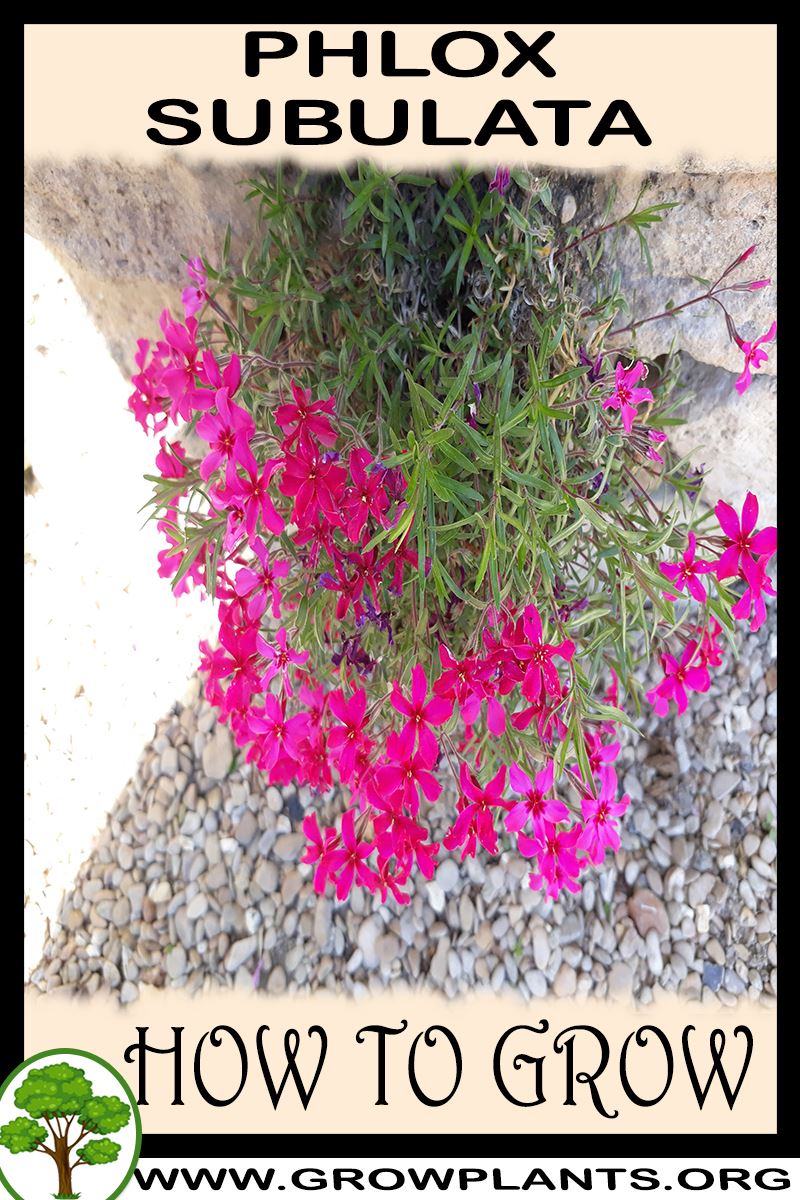
![Greenwood Nursery: Live Ground-Cover Plants - Emerald Blue Creeping/Moss Phlox + Subulata - [Qty: 2X Pint Pots] - (Click for Other Available Plants/Quantities)](https://m.media-amazon.com/images/I/51WlNmwPONL._SL160_.jpg)

![Greenwood Nursery: Live Ground-Cover Plants - Purple Beauty Creeping/Moss Phlox + Subulata - [Qty: 2X Pint Pots] - (Click for Other Available Plants/Quantities)](https://m.media-amazon.com/images/I/41IT6pde-ML._SL160_.jpg)



Plant Profile & Key Characteristics
Overview: A low, evergreen mat-forming perennial only 10-30 cm (4-12 in) tall that spreads into a dense carpet. It is grown as an ornamental groundcover, smothering itself in small flowers over needle-like foliage.
Quick Specifications
| Specification | Attribute |
|---|---|
| Plant Type / Life Cycle | Evergreen perennial (subshrub) |
| Foliage Type | Evergreen |
| Mature Size | 10-30 cm (4-12 in) tall, spreading into a mat |
| Growth Rate | Fast to moderate |
| Root System | Shallow, mat-forming |
| Toxicity | Non-toxic |
| Hardiness | USDA zones 3-9 |
Growth Form & Structure
- Height & Spread: Stays very low at 10-30 cm (4-12 in) but creeps outward into a wide dense mat; ideal spilling over walls, edges and containers.
- Growth Habit & Form: Prostrate, creeping subshrub forming a tight evergreen carpet of trailing stems.
- Lifespan & Maturity: A long-lived evergreen perennial that steadily broadens its mat and is easily divided.
Anatomy & Physical Features
- Leaves & Foliage: Small, stiff, needle-like green leaves crowding the trailing stems into a moss-like mat.
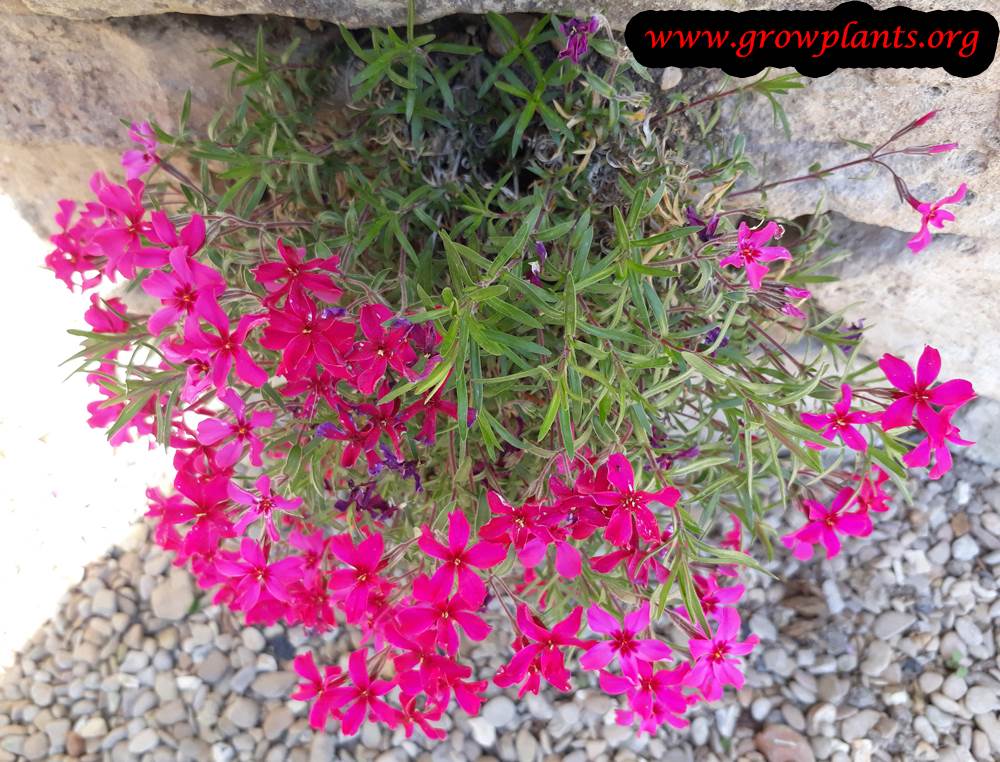
- Flower Characteristics: Five-petalled flowers in purple, blue, white or pink, borne so thickly they hide the foliage in spring.
Primary Uses & Landscape Value
- Functional & Ornamental Roles: A leading evergreen groundcover for rock gardens, banks, wall-tops and edging, prized for its dense spring flower carpet.
Care Guide: Planting, Soil & Watering
Overview: Moss phlox is a low, mat-forming groundcover that thrives in full sun to light shade in gritty, sharply drained soil. It prefers lean, well-drained ground and, once established, is quite drought-tolerant.
Quick Care Requirements
| Requirement | Ideal Condition |
|---|---|
| Planting Season | Spring to summer in the growing season |
| Growth Rate | Fast to moderate |
| Soil Type | Gritty, lean, sharply drained |
| Water Need | Low to moderate — let the soil dry between waterings; avoid soggy ground |
Planting & Establishment
- Best Planting Season: Plant in spring or summer during the active growing season.
- How to Plant:
- Hole Preparation: Dig a shallow hole as wide as and a little deeper than the root ball on a freely draining site such as a slope, wall or rockery.
- Soil Amendments: Add grit or coarse sand to sharpen drainage rather than rich organic matter.
- Planting Depth: Set the root ball level with the surface so the spreading stems can root along the ground; keep the crown at soil level.
- Growth Speed & Expectations: Expect fast-to-moderate spread into a dense mat only 10–30 cm tall.
Soil, Watering & Drainage Care
- Soil Mix & Drainage Needs: Sharp drainage is key — it rots in heavy, wet soil despite the source rating it a heavy drinker. In a container use a gritty, free-draining mix.
- Watering Schedule & Technique:
- Young / Newly Planted: Water occasionally to settle young plants in during their first season.
- Established: Water moderately, letting the top of the soil dry out between waterings; it tolerates dry spells well.
- Seasonal Adjustments: Give a little more water in prolonged summer drought and withhold it in cool, wet weather.
Climate, Light & Hardiness
Creeping or moss phlox (Phlox subulata) is a very hardy, evergreen, mat-forming groundcover for temperate and subtropical rock gardens and banks, grown in full sun to half shade for its spring sheets of flowers. It is a tough, low subshrub - cold-hardy in winter and, once established, tolerant of heat and open exposure.
Quick Climate Specifications
| Climate Zones | Temperate and subtropical |
| USDA Hardiness Zones | Approx. 3–9 |
| Optimal Temp Range | approximately 15–24 °C (59–75 °F) |
| Cold Damage Begins | evergreen mat hardy through frost; foliage may bronze in hard cold |
| Approx. Survival Minimum | hardy to about −37 °C (−34 °F) (zone 3) |
| Frost Tolerance | High |
| Light Conditions | Full Sun / Half Shade |
| Wind Tolerance | High (low, ground-hugging mat) |
Sunlight & Light Exposure
Optimal Light Setup
Full sun gives the densest mats and heaviest flowering; the facts also allow half shade, which it tolerates, though bloom thins in shadier spots.
Direct Sun Requirement
It genuinely wants open sun for a tight, free-flowering carpet - a true rock-garden and bank plant - with only light shade tolerated.
Best Exposure & Orientation
An open, sunny, sharply drained slope or wall top suits it; its low profile shrugs off exposure that troubles taller plants.
Temperature Extremes & Hardiness
USDA Hardiness & Regional Limits
The site lists USDA 3–9. As a low evergreen alpine-type mat it is extremely cold-hardy, coming through severe winters to around −37 °C (−34 °F) at the cold end, while at the warm end (about zone 9) it copes with heat far better than the tall border phloxes provided drainage is sharp.
Cold Damage & Winter Protection
The evergreen foliage persists through winter and needs no real protection; it may take on a bronzed tint in hard cold, recovering as spring warms. Sharp drainage matters more than cold hardiness, since a wet, frozen crown is the main risk.
Frost Sensitivity
Very low: this is one of the hardier groundcovers, essentially untroubled by frost.
Extreme Heat Tolerance
Once established it tolerates heat and open, sunny exposure well, especially in free-draining, gritty soil; hot, wet, poorly drained conditions are more of a problem than heat itself.
Wind, Humidity & Microclimate
Dry-Air Tolerance
The needle-like evergreen foliage copes well with dry air and exposed, sunny sites once the mat is established.
Wind Tolerance
Excellent - the ground-hugging mat (10–30 cm / 4–12 in high) presents almost nothing to the wind and thrives in open positions.
Rainfall & Seasonal Moisture
Adapted to temperate to subtropical climates with sharp drainage; it prefers moderate moisture and resents waterlogging, especially in cold, wet winters. This is a climate-adaptation note, separate from routine irrigation.
Microclimate Recommendations
An open, sunny, sharply drained bank, wall or rock garden is ideal; the key is free drainage rather than any need for cold or wind protection.
Growing in Pots, Balconies & Indoors
Creeping or moss phlox (Phlox subulata) is a low, spreading, sun-loving evergreen – not a houseplant, but excellent in containers, troughs, wall pots and hanging baskets, and along the edge of a mixed pot where its carpet of spring flowers spills over the rim. Indoors it will never get the sun it needs.
Quick Details
- Container Size: Wide and shallow suits its low, trailing habit (only about 10-30 cm / 4-12 in high); ideal too for a hanging basket or the edge of a larger pot.
- Indoor Suitability: Not a houseplant – it needs full outdoor sun.
- Best Spot: Full sun to half shade.
- Soil & Drainage: Gritty and free-draining – it dislikes wet feet.
- Watering in Pots: Average moisture; let the surface dry a little between waterings and never waterlog.
Indoors & On the Windowsill
- Not for indoors: It is a sun-loving carpeter and will not thrive as a houseplant.
On a Balcony or Patio
- Sun and spill: Give it full sun; it is superb spilling over railing planters and wall pots. Tough and fairly drought-tolerant once established, but pots still dry fast – check them in hot weather.
Choosing the Pot, Soil & Long-Term Care
- Pot & drainage: Any pot with strong drainage holes; add grit to the mix and skip a standing saucer of water.
- Potting mix: Free-draining and not too rich – a gritty, open mix keeps it healthy.
- Feeding: Feed lightly in the growing season; over-feeding gives lax growth at the expense of flowers.
- Repotting & winter: Fully hardy (about zone 3-9); shear it back lightly after flowering to keep it neat, and refresh or divide it every couple of years.
Fertilizing & Feeding
A moderate feeder: steady balanced feeding through the growing season supports both foliage and flowers, with feeding tapering off as the plant slows for its rest period.
Quick Fertilizing Specs
| Feeding Level | Moderate |
|---|---|
| Main Nutrient Priority | Balanced nutrition with adequate nitrogen; no high-phosphorus bloom boosters |
| Best Feeding Period | Through the active growing and blooming season |
| Organic Options | Compost, well-rotted manure, or a balanced organic fertilizer |
| Soil pH | Slightly acidic to near neutral |
| Reduce/Stop Feeding | Reduce and stop feeding as growth slows into dormancy |
Feeding by Growth Stage
Spring growth flush
Support strong new leaves and stems as the plant breaks into active growth.
| Nutrient direction | A balanced complete fertilizer with adequate nitrogen to fuel foliage and stems. |
|---|---|
| Timing | As new growth begins in spring. |
| Frequency | Feed steadily through the active growth period, easing back as blooming approaches. |
| Fertilizer types | Balanced complete garden fertilizer, Slow-release granular fertilizer, Compost or other organic matter worked into the soil |
| Precautions | Avoid heavy nitrogen, which can push soft leafy growth at the expense of flowers. |
Blooming period
Sustain flowering with steady, balanced nutrition without forcing excess foliage.
| Nutrient direction | A balanced complete fertilizer; adequate nitrogen alongside potassium supports continued bloom, and high-phosphorus bloom boosters are not needed. |
|---|---|
| Timing | Through the flowering season. |
| Frequency | Keep feeding light and steady while the plant is in bloom. |
| Fertilizer types | Balanced complete fertilizer, Liquid feed for garden and container plants |
| Precautions | Skip high-phosphorus bloom formulas; they do not increase flowering and can build up in the soil. |
Dormancy and winter rest
Let the plant rest through dormancy without pushing new growth.
| Nutrient direction | None – withhold fertilizer during dormancy. |
|---|---|
| Timing | Autumn into winter as growth stops. |
| Frequency | No feeding at this stage. |
| Fertilizer types | No feeding at this stage; do not fertilize while the plant is dormant. |
| Precautions | Do not fertilize until active growth resumes in spring. |
Nutrient Deficiency Signs & Corrections
Older, lower leaves turn pale green to yellow and overall growth slows.
| Possible causes | Low soil nitrogen or infrequent feeding, Nitrogen leached out by heavy watering or from sandy soil, Cold soil early in the season limiting uptake |
|---|---|
| Appears first on | Older, lower leaves |
| What to check | Recent feeding history, Soil drainage and watering habits, Soil temperature in early spring |
| Possible correction | Apply a balanced complete fertilizer at its labeled rate and make sure the soil is warm and evenly moist. |
New leaves yellow between the veins while the veins themselves stay green.
| Possible causes | High soil pH reducing iron availability, Poor drainage or waterlogged roots, Genuinely low iron in the soil |
|---|---|
| Appears first on | Youngest leaves |
| What to check | Soil pH, Drainage and root health, Signs of overwatering |
| Possible correction | Correct soil pH and improve drainage; apply a chelated iron product per its label if the problem persists. |
Leaf edges and tips brown and scorch, sometimes with a whitish crust on the soil surface.
| Possible causes | Over-application of fertilizer and salt buildup, Insufficient leaching, especially in containers, Underwatering that concentrates salts in the root zone |
|---|---|
| Appears first on | Leaf tips and margins |
| What to check | Recent fertilizer amounts, Salt crust on the soil or pot rim, Whether watering wets the whole root zone |
| Possible correction | Cut back on feeding and leach the root zone thoroughly with plain water to flush out the excess salts. |
The plant makes lush leafy growth but produces few flowers.
| Possible causes | Excess nitrogen from over-feeding, Too much shade or insufficient light, An immature or heavily pruned plant |
|---|---|
| Appears first on | Whole plant, where vegetative growth dominates |
| What to check | Nitrogen inputs and fertilizer type, Light exposure, Plant maturity and recent pruning |
| Possible correction | Ease off nitrogen, switch to a balanced fertilizer, and make sure the plant gets enough light. |
Pruning, Training & Seasonal Maintenance
Creeping or moss phlox (Phlox subulata) is a low, evergreen, mat-forming subshrub grown as a groundcover, and unlike its tall cousin it is one of the few garden plants that genuinely benefits from shearing. The single most valuable cut is to shear the whole mat back by about a third right after the spring flower flush ends — this forces dense new growth, keeps the cushion tight, and prevents the woody, bare centre that neglected mats develop. It does not die down in winter, so it is never cut to the ground.
Quick Pruning & Maintenance Specs
| Pruning Tolerance | Moderate — tolerates shearing but not cutting into old bare wood |
| Primary Pruning Window | Immediately after the spring bloom fades |
| Secondary Maintenance Window | Light tidying of stray or winter-damaged stems in spring |
| Typical Frequency | Once a year (the post-bloom shear), plus occasional tidy-ups |
| Main Objective | Keep the mat dense and prevent centre die-out |
| Young Plant Priority | Light post-bloom trim to encourage spreading |
| Mature Plant Priority | Firm post-bloom shear; renew or replace bare-centred mats |
| Best Tool Type | Hedge shears for the mat; snips for tidying |
| Avoid Heavy Pruning During | Autumn and winter, and while in full bloom |
Pruning by Plant Age & Size
Newly Established
A young plug spreads on its own; a light shear after its first bloom encourages it to branch and knit into a fuller mat sooner. Remove nothing but dead or damaged stems otherwise.
Young / Formative
No structural training — the “form” is simply a spreading carpet. Shearing after flowering is the only shaping, encouraging horizontal density rather than a leggy, open cushion.
Mature / Established
Shear the mat back by roughly one-third to one-half straight after the main bloom to keep it compact and floriferous. Where an old mat has gone woody and bare in the middle, cut back to any live growth, lift and divide it, or layer the trailing edges to regenerate coverage — cutting into leafless old wood alone rarely re-sprouts.
Seasonal Pruning Schedule
Post-Flowering (the key cut)
Objective: density and next year’s flower power. Remove: the top third of the spent flowering growth across the whole mat with shears. Do NOT remove: so much that you expose bare, leafless old stems. Response: a flush of fresh, tight foliage and a stronger cushion for the following spring.
Ongoing Sanitary
Objective: tidiness. Remove: winter-burned or dead patches and stray runners straying past their bounds. Impact: cosmetic; the mat fills back in from the edges.
Structural Pruning & Training
Beyond the annual post-bloom shear, the only structural task is edge control — trimming or lifting runners that creep past where you want the carpet to stop. Trailing stems that touch soil often self-layer, which you can use to patch thin areas.
Container & Small-Space Pruning
Spilling over a wall, trough or rockery edge, moss phlox is trimmed the same way: shear after bloom to keep the cascade dense rather than stringy. In a container the centre goes woody faster, so plan to divide or restart the plant every few years rather than relying on cutting old wood back.
Cut Placement & Technique
This is one of the rare plants where uniform shearing is correct rather than selective cuts — run the shears evenly over the whole surface to remove the spent flower layer, staying within the leafy zone. Avoid cutting down into the bare brown stem bases, which are slow to re-clothe.
Heavy Pruning & Rejuvenation
An old mat that is bare and woody in the middle does not rejuvenate reliably from hard cuts into leafless wood. The dependable renewal is division and replanting, or edge-layering: peg trailing shoots onto soil, let them root, then lift and replant them to rebuild a fresh, dense mat.
Post-Pruning Care
After the shear, water if the weather is dry and let the fresh growth flush — no routine feeding is required simply for pruning. Good drainage matters more than richness; a soggy, shaded mat thins out regardless of how it is trimmed.
Common Pruning Mistakes
- Skipping the post-bloom shear, so the mat grows open and dies out in the centre.
- Shearing too late (autumn/winter) instead of right after flowering, wasting the regrowth window and exposing tender cuts to cold.
- Cutting hard into bare old wood and expecting it to re-leaf.
- Treating it like tall phlox and cutting it to the ground — it is evergreen and should keep its foliage.
When NOT to Prune
Do not shear while it is in full bloom — wait until the flowers fade. Avoid a hard cut in autumn or winter, which leaves fresh cuts exposed to frost on an evergreen mat and offers no regrowth benefit.
Recommended Tools (by task)
- hedge_shears — the one plant where even shearing is right: taking the whole mat back by a third after bloom for density.
- precision_snips — tidying winter-damaged patches and trimming stray runners at the edges.
Pruning Troubleshooting
| Problem | Possible Cause | What to Check | Corrective Action |
| Bare, woody centre with growth only at the edges | Never sheared after bloom; mat aged out | Whether an annual post-bloom shear was done; age of the planting | Shear yearly after flowering; renew an old mat by dividing or edge-layering rather than cutting bare wood |
| Sparse bloom and leggy, open growth | Too much shade or no rejuvenating trim | Light levels and shearing history | Give full sun and shear after each bloom to force compact, flower-bearing growth |
Propagation Guide
Creeping (moss) phlox is very easily increased: its trailing stems root where they touch the ground, so division and simple layering both work with little effort, and semi-ripe cuttings root readily after flowering. Seed suits only the species, so overall it is an Easy plant to propagate.
Quick Propagation Specs
| Best Propagation Method | Division (using the self-rooted trailing stems) |
| Alternative Methods | Semi-ripe stem cuttings; ground layering; seed (species only) |
| Propagation Difficulty | Easy |
| Seed True-to-Type | Colour forms are variable from seed; the species is mostly uniform |
| Vegetative True-to-Type | Yes — division, cuttings and layers keep the colour form |
| Best Propagation Season | Cuttings and division after flowering; layers root through the growing season |
| Cutting Rooting Time | Semi-ripe cuttings typically root within a few weeks |
Growing from Seed
Seed reproduces only the plain species reliably; named colour selections come variable, so they are increased vegetatively. Species seed can be sown in spring, though germination may be uneven.
Stem Cuttings
Take short semi-ripe tip cuttings from non-flowering shoots after the main flush of bloom, and root them in a gritty, moist mix; rooting hormone is optional. They root within a few weeks.
Air & Ground Layering
Because the mat-forming stems root naturally at the nodes, layering is the simplest method: press a trailing stem onto the soil (or mound gritty mix over it), keep it moist, and sever the rooted portion once it has anchored.
Division, Offsets, Pups & Suckers
Lift the mat and pull or cut it into pieces that already carry roots; replant these self-rooted sections straight away.
Bloom & Edible Flower Guide
Quick Details
- Bloom Season: Spring (with a lighter scattering into early summer)
- Time to First Bloom: Spreads and flowers in its first spring after planting
- Flower Appearance: Small five-petalled flowers, purple, blue, white or pink, smothering the mat
- Edibility: Edible – the flowers are edible, as with other phlox, and make a mild garnish
Detailed Blooming Overview
Creeping phlox forms a low, spreading carpet of needle-like foliage that all but disappears under flowers in spring. The five-petalled blooms open so densely that a well-grown mat becomes a solid sheet of colour, spilling beautifully over walls, banks and rock gardens.
Flower Characteristics
- Small flowers with five petals, often lightly notched, in purple, blue, white or pink.
- Carried in such numbers that they hide the mat of foliage.
- Edible, as with other phlox, with a mild flavour best used as a garnish.
Bloom Care & Thinning
- After flowering: Shear the whole mat back lightly once the main flush fades – this keeps it dense and can bring a modest second showing.
- Pollination: Bees and butterflies visit the flowers.
Bloom Health & Protection
- Spider mites: In hot, dry spots the mat can suffer mites that dull the foliage around bloom time; rinsing the plants and using insecticidal soap helps.
Pests, Diseases & Troubleshooting
Overview: Creeping moss phlox is a tough, mat-forming alpine that is far less troubled than its tall border cousin – it largely shrugs off powdery mildew and has few pests. Its real weaknesses are root and stem rot in wet, heavy soil and a tendency for the mat to die out in the centre. Spider mite in hot dry spells and slugs on fresh growth are the only common nuisances.
Quick Troubleshooting Overview
| Issue / Pest | Main Symptom | Primary Solution |
|---|---|---|
| Stem/root rot | Brown dead patches in the mat | Sharp drainage, lean soil, avoid wet feet |
| Centre die-out | Bare, woody middle of the mat | Shear after flowering; topdress and divide |
| Spider mite | Stippled, bronzed foliage in dry heat | Water, hose foliage, horticultural oil |
| Slugs & snails | Grazed new shoots in damp spells | Hand-pick, iron-phosphate pellets |
| Powdery mildew | Occasional light white film | Airflow, sun; usually resistant |
Common Pests & Management
- Two-spotted spider mite (Tetranychus urticae):
- Symptoms: Fine pale stippling on leaves, faint webbing on undersides and leaf axils, and a dusty bronzed look in warm dry conditions. Tiny moving specks visible with a hand lens.
- Prevention & Control: Raise humidity and hose foliage regularly, as mites thrive in hot dry air; introduce predatory mites (Phytoseiulus persimilis) under cover. Treat hotspots with insecticidal soap or horticultural oil, ensuring thorough coverage of leaf undersides.
- Aphids (Aphidoidea spp.):
- Symptoms: Small soft-bodied green, black or grey insects clustered on new shoot tips; causes curled, distorted foliage, sticky honeydew and sooty mould. Look-alikes: whitefly (which flies up when disturbed).
- Prevention & Control: Encourage ladybirds, lacewings and parasitic wasps; blast colonies off with a firm jet of water; remove badly infested tips. Persistent outbreaks respond to insecticidal soap or a light horticultural oil applied to leaf undersides in the cool of the evening to protect pollinators.
- Slugs & snails (Gastropoda spp.):
- Symptoms: Irregular ragged holes in leaves and soft new shoots, worst in damp shady conditions, with tell-tale slime trails at night.
- Prevention & Control: Hand-pick after dark; remove damp hiding places; set beer traps or copper barriers; encourage frogs and ground beetles. Scatter iron-phosphate pellets, which are safe around pets and wildlife, only where needed.
Diseases & Fungal Issues
- Stem & root rot (Phytophthora / Rhizoctonia spp.):
- Symptoms: Brown, dead, collapsing patches within the green mat, spreading in wet, heavy or poorly drained soil.
- Treatment & Management: Plant in sharply drained, lean soil in full sun, avoid overwatering, and improve drainage with grit; remove dead patches and let the mat regrow.
- Powdery mildew (Golovinomyces spp.):
- Symptoms: An occasional light white film in humid, shaded or crowded conditions – far less of a problem than on border phlox.
- Treatment & Management: Grow in full sun with airflow and avoid overhead watering; rarely needs treatment on this resistant species.
Growing Difficulties & Abiotic Problems
- Centre die-out / bare patches:
- Cause & Symptoms: Older mats go woody and die out in the middle, and drought or shade thins the cushion.
- Correction Strategy: Shear the whole mat back by a third right after flowering to force dense fresh growth, topdress with gritty soil, and divide or replant every few years.
- Root rot (overwatering):
- Cause & Symptoms: Waterlogged, airless roots in heavy, wet, poorly drained soil lead to soft brown roots, wilting despite wet soil, yellowing lower leaves and collapse; Pythium and Phytophthora water-moulds move in.
- Correction Strategy: Let the top of the mix dry before rewatering; improve drainage and use a free-draining medium; never leave the pot standing in water. Repot into fresh gritty mix, trimming away any blackened roots.
- Sunburn / leaf scorch:
- Cause & Symptoms: Sudden exposure to intense sun after shade, or reflected heat, causes bleached, papery or brown patches on the most exposed leaves.
- Correction Strategy: Acclimatise plants gradually to brighter positions; provide light shade during the fiercest midday sun; keep roots evenly moist so foliage is not additionally heat-stressed.
What Helps – Products & Tools
Moss phlox needs little intervention – full sun and sharp drainage prevent its main problem, rot. Shears for the post-bloom cut-back are the key tool; iron-phosphate pellets handle slugs, and horticultural oil or insecticidal soap covers the rare mite or aphid outbreak. Fungicide is seldom needed on this mildew-resistant species.