
Plant Profile & Key Characteristics
Overview: A low, spreading tender perennial 10-30 cm (4-12 in) tall that trails and mounds widely, almost always grown as a warm-season annual. It is a purely ornamental bedding and container plant, prized for its near-continuous, brightly coloured trumpet flowers.
Quick Specifications
| Specification | Attribute |
|---|---|
| Plant Type / Life Cycle | Tender perennial, grown as an annual |
| Mature Size | 10-30 cm (4-12 in) tall, spreading wide |
| Growth Rate | Fast |
| Root System | Fibrous, shallow |
| Toxicity | Non-toxic |
| Hardiness | USDA zones 10-12 as a perennial; grown as an annual in zones 2+ |
Growth Form & Structure
- Height & Spread: Stays low at 10-30 cm (4-12 in) but spreads and cascades widely, making it a strong front-of-border groundcover and an ideal trailer for pots, baskets and window boxes.
- Growth Habit & Form: Creeping, soft-stemmed subshrub that branches into a dense spreading mat; pinching or dead-heading keeps it bushy and flowering.
- Lifespan & Maturity: Fast to reach flowering size, blooming within weeks of planting and continuing for most of the frost-free season in a single year.
Anatomy & Physical Features
- Leaves & Foliage: Soft green, slightly sticky leaves, elliptic to ovate and 2-4 cm long, on trailing stems.
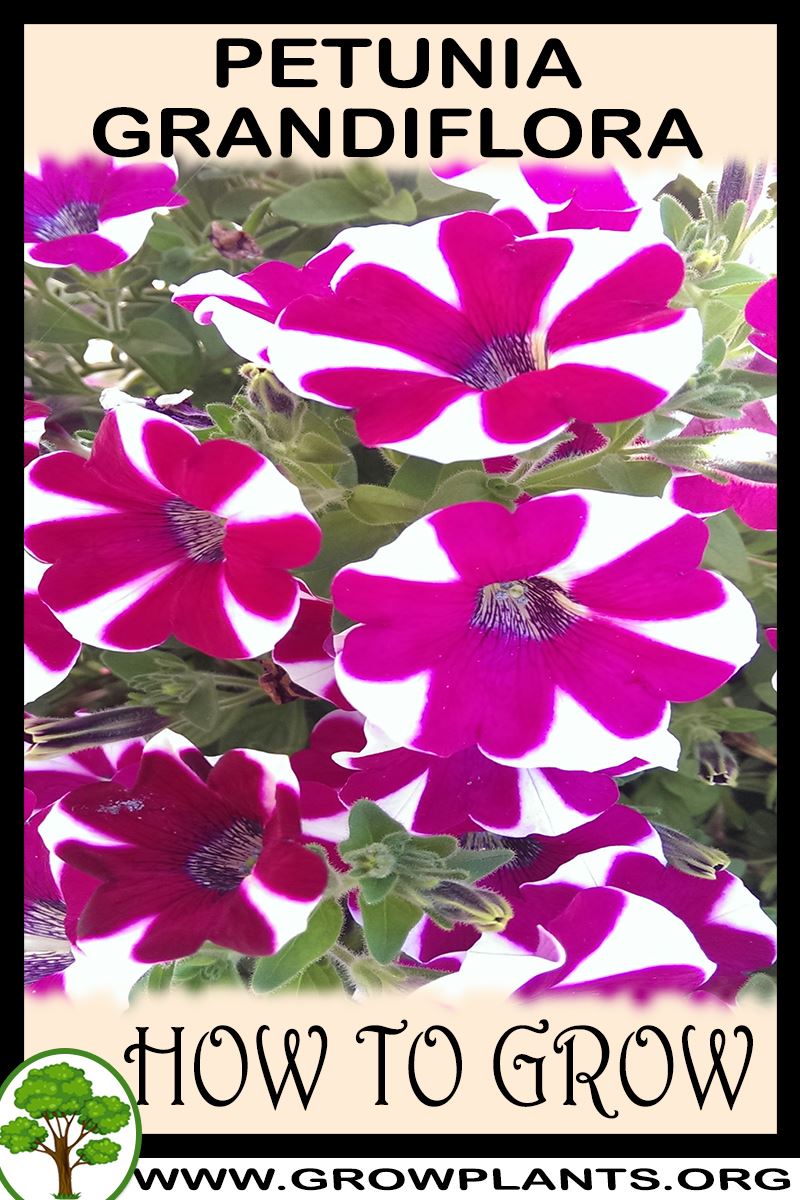
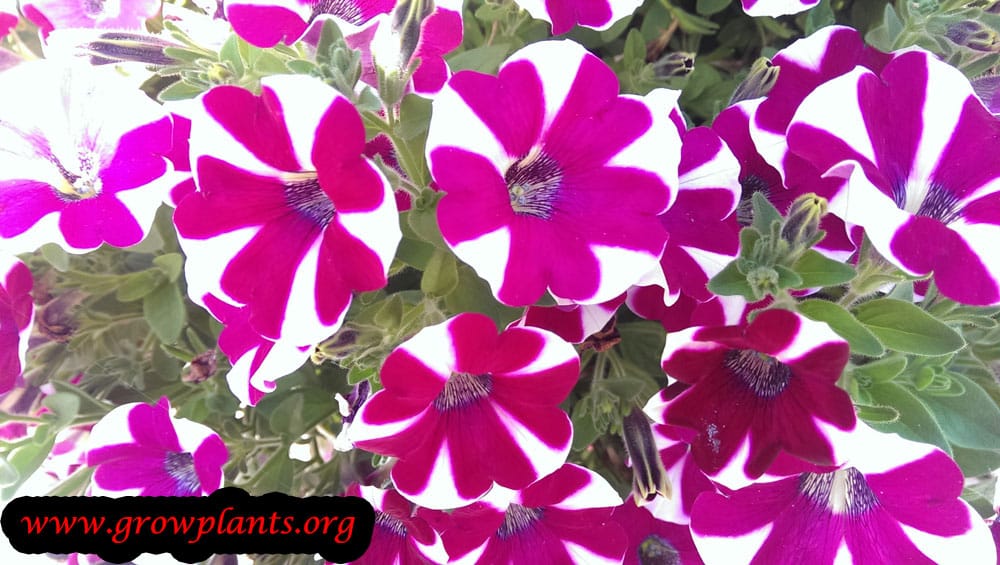
- Flower Characteristics: Extra-large single trumpet flowers in red, pink, purple, blue, yellow, orange, near-black or white, often bicoloured — the largest blooms of the petunia types.
Primary Uses & Landscape Value
- Functional & Ornamental Roles: A leading warm-season bedding, groundcover and container plant for massed colour in borders, hanging baskets and window boxes; can self-seed and spread readily.
Care Guide: Planting, Soil & Watering
Overview: Petunia grandiflora is a fast-growing, free-flowering warm-season annual grown as a trailing ground cover or in containers (hardiness zones 2+ for spring planting, 10–12 for autumn–winter planting in frost-free areas). It flowers best in full sun in fertile, well-drained soil kept lightly and evenly moist.
Quick Care Requirements
| Requirement | Ideal Condition |
|---|---|
| Planting Season | Spring in cooler zones; autumn–winter in hot, frost-free areas (10–12) |
| Growth Rate | Fast |
| Soil Type | Fertile, rich, well-draining, moisture-retentive |
| Water Need | Moderate – keep lightly and evenly moist |
Planting & Establishment
- Best Planting Season: Plant in spring in cooler zones, or in autumn to winter in hot, frost-free areas (zones 10–12).
- How to Plant:
- Hole Preparation: Dig a hole about twice the width of the root ball and no deeper than its height, loosening the sides so young roots can spread easily.
- Soil Amendments: Work compost or well-rotted organic matter into the backfill; on heavy ground add grit or coarse material to sharpen drainage.
- Planting Depth: Set the plant so the root collar sits level with the surrounding soil – never bury the stem – then firm gently and water in.
- Growth Speed & Expectations: A fast grower that establishes and spreads quickly, flowering for much of the season.
Soil, Watering & Drainage Care
- Soil Mix & Drainage Needs: Provide fertile, well-drained soil or potting mix kept lightly moist; sharp drainage prevents rot while regular feeding and moisture fuel continuous bloom. Containers dry out quickly and need closer attention.
- Watering Schedule & Technique:
- Young / Newly Planted: Water in well and keep the soil evenly moist while young plants establish.
- Established: Water regularly so the soil stays lightly moist – avoid both drought stress and waterlogging.
- Seasonal Adjustments: Water more often in summer heat (especially in pots) and cut back in cool, damp weather.
Climate, Light & Hardiness
Grandiflora petunia is a tender bedding plant with the largest flowers of the petunia types, grown as an annual across tropical, Mediterranean, subtropical and temperate climates. It flowers best in full sun in cool-to-mild weather (with light shade helping where summers are hot), and the site rates it at hardiness zones 10–12 for autumn-to-winter planting and zone 2 and warmer for spring planting.
Quick Climate Specifications
| Climate Zones | Tropical, Mediterranean, subtropical, temperate |
|---|---|
| USDA Hardiness Zones | Approximately 10–12 for autumn-winter planting; 2 and warmer for spring planting (site data) |
| Optimal Temp Range | Mild, roughly 15–25°C (59–77°F) |
| Cold Damage Begins | Frost damages foliage and flowers |
| Frost Tolerance | Low to none |
| Light Conditions | Full sun (partial shade in hot-summer climates) |
Sunlight & Light Exposure
Optimal Light Setup
Full sun in cool-to-mild weather gives compact plants smothered in large blooms; low light produces leggy growth and few flowers.
Shade & Heat Management
The big flowers are more easily scorched by intense sun and heat than smaller-flowered types, so in hot regions give light afternoon shade and lean on the cooler autumn-to-spring seasons.
Temperature Extremes & Hardiness
USDA Hardiness & Regional Limits
The two figures reflect cultivation, not two different plants: in frost-free climates (zones 10–12) it is set out in autumn for winter and spring bloom, while in colder regions (zone 2 and up) it is a spring-to-summer annual. It is grown as an annual because winter cold ends it, not because it could not live longer in frost-free conditions.
Cold Damage & Winter Protection
Frost damages the soft foliage and flowers, so planting is timed to the frost-free window; in mild, frost-free winters it keeps blooming.
Extreme Heat Tolerance
Moderate, and a little lower than small-flowered petunias – prolonged heat and harsh sun fade and burn the large blooms and slow flowering.
Wind, Humidity & Microclimate
Rainfall & Seasonal Moisture
The large, soft flowers are readily bruised and matted by heavy rain, so a position with some overhead shelter keeps the display clean in wet weather.
Wind Tolerance
Low to moderate; strong wind tears the big petals, so shelter improves the look.
Microclimate Recommendations
A sunny, sheltered spot protected from driving rain – and the cooler seasons in hot climates – gives the best of the large blooms.
Growing in Pots, Balconies & Indoors
Grandiflora petunias are compact, wide-spreading bedding plants (10-30 cm / 4-12 in) with large flowers. They are not houseplants – they need strong sun and grow leggy and shy of flowering indoors – but in pots, window boxes and hanging baskets they are among the best of all sunny balcony and patio plants.
Quick Details
- Container Size: Any pot, window box or hanging basket with good drainage; they spread and trail, so give them room
- Indoor Suitability: Not a houseplant; a very bright, sunny sill at best – they truly belong outdoors in full sun
- Best Spot: Full sun, with a little afternoon shade in hot-summer climates
- Soil & Drainage: Light, free-draining potting mix (peat/coir with perlite); it must not stay waterlogged
- Watering in Pots: Regular – pots and baskets dry fast; keep evenly moist but not soggy
Indoors & On the Windowsill
- Houseplant limits: In low light they stretch, go pale and stop blooming – this is an outdoor plant.
- Windowsill growing: A very bright, sunny sill can hold them for a while, but a balcony or patio in full sun is far better.
- Overwintering: Usually grown as annuals and replaced each year; a favourite plant can be kept over somewhere bright and frost-free.
On a Balcony or Patio
- Light & wind: This is their ideal home – railing boxes and hanging baskets in full sun. They dry out fast in wind and heat, so check them daily and water often.
- Keep them blooming: Deadhead spent flowers and they will flower non-stop through the warm season.
Choosing the Pot, Soil & Long-Term Care
- Pot & drainage: Any container with strong drainage holes; skip a standing water saucer to avoid root rot. Terracotta breathes and dries faster, while glazed or plastic pots and baskets hold moisture longer.
- Potting mix: A light, free-draining potting mix – peat or coir with perlite.
- Feeding: They are hungry plants in pots – feed regularly through the season, as nutrients leach out with frequent watering; this keeps the flowers coming.
- Renewal: Being fast annuals, they are simply replaced each year rather than repotted long-term.
Fertilizing & Feeding
A steady, light feeder: a balanced complete fertilizer through the growing and blooming season keeps flowering ornamentals healthy without forcing soft growth.
Quick Fertilizing Specs
| Feeding Level | moderate |
|---|---|
| Main Nutrient Priority | A balanced complete fertilizer with steady nitrogen; extra phosphorus is not needed for bloom. |
| Best Feeding Period | Through the active growing and flowering season. |
| Organic Options | Compost and other organic matter improve the soil and supply gentle, steady nutrition. |
| Soil pH | Slightly acidic to near neutral suits most flowering ornamentals. |
| Reduce/Stop Feeding | Ease off feeding as growth slows heading into the cool, dormant rest period. |
Feeding by Growth Stage
Spring growth flush
Support healthy new shoots and leaf growth as the plant wakes up.
| Nutrient direction | A complete, balanced fertilizer with steady nitrogen to build strong foliage and stems. |
|---|---|
| Timing | As new growth begins in spring and the weather warms. |
| Frequency | Light, regular feedings through the active growing season. |
| Fertilizer types | A balanced complete garden fertilizer, A slow-release complete fertilizer worked into the soil, Compost or other organic matter to enrich the soil |
| Precautions | Feed lightly and avoid overfeeding with nitrogen, which pushes soft leafy growth at the expense of flowers. |
Flowering period
Fuel abundant, well-colored flowers while keeping the plant vigorous.
| Nutrient direction | A balanced complete fertilizer with adequate nitrogen; balanced feeding, not extra phosphorus, drives good bloom. |
|---|---|
| Timing | Through the blooming season. |
| Frequency | Steady, light feeding maintained across the flowering period. |
| Fertilizer types | A balanced complete flowering-plant fertilizer, A water-soluble complete fertilizer for container plants |
| Precautions | Skip high-phosphorus ‘bloom booster’ products; they are rarely needed and excess phosphorus can harm the soil. Container plants need even feeding to avoid salt buildup. |
Repeat bloom and rebound
Keep long-blooming plants flushing new flowers after deadheading or shearing.
| Nutrient direction | A balanced complete fertilizer to refuel growth and encourage the next wave of flowers. |
|---|---|
| Timing | After each flush of bloom or a mid-season trim, while the plant is still actively growing. |
| Frequency | Resume light, regular feeding as new growth pushes. |
| Fertilizer types | A balanced water-soluble complete fertilizer, A balanced complete garden fertilizer |
| Precautions | Feed sparingly in heat; combine feeding with consistent watering so nutrients stay available. |
Dormancy or cool-season rest
Let the plant rest through cold or low-light conditions without forcing new growth.
| Nutrient direction | None – withhold fertilizer while the plant is resting. |
|---|---|
| Timing | During cold winter weather or the plant’s low-light dormant rest. |
| Frequency | No feeding at this stage. |
| Fertilizer types | No feeding at this stage – resume only when active growth returns. |
| Precautions | Do not fertilize until active growth resumes; feeding a resting plant risks salt buildup and root injury. |
Nutrient Deficiency Signs & Corrections
Older, lower leaves fade to pale green or yellow and overall growth is weak.
| Possible causes | Low nitrogen in the soil, Nutrients leached out by heavy rain or frequent watering, Cold, wet roots slowing nutrient uptake |
|---|---|
| Appears first on | Older, lower leaves |
| What to check | Recent feeding history, Soil drainage and how often it is watered, Whether roots are healthy and warm enough |
| Possible correction | Apply a balanced complete fertilizer and improve drainage; correct soil pH if it is far off so nutrients stay available. |
Newest leaves turn yellow between green veins (interveinal yellowing) while older leaves stay greener.
| Possible causes | High soil pH locking up iron, Waterlogged or poorly aerated roots, Genuinely low available iron |
|---|---|
| Appears first on | Youngest, newest leaves |
| What to check | Soil pH, Drainage and root health, Whether only new growth is affected |
| Possible correction | Correct soil pH and improve drainage; where iron is truly short, apply a chelated iron product per its label. |
Lush leaves but few flowers, or pale weak blooms.
| Possible causes | Excess nitrogen driving leafy growth over flowers, Too little light for good flowering, A pest or cultural problem rather than a nutrient shortage |
|---|---|
| Appears first on | Flower buds and flowering shoots |
| What to check | How much nitrogen was applied, Hours of direct light, General plant health and pest pressure |
| Possible correction | Ease off nitrogen, move the plant to brighter light, and keep feeding balanced rather than reaching for high-phosphorus products. |
Pruning, Training & Seasonal Maintenance
Petunia grandiflora is a fast-growing tender sub-shrub grown as a warm-season bedding and trailing annual, prized for the largest flowers of any petunia. Those big, single trumpets are also the most weather-vulnerable — rain and overhead watering bruise and mat them — so removing damaged and spent blooms is the core task, alongside pinching for branching and a mid-season cutback to beat legginess. There is no permanent woody structure to train.
Quick Pruning & Maintenance Specs
| Pruning Tolerance | High — pinching and cutting-back drive fuller growth |
| Primary Pruning Window | Throughout the warm growing and blooming season |
| Secondary Maintenance Window | One mid-season rejuvenation cutback when stems go leggy |
| Typical Frequency | Ongoing — deadhead every few days; pinch as needed; one hard cutback mid-season |
| Main Objective | Bushy, non-leggy habit and continuous bloom |
| Young Plant Priority | Pinch growing tips to force side branching |
| Mature Plant Priority | Deadhead and cut back leggy stems to rejuvenate |
| Best Tool Type | Fingers or precision snips (soft stems) |
| Avoid Heavy Pruning During | Peak heat / drought stress, and late in the season near frost |
Pruning by Plant Age & Size
Newly Established
On a young transplant, pinch out the growing tip once it has three or four sets of leaves. That single soft pinch — the only “training” this plant needs — breaks apical dominance and turns one stem into several, the foundation of a mounded, full plant rather than a single stretched stalk.
Young / Formative
Keep pinching the strongest shoots as they extend. There is no leader, vase or framework to establish; the aim is simply many branch points low down. Removing the first flower buds on a very small plant channels early energy into structure, though it is optional on already-bushy nursery stock.
Mature / Established
By mid-season a vigorous petunia typically stretches and blooms only at the stem ends. Cut the whole plant back by about one third to one half, just above healthy leaves, to force a fresh flush of branched, floriferous growth. Combined with routine deadheading, this is what carries the display to frost.
Seasonal Pruning Schedule
As a plant grown for a single warm season, it has no dormant or old-wood cycle — maintenance is continuous rather than seasonal.
Ongoing (growing season)
Objective: sustain bloom and prevent legginess. Remove: spent and damaged flowers, seed capsules, any yellowing lower leaves. Do not remove: healthy leafy growth — the plant re-blooms from the leaf axils you leave. Response: quick re-branching and new buds in warm weather. Bloom impact: deadheading and the mid-season cutback both increase total flowering.
Special Growth to Remove
Rain-spotted and spent large flowers are the priority to remove: grandiflora blooms are big enough that a few decaying heads look untidy and rot into the foliage, and seed-set slows flowering. Snip each faded or storm-damaged bloom back to the first healthy leaf, together with the seed capsule forming behind it. There are no suckers, watersprouts or runners on a petunia — do not treat vigorous leafy shoots as unwanted; they carry the next flush of bloom.
Container & Small-Space Pruning
Most petunias are grown in pots, window boxes and hanging baskets, and this is where cutting-back matters most. Confined roots and long trailing stems go bare-in-the-middle quickly, so pinch early and do not skip the mid-season haircut — cutting a tired basket back by half looks drastic for a week, then rewards you with a rebuilt, flower-covered mound. Root-pruning does not apply; these are replaced each season, not kept on.
Tools
Soft, hollow stems cut cleanly with fingertips or precision snips. Nothing heavier is ever needed — no loppers, saws or hedge shears. A light hand shear can speed the mid-season cutback across a big basket, but follow it by tidying any torn stems.
Tool Hygiene & Disease Risk
Routine. Clean, sharp snips are enough for everyday deadheading. Raise to increased caution only if a plant shows mottled, distorted leaves: petunias can carry mosaic-type viruses, so pull and bin obviously virused plants rather than trimming through them, and wash hands before working on healthy stock. There is no need to disinfect between every routine cut on healthy plants.
Cut Placement & Technique
Pinch or cut just above a leaf or leaf pair — new shoots break from those axils, so a cut left in bare stem simply dies back. When deadheading, remove the seed capsule as well as the petals, not just the faded bloom. For the mid-season cutback, cut the whole plant to a consistent height above leafy growth rather than shearing into bare lower stems.
Heavy Pruning & Rejuvenation
Well tolerated and, in fact, the key mid-season technique: a leggy petunia cut back by up to half will re-flush from lower leaves within one to two weeks in warm weather, briefly pausing bloom before returning fuller than before. Because it is grown as an annual there is no multi-year renovation — one rejuvenation cut per season is the whole story.
Post-Pruning Care
After the mid-season cutback, water well and give a light balanced feed. Unlike woody plants — where feeding after hard pruning is discouraged — these fast, heavy-feeding container annuals genuinely draw down nutrients while rebuilding, and a modest feed fuels the re-flush. Keep the rootball evenly moist for the week or two of regrowth and watch for aphids colonising the soft new tips.
Common Pruning Mistakes
- Letting rain-damaged large blooms sit and rot into the canopy instead of removing them promptly.
- Skipping the mid-season cutback, so the large-flowered stems stretch, flop and flower only at the ends.
- Overhead watering that batters the big trumpets — a maintenance habit, not a cut, but it makes far more deadheading work.
When NOT to Prune
Do not take the hard mid-season cutback during a heatwave, drought stress or immediately after transplanting — wait for the plant to be turgid and actively growing. There is also little point in a heavy cutback late in the season, when frost will end the plant before it can rebuild.
Recommended Tools (by task)
- precision_snips — the only cutting tool this plant needs: clean deadheading and the mid-season cutback on thin, soft stems.
Propagation Guide
Large-flowered (grandiflora) petunias are usually raised from seed, most types being F1 hybrids that give uniform plants from bought seed but do not come true from home-saved seed; a chosen plant can also be kept by cuttings. The dust-fine seed makes it a moderate crop to start.
Quick Propagation Specs
| Best Propagation Method | Seed (F1) |
| Alternative Methods | Softwood cuttings (to keep a chosen plant) |
| Propagation Difficulty | Moderate |
| Seed True-to-Type | Cultivar-dependent — F1 seed gives uniform plants, home-saved seed varies |
| Vegetative True-to-Type | Yes |
| Best Propagation Season | Warm season |
| Germination Temperature | About 20–25°C (68–77°F) |
| Seed Sowing Depth | Surface-sow — seed needs light, do not cover |
Growing from Seed
Seed Handling & Viability
The seed is very fine (dust-like) and needs light to germinate, so it is sown on the surface and not covered.
Sowing Depth & Orientation
Surface-sow and press lightly into the mix; do not bury, as light is required.
Germination Conditions
Keep the surface evenly moist and warm, about 20–25°C (68–77°F), with good light.
Germination Time
Seedlings usually appear within one to two weeks; they are tiny at first and need careful watering.
Stem Cuttings
Cutting Type & Timing
Softwood tip cuttings taken in the warm season.
Rooting Setup & Hormone
Root in a moist, free-draining mix under high humidity; a rooting hormone is optional as tips root easily.
Rooting Time
Cuttings root within a couple of weeks. Cuttings keep a particular plant true where saved seed would not.
Bloom & Flower Guide
Quick Details
- Bloom Season: Nearly year-round in mild climates; spring through autumn (until frost) in temperate zones
- Time to First Bloom: Fast – usually within a few weeks of planting out in warm weather
- Flower Appearance: Large single trumpet flowers in red, pink, purple, blue, yellow, orange, near-black or white, often more than one colour
- Edibility: Ornamental only – grown for its flowers, not for eating
Detailed Blooming Overview
The grandiflora group has the largest flowers of the petunias – big, showy single trumpets. They bloom for most of the year in mild climates and from spring to frost in cooler zones. The large blooms can be battered by heavy rain, so a little shelter keeps them looking their best.
Flower Characteristics
- Large, single, trumpet-shaped flowers – bigger than other petunia types.
- A very wide colour range: red, pink, purple, blue, yellow, orange, near-black or white, often bicoloured.
Bloom Care & Thinning
- Keeping it flowering: Deadhead faded blooms and pinch leggy stems; feed regularly, and shelter the big flowers from heavy rain.
Bloom Health & Protection
- Budworm: Tobacco budworm caterpillars chew into buds and open flowers – a Bt (Bacillus thuringiensis) spray targets the caterpillars while sparing pollinators.
- Botrytis (grey mould): In cool, damp, crowded conditions faded blooms can rot and turn fuzzy-grey – better airflow and removing spent flowers keeps it in check.
Pests, Diseases & Troubleshooting
Overview: Petunias are vigorous, free-flowering bedding and container plants, but as members of the nightshade family they are a magnet for aphids, thrips and especially the tobacco (geranium) budworm, whose caterpillars bore into buds. Good airflow, deadheading and a beneficial-insect-friendly garden keep most attacks cosmetic; botrytis and root rot are the main risks in wet, crowded conditions.
Quick Troubleshooting Overview
| Issue / Pest | Main Symptom | Primary Solution |
|---|---|---|
| Tobacco budworm | Holes in buds, no flowers opening | Hand-pick at dusk, Bt spray, remove bored buds |
| Aphids | Sticky curled shoot tips | Water jet, insecticidal soap, ladybirds |
| Thrips | Streaked, distorted petals; virus risk | Blue sticky traps, remove spent blooms |
| Botrytis (grey mould) | Fuzzy grey rot on flowers in wet weather | Deadhead, improve airflow, avoid wetting blooms |
| Root/crown rot | Wilting, blackened stem base | Sharp drainage, water at base, don’t overwater |
Common Pests & Management
- Tobacco / geranium budworm (Chloridea virescens):
- Symptoms: Small green, brown or reddish caterpillars bore neat holes into buds and petals; buds fail to open or emerge shredded, often with dark frass pellets. The classic reason petunias ‘stop flowering’ in mid-season.
- Prevention & Control: Inspect buds at dusk and hand-pick; remove and bin damaged buds to break the cycle; encourage birds and parasitic wasps. Bacillus thuringiensis (Bt) or spinosad, applied to buds in the evening, controls heavier infestations.
- Aphids (Aphidoidea spp.):
- Symptoms: Small soft-bodied green, black or grey insects clustered on soft shoot tips and buds; causes curled, distorted foliage, sticky honeydew and sooty mould. Look-alikes: whitefly (which flies up when disturbed).
- Prevention & Control: Encourage ladybirds, lacewings and parasitic wasps; blast colonies off with a firm jet of water; remove badly infested tips. Persistent outbreaks respond to insecticidal soap or a light horticultural oil applied to leaf undersides in the cool of the evening to protect pollinators.
- Thrips (Thysanoptera spp.):
- Symptoms: Silvery streaks and flecking on leaves and petals, black frass specks, and distorted new growth; slender fast-moving insects.
- Prevention & Control: Use blue sticky traps for monitoring; remove weeds and spent flowers that harbour them; encourage predatory mites and pirate bugs. Spot-treat with insecticidal soap or spinosad-type products following the label.
- Whitefly (Trialeurodes vaporariorum):
- Symptoms: Clouds of tiny white moth-like insects rise when foliage is disturbed; leaf undersides carry scale-like nymphs, and honeydew fuels sooty mould.
- Prevention & Control: Hang yellow sticky traps to monitor and reduce adults; introduce the parasitic wasp Encarsia formosa under cover; keep plants unstressed. Treat with insecticidal soap or horticultural oil to leaf undersides, repeating regularly.
- Two-spotted spider mite (Tetranychus urticae):
- Symptoms: Fine pale stippling on leaves, faint webbing on undersides and leaf axils, and a dusty bronzed look in warm dry conditions. Tiny moving specks visible with a hand lens.
- Prevention & Control: Raise humidity and hose foliage regularly, as mites thrive in hot dry air; introduce predatory mites (Phytoseiulus persimilis) under cover. Treat hotspots with insecticidal soap or horticultural oil, ensuring thorough coverage of leaf undersides.
- Slugs & snails (Gastropoda spp.):
- Symptoms: Irregular ragged holes in leaves and soft new shoots, worst in damp shady conditions, with tell-tale slime trails at night.
- Prevention & Control: Hand-pick after dark; remove damp hiding places; set beer traps or copper barriers; encourage frogs and ground beetles. Scatter iron-phosphate pellets, which are safe around pets and wildlife, only where needed.
Diseases & Fungal Issues
- Grey mould (botrytis) (Botrytis cinerea):
- Symptoms: Fuzzy grey-brown rot on spent flowers and soft growth in damp, crowded conditions, spreading to healthy tissue.
- Treatment & Management: Deadhead regularly, space plants for airflow, water at the base and clear fallen petals; remove infected parts promptly. Reserve fungicide for persistent damp-season problems.
- Root & crown rot (Phytophthora / Pythium spp.):
- Symptoms: Wilting despite moist soil, blackening at the stem base and collapse, worst in heavy wet soil or overwatered pots.
- Treatment & Management: Plant in free-draining soil or mix, avoid overwatering and overhead splashing, and do not plant too deep; discard badly affected plants.
- Tomato spotted wilt / mosaic viruses (TSWV, CMV):
- Symptoms: Ring spots, mottling, distorted streaked growth and stunting, spread by thrips and aphids.
- Treatment & Management: There is no cure – remove and destroy affected plants, and control the thrips and aphids that vector these viruses.
Growing Difficulties & Abiotic Problems
- Legginess & flowering slump:
- Cause & Symptoms: Heat, missed deadheading or budworm damage leaves plants sparse, stretched and bloomless by midsummer.
- Correction Strategy: Pinch and cut back by a third to rejuvenate, feed with a bloom fertiliser, and deadhead often; keep evenly watered.
- Nutrient / iron chlorosis:
- Cause & Symptoms: Hungry container plants and alkaline mix yellow between the veins and flower poorly.
- Correction Strategy: Feed regularly with a balanced or high-potash liquid feed; correct iron chlorosis with a chelated iron product and slightly acidic mix.
- Sunburn / leaf scorch:
- Cause & Symptoms: Sudden exposure to intense sun after shade, or reflected heat, causes bleached, papery or brown patches on the most exposed leaves.
- Correction Strategy: Acclimatise plants gradually to brighter positions; provide light shade during the fiercest midday sun; keep roots evenly moist so foliage is not additionally heat-stressed.
What Helps – Products & Tools
Reach first for cultural fixes – deadheading, airflow and hand-picking budworm. Where needed, use Bacillus thuringiensis (Bt) or spinosad for budworm, insecticidal soap or light horticultural oil for aphids, whitefly and mites, and blue sticky traps for thrips. A high-potash bloom feed and chelated iron keep container plants flowering; save fungicides for wet-weather botrytis.