Plant Profile & Key Characteristics
Overview: An evergreen (deciduous or annual where cool) perennial subshrub reaching about 0.3-1.2 m (1-4 ft), grown for its long-lasting clusters of star-shaped flowers. It is a favourite butterfly and pollinator ornamental for beds and containers.
Quick Specifications
| Specification | Attribute |
|---|---|
| Plant Type / Life Cycle | Perennial subshrub (often grown as an annual in cool climates) |
| Foliage Type | Evergreen (deciduous in cooler areas) |
| Mature Size | 0.3-1.2 m (1-4 ft) tall |
| Growth Rate | Moderate to slow |
| Toxicity | Non-toxic — Pentas is listed as non-toxic to cats and dogs |
| Hardiness | USDA zones 9 and warmer |
Growth Form & Structure
- Height & Spread: Forms a bushy mound 0.3-1.2 m (1-4 ft) tall in the ground; compact and free-flowering in a container.
- Growth Habit & Form: A rounded, branching subshrub with soft upright stems, kept dense by regular deadheading and an end-of-winter prune.
- Lifespan & Maturity: Reaches flowering size in its first season and blooms over a long warm period; a tender perennial that is often replanted annually in cold regions.
Anatomy & Physical Features
- Leaves & Foliage: Green to light-green, elliptic, softly hairy leaves with a slightly quilted texture.
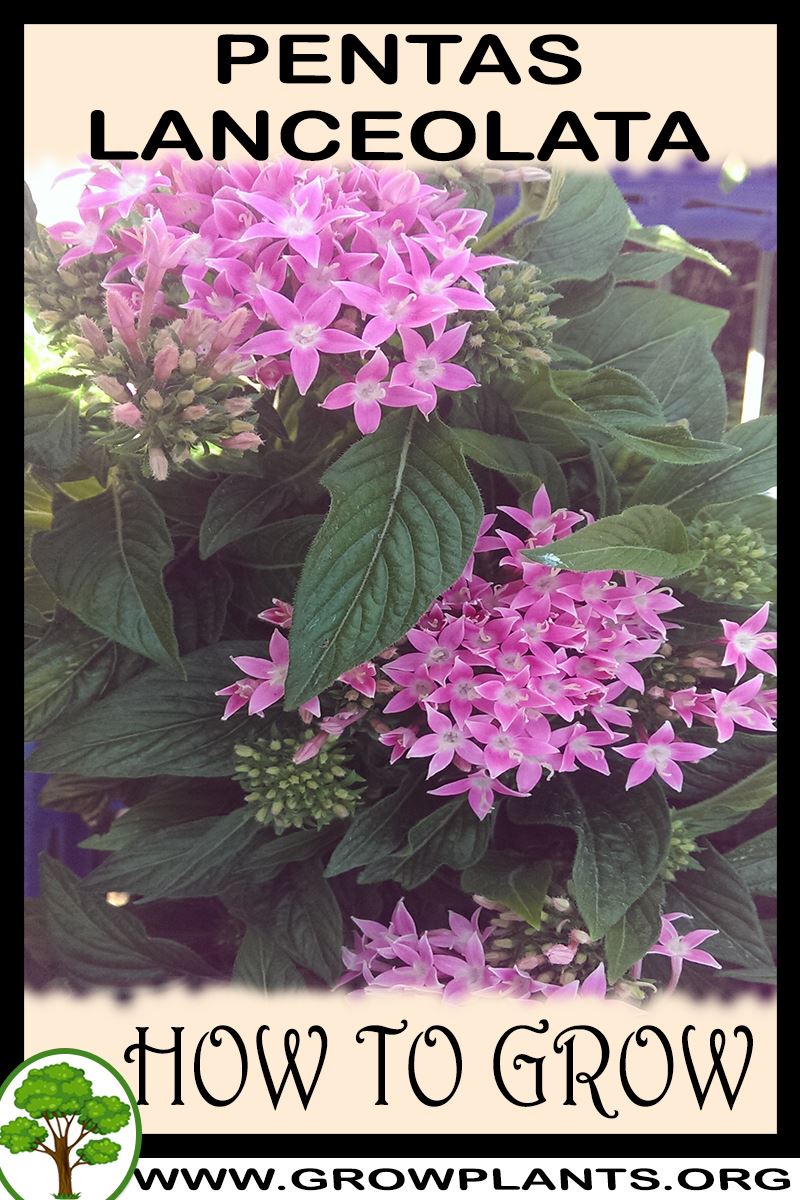
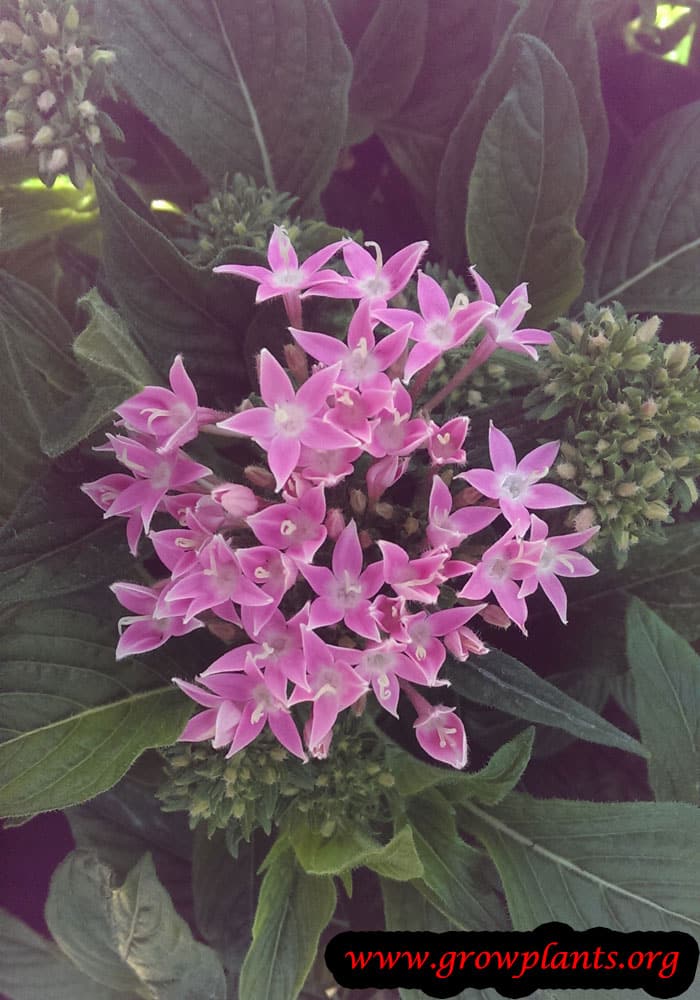
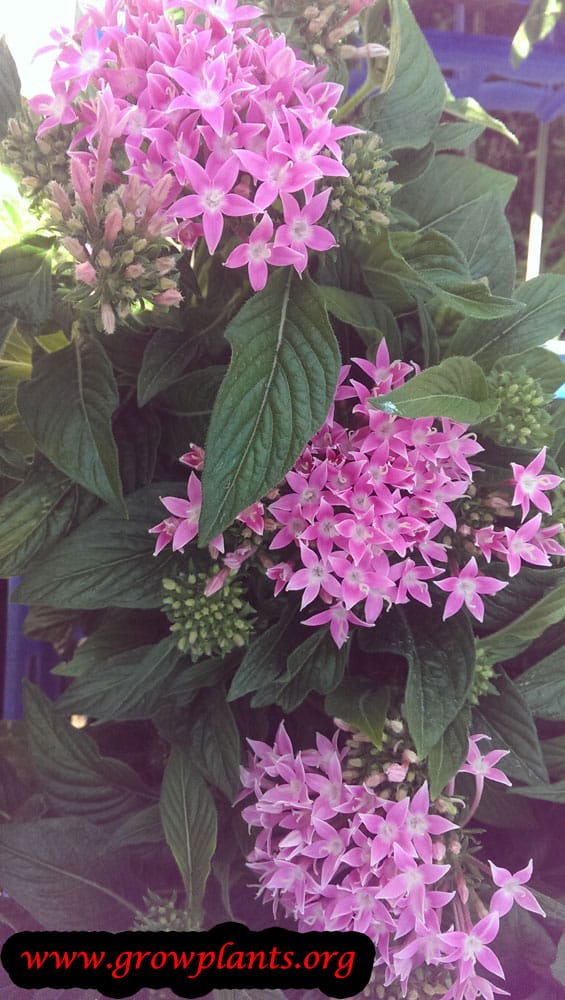
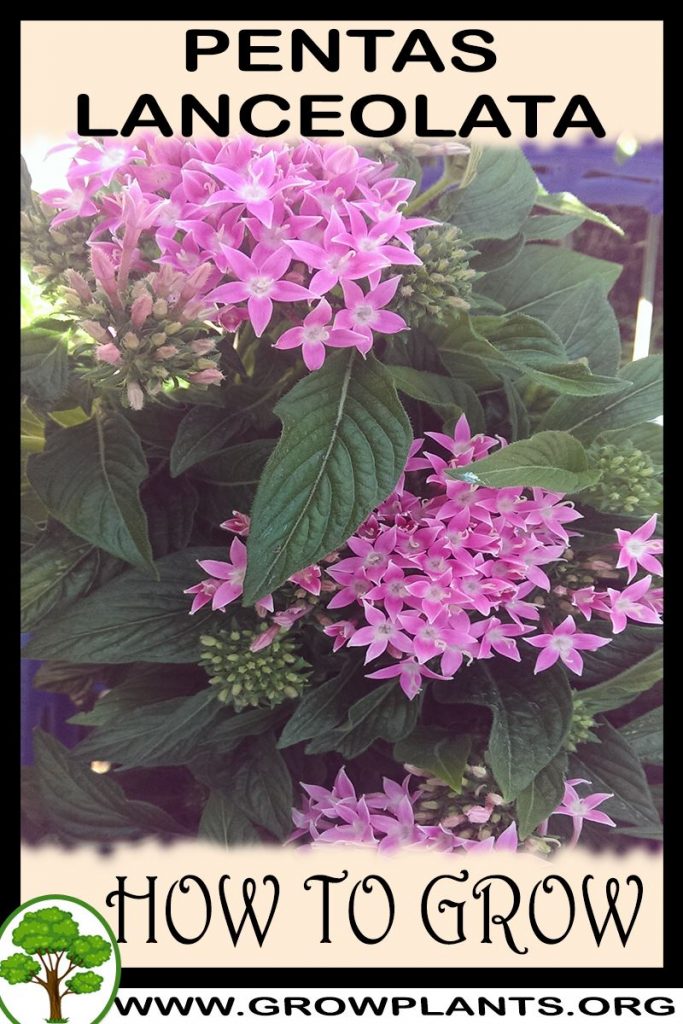
- Flower Characteristics: Small (1-2 cm) five-pointed star flowers in red, white, pink or purple, packed into domed clusters of 20-plus that draw butterflies.
Primary Uses & Landscape Value
- Functional & Ornamental Roles: A premier butterfly- and hummingbird-attracting bedding and container plant, used in borders, mass plantings and patio pots for continuous warm-season colour.
Care Guide: Planting, Soil & Watering
Overview: Pentas lanceolata is an evergreen (or short-lived) flowering shrub for tropical to Mediterranean zones (9 and warmer), loved for its butterfly-drawing blooms. It thrives in full sun to partial shade in fertile, well-drained soil kept reasonably moist.
Quick Care Requirements
| Requirement | Ideal Condition |
|---|---|
| Planting Season | Spring through autumn, after any danger of frost |
| Growth Rate | Slow to Moderate |
| Soil Type | Fertile, rich, well-draining |
| Water Need | Moderate to High |
Planting & Establishment
- Best Planting Season: Plant in the warm season – spring through autumn – once all danger of frost has passed.
- How to Plant:
- Hole Preparation: Dig a hole about twice the width of the root ball and no deeper than its height, loosening the sides so young roots can spread easily.
- Soil Amendments: Work compost or well-rotted organic matter into the backfill; on heavy ground add grit or coarse material to sharpen drainage.
- Planting Depth: Set the plant so the root collar sits level with the surrounding soil – never bury the stem – then firm gently and water in.
- Growth Speed & Expectations: Growth is slow to moderate; it steadily bushes out over the warm season into a mounded, flowering clump.
Soil, Watering & Drainage Care
- Soil Mix & Drainage Needs: Give fertile, well-drained soil enriched with organic matter; good drainage prevents root rot while the organic content holds the moisture it likes. It also grows well in containers of free-draining mix.
- Watering Schedule & Technique:
- Young / Newly Planted: Water in well and keep the soil evenly moist while the young plant establishes.
- Established: Water regularly so the soil stays reasonably moist; water deeply and let excess drain away.
- Seasonal Adjustments: Increase watering in heat and reduce in cooler, wetter weather.
Climate, Light & Hardiness
Pentas is an evergreen tropical-to-subtropical shrub that becomes deciduous or is grown as an annual in cooler temperate climates. It grows in full sun to half shade and needs essentially frost-free conditions to persist as a perennial.
Quick Climate Specifications
| Climate Zones | Tropics, subtropics, Mediterranean, temperate |
|---|---|
| USDA Hardiness Zones | Approximately 9 and warmer as a perennial; grown as an annual in colder temperate climates |
| Light Conditions | Full Sun to Half Shade |
Sunlight & Light Exposure
Optimal Light Setup
Full sun to half shade produces the strongest, most continuous flowering.
Temperature Extremes & Hardiness
USDA Hardiness & Regional Limits
Hardy as a perennial from roughly USDA zone 9 upward; in colder temperate climates it dies back seasonally or is grown as a warm-season annual.
Cold Damage & Winter Protection
In cooler parts of its range it goes deciduous over winter rather than staying evergreen; hard freezes in temperate climates end the growing cycle where it is treated as an annual.
Growing in Pots, Balconies & Indoors
Egyptian star cluster carries rounded heads of starry flowers that butterflies and hummingbirds adore. The grower rates it for containers but not as an indoor houseplant – it flowers best with lots of sun, so it excels in a pot on a bright patio or balcony.
Quick Details
- Container Size: A medium-large pot, 15-30 L (4-8 gal)
- Indoor Suitability: Not a houseplant (grower); needs lots of sun, though a very bright window can suit a compact plant
- Best Spot: Full sun to partial shade; a bright spot with some direct sun is ideal.
- Soil & Drainage: Aerated, organic-rich mix (quality potting mix, or peat/coir with perlite or vermiculite); it must drain freely.
- Watering in Pots: Keep the mix consistently moist – this one likes water – but make sure it drains freely; never let a potted plant go bone-dry.
Indoors & On the Windowsill
- Houseplant limits: The grower marks it as not an indoor houseplant; it needs plenty of sun to keep flowering, and deep in a room it grows leggy and shy to bloom.
- Windowsill option: A compact plant may still flower at a very bright, sunny window with direct sun; anything less and it will disappoint.
- Overwintering: It is frost-tender and often grown as an annual – in cold climates keep it as a potted plant that comes into a bright, warm spot over winter.
On a Balcony or Patio
- Light & heat: Give it full sun to part shade and warmth; it flowers all season in a hot, bright spot and tolerates reflected wall heat well – just keep the pot watered.
- Watering: Keep the mix evenly moist through the flowering season; pots dry fast in heat, so check often. Deadhead to keep new flower heads coming.
Choosing the Pot, Soil & Long-Term Care
- Pot & drainage: A medium-large pot with strong drainage holes; skip a standing-water saucer. Keep the mix moist but free-draining.
- Potting mix: Use a well-aerated, organic-rich mix – quality potting mix, or peat/coir blended with perlite or vermiculite.
- Feeding: As nutrients wash out of pots faster than open ground, feed potted plants regularly through the growing season with a balanced fertiliser.
- Repotting: Refresh the mix and pot up each year or two; pinch and trim to keep it bushy and full of flower.
Fertilizing & Feeding
Egyptian star cluster flowers over an extended season and draws butterflies with its clustered star-shaped blooms; it does well on rich, well-drained soil with steady, moderate feeding through active growth.
Quick Fertilizing Specs
| Feeding Level | Moderate; a long-blooming plant that benefits from consistent feeding. |
|---|---|
| Main Nutrient Priority | Balanced nutrition to support both foliage growth and the extended clustered flower display. |
| Best Feeding Period | Through the spring, summer and autumn growth and bloom period. |
| Organic Options | Rich, well-drained soil built up with compost suits this plant well. |
| Reduce/Stop Feeding | Ease off feeding as growth slows in cooler weather, or where the plant is grown as a cool-season annual. |
Feeding by Growth Stage
Establishment
Help a newly planted Egyptian star cluster root into rich, well-drained soil and put out its first flush of light green, elliptic leaves.
| Nutrient direction | Light, balanced nutrition to support root and early leaf growth. |
|---|---|
| Timing | In the weeks after planting or transplanting. |
| Frequency | A light feeding at planting is usually enough to help this plant establish. |
| Fertilizer types | A balanced complete fertilizer used lightly, Compost worked into rich, well-drained soil |
| Precautions | Avoid heavy feeding right at transplanting, which can stress young roots before they’ve spread into the surrounding soil. |
Growth and extended bloom
Support steady foliage growth and the clusters of small red, white, pink or purple star-shaped flowers that attract butterflies over a long season.
| Nutrient direction | Steady, balanced nutrition to keep both foliage and the extended flower display going strong. |
|---|---|
| Timing | Through the main spring, summer and autumn growth and flowering period. |
| Frequency | Regular light feedings through the growing season support this plant’s long bloom period better than infrequent heavy doses. |
| Fertilizer types | A balanced complete fertilizer used regularly through the season, For container-grown plants, a diluted balanced liquid feed |
| Precautions | Deadheading spent flower clusters, alongside steady feeding, helps keep this plant blooming continuously. |
Cool-season rest
Let growth slow where cooler temperatures interrupt active growth, or where this plant is grown as an annual and finishes its life cycle for the season.
| Nutrient direction | None – withhold fertilizer while growth is not active. |
|---|---|
| Timing | Through the cooler part of the year, or toward the end of the season where grown as an annual. |
| Frequency | No feeding at this stage. |
| Fertilizer types | No feeding – resume feeding on perennial plants once active growth clearly resumes |
| Precautions | Do not fertilize a dormant or declining plant; wait for clear new growth before feeding perennial specimens again. |
Nutrient Deficiency Signs & Corrections
Foliage looks pale green and stems stretch thin rather than forming a full, bushy plant.
| Possible causes | Too little light for good compact growth, A general nutrient shortage on poor soil, Overcrowding limiting light and airflow |
|---|---|
| Appears first on | New growth across the plant. |
| What to check | Light levels at the planting or container site, Recent feeding history, Plant spacing |
| Possible correction | Confirm the site gets enough sun, then give a light balanced feeding if pale, stretched growth continues. |
Leaves yellow between the veins while the veins themselves stay green.
| Possible causes | High soil pH reducing iron or manganese availability, Waterlogged or compacted soil limiting root uptake, A genuine iron or manganese shortage in the soil |
|---|---|
| Appears first on | New, upper leaves. |
| What to check | Soil pH, Drainage and whether roots are sitting wet, Whether only the newest growth is affected |
| Possible correction | Correct soil pH and drainage first; if the pattern persists, apply a chelated iron or manganese product per its label. |
The plant grows leafy and vigorous but produces few of its clustered star-shaped flowers.
| Possible causes | Excess nitrogen favoring leafy growth over flowers, Spent flower clusters not being deadheaded to encourage rebloom, Insufficient sun for good bud formation |
|---|---|
| Appears first on | Overall flowering across the plant. |
| What to check | Recent nitrogen-heavy feeding, Whether spent flower clusters have been trimmed, Sun exposure |
| Possible correction | Ease back on nitrogen, deadhead spent flower clusters regularly, and confirm adequate sun. |
Pruning, Training & Seasonal Maintenance
Pentas is a soft, fast-flushing subshrub that tolerates a fairly hard annual cutback. It blooms nearly continuously through the growing season, so the single major reset prune is safest right at the end of winter, before new spring growth begins, while spent flower clusters can be snipped off all year to keep the display going.
Quick Pruning & Maintenance Specs
| Pruning Tolerance | Moderate–High |
| Primary Pruning Window | End of winter |
| Secondary Maintenance Window | Ongoing deadheading, all year |
| Typical Frequency | One major cutback per year, plus continuous light deadheading |
| Main Objective | Rejuvenation, bushiness, continued bloom |
| Young Plant Priority | Pinch growing tips to build a bushy, multi-stemmed habit early |
| Mature Plant Priority | Annual hard cutback plus ongoing deadheading |
| Best Tool Type | Precision snips |
| Avoid Heavy Pruning During | Peak summer bloom flush |
Pruning by Plant Age & Size
Newly Established
Pinch growing tips once the plant is established to encourage branching; do not hard-prune very young plants.
Young / Formative
Pinching only – there is no leader or vase system for this low subshrub.
Mature / Established
Annual hard cutback at the end of winter to reset size and vigor before the plant becomes woody and leggy at the base.
Seasonal Pruning Schedule
| Stage | Objective | Remove | Do Not Remove | Expected Response | Flowering Impact |
| Pre-Growth/End-of-Winter | Reset size and shape, renew vigor | Old, woody or leggy stems | Healthy low growth points | Vigorous new bushy growth | None – forces the fresh growth that carries the coming season’s bloom |
| Ongoing Sanitary | Prolong flowering, tidy the plant | Spent flower clusters, dead leaves | Actively developing buds | Continued flowering | Encourages further bloom, since Pentas flowers on current growth |
Flowering & Fruiting Wood
Pentas blooms on new, current-season growth, so the end-of-winter cutback does not sacrifice a stored crop of flower buds – it instead forces the fresh growth that will carry the coming season’s flowers.
Structural Pruning & Training
No formal training system applies. Over time the base can become woody and leggy; the annual cutback functions as informal renewal pruning to keep the plant compact and floriferous rather than sparse and stemmy.
Special Growth to Remove
- Spent flower clusters – deadhead year-round.
- Dead or yellowing leaves.
Container & Small-Space Pruning
In containers, pinch more assertively to keep the plant compact, since it can stretch and get leggy without strong light. The end-of-winter hard cutback still applies to keep container specimens in scale.
Tools
Precision snips for deadheading and pinching; bypass secateurs only if the base has become notably woody on an older, larger plant.
Tool Hygiene & Disease Risk
Routine – the only issue noted is aphids; clean, sharp tools are sufficient.
Cut Placement & Technique
Pinch or cut just above a leaf node or leaf pair to encourage low branching; deadhead spent flower heads back to the first healthy leaf set.
Heavy Pruning & Rejuvenation
Tolerates a hard cutback (roughly by half or more) at the end of winter to rejuvenate a leggy plant; expect a flush of new bushy growth and flowers by spring.
Post-Pruning Care
Water normally after the cutback and watch for the new flush; pinch again once new growth is a few inches long to build extra branching. No special feed is needed beyond routine care.
Common Pruning Mistakes
- Letting the plant go without an annual cutback until it becomes thin and leggy.
- Deadheading too shallow, leaving long bare stubs instead of cutting back to a leaf node.
When NOT to Prune
Avoid a hard cutback in the middle of the summer bloom flush – reserve the major cut for the end of winter.
Recommended Tools (by task)
- precision_snips – the only tool this small, soft-stemmed subshrub genuinely needs, for both deadheading/pinching and the end-of-winter cutback.
Propagation Guide
Pentas is most easily and quickly increased from softwood stem cuttings, which root fast and keep named flower-colour selections true; seed also works well for the species but named colour cultivars may not come true from seed. Overall propagation is Easy.
Quick Propagation Specs
| Best Propagation Method | Softwood stem tip cuttings |
| Alternative Methods | Seed |
| Propagation Difficulty | Easy |
| Seed True-to-Type | Usually true-to-type for the species; cultivar-dependent for named flower-colour selections |
| Vegetative True-to-Type | Yes |
| Best Propagation Season | Spring through summer and early autumn, matching this plant’s planting season |
| Seed Germination Time | Typically about 1–3 weeks under warm conditions |
| Cutting Rooting Time | Typically 1–3 weeks |
| Germination Temperature | Roughly 21–27°C (70–80°F) |
| Seed Sowing Depth | Surface-sow or barely cover; seed benefits from light exposure to germinate |
Growing from Seed
Seed Handling & Viability
No special storage requirement is noted; seed is best sown reasonably fresh.
Dormancy & Pre-Sowing Treatment
No significant dormancy; light aids germination, so avoid burying the seed deeply.
Sowing Season
Spring, or indoors ahead of the outdoor planting season in cooler climates.
Sowing Depth & Orientation
Surface-sow or just barely cover.
Germination Conditions
Warm (roughly 21–27°C / 70–80°F), consistently moist, bright conditions.
Germination Time
Typically about 1–3 weeks.
Seedling Care
Pinch young plants once established to encourage bushier growth, consistent with this plant’s regular deadheading/shaping regime.
Stem Cuttings
Cutting Type
Softwood tip cuttings, about 8–10cm (3–4in), with a few leaf nodes.
Best Timing
Spring to summer during active growth; in climates where Pentas is grown as an annual, cuttings can also be taken before autumn to overwinter indoors.
Cutting Preparation
Remove the lower leaves and cut just below a node.
Rooting Setup
A moist, well-drained mix or plain water, kept warm in bright, indirect light.
Rooting Hormone
Not usually necessary; Pentas roots readily on its own.
Rooting Time
Typically 1–3 weeks.
Bloom & Flower Guide
Quick Details
- Bloom Season: Spring through autumn (nearly year-round in frost-free climates)
- Time to First Bloom: In its first season when grown from seed or plugs, as it is often treated as an annual in cooler climates
- Flower Appearance: Small five-pointed star flowers in dense, domed clusters
- Edibility: Ornamental – not eaten
Detailed Blooming Overview
Pentas, or Egyptian star cluster, is one of the most dependable butterfly plants, flowering long and generously through the warm season. Each rounded head is packed with tiny star-shaped flowers, and the plant keeps producing them from spring right through autumn where frost is not a factor.
Flower Characteristics
- Flowers are small, about 1-2 cm, with five pointed lobes forming a star.
- Colours include red, white, pink, and purple, with more than twenty flowers to a cluster – a reliable magnet for butterflies.
Bloom Care & Thinning
- Encouraging bloom: Deadhead spent flowers through the season and give a harder prune at the end of winter to keep it compact and flowering.
- Light and water: Full sun to half shade with rich soil and steady watering supports continuous bloom.
Pests, Diseases & Troubleshooting
Egyptian starcluster is a robust, butterfly-friendly bedding plant with relatively few serious problems. Its real pests are sap-suckers—aphids, spider mites, whiteflies and mealybugs—encouraged by heat, drought stress or crowding, while its main diseases are fungal leaf spots and root rot in wet, poorly drained soil. Good sun, airflow and drainage keep it healthy.
Quick Troubleshooting Overview
| Issue / Pest | Main Symptom | Primary Solution |
|---|---|---|
| Aphids | Sticky, curled new growth with honeydew | Hose off; insecticidal soap; encourage beneficials |
| Spider mites | Fine stippling, bronzed leaves, webbing in dry heat | Raise humidity, hose foliage, insecticidal soap/oil |
| Whiteflies | Clouds of tiny white flies, yellowing leaves, honeydew | Yellow sticky traps, insecticidal soap on undersides |
| Root rot | Wilting, yellowing, plant collapse in wet soil | Improve drainage; water only when soil dries |
| Leaf spot | Brown or dark spots that merge in humid weather | Remove affected leaves, water at the base |
Common Pests & Management
- Aphids (Aphidoidea):
- Symptoms: Soft-bodied green, yellow or black insects clustered on new shoots and flower clusters, causing distortion, honeydew and sooty mould.
- Prevention & Control: Blast off with water, encourage ladybirds and lacewings, and use insecticidal soap or light horticultural oil for persistent colonies in the evening to spare pollinators.
- Spider mites (Tetranychidae):
- Symptoms: Fine pale stippling, dull bronzed leaves and faint webbing during hot, dry spells, especially on stressed plants.
- Prevention & Control: Keep well watered, hose foliage to raise humidity and remove mites, and treat stubborn infestations with insecticidal soap or horticultural oil.
- Whiteflies (Aleyrodidae):
- Symptoms: Tiny white flies that flutter up when the plant is disturbed, with honeydew, sooty mould and yellow-flecked leaves.
- Prevention & Control: Monitor with yellow sticky traps, support Encarsia parasitoids and lacewings, and spray insecticidal soap or horticultural oil to the leaf undersides.
- Mealybugs (Pseudococcidae):
- Symptoms: White cottony clusters in leaf axils and stems, with honeydew and stunted growth, more common on container or greenhouse plants.
- Prevention & Control: Dab with an alcohol swab, prune infested tips, and treat with insecticidal soap or horticultural oil.
Diseases & Fungal Issues
- Leaf spot (Cercospora / Alternaria spp.):
- Symptoms: Brown-to-dark spots, sometimes with yellow halos, that enlarge and merge on leaves kept wet in humid weather.
- Treatment & Management: Water at the base, improve airflow and spacing, remove affected leaves, and use a copper-based fungicide only if spotting spreads.
- Root and crown rot (Pythium / Phytophthora / Rhizoctonia spp.):
- Symptoms: Wilting despite moist soil, yellowing, and soft, dark roots or stem base in waterlogged conditions.
- Treatment & Management: Grow in free-draining soil, avoid overwatering, and remove affected plants; drench with a labelled fungicide only for valued plantings.
- Botrytis (grey mould) (Botrytis cinerea):
- Symptoms: Fuzzy grey mould on spent flowers and crowded, damp foliage in cool, humid conditions.
- Treatment & Management: Deadhead spent flower clusters, improve airflow, and remove affected tissue promptly.
Growing Difficulties & Abiotic Problems
- Overwatering / root rot:
- Cause & Symptoms: Soggy soil suffocates roots, causing yellowing, wilting and collapse.
- Correction Strategy: Use free-draining soil, water only when the surface dries, and ensure good drainage in beds and pots.
- Iron chlorosis:
- Cause & Symptoms: Alkaline or waterlogged soil locks up iron, yellowing young leaves between green veins.
- Correction Strategy: Correct drainage, acidify the soil slightly, and apply a chelated-iron feed for a quick green-up.
- Leggy growth / poor bloom:
- Cause & Symptoms: Too little light or over-rich feeding gives lanky, sparse-flowering plants.
- Correction Strategy: Grow in full sun, pinch young plants to bush out, and deadhead to keep the flush of blooms coming.
What Helps – Products & Tools
Keep insecticidal soap and light horticultural oil for aphids, mites, whitefly and mealybugs, yellow sticky traps for monitoring, and a copper-based fungicide for leaf spot. A chelated-iron feed cures chlorosis, and sharp drainage plus deadheading keep plants vigorous and blooming.