

Plant Profile & Key Characteristics
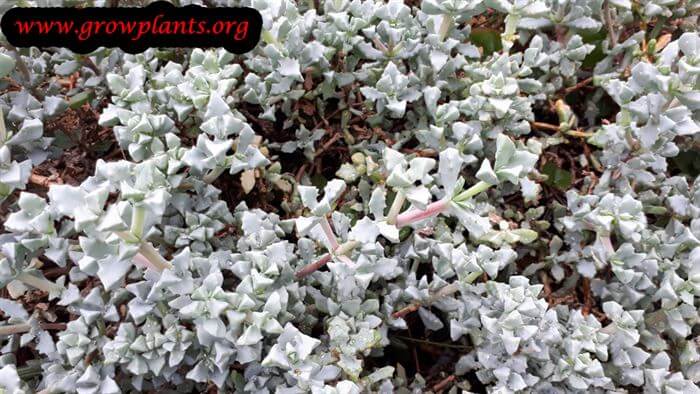
Overview: Oscularia deltoides (deltoid-leaved dewplant) is a low, spreading succulent subshrub only 5-20 cm tall that trails and mats as wide as it is given. It is an evergreen perennial grown as a flowering groundcover for its blue-grey triangular leaves and pink-purple blooms.
Quick Specifications
| Specification | Attribute |
|---|---|
| Plant Type / Life Cycle | Perennial (evergreen succulent) |
| Foliage Type | Evergreen |
| Mature Size | 5-20 cm (2-8 in) tall, spreading widely |
| Growth Rate | Moderate to fast |
| Root System | Shallow, fibrous (succulent) |
| Hardiness | USDA zone 8+ |
Growth Form & Structure
- Height & Spread: 5-20 cm (2-8 in) tall, spreading indefinitely; good in pots and hanging containers.
- Growth Habit & Form: Trailing, mat-forming succulent groundcover with reddish stems.
- Lifespan & Maturity: Long-lived; fast to spread and easily renewed from cuttings.
Anatomy & Physical Features
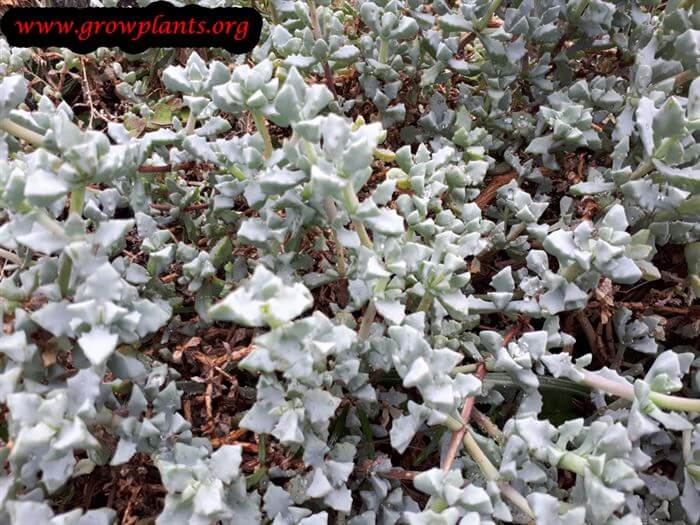
- Leaves & Foliage: Fleshy grey-green three-sided (deltoid) leaves.
- Flower Characteristics: Small round pink-to-purple daisy-like flowers (full detail in the Bloom guide).
Primary Uses & Landscape Value
- Functional & Ornamental Roles: Flowering groundcover, rockery and container / hanging-basket succulent; can be invasive where it spreads freely.
Care Guide: Planting, Soil & Watering
Overview: Oscularia deltoides is a fleshy-leaved succulent groundcover that thrives in sun and sandy, sharply draining soil. It needs little water and spreads readily, so give it room and let the soil dry between waterings.
Quick Care Requirements
| Requirement | Ideal Condition |
|---|---|
| Planting Season | Spring–summer in zones 8–10a; spring–autumn in zone 10b–11; year-round in zone 12+ |
| Growth Rate | Moderate to Fast |
| Soil Type | Sandy, gritty, well-draining |
| Water Need | Low – let the soil dry between waterings |
Planting & Establishment
- Best Planting Season: Plant in the warm season – spring onward in cooler zones, and effectively year-round in frost-free tropical climates.
- How to Plant:
- Hole Preparation: Dig a shallow hole just a little larger than the root ball; the roots are shallow and spread sideways as the plant carpets the ground.
- Soil Amendments: Keep the mix lean and gritty – add sand or perlite for drainage rather than rich organic matter.
- Planting Depth: Set the plant at soil level and do not bury the fleshy stems, which rot if kept buried and damp.
- Growth Speed & Expectations: Growth is moderate to fast and spreading; it fills in quickly as a groundcover, so allow space or trim to control it.
Soil, Watering & Drainage Care
- Soil Mix & Drainage Needs: Use a sandy or gritty, fast-draining medium; in containers sandy soil, a potting mix, or peat with added perlite all work, as long as it drains freely and is not kept soggy.
- Watering Schedule & Technique:
- Young / Newly Planted: Water lightly to help it establish, keeping the soil just barely moist rather than wet.
- Established: Water infrequently and deeply, letting the soil dry out well between waterings.
- Seasonal Adjustments: Give minimal water in winter and a little more during summer heat.
Climate, Light & Hardiness
Oscularia deltoides is a South African succulent subshrub grown as a groundcover across subtropical, Mediterranean, desert, tropical, and temperate climates in full sun to half shade. It is relatively cold-hardy for a succulent groundcover, tolerating occasional light frost once established.
Quick Climate Specifications
| Climate Zones | Subtropical, Mediterranean, Desert, Tropical, Temperate |
|---|---|
| USDA Hardiness Zones | 8+ |
| Approx. Survival Minimum | Zone 8 corresponds to a typical average minimum extreme of roughly −12 to −7°C (10–20°F) |
| Frost Tolerance | Low to Moderate |
| Light Conditions | Full Sun / Half Shade |
Sunlight & Light Exposure
Optimal Light Setup
Full sun gives the densest mat and best flowering; half shade is tolerated with looser, less floriferous growth.
Shade & Heat Management
Handles full desert and Mediterranean summer sun and heat well once established.
Best Exposure / Orientation
Open, unshaded slopes or borders suit its spreading groundcover habit.
Temperature Extremes & Hardiness
USDA Hardiness & Regional Limits
Hardy outdoors in USDA zone 8 and warmer per the site data - relatively cold-tolerant for a succulent groundcover of this type, consistent with related South African 'ice plant' relatives that can handle occasional light frost.
Cold Damage & Winter Protection
Foliage may show damage in a hard freeze; sharply-draining, sandy soil reduces the risk of cold, wet root rot in winter.
Frost Sensitivity
Some tolerance of brief light frost once established, but sustained hard freezing is likely to kill it.
Wind, Humidity & Microclimate
Humidity Preferences
Adapts to both the humid conditions of subtropical/tropical climates and the drier air of desert and Mediterranean regions.
Dry-Air Tolerance
High, as a drought-tolerant succulent.
Wind Tolerance
Generally good, given its low, spreading, ground-hugging habit.
Rainfall & Seasonal Moisture
Adapted to seasonally dry conditions; excess moisture, especially in cold weather, is more of a risk than drought.
Microclimate Recommendations
Well suited to sandy banks, rock gardens, or other sharply-draining sites; the site notes it can be invasive/spreading, so give it room accordingly.
Growing in Pots, Balconies & Indoors
Oscularia deltoides (Deltoid-leaved dewplant) is a low, fast-spreading succulent with grey-green triangular leaves and pink-to-purple flowers. The grower does not list it as an indoor houseplant – it wants full sun to half shade – but he gives detailed pot instructions and it makes an excellent trailing container and balcony plant; a pot also curbs its invasive spread.
Quick Details
- Container Size: A pot about 50% larger than the root ball, or your chosen display size; wide rather than deep for this spreading succulent
- Indoor Suitability: Not a deep-room houseplant; only a bright, sunny sill keeps it compact and flowering
- Best Spot: Full sun to half shade
- Soil & Drainage: Sandy soil, or potting mix or peat with perlite – free-draining; strong drainage holes
- Watering in Pots: Small amounts; take care not to overwater – let it dry before watering again
Indoors & On the Windowsill
- Houseplant limits: The grower marks it as not a true houseplant – indoors the light is too weak and the trailing stems stretch and go pale.
- Windowsill growing: On the sunniest sill it grows well as a trailing succulent; give it direct sun and trim to keep it tidy, as it grows fast and wide.
On a Balcony or Patio
- Light & spread: A lovely sunny-balcony trailer spilling over the rim of a pot or railing box. Reflected wall heat dries pots quickly, which suits its drought tolerance – just avoid a soggy pot.
- Keep it contained: Since it is invasive in open ground, a pot or raised planter is the neatest way to grow it; shear back after flowering to control spread.
Choosing the Pot, Soil & Long-Term Care
- Pot & drainage: A pot about 50% bigger than the root ball with strong holes; skip a standing water saucer. Terracotta breathes and dries fast, which suits it.
- Potting mix: The grower’s choice of sandy soil, ordinary potting mix, or peat with perlite all work, as long as it drains freely.
- Feeding: Light feeding only – a dilute feed once or twice in the growing season, since pots leach nutrients.
- Repotting: Fast-growing: switch the soil every few years and cut back the roots. If the root ball gets too big, prune both roots and top growth before replanting.
Fertilizing & Feeding
A light feeder. This spreading, triangular-leaved dewplant thrives in lean, sandy, fast-draining soil and grows readily on its own; a little feeding during its long spring-to-autumn growth and bloom is enough, and none is needed once growth slows in cooler weather.
Quick Fertilizing Specs
| Feeding Level | Light feeder |
|---|---|
| Main Nutrient Priority | A diluted, low-nitrogen feed; this vigorous ground cover spreads well without extra nitrogen |
| Best Feeding Period | The warm active growing season, spring through autumn |
| Organic Options | A thin topdressing of compost worked into the sandy mix at planting |
| Reduce/Stop Feeding | Stop feeding as growth slows in cool weather |
| Micronutrients | Usually adequate from a complete fertilizer; correct only a diagnosed issue |
| Soil pH | Tolerates a wide range in well-drained sandy soil |
Feeding by Growth Stage
Warm-season spreading growth
Support this trailing ground cover’s spread and its long spring-to-autumn bloom of purple-pink flowers without pushing it to become even more vigorous.
| Nutrient direction | A diluted, low-nitrogen complete fertilizer; this plant already spreads readily and has a known tendency to naturalize, so extra nitrogen is rarely useful. |
|---|---|
| Timing | Through the warm active growing season while the mat is spreading and flowering. |
| Frequency | Feed sparingly; a light feeding once new growth is established is usually enough for a full season. |
| Fertilizer types | A diluted, low-nitrogen complete fertilizer, A cactus and succulent fertilizer used at reduced strength, A light topdressing of compost in sandy soil |
| Precautions | Keep feeding light and apply to moist soil; this vigorous ground cover can spread beyond its bed in rich, over-fed conditions, and salt can build up quickly in fast-draining sandy soil. |
Cool-season slowdown
Let the planting rest through the cooler part of the year without pushing growth it cannot use.
| Nutrient direction | None – withhold fertilizer while growth has slowed or stopped in cool weather. |
|---|---|
| Timing | Cool weather and any period when the planting is clearly not actively spreading or flowering. |
| Frequency | No feeding at this stage; resume only once warm-season growth returns. |
| Fertilizer types | No feeding at this stage; do not fertilize until active growth resumes. |
| Precautions | Do not fertilize a resting planting; feeding now only encourages unwanted spread and risks salt injury in sandy soil that is watered sparingly. |
Nutrient Deficiency Signs & Corrections
The gray-green triangular leaves fade further and the mat spreads and flowers weakly over a full season.
| Possible causes | very low available nitrogen in lean, sandy soil, nitrogen leaching quickly from fast-draining sandy soil, a planting never fed since establishment |
|---|---|
| Appears first on | older growth throughout the mat |
| What to check | when the planting was last fed, soil texture and drainage, whether pale color is simply this plant’s normal gray-green cast |
| Possible correction | During the warm season apply a single diluted, low-nitrogen feeding to moist soil; avoid overcorrecting an already vigorous spreader. |
Leaf tips brown or the fleshy foliage looks scorched despite regular light watering.
| Possible causes | fertilizer-salt buildup in fast-draining sandy soil, feeding at too high a strength for a lean-feeding succulent ground cover, feeding onto dry soil |
|---|---|
| Appears first on | leaf tips and outer mat edges |
| What to check | how strong and how often recent feeding has been, whether fertilizer was applied to dry soil, any visible salt crust on the sandy surface |
| Possible correction | Ease off feeding, water thoroughly to flush accumulated salts through the fast-draining soil, then return to only light warm-season feeding. |
New growth at the spreading tips turns pale or yellow between the veins while older leaves stay greener.
| Possible causes | iron tied up by overly wet or poorly drained soil, high soil pH reducing iron availability, root stress from soggy conditions limiting uptake |
|---|---|
| Appears first on | new growth at the spreading tips |
| What to check | drainage and how long the soil stays wet, soil pH, root condition for rot from overwatering |
| Possible correction | Improve drainage and let the soil dry properly between waterings; correct pH if high and, only if a true deficiency is confirmed, apply a chelated iron product per its label. |
Pruning, Training & Seasonal Maintenance
Oscularia deltoides is a fast-spreading succulent ground cover that tolerates fairly free pruning and benefits from it: like related trailing “ice plant” family succulents, it tends to get woody and sparse in the centre after a couple of seasons, and a cutback after its main bloom keeps it dense rather than straggly. Because it spreads readily (it is noted as able to become invasive if unchecked), pruning here is as much about containing its spread as about shaping it.
Quick Pruning & Maintenance Specs
| Pruning Tolerance | Moderate to High |
| Primary Pruning Window | After the main spring–autumn bloom, ideally in autumn |
| Typical Frequency | 1–2 times per year, plus edge-trimming as needed |
| Main Objective | Deadhead, rejuvenate a woody/sparse centre, and contain spread |
| Young Plant Priority | Pinch trailing stem tips to encourage a denser mat |
| Mature Plant Priority | Cut back hard where the mat has gone bare/woody; trim the spreading edge to keep it in bounds |
| Best Tool Type | Precision snips or bypass secateurs |
| Avoid Heavy Pruning During | Peak bloom (spring–summer), so as not to lose the current flower show |
Pruning by Plant Age & Size
Newly Established
Minimal – only remove damaged growth while it establishes.
Young / Formative
Pinch trailing tips a few times in the first season to encourage branching and a denser mat rather than a few long runners.
Mature / Established
An annual (or every-other-year) cutback after bloom – shearing the mat back by roughly a third to half – refreshes growth once the centre starts to go bare and woody, which this species does readily given how fast it spreads.
Seasonal Pruning Schedule
Post-Flowering
Objective: deadhead and rejuvenate after the main bloom, best timed in autumn. Remove: spent pink-to-purple flowers and, where the mat has become woody/bare, cut those sections back hard to encourage fresh basal growth. Do not remove: young, actively spreading growth at the mat’s leading edge unless it is growing somewhere unwanted. Expected response: dense new growth from the cut sections within the next growing season. Flowering impact: minimal – done after bloom, it does not cost the current season’s flowers, and a refreshed mat flowers better the following year.
Structural Pruning & Training
No formal framework; management is about density (cutting back bare, woody sections to force fresh basal shoots) and containment (trimming the spreading edge before it roots into unwanted areas).
Special Growth to Remove
- Spent flowers – deadhead for tidiness and to redirect energy to vegetative growth.
- Runners/trailing stems that have rooted outside the intended area – cut and lift, given this species’ noted tendency to spread aggressively.
Container & Small-Space Pruning
In a container, trim trailing stems to control spill-over and, at repotting, it is fine to prune both the roots and the top growth if the plant has outgrown its pot – this species tolerates that combined cutback well.
Tools
Precision snips for deadheading and tip-pinching; bypass secateurs for the tougher, woodier base stems during a rejuvenation cutback.
Tool Hygiene & Disease Risk
Routine – no specific pathogen risk noted; clean, sharp tools are sufficient.
Cut Placement & Technique
Cut back into the woody base just above a node with visible growth buds, rather than into completely bare, leafless stem that may not resprout.
Heavy Pruning & Rejuvenation
Tolerated and often useful – cutting a bare, leggy mat back hard after bloom is the main way to keep this fast-growing succulent from thinning out; expect vigorous regrowth given its fast growth rate.
Post-Pruning Care
Water lightly as usual; watch cut sections for slug/snail damage on the tender new regrowth, a pest already noted for this species.
Common Pruning Mistakes
- Never cutting back, letting the centre of the mat go permanently bare and woody.
- Letting spreading stems root unchecked into neighbouring beds or lawn, given this plant’s invasive tendency.
- Hard-pruning during peak bloom and losing the current flower display.
When NOT to Prune
Avoid a hard rejuvenation cutback during peak spring–summer bloom; light deadheading is fine at any time.
Recommended Tools (by task)
- Deadheading / tip-pinching: precision_snips.
- Rejuvenation cutback of woody base growth: bypass_secateurs.
Propagation Guide
Oscularia deltoides is easiest to start from cuttings — stem or leaf sections rooted in soil, or a low branch layered into the ground — rather than from seed; the site notes that although grafting or vegetative propagation isn’t strictly required, cuttings are the more convenient route. Propagation is easy.
Quick Propagation Specs
| Best Propagation Method | Stem cuttings |
| Alternative Methods | Leaf cuttings; ground layering; seed |
| Propagation Difficulty | Easy |
| Seed True-to-Type | Yes (species) |
| Vegetative True-to-Type | Yes |
| Best Propagation Season | Best in spring, though possible year-round in tropical climates |
| Cutting Rooting Time | Typically a few weeks in warm conditions |
| Germination Temperature | Warm, roughly 20–25°C (68–77°F) |
| Seed Sowing Depth | Surface-sow; seed is fine |
Growing from Seed
Germination Conditions
Use a well-drained, sandy mix kept only lightly moist and warm.
Stem Cuttings
Best Timing
Best done in spring, though possible year-round in tropical climates.
Cutting Preparation
Cut sections of stem for propagation.
Rooting Setup
Cuttings can be rooted first in water, but shouldn’t be left there too long — if roots haven’t formed within a reasonable time, move the cutting to soil instead. Whether rooted in water first or set directly into soil, use a well-drained mix and keep it only lightly moist; this drought-tolerant succulent does not want to sit wet.
Rooting Hormone
Not necessary; cuttings of this succulent root readily on their own.
Rooting Time
Typically a few weeks under warm conditions.
Leaf & Root Cuttings
Individual leaves can also be rooted directly in soil in the same way as stem cuttings: keep the well-drained medium lightly moist and avoid overwatering while the leaf develops roots and, eventually, a small new plantlet.
Air & Ground Layering
A low, flexible branch can be bent down to the ground, covered with soil, and kept just lightly moist until it roots at the point of contact; once rooted, the new section can be severed from the parent plant and grown on independently.
Bloom & Flower Guide
Quick Details
- Bloom Season: From spring through autumn in warm conditions
- Time to First Bloom: Quick – this spreading succulent flowers within its first season once established
- Flower Appearance: Round, daisy-like flowers in pink to purple, lightly fragrant, set over grey-green triangular leaves
- Edibility: Grown for its flowers and colourful foliage as ground cover – the flowers are not eaten
Detailed Blooming Overview
The dewplant is grown both for its neat grey-green foliage and for its many-petalled, round flowers in pink to purple, which carry a light almond scent. Like other mat-forming succulents of its family, the flowers open in bright sunshine and close in dull weather and toward evening, so it looks its best on warm, sunny days.
Flower Characteristics
- Round, many-petalled, daisy-like flowers in pink to purple.
- Lightly fragrant, opening in sun and closing in dull light.
Bloom Care & Thinning
- Sun for flowers: Full sun is essential for a good show; in shade the plant stays leafy and shy to flower.
- Lean and dry: Free-draining soil and sparing water suit it best; wet, rich ground favours foliage over blooms.
- Trim after flushes: A light shear keeps the mat compact and encourages more flowering shoots.
Pests, Diseases & Troubleshooting
Overview: Oscularia is a tough, mat-forming Aizoaceae succulent that is largely pest-free; when trouble does come it is the usual succulent story – cottony mealybugs and scale sheltering in the dense grey foliage, the odd aphid on the honey-scented flowers, and above all root rot when the free-draining soil it demands is kept too wet. Lean, gritty, sunny culture keeps it clean.
Quick Troubleshooting Overview
| Issue / Pest | Main Symptom | Primary Solution |
|---|---|---|
| Mealybugs | White cottony tufts in leaf axils; honeydew | Alcohol swab, insecticidal soap/neem |
| Aphids | Clusters on flower stems; sticky honeydew | Water jet, soap spray |
| Scale | Brown bumps on stems; sticky residue | Scrape off, horticultural oil |
| Snails & slugs | Chewed tender growth; slime trails | Hand-pick, grit barriers, iron-phosphate bait |
| Root rot | Soft, mushy, blackening stems and roots | Cut back watering; gritty mix; re-root cuttings |
| Etiolation | Stretched, pale, floppy stems | Move to full sun; more light |
Common Pests & Management
- Mealybugs (Pseudococcus / Planococcus spp.):
- Symptoms: White cottony tufts wedged into leaf axils, stem joints and among the crowded triangular leaves, with sticky honeydew and sooty mould; root mealybugs may hide as white powder in the root ball.
- Prevention & Control: Dab clusters with a cotton bud of dilute rubbing alcohol, or rinse and spray with insecticidal soap or neem oil, reaching into the tight foliage. Inspect roots at repotting and drench if needed; avoid overfeeding, which produces the soft growth they favour.
- Aphids (Aphididae):
- Symptoms: Green or black soft-bodied insects massing on the flower stalks and tender tips, leaving sticky honeydew and distorted buds.
- Prevention & Control: Blast off with water and encourage ladybirds and lacewings; use insecticidal soap for stubborn colonies, spraying in the cool of the day to spare the succulent foliage.
- Scale insects (Coccidae / Diaspididae):
- Symptoms: Small, immobile brown or tan bumps along the stems and older leaves, with sticky honeydew from soft scales and general loss of vigour.
- Prevention & Control: Scrape off with a fingernail or soft brush and wipe with horticultural or neem oil to smother the crawlers; repeat every week or two and isolate affected plants.
- Snails & slugs (Helix / Deroceras spp.):
- Symptoms: Ragged holes and notches in the fleshy leaves and stems with tell-tale slime trails, worst on soft new growth at ground level after rain, as noted in the source.
- Prevention & Control: Hand-pick after dark, clear damp hiding places, and ring plants with sharp grit or copper tape; iron-phosphate baits give safe extra control.
Diseases & Fungal Issues
- Root and stem rot (Pythium / Phytophthora / Fusarium spp.):
- Symptoms: Stems and roots turn soft, translucent, then black and mushy from the base, and the mat collapses – the classic and usually fatal result of overwatering or heavy, wet soil, especially in cool weather.
- Treatment & Management: Prevention is the cure: a very gritty, free-draining mineral mix, shallow watering only when the soil has dried, and full sun with airflow. If rot appears, snip clean healthy tips, let them callus, and re-root as fresh cuttings; discard the rotten base.
- Fungal leaf spot (various fungi):
- Symptoms: Occasional dark or sunken spots on leaves in prolonged damp, humid, stagnant conditions – uncommon on this sun-loving succulent.
- Treatment & Management: Improve airflow, keep water off the foliage, and remove affected leaves; correcting the humid conditions is normally enough without fungicide.
Growing Difficulties & Abiotic Problems
- Root rot from overwatering:
- Cause & Symptoms: By far the biggest killer: soggy soil, deep pots that stay wet, or watering in cool weather suffocate the roots and trigger rot.
- Correction Strategy: Use a gritty succulent mix and a pot with good drainage, water sparingly and only when dry, and cut back sharply in cool or dormant periods.
- Etiolation in low light:
- Cause & Symptoms: In too little sun the stems stretch, pale and flop, spacing out the leaves and losing the compact grey cushion and pink flowers.
- Correction Strategy: Grow in the brightest possible spot or full sun; cut back leggy growth and re-root the tips to restart a dense plant.
- Invasive spreading:
- Cause & Symptoms: As the source notes, this vigorous mat-former can root as it sprawls and overrun neighbours or escape its bounds.
- Correction Strategy: Contain it in pots, raised edges or defined beds, and trim back the running stems periodically to keep it in check.
- Sunburn on soft growth:
- Cause & Symptoms: Plants moved abruptly from shade into fierce sun, or lush from overfeeding, can scorch or bleach.
- Correction Strategy: Acclimatise gradually to full sun and keep feeding lean so growth is firm and sun-hardened.
What Helps – Products & Tools
The short list here is rubbing alcohol and insecticidal soap or neem oil for mealybugs, scale and aphids, horticultural oil for scale, iron-phosphate bait or copper/grit barriers for slugs and snails, and – most importantly – a gritty free-draining succulent mix that prevents the root rot which is this plant’s real threat. Apply oils and soaps in the evening to protect the fleshy leaves.