Plant Profile & Key Characteristics
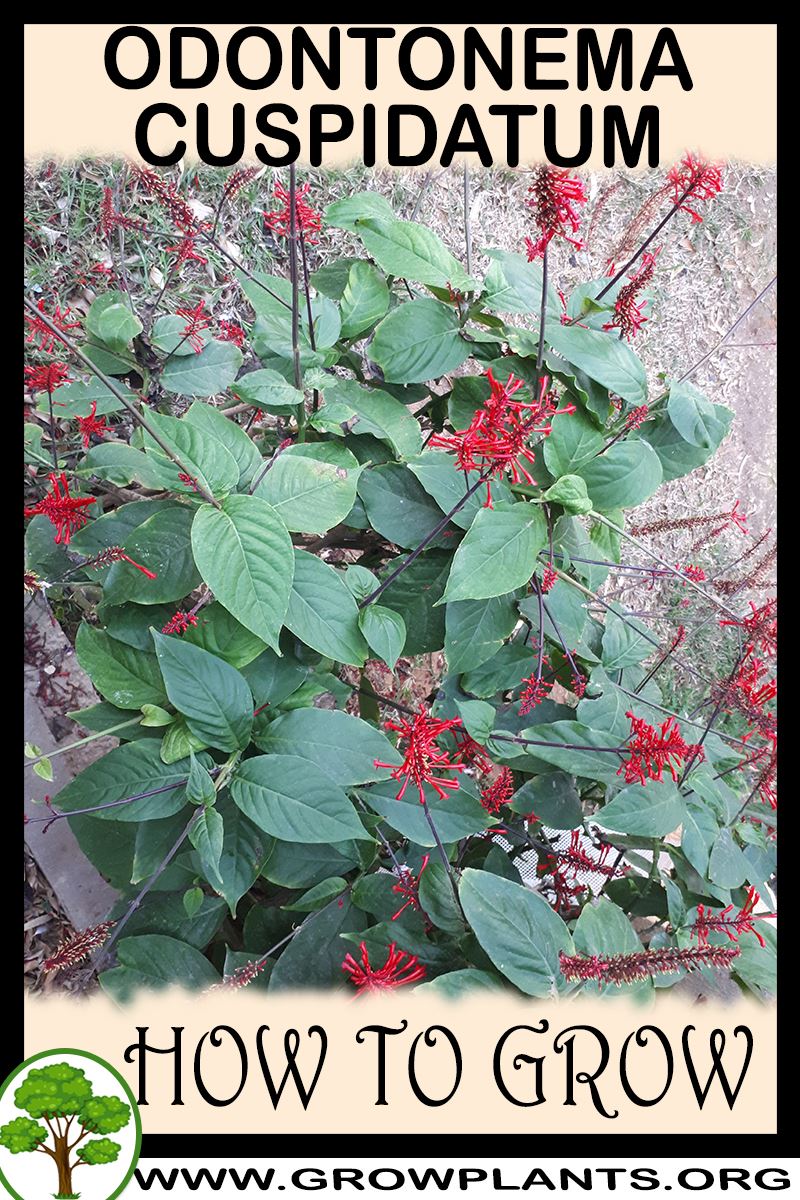
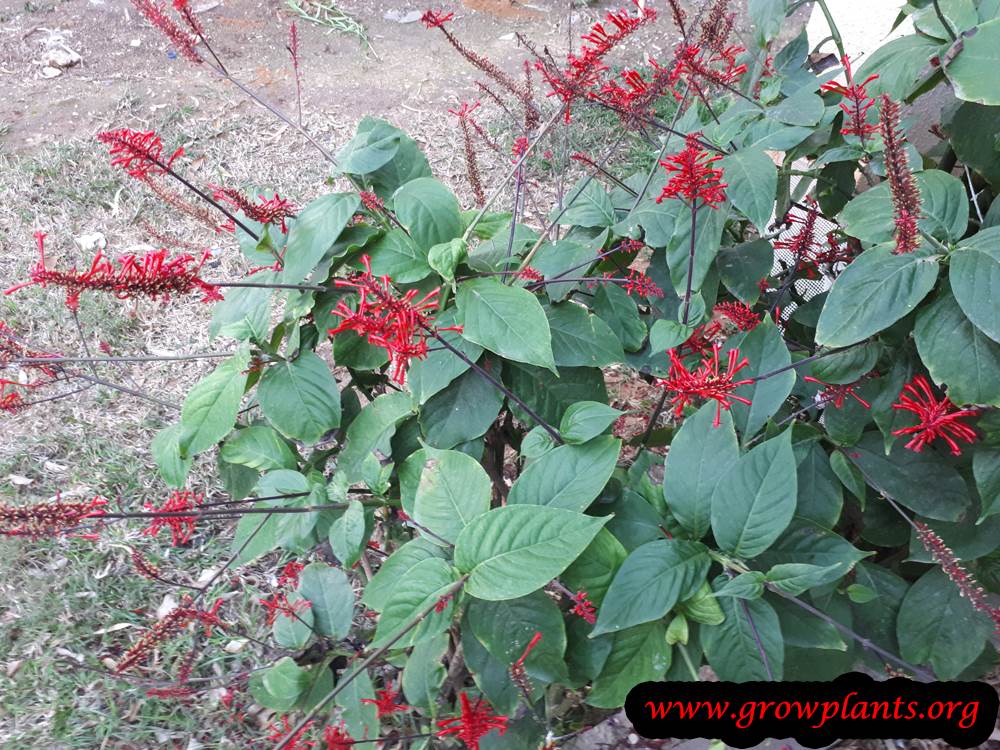
Overview: Odontonema cuspidatum (firespike) is an evergreen flowering shrub reaching about 1-2 m (3-6.5 ft). It is a perennial grown as an ornamental and hedge plant, valued for its showy red flower spikes that attract pollinators, and it is drought tolerant once established.
Quick Specifications
| Specification | Attribute |
|---|---|
| Plant Type / Life Cycle | Perennial |
| Foliage Type | Evergreen (may be deciduous in cold) |
| Mature Size | 1-2 m (3-6.5 ft) tall |
| Growth Rate | Fast to moderate |
| Toxicity | Non-toxic |
| Hardiness | USDA zone 9+ |
Growth Form & Structure
- Height & Spread: 1-2 m (3-6.5 ft) tall in the ground; also grown in large containers.
- Growth Habit & Form: Upright, multi-stemmed evergreen shrub suitable for informal hedging.
- Lifespan & Maturity: Fast-growing perennial that reaches flowering size within a season or two.
Anatomy & Physical Features
- Leaves & Foliage: Elliptic leaves in light to dark green, sometimes variegated green and white.
- Flower Characteristics: Tubular red flowers borne in showy clusters (see the Bloom guide).
Primary Uses & Landscape Value
- Functional & Ornamental Roles: Ornamental flowering shrub, informal hedge and pollinator / hummingbird plant; drought tolerant and can be grown indoors.
Care Guide: Planting, Soil & Watering
Overview: Odontonema is a fast-growing tropical to subtropical shrub that thrives in rich, well-mulched soil with steady moisture, in shade to part shade. It appreciates fertile ground and consistent watering.
Quick Care Requirements
| Requirement | Ideal Condition |
|---|---|
| Planting Season | In spring–summer after frost; year-round in frost-free tropical climates |
| Growth Rate | Fast to moderate |
| Soil Type | Rich, fertile, mulched soil |
| Water Need | Moderate — keep the soil evenly moist, not waterlogged |
Planting & Establishment
- Best Planting Season: Plant in spring to summer once frost has passed; in frost-free tropical climates it can be planted year-round.
- How to Plant:
- Hole Preparation: Dig a hole as deep as and wider than the root ball.
- Soil Amendments: Enrich the soil with compost or organic matter and mulch well after planting.
- Planting Depth: Set the root collar level with the soil surface.
- Growth Speed & Expectations: Fast to moderate — establishes and fills out quickly in warm conditions.
Soil, Watering & Drainage Care
- Soil Mix & Drainage Needs: Rich but free-draining soil topped with mulch retains moisture while preventing sogginess.
- Watering Schedule & Technique:
- Young / Newly Planted: Water regularly to establish.
- Established: Keep the soil evenly moist.
- Seasonal Adjustments: More in summer heat, less in cooler months.
Climate, Light & Hardiness
Odontonema cuspidatum is a shade-loving, drought-tolerant shrub suited to tropical, subtropical, mediterranean, and temperate climates, or grown as a houseplant, hardy in USDA zone 9 and warmer. It grows best in full shade with rich, mulched soil.
Quick Climate Specifications
| Climate Zones | Tropical, subtropical, mediterranean, temperate (or houseplant) |
|---|---|
| USDA Hardiness Zones | 9+ |
| Frost Tolerance | Low |
| Light Conditions | Full shade |
Sunlight & Light Exposure
Optimal Light Setup
Full shade.
Shade & Heat Management
As a shade-adapted species, it doesn't need protection from heat beyond the shade itself; mulch helps retain soil moisture.
Best Exposure / Orientation
A shaded understory position outdoors, or an indoor spot without direct sun.
Temperature Extremes & Hardiness
USDA Hardiness & Regional Limits
Hardy only in zone 9 and warmer - a true warm-climate species not suited to regions with regular freezes.
Cold Damage & Winter Protection
Frost damage is likely; in marginal areas, mulch the root zone and consider container culture that can be moved indoors for winter.
Frost Sensitivity
Low tolerance.
Extreme Heat Tolerance
Its drought tolerance and shade preference help it cope with the heat of tropical and subtropical climates.
Wind, Humidity & Microclimate
Dry-Air Tolerance
Moderate to high, consistent with its drought tolerance.
Rainfall & Seasonal Moisture
Grown with an average amount of water in rich, mulched soil.
Microclimate Recommendations
A shaded, humid understory position, or a bright (but not direct-sun) indoor spot.
Growing in Pots, Balconies & Indoors
Firespike is a shade-tolerant tropical shrub with spikes of red tubular flowers, and the grower confirms it grows well as a houseplant and in containers. Its tolerance of low light makes it one of the easier flowering plants for a bright indoor room.
Quick Details
- Container Size: A medium to large pot, potting on as it grows
- Indoor Suitability: A genuine houseplant – the grower grows it indoors; it also takes shade outdoors
- Best Spot: Bright, indirect light indoors; part to full shade outdoors
- Soil & Drainage: Aerated, organic-rich mix (peat or coir with perlite or vermiculite); must drain freely
- Watering in Pots: Keep evenly moist in growth – it likes steady moisture; reduce when cooler
Indoors & On the Windowsill
- A real houseplant: The grower keeps it indoors – give it bright, indirect light and warm, humid air, and it will flower even away from a hot window.
- Care indoors: Keep the mix evenly moist, feed in growth, and pinch or prune to keep it bushy; it tolerates the lower light of a room better than most flowering shrubs.
- Overwintering: It is frost-tender, so where winters are cold keep it as an indoor plant year-round or bring it in before the cold.
On a Balcony or Patio
- Light & shelter: Outdoors it prefers part to full shade – a bright but not baking balcony corner; shelter it from strong wind and midday sun.
- Practicalities: Pots dry faster outside, so check moisture often; move it back indoors before cold nights.
Choosing the Pot, Soil & Long-Term Care
- Pot & drainage: A pot with strong drainage holes and no standing-water saucer, to avoid root rot.
- Potting mix: A rich, well-aerated organic mix – peat or coir with perlite or vermiculite.
- Feeding: Feed through the growing season, as potted shrubs leach nutrients quickly.
- Repotting & pruning: Pot on every couple of years and prune after flowering to keep it compact.
Fertilizing & Feeding
A fast-to-medium growing flowering shrub used for hedging and pollinator gardens; it responds well to balanced, moderate feeding in rich soil rather than any high-phosphorus bloom booster.
Quick Fertilizing Specs
| Feeding Level | Moderate feeder |
|---|---|
| Main Nutrient Priority | Balanced feeding to support foliage, hedge density, and the red tubular flower clusters |
| Best Feeding Period | Spring into the main growing and bloom season |
| Organic Options | Rich soil amended with compost and maintained with a mulch layer |
| Reduce/Stop Feeding | Reduce feeding as growth and bloom slow going into the cooler part of the year |
| Soil pH | Prefers rich, well-amended soil rather than lean or poor ground |
Feeding by Growth Stage
Spring growth and hedge fill-in
Support fresh foliage growth and denser branching, especially where grown as a hedge.
| Nutrient direction | A balanced, complete fertilizer worked into rich soil supports vigorous new growth and fuller branching. |
|---|---|
| Timing | In spring as new growth begins. |
| Frequency | A seasonal feeding as growth resumes is generally enough for this fast to medium grower. |
| Fertilizer types | A balanced, complete shrub fertilizer worked into the root zone, Compost and mulch refreshed around the planting |
| Precautions | Keep fertilizer off the stems and work it into the surrounding soil rather than piling it against the base. |
Flowering through the growing season
Support the red tubular flower clusters that attract pollinators through spring, summer, and autumn.
| Nutrient direction | Continued balanced feeding, rather than a high-phosphorus bloom product, supports steady flowering in this species. |
|---|---|
| Timing | Through the main spring-to-autumn bloom period. |
| Frequency | A light follow-up feeding during the bloom season is usually all this shrub needs beyond its spring application. |
| Fertilizer types | A balanced liquid or granular shrub fertilizer if bloom or foliage looks light, No separate high-phosphorus bloom booster is needed |
| Precautions | Avoid heavy nitrogen feeding late in the season, which can push soft growth at the expense of flowering and hedge density. |
Cooler-season dieback and rest
Let growth slow or die back through the coldest part of the year, particularly toward the cooler end of its hardiness range.
| Nutrient direction | None – withhold fertilizer once growth slows or dies back for the season. |
|---|---|
| Timing | Autumn through winter. |
| Frequency | No feeding at this stage. |
| Fertilizer types | No feeding at this stage; do not fertilize until active growth resumes in spring. |
| Precautions | Fertilizing dying-back or dormant growth wastes nutrients and can encourage tender growth vulnerable to cold, especially near the edge of this shrub’s hardiness range. |
Nutrient Deficiency Signs & Corrections
Pale green, sparse foliage and thinner hedge density than expected.
| Possible causes | insufficient nitrogen in the root zone, competition from nearby hedge or bed plants, compacted or poor soil limiting root uptake |
|---|---|
| Appears first on | older, interior leaves |
| What to check | overall foliage color and hedge density, soil richness and compaction, competing vegetation nearby |
| Possible correction | Apply a balanced shrub fertilizer and improve soil richness with compost. |
Good foliage and hedge fill-in but few of the red tubular flower clusters.
| Possible causes | excess nitrogen favoring leafy growth over flowering, too little light, since this species can tolerate shade but flowers less there, stress from recent hard pruning removing flowering wood |
|---|---|
| Appears first on | overall flower count rather than a specific leaf symptom |
| What to check | recent feeding rate, light exposure of the planting, recent pruning history |
| Possible correction | Favor balanced, moderate feeding over heavy nitrogen and improve light exposure where practical; time any hard pruning away from the bloom season. |
Yellowing between the veins of new leaves while the veins themselves stay green.
| Possible causes | high soil pH limiting iron availability, waterlogged or compacted soil restricting root uptake, naturally low soil iron |
|---|---|
| Appears first on | newest leaves at the growing tips |
| What to check | soil pH, drainage and compaction, whether older leaves remain a normal color |
| Possible correction | Correct soil pH and drainage where practical, and apply a chelated iron product per its label if chlorosis persists. |
Pruning, Training & Seasonal Maintenance
Firespike is a soft-to-semi-woody evergreen shrub (1–2m) grown for its red tubular flower spikes and often used as an informal or clipped hedge. It tolerates hard pruning very well, but timing matters: the flowers open in autumn on growth produced earlier that same season, so the correct main pruning window is late winter to early spring – after frost risk passes but before new growth starts – not autumn. A late-winter hard cutback forces the vigorous new shoots that will carry that year’s autumn bloom, while cutting in autumn itself would remove flower buds as they form.
Quick Pruning & Maintenance Specs
| Pruning Tolerance | High – recovers vigorously from a hard cutback |
| Primary Pruning Window | Late winter–early spring, after frost risk passes and before new growth starts |
| Secondary Maintenance Window | Light deadheading after autumn bloom finishes; hedge-shaping touch-ups through the growing season if clipped |
| Typical Frequency | One hard annual cutback, plus periodic shaping if grown as a hedge |
| Main Objective | Strong new growth to carry the autumn flower spikes, and control of size/legginess |
| Young Plant Priority | Pinch repeatedly to build multiple branching stems from the base |
| Mature Plant Priority | Annual late-winter cutback to renew flowering wood; periodic removal of old, bare-based canes |
| Best Tool Type | Bypass secateurs for informal specimens; hedge shears where kept clipped as a hedge |
| Avoid Heavy Pruning During | Autumn, while flower buds are developing and opening – and during hard frost |
Pruning by Plant Age & Size
Newly Established
Pinch tips to build branching low on the plant; avoid a hard cutback in the first season while roots are still establishing.
Young / Formative
No leader-type framework applies – this is an open, multi-stem shrub. Pinch several times through the first year or two to build a full base, since it can otherwise grow leggy.
Mature / Established
Give it an annual hard cutback in late winter (commonly by a third to half, or harder if renewing an overgrown plant) to force the flush of new growth that will flower that autumn. If kept as a hedge, add shaping cuts through spring and summer growth.
Seasonal Pruning Schedule
Pre-Growth/Early-Spring
The main structural cutback: prune hard once frost danger has passed and before new growth begins. This is what drives the coming season’s bloom – it does not delay or reduce flowering, since the flowers form on wood that hasn’t grown yet.
Ongoing Sanitary
Deadhead spent flower spikes as autumn bloom fades, and clean up any frost-nipped tips in early spring right before the main cutback.
Flowering & Fruiting Wood
Firespike flowers on current-season growth: stems that elongate through spring and summer produce the terminal red spikes that open in autumn. This means a late-winter/early-spring cutback removes only old, spent wood and has no negative effect on bloom – it typically increases the flower count by forcing more new flowering shoots. Pruning in autumn, by contrast, removes the developing flower buds directly and should be avoided.
Structural Pruning & Training
- Branch selection: open, multi-stem form – no central leader to maintain.
- Canopy density: thinning some interior stems at the annual cutback improves light and airflow, which helps in the full-shade conditions this species favours and can reduce pest buildup.
- Renewal pruning: remove the oldest, most bare-based woody canes periodically at ground level to keep the shrub filled with vigorous, floriferous younger growth.
Special Growth to Remove
- Spent flower spikes, deadheaded as bloom finishes.
- Old, bare-based woody canes, removed at renewal time.
- Frost-damaged tips, cleaned up in early spring.
Container & Small-Space Pruning
Also grown as a houseplant/container specimen. Indoors or in lower light, pinch a little more frequently to prevent stretching. The same late-winter hard cutback applies if the plant is moved outdoors seasonally or grown in a bright conservatory-type setting; frost timing is obviously not a factor for indoor specimens.
Tools
- Bypass secateurs – the main cutback and renewal cane removal.
- Hedge shears – only where the plant is maintained as a clipped hedge, matching its documented use as a hedge plant.
- Precision snips – deadheading spent flower spikes.
Tool Hygiene & Disease Risk
Routine – no transmissible disease is documented; clean, sharp tools are sufficient. The facts note aphids and spidermites as pests, so avoid moving straight from heavily infested growth to healthy plants without a quick wipe-down.
Cut Placement & Technique
This species takes heading cuts well, unlike many woody shrubs – cut stems back to just above a healthy node or bud. For hedged specimens, shape to a slightly informal, rounded line rather than a hard flat face, which suits its natural arching habit better.
Heavy Pruning & Rejuvenation
Tolerated well. An overgrown or leggy plant can be cut back hard – even down to 15–30cm from the ground – in late winter, and given its fast-to-medium growth rate it will typically regrow and still flower that same autumn.
Post-Pruning Care
Water normally after the cutback; skip fertiliser immediately afterward, since the hard prune is already forcing a strong new flush. Watch the tender new regrowth for aphids and spidermites, its documented pests.
Common Pruning Mistakes
- Following a generic “autumn/winter” pruning rule literally and cutting in autumn, which removes the developing flower spikes.
- Only ever shearing the outer hedge line and never doing a renewal cut, leaving a hollow shell of growth over bare, woody stems.
- Skipping the annual hard cutback, which leads to a leggy, sparsely-flowering shrub over time.
When Not to Prune
Avoid pruning during autumn while flower buds are developing or the plant is in bloom, and avoid hard cuts right before or during frost.
Recommended Tools (by task)
- Main late-winter cutback and cane renewal – bypass_secateurs: clean cuts through soft-to-semi-woody stems up to finger thickness.
- Hedge shaping, where grown as a hedge – hedge_shears: matches its documented use as a hedge plant, for the outer shaping cuts only.
- Deadheading spent flower spikes – precision_snips: quick, targeted removal without disturbing nearby buds.
Pruning Troubleshooting
| Problem | Possible Cause | What to Check | Corrective Action |
| Little or no autumn flowering | Pruned during autumn bud development, or too late into the season | Timing of the last hard cut relative to bloom season | Shift the main cutback to late winter/early spring only |
| Leggy shrub, bare and woody at the base | Only lightly tip-trimmed or hedged, with no renewal cutback | Base of the plant for old, unproductive woody canes | Remove the oldest canes at ground level as part of the annual cutback |
| Dense, pest-prone interior with poor flowering there | Unthinned growth in full shade, favouring aphids/spidermites | Interior stems for shade density and pest colonies | Thin some interior stems at the annual cutback to improve light and airflow |
Propagation Guide
Odontonema cuspidatum is best propagated from stem cuttings, which root quickly and reliably and reproduce the plant exactly – important since this species can have variegated green-and-white foliage that seed-grown plants may not reliably reproduce. Difficulty is easy; this shrub family is well known for rooting readily from cuttings.
Quick Propagation Specs
| Best Propagation Method | Softwood or semi-hardwood stem cuttings |
| Alternative Methods | Seed (less commonly used, and may not reproduce variegated foliage) |
| Propagation Difficulty | Easy |
| Seed True-to-Type | Variable – variegated foliage in particular may not come true from seed |
| Vegetative True-to-Type | True-to-type, including variegation |
| Best Propagation Season | Spring to summer, or year-round in tropical climates, matching the site’s planting season |
| Cutting Rooting Time | Typically a few weeks under warm, humid conditions |
| Germination Temperature | Warm, roughly 21–27°C (70–80°F) |
Growing from Seed
Seed is a less common route for this shrub and is not needed to grow it well; when used, sow in warm, consistently moist, rich soil (matching the site’s rich-soil-and-mulch note). Note that seed-grown plants may not reproduce the variegated leaf pattern reliably.
Stem Cuttings
Cutting Type
Softwood or semi-hardwood tip cuttings with several nodes.
Best Timing
Spring to summer during active growth, or year-round in frost-free tropical conditions.
Cutting Preparation
Remove the lower leaves and trim just below a node before inserting.
Rooting Setup
A moist, rich, well-drained mix (in keeping with the site’s rich soil and mulch note) with warmth and high humidity; cuttings will often root in water as well.
Rooting Hormone
Optional – can speed rooting slightly but is not essential, as this shrub roots readily on its own.
Rooting Time
Typically a few weeks under warm, humid conditions.
Bloom & Flower Guide
Quick Details
- Bloom Season: Summer into autumn (and longer in warm climates)
- Flower Appearance: Tall, upright spikes of tubular red flowers
- Edibility: Ornamental only
Detailed Blooming Overview
Commonly called firespike, this shrub throws up bold spikes of glossy red tubular flowers that hold for weeks, often carrying on well past summer in mild areas. Those long red tubes are tailor-made for hummingbirds, and the plant is a well-known magnet for them as well as for butterflies.
Flower Characteristics
- Tubular red flowers packed onto erect terminal spikes.
- Held above the foliage in clusters.
Bloom Care & Thinning
- Pollinators: A strong draw for hummingbirds and butterflies.
- After bloom: Cutting back spent spikes keeps the plant neat and encourages fresh flowering wood.
Pests, Diseases & Troubleshooting
Overview: Firespike is a robust, fast-growing tropical shrub in the Acanthaceae; outdoors in warm climates it is largely trouble-free and a strong hummingbird/butterfly draw, but its soft, lush foliage attracts sap-suckers – whitefly, mealybug, spider mites, aphids and scale – particularly under cover or in dry heat. Grow it vigorously in rich, moist but well-drained soil with good air movement and it shrugs off most problems; frost is its real limit.
Quick Troubleshooting Overview
| Issue / Pest | Main Symptom | Primary Solution |
|---|---|---|
| Whitefly | Clouds of white flies, sticky yellowing leaves | Sticky traps, soap/oil on undersides |
| Spider mites | Fine stippling, webbing in dry heat | Raise humidity, hose foliage, miticidal oil |
| Mealybugs / scale | White fluff or brown bumps on stems and axils | Alcohol swab, horticultural oil |
| Aphids | Curled sticky new tips | Water blast, insecticidal soap, beneficials |
| Root rot | Wilting, yellowing in soggy soil | Improve drainage, ease off watering |
| Frost damage | Blackened top growth after cold | Protect/mulch; usually reshoots from base |
Common Pests & Management
- Whitefly (Trialeurodes vaporariorum / Bemisia tabaci):
- Symptoms: Tiny white flies rise in a cloud when the plant is brushed; leaves yellow, weaken and turn sticky, with sooty mould on the honeydew. A common Acanthaceae pest under cover.
- Prevention & Control: Yellow sticky traps to monitor and reduce adults; spray insecticidal soap or horticultural oil onto the leaf undersides where nymphs feed, repeating to break the cycle. Encourage Encarsia parasitoids and lacewings.
- Two-spotted spider mite (Tetranychus urticae):
- Symptoms: Pale stippling, a bronzed dull cast and fine webbing on the undersides in hot, dry, still air.
- Prevention & Control: Raise humidity and hose the foliage; treat hot spots with insecticidal soap or oil, and use predatory mites under glass.
- Mealybugs (Pseudococcus spp.):
- Symptoms: White cottony masses in leaf axils, stem joints and on shoot tips, with honeydew and sooty mould; stunted, distorted growth.
- Prevention & Control: Spot-treat with an alcohol-dipped swab, then horticultural oil or soap; isolate new plants and inspect axils regularly.
- Aphids (Aphis spp.):
- Symptoms: Green or black colonies on soft new tips and flower spikes; curled, sticky growth.
- Prevention & Control: Knock off with water, encourage ladybirds and hoverflies, and use insecticidal soap for persistent clusters.
- Scale insects (Coccidae / Diaspididae):
- Symptoms: Brown or waxy bumps along stems and leaf veins; yellow flecking and honeydew with soft scale.
- Prevention & Control: Scrape off light infestations; smother with horticultural oil, repeating to catch crawlers.
Diseases & Fungal Issues
- Fungal leaf spot (Cercospora / Colletotrichum spp.):
- Symptoms: Brown or dark angular spots, sometimes with yellow halos, on older leaves in warm humid weather with overhead watering.
- Treatment & Management: Remove affected leaves, water at the base, and improve airflow and spacing. Copper fungicide only if it spreads.
- Root & stem rot (Pythium / Phytophthora / Rhizoctonia):
- Symptoms: Wilting and yellowing despite moist soil, blackened soft stem bases, collapse in waterlogged ground.
- Treatment & Management: Improve drainage, let the soil surface dry between waterings, and avoid heavy wet mulch against the stems. Remove and destroy badly affected plants.
- Powdery mildew (Erysiphe spp.):
- Symptoms: White powdery film on leaves in crowded, shaded, poorly ventilated positions.
- Treatment & Management: Thin and prune for airflow; a potassium-bicarbonate or sulfur spray if needed. Rarely serious on a well-grown plant.
Growing Difficulties & Abiotic Problems
- Frost / cold damage:
- Cause & Symptoms: Frost blackens and collapses the soft top growth; the plant is damaged below about 0–2 °C.
- Correction Strategy: Mulch the roots and protect in cold snaps; in mild climates it typically reshoots vigorously from the base in spring, so cut back frosted growth.
- Wilting from drought or root rot:
- Cause & Symptoms: This thirsty shrub wilts quickly if dry, but also wilts if roots are rotting in soggy soil – check which before acting.
- Correction Strategy: Keep soil evenly moist and well-drained; water deeply in heat, but ensure the site never stays waterlogged.
- Leaf scorch / few flowers:
- Cause & Symptoms: Harsh midday sun scorches leaf margins; heavy shade or excess nitrogen gives lush leaves but few of the red flower spikes.
- Correction Strategy: Give bright light with some afternoon shade in hot climates, and avoid over-feeding with nitrogen to encourage blooming.
What Helps — Products & Tools
A simple kit covers firespike: yellow sticky traps and insecticidal soap or horticultural/neem oil for whitefly, mites, mealybug, aphids and scale; rubbing alcohol for spot-treating; and copper fungicide or a bicarbonate/sulfur spray only if leaf spot or mildew appears. Most control is cultural – airflow, base watering and good drainage.