Plant Profile & Key Characteristics
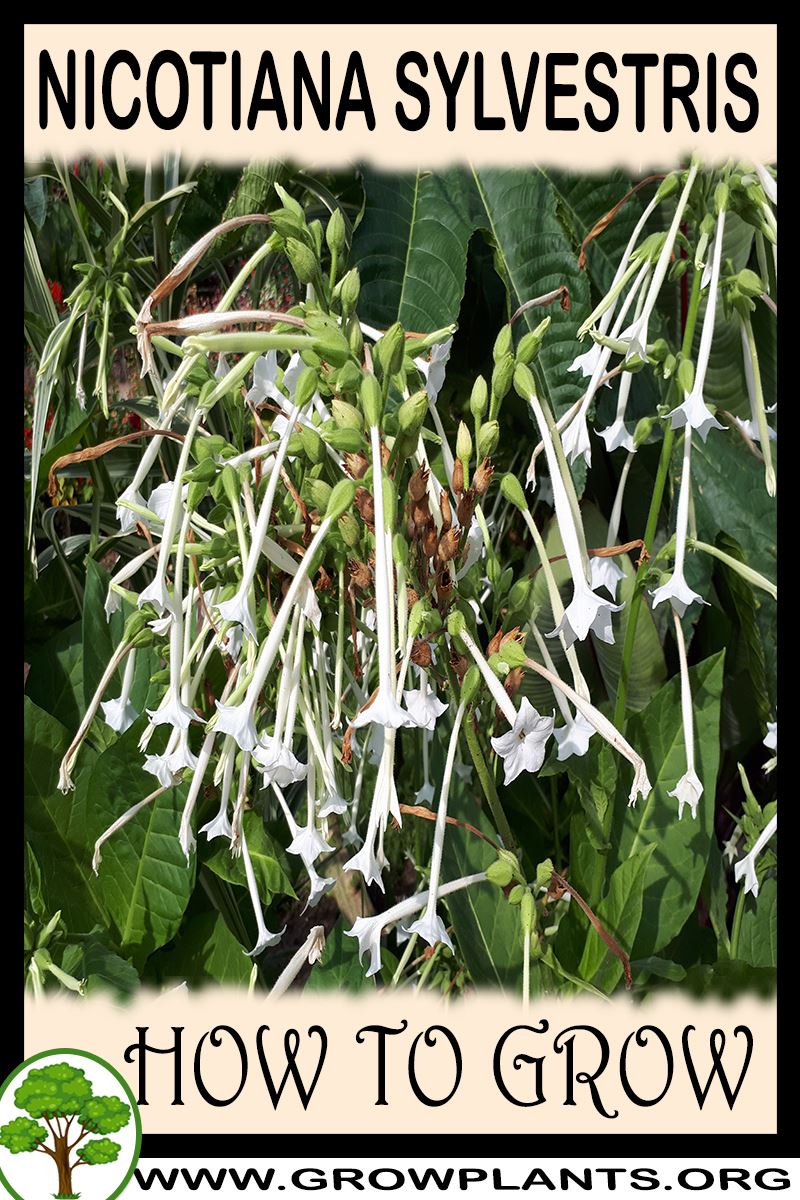
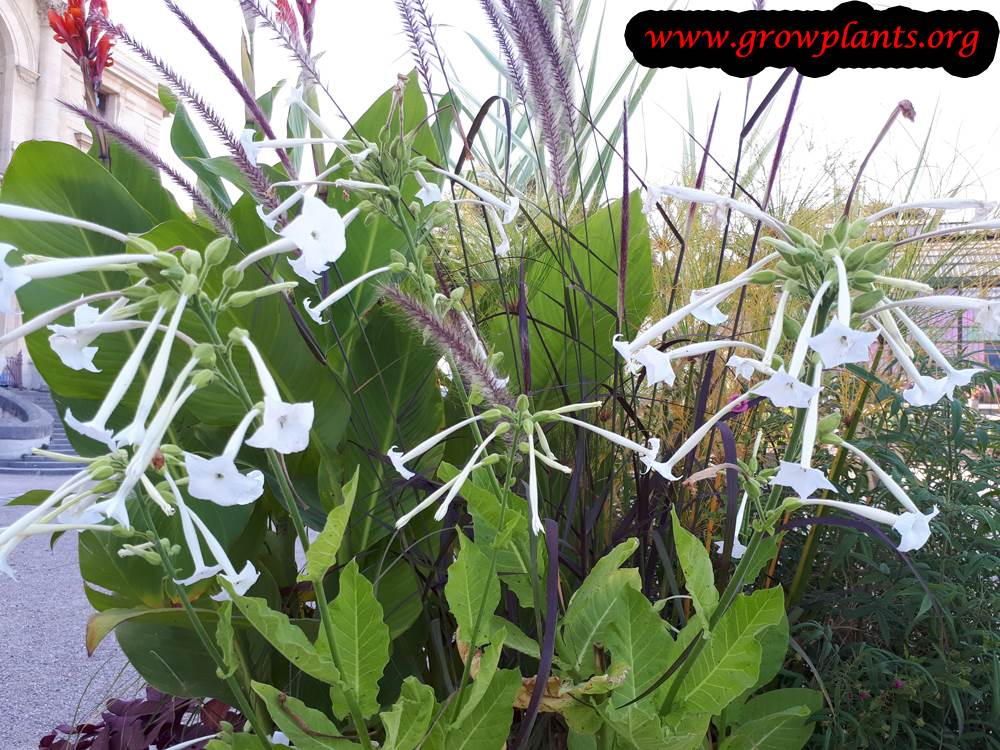
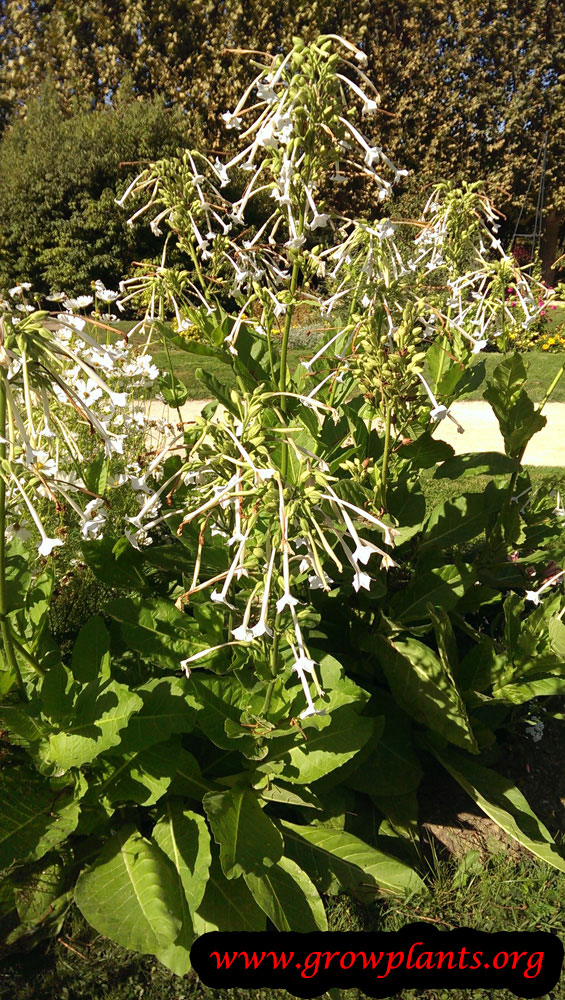
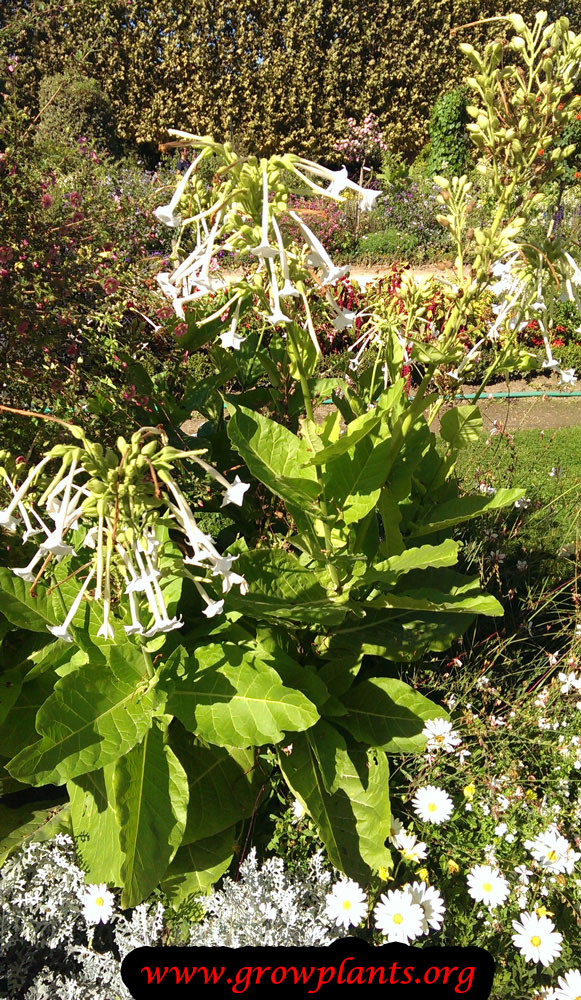
Overview: Nicotiana sylvestris (flowering tobacco) is a tall herbaceous plant 1-1.5 m (3-5 ft) high, grown as a perennial or annual for its fragrant, night-scented white trumpet flowers. It suits tropical, Mediterranean, subtropical and temperate climates.
Quick Specifications
| Specification | Attribute |
|---|---|
| Plant Type / Life Cycle | Perennial (often grown as an annual) |
| Foliage Type | Evergreen (in frost-free climates) |
| Mature Size | 1-1.5 m (3-5 ft) tall |
| Growth Rate | Fast |
| Root System | Taproot |
| Toxicity | Toxic – contains nicotine (Solanaceae); all parts poisonous if eaten |
| Hardiness | USDA zones 10b+ as perennial (4+ as annual) |
Growth Form & Structure
- Height & Spread: Forms a large basal clump of leaves topped by tall flower stems to 1-1.5 m (3-5 ft); also grown in large containers.
- Growth Habit & Form: Upright herbaceous plant with a broad rosette of large leaves and towering flower stalks.
- Lifespan & Maturity: Fast-growing; short-lived perennial usually treated as an annual.
Anatomy & Physical Features
- Leaves & Foliage: Large, elliptic green leaves.
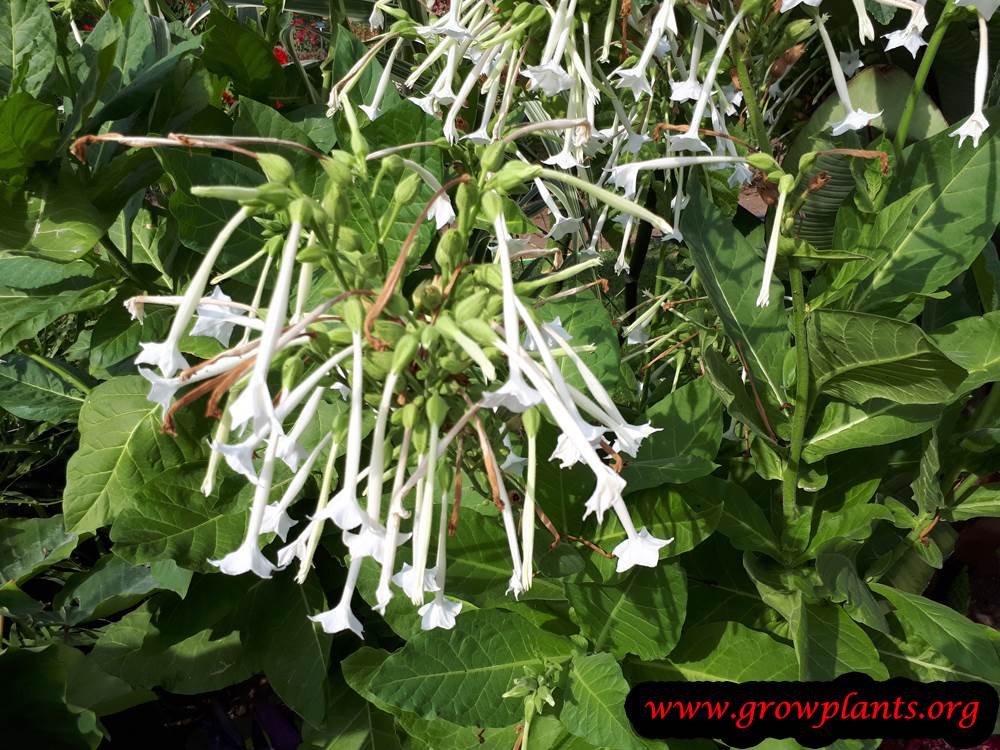
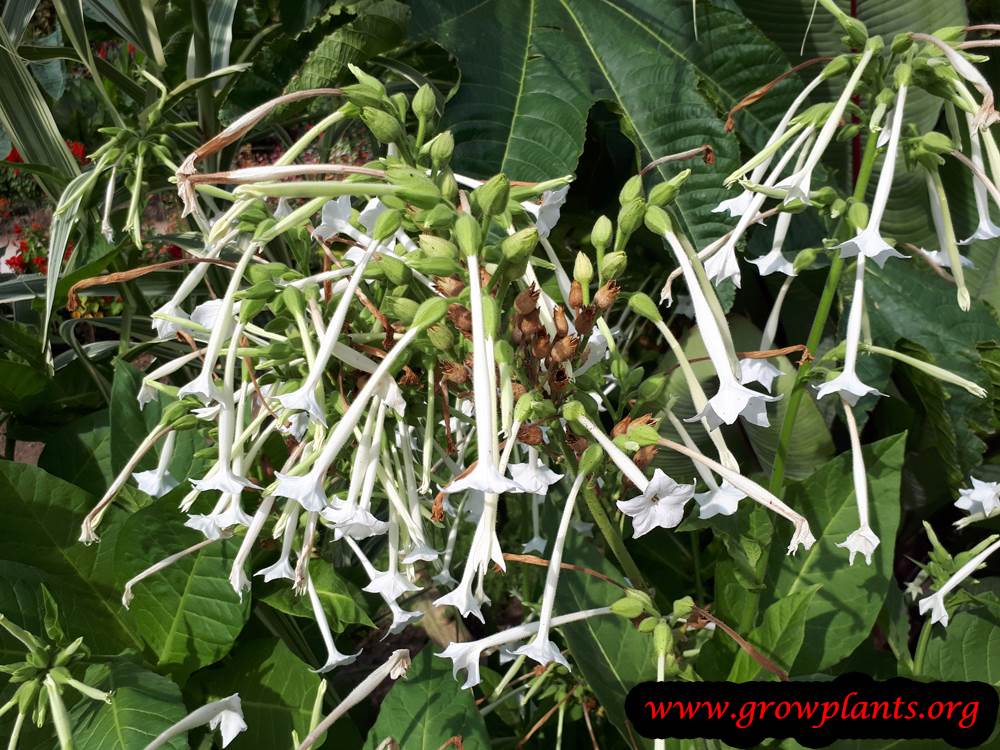
- Flower Characteristics: White, fragrant, long-tubed trumpet flowers in drooping clusters; scent is strongest in the evening.
Primary Uses & Landscape Value
- Functional & Ornamental Roles: Ornamental for borders and evening/night gardens; valued as an architectural, fragrant accent.
Care Guide: Planting, Soil & Watering
Overview: Nicotiana sylvestris (flowering tobacco) is a fast-growing plant that wants fertile, well-drained soil in full sun. It needs only low-to-moderate water and reaches a tall, statuesque size in a single season.
Quick Care Requirements
| Requirement | Ideal Condition |
|---|---|
| Planting Season | Spring (warm season); spring to autumn as a perennial in mild zones |
| Growth Rate | Fast |
| Soil Type | Fertile, well-drained |
| Water Need | Low to moderate |
Planting & Establishment
- Best Planting Season: Plant in spring after the last frost (spring to autumn where grown as a perennial in mild zones).
- How to Plant:
- Hole Preparation: Dig a hole as wide as the root ball.
- Soil Amendments: Work in compost or organic matter for fertility, keeping the soil well-drained.
- Planting Depth: Set the crown at soil level.
- Growth Speed & Expectations: Fast – it grows tall (up to ~1.5 m) in a single season.
Soil, Watering & Drainage Care
- Soil Mix & Drainage Needs: Fertile, well-drained soil; it tolerates moderate dryness.
- Watering Schedule & Technique:
- Young / Newly Planted: Keep moist to establish.
- Established: Water moderately when the top of the soil dries; avoid waterlogging.
- Seasonal Adjustments: More water in heat; less in cool weather.
Climate, Light & Hardiness
Nicotiana sylvestris is a warm-climate ornamental that thrives in the mild conditions of tropical, subtropical, Mediterranean and warm-temperate gardens, growing and flowering best in full sun to very light shade. It is frost-tender: reliably perennial only in frost-free winters (roughly USDA zone 10b and warmer per the site data), and is very widely grown as a warm-season annual in colder regions where winter frost ends its season.
Quick Climate Specifications
| Climate Zones | Tropical, subtropical, Mediterranean, warm-temperate |
| USDA Hardiness Zones | Approximately 10b and warmer as a perennial; grown as a warm-season annual in far colder zones |
| Optimal Temp Range | Approximately 15–25 °C (59–77 °F) |
| Cold Damage Begins | Around light frost, near 0 °C (32 °F) |
| Frost Tolerance | Very Low |
| Light Conditions | Full sun to light/part shade |
Sunlight & Light Exposure
Optimal Light Setup
The site data lists full sun as the optimal condition, and open sun gives the strongest, most floriferous plants. In hot, high-light regions a little afternoon shade helps prevent wilting and leaf scorch.
Shade & Heat Management
Tolerates some shade, though heavy shade reduces flowering and makes stems leggy. The fragrant, trumpet-shaped blooms are most noticeable in the cooler evening hours, so a spot enjoyed after sundown pays off.
Best Exposure / Orientation
A sunny, open position suits it; in the hottest climates a place with afternoon shelter from the fiercest sun keeps the foliage fresh.
Temperature Extremes & Hardiness
USDA Hardiness & Regional Limits
Per the site data it is perennial only in frost-free conditions (about USDA zone 10b and warmer) and is otherwise treated as an annual from about zone 4 upward. Hardiness reflects winter cold survival, not summer preference: the plant enjoys warmth but cannot persist through freezing winters as a permanent plant.
Cold Damage & Frost Sensitivity
Frost is the limiting factor. Foliage and stems are damaged at or just below freezing (near 0 °C / 32 °F), and a hard freeze kills the plant. It is commonly grown as an annual where winters freeze, yet is capable of longer-term growth in frost-free conditions.
Extreme Heat Tolerance
Handles ordinary summer heat well, but prolonged very hot, dry spells can bring on midday wilting; steady moisture and light shade ease heat stress.
Frost-Free Growing Season
As a warm-season plant it needs a frost-free stretch to grow, flower and set seed. Set out only after the last spring frost; the display then continues until the first autumn frost.
Wind, Humidity & Microclimate
Humidity Preferences
Adaptable to average garden humidity; lush growth and good flowering favour reasonable moisture in the air and soil rather than parched conditions.
Wind Tolerance
The tall flowering stems (to roughly 1.5 m / 5 ft) are top-heavy and can be bent or snapped by wind, so give this species a sheltered spot or light support.
Microclimate Recommendations
A warm, sheltered, sunny corner extends the season and shows off the evening fragrance; in containers the root zone heats and dries faster, so watch for wilting in hot, exposed spots.
Growing in Pots, Balconies & Indoors
Nicotiana sylvestris (flowering tobacco) is a fragrant ornamental grown for its tubular flowers that scent the evening air – a lovely large-container plant for a sunny balcony or patio, but not a houseplant, as it needs full sun. All parts are toxic, so site it with care.
Quick Details
- Container Size: A roomy pot of about 10-20 L (2.6-5.2 gal) suits its 1-1.5 m (3-5 ft) height
- Indoor Suitability: Not a room houseplant (grower); it needs full sun that indoor corners lack
- Best Spot: Full sun – a bright, sheltered balcony or patio
- Soil & Drainage: Aerated, organic-rich mix that drains freely – potting mix with perlite or vermiculite
- Watering in Pots: Small to average amounts; keep lightly moist and let the top dry between waterings
Indoors & On the Windowsill
- Not a houseplant: The grower marks it unsuitable indoors – it needs full sun to grow and flower well.
- Sunny windowsill: Only the brightest, sunniest sill could hold a young plant; it really belongs outdoors in strong light.
- Grown as an annual: It is usually raised fresh each season, flowers over a long summer, then is replaced.
On a Balcony or Patio
- Light & scent: Give it a sunny, sheltered spot; the flowers release their scent in the evening, so a seating area or doorway is ideal.
- Tall & top-heavy: At 1-1.5 m (3-5 ft) it needs a large, heavy, wide-based pot and staking, and shelter from wind that could snap the soft stems.
Choosing the Pot, Soil & Long-Term Care
- Pot & drainage: A 10-20 L pot with strong drainage holes; skip a standing water saucer to avoid root rot.
- Potting mix: Well-aerated, organic-rich mix – potting mix or peat with perlite or vermiculite.
- Feeding: A balanced feed through the growing season keeps it flowering; pot nutrients leach, so feed little and often.
- Growing on: As an annual there is no long-term repotting – grow it on in its final pot and renew from seed each year.
Safety
- Toxic plant: All parts of flowering tobacco contain nicotine and are poisonous if eaten – keep it well away from children and pets, and wash hands after handling.
Growing this plant in a greenhouse
A greenhouse can give nicotiana sylvestris frost protection and cold protection.
Greenhouse at a glance
| Greenhouse suitability | Conditional - depends on your climate |
|---|---|
| Main benefits | frost protection, cold protection |
| Season extension | earlier spring & later autumn |
| Outdoor protection advisable below | about 5°C |
| Maintain greenhouse minimum | around 5°C for active growth |
| Suitable types | unheated greenhouse, polycarbonate greenhouse |
| Heating | Heating is optional - useful mainly for winter growing in cold areas. |
Related greenhouse guides
- Greenhouses: How to Choose the Right Greenhouse
- Polycarbonate Greenhouses: What to Look for Before Buying
Fertilizing & Feeding
This is a moderate feeder that responds to steady, balanced nutrition through the growing and blooming season, then very little once it slows for its dormant period.
Quick Fertilizing Specs
| Feeding Level | Moderate |
|---|---|
| Best Feeding Period | Through the active growing and blooming season |
| Main Nutrient Priority | A balanced complete fertilizer with adequate nitrogen to support both foliage and flowering |
| Organic Options | Compost or a balanced organic fertilizer worked in at planting and used as a topdressing |
| Soil pH | Slightly acidic to neutral; adaptable to a range of soils |
| Reduce/Stop Feeding | Ease off feeding as growth slows heading into the cool, dormant season |
| Micronutrients | A complete fertilizer usually supplies the trace elements these plants need |
Feeding by Growth Stage
Spring flush of new growth
Fuel vigorous new leaves and stems as the plant breaks into active growth
| Nutrient direction | A balanced complete fertilizer with steady nitrogen to build healthy foliage |
|---|---|
| Timing | From the start of active growth in spring |
| Frequency | Light, regular feedings through the active growing season |
| Fertilizer types | Balanced complete fertilizer, Compost or a balanced organic fertilizer as a topdressing |
| Precautions | Avoid heavy nitrogen, which can push soft leafy growth at the expense of flowers |
Blooming period
Support abundant flowering while keeping foliage healthy
| Nutrient direction | A balanced complete fertilizer; adequate nitrogen with potassium supports flowering |
|---|---|
| Timing | As flower buds form and through the blooming season |
| Frequency | Continue light, regular feedings while the plant is in bloom |
| Fertilizer types | Balanced complete fertilizer |
| Precautions | Avoid high-phosphorus bloom boosters; balanced feeding and good light are what drive flowering |
Dormancy or rest period
Let the plant rest through its resting period without pushing new growth
| Nutrient direction | None – withhold fertilizer while active growth has stopped |
|---|---|
| Timing | During the cool, dormant or resting season |
| Frequency | No feeding at this stage |
| Fertilizer types | No feeding at this stage – do not fertilize until active growth resumes |
| Precautions | Do not fertilize until active growth resumes in spring |
Nutrient Deficiency Signs & Corrections
Overall pale color with yellowing older leaves and weak, slow growth
| Possible causes | Low soil nitrogen, Nutrients leached out by frequent watering, especially in containers, Cold soils limiting nutrient uptake |
|---|---|
| Appears first on | older, lower leaves |
| What to check | recent feeding history, soil moisture and drainage, whether growth simply slowed with cool weather |
| Possible correction | Resume regular feeding with a balanced complete fertilizer through the growing season |
Yellowing between the veins on the newest leaves while the veins stay green
| Possible causes | High soil pH reducing iron and manganese availability, Waterlogged or poorly drained soil, Cold, wet root conditions |
|---|---|
| Appears first on | new, upper leaves |
| What to check | soil pH, drainage, root health |
| Possible correction | Correct pH and drainage; a chelated iron product applied per its label can green up new growth |
Lush leafy growth but few flowers
| Possible causes | Excess nitrogen relative to other nutrients, Too little light, Over-rich feeding |
|---|---|
| Appears first on | the whole plant |
| What to check | light exposure, the nitrogen level of the fertilizer being used |
| Possible correction | Move to brighter light and switch to a balanced fertilizer rather than a high-nitrogen one |
Pruning, Training & Seasonal Maintenance
Nicotiana sylvestris is a soft-stemmed tender perennial (grown as an annual outside frost-free zones) that reaches 1–1.5m – considerably taller than most bedding Nicotiana – topped with heavy clusters of long white trumpet flowers. There is no wood to shape, so maintenance is pinching young plants for a sturdier base, staking or siting out of strong wind to support the top-heavy flower heads, and deadheading through the season. It tolerates cutting back at almost any point while in leaf.
Quick Pruning & Maintenance Specs
| Pruning Tolerance | High – soft stems tolerate repeated pinching and cutting through the growing season |
| Primary Pruning Window | Throughout the growing season, spring to autumn |
| Typical Frequency | Pinch once when young; deadhead on an ongoing basis through bloom |
| Main Objective | Sturdier branching to carry the tall flower clusters; extend bloom via deadheading |
| Young Plant Priority | Pinch the growing tip early to build a stronger, more branched base before the plant gains height |
| Mature Plant Priority | Stake or support flowering stems in exposed spots; deadhead and remove infected/dead leaves |
| Best Tool Type | Precision snips or finger-pinching |
| Avoid Heavy Pruning During | Peak bloom, when the tall flower spikes are the display |
Pruning by Plant Age & Size
Newly Established
Pinch the central growing tip once the young plant has a few leaf pairs. Because this species grows fast and tall, an early pinch builds a stronger branched framework that is much less likely to flop later than an unpinched single stem.
Young / Formative
Staking is the main "training" task here, unlike shorter Nicotiana – at 1–1.5m with heavy terminal flower clusters, plants in open or windy positions benefit from a discreet stake or twiggy support put in early, before the stems bulk up.
Mature / Established
Ongoing deadheading of finished flower spikes, plus removal of lower leaves that have yellowed or show infection; check stakes/ties as the flowering stems gain weight.
Seasonal Pruning Schedule
Ongoing Sanitary
Objective: keep foliage clean through the growing season. Remove infected or dead leaves as they occur. Do not remove healthy upper leaves or unopened buds. Expected response: continued vigorous growth.
Post-Flowering (per flush)
Objective: prolong bloom and limit self-seeding. Deadhead spent flower spikes at their stem once they finish. Expected response: further flowering side-shoots rather than the plant’s energy going into seed production.
Special Growth to Remove
- Spent flower spikes – deadhead at the stem once finished.
- Infected or fully yellowed leaves – remove as they appear.
Container & Small-Space Pruning
Given its height, this species is a poor fit for small pots without a sturdy stake; where grown in a large container, pinching young plants harder than usual helps keep the eventual flower spikes in proportion to the pot, and containers should be sited out of strong wind to protect the top-heavy blooms.
Tools
Precision snips (or finger-pinching) for the soft stems, pinching and deadheading; soft ties or stakes for supporting the tall flowering stems in exposed positions – nothing here is woody enough for loppers or a saw.
Tool Hygiene & Disease Risk
Increased: like other Nicotiana, this species is a known host for tobacco mosaic virus, which spreads readily by mechanical contact. Disinfect blades between plants if any mottling or distorted growth is seen; routine clean tools are otherwise sufficient for healthy plants.
Cut Placement & Technique
Deadhead by cutting the flower stem just above the next leaf or side shoot. Pinch growing tips just above a leaf node. Tie flowering stems loosely to their support, allowing room for the stem to thicken.
Heavy Pruning & Rejuvenation
Where kept as a tender perennial in frost-free conditions, cutting the plant back hard after its main flush (or after minor frost damage) can produce a fresh, more compact flowering stem later in the season. Where grown as an annual, the plant is removed at season’s end rather than cut back for renewal.
Post-Pruning Care
Water as normal and check ties/stakes after any wind event, since the flower clusters are heavy relative to the stem. Watch fresh regrowth after pinching for aphids on the tender new shoots.
Common Pruning Mistakes
- Skipping the early pinch and ending up with a single tall stem that needs heavier staking later.
- Staking too late, after wind has already bent or snapped a flowering stem.
- Deadheading so hard that developing buds are removed along with finished flowers.
When NOT to Prune
Avoid a hard cutback during peak bloom if the tall flower display is wanted. Avoid disturbing staking or ties while stems are actively elongating, which can snap brittle new growth.
Recommended Tools (by task)
- Pinching young growth & deadheading – precision_snips: clean single cuts through soft stems.
- Supporting tall flowering stems – soft_ties_stakes: this species’ height and heavy terminal flower clusters make staking a genuine, not optional, task in exposed spots.
Propagation Guide
Nicotiana sylvestris (flowering tobacco) is grown almost entirely from its fine, dust-like seed, which germinates readily when sown on the surface in warmth and light. The species comes true from seed, but named bedding strains and colour mixes are selected or F1 material and their seedlings vary — overall an Easy plant to raise.
Quick Propagation Specs
| Best Propagation Method | Seed |
| Alternative Methods | Basal stem cuttings (uncommon, only to hold a favoured tender-perennial plant over winter) |
| Propagation Difficulty | Easy |
| Seed True-to-Type | Species is true from seed; named strains and mixes are variable |
| Best Propagation Season | Sow late winter to spring (started under cover or direct after frost) |
| Seed Germination Time | About 1–3 weeks, sometimes uneven |
| Germination Temperature | Warm, roughly 18–24°C (65–75°F) |
| Seed Sowing Depth | Surface-sow — the seed needs light and is not covered |
Growing from Seed
Seed Handling & Viability
The seed is extremely fine. Kept dry and cool it stores well for several years, so there is no need to sow it all at once.
Dormancy & Pre-Sowing Treatment
No dormancy treatment is needed, but the seed requires light to germinate, so it must not be buried.
Sowing Season
Sow in spring; where grown as a short-lived perennial it can also be started in spring, summer or autumn. Start it under cover several weeks before the last frost, or sow direct once the soil has warmed.
Sowing Depth & Orientation
Scatter the seed thinly on the surface of a moist, fine seed mix and press it in gently; do not cover it.
Germination Conditions & Time
Keep warm, evenly moist and bright; seedlings usually appear within about 1–3 weeks, though emergence can be staggered.
Seedling Care
Prick the seedlings out once they are large enough to handle, grow them on in good light, and harden them off before planting out after the last frost.
Bloom & Flower Guide
Quick Details
- Bloom Season: Summer into autumn, with a strong evening fragrance.
- Time to First Bloom: Flowers in its first year from an early sowing; often blooms from midsummer until frost.
- Flower Appearance: Long, drooping white trumpet flowers with a long slender tube, in nodding clusters.
- Edibility: Not edible – toxic. This is an ornamental tobacco; all parts, flowers included, contain nicotine and related alkaloids and must never be eaten.
Detailed Blooming Overview
Woodland tobacco is a statuesque plant topped with large heads of long, pendulous white trumpets. Powerfully fragrant at night, they are shaped for long-tongued moths and open their scent as the light fades. Bloom carries on from summer into autumn, peaking in the cool of the evening when the scent is strongest.
Flower Characteristics
- Shape: Long-tubed trumpet flowers that flare into a five-lobed star at the mouth, carried in clusters.
- Colour: long, drooping white trumpet flowers with a long slender tube, in nodding clusters.
- Also known as: flowering / woodland tobacco.
- Pollinators: Night-active moths, drawn by the evening scent and long nectar tube; some day visits from bees.
Bloom Care & Thinning
- Deadheading: Removing spent trumpets keeps the plant flowering longer through the season.
- Handling: Wash hands after cutting or deadheading – the foliage and flowers are toxic if ingested and the sap can irritate skin.
- Pollination: Moth-pollinated in the evening; no help needed for a full display.
Bloom Health & Protection
- Tobacco budworm: The caterpillars bore into buds and flowers and spoil the display; a Bt (Bacillus thuringiensis) spray or hand-picking is the usual answer.
- Aphids: Cluster on soft buds and shoots; insecticidal soap or neem oil, or a firm jet of water, keeps them down.
Pests, Diseases & Troubleshooting
Overview: Woodland flowering tobacco (Nicotiana sylvestris) is a member of the nightshade family (Solanaceae) and shares that family’s pests and diseases: aphids and hornworms, plus tobacco mosaic virus and downy mildew (blue mold). As a tall ornamental flowering tobacco it is grown for its fragrant white blooms, but shares the full nightshade pest and disease list. Manage with hygiene, resistant stock where available, and organic controls, watching especially for virus spread.
Quick Troubleshooting Overview
| Issue / Pest | Main Symptom | Primary Solution |
|---|---|---|
| Aphids | Clusters on shoots/undersides; virus spread | Water jet; soap; control for virus |
| Tobacco hornworm | Large green caterpillars stripping leaves | Handpick; Bt; encourage parasitic wasps |
| Flea beetles | Shot-hole damage on leaves | Fleece; keep vigorous; sanitation |
| Whiteflies / thrips | Sticky or silvered leaves; virus risk | Sticky traps; soap/neem |
| Tobacco mosaic virus | Mottled, distorted leaves | Rogue plants; strict hygiene; no tobacco handling |
| Blue mold (downy mildew) | Yellow blotches, gray-blue fuzz beneath | Airflow; remove plants; fungicide if severe |
| Black shank / wilt | Sudden wilt, blackened stem base | Rotate; drainage; resistant lines |
Common Pests & Management
- Aphids (Myzus persicae):
- Symptoms: Dense green or pink colonies on shoot tips and leaf undersides, distorting growth, fouling with honeydew and – most importantly – spreading viruses.
- Prevention & Control: Hose off, encourage ladybirds, lacewings and parasitic wasps, and use insecticidal soap or neem; controlling aphids is central to limiting virus in nightshades.
- Tobacco / tomato hornworm (Manduca sexta):
- Symptoms: Large green caterpillars with a tail horn that rapidly strip leaves and leave dark droppings.
- Prevention & Control: Handpick (they are big and easy to spot), encourage parasitic braconid wasps (leave caterpillars carrying white cocoons), and use Bt (Bacillus thuringiensis) on younger larvae.
- Flea beetles (Epitrix spp.):
- Symptoms: Numerous tiny shot-holes in leaves, worst on young plants and seedlings.
- Prevention & Control: Protect seedlings with fine mesh or fleece, keep plants growing strongly, clear crop debris, and use kaolin clay or targeted controls where pressure is high.
- Whiteflies (Trialeurodes / Bemisia):
- Symptoms: Tiny white flies rising from disturbed foliage, with honeydew and virus transmission.
- Prevention & Control: Hang yellow sticky traps, rinse leaf undersides, and apply insecticidal soap or neem; whiteflies also vector viruses, so keep numbers down.
- Thrips (Frankliniella spp.):
- Symptoms: Silvery scarring and distorted growth; vectors of spotted-wilt viruses.
- Prevention & Control: Use blue sticky cards, remove badly affected growth, and treat with spinosad, soap or neem if needed.
- Budworm (Heliothis / Helicoverpa spp.):
- Symptoms: Caterpillars boring into buds and flowers.
- Prevention & Control: Handpick, encourage predators, and use Bt or spinosad on young larvae.
Diseases & Fungal Issues
- Tobacco mosaic virus (Tobacco mosaic virus (TMV)):
- Symptoms: Light-and-dark green mosaic mottling, leaf distortion, blistering and stunting; extremely contagious and very stable.
- Treatment & Management: There is no cure – rogue out and destroy infected plants, wash hands and tools with soap, and (critically for these plants) never handle them after handling tobacco products; control aphid vectors and use resistant lines where available.
- Blue mold (downy mildew) (Peronospora tabacina):
- Symptoms: Yellow blotches on upper leaves with gray-blue downy growth beneath in cool, damp weather, spreading fast and defoliating plants.
- Treatment & Management: Space and ventilate plants, avoid overhead watering and prolonged leaf wetness, remove affected plants, and use a suitable fungicide preventively where the disease is known.
- Black shank & Fusarium/bacterial wilt (Phytophthora nicotianae / Fusarium / Ralstonia):
- Symptoms: Sudden wilting with a blackened, rotting stem base (black shank) or vascular browning and collapse in warm, wet soils.
- Treatment & Management: Rotate away from nightshades, plant in well-drained soil, avoid waterlogging and root injury, and use resistant varieties; remove and destroy affected plants.
- Target spot / leaf spots (Alternaria / Cercospora):
- Symptoms: Concentric-ringed brown spots on leaves in warm humid weather.
- Treatment & Management: Improve airflow, remove affected leaves and debris, avoid overhead watering, and apply a protectant fungicide only where severe.
Growing Difficulties & Abiotic Problems
- Leaf scorch / sunscald:
- Cause & Symptoms: Intense sun and heat, or transplant shock, scorch and pale the large soft leaves.
- Correction Strategy: Harden off transplants, keep evenly watered, and provide some relief in extreme heat.
- Nutrient issues:
- Cause & Symptoms: Heavy feeders, these plants yellow and stunt in poor soil; excess nitrogen makes soft, pest-prone growth.
- Correction Strategy: Feed with balanced fertilizer and adequate potassium and magnesium; avoid over-fertilizing with nitrogen.
- Note on toxicity:
- Cause & Symptoms: All parts are toxic (nicotine and related alkaloids) to people and pets if eaten. It is an ornamental, not for consumption.
- Correction Strategy: Handle as an ornamental/crop only, keep away from children and pets, and wash hands after handling.
What Helps – Products & Tools
Manage organically: insecticidal soap or neem for aphids, whitefly and thrips, Bt for hornworms and budworm, sticky traps and fleece for monitoring and flea beetles, and cultural control plus resistant lines for TMV, blue mold and wilts – strict hygiene is the main defense against the viruses.