Plant Profile & Key Characteristics
Overview: Nemophila maculata (five spot) is a low, spreading annual 10-30 cm (4-12 in) tall, grown as an ornamental groundcover for its spotted bowl-shaped flowers. It suits temperate, subtropical and Mediterranean climates.
Quick Specifications
| Specification | Attribute |
|---|---|
| Plant Type / Life Cycle | Annual |
| Mature Size | 10-30 cm (4-12 in) tall |
| Growth Rate | Moderate to Fast |
| Hardiness | USDA zones 3-10 |
Growth Form & Structure
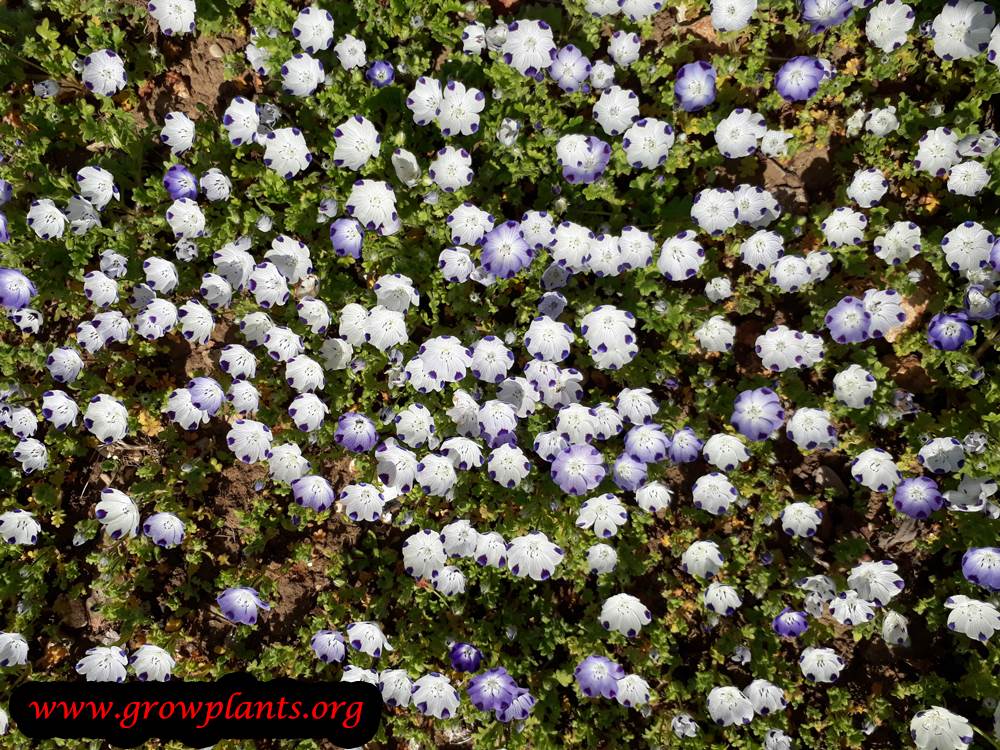
- Height & Spread: Low and spreading, 10-30 cm (4-12 in) tall, forming a carpet; also suited to containers and hanging baskets.
- Growth Habit & Form: Trailing, mounding annual groundcover with soft, brittle stems.
- Lifespan & Maturity: Fast-growing single-season annual that self-seeds readily.
Anatomy & Physical Features
- Leaves & Foliage: Green, deeply cut (pinnatisect) leaves.
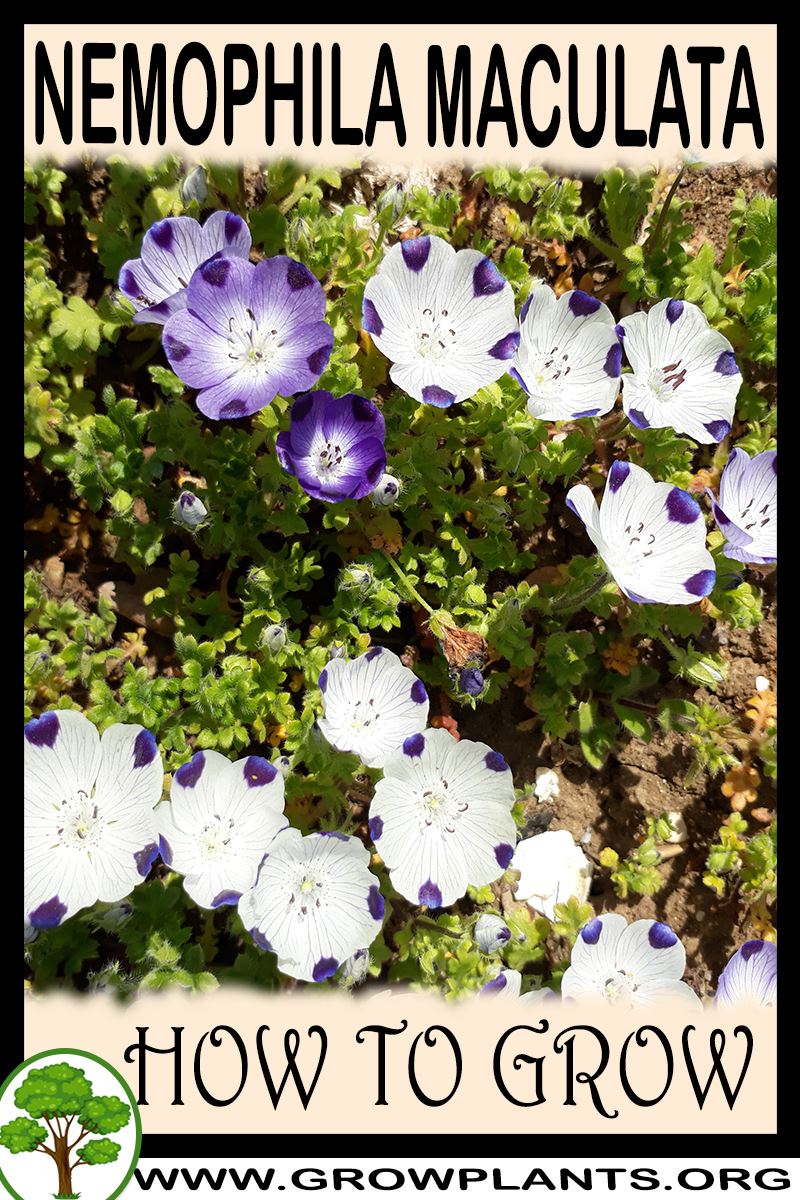
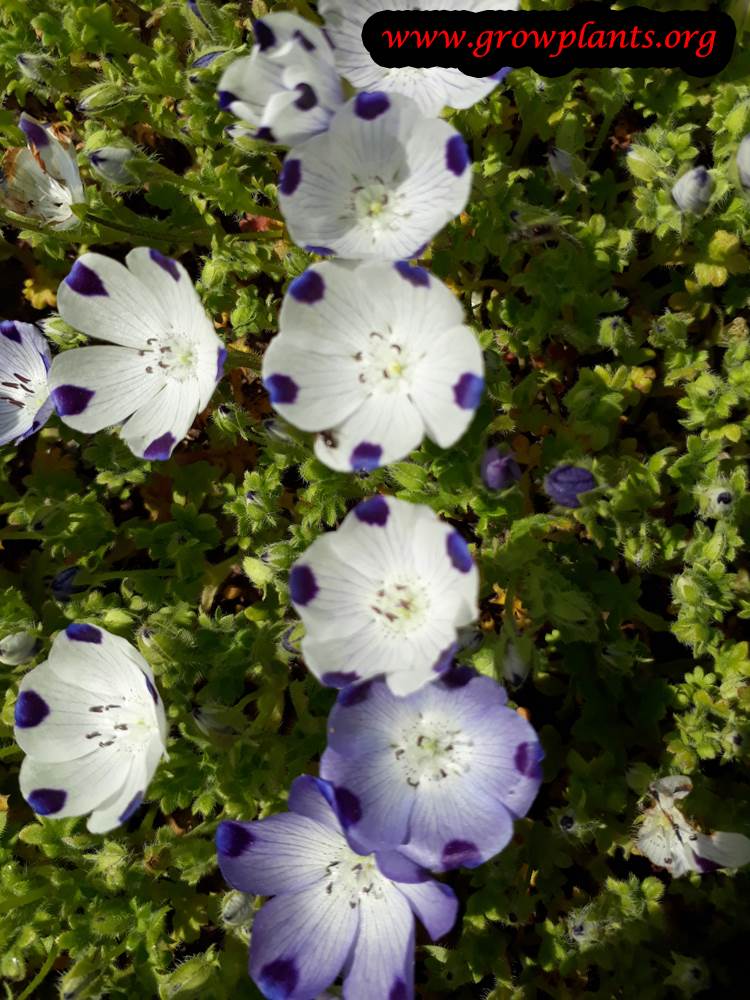
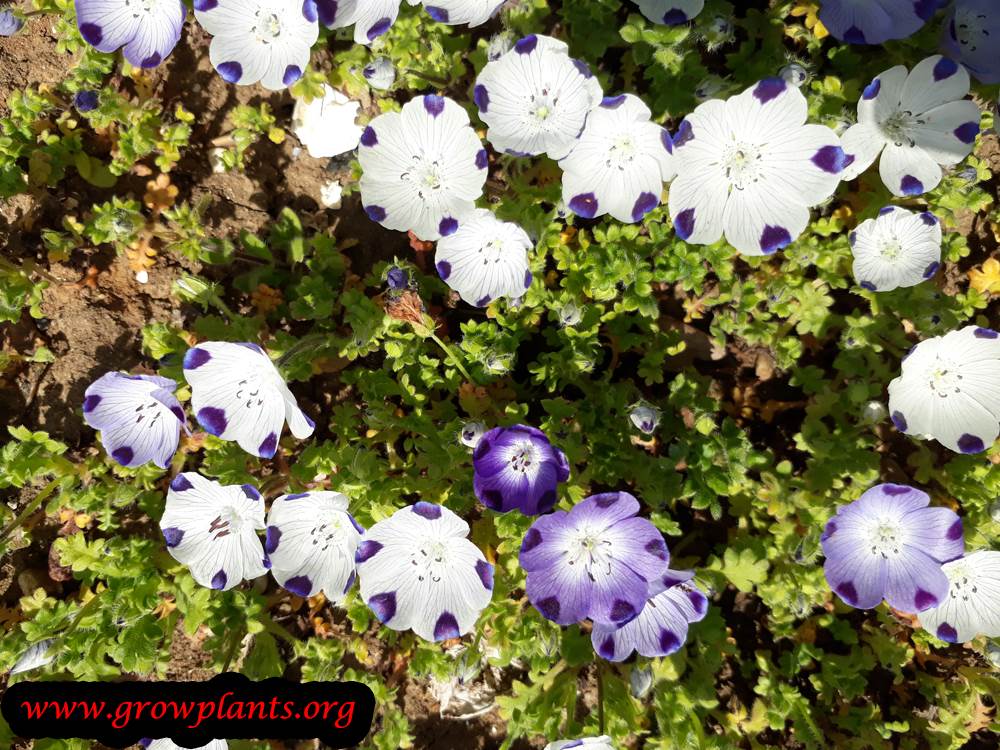
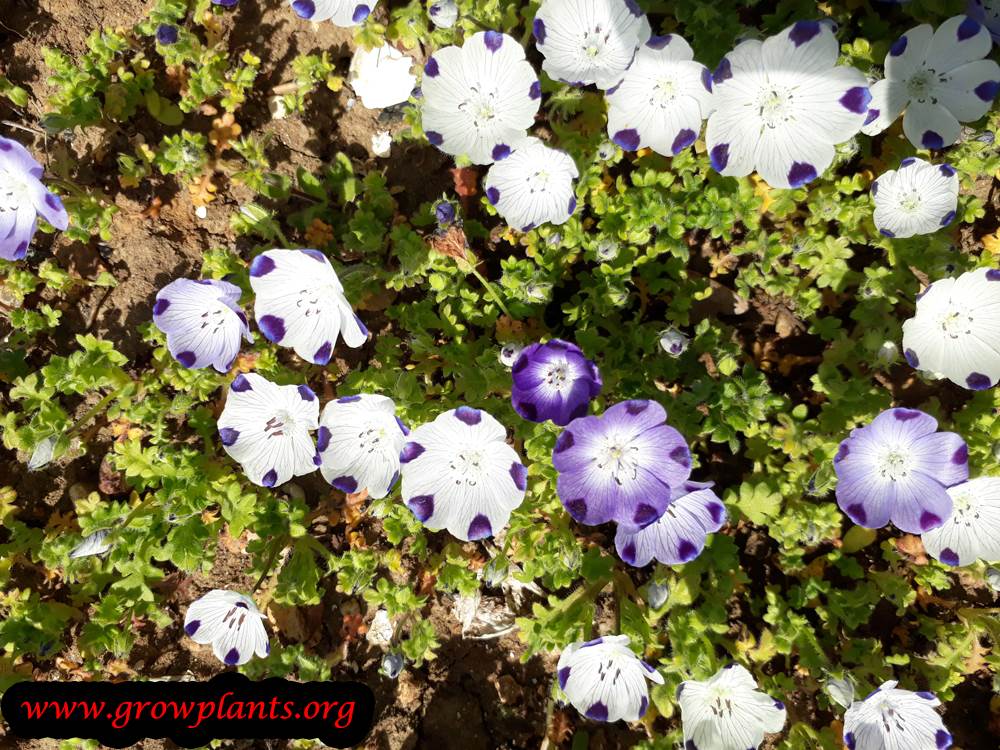
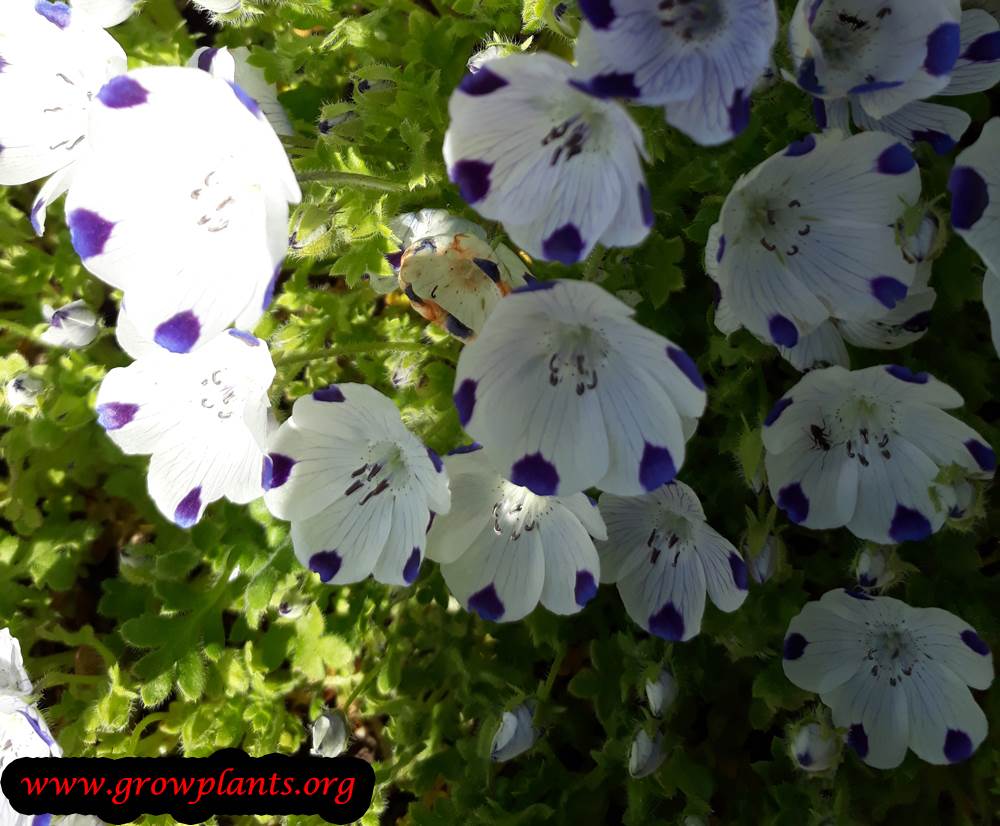
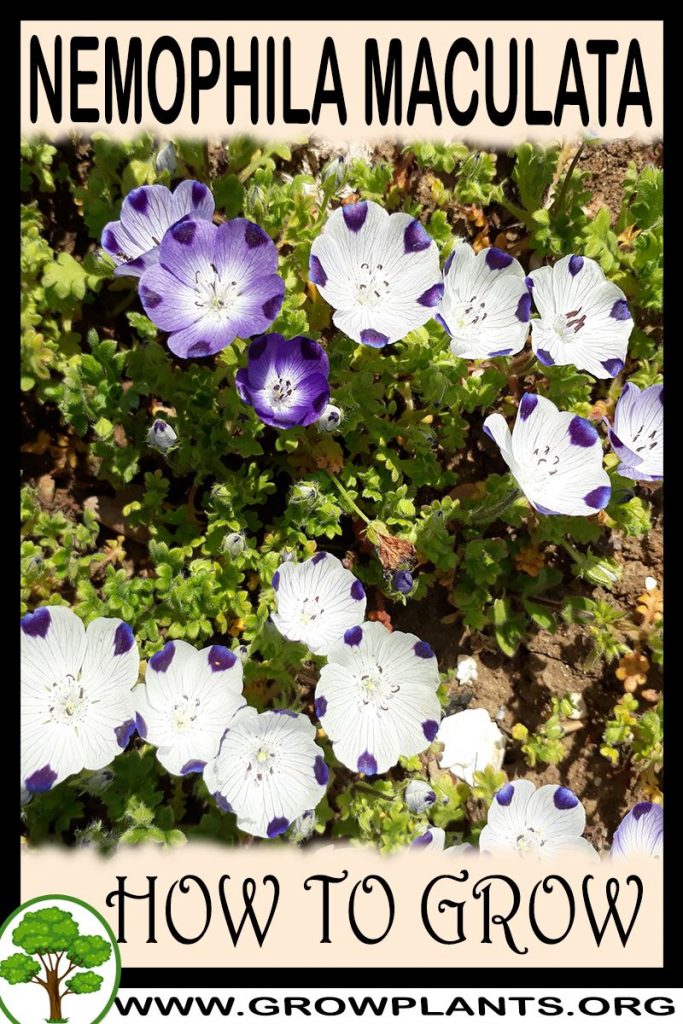
- Flower Characteristics: Bowl-shaped, five-petalled white flowers each marked with a purple spot at the petal tip.
Primary Uses & Landscape Value
- Functional & Ornamental Roles: Ornamental groundcover for borders, edging, rockeries, containers and cottage-style plantings.
Care Guide: Planting, Soil & Watering
Overview: Five-spot (Nemophila maculata) is a cool-season annual that grows best in well-drained, moderately fertile soil and kept evenly moist. It flowers fast and prefers mild weather over summer heat.
Quick Care Requirements
| Requirement | Ideal Condition |
|---|---|
| Planting Season | Cool season – autumn, winter and spring |
| Growth Rate | Fast to moderate |
| Soil Type | Well-drained, moderately fertile |
| Water Need | Moderate to high; keep evenly moist |
Planting & Establishment
- Best Planting Season: Plant in the cool season (autumn through spring); it is a cool-weather annual that fades in summer heat.
- How to Plant:
- Hole Preparation: For transplants, dig a hole as wide as the root ball and the same depth (it is also easily direct-sown).
- Soil Amendments: Work in a little compost and make sure the soil drains well.
- Planting Depth: Set the crown at soil level; do not bury it.
- Growth Speed & Expectations: Fast; it self-seeds and can be invasive in favourable spots.
Soil, Watering & Drainage Care
- Soil Mix & Drainage Needs: Wants well-drained soil and dislikes waterlogging, while staying evenly moist.
- Watering Schedule & Technique:
- Young / Newly Planted: Keep evenly moist for germination and establishment.
- Established: Water regularly and moderately-to-generously; do not let it dry out.
- Seasonal Adjustments: More water in warm weather; it winds down as heat arrives.
Climate, Light & Hardiness
Nemophila maculata is a low, cool-season annual for temperate, Mediterranean and subtropical gardens, grown in full sun to half shade on well-drained soil. Per site data it fits zones 3–10 across a single cool growing season - sown and grown from autumn through spring - with summer heat, rather than winter cold, ending its cycle.
Quick Climate Specifications
| Climate Zones | Temperate, subtropical and Mediterranean (cool-season) |
|---|---|
| USDA Hardiness Zones | 3–10 (site data) |
| Cold Damage Begins | Seedlings take light frost; hard freeze damages soft growth |
| Frost Tolerance | Low to moderate (cool-hardy young growth; not for hard freezes) |
| Light Conditions | Full sun to half shade |
| Wind Tolerance | Moderate (low, delicate habit) |
Sunlight & Light Exposure
Optimal Light Setup
Full sun in cool weather gives the best flowering; half shade helps as temperatures climb and in the warmer zones.
Direct Sun Requirement
It flowers well in full sun during the cool season; part shade simply prolongs the display once heat builds.
Best Exposure / Orientation
An open, sunny position for autumn-to-spring growth, with a cooler aspect useful at the warm end of its range.
Temperature Extremes & Hardiness
USDA Hardiness & Regional Limits
Site data spans zones 3–10. As an annual it is sown to grow through the cool months and flower in spring; the wide zone span describes where that cool-season window exists rather than a plant overwintering as a perennial. In cold-winter zones it is a spring-sown or cool-season annual; in mild zones it grows through autumn and winter and finishes before summer heat.
Cold Damage & Winter Protection
Young plants tolerate light frost and cool conditions, but a hard freeze damages the soft growth. In frost-free climates it is grown right through winter.
Frost Sensitivity
Low to moderate - cool-hardy while young, but not a plant for prolonged hard frost.
Extreme Heat Tolerance
Low. Summer heat is the limiting factor: the plant finishes flowering and dies off as hot weather arrives, which is why it is grown as a cool-season annual.
Wind, Humidity & Microclimate
Wind Tolerance
Moderate; the low, delicate growth is fairly sheltered near the ground but exposed sites can batter the fine stems.
Rainfall & Seasonal Moisture
Adapted to cool, moist growing conditions with well-drained soil; it suits the moist autumn-to-spring window rather than hot, dry summers.
Microclimate Recommendations
Time it to the cool season and give it a moist, well-drained, sheltered spot; in mild climates an autumn sowing gives the longest display before summer heat.
Growing in Pots, Balconies & Indoors
Baby blue eyes is a low, spreading annual that looks lovely trailing from window boxes, hanging pots and the edge of patio containers – it is not a houseplant, but a young plant can be grown on a bright, sunny sill. Being an annual, it flowers fast and is best sown afresh each season rather than kept long-term.
Quick Details
- Container Size: Small – a 2-5 L (0.5-1.3 gal) pot, box or basket for a plant of 10-30 cm
- Indoor Suitability: Not a room houseplant; a bright, sunny windowsill can grow it
- Best Spot: Full sun to half shade, with steady moisture
- Soil & Drainage: Well-drained mix – it dislikes waterlogging
- Watering in Pots: Average to generous – keep moist as small pots dry quickly, but drain freely
Indoors & On the Windowsill
- Not a houseplant: The grower marks it unsuitable for deep-room culture – it needs strong outdoor light.
- Windowsill growing: On the brightest, sunniest sill a plant will grow and flower for its season; give it maximum direct light.
- Annual habit: It grows fast, flowers and sets seed within a season, so sow again rather than overwintering it.
On a Balcony or Patio
- A trailing filler: Its low, spreading habit suits baskets and box fronts; give it a bright, airy spot.
- Water & wind: Soft growth flops in strong wind – shelter it, and check moisture often as pots dry fast in sun.
Choosing the Pot, Soil & Long-Term Care
- Pot & drainage: A small pot or basket with strong drainage holes; skip a standing water saucer so roots never sit wet.
- Potting mix: Well-aerated, free-draining mix – potting compost with perlite or vermiculite.
- Feeding: A light feed through growth is enough for this quick annual; pot nutrients leach, so little and often is best.
- Growing on: As an annual there is no repotting – sow into the final pot or basket and let it run its season.
Fertilizing & Feeding
A light-feeding annual: it flowers well with modest nutrition in decent soil and is easily overfed. Give a little balanced fertilizer early, then let it run its season.
Quick Fertilizing Specs
| Feeding Level | Light |
|---|---|
| Main Nutrient Priority | Balanced nutrition; adequate nitrogen supports both foliage and bloom |
| Best Feeding Period | Active growth through the flowering season |
| Soil pH | Adaptable; slightly acidic to near-neutral |
| Reduce/Stop Feeding | Feeding ends naturally as the plant finishes its short season. |
| Organic Options | Compost or a slow-release organic fertilizer worked into the soil |
| Micronutrients | Rarely limiting in reasonable garden soil |
Feeding by Growth Stage
Establishment
Get seedlings and young plants growing steadily.
| Nutrient direction | Light balanced nutrition; rich, well-drained soil usually supplies most of what a fast annual needs. |
|---|---|
| Timing | Early in the growing season, once seedlings are established. |
| Frequency | A light feeding early on is usually enough. |
| Fertilizer types | Balanced complete fertilizer, Slow-release granular fertilizer, Compost or well-rotted organic matter |
| Precautions | As a fast, short-lived annual it rarely needs much fertilizer; avoid overfeeding. |
Flowering period
Sustain flowering and overall vigor during bloom.
| Nutrient direction | Continue balanced nutrition; steady, adequate nitrogen and potassium support flowering better than high-phosphorus bloom products. |
|---|---|
| Timing | Through the flowering season. |
| Frequency | Light, steady feeding while the plant is actively flowering. |
| Fertilizer types | Balanced complete fertilizer, Slow-release granular fertilizer, Compost or well-rotted organic matter |
| Precautions | Do not rely on high-phosphorus bloom boosters; balanced feeding with enough nitrogen drives better flowering. |
Nutrient Deficiency Signs & Corrections
Older, lower leaves turn uniformly pale green to yellow and growth is weak and slow.
| Possible causes | Low nitrogen availability in the soil, Cold or waterlogged soil limiting root uptake, Leaching of nitrogen from light, sandy soils |
|---|---|
| Appears first on | Older, lower leaves first. |
| What to check | Recent feeding history, Soil drainage and moisture, Whether older leaves are affected before the new growth |
| Possible correction | Apply a balanced complete fertilizer and correct any drainage or watering problems before adding more. |
The youngest leaves yellow between the veins while the veins themselves stay green.
| Possible causes | Alkaline soil pH reducing iron availability, Waterlogged or cold roots impairing uptake, A genuine shortage of available iron |
|---|---|
| Appears first on | New, young leaves at the shoot tips. |
| What to check | Soil pH, Drainage and root health, Whether only the new growth is affected |
| Possible correction | Correct soil pH toward the plant’s preferred range and, if the problem persists, apply a chelated iron product per its label. |
Brown, scorched leaf edges and tips, sometimes with wilting even when the soil is moist.
| Possible causes | Excess fertilizer or salt buildup in the soil, Under-watering that concentrates salts around the roots, Salt accumulation in containers |
|---|---|
| Appears first on | Leaf margins and tips across many leaves. |
| What to check | Recent fertilizer amounts, Salt buildup or the need to leach the soil, Watering consistency |
| Possible correction | Ease off feeding, leach the soil with plain water, and give only light feeding once the plant recovers. |
Pruning, Training & Seasonal Maintenance
Five-spot (Nemophila maculata) is a low, spreading hardy annual grown for its white, blue-spotted flowers, so it needs almost no pruning — just optional pinching of young seedlings for bushiness and light deadheading to prolong the display. It is a cool-season annual that naturally declines in summer heat, at which point it is removed rather than cut back.
Quick Pruning & Maintenance Specs
| Pruning Tolerance | Low need – soft annual; only pinch or deadhead |
| Primary Pruning Window | While in active growth and bloom (cool season) |
| Secondary Maintenance Window | Removal once it fades in heat |
| Typical Frequency | Minimal – occasional pinch or deadhead |
| Main Objective | Encourage bushiness, prolong bloom, tidy |
| Young Plant Priority | Optional tip-pinch of seedlings to branch |
| Mature Plant Priority | Deadhead lightly; remove when spent |
| Best Tool Type | Precision snips or fingertips |
| Avoid Heavy Pruning During | Any hard cutting – it does not regrow from cuts |
Pruning by Plant Age & Size
Newly Established
Once the seedling has a few leaves, optionally pinch the tip to make a bushier, fuller plant; otherwise leave it.
Young / Formative
No training — a spreading annual; let it fill and trail.
Mature / Established
Deadhead spent flowers to extend bloom; once heat ends the display, pull the plant.
Seasonal Pruning Schedule
Cool-Season Growth & Bloom
Light deadheading keeps flowers coming; remove any flopped or damaged stems.
Onset of Summer Heat
The plant fades naturally — remove it, letting some seed drop first if you want it to return.
Ongoing Sanitary
Remove aphid-infested tips and damaged foliage.
Structural Pruning & Training
None — a soft, low annual with no framework to prune; support is not needed.
Special Growth to Remove
Spent flowers (to prolong bloom) and the whole plant once it declines in heat. If you want it back next season, allow some seed to set before removal.
Container & Small-Space Pruning
Good for pots and edges — pinch young for fullness, deadhead lightly, and discard it when it fades in summer.
Tools
Precision snips or fingertips for pinching and deadheading; nothing heavier.
Tool Hygiene & Disease Risk
Routine — clean snips. The main issue is aphids, a pest rather than a pruning-borne disease.
Cut Placement & Technique
Pinch just above a leaf node to encourage branching; snip spent flowers back into the foliage.
Heavy Pruning & Rejuvenation
Not applicable — as a short-lived annual it is not cut back to regrow. Refresh a bed by re-sowing or relying on self-sown seed rather than pruning.
Post-Pruning Care
Keep it cool and evenly moist to prolong the display after pinching; heat, not pruning, ends its life.
Common Pruning Mistakes
- Hard-cutting an annual and expecting a flush of regrowth.
- Forgetting to leave a few seed heads if you want it to return.
- Letting aphids build up on the soft tips.
When NOT to Prune
No hard cuts at all; and do not shear off all the seed heads if you want it to self-sow.
Recommended Tools (by task)
- precision_snips — the only tool needed, for optional pinching and light deadheading.
Propagation Guide
Baby blue eyes is grown almost entirely from seed, sown straight where it is to flower because this hardy annual resents having its roots disturbed. Seed comes reasonably true to type and no vegetative method is needed or practical, so it is one of the easiest annuals to raise.
Quick Propagation Specs
| Best Propagation Method | Seed, direct-sown |
| Alternative Methods | Self-seeding |
| Propagation Difficulty | Easy |
| Seed True-to-Type | Usually true-to-type |
| Best Propagation Season | Autumn in mild-winter areas, otherwise early spring |
| Germination Temperature | 10–18°C (50–65°F) |
| Seed Germination Time | Typically one to a few weeks in cool, moist soil |
| Seed Sowing Depth | About 6 mm (roughly 1/4 inch), barely covered |
Growing from Seed
Seed Handling & Viability
Keep seed cool and dry and use it within a year or two, while germination is reliable. Plants self-sow freely, so a stand often renews itself from dropped seed.
Sowing Season
As an annual it is direct-sown in autumn in frost-free or mild-winter climates for spring bloom, or in early spring where winters are cold. The site records planting across autumn, winter and spring, matching this cool-season pattern.
Sowing Depth & Orientation
Sow thinly onto prepared soil and barely cover; light exclusion at the seed helps, so press the seed in and cover only lightly.
Germination Conditions
Germinates best in cool conditions, about 10–18°C (50–65°F), with the surface kept evenly moist.
Seedling Care
Thin seedlings to stand a few centimetres apart. Avoid moving established seedlings, as the roots are sensitive to disturbance; sowing in situ is far more successful than transplanting.
Bloom & Flower Guide
Quick Details
- Bloom Season: Spring, summer and into autumn
- Flower Appearance: Bowl-shaped, five-petalled flowers, white to pale lavender, each petal tipped with a blue or purple spot
- Edibility: Ornamental – grown for its flowers, not for eating
Detailed Blooming Overview
Nemophila maculata is a low, spreading annual grown for its cheerful bowl-shaped flowers, each white-to-lilac petal marked with a single blue-purple spot – the reason it is widely known as five-spot. It flowers freely from spring, and in cooler conditions on into autumn, making quick and pretty ground cover.
Flower Characteristics
- Bowl-shaped flowers with five broad petals
- White to pale lavender, each petal tipped with a blue or purple spot
- Held just above ferny, lobed foliage
Bloom Care & Thinning
- Prolonging the show: keep plants cool and moist and deadhead lightly to stretch flowering
- Self-seeding: allow a few flowers to set seed and it will often return the next year
- Siting: best in full sun to part shade in cooler weather, as heat shortens the display
Pests, Diseases & Troubleshooting
Overview: Five-spot (Nemophila maculata) is an easy, fast hardy annual with few serious enemies. Aphids and slugs on soft seedlings, plus powdery mildew and rot in crowded damp conditions, are its main issues – all readily handled with spacing, drainage and gentle organic care.
Quick Troubleshooting Overview
| Issue / Pest | Main Symptom | Primary Solution |
|---|---|---|
| Aphids | Clusters on shoots; sticky, curled leaves | Water jet; soap; encourage predators |
| Slugs & snails | Grazed seedlings, holed leaves | Handpick at night; iron-phosphate bait |
| Powdery mildew | White coating in crowded plantings | Space plants; improve airflow |
| Root rot | Wilting, yellowing in wet soil | Sharp drainage; ease off watering |
Common Pests & Management
- Aphids (Aphis / Myzus spp.):
- Symptoms: Colonies on tender shoots and leaf undersides, curling growth and leaving honeydew.
- Prevention & Control: Hose off with water, encourage ladybirds and hoverflies, and use insecticidal soap only if colonies persist.
- Slugs & snails (Gastropoda):
- Symptoms: Seedlings and low foliage grazed to ragged stubs, worst in damp, shady, cool conditions.
- Prevention & Control: Handpick after dark, clear damp hiding places, and ring young plants with grit or iron-phosphate bait.
- Leafhoppers & thrips (various):
- Symptoms: Occasional pale stippling or flecking on leaves; usually minor.
- Prevention & Control: Tolerate light damage, use sticky traps to monitor, and rarely need to treat.
Diseases & Fungal Issues
- Powdery mildew (Erysiphaceae):
- Symptoms: White powdery film on leaves and stems late in the season or in crowded, dry-rooted plants.
- Treatment & Management: Sow at proper spacing, keep roots evenly moist, improve airflow, and treat with sulfur, potassium bicarbonate or neem if it spreads.
- Root & crown rot (Pythium / Rhizoctonia):
- Symptoms: Wilting and collapse in heavy, waterlogged soil or overwatered containers.
- Treatment & Management: Grow in free-draining soil, avoid overwatering, and remove collapsed plants; this cool-season annual dislikes soggy roots.
- Damping off (Pythium / damping-off complex):
- Symptoms: Seedlings topple at the soil line in cold, wet, over-sown seed trays.
- Treatment & Management: Sow thinly in clean, well-drained media, avoid overwatering, and give good light and airflow.
Growing Difficulties & Abiotic Problems
- Heat collapse / short life:
- Cause & Symptoms: As a cool-season annual it fades quickly and dies back in summer heat.
- Correction Strategy: Sow in cool seasons, give light shade in heat, and enjoy it as a spring/early-summer plant; let it self-seed for next year.
- Legginess in shade:
- Cause & Symptoms: Too little light makes plants stretch and flower poorly.
- Correction Strategy: Grow in full sun to light shade for compact, floriferous plants.
- Nutrient deficiency:
- Cause & Symptoms: Pale, weak growth in poor soil.
- Correction Strategy: Feed lightly; this annual needs only modest fertility and dislikes rich, wet soil.
What Helps – Products & Tools
Very little is needed: a water jet and insecticidal soap for aphids, iron-phosphate bait for slugs on seedlings, and sulfur or potassium bicarbonate for occasional powdery mildew – the real tools are spacing, sun and drainage.