Plant Profile & Key Characteristics
Overview: Matthiola incana (hoary stock) is an upright evergreen perennial or biennial, 30-90 cm, grown as an ornamental for its dense spikes of highly fragrant, often double flowers, popular as a cut flower.
Quick Specifications
| Specification | Attribute |
|---|---|
| Plant Type / Life Cycle | Perennial (evergreen) or biennial |
| Foliage Type | Evergreen |
| Mature Size | 30-90 cm (12-36 in) |
| Growth Rate | Fast to moderate |
| Toxicity | Non-toxic (flowers edible) |
| Hardiness | USDA 7-10 |
Growth Form & Structure
- Height & Spread: 30-90 cm (12-36 in); grows well in containers.
- Growth Habit & Form: Upright, branching herb from a basal rosette, often grown as a cool-season annual.
- Lifespan & Maturity: Fast-growing; flowers in its first or second year.
Anatomy & Physical Features
- Leaves & Foliage: Grey-green, elliptic leaves in a basal rosette.
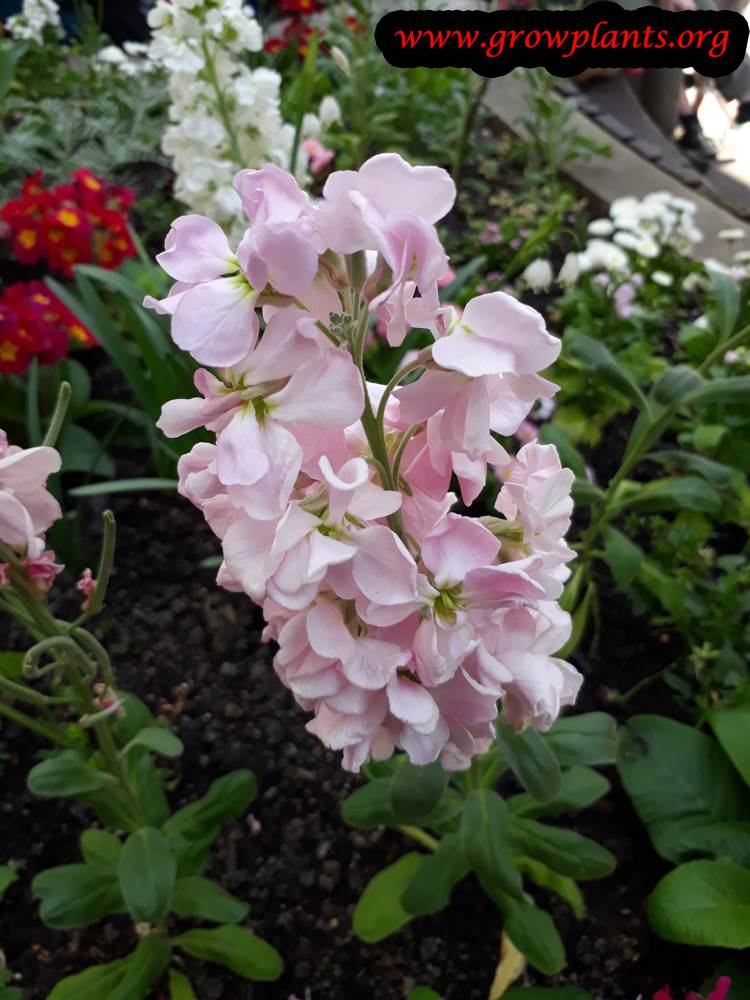
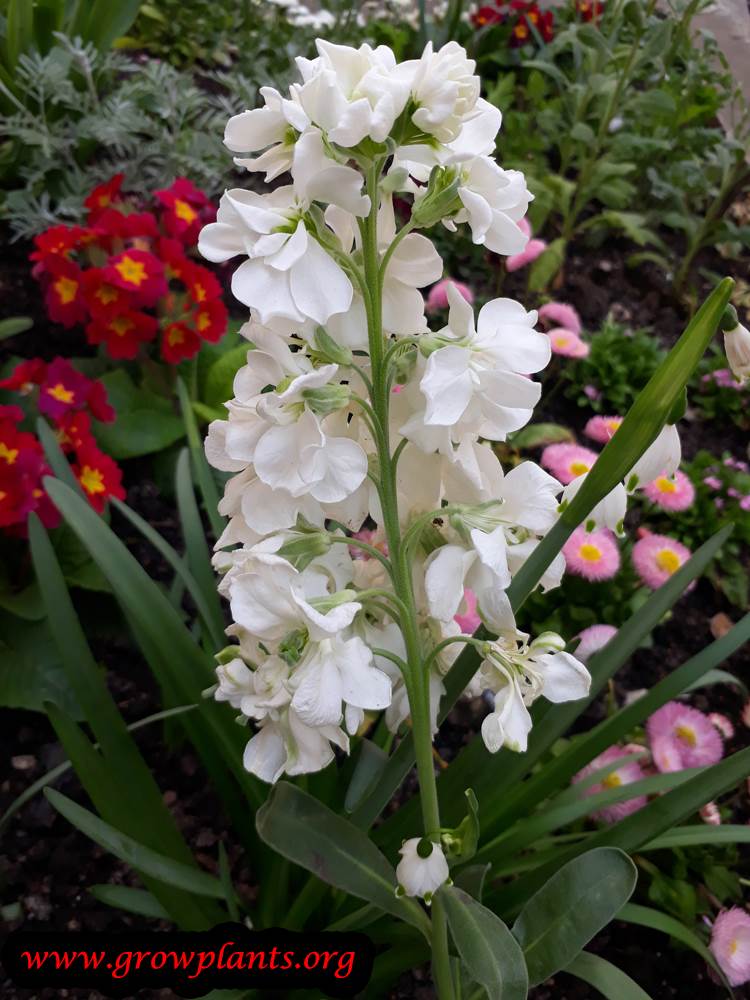
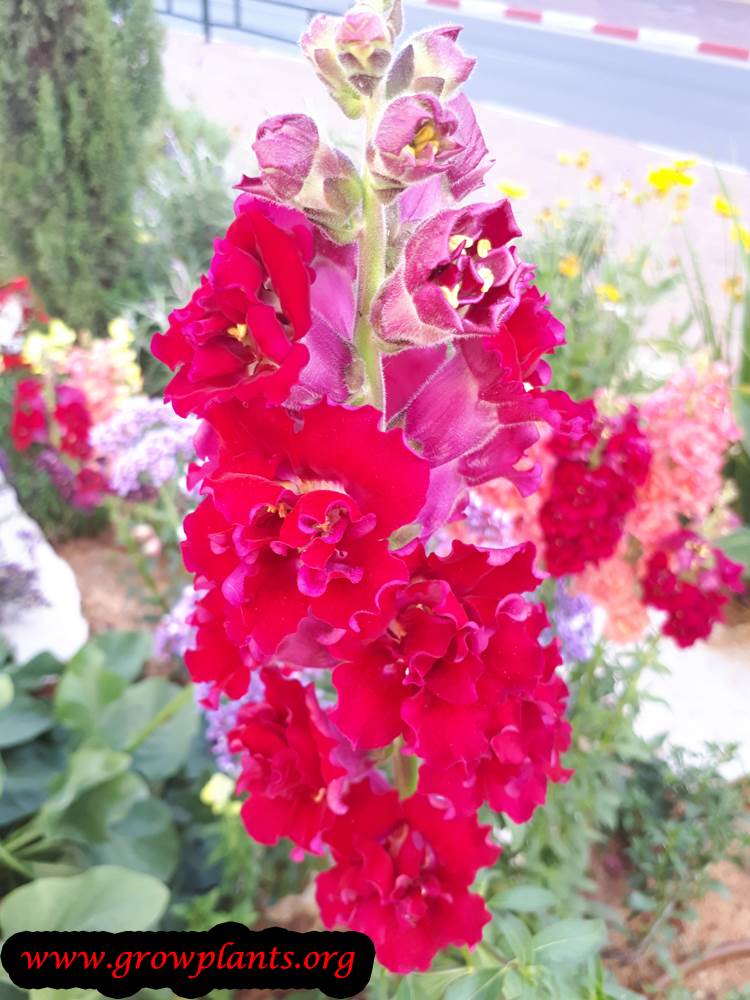
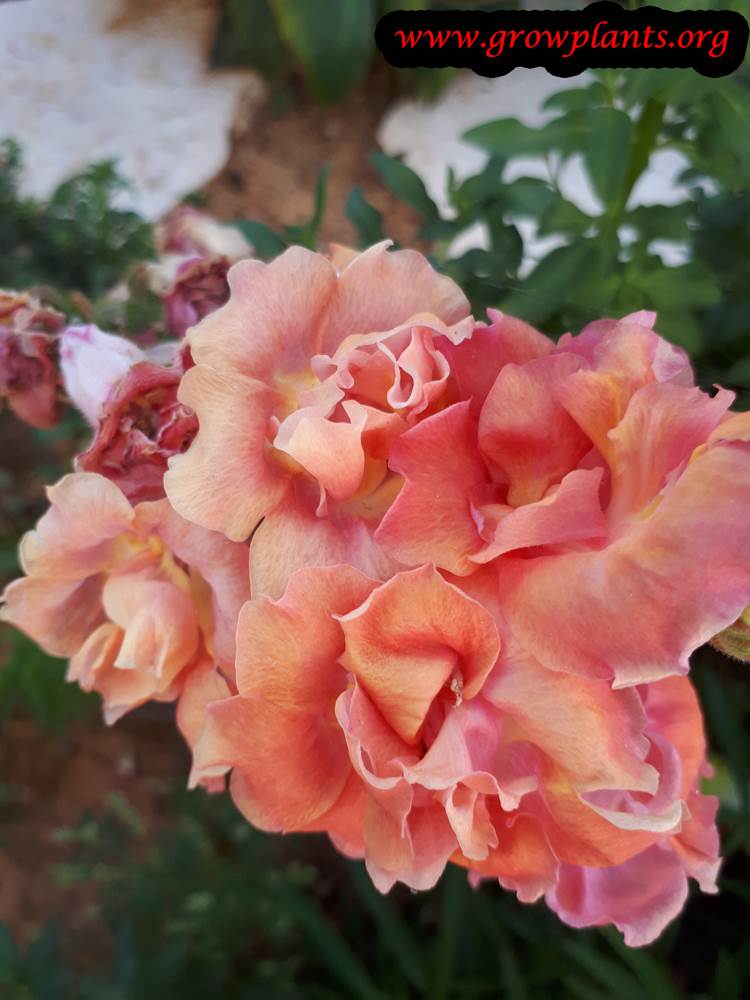
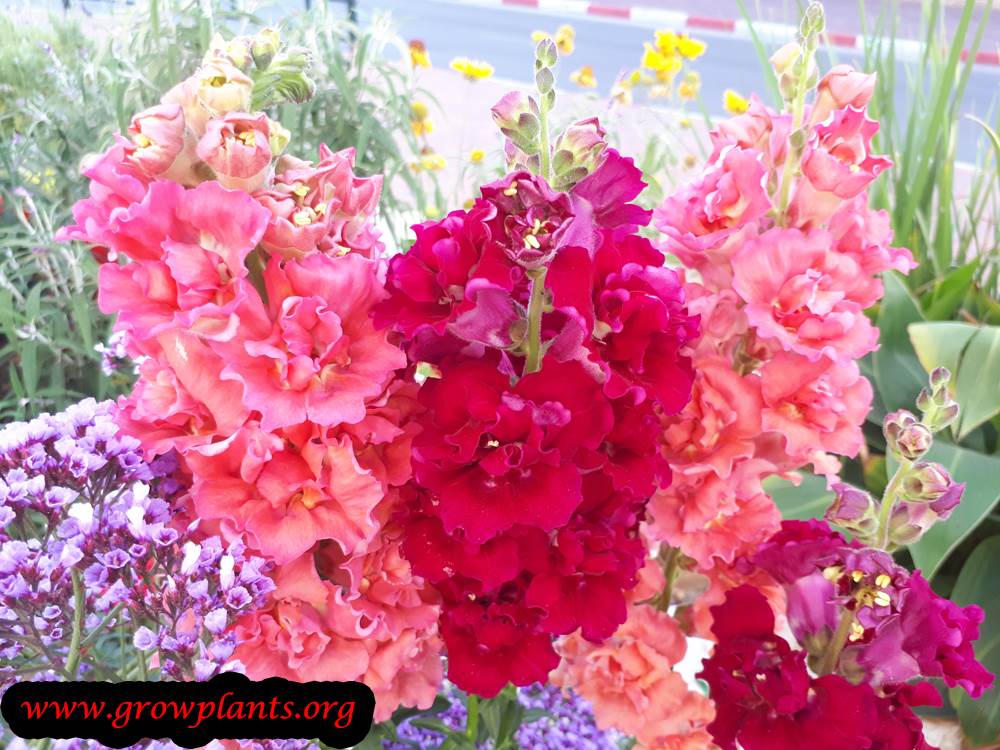
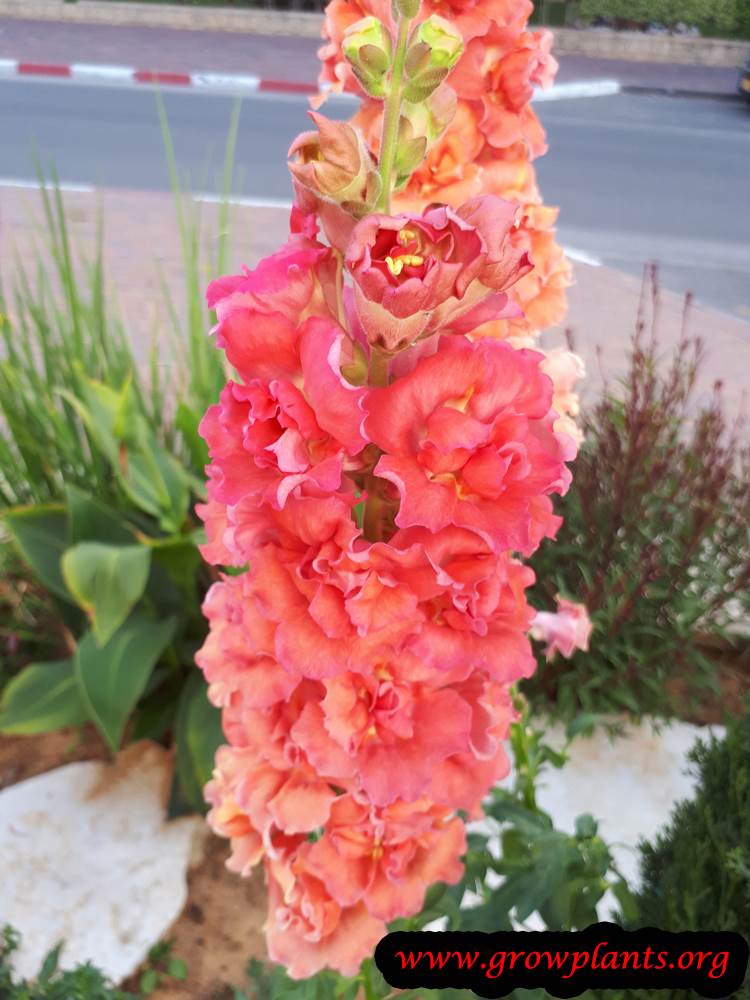
- Flower Characteristics: Fragrant single-to-double flowers in white, purple, pink, red or yellow on upright stalks (see Bloom guide).
Primary Uses & Landscape Value
- Edible Uses: Petals are edible and used as a garnish.
- Functional & Ornamental Roles: Fragrant bedding and border plant, container plant and long-lasting cut flower.
Care Guide: Planting, Soil & Watering
Overview: Hoary stock (Matthiola incana) is a fast- to medium-growing cool-season plant (zones 7–10) that grows in full sun to part shade and flowers best where winters are cool. It wants rich, well-draining soil and moderate, even watering.
Quick Care Requirements
| Requirement | Ideal Condition |
|---|---|
| Planting Season | Summer to autumn (for cool-season flowering) |
| Growth Rate | Fast to Moderate |
| Soil Type | Rich, well-draining |
| Water Need | Moderate |
Planting & Establishment
- Best Planting Season: Plant in summer to autumn so plants grow through the cool season and flower in spring.
- How to Plant:
- Hole Preparation: Dig a hole a little wider than the root ball in a sunny, free-draining spot.
- Soil Amendments: Enrich the backfill with compost or organic matter while keeping it well-draining.
- Planting Depth: Set the root ball at soil level and firm gently.
- Growth Speed & Expectations: Fast to medium — reaches about 30–90 cm (12–36 in).
Soil, Watering & Drainage Care
- Soil Mix & Drainage Needs: Rich, well-draining soil is best; it also grows in containers with a good potting mix and drainage holes.
- Watering Schedule & Technique:
- Young / Newly Planted: Keep the soil evenly moist while plants establish.
- Established: Water moderately, letting the top of the soil dry slightly between waterings.
- Seasonal Adjustments: A little more in warm, dry weather and less in cool, wet spells to avoid rot.
Climate, Light & Hardiness
Hoary stock is a cool-season ornamental of temperate, Mediterranean and subtropical gardens, grown as a biennial or short-lived perennial and prized for its fragrant spikes. It likes full sun to half shade and cool growing weather; the site frames it at about zone 7–10 with a cool winter, and heat - not cold - is its main limit.
Quick Climate Specifications
| Climate Zones | Temperate, Mediterranean and subtropical, favouring the cool season |
| USDA Hardiness Zones | Site lists zone 7–10 |
| Optimal Temp Range | Cool, mild conditions of roughly 10–18 °C (50–64 °F) |
| Cold Damage Begins | Hard freezes damage foliage and buds; young plants are more tender than established ones, generally around −3 to −5 °C (27–23 °F) |
| Approx. Survival Minimum | Established plants tolerate cold consistent with a zone 7 limit, roughly −15 °C (5 °F); varies with plant age and conditions |
| Frost Tolerance | Moderate |
| Light Conditions | Full sun to half shade |
Sunlight & Light Exposure
Optimal Light Setup
Full sun gives the sturdiest, best-flowering plants; half shade is accepted, and useful where spring warms quickly.
Shade & Heat Management
As the season heats up, light shade prolongs the cool-season display before rising temperatures end it.
Best Exposure / Orientation
An open, sunny bed for winter-to-spring bloom in mild climates suits it well.
Temperature Extremes & Hardiness
USDA Hardiness & Regional Limits
Zone 7–10 with a 'cool winter' note describes a plant that wants cool conditions and mild winters; in warm-winter areas it is grown for winter and spring colour, and heat brings its season to a close.
Cold Damage & Winter Protection
It withstands light frost but hard freezes damage the soft growth, and young plants are more vulnerable than established ones.
Frost Sensitivity
Moderately frost-tolerant - it takes light frost in stride but not prolonged hard freezing.
Extreme Heat Tolerance
Heat is the real limit: hot weather stops flowering and shortens the plant's life, which is why it is grown as a cool-season crop.
Wind, Humidity & Microclimate
Humidity Preferences
It prefers moderate humidity; damp, still, crowded conditions can encourage mildew on the foliage.
Microclimate Recommendations
Give it an open, airy, sunny spot for the cool season; good airflow keeps the foliage healthy in humid weather.
Growing in Pots, Balconies & Indoors
Stocks are cool-season, sweetly scented plants that do well in patio and balcony pots for a spring display. They are not houseplants, but a bright, cool, sunny windowsill can raise or hold a compact plant, and pots let you place that perfume right by a door or seat.
Quick Details
- Container Size: Small to medium – about 5-15 L (1-4 gal), general guidance
- Indoor Suitability: Not a houseplant; a bright, cool sunny sill can hold a compact plant
- Best Spot: Full sun to light shade, in cool air
- Soil & Drainage: Free-draining, organic-rich mix
- Watering in Pots: Keep evenly moist – pots dry fast; avoid waterlogging
Indoors & On the Windowsill
- Houseplant limits: The grower marks it ‘no’ – a warm room is too dim and stuffy, and plants stretch and flop.
- Windowsill growing: A bright, cool, sunny sill suits it far better than a warm room and can raise seedlings or hold a compact plant in flower for its scent.
On a Balcony or Patio
- Light & wind: Give it full sun and cool, fresh air; set pots near seating so the fragrance carries. Pots dry fast, so keep them evenly moist.
- Practicalities: A short-lived plant, so it is easy to move small pots to catch the best light.
Choosing the Pot, Soil & Long-Term Care
- Pot & drainage: A 5-15 L pot with strong drainage holes; skip a standing-water saucer to avoid root rot. Terracotta breathes and dries fast, while glazed or plastic pots hold moisture longer.
- Potting mix: A well-aerated, organic-rich mix – peat or coir with perlite or vermiculite – suits container growing.
- Feeding: Potted plants need feeding more often than those in open ground, since each watering leaches nutrients away – a balanced liquid feed through the growing season keeps growth strong.
- Short-lived: Grown as an annual or biennial, so refresh the mix and replant each season rather than potting on long-term.
Growing this plant in a greenhouse
A greenhouse can give matthiola incana cold protection, a longer growing season, winter growing and a head start for propagation.
Greenhouse at a glance
| Greenhouse suitability | Good - clearly useful |
|---|---|
| Main benefits | cold protection, a longer growing season, winter growing, a head start for propagation |
| Season extension | can grow through winter |
| Outdoor protection advisable below | about -5°C |
| Suitable types | unheated greenhouse, polycarbonate greenhouse |
| Heating | No added heat is normally needed. |
Related greenhouse guides
- Greenhouses: How to Choose the Right Greenhouse
- Polycarbonate Greenhouses: What to Look for Before Buying
- Greenhouse Propagation Equipment
Fertilizing & Feeding
A moderate feeder: light, steady, balanced feeding through the growing season supports both foliage and repeated bloom, tapering off as the plant rests.
Quick Fertilizing Specs
| Feeding Level | moderate |
|---|---|
| Main Nutrient Priority | Balanced nutrition with adequate nitrogen; no phosphorus spike needed for bloom |
| Best Feeding Period | Spring through the flowering season |
| Reduce/Stop Feeding | Taper and stop as the plant enters winter rest |
| Soil pH | Adaptable; most prefer near-neutral, well-drained soil |
| Organic Options | Compost or aged manure improves fertility and structure |
| Micronutrients | Usually supplied by a complete fertilizer; correct only if a deficiency appears |
Feeding by Growth Stage
Spring growth flush
Support new stems and leafy growth as the plant breaks into active growth.
| Nutrient direction | A balanced complete fertilizer with adequate nitrogen to fuel fresh shoots and foliage. |
|---|---|
| Timing | As growth resumes in spring. |
| Frequency | Light, regular feeding through the early growing season. |
| Fertilizer types | Balanced granular or liquid complete fertilizer, Compost or other organic matter worked into the soil |
| Precautions | Avoid heavy nitrogen, which pushes soft foliage at the expense of flowers. |
Bloom period
Sustain flowering without forcing excess leafy growth.
| Nutrient direction | A balanced complete fertilizer; steady nitrogen supports continued flowering rather than a phosphorus spike. |
|---|---|
| Timing | Through the flowering season. |
| Frequency | Light, steady feeding while the plant is in bloom. |
| Fertilizer types | Balanced liquid or granular complete fertilizer |
| Precautions | High-phosphorus bloom-booster products are unneeded; balanced feeding drives bloom. |
Dormancy or winter rest
Let the plant rest; growth and nutrient demand fall away.
| Nutrient direction | None – withhold fertilizer while the plant is resting. |
|---|---|
| Timing | During cold-season dormancy or the rest period after flowering. |
| Frequency | No feeding at this stage. |
| Fertilizer types | No feeding at this stage while the plant is dormant. |
| Precautions | Do not fertilize until active growth resumes in spring. |
Nutrient Deficiency Signs & Corrections
Older, lower leaves turn pale or yellow and growth slows.
| Possible causes | Low soil nitrogen, Nitrogen leached by frequent watering, especially in containers, Cold or waterlogged soil limiting root uptake |
|---|---|
| Appears first on | Older, lower leaves |
| What to check | Recent feeding history, Soil drainage and moisture, Whether overall growth has stalled |
| Possible correction | Apply a balanced complete fertilizer and correct any drainage problem, then resume light regular feeding. |
New leaves yellow between green veins.
| Possible causes | High soil pH reducing iron availability, Waterlogged or cold roots, A genuine iron shortage |
|---|---|
| Appears first on | New, young leaves |
| What to check | Soil pH, Drainage, Whether only new growth is affected |
| Possible correction | Correct soil pH and drainage; if it persists, apply a chelated iron product per its label. |
Leaf margins brown and scorch, often on container plants.
| Possible causes | Fertilizer salt buildup in the pot, Drought stress between waterings, Overfeeding |
|---|---|
| Appears first on | Leaf tips and margins |
| What to check | Feeding rate, Salt crust on soil or pot, Watering consistency |
| Possible correction | Flush the container thoroughly with clean water and reduce the feeding rate. |
Pruning, Training & Seasonal Maintenance
Hoary stock (Matthiola incana) is grown as an ornamental and cut flower, but its clove-scented flowers are edible and are occasionally used as a garnish, which is the only edible part of interest here. As a soft herbaceous annual/biennial (30–90 cm) it has no woody structure to prune; “pruning” is limited to early pinching to encourage branching and deadheading spent flower stalks. This is a borderline, uncommon edible use – treat the guidance as edible-flower-oriented.
Pruning & the Edible Harvest
If the flowers are the edible target, pinching the growing tip of a young plant encourages more branching stems and therefore more flowers, and cutting spent flower stalks (deadheading) can prolong flowering. So light pinching and deadheading strongly affect how many edible flowers a plant produces, though the plant is short-lived and the crop is small and specialised.
Quick Pruning & Maintenance Specs
| Pruning Tolerance | Moderate – soft stems; tolerates pinching and deadheading, not hard woody cuts |
| Primary Pruning Window | Pinch young plants before flowering; deadhead through bloom (spring–summer) |
| Secondary Maintenance Window | Autumn – remove dead flower stalks |
| Typical Frequency | An early pinch, then deadhead as flowers fade |
| Main Objective | More branching flower stems; tidy spent blooms |
| Best Tool Type | Precision snips |
| Avoid Heavy Pruning During | Flowering peak (if flowers are wanted) and heat stress |
Pruning & Deadheading
Pinch the soft growing tip of a young plant once it has several sets of leaves to encourage side branches and more flowering stems. As blooms fade, cut spent flower stalks back to a leaf or side shoot to keep the plant tidy and encourage further flowering; the source notes autumn removal of dead flower stalks. There is no framework, renewal or structural pruning – the plant is short-lived and is replaced rather than rejuvenated.
Tools
Precision snips are all that is needed for pinching and deadheading soft stems; no secateurs, saw or shears are appropriate.
Tool Hygiene & Disease Risk
Routine: a clean, sharp blade. The plant is prone to powdery mildew, aphids and whitefly rather than tool-borne disease, so blanket sterilising between cuts is unnecessary; just avoid spreading mildew on wet foliage.
When NOT to Prune
Do not cut back hard during flowering if you want the edible/ornamental blooms, or during heat and drought stress. Do not treat this as a productive crop plant – the edible use is marginal.
Recommended Tools (by task)
- precision_snips – for pinching young tips and deadheading soft flower stalks, the only cuts this plant needs.
Propagation Guide
Stock is grown from seed; it is not propagated by cuttings or grafting. Seed strains segregate into single- and double-flowered plants — the prized doubles are sterile, so they cannot set their own seed and are instead perpetuated through selected seed strains. Easy from seed, the main points being cool conditions and light for germination.
Quick Propagation Specs
| Best Propagation Method | Seed |
| Propagation Difficulty | Easy |
| Seed True-to-Type | Variable — seed strains give a mix of single and double flowers (doubles are sterile); some strains let doubles be selected at the seedling stage |
| Best Propagation Season | Summer to autumn sowing for cool-season flowering |
| Seed Germination Time | Usually about one to two weeks |
| Germination Temperature | Cool, roughly 10–18°C (50–64°F) |
| Seed Sowing Depth | Barely cover — light aids germination |
Growing from Seed
Seed Handling & Viability
Seed stores well kept cool and dry. Because double flowers are sterile, seed comes only from single-flowered plants of a strain; good strains are bred to throw a high proportion of doubles, sometimes distinguishable as seedlings by leaf colour.
Sowing Season
Sow in summer to autumn so plants flower in the cool part of the year, which stock needs; it is grown as an annual or biennial.
Sowing Depth & Germination Conditions
Barely cover the seed, as light aids germination, and keep the mix cool and moist. Germination is usually within one to two weeks at around 10–18°C (50–64°F).
Seedling Care
Grow the seedlings on cool and well-lit; stock resents heat, and cool growing conditions give the best plants.
Bloom & Edible Flower Guide
Quick Details
- Bloom Season: Spring to summer (a cool-season bloomer)
- Time to First Bloom: In its first season from an early start; biennial types flower in their second year
- Flower Appearance: Dense spikes of four-petalled flowers, single or double, in white, pink, red, purple, yellow or mixes
- Edibility: The clove-scented flowers are edible and make a pretty garnish
Detailed Blooming Overview
Hoary stock (Matthiola incana) is prized for tall, richly fragrant flower spikes in cool weather. A member of the cabbage family, its blooms carry a spicy, clove-like scent and resent heat, which cuts the display short.
Flower Characteristics
- Four-petalled flowers (often doubled into many petals) packed along upright spikes.
- Strongly and sweetly clove-scented, in a wide colour range.
- Edible, with a mild, spicy-clove flavour, pretty as a garnish or scattered over salads.
Bloom Care & Thinning
- Encouraging bloom: Cool temperatures and full sun bring the best spikes; deadheading prolongs the display.
- Pollination: The fragrant flowers attract bees and other pollinators.
Bloom Health & Protection
- Aphids may gather on the flower spikes, and damp, crowded conditions can bring gray mould (Botrytis) onto the blooms. What helps: an insecticidal soap or a strong water spray for aphids, and good spacing and airflow (a suitable fungicide if mould persists).
Fruit & Uses
Matthiola incana (hoary stock) is grown as an ornamental flower, and the only part with any edible use is the flower, which is sometimes used as a scented, clove-like edible garnish. It should be treated as a decorative edible only, and used solely when the flowers are known to have been grown without pesticides for that purpose.
Quick Edible Specs
| Edible Parts | Flowers only (petals), as a garnish |
|---|---|
| Main Use(s) | Culinary garnish – the flowers have a mild, clove-like, spicy scent and are used decoratively |
| Eaten Raw or Cooked | Raw, as a garnish (small amounts) |
| Preparation Required | Use only pesticide-free flowers; rinse gently and remove the bitter base of the petals if desired |
| Harvest Season | Spring to summer, while the plant is in bloom |
| Safety/Toxicity Caveat | Grown as an ornamental and often treated with pesticides — only flowers deliberately grown for eating should be used, and only in small, garnish quantities; the rest of the plant is not eaten |
Flowers & Flower Buds
The flowers – which range from white to purple, pink, red, yellow or mixed and carry a clove-like fragrance – are the only part put to any edible use, as a decorative garnish for salads and desserts. Pick freshly opened blooms from plants you know have not been sprayed. Because this is a marginal, garnish-only use of an ornamental plant, keep quantities small and do not treat the leaves, stalks or seeds as food.
Pests, Diseases & Troubleshooting
Overview: Stock (Matthiola incana) is a fragrant brassica-family bedding and cut flower, so it inherits the classic cabbage pests — cabbage aphids, flea beetles and caterpillars — plus whiteflies and thrips, and it is prone to downy and powdery mildew, grey mould, soil-borne wilts, clubroot and damping-off in cool, wet or crowded conditions. Management leans on crop rotation away from brassicas, clean well-drained soil, airflow and vigilance, with organic controls first.
Quick Troubleshooting Overview
| Issue / Pest | Main Symptom | Primary Solution |
|---|---|---|
| Cabbage aphids | Grey waxy clusters on shoots and undersides; distortion | Hose off, insecticidal soap or neem; support predators |
| Flea beetles | Tiny shot-holes in leaves, worst on seedlings | Row cover, keep vigorous; spinosad if severe |
| Caterpillars | Chewed leaves and frass from loopers/diamondback | Hand-pick, Btk spray; row cover |
| Downy mildew | Yellow leaf patches with grey mould beneath | Airflow, dry foliage, resistant stock; copper if needed |
| Grey mould (botrytis) | Fuzzy grey rot on flowers and stems in damp cool air | Remove faded blooms, ventilate, avoid wetting |
| Wilts / clubroot | Wilting, yellowing, stunting; swollen distorted roots | Rotate off brassicas, clean soil, lime for clubroot |
Common Pests & Management
- Cabbage aphids (Brevicoryne brassicae):
- Symptoms: Dense grey-green waxy clusters coat shoot tips, flower spikes and leaf undersides, sucking sap so growth curls and stunts, fouling plants with honeydew and potentially spreading virus.
- Prevention & Control: Blast off with water, squash colonies, and treat with insecticidal soap or neem oil; conserve ladybirds, lacewings and parasitic wasps, and remove badly infested shoots.
- Flea beetles (Phyllotreta spp.):
- Symptoms: Tiny jumping beetles chew numerous small round “shot-holes” in the leaves, most damaging to seedlings and young transplants, which can be riddled and checked.
- Prevention & Control: Protect young plants with fine mesh row cover, keep them vigorous and well watered so they outgrow damage, and use a spinosad product only where infestation is severe.
- Caterpillars (Plutella xylostella; Trichoplusia ni; Pieris spp.):
- Symptoms: Diamondback moth, cabbage loopers and cabbage-white caterpillars chew holes and skeletonise leaves, leaving dark frass and damaging flower spikes.
- Prevention & Control: Hand-pick and use row cover to exclude egg-laying moths; spray Bacillus thuringiensis (Btk) for heavier infestations, which targets caterpillars while sparing beneficials.
- Whiteflies (Trialeurodes / Bemisia spp.):
- Symptoms: Clouds of tiny white flies rise when plants are disturbed; nymphs on leaf undersides suck sap, yellow foliage and deposit honeydew.
- Prevention & Control: Hang yellow sticky traps and spray insecticidal soap or neem to the undersides, repeating regularly; better airflow reduces build-up.
- Thrips (Frankliniella spp.):
- Symptoms: Silvery streaks and flecking on leaves and petals with distorted, discoloured flowers; thrips can also transmit viruses.
- Prevention & Control: Use blue sticky traps, remove damaged blooms, and apply insecticidal soap or spinosad if numbers build.
Diseases & Fungal Issues
- Downy mildew (Peronospora parasitica (Hyaloperonospora)):
- Symptoms: Pale yellow patches on the upper leaf surface with greyish downy mould beneath, favoured by cool, damp, humid conditions; severe on seedlings and crowded stands.
- Treatment & Management: Grow with good airflow, avoid overhead watering and overcrowding, and use resistant seed and clean trays; remove affected leaves and apply a copper fungicide protectively in persistent damp.
- Grey mould (botrytis) (Botrytis cinerea):
- Symptoms: Fuzzy grey-brown mould on flowers, buds, stems and damaged tissue in cool, damp, still air, rotting the dense flower spikes.
- Treatment & Management: Space plants, ventilate, and remove faded flowers and dead material promptly; avoid wetting foliage and use a botrytis-active fungicide in prolonged damp.
- Fusarium & verticillium wilt (Fusarium oxysporum; Verticillium spp.):
- Symptoms: Yellowing, wilting and stunting, often one-sided, with browned vascular tissue inside the stem; plants collapse and do not recover.
- Treatment & Management: Rotate away from brassicas and susceptible crops, use clean soil and resistant varieties, remove and destroy infected plants, and avoid replanting stock in affected ground.
- Clubroot (Plasmodiophora brassicae):
- Symptoms: Wilting in warm weather, stunting and purpling, with swollen, distorted, galled roots; a persistent soil-borne disease of the whole cabbage family.
- Treatment & Management: Practise long rotations away from brassicas, raise soil pH with lime, improve drainage, and never move infested soil; use clean transplants and resistant lines where available.
- Damping-off (Pythium / Rhizoctonia):
- Symptoms: Seedlings rot and collapse at the soil line in cold, wet, overcrowded compost.
- Treatment & Management: Sow thinly in clean, free-draining mix, provide warmth and airflow, avoid overwatering, and water from below.
Growing Difficulties & Abiotic Problems
- Root rot / waterlogging:
- Cause & Symptoms: Wilting and yellowing with soft, dark roots where soil stays wet and heavy.
- Correction Strategy: Grow in free-draining soil, avoid waterlogging, and do not overwater; raised beds help on heavy ground.
- Poor doubling / flower quality:
- Cause & Symptoms: Single rather than the prized double flowers, or weak spikes, from heat, stress or seed genetics.
- Correction Strategy: Grow in cool conditions for best flower quality, select doubling strains, and keep plants unstressed and well fed.
- Bolting / heat stress:
- Cause & Symptoms: Premature stretching and poor flowering in heat, since stock is a cool-season plant.
- Correction Strategy: Grow in the cool part of the season, provide even moisture, and avoid hot, dry sites.
What Helps – Products & Tools
Rotation and clean, well-drained soil are the foundation, backed by airflow and sanitation. Useful products are insecticidal soap and neem for aphids, whiteflies and thrips, fine row cover for flea beetles and caterpillars, Btk for caterpillars, blue and yellow sticky traps, garden lime for clubroot suppression, and a copper fungicide for downy mildew plus a botrytis-active fungicide for grey mould.