


Plant Profile & Key Characteristics
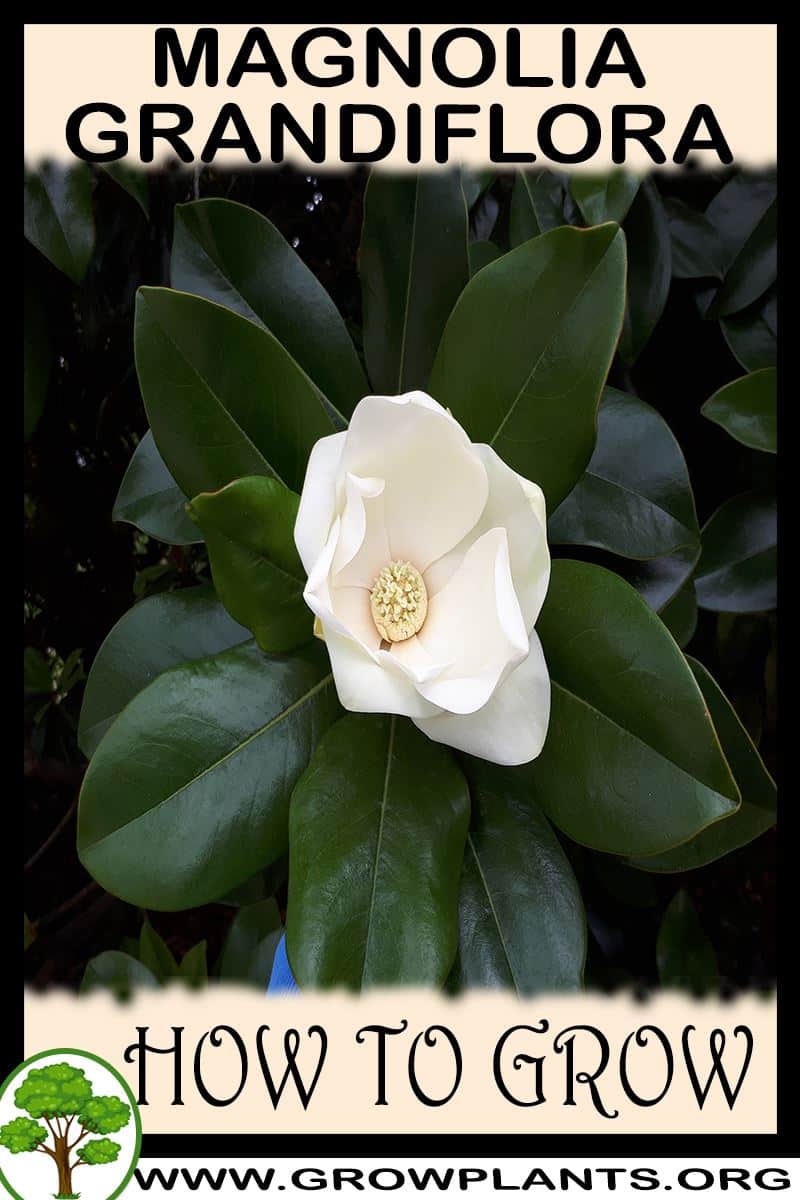
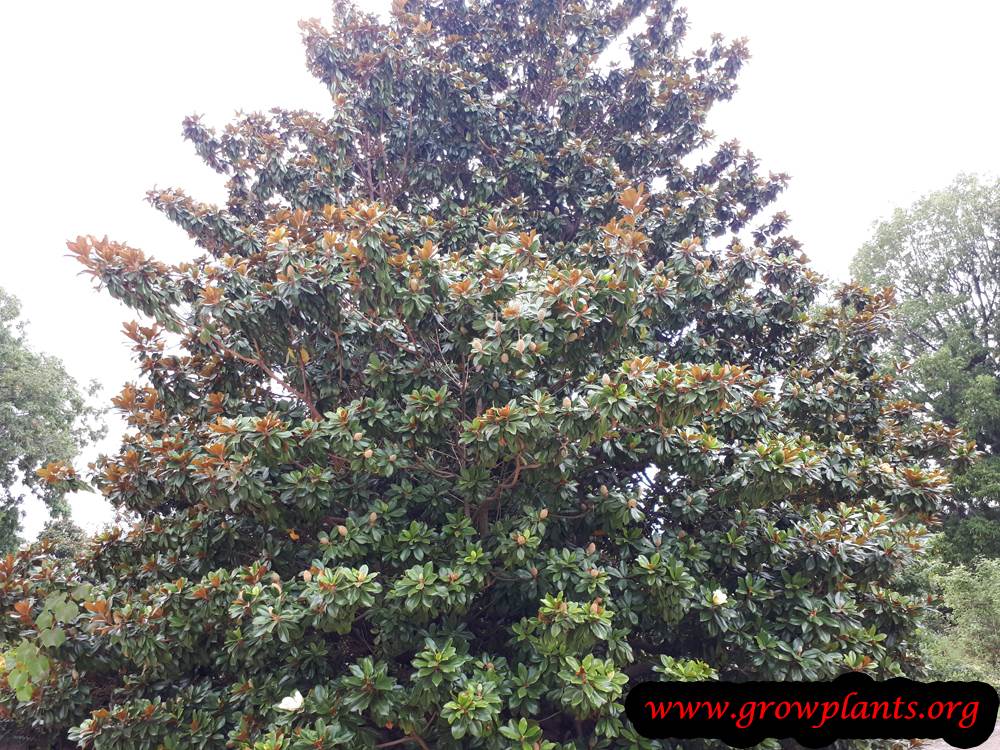
Overview: Large evergreen tree reaching 10-30 m, grown as a fragrant ornamental and shade tree. Bears very large, fragrant white flowers over glossy, leathery foliage.
Quick Specifications
| Specification | Attribute |
|---|---|
| Plant Type / Life Cycle | Perennial (evergreen tree) |
| Foliage Type | Evergreen |
| Mature Size | 10-30 m (30-100 ft) |
| Growth Rate | Moderate |
| Root System | Shallow, wide-spreading rope-like roots |
| Toxicity | Non-toxic |
| Hardiness | USDA zones 6-10 |
Growth Form & Structure
- Height & Spread: 10-30 m; too large for containers.
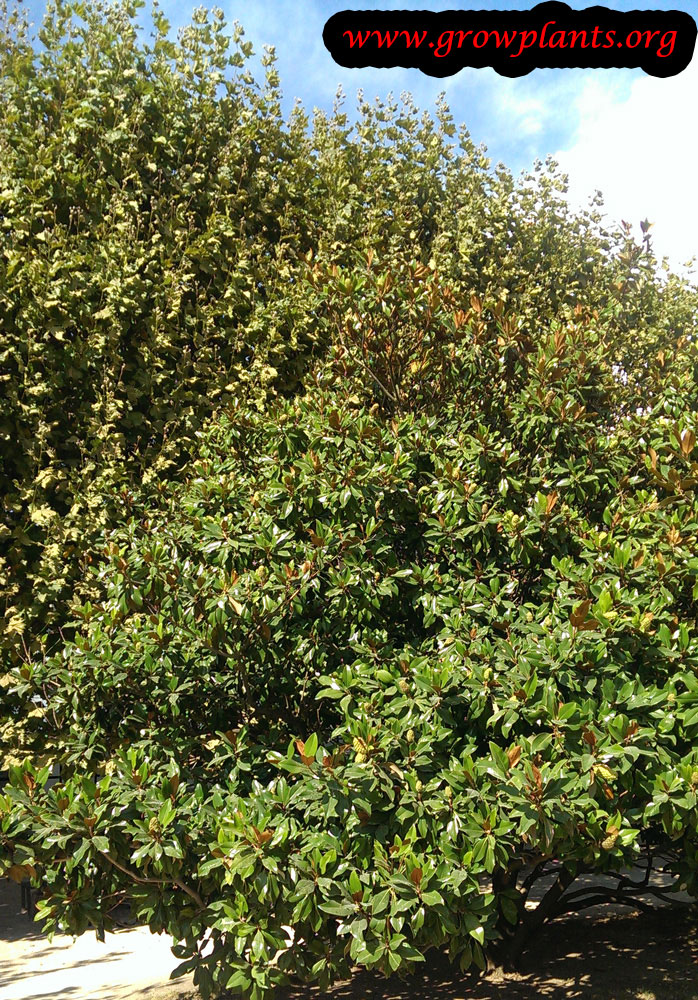
- Growth Habit & Form: Large, dense evergreen tree with a broad, pyramidal to rounded crown.
- Lifespan & Maturity: Long-lived; slow to reach full size.
Anatomy & Physical Features
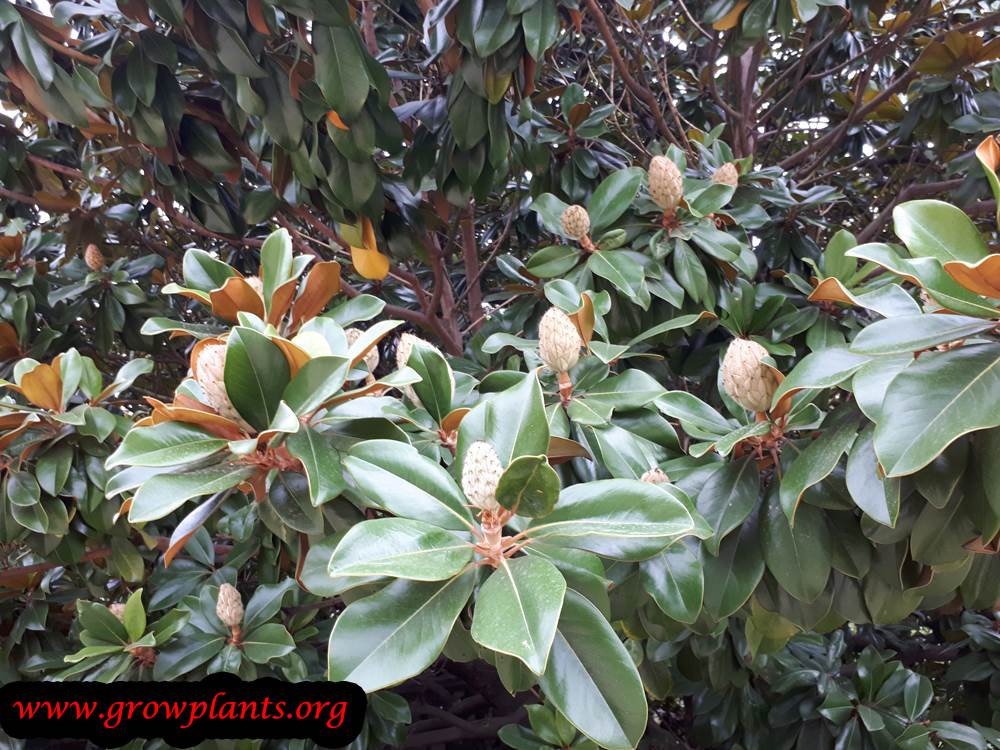
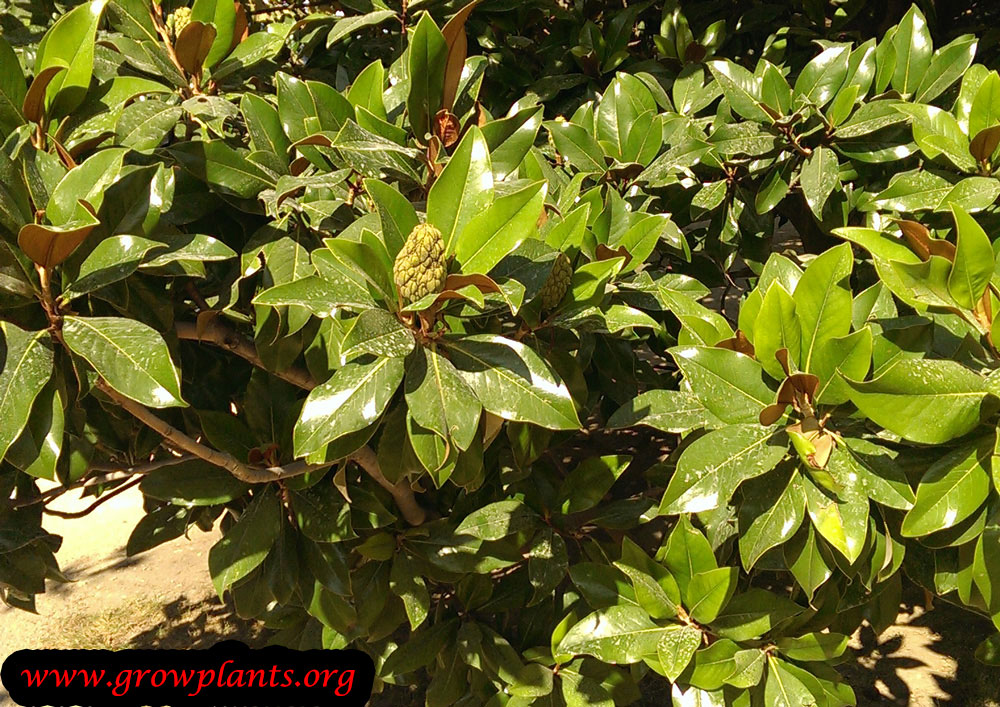
- Leaves & Foliage: Large, glossy, leathery elliptic leaves, dark green above and often rusty-felted beneath.
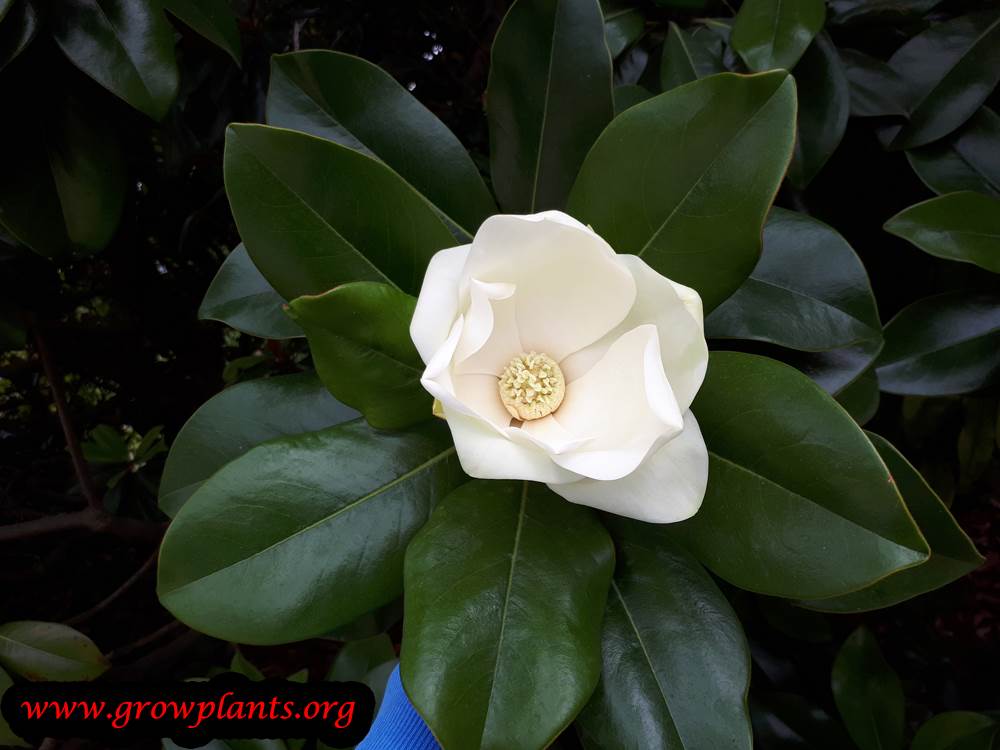
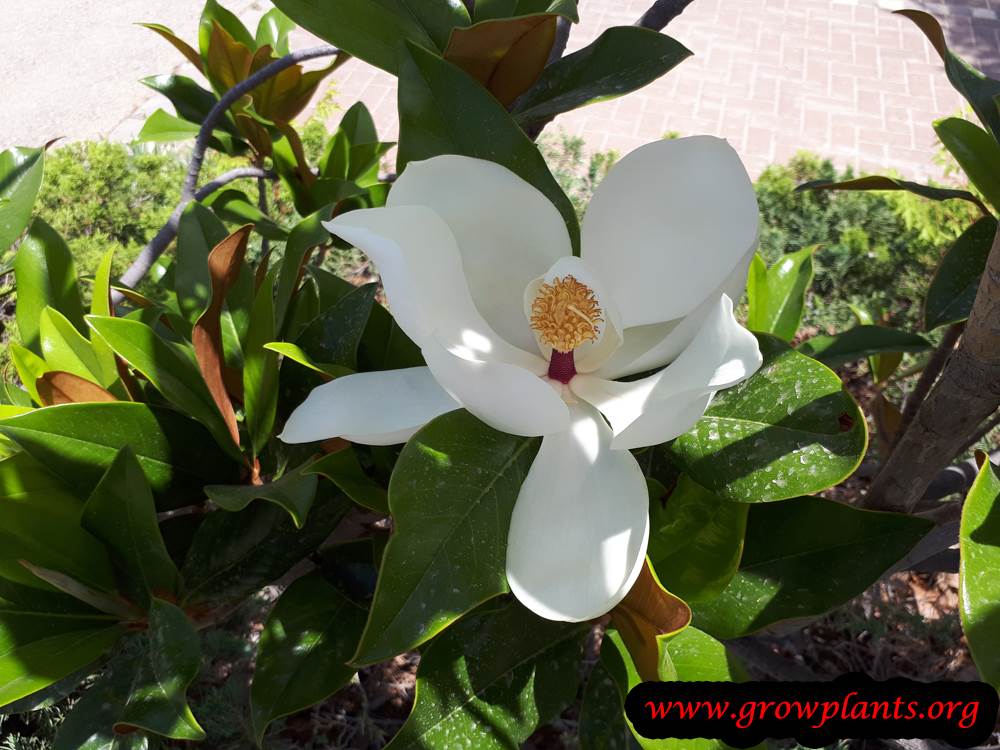
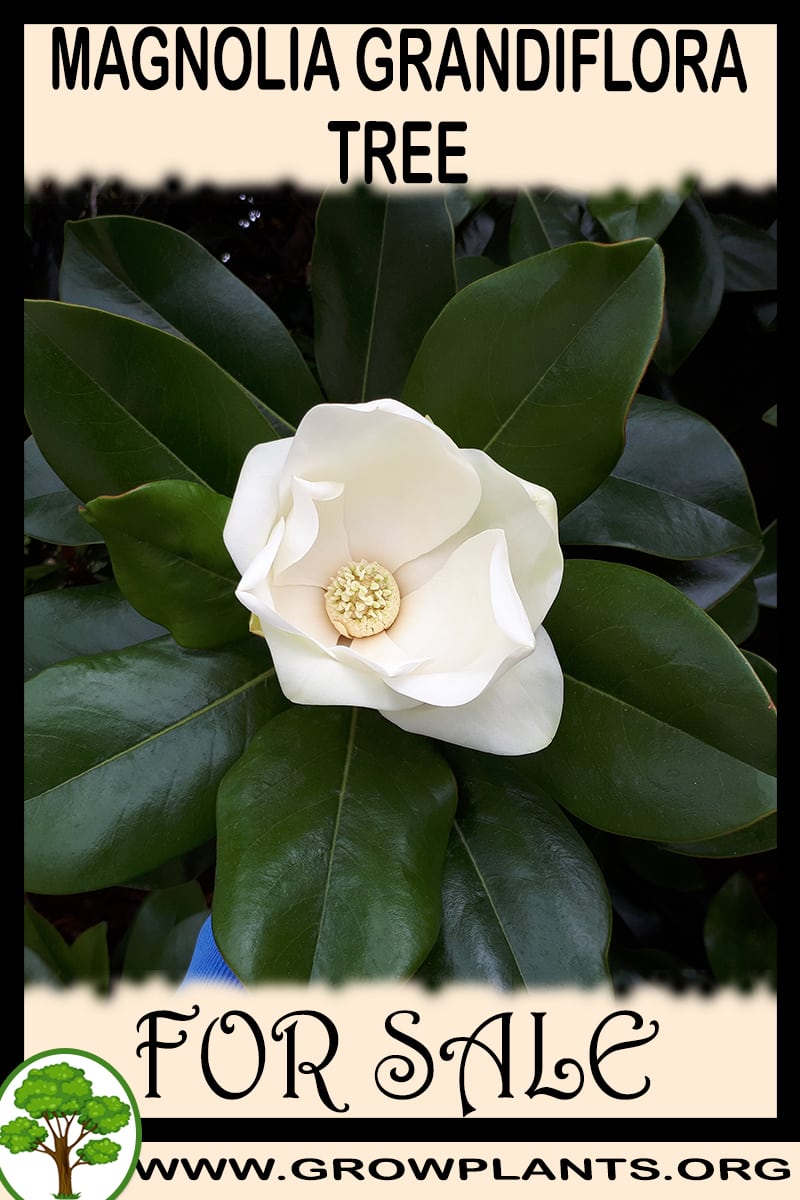
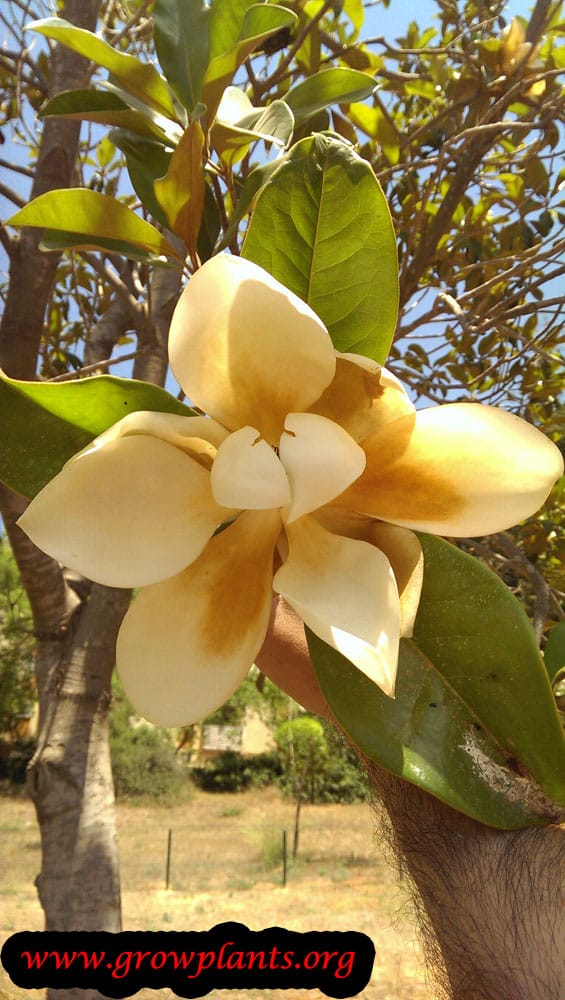
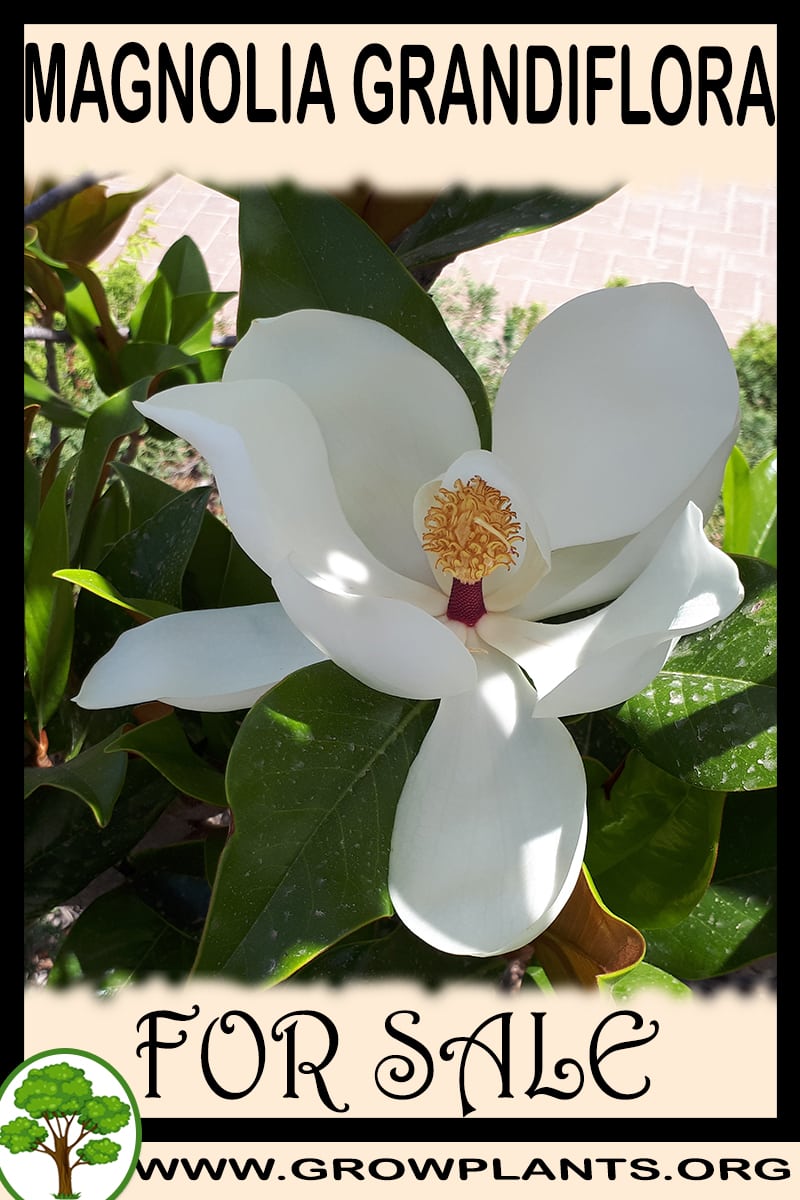
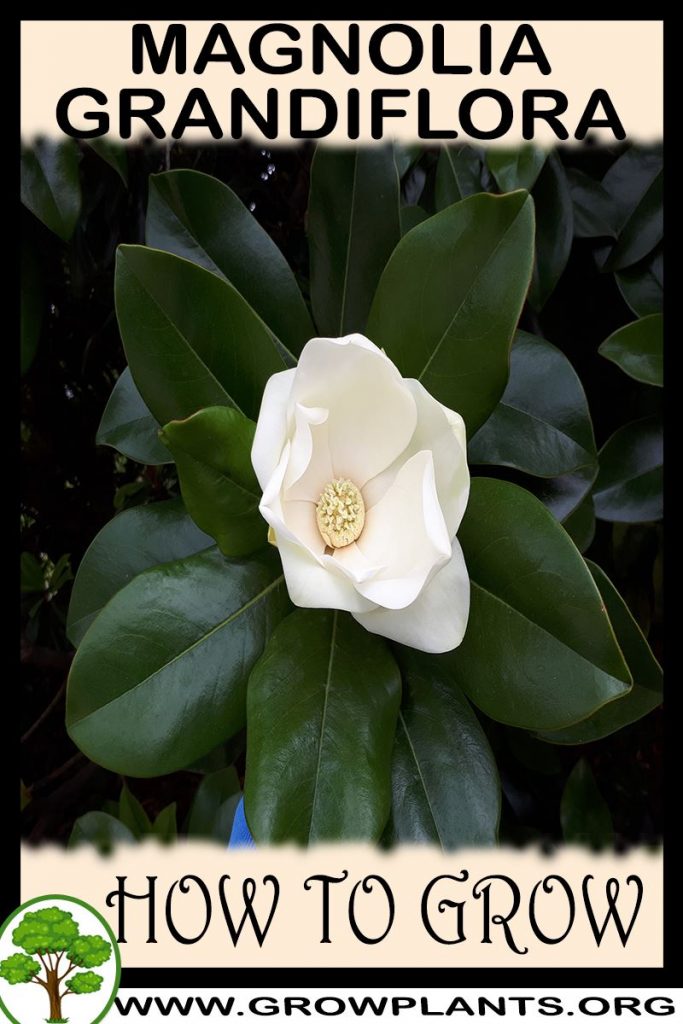
- Flower Characteristics: Very large, fragrant white flowers 10-30 cm across, with 6-12 petals.
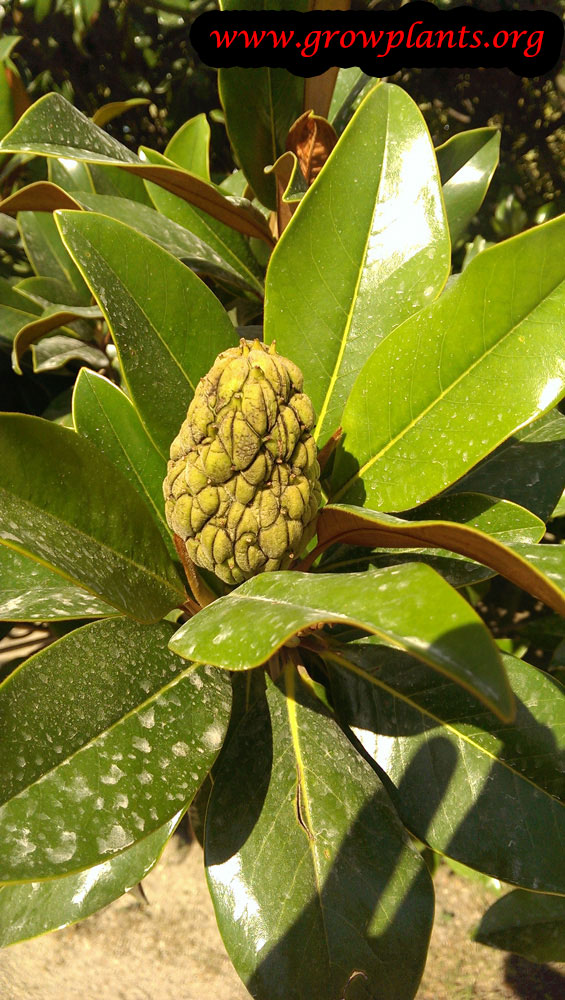
- Fruit Profile: Cone-like fruit opening to reveal red seeds – not edible.
Primary Uses & Landscape Value
- Functional & Ornamental Roles: Specimen shade tree grown for its fragrant flowers and evergreen foliage; the foliage is also used in floristry.
Care Guide: Planting, Soil & Watering
Overview: Southern magnolia (Magnolia grandiflora) is a large, moderate-growing evergreen tree (zones 6–10) for full sun to part shade. It thrives in a rich, moist, well-drained and slightly acidic soil, and prefers steady, moderate moisture.
Quick Care Requirements
| Requirement | Ideal Condition |
|---|---|
| Planting Season | Spring, summer or autumn |
| Growth Rate | Moderate |
| Soil Type | Rich, moist, well-drained, acidic |
| Soil pH | Slightly acidic (approx. 5.0–6.5) |
| Water Need | Moderate – keep evenly moist |
Planting & Establishment
- Best Planting Season: In spring, summer or autumn, avoiding the coldest part of winter.
- How to Plant:
- Hole Preparation: Dig a hole about the depth of the root ball and two to three times as wide, loosening the sides for the spreading roots.
- Soil Amendments: Blend generous compost, leaf mould or other acidic organic matter into the backfill to enrich the soil and support drainage.
- Planting Depth: Set the root collar level with, or very slightly above, the soil surface; magnolias resent deep planting.
- Growth Speed & Expectations: A moderate grower that becomes a very large tree over time, so allow plenty of space.
Soil, Watering & Drainage Care
- Soil Mix & Drainage Needs: A deep, humus-rich, moisture-retentive but free-draining acidic soil is ideal; mulch to keep the roots cool and moist. Too large for permanent container growing.
- Watering Schedule & Technique:
- Young / Newly Planted: Keep the soil consistently moist while the plant establishes, watering whenever the surface begins to dry.
- Established: Water deeply when the top few centimetres dry, keeping the soil evenly moist — it dislikes drying out fully.
- Seasonal Adjustments: Cut back in winter and water more often during hot, dry spells.
Climate, Light & Hardiness
Southern magnolia is a stately broadleaf evergreen tree for subtropical, Mediterranean, warm-temperate and tropical climates, valued for glossy foliage and large fragrant flowers. It grows in full sun to partial shade and is notably cold-hardy for an evergreen of its kind, rated by the site across hardiness zones 6–10.
Quick Climate Specifications
| Climate Zones | Subtropical, Mediterranean, warm-temperate, tropical |
|---|---|
| USDA Hardiness Zones | Approximately 6–10 (site data) |
| Optimal Temp Range | Warm to mild, roughly 18–30°C (64–86°F) |
| Cold Damage Begins | Severe cold and freezing wind scorch the evergreen foliage |
| Frost Tolerance | Moderate to high (established trees) |
| Light Conditions | Full sun to partial shade |
| Wind Tolerance | Moderate |
Sunlight & Light Exposure
Optimal Light Setup
Full sun gives the densest crown and heaviest flowering, but the tree also grows well in partial shade, which can help in very hot, dry regions.
Best Exposure / Orientation
In colder parts of its range a position sheltered from cold, drying winter winds – and away from the harshest freezing exposure – reduces leaf scorch and protects early growth.
Temperature Extremes & Hardiness
USDA Hardiness & Regional Limits
Site data lists zones 6–10; the lower edge of zone 6 corresponds to winter lows around −23 to −18°C (−10 to 0°F). Cold tolerance varies by cultivar and by plant age, with mature trees noticeably tougher than young ones.
Cold Damage & Winter Protection
Established trees withstand hard frost, but severe cold and freezing wind can brown and scorch the large evergreen leaves; foliage typically recovers in spring. Young trees benefit from shelter through their first winters.
Extreme Heat Tolerance
Good – it is well suited to hot subtropical and Mediterranean summers, growing best where soil stays evenly moist, slightly acidic and well drained.
Wind, Humidity & Microclimate
Wind Tolerance
Moderate. The big glossy leaves catch the wind and can tatter or scorch in strong, dry or freezing gusts, and limbs are somewhat brittle, so a sheltered position is preferable in exposed gardens.
Coastal / Salt Tolerance
Tolerates some coastal exposure and salt spray but is not a front-line seaside tree; give it shelter behind hardier plantings near the coast.
Growing in Pots, Balconies & Indoors
Southern magnolia is a magnificent large evergreen tree, reaching 10-30 m – the grower marks it as neither a houseplant nor a long-term container plant, and both assessments are honest. It is a ground tree at heart; a pot can only ever hold a young plant briefly before it needs to be planted out.
Quick Details
- Container Size: Only a very large tub for a young plant, and then not for long – the grower does not recommend it as a container tree
- Indoor Suitability: Not a houseplant – far too large and light-hungry for indoors
- Best Spot: Full sun to half shade, in the open ground where it has room
- Soil & Drainage: Rich, moist, slightly acid, well-drained soil (grower’s guidance)
- Watering in Pots: If pot-grown while young, keep steadily moist – but a big tree soon outgrows any pot
Indoors & On the Windowsill
- Not a houseplant: The grower marks it unsuitable indoors – it is a forest-scale tree with glossy leaves that need full outdoor light.
- No windowsill option: Even a young plant quickly becomes too large and woody for a sill or room.
On a Balcony or Patio
- Only briefly, while young: A young plant can stand in a large tub on a patio for a season or two, but it is short-term – it will need planting into the ground.
- Weight & wind: A big evergreen in a tub is heavy and catches wind; keep it staked, sheltered and never let the large glossy leaves dry out.
Choosing the Pot, Soil & Long-Term Care
- Pot & drainage: If holding a young plant, use the largest tub you can with strong drainage holes and no standing-water saucer; terracotta breathes, plastic holds moisture longer.
- Potting mix: A rich, slightly acid, moisture-retentive but free-draining mix.
- Feeding: Feed through the growing season while potted – nutrients leach quickly – but understand this is a stop-gap, not a home.
- Plant it out: The right long-term care is to plant it in open ground; it is not a plant to keep in a container.
Fertilizing & Feeding
A moderate feeder that blooms best on balanced feeding with adequate nitrogen; avoid high-phosphorus bloom boosters, and stop feeding by late summer so no frost-tender growth is pushed.
Quick Fertilizing Specs
| Feeding Level | Moderate |
|---|---|
| Main Nutrient Priority | Balanced feeding with adequate nitrogen, not high phosphorus |
| Best Feeding Period | Early in the growing season through spring |
| Organic Options | Compost and organic mulch over the root zone |
| Micronutrients | Watch for iron on alkaline soils |
| Soil pH | Moist, well-drained, slightly acidic soil |
| Reduce/Stop Feeding | Stop feeding by late summer to avoid frost-tender growth |
Feeding by Growth Stage
Spring growth
Support a healthy flush of new leaves and shoots as growth resumes.
| Nutrient direction | A balanced complete fertilizer as new growth begins; adequate nitrogen, not high phosphorus. |
|---|---|
| Timing | Early in the growing season as buds break and shoots extend. |
| Frequency | A feeding early in the growing season supports the season’s growth. |
| Fertilizer types | A balanced complete fertilizer, Slow-release granular fertilizer, Compost or organic matter |
| Precautions | Avoid high-phosphorus “bloom booster” products; balanced feeding with adequate nitrogen drives healthy bloom. |
Flowering
Sustain the plant through fragrant flowering without forcing soft growth.
| Nutrient direction | Keep balanced feeding rather than switching to a high-phosphorus product for more flowers. |
|---|---|
| Timing | Around the flowering period. |
| Frequency | Little extra feeding is needed during bloom itself. |
| Fertilizer types | A balanced complete fertilizer |
| Precautions | Extra phosphorus does not increase bloom and can harm soil life; keep feeding balanced. |
Dormancy / winter rest
Let the tree rest through the cold season.
| Nutrient direction | None – withhold fertilizer while the tree is dormant. |
|---|---|
| Timing | Late autumn and winter dormancy. |
| Frequency | No feeding at this stage. |
| Fertilizer types | No feeding at this stage until growth resumes in spring. |
| Precautions | Do not fertilize a dormant tree; feeding late can push frost-tender growth. |
Nutrient Deficiency Signs & Corrections
Younger leaves yellow between the veins while the veins remain green; severe cases scorch.
| Possible causes | Iron uptake limited by high or alkaline soil pH, Waterlogged or compacted soil, Root damage or stress |
|---|---|
| Appears first on | Youngest leaves |
| What to check | soil pH, drainage and soil compaction, root condition |
| Possible correction | Correct soil pH toward slightly acidic and apply a chelated iron product following its label. |
Overall pale foliage with weak, slow new growth.
| Possible causes | Low soil nitrogen, Leaching in sandy soils, Competition from turf or nearby roots |
|---|---|
| Appears first on | Older leaves |
| What to check | soil fertility and feeding history, mulch and organic matter, surrounding competition |
| Possible correction | Apply a balanced feed with adequate nitrogen and maintain organic mulch. |
Leaf margins brown and scorch, or soft late growth is damaged by frost.
| Possible causes | Excess fertilizer salts, Feeding too late in the season pushing tender growth, Drought stress |
|---|---|
| Appears first on | Leaf margins and new shoots |
| What to check | recent feeding timing and amount, soil moisture, exposure to frost |
| Possible correction | Lighten feeding, water thoroughly to flush salts, and avoid late-season nitrogen. |
Pruning, Training & Seasonal Maintenance
Magnolia grandiflora (Southern magnolia) is a large evergreen tree that naturally forms a fine pyramidal shape and needs very little pruning. Much of its beauty depends on keeping the low branches, or “skirt,” sweeping to the ground, so the usual aim is only to remove dead or crossing wood and to do any shaping while the tree is young – the facts note it becomes hard to prune once large. It flowers in summer on the current season’s tip growth and heals wounds slowly, so heavy or late cuts cost both blooms and long-term health.
Quick Pruning & Maintenance Specs
| Pruning Tolerance | Low – minimal cuts; slow to heal large wounds |
| Primary Pruning Window | Just after flowering, or late winter, kept light |
| Typical Frequency | Rarely – every few years for deadwood and form |
| Main Objective | Remove dead/crossing wood; keep a central leader and the low skirt |
| Young Plant Priority | Establish one central leader; correct competing leaders early |
| Mature Plant Priority | Deadwood and storm damage only; avoid large cuts |
| Best Tool Type | Bypass secateurs and loppers; a saw and pole pruner for height |
| Avoid Heavy Pruning During | Any time in the sense of “heavy” – no topping; avoid hot, dry spells |
Pruning by Plant Age & Size
Newly Established
Remove only damaged growth; do not shorten the leader. Early establishment is about letting the tree build its natural form.
Young / Formative
Train a single central leader and remove any double leader or badly crossing limb now, while the cuts are small and reachable – this is the moment the facts hint at, before the tree becomes too big to prune. Keep the low branches; they are part of the tree’s character.
Mature / Established
Restrict work to deadwood, storm breakage and the occasional crossing limb. Accept the tree’s ultimate size rather than trying to reduce it, since big cuts heal poorly.
Seasonal Pruning Schedule
Post-Flowering / Late-Winter Light Structural
Objective: small corrective cuts with the least bloom loss. Remove: dead, crossing or poorly placed small limbs. Do NOT remove: many growing tips, which reduces the summer flowering. Expected response: slow wound closure, so keep cuts small and clean.
Ongoing Sanitary
Objective: safety and health. Remove: deadwood and storm-damaged limbs as they appear. Do NOT: undertake hard seasonal shearing – this is not a plant to clip.
Flowering & Fruiting Wood
Flowers form on the current season’s terminal growth in summer, followed by the red-seeded, cone-like fruit. Because bloom is on new growth, light late-winter or post-flowering pruning removes little bloom; but heavy heading that strips many growing tips both reduces flowering and spoils the dense evergreen form, so keep any cuts modest.
Structural Pruning & Training
A single central leader is the goal; remove co-dominant leaders and crossing or rubbing branches while the tree is young. Avoid hard canopy thinning – this tree is prized for its dense evergreen mass, and large thinning wounds compartmentalize slowly and invite decay.
Special Growth to Remove
- Low watersprouts or basal shoots – remove only if you specifically want a clean trunk; many growers instead keep the full low skirt.
- Deadwood – remove as needed; the tree is not grafted, so there are no rootstock suckers.
Container & Small-Space Pruning
This is not a container subject long term – it is a large forest tree and the facts confirm it is not suited to pots – so there is no container-specific pruning; give it ground room instead of trying to restrain it by cutting.
Tools
Use bypass secateurs and loppers for small limbs, a pruning saw for larger deadwood, and a pole pruner to reach height on a tall specimen. Hedge shears are never appropriate on this tree.
Tool Hygiene & Disease Risk
Routine, with an emphasis on clean cuts: because this slow healer compartmentalizes wounds gradually, sharp, clean tools that leave a tidy collar cut matter more than disinfection. Disinfect only when working on obviously cankered or diseased wood.
Cut Placement & Technique
Cut just outside the branch collar – never flush and never leaving a long stub, both of which decay on a slow-healing magnolia. Stage-remove any large limb in sections (undercut first) to avoid tearing the bark down the trunk under its weight.
Heavy Pruning & Rejuvenation
Poorly tolerated. Magnolia grandiflora does not respond well to topping or hard renovation; large wounds decay slowly and can lead to dieback and rot. The real remedy is prevention – shape lightly when young rather than cutting hard later – and to reduce the tree’s eventual scale by siting, not sawing.
Post-Pruning Care
Little is needed. Monitor large wounds, which close slowly, keep the tree watered through drought after any canopy opening (newly exposed bark and inner leaves can scorch), and do not feed to force regrowth.
Common Pruning Mistakes
- Removing the low skirt and leaving a bare, out-of-character trunk.
- Topping the tree to reduce height, which triggers decay and ugly regrowth.
- Large flush cuts or stubs that rot rather than heal.
- Leaving all formative training until the tree is too big to reach safely.
When NOT to Prune
Avoid large cuts on a mature tree at any time, and do not prune heavily in hot, dry spells or straight after transplanting, when a slow healer is most vulnerable to stress and decay.
Recommended Tools (by task)
- bypass_secateurs – small twiggy cuts and deadwood on reachable branches.
- loppers – crossing or dead limbs up to a few centimetres thick.
- pruning_saw – larger deadwood and staged limb removal with clean collar cuts.
- pole_pruner – to reach height on this tall tree without topping or climbing.
Pruning Troubleshooting
| Problem | Possible Cause | What to Check | Corrective Action |
| Dieback and decay after big cuts | Large wounds closing slowly | Whether cuts were large, flush or stubbed | Stop making large cuts; cut future limbs at the collar and keep them small |
| Sparse flowering after pruning | Too many growing tips removed | How much current-season tip growth was cut | Prune only lightly after bloom; let tips rebuild |
| Bark torn down the trunk | Heavy limb removed in one cut | Whether limbs were staged/undercut | Remove big limbs in sections with an undercut first |
| Bare, exposed lower trunk | Low skirt removed | Whether low branches were cut off | Retain the skirt in future; lost low limbs will not regrow on old wood |
Propagation Guide
The species is grown from seed, which must be cleaned and cold-stratified and never allowed to dry out, while named cultivars are propagated by semi-hardwood cuttings or grafting to stay true. Seedlings are variable and slow, so propagation is moderate to difficult depending on the method chosen.
Quick Propagation Specs
| Best Propagation Method | Seed for the species; semi-hardwood cuttings or grafting for named cultivars |
| Alternative Methods | Air layering; chip budding |
| Propagation Difficulty | Moderate to Difficult |
| Seed True-to-Type | Variable — seedlings differ from the parent |
| Vegetative True-to-Type | Yes — needed to keep a cultivar |
| Best Propagation Season | Sow after stratification; take semi-hardwood cuttings in mid to late summer |
| Seed Germination Time | Slow and often erratic after stratification |
Growing from Seed
Seed Handling & Viability
Seed is recalcitrant: remove the fleshy red seed coat (aril), keep the seed moist, and do not let it dry, as viability falls quickly with drying. Sow fresh or hold in moist, cool storage until stratified.
Dormancy & Pre-Sowing Treatment
Seed needs a period of moist cold stratification of roughly two to four months before it will germinate.
Sowing Depth & Germination Conditions
Sow about 1–2 cm (roughly ½ in) deep in a moist, well-drained mix and keep warm after the cold period.
Germination Time
Emergence is slow and staggered; seedlings then grow on for several seasons before reaching planting size.
Stem Cuttings
Cutting Type & Timing
Semi-hardwood cuttings of the current season’s growth, taken in mid to late summer.
Cutting Preparation & Rooting Hormone
Wounding the base and treating with a strong rooting hormone are strongly recommended, as this species roots slowly and unevenly.
Rooting Setup & Time
Root under mist or high humidity with gentle warmth; rooting is slow, often taking several weeks to a few months.
Grafting & Budding
Why Grafting Is Used
Cultivars that are slow or difficult from cuttings are grafted to reproduce them true and to speed nursery production.
Preferred Methods & Rootstock
Chip budding or side-veneer grafting onto seedling Magnolia grandiflora rootstock is typical; graft in late winter under cover or in summer.
Air & Ground Layering
Air layering of a younger, pencil-thick branch — girdle, wrap with moist medium, and keep it damp — can root over a growing season before the layer is separated.
Bloom & Edible Flower Guide
Quick Details
- Bloom Season: Late spring and summer
- Time to First Bloom: A slow starter – nursery-grown or grafted trees usually flower within a few years, while seedlings can take much longer
- Flower Appearance: Large, fragrant, creamy-white flowers with 6-12 petals, up to 10-30 cm across
- Edibility: The petals are edible – crisp, with a lemony, gingery bite, and are sometimes pickled or used as a spice; use only freshly opened, unsprayed flowers
Detailed Blooming Overview
Magnolia grandiflora belongs to a very old flowering lineage that appeared before bees, so its big, cup-shaped blooms are built for, and mainly pollinated by, beetles. The fragrant, creamy-white flowers open a few at a time across late spring and summer.
Flower Characteristics
- Large, white, fragrant flowers with 6-12 petals (tepals), 10-30 cm across.
- Goblet-shaped, opening wide in warm weather.
- Carried over a long season, a few blooms at a time.
Bloom Care & Thinning
- Managing the bloom: Little is needed – the tree flowers naturally; simply remove spent blooms within reach for tidiness.
- Pollination: Primarily beetle-pollinated.
- Edible use: Pick only just-opened, unsprayed petals; the flavour is strong, so use sparingly.
Fruit & Uses
Southern magnolia is grown as an ornamental tree, not as a food crop, and most of it is not eaten. Its only edible part is the flower petal, which has a marginal, niche use as a pickle or aromatic flavouring; the red cone-like fruit and its seeds are not edible.
Quick Edible Specs
| Edible Parts | Flower petals only (marginal use) |
|---|---|
| Main Use(s) | Occasional culinary flavouring – petals pickled or candied; otherwise purely ornamental |
| Eaten Raw or Cooked | Petals are pickled or cooked and used in very small amounts |
| Preparation Required | Use young petals, wash well, pickle/candy; the flavour is strong so use sparingly |
| Safety/Toxicity Caveat | Fruit and seeds are not edible; treat the petals as a garnish/flavouring, not a food staple, and be sure of correct identification |
Flowers & Flower Buds
The flowers are large, white and strongly fragrant, with 6–12 petals and a size of about 10–30 cm. Young, thick petals are the only part with a culinary tradition – they are pickled in vinegar or candied and used as a spice-like, ginger-ish flavouring. Because the aroma is intense, only small quantities are used.
Preparation, Uses & Safety
This is a marginal culinary use, not a mainstream food. If used, take fresh young petals, wash them, and pickle or lightly cook them; use sparingly because of the strong flavour. The red fruit/cone and the seeds are not eaten. No medicinal or health claims are made.
Pests, Diseases & Troubleshooting
Overview: Magnolias are generally robust ornamental trees whose most conspicuous pest is magnolia scale, backed by other scales, mites and thrips, while their diseases are mostly cosmetic leaf spots and mildews plus occasional canker and Verticillium wilt. The commonest real problems are abiotic – chlorosis on alkaline soil, leaf scorch and, for early-blooming types, frost damage to the flowers. Culture and sanitation carry the day.
Quick Troubleshooting Overview
| Issue / Pest | Main Symptom | Primary Solution |
|---|---|---|
| Magnolia scale | Large shiny bumps on twigs; heavy honeydew, sooty mould | Prune out; dormant/horticultural oil at crawler stage |
| Scale (soft/tuliptree) | Brown scales, yellowing, sticky leaves | Scrape/prune; horticultural oil |
| Spider mites | Stippling and bronzing in hot dry weather | Hose foliage; horticultural oil |
| Leaf spots / algal spot | Brown or grey-green spots on leaves | Rake leaves; airflow; copper if severe |
| Chlorosis | Interveinal yellowing on alkaline soil | Acidify soil; chelated iron; mulch |
| Frost/scorch damage | Browned flowers or scorched leaf margins | Shelter siting; even watering; delay pruning |
Common Pests & Management
- Magnolia scale (Neolecanium cornuparvum):
- Symptoms: One of the largest soft scales – smooth, shiny, pinkish-brown to grey bumps up to a centimetre across encrust twigs and branches, drenching the plant in honeydew and black sooty mould and causing branch dieback.
- Prevention & Control: Prune out and destroy heavily infested twigs, apply horticultural or dormant oil to smother the overwintering nymphs and target the crawler stage in the warm season, and conserve parasitoid wasps and lady beetles; spray oils in the evening to protect pollinators.
- Tuliptree / soft scale (Toumeyella liriodendri / Coccus spp.):
- Symptoms: Brown, rounded scales on twigs and leaf undersides suck sap, yellowing leaves and coating foliage with honeydew and sooty mould.
- Prevention & Control: Scrape off accessible scale, prune out infested wood, and treat crawlers with horticultural oil; keep trees vigorous and unstressed.
- Two-spotted / spider mites (Tetranychus urticae / Oligonychus spp.):
- Symptoms: Fine pale stippling, bronzing and faint webbing on leaves in hot, dry, dusty conditions, causing dullness and early leaf drop.
- Prevention & Control: Hose foliage to remove dust and mites, keep the tree watered during drought, and use horticultural oil for persistent colonies; conserve predatory mites.
- Thrips (Thrips / Frankliniella spp.):
- Symptoms: Silvery flecking and distortion of young leaves and petals with tiny black frass, sometimes browning the flowers.
- Prevention & Control: Encourage predators, hose foliage, and use insecticidal soap or neem only if damage is heavy; keep plants unstressed.
- Magnolia leafminer / borer (occasional) (various Lepidoptera / Coleoptera):
- Symptoms: Blotch mines or tunnels in leaves and, rarely, borers in stressed wood; usually minor on healthy trees.
- Prevention & Control: Keep trees vigorous, remove and destroy mined leaves, and address the underlying stress; borers seldom trouble healthy magnolias.
Diseases & Fungal Issues
- Bacterial leaf spot (Pseudomonas syringae):
- Symptoms: Angular water-soaked then brown-black spots on leaves, sometimes with yellow halos, in cool wet conditions; mostly cosmetic.
- Treatment & Management: Rake up and destroy fallen leaves, avoid overhead watering, improve airflow, and use a copper spray only where it recurs badly.
- Algal leaf spot (Cephaleuros virescens):
- Symptoms: Circular grey-green to orange velvety patches on leaves of evergreen magnolias in warm, humid, still conditions.
- Treatment & Management: Improve air circulation by pruning, reduce leaf wetness, keep trees vigorous, and apply a copper product for severe infections.
- Powdery mildew (Microsphaera spp.):
- Symptoms: White powdery patches on leaves in warm, humid, crowded conditions, causing yellowing and distortion.
- Treatment & Management: Prune for airflow, water at the base, remove affected leaves, and use sulfur or potassium-bicarbonate if it spreads.
- Verticillium wilt (Verticillium spp.):
- Symptoms: Sudden wilting, yellowing and dieback of one side or scattered branches, with dark staining in the wood – a soil-borne vascular disease.
- Treatment & Management: There is no cure: prune out dead wood, keep the tree vigorous with water and mulch, avoid planting magnolias where the disease is known, and remove severely affected trees.
- Canker & dieback (Nectria / Botryosphaeria):
- Symptoms: Sunken, cracked cankers on branches with dieback, usually entering through wounds or cold-damaged bark.
- Treatment & Management: Prune out cankered wood well below the lesion with sterilised tools in dry weather, avoid wounding, and keep trees unstressed.
Growing Difficulties & Abiotic Problems
- Lime-induced chlorosis:
- Cause & Symptoms: Interveinal yellowing of leaves on alkaline soil, as magnolias prefer neutral to acid ground and cannot take up iron at high pH.
- Correction Strategy: Test and acidify the soil with organic matter and elemental sulfur, mulch with leaf-mould, and correct quickly with chelated iron; site in suitable acid-to-neutral soil long term.
- Leaf scorch & sunburn:
- Cause & Symptoms: Browned leaf margins and bleached patches from drought, hot wind or intense reflected sun, worst on newly planted trees.
- Correction Strategy: Water deeply and evenly especially while establishing, mulch to conserve moisture, and shelter from hot drying wind; avoid planting against hot reflective walls.
- Salt & wind on evergreen foliage:
- Cause & Symptoms: Marginal browning and leaf drop on this broadleaf evergreen from salt spray, road salt or persistent wind.
- Correction Strategy: Site with wind shelter, avoid salt exposure, and rinse foliage in coastal settings; choose a protected position for best evergreen appearance.
What Helps – Products & Tools
Sanitation and oil are the mainstays: prune out and oil-treat magnolia scale at the crawler stage, hose off mites, and rake leaves to limit leaf spots. Chelated iron corrects chlorosis on limey soil, and copper or sulfur handle stubborn leaf spot or mildew. Careful siting prevents most scorch and frost damage.