



Plant Profile & Key Characteristics
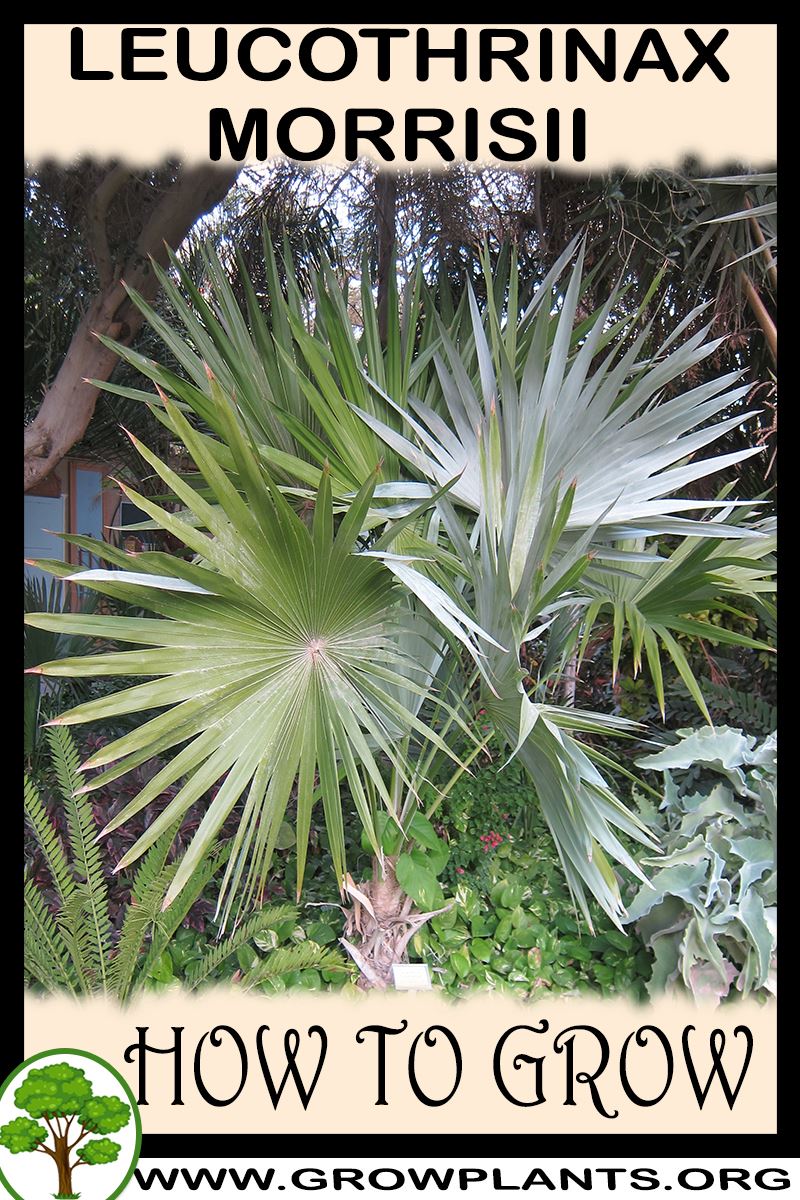
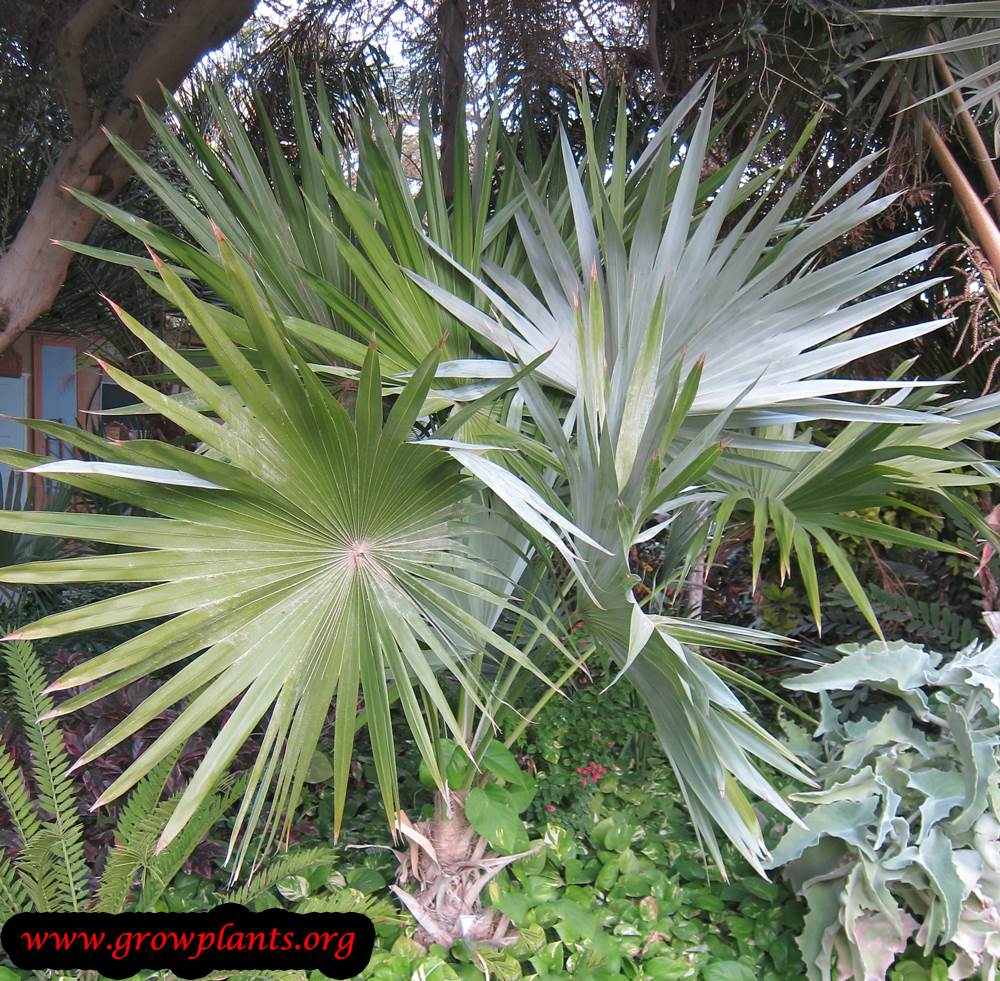
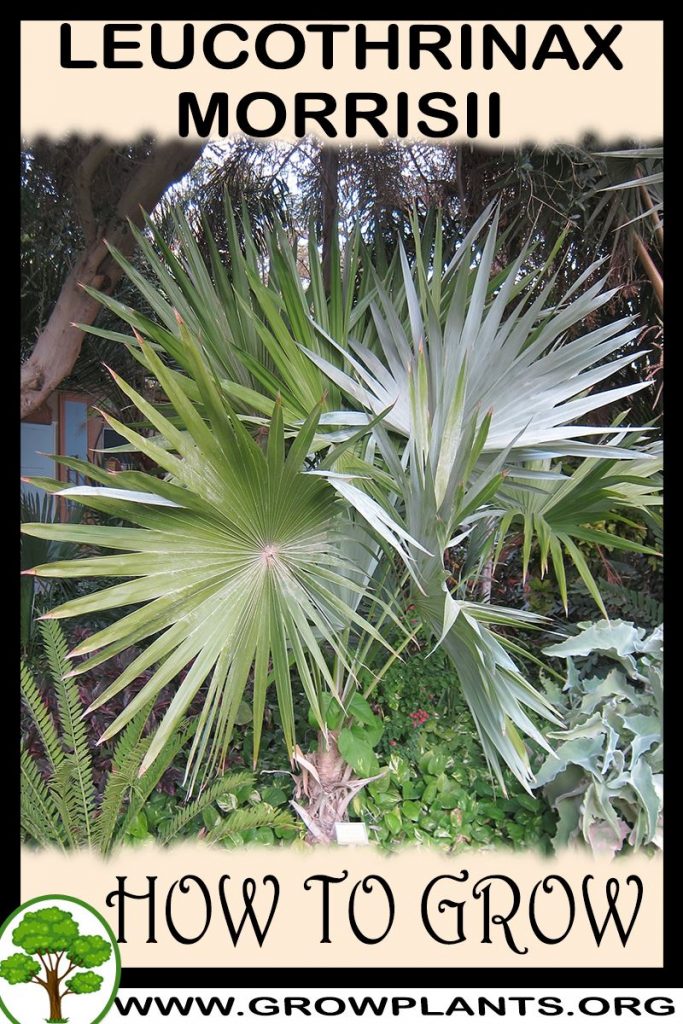
Overview: Leucothrinax morrisii, the key thatch palm, is a small to medium evergreen fan palm grown as an ornamental in warm climates. It develops a slender trunk topped by rounded, deeply divided green fan leaves.
Quick Specifications
| Plant Type | Evergreen perennial palm |
| Growth Habit | Solitary fan palm |
| Growth Rate | Moderate |
| Light | Full sun |
| Water Need | Moderate with good drainage |
| Climate | Tropical to subtropical; also suitable to warm Mediterranean or arid climates with protection from cold |
| Primary Use | Ornamental palm |
Growth Form & Structure
The crown is formed from stiff fan-shaped fronds that divide into narrow segments. The palm is best treated as a solitary species, which is also why seed is the normal propagation route.
Care Guide: Planting, Soil & Watering
Overview: Key thatch palm is a slow-to-moderate palm that grows in full sun in tropical, subtropical, Mediterranean, or desert climates (hardiness zone 10b+). It needs a well-drained soil – it tolerates sandy, coastal, limestone ground – and moderate water.
Quick Care Requirements
| Requirement | Ideal Condition |
|---|---|
| Planting Season | Year-round in warm, frost-free conditions |
| Growth Rate | Moderate |
| Soil Type | Well-draining; tolerates sandy, coastal limestone soil |
| Water Need | Moderate |
Planting & Establishment
- Best Planting Season: Plant year-round wherever it stays warm and frost-free.
- How to Plant:
- Hole Preparation: Dig a hole as wide as or slightly larger than the root ball.
- Soil Amendments: Ensure the site drains freely.
- Planting Depth: Set the palm at the same depth as its root ball; do not bury the base of the trunk.
- Growth Speed & Expectations: A moderate grower reaching about 1-10 m (3-30 ft).
Soil, Watering & Drainage Care
- Soil Mix & Drainage Needs: Use a well-drained soil.
- Watering Schedule & Technique:
- Young / Newly Planted: Water regularly to help it establish.
- Established: Water moderately and deeply; it is drought tolerant once established.
- Seasonal Adjustments: Reduce watering in winter.
Climate, Light & Hardiness
Key thatch palm is a warm-climate palm for tropical, Mediterranean, desert, and subtropical gardens, needing full sun and essentially frost-free winters.
Quick Climate Specifications
| Climate Zones | Tropical, Mediterranean, Desert, Subtropical |
|---|---|
| USDA Hardiness Zones | 10b and above |
| Frost Tolerance | Very Low |
| Light Conditions | Full Sun |
Sunlight & Light Exposure
Optimal Light Setup
Needs full sun for healthy crown development.
Temperature Extremes & Hardiness
USDA Hardiness & Regional Limits
Suited to USDA zone 10b and warmer; it has little tolerance for freezing temperatures, and even a light frost can damage the crown.
Frost Sensitivity
Frost-sensitive; best reserved for essentially frost-free climates.
Wind, Humidity & Microclimate
Coastal / Salt Tolerance
As a palm native to Caribbean and Florida Keys coastal habitats, it is well adapted to salt spray and coastal wind.
Growing in Pots, Balconies & Indoors
The Key thatch palm is a slow but ultimately large fan palm, to about 10 m – the grower marks it as neither a houseplant nor a long-term container plant. A young specimen can spend a few years in a big pot, but it is really a full-sun landscape palm for open, frost-free ground.
Quick Details
- Container Size: Only a large tub for a young palm; it will eventually outgrow any pot
- Indoor Suitability: Not suited to indoor or long-term container life – too large
- Best Spot: Full sun; outdoors in a frost-free climate
- Soil & Drainage: Free-draining mix; it is drought- and salt-tolerant once established
- Watering in Pots: Average water while young and potted; let the surface dry between waterings
Indoors & On the Windowsill
- Not a houseplant: A full-sun palm that will not thrive as a room plant.
- While young only: A juvenile tolerates a large pot on a bright terrace for a few years before needing to be planted out; there is no windowsill option.
On a Balcony or Patio
- Light & space: Give a young potted palm the sunniest, most sheltered outdoor spot; it is tough and wind-tolerant but wants warmth.
- Weight: A tubbed palm is heavy – keep it stable and plan to plant it out in time.
Choosing the Pot, Soil & Long-Term Care
- Pot & drainage: The largest stable tub you can manage, with strong drainage holes and no standing-water saucer to avoid root rot; terracotta breathes and dries faster, glazed or plastic holds moisture longer; this only buys a few years.
- Potting mix: Free-draining, a well-aerated, organic-rich potting mix – peat or coir blended with perlite or vermiculite.
- Feeding: Potted plants are fed more often than those in the ground, as watering steadily leaches nutrients from the mix – use a palm feed through the growing season.
- Long term: Plant it in the ground once it outgrows the pot; it is not a permanent container subject.
Fertilizing & Feeding
A slower-growing ornamental palm well suited to coastal and well-drained sites; it benefits from a dedicated palm fertilizer supplying steady, balanced nutrition, since palms are prone to visible potassium and magnesium deficiencies when fed with an ordinary landscape fertilizer.
Quick Fertilizing Specs
| Feeding Level | Moderate feeder – a dedicated palm fertilizer program supports steady frond growth |
|---|---|
| Main Nutrient Priority | Balanced feeding with attention to potassium and magnesium, which palms need consistently |
| Best Feeding Period | Through the active growing season |
| Soil pH | Tolerates a range of well-drained soils |
| Reduce/Stop Feeding | Ease off during cooler, slow-growth periods |
Feeding by Growth Stage
Establishment
Help a newly planted palm build root systems and settle into its site before pushing top growth
| Nutrient direction | A light, balanced feeding supports root establishment without stressing the young palm |
|---|---|
| Timing | The first growing season after planting |
| Frequency | Light feeding through the active growing season while roots establish |
| Fertilizer types | A balanced palm-formulated fertilizer applied at a light rate, Organic matter worked into the planting area |
| Precautions | Avoid heavy feeding right after transplanting, which can stress unestablished roots |
Established Growth
Maintain steady frond production and overall vigor once the palm is well rooted
| Nutrient direction | A balanced, palm-specific fertilizer that supplies consistent potassium and magnesium alongside nitrogen |
|---|---|
| Timing | Through the active growing season each year |
| Frequency | Regular light feedings through the growing season support consistent frond quality |
| Fertilizer types | A controlled-release palm-formulated fertilizer supplying balanced nutrients with potassium and magnesium |
| Routine trace nutrients | manganese, magnesium |
| Precautions | Use a palm-specific product rather than a generic landscape fertilizer, since palms are especially prone to potassium and magnesium shortfalls |
Nutrient Deficiency Signs & Corrections
Yellow to orange spotting on older fronds progressing to frizzled, necrotic leaf tips
| Possible causes | Potassium deficiency, common in palms fed with non-palm fertilizer, Sandy soil that leaches nutrients quickly, General nutrient imbalance from irregular feeding |
|---|---|
| Appears first on | Oldest fronds first |
| What to check | Fertilizer history and product type, Soil texture and drainage, Overall frond age pattern of symptoms |
| Possible correction | Switch to a palm-specific fertilizer with steady potassium and correct per its label |
Broad yellow banding along the edges of older fronds while the center of the leaf stays green
| Possible causes | Magnesium deficiency from an unbalanced or generic fertilizer, Sandy, well-leached soil, Competing potassium excess limiting magnesium uptake |
|---|---|
| Appears first on | Older, lower fronds |
| What to check | Fertilizer type and history, Soil drainage and texture, Pattern of yellowing across frond age |
| Possible correction | Apply a palm-specific fertilizer that supplies magnesium in its routine blend per its label |
New emerging fronds appear weak, yellow-streaked, or frizzled and undersized
| Possible causes | Manganese deficiency, common in palms on high-pH or poorly drained soil, Root stress from waterlogging, Overall nutrient imbalance |
|---|---|
| Appears first on | Newest emerging fronds |
| What to check | Soil pH and drainage, Recent feeding history, Root health |
| Possible correction | Improve drainage and apply a chelated manganese product per its label if the palm fertilizer alone doesn’t resolve it |
Pruning, Training & Seasonal Maintenance
Key thatch palm needs very little pruning, and what it tolerates is strictly limited to removing fully dead, brown fronds – never green, living ones. As a single-trunk palm with one growing point at its crown, it has no branch framework to shape and no capacity to regrow from a cut trunk, so the entire point of "pruning" here is sanitary frond removal rather than any kind of shaping. Autumn tends to be when dead fronds are typically cleared, though in practice a dead, fully browned frond can be removed whenever it is noticed.
Quick Pruning & Maintenance Specs
| Pruning Tolerance | Low (dead-frond removal only) |
| Primary Pruning Window | Autumn, or whenever a frond is fully dead |
| Typical Frequency | As needed, whenever a frond has fully browned |
| Main Objective | Remove only fully dead fronds; protect the trunk and growing point |
| Young Plant Priority | Leave all green fronds in place to support establishment |
| Mature Plant Priority | Remove dead fronds without cutting the frond base flush to the trunk |
| Best Tool Type | Pruning saw or loppers, sized to the frond stem |
| Avoid Heavy Pruning During | Always – this species does not tolerate structural or green-frond pruning at any time |
Pruning by Plant Age & Size
Newly Established
Do not remove any fronds beyond the fully dead; a young palm needs every green frond it has to establish its root system and support crown growth.
Young / Formative
No structural training applies – a palm has a single growing point (the crown) and cannot be trained into a branching framework the way a shrub or tree can.
Mature / Established
The only ongoing task is removing fronds once they have fully died and browned; green fronds, even ones that look untidy or are drooping, should stay on the plant as long as they retain any green tissue.
Special Growth to Remove
- Fully dead, brown fronds – the only growth that should ever be cut from this palm.
- Old flower/fruit clusters once fully spent and dry, if desired for tidiness; this species is dioecious with separate male and female plants, and removing spent inflorescences has no effect on the palm’s structure or future growth.
Tools
- Pruning saw for thicker, older frond bases.
- Loppers for smaller or already partially detached dead fronds.
Tool Hygiene & Disease Risk
High-risk in one specific sense: this species is documented as susceptible to the red palm weevil (Rhynchophorus ferrugineus), a pest strongly attracted to fresh wounds on palms. Because of this, avoid unnecessary cuts altogether, and when a genuinely dead frond is removed, use a clean, sharp tool and avoid leaving ragged wound tissue that could attract egg-laying weevils.
Cut Placement & Technique
When removing a dead frond, cut it away but deliberately leave the leaf-base (the "boot" where the frond stem attaches) in place rather than cutting flush to the trunk – on this species the retained frond bases physically protect the trunk beneath them, and stripping the trunk bare removes that protection for no horticultural benefit.
Heavy Pruning & Rejuvenation
Not tolerated in any form: a palm cannot be cut back and regrown the way a shrub can, since all of its growth comes from the single crown. Damaging or over-pruning the crown, or removing too many green fronds at once, can seriously weaken or kill the plant.
Post-Pruning Care
After removing a dead frond, simply monitor the cut area for any sign of pest activity (particularly boring damage consistent with red palm weevil) rather than treating the wound itself, and avoid making any further unnecessary cuts nearby.
Common Pruning Mistakes
- Removing green, living fronds for a tidier look – this is the single most damaging thing an owner can do to a palm’s health, since every green frond feeds the single growing crown.
- Stripping the trunk clean of old frond bases (a "hurricane cut" look) instead of leaving the protective boots in place.
- Making unnecessary cuts that create fresh wounds, given this species’ documented susceptibility to red palm weevil, which is drawn to pruning wounds.
When NOT to Prune
Never remove a frond that still has green tissue, regardless of season – only fully brown, dead fronds should ever be cut. Avoid any pruning beyond genuinely dead material at any time of year.
Recommended Tools (by task)
- pruning_saw – removing thicker, well-attached dead frond bases at the trunk.
- loppers – removing smaller or already loosened dead fronds.
Pruning Troubleshooting
| Problem | Possible Cause | What to Check | Corrective Action |
| Weakened or declining crown after pruning | Excessive removal of green fronds ("over-pruning"), which starves the single growing point | Count remaining healthy green fronds relative to how many were recently cut | Stop all further frond removal immediately and allow the palm to rebuild its canopy; only remove fully dead fronds going forward |
| Boring damage or frass near recent cuts | Red palm weevil (Rhynchophorus ferrugineus) attracted to fresh pruning wounds | Inspect cut sites and the crown for entry holes, frass or wilting new growth | Minimise further cuts, monitor closely, and seek local extension/pest-control guidance promptly given this pest’s potential to kill palms |
Propagation Guide
Leucothrinax morrisii is propagated primarily from seed. Routine propagation by suckers, pups, division, stem cuttings or leaf cuttings is not appropriate for this solitary palm.
Quick Propagation Specs
| Primary Method | Seed |
| Offshoots / Suckers | Not a routine method for this solitary palm |
| Stem or Leaf Cuttings | Not recommended |
Growing from Seed
Use mature, viable seed. Remove fleshy fruit material where present, clean the seed, and sow it in a clean, well-drained propagation medium. Keep the medium evenly moist but not waterlogged and provide warm conditions while germination and early root growth occur.
Seedling Care
Move seedlings carefully once they are established, protect young roots from damage, and increase light gradually as the young palm develops.
Bloom & Flower Guide
Quick Details
- Bloom Season: Spring
- Time to First Bloom: Only mature palms flower, after several years of growth
- Flower Appearance: Small creamy-white flowers carried on slender branched inflorescences among the leaves
- Edibility: Not eaten – an ornamental palm
Detailed Blooming Overview
The Key thatch palm sends out slender, branched flower stalks (inflorescences) from among its fan leaves, carrying many small creamy-white flowers. Unlike some palms, its flowers are bisexual (each flower has both male and female parts), so a single tree can set its own seed. Only established, mature palms reach flowering size.
Flower Characteristics
- Numerous small, creamy-white bisexual flowers.
- Held on fine, branching inflorescences that arch out among the leaves.
Bloom Care & Thinning
- Pollination: Worked by insects; the perfect (bisexual) flowers allow a lone tree to fruit.
- Managing the bloom: No thinning is needed; spent flower and fruit stalks can be trimmed off for tidiness.
Pests, Diseases & Troubleshooting
Overview: Key thatch palm is a small, slow, hardy fan palm of coastal limestone, and like other palms its concerns are scale and mite pests on the fronds, the boring weevils and caterpillars that attack palm crowns and stems, and a set of serious palm diseases – bud/root rots, Ganoderma butt rot and phytoplasma yellows. It is tougher than most palms, but vigilance for crown-borers and lethal yellowing matters where those occur.
Quick Troubleshooting Overview
| Issue / Pest | Main Symptom | Primary Solution |
|---|---|---|
| Red palm weevil / palm borers | Wilting crown, oozing holes, collapse of the spear | Remove/monitor; pheromone traps; act fast |
| Scale insects | Bumps and honeydew/sooty mould on fronds | Horticultural oil; prune worst fronds |
| Spider mites | Fine stippling, dull fronds in dry heat | Hose; raise humidity; miticidal oil |
| Palm leaf skeletonizer / caterpillars | Frass tubes; skeletonised frond tissue | Remove frass; Bt; prune |
| Ganoderma butt rot | Conks at trunk base; wilting, decline | No cure; remove; do not replant palms there |
| Lethal yellowing (phytoplasma) | Fruit drop, frond yellowing top-down, spear death | Remove; manage leafhopper vectors; resistant stock |
Common Pests & Management
- Red palm weevil & palm borers (Rhynchophorus ferrugineus):
- Symptoms: Large weevils whose grubs bore into the crown and trunk, hollowing the growing point so the spear and central fronds wilt, collapse and can be pulled out, often with oozing holes and a fermenting smell; a lethal, fast-moving pest where it occurs.
- Prevention & Control: Inspect the crown regularly, avoid unnecessary wounding of the trunk (which attracts egg-laying), and remove and destroy infested palms promptly. Use pheromone traps to monitor and reduce adults, and follow local biosecurity/quarantine advice – this pest can kill a palm before symptoms are obvious.
- Scale insects (Diaspididae / Coccidae):
- Symptoms: Brown, white or waxy bumps encrusting the fronds and stems, sucking sap and leaving honeydew that blackens with sooty mould; heavy infestations yellow and weaken the fronds.
- Prevention & Control: Prune out the worst-infested fronds, wipe or spray with horticultural oil to smother scale and crawlers (repeat as needed), and encourage ladybirds and parasitic wasps; the sooty mould clears once the scale is controlled.
- Spider mites (Tetranychus spp.):
- Symptoms: Fine pale stippling and a dull, dusty look to the fronds in hot, dry conditions, with fine webbing when severe; worse on sheltered or indoor palms.
- Prevention & Control: Hose the fronds, raise humidity, and use a horticultural oil or insecticidal soap; predatory mites help under cover.
- Palm leaf skeletonizer & caterpillars (Homaledra / Noctuidae):
- Symptoms: Caterpillars that feed under a covering of frass and webbing on the fronds, skeletonising the tissue between the veins and leaving tell-tale frass tubes.
- Prevention & Control: Remove and destroy frass-covered fronds, hose off the debris, and treat with Bacillus thuringiensis (Bt) on young larvae; encourage natural predators.
Diseases & Fungal Issues
- Ganoderma butt rot (Ganoderma zonatum):
- Symptoms: A fatal rot of the lower trunk: fronds wilt, yellow and collapse and shelf-like brown-and-white conks (brackets) appear at the trunk base; the internal wood rots and the palm dies.
- Treatment & Management: There is no cure. Remove and destroy affected palms including as much of the stump and roots as possible, do not replant a palm in the same spot, and avoid wounding trunk bases, which invites infection.
- Bud & root rot (Phytophthora / Thielaviopsis spp.):
- Symptoms: Rot of the central spear and bud (the spear pulls out easily and smells foul) or of the roots, with wilting and decline, in wet, poorly drained or over-watered conditions or after crown injury.
- Treatment & Management: Improve drainage, avoid over-watering and water sitting in the crown, and protect the bud from injury. Remove badly affected palms; a copper fungicide drench to the crown can help early bud rot on valued specimens.
- Lethal yellowing / phytoplasma (phytoplasma):
- Symptoms: A phytoplasma disease spread by planthoppers: premature fruit drop, then top-down yellowing and death of the fronds and the growing spear, killing the palm; occurs in certain regions.
- Treatment & Management: There is no home cure – remove and destroy infected palms to reduce spread, manage the leafhopper/planthopper vectors, and plant resistant species/stock where the disease is present. Follow local advice.
- Leaf spot & false smut (Various fungi (e.g. Graphiola)):
- Symptoms: Brown or black spots, blotches or small wart-like fruiting bodies on the fronds in humid, wet conditions; usually cosmetic on a healthy palm.
- Treatment & Management: Improve airflow, avoid overhead watering, remove badly spotted fronds, and use a copper fungicide only where persistent and disfiguring.
Growing Difficulties & Abiotic Problems
- Nutrient deficiency (K, Mg, Mn):
- Cause & Symptoms: Classic palm deficiencies – yellow-to-orange spotting and frond-tip necrosis (potassium), yellow banding (magnesium), or frizzled new growth (‘frizzle top’, manganese) – on poor or leached sandy soils.
- Correction Strategy: Feed with a slow-release palm fertiliser carrying potassium, magnesium and micronutrients including manganese, and correct extreme soil pH; do not remove yellowing older fronds too soon, as the palm withdraws nutrients from them.
- Over-watering / poor drainage:
- Cause & Symptoms: Yellowing, wilting and root/bud rot where soil stays wet, especially in containers.
- Correction Strategy: Grow in free-draining soil, water when the surface dries, and never leave the crown or pot standing in water.
- Cold / wind / salt burn:
- Cause & Symptoms: Browned, scorched or torn fronds from cold snaps, strong wind or (less so, as it is salt-tolerant) extreme exposure.
- Correction Strategy: Site with some shelter in marginal climates, protect in unusual cold, and simply trim off badly damaged fronds once new growth resumes.
What Helps – Products & Tools
For palms, feeding and vigilance lead. Keep a slow-release palm fertiliser (with K, Mg and Mn) for the near-inevitable deficiencies, horticultural (neem) oil for scale and mites, Bt for frond caterpillars, and pheromone traps to monitor palm weevils. For disease, a copper fungicide addresses early bud rot and leaf spot, while Ganoderma and lethal yellowing are managed by removal and resistant stock, not sprays. Spray oils in the evening to protect pollinators, and heed local biosecurity for weevils and lethal yellowing.