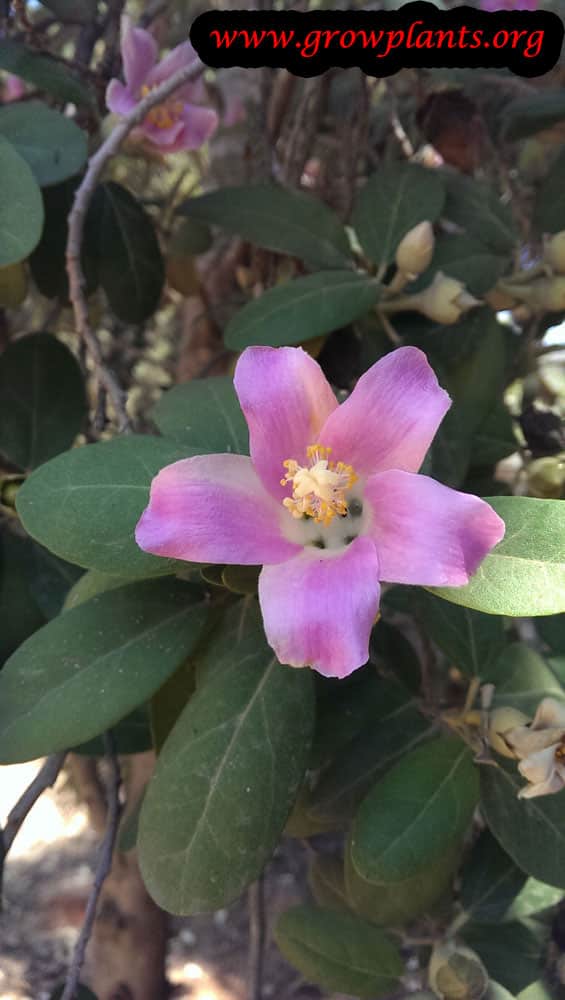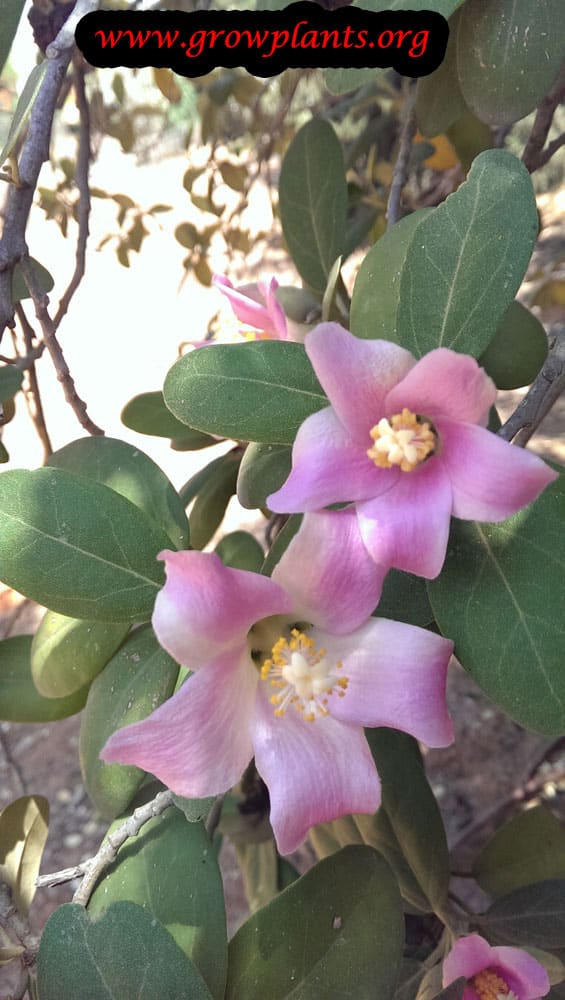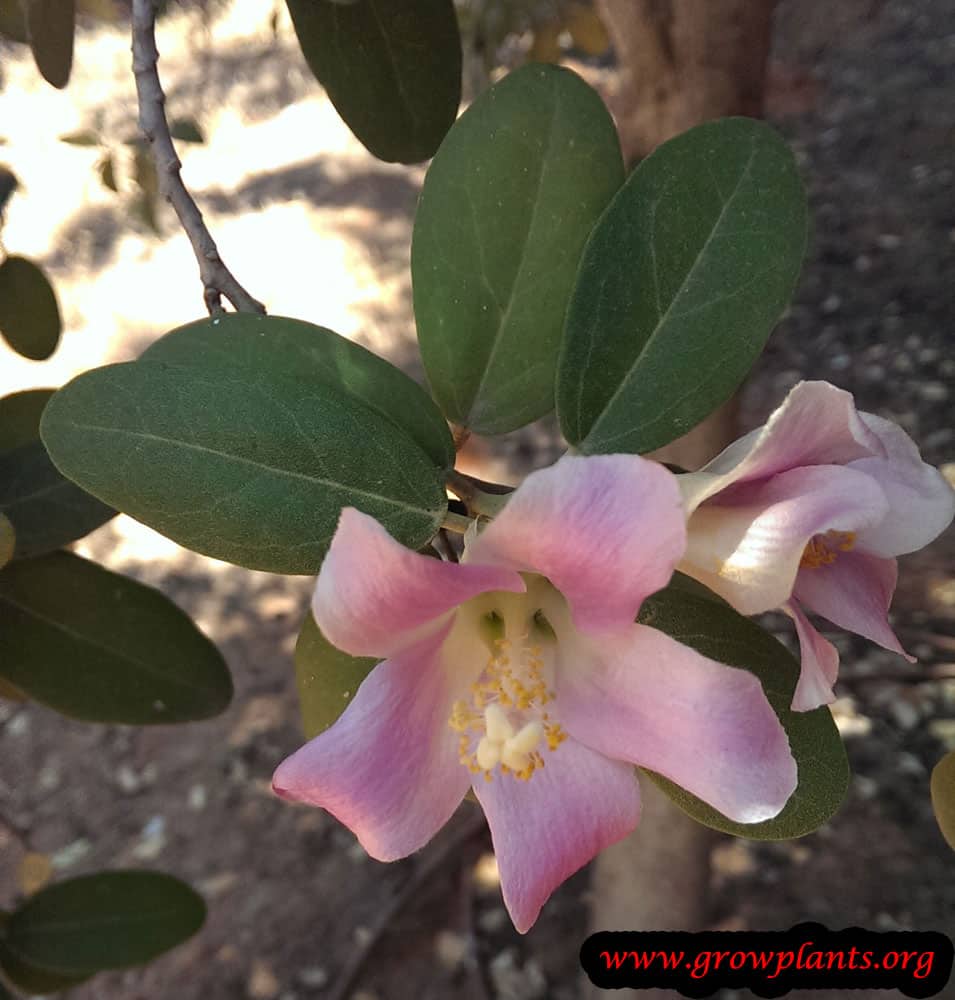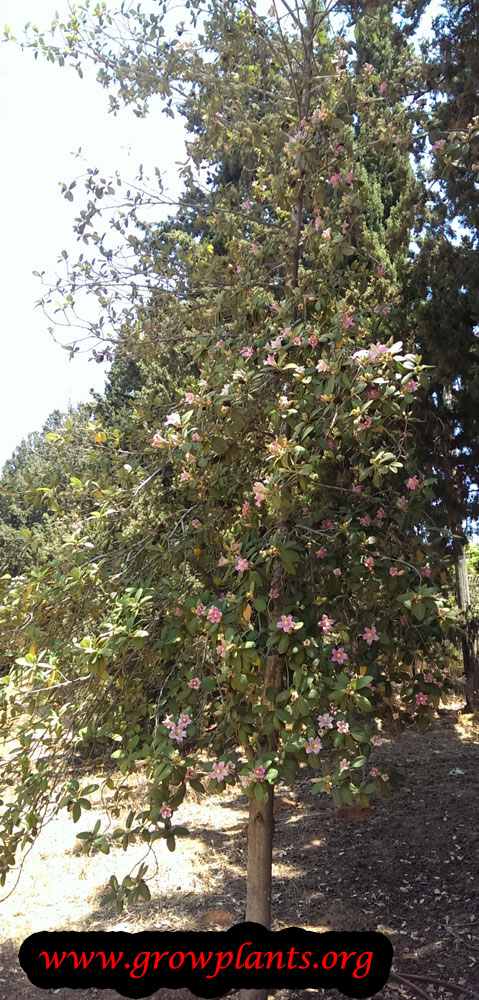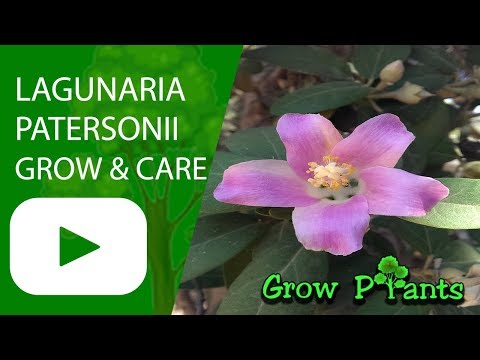

Plant Profile & Key Characteristics
Overview: Lagunaria patersonii (Norfolk Island hibiscus) is an evergreen ornamental tree reaching 7-15 m, grown for its pink, hibiscus-like flowers. Moderately fast-growing and drought tolerant, it has a neat, upright form suited to coastal and warm-climate landscapes.
Quick Specifications
| Specification | Attribute |
|---|---|
| Plant Type / Life Cycle | Perennial |
| Foliage Type | Evergreen |
| Mature Size | 7-15 m (21-45 ft) tall |
| Growth Rate | Moderate |
| Toxicity | Seed-capsule hairs are a skin and eye irritant (the ‘cow itch tree’) |
| Hardiness | USDA zones 10+ |
Growth Form & Structure
- Height & Spread: 7-15 m (21-45 ft) tall with an upright, pyramidal to columnar canopy; not suited to containers.
- Growth Habit & Form: evergreen tree with a dense, symmetrical crown.
- Lifespan & Maturity: long-lived; drought tolerant once established.
Anatomy & Physical Features
- Leaves & Foliage: light-green, elliptic leaves.
- Flower Characteristics: pink, five-petalled hibiscus-like flowers, 4-6 cm across (spring to summer).
- Fruit Profile: woody seed capsules lined with fine irritant hairs – not edible, handle with care.
Primary Uses & Landscape Value
- Functional & Ornamental Roles: drought-tolerant ornamental, coastal and avenue tree, windbreak and shade tree.
Care Guide: Planting, Soil & Watering
Overview: Norfolk Island hibiscus is an evergreen, drought-tolerant tree for warm, frost-free climates, growing in full sun to part shade. It is undemanding about soil provided drainage is good.
Quick Care Requirements
| Requirement | Ideal Condition |
|---|---|
| Planting Season | In spring and summer, once the weather is warm and settled |
| Growth Rate | Moderate |
| Soil Type | Well-draining soil; tolerant of a range of soils once established |
| Water Need | Low – drought tolerant once established |
Planting & Establishment
- Best Planting Season: Plant in spring or summer once conditions are warm; this frost-tender tree needs settled, mild weather to establish.
- How to Plant:
- Hole Preparation: Dig a hole wider than the root ball and loosen the sides so the roots can spread into the surrounding soil.
- Soil Amendments: Work a little compost into poor backfill; the tree is not demanding and tolerates lean soils.
- Planting Depth: Set the tree with its root collar at soil level; do not bury the trunk.
- Growth Speed & Expectations: A moderate grower that develops into a tall tree, in time reaching around 7-15 m.
Soil, Watering & Drainage Care
- Soil Mix & Drainage Needs: Needs free-draining soil; it tolerates a range of soils and coastal exposure but will not stand waterlogging.
- Watering Schedule & Technique:
- Young / Newly Planted: Water regularly while the young tree establishes its roots.
- Established: Once established it is drought tolerant and needs only occasional deep watering in prolonged dry spells.
- Seasonal Adjustments: Give a little extra water in extended summer drought; keep it on the dry side in winter.
Climate, Light & Hardiness
Norfolk Island hibiscus grows in tropical, subtropical, Mediterranean, and desert climates, hardy outdoors from about zone 10 upward. It grows in full sun to half shade and, as noted for this species, tolerates brief cold to roughly −3°C (27°F).
Quick Climate Specifications
| Climate Zones | Tropics, subtropics, Mediterranean, desert |
|---|---|
| USDA Hardiness Zones | 10+ |
| Approx. Survival Minimum | Approximately −3°C (27°F) |
| Frost Tolerance | Low |
| Light Conditions | Full Sun to Half Shade |
Sunlight & Light Exposure
Grows well in full sun to half shade; full sun supports the fullest flowering and densest canopy.
Temperature Extremes & Hardiness
USDA Hardiness & Regional Limits
Hardy outdoors from about zone 10 upward; it is a warm–climate tree not suited to regions with regular hard freezes.
Cold Damage & Winter Protection
The site notes it tolerates cold down to roughly −3°C (27°F); below this, foliage and branches are at risk of damage.
Frost Sensitivity
Tolerates only brief, light frost; harder or sustained freezes cause significant damage.
Wind, Humidity & Microclimate
Its drought–tolerant, low–water nature and desert/Mediterranean adaptability indicate good tolerance of dry air and coastal conditions typical of its native island habitat.
Growing in Pots, Balconies & Indoors
Norfolk Island hibiscus (Lagunaria patersonii) is a substantial evergreen tree – the grower marks it as neither a houseplant nor a container subject. It really wants the open ground; the notes below explain why and what to expect if you try a young plant in a pot.
Quick Details
- Container Size: Not recommended long-term; only a young plant in a large pot
- Indoor Suitability: Not a houseplant – a large tree unsuited to indoor light
- Best Spot: Full sun to part shade
- Soil & Drainage: Free-draining mix
- Watering in Pots: Low – drought-tolerant once established
Indoors & On the Windowsill
- Not a houseplant: Marked No – it becomes a 7-15 m tree, far too large for indoors.
- Windowsill: Not viable given its eventual size.
On a Balcony or Patio
- Container caveat: The grower marks container growing No – it is a large tree that resents confinement. A young plant can be held briefly in a big pot before planting out.
- Light & shelter: Full sun and wind-tolerant once established; a heavy pot keeps a young plant stable.
- Safety: The seed pods contain fine irritant hairs (it is nicknamed the “cow itch tree”) – handle pods with care and keep children away from them.
Choosing the Pot, Soil & Long-Term Care
- Pot & drainage: A large pot only if holding a young plant briefly with strong drainage holes; skip a standing-water saucer to avoid root rot. Terracotta breathes and dries fast, while glazed or plastic holds moisture longer.
- Potting mix: A well-aerated, organic-rich mix – peat or coir blended with perlite or vermiculite for free drainage.
- Feeding: Potted plants run their soil down fast as nutrients leach out, so feed more often than plants in open ground during active growth.
Fertilizing & Feeding
Lagunaria patersonii is a drought-tolerant landscape tree that performs well on modest feeding; established plantings often thrive with little to no routine fertilizer once settled in.
Quick Fertilizing Specs
| Feeding Level | Moderate – heavier during establishment, lighter once mature. |
|---|---|
| young_feeding | Young, newly planted trees benefit from light, balanced feeding through the growing season to support establishment. |
| mature_feeding | Established trees are drought-tolerant and typically need little to no supplemental feeding in reasonable soil. |
| Main Nutrient Priority | Balanced overall nutrition rather than any single nutrient. |
| Best Feeding Period | Active spring-to-summer growth. |
| Organic Options | Compost worked into the planting area supplies gradual nutrition for most sites. |
| Soil pH | Adaptable to a wide range of well-drained soils. |
| Reduce/Stop Feeding | Taper off as growth slows heading into the cooler part of the year. |
| Micronutrients | A complete tree fertilizer that includes iron and manganese is sufficient; no routine supplementation typically needed. |
Feeding by Growth Stage
Spring-Summer Growth Flush
Support new leaf and branch growth as the tree resumes active growth in the warm season.
| Nutrient direction | A balanced, nitrogen-adequate feeding supports steady canopy development without pushing overly soft, storm-prone growth. |
|---|---|
| Timing | As new growth begins in spring and continues through summer. |
| Frequency | Light, infrequent feedings through the active growing season are usually enough; established trees in reasonable soil often need very little supplemental feeding at all. |
| Fertilizer types | A balanced, general-purpose tree and shrub fertilizer, or a slow-release granular product worked lightly into the root zone. |
| Routine trace nutrients | iron, manganese |
| Precautions | Avoid heavy nitrogen applications, which can produce weak growth on a species valued for its sturdy, wind-tolerant form; keep feeding modest, especially on established trees. |
Bloom Support
Maintain even nutrition through the flowering period without forcing bloom with excess phosphorus.
| Nutrient direction | Continue the same balanced approach; adequate overall nutrition, not a phosphorus boost, is what drives good flowering in a tree like this. |
|---|---|
| Timing | During the spring-to-summer bloom period. |
| Frequency | Feeding needs stay light during bloom; a well-nourished tree from the growth-flush stage rarely needs an additional feeding just to bloom. |
| Fertilizer types | The same balanced, general-purpose formulation used during the growth flush, applied sparingly if at all. |
| Precautions | Resist the common idea that a high-phosphorus ‘bloom booster’ improves flowering; most soils already supply enough phosphorus for good bloom. |
Cool-Season Rest
Let growth slow naturally without pushing tender new shoots into cooler weather.
| Nutrient direction | None – withhold fertilizer while the tree is not in active growth. |
|---|---|
| Timing | Once seasonal growth has slowed heading into the cooler part of the year. |
| Frequency | No feeding at this stage. |
| Fertilizer types | No feeding at this stage; resume only once new growth restarts. |
| Precautions | Do not fertilize during the dormant rest period – late feeding can trigger frost-tender new growth going into cold weather. |
Nutrient Deficiency Signs & Corrections
Interveinal yellowing on new leaves while the veins stay green.
| Possible causes | Iron deficiency, often induced by high soil pH, Poor drainage or waterlogged roots limiting nutrient uptake, Root stress or root damage from compacted soil, Recent transplant or root disturbance |
|---|---|
| Appears first on | Newest leaves at branch tips. |
| What to check | Soil drainage and compaction around the root zone, Recent construction, grading, or root disturbance near the tree, Overall soil pH and texture |
| Possible correction | Improve drainage and aeration first; if the cause is pH-related, correct soil pH gradually and consider a chelated iron product applied per its label. |
Pale, uniformly yellow-green older leaves and slowed shoot extension.
| Possible causes | Nitrogen deficiency in the root zone, Competition from turf or weeds for available nutrients, Waterlogged or compacted soil limiting root uptake, Naturally lean, sandy soil |
|---|---|
| Appears first on | Older, lower-canopy leaves first. |
| What to check | Overall vigor and leaf color trend across the season, Soil compaction and competing vegetation near the root zone, Watering pattern for signs of over- or under-watering |
| Possible correction | A modest, balanced feeding during active growth is usually enough to correct mild nitrogen deficiency; address drainage or competing vegetation if that is the underlying cause. |
Marginal browning or scorch along the edges of older leaves.
| Possible causes | Potassium deficiency, Drought or salt stress, Leaching of nutrients from sandy, fast-draining soil, Root restriction in a confined planting site |
|---|---|
| Appears first on | Leaf margins of older leaves. |
| What to check | Recent drought stress or irrigation consistency, Soil texture and drainage rate, Any nearby salt exposure such as de-icing salt or coastal spray |
| Possible correction | Ensure consistent watering during establishment and use a balanced fertilizer with adequate potassium; avoid salty irrigation sources where possible. |
Pruning, Training & Seasonal Maintenance
Lagunaria patersonii is a medium-to-large evergreen tree that tolerates pruning well and is regularly shaped as a street, screen or specimen tree rather than grown for any harvest. Because it holds foliage year-round and is not frost-sensitive above about -3°C, light shaping cuts can be made in most seasons, but structural work is safest done in late winter, just before the spring growth flush, so wounds close quickly and the tree isn’t set back during its spring/summer bloom. Pruning mainly controls overall size, canopy shape and clearance rather than affecting fruit production, though heavy cuts made during the spring–summer flowering period will remove some of the current flush of pink hibiscus-like blooms.
Quick Pruning & Maintenance Specs
| Pruning Tolerance | Moderate–High (shapes well; avoid repeated heavy topping on mature trees) |
| Primary Pruning Window | Late winter, before the spring growth flush |
| Secondary Maintenance Window | Light shaping/deadwood removal tolerated most of the year |
| Typical Frequency | Annual structural check while young; light maintenance every 1–2 years once mature |
| Main Objective | Form, size and canopy clearance for a street/specimen/screen tree |
| Young Plant Priority | Establish a single dominant leader or clean multi-trunk framework |
| Mature Plant Priority | Canopy clearance, crossing/crowded limb removal, size control |
| Best Tool Type | Bypass secateurs and loppers for young wood; pruning saw and pole pruner for mature canopy |
| Avoid Heavy Pruning During | Peak spring–summer bloom, if flower display is a priority |
Pruning by Plant Age & Size
Newly Established
Remove only damaged, crossing or poorly angled growth in the first year or two; avoid heading cuts while the root system is still establishing.
Young / Formative
Select and train either a single central leader (typical for street/specimen use) or a clean multi-trunk form if a rounded screen habit is wanted; remove low competing branches gradually rather than all at once, and correct any narrow, weak crotch angles early while cuts are small.
Mature / Established
Maintenance shifts to canopy clearance (over paths, structures or sightlines), thinning of crowded or crossing interior limbs, and size management on trees that have outgrown their space; avoid repeated hard topping, which produces weakly attached regrowth on a tree this size.
Structural Pruning & Training
- Maintain one dominant leader or a small number of well-spaced main trunks; remove competing co-dominant stems while they are still small.
- Remove crossing, rubbing or inward-growing branches to keep the canopy open and reduce future limb failure.
- Raise the canopy gradually over several seasons if clearance is needed, rather than removing many large lower limbs in one visit.
- Because this species is not typically grafted, there are no rootstock suckers to manage; base/watersprout growth after hard pruning should simply be thinned to the strongest one or two shoots if a new leader needs re-establishing.
Special Growth to Remove
- Dead, storm-damaged or fungal-affected wood, removed promptly given this species’ susceptibility to fungal disease.
- Watersprouts and dense basal resprouts following any hard cut, thinned back to maintain the intended form.
- Spent flower clusters can be left to mature into seed capsules for ornamental interest, or removed for tidiness – see the caution below on handling the capsules.
Tools
- Bypass secateurs for young shoots and small formative cuts.
- Loppers for branches up to a few centimetres thick during formative training.
- Pruning saw for scaffold-branch removal on established trees.
- Pole pruner for canopy work out of easy reach once the tree exceeds a few metres in height; for major limb removal on a mature 7–15 m specimen, engage a qualified arborist rather than working from a ladder.
Tool Hygiene & Disease Risk
Increased risk: this species is noted as susceptible to fungal disease, so cutting tools should be cleaned of sap and debris between trees, and any obviously diseased wood should be removed and disposed of (not composted) to limit spread.
Cut Placement & Technique
- Use thinning cuts (removing a branch back to its point of origin) in preference to heading cuts, which encourage dense, weakly attached regrowth on a tree of this eventual size.
- Cut just outside the branch collar – never flush to the trunk – to allow proper wound closure.
- Stage the removal of any large limb (undercut, then top-cut, then final flush cut) to avoid bark tearing down the trunk.
Heavy Pruning & Rejuvenation
Established trees tolerate moderate rejuvenation – for example reducing an overgrown canopy or screen back by up to a third – but this is best spread across two or three seasons on a mature tree rather than done in one severe cut, which can trigger excessive, poorly attached epicormic growth and a temporary loss of flowering.
Post-Pruning Care
- Water newly pruned young trees normally through the following growth flush; established trees rarely need extra irrigation after routine maintenance pruning.
- Do not fertilize specifically to “push” regrowth after a hard prune – the cut itself already stimulates new shoots.
- Watch previously shaded bark that is suddenly exposed to full sun after canopy thinning for sunscald, and monitor cut surfaces for fungal dieback.
- Wear gloves and eye protection when working near mature seed capsules, as the fibrous material inside is a known skin and eye irritant on this species.
Common Pruning Mistakes
- Topping the tree for quick height reduction, which produces a dense thicket of weak regrowth on a tree that should instead be thinned and reduced gradually.
- Removing large lower limbs all at once rather than raising the canopy progressively, leading to large, slow-healing wounds.
- Handling mature seed capsules without gloves/eye protection.
When NOT to Prune
- Avoid heavy structural cuts during peak spring–summer bloom if flower display matters that season.
- Avoid pruning newly transplanted young trees beyond removing damaged growth until they are established.
- Avoid major work during prolonged wet weather, given the tree’s susceptibility to fungal disease.
Recommended Tools (by task)
- bypass_secateurs – young/formative growth and small twiggy cuts.
- loppers – branches up to a few centimetres during structural training.
- pruning_saw – scaffold-limb removal on established trees.
- pole_pruner – canopy maintenance once the tree exceeds easy reach, appropriate given its 7–15 m mature size.
Pruning Troubleshooting
| Problem | Possible Cause | What to Check | Corrective Action |
| Dense, weak regrowth after a cut | Topping or heading cuts instead of thinning cuts | Look for clustered shoots at old cut points | Selectively thin new shoots to one or two well-placed leaders; switch to thinning cuts going forward |
| Dieback near cut surfaces | Fungal infection entering fresh wounds, especially after wet weather | Inspect wound margins for discoloration or oozing | Prune back to clean wood, disinfect tools between cuts, avoid pruning right before rain |
| Reduced flowering after pruning | Hard cuts made during or just before the spring–summer bloom flush | Confirm timing of the last major prune | Shift structural pruning to late winter; keep in-season work light |
| Sunscald on previously shaded bark | Sudden canopy thinning exposing bark to direct sun | Check for cracked or discolored bark on sun-facing limbs | Thin canopy gradually over multiple seasons rather than all at once |
Propagation Guide
Lagunaria patersonii is propagated from seed, the only method the site lists for this tree, and grafting or vegetative propagation is not necessary. Seedlings are generally true to type for the species and germination is straightforward, making propagation easy overall.
Quick Propagation Specs
| Best Propagation Method | Seed |
| Propagation Difficulty | Easy |
| Seed True-to-Type | Usually true-to-type |
| Best Propagation Season | Spring to summer |
Growing from Seed
Seed Handling & Viability
The site notes this tree can cause allergic reaction; its seed pods are known to carry fine irritant fibers similar to other Malvaceae relatives, so handle pods and clean seed with gloves and avoid contact with skin and eyes.
Sowing Season
Spring to summer, matching the plant’s planting season.
Germination Conditions
Warm, well-drained conditions suit this subtropical to desert-climate tree; keep the sowing mix moist but not waterlogged.
Seedling Care
Grow seedlings on in a free-draining mix in full sun to half shade before transplanting once they are established.
Bloom & Flower Guide
Quick Details
- Bloom Season: Spring and summer
- Flower Appearance: Hibiscus-like flowers about 4–6 cm across, soft pink with five petals
- Edibility: Ornamental — not eaten; the plant can cause skin irritation, so handle it with care
Detailed Blooming Overview
The Norfolk Island hibiscus flowers through spring and summer with pretty, five-petalled pink blooms that clearly show its kinship with true hibiscus. It makes a tough, wind- and salt-tolerant ornamental tree — just note that the plant, and especially its later seed capsules, carries fine irritant hairs, which is why it is sometimes called the cow-itch tree.
Flower Characteristics
- Hibiscus-like, five-petalled, soft-pink flowers about 4–6 cm across.
Bloom Care & Thinning
- Encouraging bloom: Full sun brings the best flowering in the warm months on mature wood; it is low-maintenance and salt-tolerant.
- Safety: Contact with the plant can irritate skin — wear gloves when handling or pruning.
Pests, Diseases & Troubleshooting
Overview: The Norfolk Island hibiscus is a tough, salt- and wind-tolerant Malvaceae tree with few serious pests; its most notable feature is the irritant fibreglass-like hairs inside its seed capsules, which earn it the name ‘cow itch tree’. As a mallow relative its likeliest troubles are scale, mealybugs and the sooty mould that follows them, plus root problems in poorly drained soil. This profile is drawn at the family/general level, as detailed pest records for the species are limited.
Quick Troubleshooting Overview
| Issue / Pest | Main Symptom | Primary Solution |
|---|---|---|
| Scale insects | Bumps on twigs, honeydew, black mould | Prune infested wood; horticultural oil |
| Mealybugs | White cottony masses in leaf axils | Spot-treat with oil/alcohol; beneficials |
| Aphids | Sticky, distorted new growth | Water jet, soap/oil, beneficials |
| Sooty mould | Black coating on leaves | Control the sap-sucker below it |
| Root rot | Wilt/dieback in wet soil | Improve drainage; avoid overwatering |
| Seed-capsule hairs | Skin/eye irritation handling pods | Wear gloves/eye protection; avoid opening pods |
Common Pests & Management
- Scale insects (Coccoidea):
- Symptoms: Small, immobile brown, tan or waxy bumps along stems, twigs and leaf veins that scrape off to reveal a soft body. They drain sap, causing yellowing, poor growth, dieback and copious honeydew with sooty mould.
- Prevention & Control: Prune out heavily encrusted twigs and rub off light infestations. Encourage parasitic wasps and predatory beetles by avoiding routine broad-spectrum sprays. Smother the crawler stage and settled adults with horticultural oil, applied thoroughly and repeated, as the waxy coat protects mature scale from contact sprays.
- Mealybugs (Pseudococcidae):
- Symptoms: White, cottony, waxy masses tucked into leaf axils, stem joints and along veins. Feeding weakens the plant, yellows leaves and produces sticky honeydew followed by black sooty mould.
- Prevention & Control: Dab visible colonies with a cotton bud dipped in surgical spirit, and isolate infested container plants. Keep plants unstressed and inspect new arrivals before introducing them. For persistent colonies apply neem or horticultural oil, ensuring the spray reaches into tight crevices where they hide.
- Aphids (Aphidoidea):
- Symptoms: Small soft-bodied green, black or grey insects clustering on new shoots, flower buds and the undersides of young leaves. They suck sap, causing curled, distorted, sticky (honeydew-coated) growth and can transmit viruses. Look for cast white skins and attending ants.
- Prevention & Control: Blast colonies off with a firm jet of water and pinch out badly infested tips. Encourage ladybirds, lacewings and hoverflies with companion flowers; avoid excess high-nitrogen feeding that produces soft, aphid-prone growth. If populations persist, treat with insecticidal soap or a light horticultural/neem oil, coating leaf undersides and spraying in the cool of the evening to protect pollinators.
Diseases & Fungal Issues
- Sooty mould (Capnodium spp.):
- Symptoms: A black superficial coating over leaves and twigs, growing on honeydew from scale, mealybugs or aphids rather than infecting the tree itself.
- Treatment & Management: Identify and control the sap-sucking insect producing the honeydew and the mould will subside; wash off residues with soapy water. It is a symptom of a pest problem rather than a disease in its own right.
- Leaf spot (various fungi):
- Symptoms: Occasional brown or dark leaf spots in humid or wet conditions, generally cosmetic on this robust tree.
- Treatment & Management: Rake up fallen leaves, water at the base, and ensure good airflow. Rarely warrants fungicide on an established tree; sanitation is usually sufficient.
- Root & crown rot (Phytophthora / Pythium / Rhizoctonia spp.):
- Symptoms: Wilting despite moist soil, yellowing lower leaves, blackened mushy roots or a rotting stem base, often in heavy, poorly drained or overwatered ground. It prefers free-draining, even sandy or coastal soils and resents heavy wet ground.
- Treatment & Management: This is a drainage and water-management problem first: plant in free-draining soil or raised beds, never let containers stand in water, and water deeply but only when the surface has dried. Remove and destroy collapsed plants and improve soil structure with grit and organic matter; biological drenches (Trichoderma) help in beds. Chemical fungicides rarely rescue an established rot.
Growing Difficulties & Abiotic Problems
- Seed-capsule irritant hairs (abiotic / mechanical):
- Cause & Symptoms: The woody seed capsules are lined with fine, stiff, irritant hairs that lodge in skin and eyes and cause intense itching if the pods are handled or split open, hence ‘cow itch tree’.
- Correction Strategy: Wear gloves, long sleeves and eye protection when collecting or clearing the fallen capsules, avoid prising pods open with bare hands, and site the tree away from play areas and paths where children might open the pods. Rinse skin and eyes with plenty of water after any contact.
- Wind & salt exposure (abiotic):
- Cause & Symptoms: Although notably salt- and wind-tolerant, exposed young trees can show leaf scorch or lean in relentless coastal wind.
- Correction Strategy: Use its natural coastal toughness to advantage but stake young trees until established and provide initial shelter on the most exposed sites; mature trees generally shrug off salt spray and wind.
- Root rot from waterlogging (abiotic):
- Cause & Symptoms: Yellowing and dieback where the tree is planted in heavy, poorly drained soil, which it dislikes despite its general hardiness.
- Correction Strategy: Plant on free-draining ground or a raised position, avoid irrigation that keeps the root zone soggy, and improve drainage on clay sites before planting.
What Helps — Products & Tools
This tough tree seldom needs treatment: horticultural oil and insecticidal soap cover scale, mealybugs and aphids, and controlling those sap-suckers clears the sooty mould. The most important ‘tools’ are protective gloves and eye protection for handling the irritant seed pods, plus good drainage at planting.