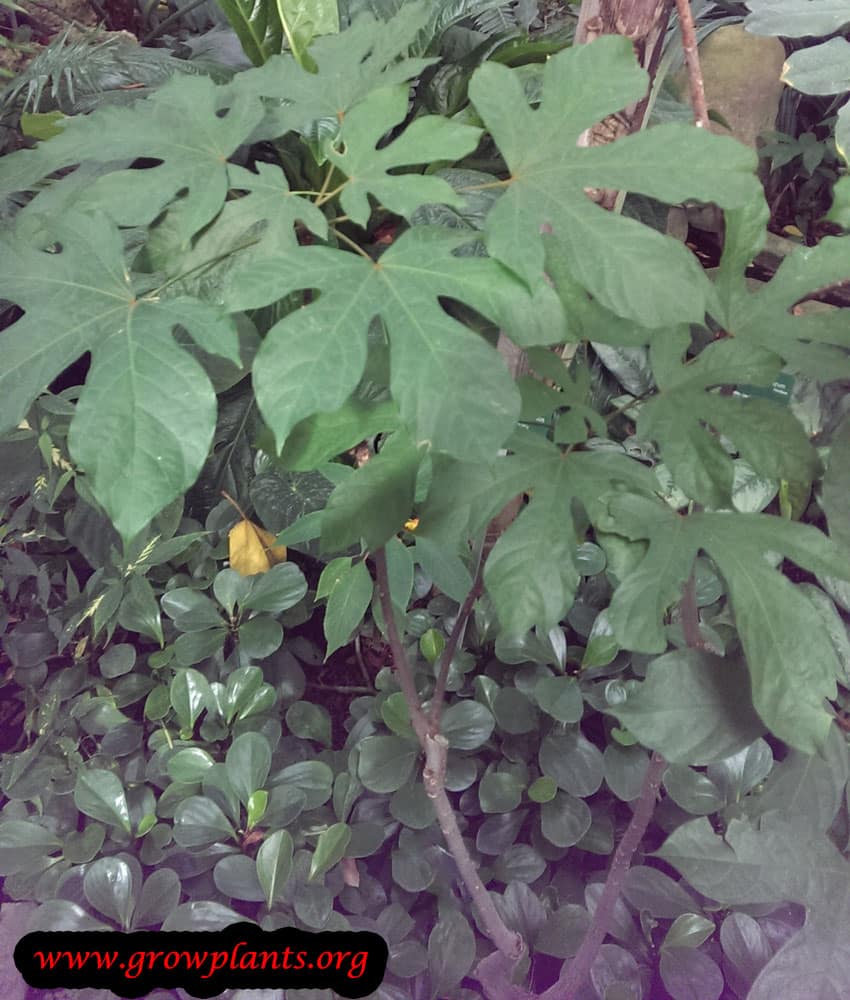
Plant Profile & Key Characteristics
Overview: A large evergreen tropical tree reaching 10-20 m, grown for its caffeine-rich edible seeds (kola nuts) and as an ornamental. It carries glossy green foliage and clustered yellow-and-red flowers.
Quick Specifications
| Specification | Attribute |
|---|---|
| Plant Type / Life Cycle | Perennial (evergreen tree) |
| Foliage Type | Evergreen |
| Mature Size | 10-20 m (30-60 ft) |
| Growth Rate | Moderate |
| Toxicity | Non-toxic — seeds (kola nuts) edible; a caffeine-containing stimulant |
| Hardiness | USDA zone 12+ |
Growth Form & Structure
- Height & Spread: A tree of 10-20 m (30-60 ft); not suited to container growing
- Growth Habit & Form: Upright evergreen tropical tree with a leafy crown
- Lifespan & Maturity: Long-lived tree; begins bearing nuts in about 4-8 years
Anatomy & Physical Features
- Leaves & Foliage: Glossy green elliptic leaves
- Flower Characteristics: Yellow flowers with red stripes and borders, borne in clusters
- Fruit Profile: Star-shaped follicles (“cases”) each holding several white, pink or red seeds — the caffeine-rich kola nut
Primary Uses & Landscape Value
- Edible Uses: Nuts chewed raw as a stimulant and used to flavour beverages
- Functional & Ornamental Roles: Ornamental shade tree and economic nut crop
Care Guide: Planting, Soil & Watering
Overview: Kola nut is a moderate-growing tropical tree (hardy only in zone 12+) that grows in full sun to half shade and needs warmth, humidity and rich soil. It prefers deep, fertile, well-draining ground and generous watering.
Quick Care Requirements
| Requirement | Ideal Condition |
|---|---|
| Planting Season | Year-round in suitable tropical climates |
| Growth Rate | Moderate |
| Soil Type | Deep, rich, well-draining |
| Water Need | High |
Planting & Establishment
- Best Planting Season: Plant year-round in warm, frost-free tropical climates.
- How to Plant:
- Hole Preparation: Dig a large hole, wider and deeper than the root ball, to give the deep roots room.
- Soil Amendments: Mix in plenty of compost, humus and organic matter for a rich, fertile soil.
- Planting Depth: Set the root collar at soil level and firm the soil gently.
- Growth Speed & Expectations: A moderate grower that becomes a large tree of 10–20 m (30–60 ft); it is not suited to container culture.
Soil, Watering & Drainage Care
- Soil Mix & Drainage Needs: Deep, rich, free-draining soil suits it; despite its high water need it still requires drainage to avoid waterlogging.
- Watering Schedule & Technique:
- Young / Newly Planted: Keep young trees consistently and generously watered while they establish.
- Established: Water established trees deeply and regularly, especially in dry weather.
- Seasonal Adjustments: Water heavily in hot, dry periods; ease off in cool, wet weather.
Climate, Light & Hardiness
The kola tree (genus Cola) is a tropical rainforest evergreen that needs constant warmth and humidity, growing in full sun to partial shade. The site rates it for hardiness zone 12 and above, so it is strictly a frost-free, tropical-climate tree.
Quick Climate Specifications
| Climate Zones | Tropical |
|---|---|
| USDA Hardiness Zones | 12+ |
| Frost Tolerance | None |
| Light Conditions | Full sun to partial shade |
| Wind Tolerance | Moderate |
Sunlight & Light Exposure
Optimal Light Setup
Grows in full sun to partial shade; young trees, in particular, appreciate some shade in the hottest, most exposed sites.
Shade & Heat Management
As a rainforest species it tolerates dappled shade well, which can protect younger plants from harsh direct sun while they establish.
Best Exposure / Orientation
A warm, bright but sheltered position, with some shade where sun is intense, suits it best.
Temperature Extremes & Hardiness
USDA Hardiness & Regional Limits
Rated by the site for zone 12 and above - a fully tropical, frost-free requirement. The site also notes it favours humid conditions and high altitudes within the tropics. It cannot be grown outdoors where frost occurs.
Cold Damage & Winter Protection
Cool temperatures well above freezing already stress this tropical tree, and it has no frost tolerance. Outside the tropics it needs continuously warm, protected conditions; young trees are the most cold-sensitive.
Frost Sensitivity
Extremely frost-sensitive - any frost is fatal.
Extreme Heat Tolerance
Good in humid tropical heat; its preference for higher altitudes suggests it favours warm rather than extreme, arid heat.
Frost-Free Growing Season
Requires year-round warmth; only a continuously frost-free tropical season supports its growth and near-continuous cropping.
Wind, Humidity & Microclimate
Humidity Preferences
The site lists humidity as a key need; a consistently moist, humid atmosphere is important.
Dry-Air Tolerance
Low - dry air does not suit this humidity-loving rainforest tree.
Wind Tolerance
Moderate; shelter from strong wind protects the large-leaved canopy.
Microclimate Recommendations
A warm, humid, frost-free, sheltered site - ideally the cooler, moister conditions of tropical high ground the site mentions - gives the best results.
Growing in Pots, Balconies & Indoors
The kola nut (Cola) is a large tree (10-20 m / 30-60 ft), so the grower marks it as neither a houseplant nor a long-term container plant – and rightly so. You can keep a young seedling in a pot for its first few years, but it soon needs open ground to develop a deep root system and full canopy.
Quick Details
- Container Size: A large tub only while young (say 30-50 L / 8-12 gal for the first years); ultimately it needs open ground
- Indoor Suitability: Not a houseplant – it becomes a full-size tree and needs full sun to part shade
- Best Spot: full sun to part shade, planted in the ground outdoors
- Soil & Drainage: Deep, free-draining soil; a potted young tree needs an aerated mix that drains freely
- Watering in Pots: A potted young tree dries out far faster than one in the ground – check it often
Indoors & On the Windowsill
- Houseplant limits: The kola nut (Cola) will not grow indoors – it demands full sun to part shade and quickly outgrows any room. Even a bright window only suits it at the seedling stage.
- Young plants: A seedling can spend its first year or two in a pot in a bright spot before being planted out.
- Overwintering young trees: This is a tender, tropical tree. In cold climates a young potted specimen must be sheltered in a bright, frost-free room for winter and returned outdoors once the weather warms.
On a Balcony or Patio
- Young specimen only: A young tree can stand on a large patio or balcony in full sun to part shade, but pots dry quickly and give no room for a taproot, so it will need moving into the ground within a few years.
Choosing the Pot, Soil & Long-Term Care
- Pot & drainage: If growing a young tree, use the largest tub you can with strong drainage holes; skip a standing water saucer to avoid root rot. Terracotta breathes and dries faster, while glazed or plastic holds moisture longer.
- Potting mix: An aerated, organic-rich mix – for example peat or coir with perlite or vermiculite.
- Watering: It likes plenty of water, so keep a young potted tree’s soil consistently moist.
- Feeding: A potted tree exhausts its soil quickly and nutrients leach with every watering, so feed more often than a tree in open ground.
- Potting on: Move it into a larger container each year while young; once it is too big for pots, plant it out.
Fertilizing & Feeding
Kola nut is a moderate feeder: build the soil with organic matter and give balanced, restrained feedings through the growing season, easing off toward dormancy.
Quick Fertilizing Specs
| Feeding Level | Moderate |
|---|---|
| young_feeding | Nitrogen-forward complete fertilizer to build the framework. |
| mature_feeding | Balanced complete fertilizer with adequate potassium at bearing. |
| Main Nutrient Priority | Nitrogen while young, shifting to balanced with potassium once bearing. |
| Best Feeding Period | Through the active growing season. |
| Organic Options | Compost, well-rotted manure and organic mulch. |
| Micronutrients | Watch for iron, zinc and manganese on alkaline soils. |
| Soil pH | Slightly acidic to near neutral. |
| Reduce/Stop Feeding | Ease off as growth slows heading into winter dormancy. |
Feeding by Growth Stage
Newly planted
Help the young Kola nut settle in and push out roots after planting.
| Nutrient direction | Focus on root establishment; keep any feeding gentle and let roots reach into the surrounding soil. |
|---|---|
| Timing | From planting through the first season of establishment. |
| Frequency | Feed sparingly at this stage; well-prepared soil often carries the tree through the first months. |
| Fertilizer types | Well-rotted compost or organic matter worked into the planting area, A gentle complete fertilizer only if soil is poor |
| Precautions | Avoid strong or concentrated fertilizer against fresh roots. This tropical tree prefers rich, humid, well-drained soil. |
Young tree (building the frame)
Drive steady shoot and canopy growth so the Kola nut builds a strong framework before it starts bearing.
| Nutrient direction | Lean toward nitrogen to support vegetative growth, within a complete fertilizer. |
|---|---|
| Timing | Through the active growing season in the pre-bearing years. |
| Frequency | Several light feedings across the growing season rather than one heavy dose. |
| Fertilizer types | A nitrogen-forward complete fertilizer, Compost or other organic matter to build soil |
| Routine trace nutrients | iron, manganese, zinc |
| Precautions | Taper feeding as growth slows toward autumn so new shoots harden before cold weather. |
Established, approaching bearing
Keep the Kola nut growing vigorously while it matures toward its first nuts crop.
| Nutrient direction | Shift toward a balanced complete fertilizer as the tree fills out. |
|---|---|
| Timing | During the active growing season as the tree nears bearing age. |
| Frequency | Light, spread-out feedings through the growing season. |
| Fertilizer types | A balanced complete fruit-tree fertilizer, Compost or mulch to maintain soil health |
| Routine trace nutrients | iron, manganese, zinc |
| Precautions | Watch for pale or yellowing new leaves on alkaline soils, a sign micronutrient availability is low. |
Mature, bearing nuts
Support consistent nuts yield and quality while keeping the mature Kola nut healthy.
| Nutrient direction | A balanced complete fertilizer with adequate potassium to support the developing crop. |
|---|---|
| Timing | From the start of the growing season through crop development. |
| Frequency | Split light feedings across the growing season; adjust to the tree’s vigor and crop load. |
| Fertilizer types | A balanced complete fruit-tree fertilizer with potassium, Compost or organic mulch |
| Routine trace nutrients | iron, manganese, zinc |
| Precautions | Reduce feeding as the season ends so the tree can harden off before dormancy. |
Nutrient Deficiency Signs & Corrections
Interveinal yellowing on the youngest leaves, with veins staying green.
| Possible causes | High or alkaline soil pH locking up iron, Waterlogged or poorly drained soil stressing roots, Genuinely low available iron in the soil |
|---|---|
| Appears first on | Newest leaves at the shoot tips. |
| What to check | Soil pH and drainage, Whether symptoms track wet spells, Recent watering pattern |
| Possible correction | Correct pH and drainage first; where needed apply a chelated iron product per its label. |
Uniform pale-green to yellow older leaves with weak, slow growth.
| Possible causes | Low soil nitrogen, Leaching of nitrogen from sandy soil, Competition from grass or weeds at the root zone |
|---|---|
| Appears first on | Older, lower leaves first. |
| What to check | Overall shoot vigor and colour, Ground cover competition, Recent feeding history |
| Possible correction | Apply a nitrogen-containing complete fertilizer during active growth and keep the root zone weed-free. |
Small, narrow leaves, shortened internodes and rosetting of new shoots.
| Possible causes | High or alkaline soil pH reducing zinc uptake, Sandy, low-organic-matter soil, Cold, wet soil slowing root activity |
|---|---|
| Appears first on | New spring growth at the shoot tips. |
| What to check | Soil pH, Leaf size versus normal, Shoot spacing and rosetting |
| Possible correction | Correct soil pH and, where confirmed, apply a zinc product per its label. |
Scorching and browning along the margins of older leaves, with poor crop fill.
| Possible causes | Low soil potassium, Leaching from sandy soil, Heavy crop load drawing down reserves |
|---|---|
| Appears first on | Margins of older, lower leaves. |
| What to check | Crop load versus leaf health, Soil type and leaching, Feeding history |
| Possible correction | Use a complete fertilizer that supplies potassium through the growing season. |
Pruning, Training & Seasonal Maintenance
Kola (Cola) is a large tropical evergreen tree (Malvaceae) grown for its caffeine-rich nuts, and it needs little pruning — the source describes cutting mainly ‘for design’. In the warm, seasonless tropics where it grows there is no dormant window, so light work can be done through the year. Pruning aims to build a sound framework and a clear trunk when young and, on a mature tree, simply to remove dead or crowding wood and keep some height and light control for harvest.
Quick Pruning & Maintenance Specs
| Pruning Tolerance | Low–Moderate – minimal, light work only |
| Primary Pruning Window | Any time (no dormancy in the tropics); light cuts |
| Secondary Maintenance Window | Deadwood/crossing removal as needed |
| Typical Frequency | Formative early; then occasional light maintenance |
| Main Objective | Sound framework, clear trunk, manageable height |
| Young Plant Priority | Set a leader and clear a trunk; space scaffolds |
| Mature Plant Priority | Deadwood, crossing/inward wood, modest height control |
| Best Tool Type | Secateurs/loppers, saw for limbs, pole pruner for height |
| Avoid Heavy Pruning During | Flowering and pod development; peak heat |
Pruning by Plant Age & Size
Newly Established
Remove only damaged shoots and encourage a single strong leader; begin clearing the lowest branches to form a clean trunk as the young tree grows.
Young / Formative
Select a well-spaced set of scaffolds on a dominant leader to build a balanced crown on what becomes a tall tree. Because it is slow to reach bearing, avoid heavy cutting that would only delay the first crop further.
Mature / Established
Keep to light maintenance: remove deadwood, crossing and strongly inward limbs, and reduce height modestly for access. Retain the older and inner branch wood that carries the pods, rather than stripping the tree back.
Seasonal Pruning Schedule
Ongoing / Any Season
With no true dormancy, take out deadwood, damaged and crossing limbs whenever seen, keeping cuts light. Objective: a sound, open-enough crown without sacrificing bearing wood.
Around Cropping
Avoid heavier cutting while the tree is flowering and carrying developing pods, so you neither knock off the crop nor stress the tree in fruit.
Flowering & Fruiting Wood
Kola carries its star-shaped flowers in clusters and then its woody pods on the older and inner branch wood, so bearing is on established wood rather than on the current season’s tips. The practical consequence for pruning is simple: do not strip out the older fruiting branches, and keep any cutting light and structural.
Structural Pruning & Training
Establish a leader and well-spaced scaffolds, remove crossing and inward wood, and control height for harvest on a potentially very tall tree. Given how little detailed, kola-specific pruning guidance exists, keep interventions conservative and structural.
Special Growth to Remove
Remove deadwood and any weak, crowded or crossing shoots; on seedling trees there is no graft-sucker issue to manage.
Container & Small-Space Pruning
Kola is a large forest tree and not a practical container subject; size is managed by in-ground structural pruning and height reduction rather than by pot culture.
Tools
Secateurs and loppers cover most cuts, a pruning saw the larger limbs, and a pole pruner allows deadwood and height work from the ground on a tall tree.
Tool Hygiene & Disease Risk
Routine — clean, sharp tools; there is no prominent tool-borne disease reported for garden-grown kola. Disinfect blades if you cut out any obviously diseased or rotten wood.
Cut Placement & Technique
Use thinning cuts back to a lateral or the branch collar, avoid stubs and flush cuts, and stage-remove any large limb in sections to prevent bark tearing.
Heavy Pruning & Rejuvenation
Hard cutting is neither needed nor well documented for kola and risks a long setback on a slow-bearing tree; keep to light, staged reduction over several seasons if an old tree must be brought down in size.
Post-Pruning Care
After removing larger limbs, watch newly exposed bark for sunburn in strong tropical sun and water normally; feeding is not driven by pruning here.
Common Pruning Mistakes
- Stripping out the older inner wood that actually carries the pods.
- Heavy cutting on a slow, late-bearing tree that only delays cropping.
- Removing large limbs and exposing bark to scorching sun.
When NOT to Prune
Avoid heavier pruning during flowering and pod development and in the most intense heat, when big cuts stress the tree and expose bark.
Recommended Tools (by task)
- bypass_secateurs — for shoots and light thinning.
- loppers — for crossing and inward limbs up to a few centimetres.
- pruning_saw — for the occasional larger limb.
- pole_pruner — to reach deadwood and height on a tall tree.
Pruning Troubleshooting
| Problem | Possible Cause | What to Check | Corrective Action |
| Poor pod yield after pruning | Older bearing wood removed | Whether inner/older fruiting branches were cut | Keep cuts light and structural; retain bearing wood |
| Slow to come into bearing | Heavy formative cutting on a slow tree | Amount of wood removed while young | Minimise cutting; build structure with light work |
| Sunburnt limbs after large cuts | Bark exposed to tropical sun | Newly exposed trunk and scaffolds | Reduce gradually; whitewash exposed bark |
Propagation Guide
Kola is grown mainly from fresh seed, which is recalcitrant — it must be sown fresh and kept moist, as it loses viability quickly if allowed to dry. Selected trees are reproduced by grafting, budding or cuttings in commercial orchards. Moderate.
Quick Propagation Specs
| Best Propagation Method | Seed (fresh) |
| Alternative Methods | Grafting / budding; cuttings (for selected clones) |
| Propagation Difficulty | Moderate |
| Seed True-to-Type | Variable |
| Vegetative True-to-Type | Yes |
| Best Propagation Season | Warm season (grows year-round in the tropics) |
| Seed Germination Time | Slow and staggered — several weeks to a few months |
| Germination Temperature | Warm, roughly 25–30°C (77–86°F) |
| Seed Sowing Depth | A few centimetres |
Growing from Seed
Seed Handling & Viability
Seed is recalcitrant: sow fresh, keep it moist, and do not let it dry out or it loses viability quickly.
Sowing & Germination
Sow a few centimetres deep in warm, moist, rich, free-draining media, matching the plant’s preference for rich soil, humidity and higher altitudes; germination is warm, humid, slow and uneven.
Seedling Care
Grow young plants in warm shade to part shade.
Grafting, Budding & Cuttings
Superior kola clones are propagated by budding, grafting or leafy stem cuttings onto seedling rootstock, to keep the type true and improve cropping.
Bloom & Flower Guide
Quick Details
- Bloom Season: Can flower more or less year-round in a warm tropical climate
- Flower Appearance: Star-shaped yellow flowers streaked and edged with red, borne in clusters
- Edibility: Ornamental – the tree is grown for its seeds (kola nuts); the flowers are not eaten
Detailed Blooming Overview
Kola is a tropical tree that flowers freely, often across much of the year where warmth and moisture are steady. The blooms gather in clusters along the branches, each one star-shaped and creamy-yellow with distinctive red striping and red margins. What look like petals are actually the lobes of a coloured calyx, which is typical of the genus.
Flower Characteristics
- Yellow, star-shaped flowers marked with red stripes and red-edged lobes.
- Carried in clusters rather than singly.
Bloom Care & Thinning
- Pollination: Visited and pollinated by bees and other insects.
- Encouraging bloom: Reliable warmth, humidity and good light keep a mature tree flowering through the year.
Fruit & Uses
The edible part is the white kola seed (the “nut”), traditionally chewed raw and used to flavour beverages. It is a natural source of caffeine, so it acts as a mild stimulant.
Quick Edible Specs
| Edible Parts | Seed / nut |
|---|---|
| Main Use(s) | Chewed raw; used to flavour beverages |
| Eaten Raw or Cooked | Raw |
| Preparation Required | Open the seed case; eat raw or use in drinks |
| Harvest Season | All year |
| Time to First Harvest | Several years from planting (see growing notes) |
| Safety/Toxicity Caveat | Contains caffeine — a mild stimulant; use in moderation |
Seeds, Pods & Nuts
The white seeds grow several together inside a brain-like case whose outer shell may be white, pink or red. Ripe seeds are collected from the ground and the case opened to release them. Harvest can occur throughout the year.
Preparation, Uses & Safety
The seed is chewed raw and used to flavour beverages. As a natural caffeine source it is a mild stimulant, so it is best used in moderation. It has a long history of traditional use (traditionally used only — no health claims are made here).
Pests, Diseases & Troubleshooting
Overview: Kola is a tropical West-African tree crop whose main enemies are weevils that bore the nuts (both on the tree and in storage), along with stem borers, capsids and sap-sucking scales and mealybugs; pod and nut rots are the key diseases. Because it is a specialized regional crop, local pest pressure varies widely, so treat these as a general guide and confirm identifications with regional agricultural advice.
Quick Troubleshooting Overview
| Issue / Pest | Main Symptom | Primary Solution |
|---|---|---|
| Kola weevil | Nuts bored with tunnels and grubs (on tree and in storage) | Prompt harvest, sanitation, proper drying/storage |
| Capsids (mirids) | Blackened lesions on shoots and pods; dieback | Prune affected shoots, monitor, shade management |
| Stem/pod borer | Tunneled stems or pods with frass | Remove and destroy borer-damaged wood |
| Mealybugs & scale | Cottony/waxy clusters; honeydew and sooty mold | Horticultural oil, prune, manage ants |
| Kola nut rot | Rotting, discolored nuts and pods | Sanitation, remove mummies, dry storage |
| Thread blight | Web-like fungal threads on branches; leaf death | Prune out, improve airflow |
Common Pests & Management
- Kola weevil (Balanogastris kolae / Sophrorhinus spp.):
- Symptoms: Signature pest: weevils bore into developing and stored nuts, tunneling the cotyledons with grubs and frass and ruining the nuts; damage continues in storage.
- Prevention & Control: Harvest promptly and avoid leaving mature pods on the tree; strict sanitation of fallen pods; dry and store nuts properly (curing, sealed/cool storage) to break the storage cycle.
- Cocoa/kola capsids (mirids) (Sahlbergella singularis / Distantiella theobroma):
- Symptoms: Sap-sucking bugs feed on shoots and pods, producing dark sunken lesions, blackening, dieback and cankered shoots.
- Prevention & Control: Monitor and prune out damaged shoots, manage shade to reduce build-up, and conserve natural enemies; targeted approved insecticide only for severe outbreaks.
- Kola stem borer (Phosphorus virescens):
- Symptoms: Larvae tunnel branches and stems, causing wilting, dieback and weakened, breakable limbs with entry holes and frass.
- Prevention & Control: Cut out and destroy infested wood, keep trees vigorous, and maintain orchard hygiene to reduce breeding sites.
- Mealybugs & scale (Planococcus / Coccus spp.):
- Symptoms: White cottony mealybugs or waxy scales on shoots, pods and leaf undersides with honeydew and sooty mold; often ant-tended.
- Prevention & Control: Horticultural oil on accessible growth, prune heavily infested parts, and manage the ants that protect them; conserve predators.
Diseases & Fungal Issues
- Kola nut/pod rot (Botryodiplodia theobromae / Phytophthora spp.):
- Symptoms: Nuts and pods rot, discolour and mummify on the tree or in storage, sometimes with dieback of associated shoots.
- Treatment & Management: Remove and destroy rotted pods and mummies, harvest and cure carefully, ensure good drainage and airflow; copper fungicide in the field where warranted.
- Thread blight (Marasmius / Marasmiellus spp.):
- Symptoms: White or brown fungal threads (rhizomorphs) run along branches and leaf undersides, killing leaves that hang webbed to the stems.
- Treatment & Management: Prune out affected branches, open the canopy for light and airflow, and remove debris; copper fungicide on valued trees if persistent.
- Leaf spot (Colletotrichum / Cercospora):
- Symptoms: Brown spots and blotches on leaves in humid conditions, mostly minor on vigorous trees.
- Treatment & Management: Improve airflow and nutrition, remove affected leaves; fungicide rarely needed.
Growing Difficulties & Abiotic Problems
- Cold/drought sensitivity:
- Cause & Symptoms: Kola needs humid, warm tropical conditions; cold or prolonged drought causes leaf loss and dieback.
- Correction Strategy: Grow only in warm, humid, frost-free conditions with reliable moisture; mulch and irrigate in dry spells.
- Nutrient deficiency chlorosis:
- Cause & Symptoms: Yellowing and weak growth from poor or unbalanced soil nutrition.
- Correction Strategy: Feed a balanced fertilizer with micronutrients and maintain organic matter; correct pH.
- Slow establishment & fruiting:
- Cause & Symptoms: Seedling trees are slow to establish and take years to bear.
- Correction Strategy: Be patient, provide light shade when young, and maintain steady water and nutrition to speed establishment.
What Helps – Products & Tools
Management centres on sanitation, harvest timing and proper nut curing/storage against the weevils, plus canopy and shade management. Tools include horticultural oil (mealybug/scale), pruning of borer- and blight-affected wood, copper fungicide for pod rot and thread blight, and balanced nutrition; confirm any pesticide choices against regional crop guidance.
Frequently Asked Questions
What is kola nut?
Kola nut (Cola) is a large evergreen tropical tree grown for its caffeine-rich seeds, called kola nuts, which have long been chewed raw as a stimulant and used to flavor beverages. The tree reaches 10-20 m (30-60 ft) tall, with glossy green foliage and clusters of yellow-and-red flowers, and it only survives in frost-free tropical climates rated hardiness zone 12 and above.
Can a kola nut tree be grown in a pot, indoors, or outside the tropics?
No, not long-term. Kola nut is a large forest tree, and the grower marks it as neither a houseplant nor a long-term container plant; a seedling can spend its first year or two in a pot in a bright spot before it needs to go into the ground. It will not grow indoors, quickly outgrowing any room, and it cannot be grown outdoors where frost occurs.
What pests and diseases most affect kola nut trees?
The kola weevil is the signature threat: weevils bore into developing and stored nuts, tunneling the cotyledons with grubs and frass and ruining the nuts, so prompt harvest and good storage sanitation matter. Other problems include capsid bugs and stem borers that damage shoots and stems, mealybugs and scale, and pod and nut rots, which are the key fungal diseases.
How much and how often should I water a kola nut tree?
Kola nut has a high water need. Keep young, newly planted trees consistently and generously watered while they establish, and water established trees deeply and regularly, especially in dry weather. Water heavily in hot, dry periods and ease off in cool, wet weather.