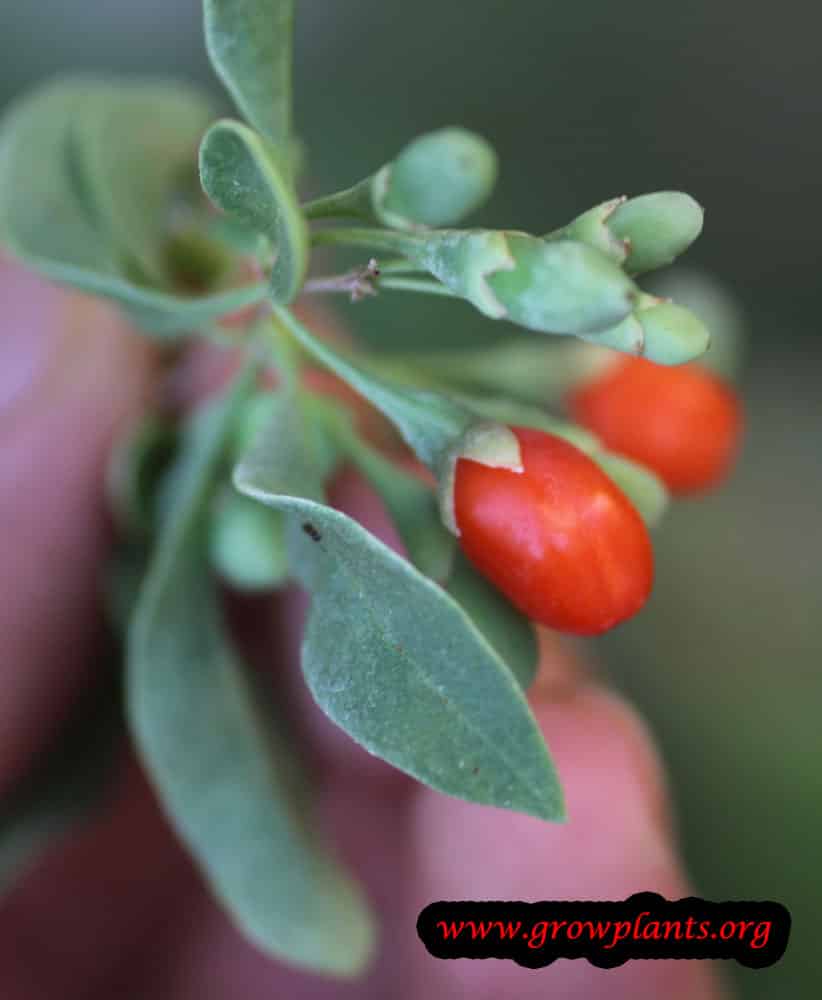
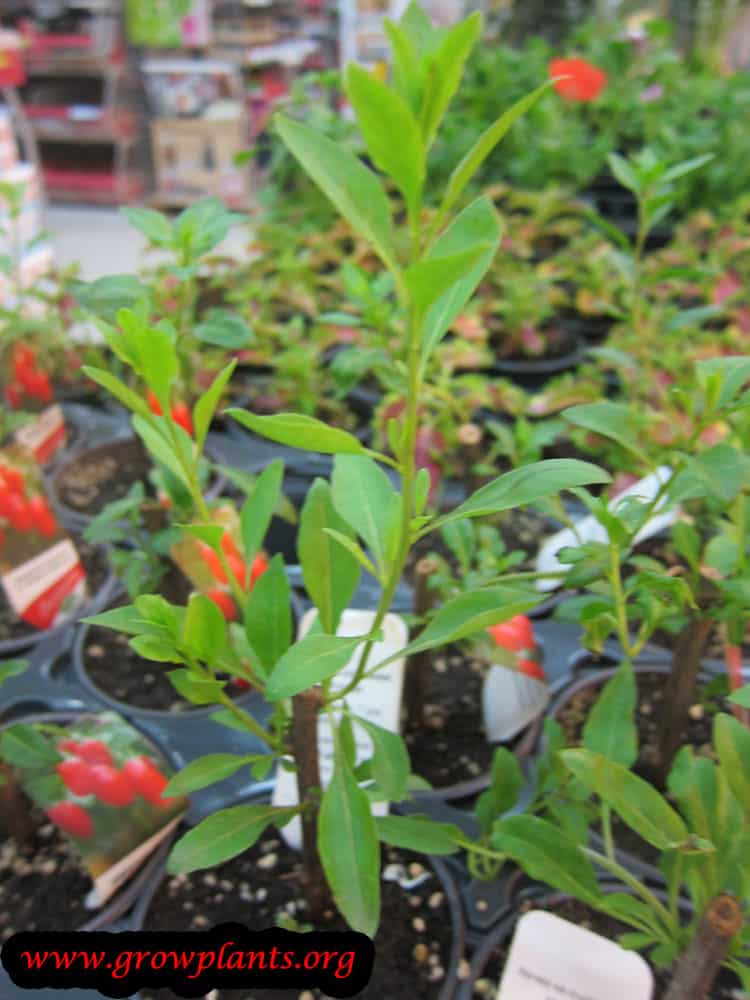
Plant Profile & Key Characteristics
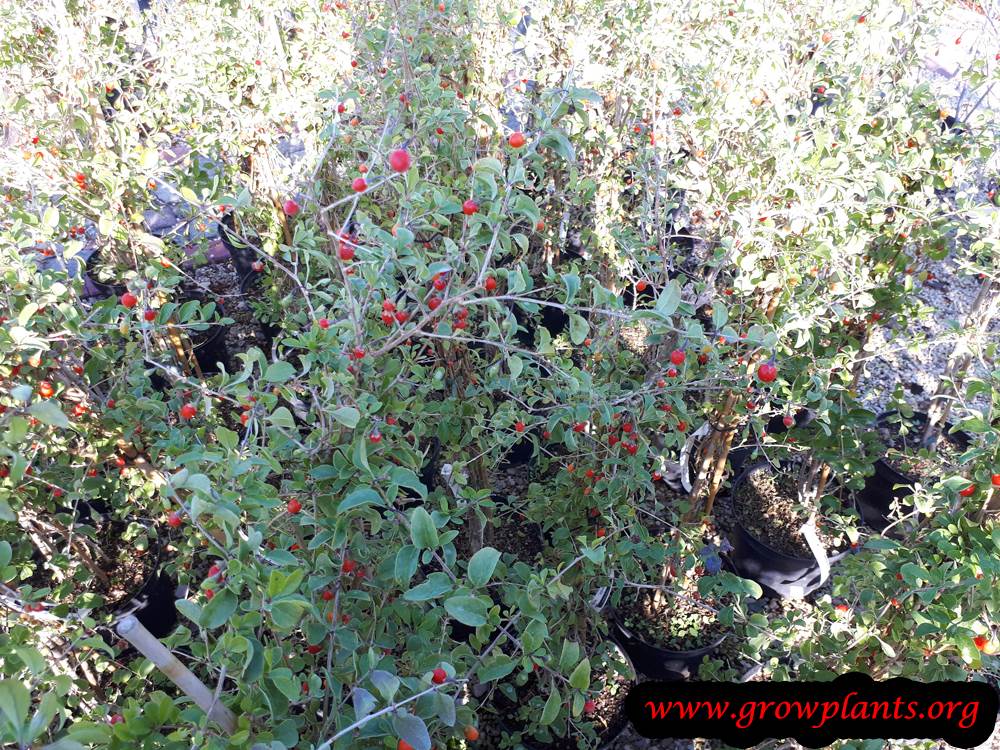
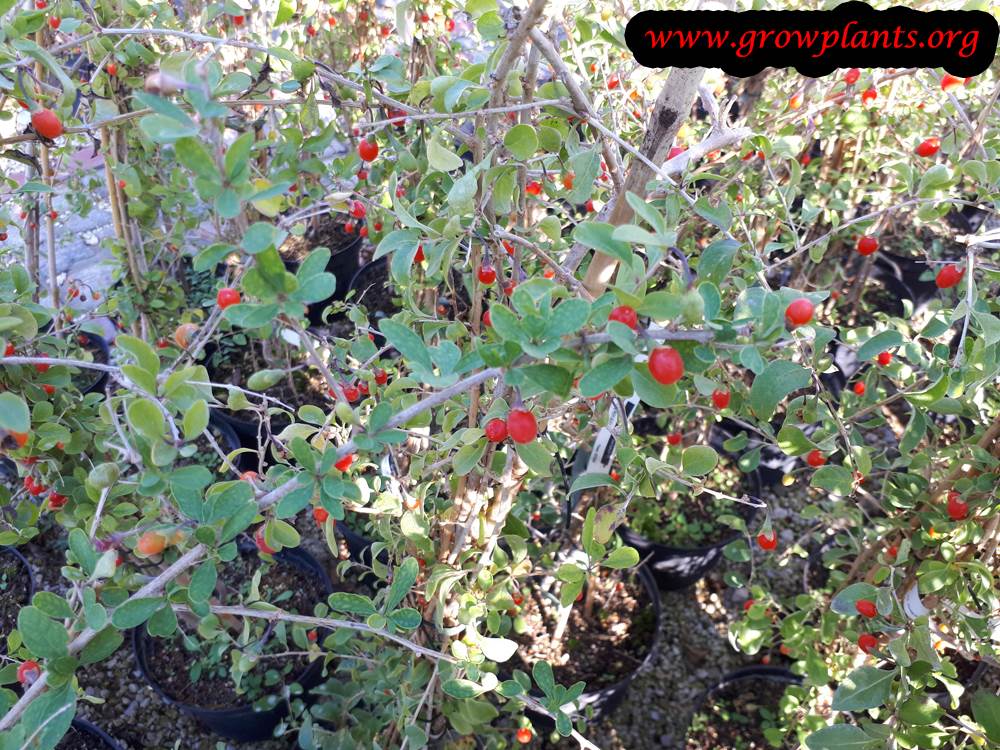
Overview: Fast-growing, short-lived shrub reaching 1-3 m with semi-evergreen foliage, grown for its edible red goji berries. Tolerates a wide climate range and bears fruit within a year or two.
Quick Specifications
| Specification | Attribute |
|---|---|
| Plant Type / Life Cycle | Perennial (short-lived shrub) |
| Foliage Type | Semi-evergreen (evergreen or deciduous by climate) |
| Mature Size | 1-3 m (3-10 ft) |
| Growth Rate | Fast to moderate |
| Root System | Suckering, spreading roots (can be invasive) |
| Toxicity | Non-toxic – fruit edible |
| Hardiness | USDA zones 5-11a |
Growth Form & Structure
- Height & Spread: 1-3 m, arching and sprawling, sometimes needing support; grows in containers.
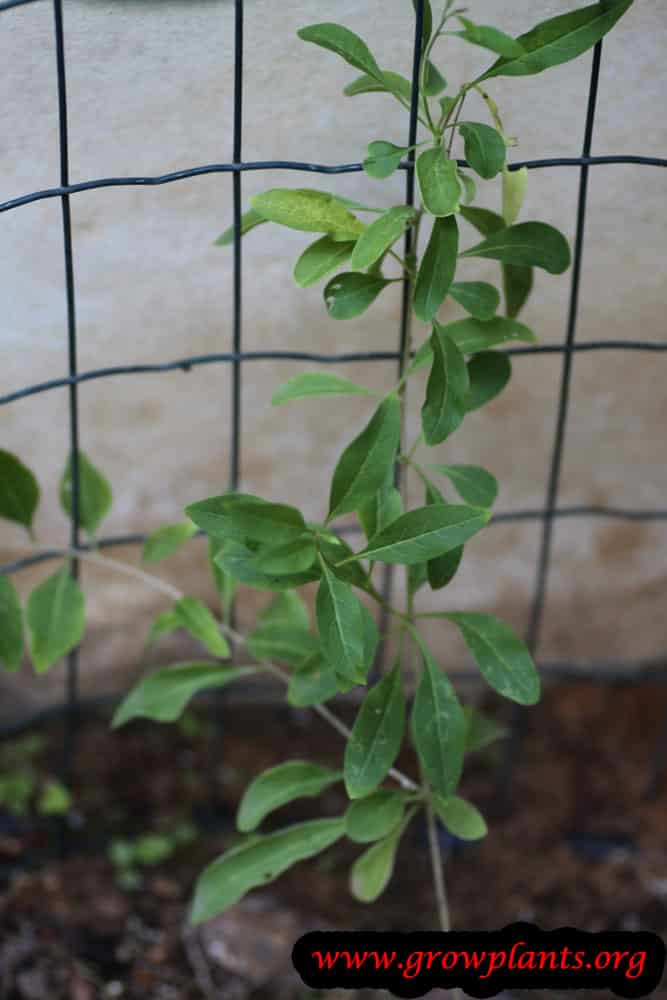
- Growth Habit & Form: Arching, lax shrub with slender branches that may need trellising.
- Lifespan & Maturity: Short-lived perennial; begins bearing in about 1 year (rarely 2).
Anatomy & Physical Features
- Leaves & Foliage: Green leaves along arching stems.
- Flower Characteristics: Purple, five-petalled flowers borne at the leaf nodes.
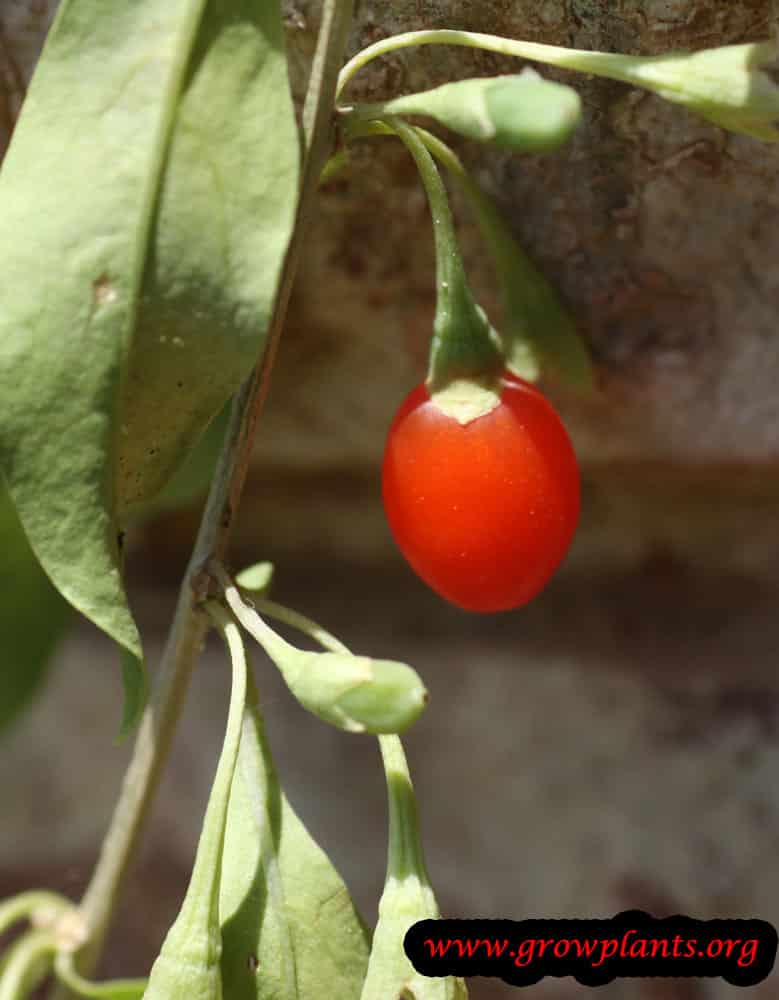
- Fruit Profile: Small red, ovate berry 0.5-2 cm, sweet-tart, each with 10-50 edible seeds.
Primary Uses & Landscape Value
- Edible Uses: Berries eaten raw, dried, or made into jams.
- Functional & Ornamental Roles: Edible fruit shrub that can also be hedged.
Care Guide: Planting, Soil & Watering
Overview: Goji berry (Lycium chinense) is a vigorous, hardy shrub (zones 5–11a) that fruits best in full sun. It likes a well-drained, slightly acidic soil and only moderate watering, and often benefits from trellising to support its long, arching fruiting branches.
Quick Care Requirements
| Requirement | Ideal Condition |
|---|---|
| Planting Season | Late winter through summer |
| Growth Rate | Moderate to fast |
| Soil Type | Well-drained, slightly acidic; adaptable |
| Water Need | Moderate |
Planting & Establishment
- Best Planting Season: From late winter through summer, avoiding hard frost.
- How to Plant:
- Hole Preparation: Dig a hole about as deep as the root ball and twice as wide; set a trellis or support at planting time, as the whippy branches struggle to hold their fruit unaided.
- Soil Amendments: Work compost or organic matter into the backfill; goji is adaptable but rewards a fertile, free-draining soil.
- Planting Depth: Set the root collar level with the surrounding soil; do not bury the stem.
- Growth Speed & Expectations: A moderate to fast grower that can begin fruiting within a year or two of planting.
Soil, Watering & Drainage Care
- Soil Mix & Drainage Needs: Free-draining soil is essential to avoid root rot; it tolerates a range of soils but prefers a slightly acidic, well-drained mix. In containers use a free-draining potting mix with drainage holes.
- Watering Schedule & Technique:
- Young / Newly Planted: Water every few days for the first weeks so the root zone never dries out completely.
- Established: Water deeply and let the top few centimetres dry between waterings; established plants are quite drought-tolerant.
- Seasonal Adjustments: Cut back in winter and water more often during hot, dry spells.
Climate, Light & Hardiness
Goji berry is a wide-ranging shrub adapted to mediterranean, subtropical, temperate, and tropical climates, growing evergreen or deciduous depending on winter cold. It fruits best in full sun, though it can survive in partial shade, and is hardy across a broad zone range.
Quick Climate Specifications
| Climate Zones | Mediterranean, subtropical, temperate, tropical |
|---|---|
| USDA Hardiness Zones | 5–11a |
| Frost Tolerance | High |
| Light Conditions | Full Sun (tolerates partial shade with reduced fruiting) |
Sunlight & Light Exposure
Optimal Light Setup
Full sun gives the best fruit yield; the plant survives in partial shade but bears less fruit.
Temperature Extremes & Hardiness
USDA Hardiness & Regional Limits
Very broadly hardy, from cold temperate zone 5 through warm subtropical zone 11a, going deciduous in colder parts of its range and evergreen in milder ones.
Growing in Pots, Balconies & Indoors
Goji berry is a hardy 1-3 m (3-10 ft) shrub. The grower says it isn’t a houseplant but grows well in a container – a good, easy patio or balcony fruit shrub, though a pot also helps contain its spreading habit.
Quick Details
- Container Size: A large, deep container (grower didn’t state a size)
- Indoor Suitability: Not a houseplant; a hardy patio container shrub
- Best Spot: Full sun (tolerates part shade but fruits less)
- Soil & Drainage: Aerated, organic-rich mix that drains freely
- Watering in Pots: Keep the mix lightly moist – pots dry faster than open ground; water once the surface starts to dry.
Indoors & On the Windowsill
- Houseplant limits: Not a houseplant – it fruits best in full sun outdoors.
- Windowsill growing: Better outdoors, but it is small enough that a young plant could sit on a very sunny sill before going outside.
- Overwintering: Very cold-hardy, so it is happy to stand outside through winter.
On a Balcony or Patio
- Light & wind: Full sun gives the best crop. Its long, arching canes can be tied in or trimmed; pots dry fast in reflected heat, so check often.
- Contain the spread: A pot is a good way to keep this vigorous, potentially invasive shrub in check.
Choosing the Pot, Soil & Long-Term Care
- Pot & drainage: A deep pot with strong drainage holes; skip a standing-water saucer to avoid root rot. Terracotta breathes and dries faster, while glazed or plastic hold moisture longer.
- Potting mix: Well-aerated, organic-rich mix – peat or coir with perlite and a little organic matter; it must drain freely.
- Feeding: Potted plants use up their food faster because nutrients leach out with each watering, so feed a little more often than plants in open ground.
- Repotting: Refresh part of the mix and pot up every couple of years; for established plants, lightly prune the root ball and top growth when you repot.
Fertilizing & Feeding
A vigorous, fast-fruiting shrub that benefits from a standard small-fruit feeding routine to keep pace with its quick growth and heavy fruit set.
Quick Fertilizing Specs
| Feeding Level | Moderate – supports this shrub’s fast growth and productive fruiting. |
|---|---|
| young_feeding | A nitrogen-leaning, balanced fertilizer while the shrub builds its cane structure. |
| mature_feeding | A balanced fertilizer with potassium emphasis once flowering and fruiting are underway. |
| Main Nutrient Priority | Balanced feeding shifting toward potassium as fruit develops; boron matters around bloom. |
| Best Feeding Period | The active growing season, from new growth through fruiting. |
| Organic Options | Compost or aged organic matter worked into the root zone. |
| Micronutrients | A complete fertilizer for fruiting shrubs typically covers routine trace needs. |
| Soil pH | Prefers slightly acidic, well-drained soil rather than heavy or waterlogged ground. |
| Reduce/Stop Feeding | Ease off feeding as fruiting winds down and growth slows in the cooler part of the year. |
Feeding by Growth Stage
Establishment
Get a newly planted goji berry rooted in before it’s asked to carry a full crop.
| Nutrient direction | Keep feeding light and balanced while the root system establishes. |
|---|---|
| Timing | The first growing season after planting. |
| Frequency | A few light feedings spread across the active growing season is enough while it settles in. |
| Fertilizer types | A balanced, complete fertilizer for young shrubs, Compost worked into the planting area |
| Precautions | Avoid heavy feeding right at planting, especially in already-fertile garden soil. |
Vegetative Growth
Build strong canes capable of supporting the shrub’s heavy fruit load, including where trellising is used.
| Nutrient direction | Lean toward a nitrogen-forward, complete fertilizer to drive vigorous cane growth. |
|---|---|
| Timing | Through the shrub’s active growing season, ahead of and alongside flowering. |
| Frequency | Regular light feedings during the warm growing months. |
| Fertilizer types | A nitrogen-forward complete fertilizer, Composted organic matter |
| Routine trace nutrients | iron, manganese |
| Precautions | This shrub can be an aggressive grower – prune and feed with restraint if it starts to spread more than wanted. |
Flowering and Fruiting
Support flowering and sustain the shrub through its fruiting window.
| Nutrient direction | Shift to a balanced fertilizer with added potassium to support fruit development and quality. |
|---|---|
| Timing | From bloom through fruit ripening in the warmer months. |
| Frequency | A steady, moderate feeding routine through the growing season, easing off as fruiting winds down. |
| Fertilizer types | A balanced, complete fertilizer with potassium emphasis, Organic mulch to build soil fertility over time |
| Routine trace nutrients | iron, manganese |
| Precautions | Keep watering and feeding consistent through fruiting – stress at this stage can affect fruit set. |
Nutrient Deficiency Signs & Corrections
Overall pale, yellowish foliage and canes that grow noticeably slower than expected.
| Possible causes | Insufficient nitrogen in the soil, Nitrogen leaching from sandy or fast-draining soil, Waterlogged roots limiting nutrient uptake |
|---|---|
| Appears first on | older leaves first |
| What to check | Cane growth rate versus prior seasons, Soil drainage and watering routine, Recent feeding history |
| Possible correction | Apply a balanced or nitrogen-leaning fertilizer and watch for improved color in new growth. |
Yellowing between the veins on new leaves while the veins stay green.
| Possible causes | Soil pH too high for this acid-preferring shrub, limiting iron availability, Poor drainage or compacted soil, A genuine iron shortfall in depleted soil |
|---|---|
| Appears first on | newest growth |
| What to check | Soil pH if testable, since this shrub prefers slightly acidic soil, Drainage around the roots, Whether older leaves remain green |
| Possible correction | Work toward a more acidic soil environment and improve drainage; a chelated iron product per its label can help if the pattern continues. |
Scorched or browning edges on older leaves during heavy fruit production.
| Possible causes | Potassium drawn down by a heavy fruit load, Drought stress limiting nutrient movement, Salt buildup interfering with potassium uptake |
|---|---|
| Appears first on | older leaves, at the margins |
| What to check | Whether symptoms track with fruit load, Watering consistency, Salinity of irrigation water, if relevant |
| Possible correction | Feed with a balanced, potassium-inclusive fertilizer and maintain even watering through fruiting. |
Pruning, Training & Seasonal Maintenance
Goji berry is a sprawling, short-lived shrub that tolerates hard annual pruning well and, left unmanaged, produces a tangle of thin stems too weak to carry its own fruit – exactly the problem the source growing guidance flags. Dormant winter pruning is the safest and most effective window: it removes the weak branches that can’t support a crop and channels the plant’s vigor into the following season’s fruiting laterals, which form at the leaf axils of new growth.
Quick Pruning & Maintenance Specs
| Pruning Tolerance | High |
| Primary Pruning Window | Winter dormancy |
| Typical Frequency | Annual dormant prune, plus staking/tying through the growing season |
| Main Objective | Remove weak branches that can’t hold fruit and build a framework that can |
| Young Plant Priority | Select a few strong main stems and stake or trellis them early, since the plant sprawls without support |
| Mature Plant Priority | Annual removal of thin, weak, or overcrowded stems; renewal of the oldest wood |
| Best Tool Type | Precision snips or bypass secateurs, plus soft ties for trellising |
| Avoid Heavy Pruning During | Active summer bloom and fruit set, since flowers form along the current season’s new growth |
Pruning by Plant Age & Size
Newly Established
Remove only damaged growth in the first season; select the strongest two to four stems to become the permanent framework and begin light staking, since goji is described as sometimes needing trellising.
Young / Formative
Staking or a simple trellis/support system suits this shrub better than free-standing training, given its sprawling habit; tie in the chosen main stems and remove weak, thin competitors as they appear.
Mature / Established
Each winter, cut out the branches too thin or weak to carry fruit – the exact issue named in the source guidance – along with any dead or overcrowded stems, and shorten overly long laterals to keep the plant within its support structure.
Seasonal Pruning Schedule
Dormant/Winter
Objective: remove weak, fruit-incapable wood and shape the framework. Remove: thin, weak, dead, or overcrowded stems. Do not remove: sturdy main framework stems that will carry the coming season’s fruiting laterals. Expected response: fewer but stronger fruiting shoots the following season. Flowering/fruiting impact: positive, since flowers and fruit form on the new growth that follows, not on the wood being removed.
Flowering & Fruiting Wood
Goji flowers form at the leaf axils along current-season growth, so the crop each year comes from new shoots produced after the dormant prune – not from old wood being cut back. This is why winter removal of weak older stems doesn’t cost a season’s fruit; it instead redirects the plant’s vigor into producing the sturdier new laterals needed to actually hold the fruit through to harvest.
Structural Pruning & Training
Because the plant sprawls and sometimes needs trellising, structure is built around a support system rather than a free-standing tree form: tie in main stems, remove weak side branches that would sag once fruited, and control spread by heading long stems back to the support.
Special Growth to Remove
Thin, weak branches unable to bear fruit weight, as specifically flagged in the source guidance; dead wood and any growth outgrowing the trellis or stake system.
Container & Small-Space Pruning
Goji is well suited to containers at its modest 1–3 m size; a small stake or hoop inside the pot keeps sprawling stems upright, and annual dormant pruning keeps the plant compact enough for the space rather than letting it flop over the container’s edge.
Tools
Precision snips or bypass secateurs handle essentially all cuts on this slender-stemmed shrub; soft ties or stakes support the framework rather than any cutting tool.
Tool Hygiene & Disease Risk
Routine – aphids are the only pest noted, with no documented transmissible disease, so clean, sharp tools are sufficient.
Cut Placement & Technique
Cut weak stems back to their point of origin at a main stem rather than leaving stubs; when tying in stems to a support, use soft ties that won’t girdle the stem as it thickens.
Heavy Pruning & Rejuvenation
Tolerated well – because goji is a fast-growing, short-lived shrub, an overgrown or tangled plant can be cut back hard in winter and will regrow vigorously the following season.
Post-Pruning Care
Re-secure remaining stems to their stake or trellis after pruning; routine watering is sufficient, with no special aftercare beyond that indicated.
Common Pruning Mistakes
Leaving thin, weak stems in place until they collapse under a full crop instead of removing them in the winter pass; skipping staking or trellising and letting the shrub sprawl untidily on the ground.
When NOT to Prune
Avoid heavy cutting during active summer bloom and fruit set, since that removes the current season’s flowering laterals.
Recommended Tools (by task)
- Removing weak or dead stems in the winter prune – precision_snips: clean cuts on this shrub’s typically slender wood
- Heading back longer laterals to the support – bypass_secateurs: for slightly thicker stem bases
- Training stems onto a stake or trellis – soft_ties_stakes: needed given the plant’s sprawling, sometimes-trellised habit
Propagation Guide
Goji berry is very easy to propagate from either seed or, even more reliably, stem cuttings, which root quickly and are commonly used to reproduce a known productive plant true-to-type since seedlings can vary in fruit size, flavor and yield; grafting is not necessary. Overall propagation difficulty is Easy.
Quick Propagation Specs
| Best Propagation Method | Stem cuttings (roots readily, guarantees fruit quality) |
| Alternative Methods | Seed; root suckers |
| Propagation Difficulty | Easy |
| Seed True-to-Type | Variable – seedling fruit size, yield and flavor may differ from the parent |
| Vegetative True-to-Type | Yes |
| Best Propagation Season | Cuttings: spring-summer (softwood) or late winter (hardwood); seed: spring – within the site’s winter-spring-summer planting season |
| Seed Germination Time | Not documented on site; commonly within a couple of weeks under warm conditions |
| Cutting Rooting Time | Often within a few weeks, even without rooting hormone |
Growing from Seed
Seed Handling & Viability
Each fruit holds many small seeds (about 10–50, per the site, and they are edible); extract and clean them from the ripe fruit pulp before sowing.
Dormancy & Pre-Sowing Treatment
No significant dormancy is typically reported for this genus – no stratification is usually needed.
Sowing Season
Spring, within the site’s winter-spring-summer planting season.
Sowing Depth & Orientation
Very shallow – the seed is small and should be barely covered.
Germination Conditions
Warm, consistently moist, bright conditions.
Germination Time
Not documented on site; commonly within a couple of weeks under warm conditions.
Seedling Care
Given the plant’s fast-to-medium growth and its tendency to self-seed (per site), seedlings generally establish readily; grow on until sturdy before transplanting.
Stem Cuttings
Cutting Type
Softwood or semi-hardwood tip cuttings; hardwood cuttings can also be used in the dormant season.
Best Timing
Spring through summer for softwood cuttings, or late winter for hardwood cuttings, within the site’s planting season.
Cutting Preparation
Take a several-inch cutting with a few nodes and remove the lower leaves.
Rooting Setup
A moist, well-draining mix; goji is known to root very easily and cuttings can even be started in water.
Rooting Hormone
Not necessary given how readily this plant roots, though it may speed and even out rooting.
Rooting Time
Often within a few weeks.
Division, Offsets, Pups & Suckers
Goji shrubs often send up root suckers from their spreading root system, which is consistent with the site’s note that the species can behave invasively. Well-rooted suckers with their own roots attached can be dug and transplanted as a simple clonal method, similar in ease to cuttings; suckers without their own roots are unlikely to establish and are not worth transplanting.
Bloom & Flower Guide
Quick Details
- Bloom Season: Spring to summer
- Flower Appearance: Small purple five-petalled flowers along the stems
- Edibility: The flowers are not eaten
Detailed Blooming Overview
Goji, or wolfberry, flowers through spring and summer, dotting its arching stems with small purple blooms. The flowers can appear at almost any leaf node, so a well-grown plant bears them freely – each one a step toward the familiar red berry.
Flower Characteristics
- Purple, with five petals in a small star or funnel shape.
- Produced at the leaf nodes all along the stems.
Bloom Care & Thinning
- Pruning for bloom: A winter prune of weak stems keeps the plant strong enough to carry its flowers and the fruit that follows.
- Pollination: Bees visit the flowers, and goji is largely self-fertile.
- Light: Full sun gives the most flowers.
Fruit & Uses
Goji berry is grown mainly for its small red fruit, eaten fresh, dried, or made into jam once ripe; the tiny seeds inside are eaten along with the flesh rather than removed. In some cuisines the young leaves and shoot tips are also cooked and eaten as a leafy green.
Quick Edible Specs
| Edible Parts | Fruit (including seeds, eaten together), young leaves |
|---|---|
| Main Use(s) | Culinary – fresh eating, drying, jam (fruit); cooked leafy green (young leaves/shoots) |
| Eaten Raw or Cooked | Fruit: raw or dried; Leaves: best cooked (e.g. stir–fried), young growth only |
| Preparation Required | Fruit: none, wash and eat; Leaves: pick young growth and cook, older leaves get tough |
| Harvest Season | Fruit: summer/autumn; Leaves: whenever soft new growth is available |
| Time to First Harvest | A fast–bearing shrub, typically fruiting within its first year or so (see Propagation) |
| Storage | Fruit dries well for long–term storage; fresh fruit is more perishable |
| Safety/Toxicity Caveat | No significant toxicity in the ripe fruit; as a nightshade–family relative, stick to young leaves cooked rather than large amounts of mature foliage eaten raw |
Fruit
The fruit is red and ovate, 0.5–2 cm, each berry holding 10–50 small seeds that are simply eaten along with the flesh rather than removed. Fruit is picked once fully red and slightly soft, either eaten straight from the shrub, dried (the familiar dried goji berry), or cooked into jam. Bearing is heaviest in full sun; shaded plants fruit less.
Leaves & Greens
Young leaves and tender shoot tips can also be picked and cooked as a leafy vegetable, typically stir–fried or added to soup. Light picking of young shoots does not conflict much with fruiting, but heavy leaf harvest will reduce the plant’s vigour for fruit production, so treat it as a bonus use rather than the main crop if you also want berries.
Harvesting
Pick fruit as it colours fully red through summer into autumn; ripe fruit is soft and pulls off easily. For leaves, take only young, tender new growth as needed through the growing season.
Preparation, Uses & Safety
Fruit needs no preparation beyond washing, and is eaten fresh, dried, or cooked into jam. Leaves should be cooked rather than eaten raw in quantity, and only young growth should be used, as is typical practice for this crop. No significant toxicity is documented for either part when used this way.
Pests, Diseases & Troubleshooting
Overview: Goji is a hardy nightshade shrub grown for its berries, and its signature problem is the goji gall mite that deforms leaves, alongside the usual aphids, spider mites, whitefly and leafhoppers, plus powdery mildew and root rot in wet soil. Birds are the main threat to the ripe fruit. Keep it sunny, airy and moderately watered and it is fairly resilient.
Quick Troubleshooting Overview
| Issue / Pest | Main Symptom | Primary Solution |
|---|---|---|
| Goji gall mite | Raised green/yellow blister galls on leaves | Prune out galled growth; remove debris; sulfur/oil dormant |
| Aphids | Curled tips, honeydew, sooty mould | Hose off; predators; insecticidal soap |
| Spider mites | Stippling and webbing in hot dry weather | Raise humidity; hose foliage; horticultural oil |
| Whitefly & leafhoppers | Yellow speckling, honeydew, hopping insects | Sticky traps; insecticidal soap; airflow |
| Powdery mildew | White coating on leaves | Airflow; base watering; sulfur |
| Birds | Ripe berries stripped | Netting as fruit colours |
Common Pests & Management
- Goji gall mite (Aceria kuko):
- Symptoms: The signature goji pest: microscopic eriophyid mites cause raised green-to-yellow, later brown, blister-like galls on leaves and shoots, distorting foliage, weakening the plant and reducing yield.
- Prevention & Control: Prune out and destroy galled shoots as they appear, clear fallen leaves that harbour overwintering mites, and keep plants vigorous. A dormant-season horticultural oil or sulfur spray, and lime-sulfur where permitted, suppresses populations; badly infested young plants may be best replaced.
- Aphids (Aphis / Myzus spp.):
- Symptoms: Colonies on tender shoots and flower clusters cause curling, stunting and sticky honeydew with sooty mould, and can spread viruses.
- Prevention & Control: Hose off, encourage ladybirds and lacewings, and use insecticidal soap or neem for heavy colonies; avoid excess nitrogen that flushes soft growth.
- Two-spotted spider mite (Tetranychus urticae):
- Symptoms: Fine stippling, bronzing and webbing on leaves in hot, dry conditions, causing early leaf drop.
- Prevention & Control: Keep plants watered, hose foliage undersides, and use horticultural oil or insecticidal soap; conserve predatory mites.
- Whitefly (Trialeurodes / Bemisia spp.):
- Symptoms: Tiny white flies clouding up from leaf undersides, sucking sap and leaving honeydew and sooty mould.
- Prevention & Control: Use yellow sticky traps and insecticidal soap or neem on leaf undersides, and remove heavily infested lower leaves.
- Leafhoppers (Empoasca / Cicadellidae spp.):
- Symptoms: Small wedge-shaped insects that hop or fly when disturbed; feeding causes pale stippling, leaf-edge yellowing and ‘hopperburn’ scorch.
- Prevention & Control: Encourage predators, use sticky traps and reflective mulch, hose foliage, and apply insecticidal soap for heavy pressure; keep weeds down.
Diseases & Fungal Issues
- Powdery mildew (Erysiphe / Leveillula taurica):
- Symptoms: White powdery patches on leaves in warm, humid, crowded conditions, leading to yellowing and reduced vigour.
- Treatment & Management: Prune for an open habit and airflow, water at the base, remove affected leaves, and apply sulfur or potassium-bicarbonate if it spreads.
- Anthracnose / berry rot (Colletotrichum spp.):
- Symptoms: Dark sunken spots on berries and leaves in wet weather, rotting the fruit before harvest.
- Treatment & Management: Improve airflow, avoid overhead watering, remove infected fruit and debris, harvest promptly, and use a copper fungicide where pressure is high.
- Root & crown rot (Phytophthora / Fusarium):
- Symptoms: Wilting, yellowing, dieback and dark rotted roots and crown in heavy or waterlogged soil.
- Treatment & Management: Plant in free-draining soil, avoid overwatering and standing water, mulch away from the trunk, and remove severely affected plants.
Growing Difficulties & Abiotic Problems
- Birds stripping fruit:
- Cause & Symptoms: Ripe berries removed quickly as they colour, since birds relish goji fruit.
- Correction Strategy: Net plants as the berries begin to ripen, or use scaring devices; harvest promptly when ripe.
- Overwatering & poor drainage:
- Cause & Symptoms: Yellowing, wilting and root decline in soggy soil; goji tolerates drought far better than wet feet.
- Correction Strategy: Water moderately and let the soil dry between waterings, plant in well-drained ground, and avoid heavy clay or improve it with grit.
- Salinity & nutrient issues:
- Cause & Symptoms: Leaf-tip scorch from salt build-up, or interveinal chlorosis on very alkaline soil.
- Correction Strategy: Leach salts with deep occasional watering, feed moderately, and correct iron chlorosis with chelated iron; goji is salt-tolerant but not immune.
- Slow establishment / suckering:
- Cause & Symptoms: Sparse fruiting in the first couple of years and vigorous suckering once settled.
- Correction Strategy: Be patient – good crops come after establishment; prune to an open framework for berries and remove unwanted suckers to control spread.
What Helps – Products & Tools
Combine pruning with gentle products: cut out gall-mite-infested shoots and apply dormant horticultural oil or sulfur, use insecticidal soap or neem for aphids, whitefly, mites and leafhoppers, sulfur for powdery mildew, and copper for berry rots. Bird netting protects the harvest.
Frequently Asked Questions
How do you grow and care for a goji berry plant?
Goji berry is a vigorous, hardy shrub (zones 5-11a) that fruits best in full sun. It likes a well-drained, slightly acidic soil and only moderate watering, and often benefits from trellising to support its long, arching fruiting branches. Plant it any time from late winter through summer, avoiding hard frost.
How do you grow goji berries from seed?
Each goji berry fruit holds many small seeds – roughly 10 to 50 – which you extract and clean from the ripe fruit pulp before sowing. Sow them in spring, very shallow, barely covering the seed, and keep conditions warm, consistently moist, and bright until they germinate.
What is the biggest pest problem for goji berry, and how do you treat it?
Goji’s signature pest is the goji gall mite (Aceria kuko) – a microscopic eriophyid mite that causes raised green-to-yellow, later brown, blister-like galls on leaves and shoots, distorting foliage, weakening the plant and reducing yield. Prune out and destroy galled shoots as they appear, clear fallen leaves that harbour overwintering mites, and keep plants vigorous; a dormant-season horticultural oil or sulfur spray, or lime-sulfur where permitted, suppresses populations, though badly infested young plants may be best replaced.
Can you grow goji berry in a container or on a patio?
Yes – goji berry does well in a large, deep container, and potting it is actually a good way to keep this vigorous, potentially invasive shrub in check. Use a well-aerated, organic-rich mix – peat or coir with perlite and a little organic matter – that drains freely, and feed it a little more often than plants in open ground, since nutrients leach out with each watering.