

Plant Profile & Key Characteristics
Also known as: Flame lily, Climbing lily, Creeping lily, Glory lily, Gloriosa lily, Tiger claw, Fire lily
Overview: Flame lily (Gloriosa superba) is a tuberous, climbing perennial vine reaching 2-4 m (6-13 ft), grown as an ornamental, cut flower and medicinal plant. Its striking red-and-yellow reflexed flowers resemble flames.
Quick Specifications
| Specification | Attribute |
|---|---|
| Plant Type / Life Cycle | Tuberous perennial climbing vine (geophyte) |
| Foliage Type | Deciduous (dies back to the tuber; evergreen only in warm climates) |
| Mature Size | 2-4 m (6-13 ft) climbing |
| Growth Rate | Fast to moderate |
| Root System | Tuberous (underground storage tuber/rhizome) |
| Toxicity | Highly toxic — all parts, especially the tubers, contain colchicine and can be fatal if eaten |
| Hardiness | USDA zones 10+ as a perennial (to zone 9 with care; lift the tuber over winter in colder zones) |
Growth Form & Structure
- Height & Spread: Climbs 2-4 m (6-13 ft) using tendril leaf-tips; grows well in a large (12 L / 3 gal+) container with support, and can be grown indoors with good light.
- Growth Habit & Form: Scrambling, climbing vine that clings by hooked, tendril-like leaf tips.
- Lifespan & Maturity: Perennial from its tuber, dying back seasonally; can become invasive in the tropics.
Anatomy & Physical Features
- Leaves & Foliage: Green, oval leaves ending in a curling tendril used for climbing.
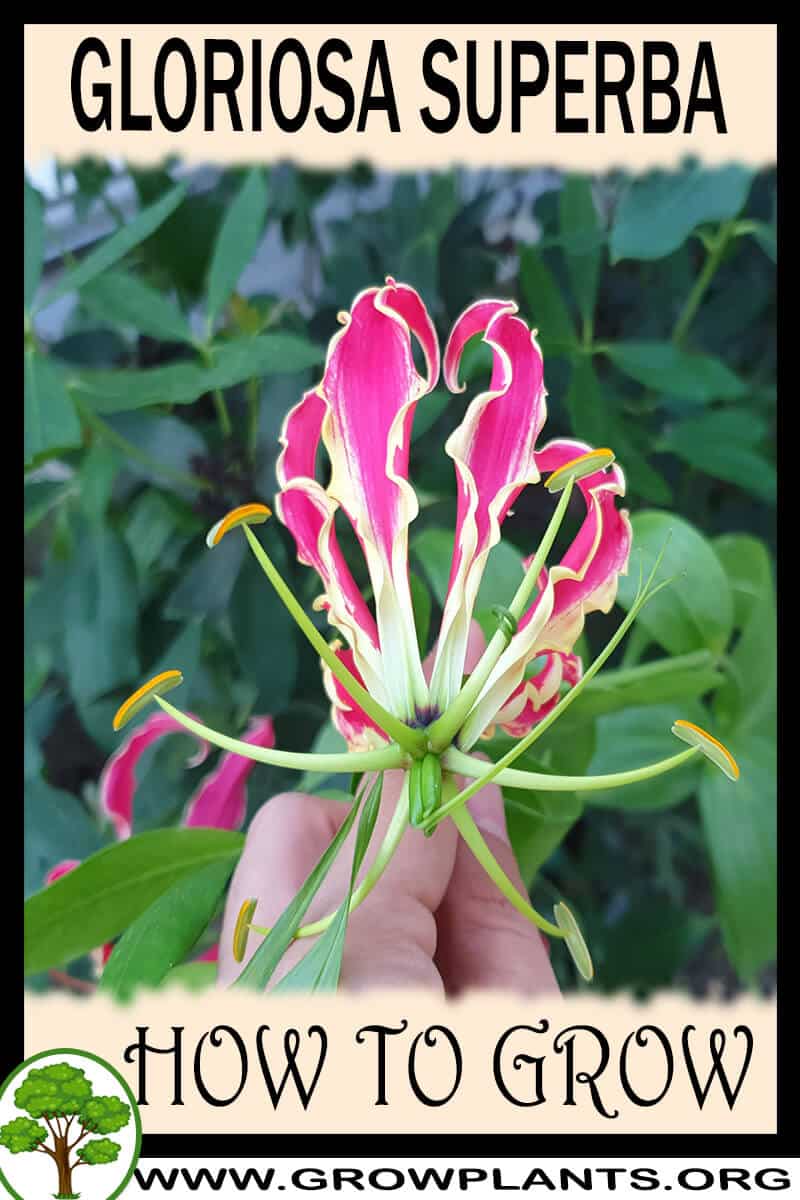
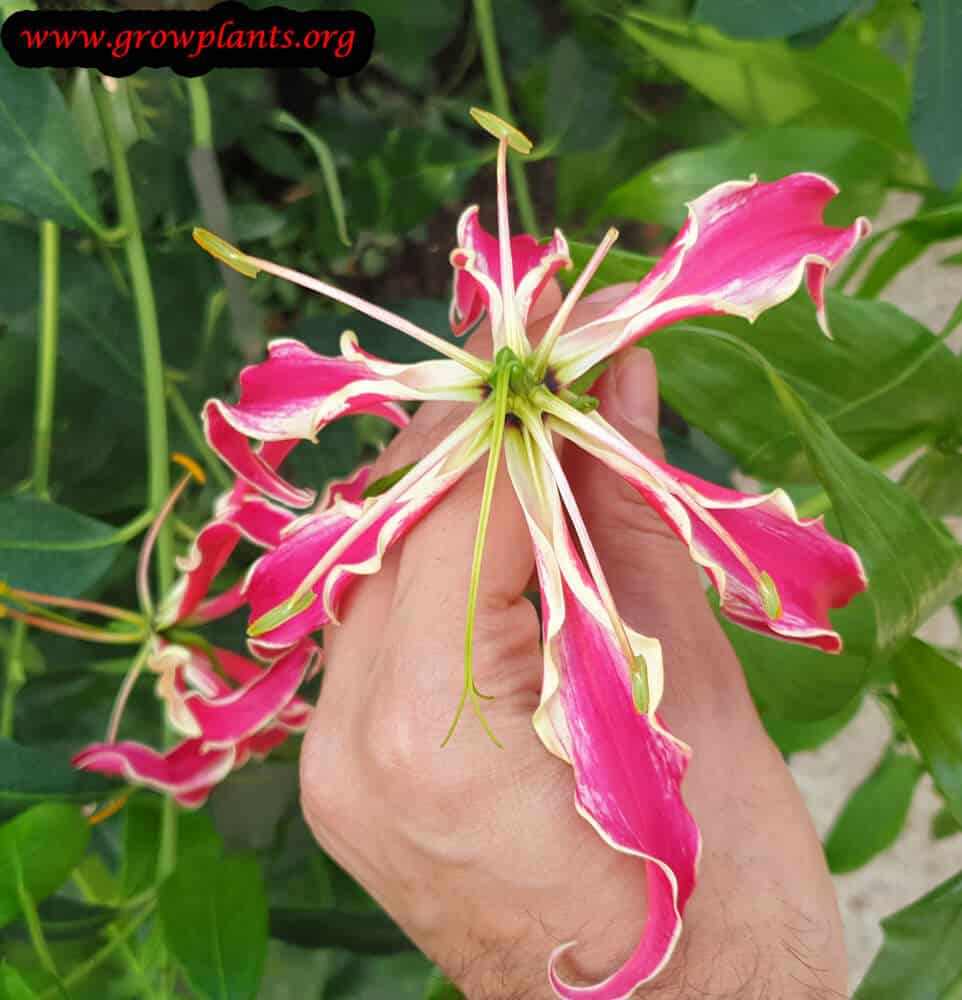
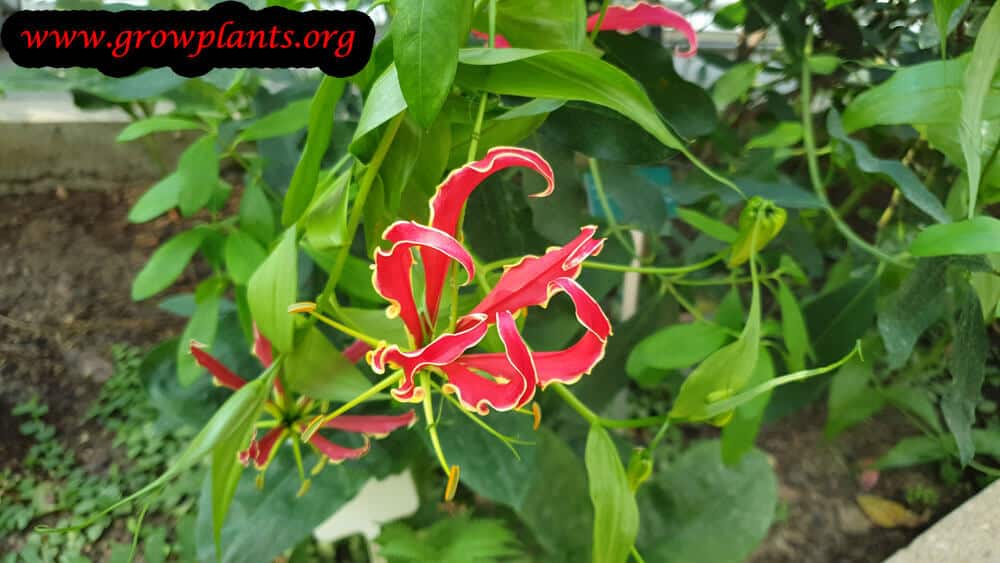
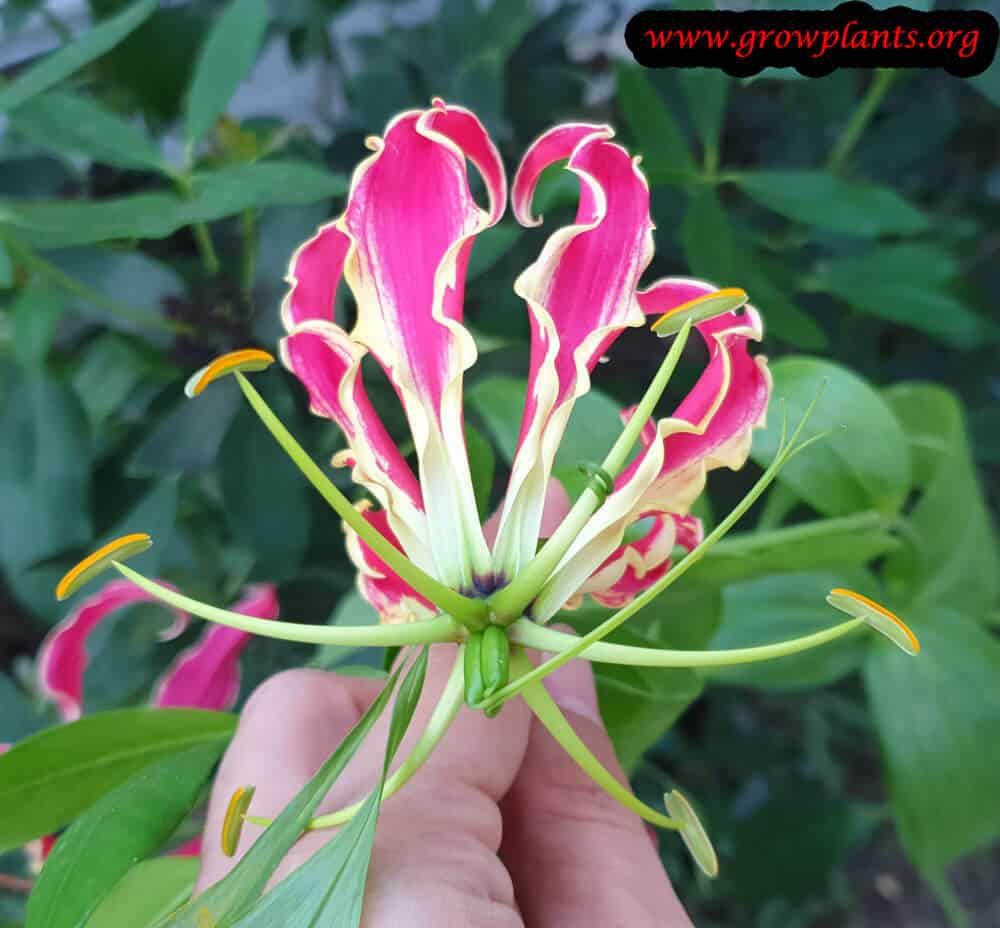
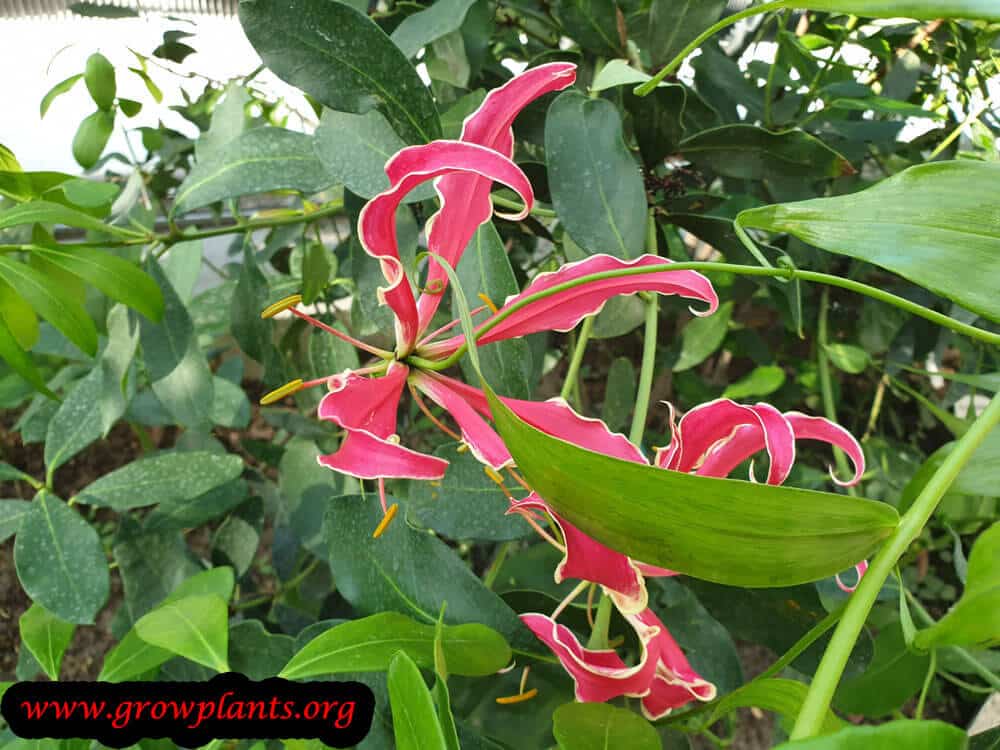
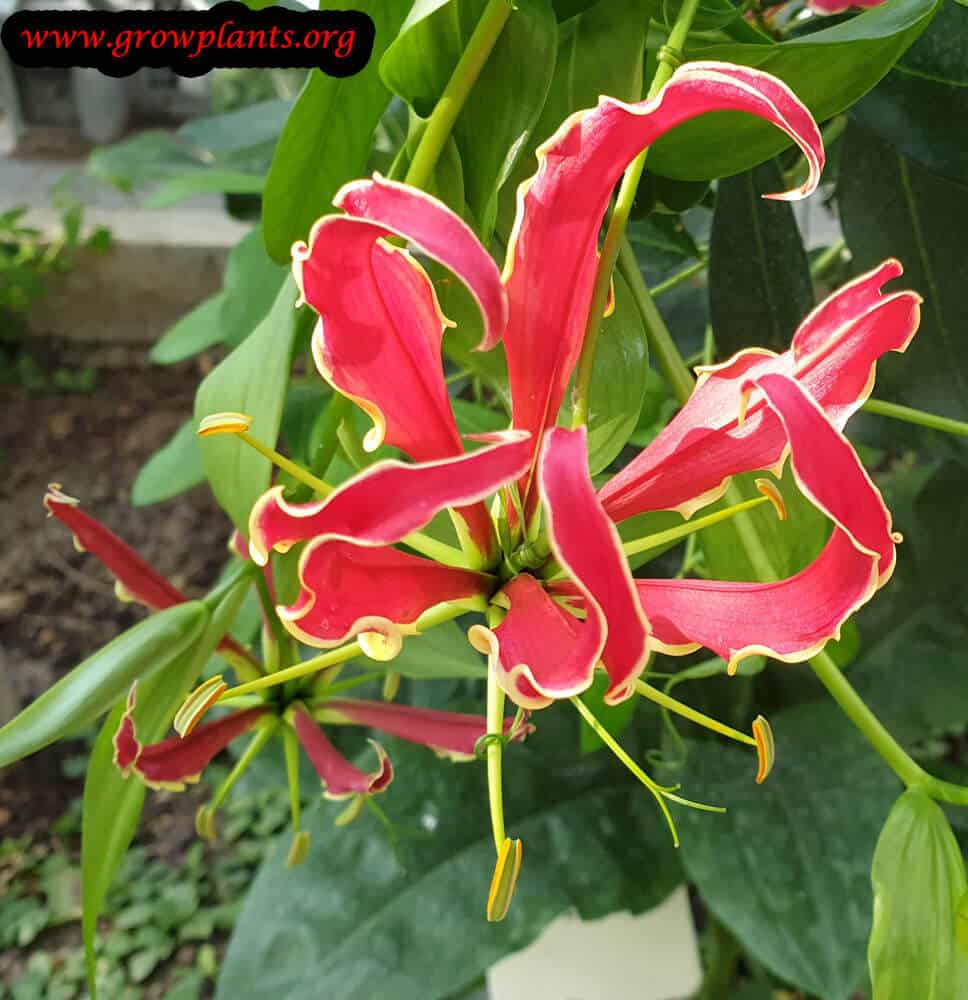
- Flower Characteristics: Showy flame-shaped flowers with reflexed, wavy red-to-orange (sometimes pink) petals that are yellow at the base.
Primary Uses & Landscape Value
- Functional & Ornamental Roles: An ornamental climber for fences, trellises and containers, a striking cut flower, and a medicinal plant — but handle with care given its toxicity.
Care Guide: Planting, Soil & Watering
Overview: Flame lily (Gloriosa superba) is a fast-growing, tuberous climbing perennial (hardiness zone 10+, or 9 with care) for full sun to part shade, thriving in rich, humus-laden, well-drained, slightly acidic soil. It wants generous moisture in active growth and dry rest when the tuber is dormant.
Quick Care Requirements
| Requirement | Ideal Condition |
|---|---|
| Planting Season | Warm season — spring, summer or autumn (spring in colder areas) |
| Growth Rate | Fast to Moderate |
| Soil Type | Rich, humus-laden, well-draining soil |
| Soil pH | Slightly acidic |
| Water Need | Moderate to High in growth; keep dry during dormancy |
Planting & Establishment
- Best Planting Season: Plant tubers in the warm season, in spring where the climate is cooler. Provide a support or trellis for the climbing stems.
- How to Plant:
- Hole Preparation: Plant the tuber horizontally about 5 cm (2 in) deep in a loosened, enriched bed, handling the brittle tuber carefully.
- Soil Amendments: Work in plenty of compost, humus and organic matter, and keep the soil slightly acidic and well-drained.
- Planting Depth: Lay the tuber flat, roughly 5 cm deep; the growing tip is at one end — avoid snapping it.
- Growth Speed & Expectations: Fast — stems climb quickly to 2–4 m and flower in the same season.
Soil, Watering & Drainage Care
- Soil Mix & Drainage Needs: Use rich, well-aerated, free-draining soil; in containers use a peat- or potting-mix base with a little perlite in a pot of at least 12 L, refreshing the soil every few years.
- Watering Schedule & Technique:
- Young / Newly Planted: Keep the soil moist and humid as the tuber sprouts and the stems climb.
- Established: Water generously through active growth and flowering, keeping the soil evenly moist but never waterlogged.
- Seasonal Adjustments: Reduce watering as the foliage dies back and keep the tuber dry through winter dormancy; in cold zones lift and store the tuber indoors.
Climate, Light & Hardiness
Flame lily grows across an unusually wide range of climates – mediterranean, desert, subtropical, temperate, and tropical – as a climbing tuberous perennial. It flowers best with full sun to half shade, and while it is reliably perennial outdoors only in warm-winter zones, its underground tuber can be saved through much colder winters if lifted and stored.
Quick Climate Specifications
| Climate Zones | Mediterranean, desert, subtropical, temperate, tropical |
|---|---|
| USDA Hardiness Zones | 10+ as a permanent outdoor perennial; zone 9 with winter protection; zones 4–8 possible if the tuber is lifted and stored indoors over winter |
| Frost Tolerance | Low (top growth); the tuber itself can survive well beyond this range if dug up before hard frost |
| Light Conditions | Full sun / half shade / full shade with good ambient light |
Sunlight & Light Exposure
Optimal Light Setup
Full sun to half shade gives the strongest flowering; it will also grow in full shade as long as the spot is still reasonably bright.
Direct Sun Requirement
Not strictly required – this vine is flexible on light, but more direct sun generally means more flowers.
Best Exposure / Orientation
As a climbing vine, pair a sunny-to-lightly-shaded exposure with something to scramble up (trellis, shrub, or fence) for the best display.
Temperature Extremes & Hardiness
USDA Hardiness & Regional Limits
Reliable as a permanent outdoor perennial from zone 10 upward, and can persist in zone 9 with attentive winter care. In zones 4–8 it is commonly grown like a dahlia or canna: the tuber is lifted in autumn and stored indoors over winter, then replanted in spring.
Cold Damage & Winter Protection
Cold weather kills the vine and foliage back; in marginal zones, a heavy mulch may protect the tuber in the ground, but in colder zones lifting and indoor storage is the dependable option.
Frost Sensitivity
Top growth is frost-tender and is killed by freezing temperatures; the below-ground tuber is the cold-hardy part of the plant.
Extreme Heat Tolerance
Well adapted to heat, given its natural range across desert, subtropical, and tropical climates.
Frost-Free Growing Season
Where the tuber is lifted each year, a long enough frost-free season is needed for the vine to re-establish, climb, and flower before autumn cold ends growth.
Wind, Humidity & Microclimate
Microclimate Recommendations
Because it climbs, site it where it has support and some shelter from strong wind that could tear the twining leaf-tips or topple the stems; beyond that, its broad climate range makes it adaptable to most garden microclimates within its hardiness limits.
Growing in Pots, Balconies & Indoors
The glory lily is a tuberous climbing lily that the grower confirms can be grown indoors as long as it gets strong light. It climbs by leaf tendrils, so give it a trellis, and it dies back to a tuber for its dormant rest. Every part is highly poisonous.
Quick Details
- Container Size: At least 12 L (3 gal), and bigger is better
- Indoor Suitability: Grows indoors given strong light – but highly toxic, so keep well away from children and pets
- Best Spot: The brightest window or a sunny to lightly shaded patio, with support to climb
- Soil & Drainage: Rich, well-aerated potting or peat mix with a little perlite; must drain freely
- Watering in Pots: Average to generous while in growth; dry the tuber off for dormancy
Indoors & On the Windowsill
- As a houseplant: The grower grows it indoors successfully, but only with plenty of light – set it at your brightest window and give it a small trellis or stakes to climb.
- Dormancy & overwintering: It naturally dies back to a tuber; ease off water as the top growth fades and keep the tuber dry and frost-free through the cold season, then restart it when growth resumes.
- Safety: All parts contain colchicine and are highly toxic if eaten – keep out of reach of children and pets.
On a Balcony or Patio
- Light & wind: Full sun to light shade suits it; tie the climbing stems to a support and shelter them from strong wind. Pots against warm walls dry quickly, so check moisture often in hot weather.
Choosing the Pot, Soil & Long-Term Care
- Pot & drainage: A 12 L (3 gal) pot or larger with strong drainage holes; skip a standing saucer of water to avoid rotting the tuber. Terracotta breathes and dries faster, glazed or plastic holds moisture longer.
- Potting mix: A rich, well-ventilated potting or peat mix with a little perlite, plus organic matter and humus.
- Feeding: The grower feeds three to four times through the growing season – potted plants need it more often as nutrients leach from the mix.
- Refreshing: Change the mix every few years; lift and divide the tubers as they multiply.
Fertilizing & Feeding
This vigorous climbing tuber is a moderate feeder through its active growing season, then needs no feeding at all once it dies back and goes dormant.
Quick Fertilizing Specs
| Feeding Level | Moderate – a vigorous climber during active growth, dormant the rest of the year |
|---|---|
| Main Nutrient Priority | Balanced feeding to support vigorous climbing growth and the long flame-colored bloom display |
| Best Feeding Period | Through the warm active growing season while the vine is climbing and flowering |
| Organic Options | Compost or humus worked into rich, well-drained soil, with mulch at planting |
| Soil pH | Prefers slightly acidic, well-drained soil |
| Micronutrients | No routine micronutrient program typically needed; watch for iron-related yellowing in poorly drained or heavy soil |
| Reduce/Stop Feeding | Feeding stops once the vine dies back and the tuber enters dormancy |
Feeding by Growth Stage
Establishment After Planting
Help a newly planted tuber or division root into rich, well-drained soil and put out its first climbing growth.
| Nutrient direction | A light, balanced feeding worked into rich, well-drained soil supports early root and shoot growth. |
|---|---|
| Timing | At planting and through the first flush of climbing growth in spring. |
| Frequency | Light feeding is enough while the tuber is still establishing. |
| Fertilizer types | A balanced, complete fertilizer worked lightly into the planting hole, Organic matter such as compost or humus mixed into the soil |
| Precautions | Avoid placing concentrated fertilizer in direct contact with the tuber, which can cause damage. |
Active Climbing Growth and Bloom
Support vigorous climbing growth and the fiery red, orange, or pink flame-shaped flowers this vine is grown for.
| Nutrient direction | Continued balanced feeding through the warm growing season fuels foliage and the long bloom display. |
|---|---|
| Timing | Through spring, summer, and autumn while the vine is actively climbing and flowering. |
| Frequency | Several light feedings spread through the active growing season generally keep this vigorous climber well fed. |
| Fertilizer types | A balanced, complete fertilizer applied through the growing season, A light compost or humus top-dressing worked around the base |
| Precautions | This can be an aggressive climber in warm climates; avoid excess nitrogen that pushes even more rampant growth. |
Dormancy / Winter Rest
Let the tuber rest through its natural dormant period, including when lifted and stored indoors in colder climates.
| Nutrient direction | None – withhold fertilizer once the vine dies back and the tuber goes dormant. |
|---|---|
| Timing | Autumn through winter dormancy, including storage indoors where the tuber must be lifted for the cold season. |
| Frequency | No feeding at this stage. |
| Fertilizer types | No feeding at this stage – withhold fertilizer while the tuber is dormant or in storage. |
| Precautions | Do not fertilize a dormant or stored tuber; resume feeding only once new growth appears in spring. |
Nutrient Deficiency Signs & Corrections
Leaves look pale green to yellowish overall, with thin, weak climbing growth.
| Possible causes | Low available soil nitrogen, Nutrients leached from very well-drained soil, Very poor or thin soil at the planting site |
|---|---|
| Appears first on | Older, lower leaves first. |
| What to check | Recent feeding history, Soil richness and organic matter, Overall vigor of new climbing growth |
| Possible correction | Apply a balanced, complete fertilizer during active growth and work organic matter into the soil. |
New leaves look pale to yellowish while the veins remain visibly greener.
| Possible causes | High or poorly draining soil limiting iron availability, Waterlogged soil stressing roots, Soil pH drifted away from the slightly acidic range this plant prefers |
|---|---|
| Appears first on | Newest leaves at the growing tips. |
| What to check | Soil drainage and pH, Whether yellowing is worst on new growth, Recent watering pattern |
| Possible correction | Improve drainage and correct soil pH; where confirmed, apply a chelated iron product per its label. |
Fewer or smaller flowers than expected, with scorching along the margins of older leaves.
| Possible causes | Low soil potassium, Leaching from frequent watering, Imbalanced feeding weighted too heavily toward nitrogen |
|---|---|
| Appears first on | Margins of older, lower leaves, and overall flower production. |
| What to check | Leaf margins versus centers, Recent feeding balance, Watering and drainage |
| Possible correction | Use a balanced, complete fertilizer that supplies potassium through the growing season. |
Pruning, Training & Seasonal Maintenance
Gloriosa superba (flame lily) is a herbaceous, tuberous climbing vine that scrambles up its support using tendrils formed at the tips of its leaves, then dies back completely to the underground tuber at the end of each growing season – so, as with other tuberous geophytes, there is no permanent structure to prune, only spent growth to clear away. The recorded autumn/winter pruning window matches this natural dieback: cut the collapsed vine away once it has browned, and never while it is still green, since the vine is feeding the tuber that produces next year’s growth and flowers.
Quick Pruning & Maintenance Specs
| Pruning Tolerance | Low – no shaping pruning; limited to clearing spent growth |
| Primary Pruning Window | Autumn to winter, after the vine dies back naturally |
| Typical Frequency | Once per year, at dieback, plus optional deadheading through the season |
| Main Objective | Clear the collapsed vine; contain self-seeding where the species is weedy |
| Young Plant Priority | Provide a fine support early and guide young tendrils onto it |
| Mature Plant Priority | Cut the dead vine to the base once fully browned |
| Best Tool Type | Precision snips or bypass secateurs |
Pruning by Plant Age & Size
Newly Established
Set up a fine trellis, mesh or twiggy support before growth begins – the leaf-tip tendrils need something thin to grip – and leave a young plant’s growth untouched through its first season.
Young / Formative
Guide the earliest shoots onto the support; beyond that, the plant climbs itself via its tendrils, so there is no formal training system to apply, just occasional redirection if it strays off the support.
Mature / Established
Deadhead spent flowers through the season if seed set/spread is a concern, then cut the whole vine down to the base once it has died back completely at season’s end.
Seasonal Pruning Schedule
Ongoing Sanitary: remove faded flowers and developing seed pods through the season where containing spread matters – this species is noted as potentially invasive in tropical climates.
Dormant / Winter: once the vine has fully collapsed and browned, cut it back to the ground; do not disturb or dig into the tuber underneath.
Structural Pruning & Training
The only real “structure” each year is the support itself: because Gloriosa climbs with thin leaf-tip tendrils rather than twining stems, a fine mesh, netting or twiggy support works far better than a thick pole or trellis wire. No thinning or shaping cuts are needed on the vine itself through the season.
Special Growth to Remove
Remove spent flowers and seed pods if limiting self-seeding is a goal, and cut away the dead vine once it has collapsed at the end of the season. There are no suckers or watersprouts on this tuberous vine.
Container & Small-Space Pruning
In a container, provide the same fine climbing support and cut the vine back once it dies down each year; let the tuber rest on the dry side over dormancy rather than repotting or disturbing it unnecessarily.
Tools
Precision snips or bypass secateurs are sufficient for cutting back this soft, herbaceous vine; soft ties or light mesh support are needed for training the climbing growth.
Tool Hygiene & Disease Risk
Routine. No significant tool-transmitted disease is reported (aphids are the main pest); ordinary clean tools are sufficient.
Cut Placement & Technique
Cut the dead vine near ground level once fully dry, taking care not to dig into or damage the tuber below the soil surface.
Heavy Pruning & Rejuvenation
Not applicable – the tuber regenerates the entire vine fresh each year on its own; there is no framework to renovate, only the dead growth to clear away.
Post-Pruning Care
After cutting back the dead vine, keep the tuber on the dry side until new growth resumes in spring; avoid feeding a dormant tuber.
Common Pruning Mistakes
- Cutting the vine back while it is still green and active, which reduces the tuber’s stored energy for next year’s growth and flowering.
- Not providing a fine climbing support early enough, leading to a sprawling, tangled plant that then needs corrective detangling.
- Handling cut vine material bare-handed – all parts of this plant, especially the tuber, are highly toxic (it contains colchicine), so gloves should be worn when cutting or clearing it.
When NOT to Prune
Never cut back the vine while it is still green, actively growing, or in flower – wait for it to die back naturally at the end of the season.
Recommended Tools (by task)
- precision_snips – deadheading and cutting back the dead vine at season’s end.
- soft_ties_stakes – guiding young growth onto a fine climbing support suited to its leaf-tip tendrils.
Propagation Guide
Gloriosa superba is most reliably increased by dividing its underground storage rhizome, which keeps the exact flower color and habit of the parent plant true; growing from seed also works and is not difficult, though seedlings take longer to reach flowering size. Overall this is an easy plant to propagate by division, stem cutting, or seed.
Quick Propagation Specs
| Best Propagation Method | Rhizome division |
| Alternative Methods | Stem cuttings; Seed |
| Propagation Difficulty | Easy |
| Seed True-to-Type | Usually true-to-type |
| Vegetative True-to-Type | Yes |
| Best Propagation Season | Division: autumn to winter; Cuttings and sowing: spring to summer |
| Seed Germination Time | 2–8 weeks |
| Cutting Rooting Time | Typically several weeks under warm, humid conditions |
| Germination Temperature | ~25°C (77°F) |
| Seed Sowing Depth | 2cm (1 inch) |
Growing from Seed
Seed Handling & Viability
Save seed in a dry, dark location until ready to sow.
Sowing Season
Spring to summer.
Sowing Depth & Orientation
Sow about 2cm (1 inch) deep, spacing plants roughly 20 x 30cm (8 x 12 inches) apart as they develop.
Germination Conditions
Keep the soil moist with high humidity and never let it dry out; a peat-based mix works well, at a warm temperature around 25°C (77°F).
Germination Time
2–8 weeks.
Seedling Care
Mulch lightly and keep seedlings in good light with moist soil and high humidity.
Stem Cuttings
Best Timing
Spring.
Rooting Setup
Keep high humidity with moist soil, mist the cutting with water, and provide well-ventilated air to help prevent rot.
Rooting Hormone
Optional – not required, but may be used.
Rooting Time
Typically several weeks under the warm, humid conditions described above.
Rhizome Division
The site’s own guidance describes vegetative reproduction by dividing the rhizome (the underground storage organ, sometimes also called a tuber in general horticultural references); this is best done from autumn into winter. Each division should include a healthy growth point and be replanted promptly into rich, well-drained, slightly acid soil with organic matter worked in.
Bloom & Flower Guide
Quick Details
- Bloom Season: Spring through autumn
- Flower Appearance: Flame-shaped flowers with reflexed, wavy petals in red, orange or pink, yellow at the base
- Edibility: Not edible – the flame lily is highly toxic (colchicine) and can be fatal if any part is eaten
Detailed Blooming Overview
The flame lily is a climbing vine that hauls itself up by tendril-like leaf tips and puts on a spectacular summer-long show. Its flowers are unmistakable: petals that sweep sharply backward, wave at the edges, and glow in red, orange and pink with yellow toward the base, so the whole bloom looks like a leaping flame. It is prized as an exotic cut flower.
Flower Characteristics
- Reflexed, wavy-edged petals in red, orange or pink with yellow at the base.
- The overall shape reads as a dancing flame – the plant’s signature look.
Bloom Care & Thinning
- Support: Give the vine a trellis or wires to climb, since it clings by the tips of its leaves.
- Safety: Every part of the plant, especially the tubers, is dangerously toxic – handle with care and keep it well away from children and pets.
Pests, Diseases & Troubleshooting
Overview: The flame lily (Gloriosa superba) is a tender tuberous climber whose main troubles are sap-sucking pests under warm conditions and, above all, tuber rot when tubers sit wet or are stored badly. It is also seriously toxic: every part, especially the tuber, contains colchicine and is potentially lethal, so handle with care. Grow it warm with strong support and a free-draining mix, and keep dormant tubers dry.
Quick Troubleshooting Overview
| Issue / Pest | Main Symptom | Primary Solution |
|---|---|---|
| Tuber rot (fungal/abiotic) | Soft, rotten tubers; failure to sprout or sudden collapse | Free-draining mix, keep dormant tubers dry, discard rotted |
| Aphids | Sticky, distorted new growth; virus spread | Hose off, encourage predators; soap or neem |
| Thrips | Silvery flecking and distorted buds/flowers | Sticky traps, remove infested buds, predatory mites |
| Red spider mites | Fine stippling, webbing and bronzing in dry heat | Raise humidity, hose foliage, predatory mites; oil if severe |
| Caterpillars | Chewed leaves and shoot tips | Hand-pick, Bt if needed |
| Toxicity (safety) | Not a pest – but tubers are lethally poisonous | Wear gloves; keep from children, pets and livestock |
Common Pests & Management
- Aphids (Aphis / Myzus spp.):
- Symptoms: Soft-bodied colonies on tender new growth, buds and flower stems, causing distortion and honeydew, and capable of spreading viruses.
- Prevention & Control: Hose off, support ladybirds and lacewings, and treat persistent colonies with insecticidal soap or neem in the evening; wear gloves when handling this toxic plant.
- Thrips (Frankliniella / Thrips spp.):
- Symptoms: Slender insects in buds and flowers, leaving silvery flecking and distorting the developing blooms; can spoil the display and vector viruses.
- Prevention & Control: Use sticky traps, remove and destroy infested buds, and introduce predatory mites; insecticidal soap or neem for active populations.
- Red spider mites (Tetranychus urticae):
- Symptoms: Fine pale stippling and bronzing with webbing in hot, dry conditions and under glass; foliage dulls and crisps.
- Prevention & Control: Raise humidity, hose leaf undersides, and release predatory mites; horticultural oil or a labelled miticide for heavy infestations.
- Whitefly (Trialeurodes vaporariorum):
- Symptoms: Clouds of tiny white flies under cover, with honeydew and sooty mould from nymphs on leaf undersides.
- Prevention & Control: Use yellow sticky traps, keep plants uncrowded, and treat with insecticidal soap or neem; parasitoid wasps under glass.
- Caterpillars (various Lepidoptera):
- Symptoms: Chewed leaves, notched margins and damaged shoot tips from leaf-eating larvae.
- Prevention & Control: Hand-pick larvae and apply Bacillus thuringiensis (Bt) for heavier pressure; encourage birds and predators.
Diseases & Fungal Issues
- Tuber & root rot (Fusarium / Pythium / Sclerotium):
- Symptoms: Soft, discoloured, foul-smelling tubers that fail to sprout, or sudden wilting and collapse of growing plants in wet, poorly drained or cold conditions; the main disease.
- Treatment & Management: Grow in a free-draining mix, water carefully in growth, and keep dormant tubers dry, warm and airy; discard any soft or rotted tubers and start clean. Handle tubers with gloves.
- Leaf blight & Botrytis (Botrytis / Alternaria):
- Symptoms: Brown blotches, leaf blight and grey mould on foliage and flowers in humid, crowded or overhead-watered conditions.
- Treatment & Management: Improve airflow, water at the base, and remove affected leaves and spent flowers; a fungicide only if it spreads.
- Leaf spot (Cercospora / Colletotrichum):
- Symptoms: Discrete brown or tan spots on leaves, largely cosmetic.
- Treatment & Management: Remove spotted leaves, improve airflow, and avoid wetting foliage.
- Viruses (Mosaic / potyviruses):
- Symptoms: Mottling, streaking and distortion spread by aphids and thrips; no cure.
- Treatment & Management: Control aphids and thrips, rogue out symptomatic plants, and start from clean tubers.
Growing Difficulties & Abiotic Problems
- Tuber rot from wet or cold storage:
- Cause & Symptoms: The commonest killer: tubers rot when left wet in the ground or stored cold and damp over dormancy.
- Correction Strategy: Lift or keep tubers dry as growth dies back, store warm, dry and airy, and grow in a free-draining mix; never leave dormant tubers waterlogged.
- Poor climbing support:
- Cause & Symptoms: Weak, tangled or sprawling growth and poor flowering without support; the plant climbs by leaf-tip tendrils.
- Correction Strategy: Provide a trellis, netting or twiggy support at planting so tendrils can grip; guide young shoots onto the support.
- Cold damage:
- Cause & Symptoms: Blackened, collapsed foliage after cold; this is a frost-tender tropical climber.
- Correction Strategy: Keep warm (above about 15°C), grow under cover in cool climates, and lift and store tubers frost-free over winter.
- Toxicity (handling & siting):
- Cause & Symptoms: Not a growing fault but a serious hazard: all parts, especially the tuber, contain colchicine and are potentially fatal if eaten.
- Correction Strategy: Wear gloves when handling tubers, wash hands after, and site well away from children, pets and grazing animals; never let anyone mistake the tuber for an edible root.
What Helps – Products & Tools
Warmth, strong support and a free-draining mix prevent most problems, and dry storage prevents tuber rot. For sap-suckers use insecticidal soap, neem or horticultural oil in the evening; raise humidity against mites; Bt for caterpillars; and a fungicide only for spreading blight. Always wear gloves – this plant is toxic.