Care Guide: Planting, Soil & Watering
Overview: Garrya elliptica (silk tassel bush) is a tough, drought-tolerant evergreen shrub for full sun to part shade. It grows in well-draining soil, tolerates poor and coastal conditions, and needs only moderate water once established.
Quick Care Requirements
| Requirement | Ideal Condition |
|---|---|
| Planting Season | Spring through autumn |
| Growth Rate | Moderate to Fast |
| Soil Type | Well-draining; tolerates poor and coastal soils |
| Water Need | Moderate — drought tolerant once established |
Planting & Establishment
- Best Planting Season: Plant from spring through autumn; establish young plants, as this shrub dislikes being moved once settled.
- How to Plant:
- Hole Preparation: Dig a hole about twice the width of the root ball to loosen the soil for the roots.
- Soil Amendments: Mix in some compost or organic matter, but keep drainage sharp — this shrub prefers free-draining ground.
- Planting Depth: Set the root collar level with the soil; plant young specimens, as Garrya resents root disturbance.
- Growth Speed & Expectations: A moderate-to-fast grower forming a shrub about 1–3 m (3–10 ft) tall, useful as an evergreen hedge or wall shrub.
Soil, Watering & Drainage Care
- Soil Mix & Drainage Needs: Well-drained soil is key; the shrub tolerates poor, dry and coastal sites but not waterlogging.
- Watering Schedule & Technique:
- Young / Newly Planted: Water regularly through the first season to establish the plant.
- Established: Once established, water only moderately — the shrub is drought tolerant and copes with dry spells.
- Seasonal Adjustments: Water more in prolonged heat and little to none in cool, wet weather.
Climate, Light & Hardiness
Garrya elliptica (silk tassel bush) is a drought-tolerant, pollinator-attracting evergreen shrub for temperate, Mediterranean, and subtropical climates; it grows well in full sun to half shade and is hardy across zone 8–11.
Quick Climate Specifications
| Climate Zones | Temperate, Mediterranean, subtropics |
|---|---|
| USDA Hardiness Zones | 8–11 |
| Frost Tolerance | Moderate |
| Light Conditions | Full Sun to Half Shade |
| Wind Tolerance | Moderate to High |
Sunlight & Light Exposure
Optimal Light Setup
Full sun to half shade; adaptable to a range of exposures.
Temperature Extremes & Hardiness
USDA Hardiness & Regional Limits
Zone 8–11.
Cold Damage & Winter Protection
Moderately cold hardy; reliable within its rated zones, though a sheltered site helps at the cold edge.
Extreme Heat Tolerance
Handles Mediterranean and subtropical heat well given its drought tolerance.
Wind, Humidity & Microclimate
Dry-Air Tolerance
Good, being noted as drought tolerant.
Wind Tolerance
Reasonably wind tolerant, a trait typical of coastal-native Garrya species often used in windbreak plantings.
Growing in Pots, Balconies & Indoors
The silk tassel bush is grown for its dramatic dangling winter catkins. The grower rates it for containers but not indoors – it is a substantial evergreen shrub that wants full outdoor light and open air.
Quick Details
- Container Size: A large tub, 30-50 L (8-13 gal), scaled to the shrub
- Indoor Suitability: Not a houseplant (grower); an evergreen shrub for outdoor pots
- Best Spot: Full sun to partial shade; a bright spot with some direct sun is ideal.
- Soil & Drainage: Aerated, organic-rich mix (quality potting mix, or peat/coir with perlite or vermiculite); it must drain freely.
- Watering in Pots: Keep the mix evenly moist, letting the surface dry slightly between waterings; pots dry faster than open ground.
Indoors & On the Windowsill
- Not a houseplant: The grower marks it unsuitable indoors; it is too large and light-hungry for a room, and its winter catkin display is an outdoor feature.
- Shelter, don’t heat: It is fairly hardy – keep it outdoors, giving only wind shelter rather than bringing it into warmth.
On a Balcony or Patio
- Light & exposure: Sun to part shade suits it; it tolerates coastal wind well, which makes it a good tough-balcony shrub. Water pots in dry spells.
- Practicalities: A large evergreen in a tub is heavy and catches wind – anchor or place it against a sheltering wall.
Choosing the Pot, Soil & Long-Term Care
- Pot & drainage: A large tub with strong drainage holes; skip a standing-water saucer. Terracotta breathes and dries fast; glazed or plastic holds moisture longer.
- Potting mix: Use a well-aerated, organic-rich mix – quality potting mix, or peat/coir blended with perlite or vermiculite.
- Feeding: As nutrients wash out of pots faster than open ground, feed potted plants regularly through the growing season with a balanced fertiliser.
- Repotting: Refresh the top few centimetres of mix each year and pot up (or root-prune and return to the same pot) about every two years.
Fertilizing & Feeding
A moderate feeder: modest balanced feeding during the cool-season growth flush supports the framework and the dangling catkin display, with feeding eased off through the hot, dry summer rest.
Quick Fertilizing Specs
| Feeding Level | Moderate feeder |
|---|---|
| Main Nutrient Priority | Balanced feeding with adequate nitrogen for foliage and catkin display |
| Best Feeding Period | Autumn through winter as growth resumes ahead of bloom |
| Organic Options | Compost or aged organic matter worked into well-drained soil |
| Reduce/Stop Feeding | Feeding is eased back through the hot, dry summer rest |
| Micronutrients | Usually met by a complete fertilizer; correct only diagnosed issues |
| Soil pH | Prefers well-drained soil; tolerates a range from slightly acidic to near neutral |
Feeding by Growth Stage
Cool-season vegetative growth
Build a sturdy evergreen framework ahead of the winter catkin display.
| Nutrient direction | Balanced feeding with adequate nitrogen supports steady leafy growth. |
|---|---|
| Timing | Autumn into winter as this Mediterranean-climate shrub resumes active growth. |
| Frequency | A modest feeding as growth resumes is usually sufficient. |
| Fertilizer types | A balanced complete fertilizer, Compost worked into the root zone |
| Routine trace nutrients | iron, manganese |
| Precautions | Keep feeding moderate; this drought-tolerant shrub does not need heavy nitrogen to perform well. |
Catkin bloom
Support the long, silvery-tasseled catkins as they hang and open through winter into spring.
| Nutrient direction | Balanced feeding continues to be favored over any high-phosphorus “bloom booster” product. |
|---|---|
| Timing | Winter into spring while the catkins are on display. |
| Frequency | A light, balanced feeding carried over from the growth flush is enough. |
| Fertilizer types | A balanced complete fertilizer |
| Routine trace nutrients | iron, manganese |
| Precautions | Avoid disturbing the root zone heavily while catkins are forming and opening. |
Hot, dry summer rest
Let this drought-tolerant shrub coast through the hot dry season without pushing soft new growth.
| Nutrient direction | None – withhold fertilizer through the summer rest period. |
|---|---|
| Timing | Summer, once the catkin display has finished. |
| Frequency | No feeding during this rest period. |
| Fertilizer types | No feeding at this stage; do not fertilize again until cool-season growth resumes. |
| Precautions | Withhold fertilizer now; feeding a drought-adapted shrub during its dry rest can push vulnerable new growth and waste nutrients. |
Nutrient Deficiency Signs & Corrections
Foliage looks pale and overall growth and catkin production are weak.
| Possible causes | low available soil nitrogen, nitrogen leaching in sandy, well-drained soil, root competition from nearby plantings |
|---|---|
| Appears first on | older, lower leaves |
| What to check | recent feeding history, soil texture and drainage, root competition nearby |
| Possible correction | Apply a balanced complete fertilizer during the cool-season growth flush. |
New leaves yellow between veins that stay noticeably green.
| Possible causes | alkaline or high-pH soil limiting iron uptake, poorly drained or compacted soil, root stress in heavy clay soils |
|---|---|
| Appears first on | newest growth |
| What to check | soil pH, drainage, recent root disturbance |
| Possible correction | Improve drainage and correct soil pH toward neutral; apply a chelated iron product per its label if it persists. |
Leaf margins scorch or brown and the shrub looks stressed despite adequate watering.
| Possible causes | fertilizer salt buildup, especially in containers or beds with poor drainage, over-fertilizing a naturally drought-tolerant, moderate feeder, irregular watering that concentrates salts |
|---|---|
| Appears first on | leaf tips and margins |
| What to check | recent fertilizer amounts, watering consistency, drainage |
| Possible correction | Ease off feeding, flush the root zone with a thorough watering, then resume with lighter applications. |
Pruning, Training & Seasonal Maintenance
Garrya elliptica (silk tassel bush) is a vigorous evergreen shrub grown above all for its long, silvery-grey catkins that dangle through winter into spring, especially on male plants. It tolerates pruning well and can be shaped as a loose specimen or clipped as a hedge/screen, but because the catkins form on the previous season’s wood, any real shaping is best done immediately after the display fades rather than during the winter bloom window itself.
Quick Pruning & Maintenance Specs
| Pruning Tolerance | Moderate–High |
| Primary Pruning Window | Spring, right after the catkins fade |
| Secondary Maintenance Window | Any time for dead or damaged wood removal |
| Typical Frequency | Annual light shaping; hedges clipped once or twice a year |
| Main Objective | Maintain shape/screen density while preserving next winter’s catkin wood |
| Young Plant Priority | Light shaping only; build a full-branched framework |
| Mature Plant Priority | Post-bloom shaping; height and spread control |
| Best Tool Type | Bypass secateurs/loppers for specimens; hedge shears only if formally clipped |
| Avoid Heavy Pruning During | The winter–spring catkin display |
Pruning by Plant Age & Size
Newly Established
Minimal — remove only damaged growth and let the plant fill out.
Young / Formative
No formal leader training; as a free-standing shrub, lightly shape for a full, well-branched form. If grown as a hedge, begin light trimming once it reaches the desired width to build density from the base up.
Mature / Established
Post-bloom shaping to control size and remove old flowering stems; hedges are clipped for density after the main catkin flush.
Flowering Wood
Catkins are produced on wood grown the previous season and open through winter into spring. Pruning that removes this wood before or during bloom sacrifices the display; pruning right after flowering allows a full growing season for new catkin-bearing wood to form.
Structural Pruning & Training
Being a fast-to-medium, fairly vigorous shrub, it can become leggy or open at the base without occasional shaping; thin crowded interior growth and control height/spread as a free-standing specimen, or maintain a defined face if clipped as a hedge.
Special Growth to Remove
Remove spent, dried catkin/bloom stems after the display fades as part of the post-bloom tidy-up.
Container & Small-Space Pruning
Can be grown in a large planter; keep more compact with an annual post-bloom trim rather than allowing it to reach full in-ground size.
Tools
Bypass secateurs for light shaping and spent-catkin removal; loppers for thicker older wood. Hedge shears are appropriate only where the plant is maintained as a clipped formal hedge/screen — note this sacrifices some of the catkin display in favor of a tight, dense face.
Tool Hygiene & Disease Risk
Routine — aphids and spider mites are the noted pest pressures; no elevated transmissible-disease risk documented.
Cut Placement & Technique
Use thinning cuts to control density on specimen plants; on hedges, clip to a slightly tapered face so light reaches the lower growth.
Heavy Pruning & Rejuvenation
Tolerates a fairly hard renovation cut in spring after flowering if it has become overgrown or leggy — it is a vigorous grower and recovers well, though the following winter’s catkin display will be reduced that one season.
Post-Pruning Care
Water normally after cutting back; no extra feeding is needed to push regrowth.
Common Pruning Mistakes
Pruning or hard-clipping during the winter bloom period, which removes the season’s catkin display; over-shearing a formal hedge so heavily that it never shows catkins at all.
When NOT to Prune
Avoid pruning through the winter–spring catkin display if that ornamental feature matters, and avoid hard cutting back in the first year after planting.
Pruning Troubleshooting
| Problem | Possible Cause | What to Check | Corrective Action |
| Few or no catkins | Pruned during or just before the winter bloom, removing bud-bearing wood | Timing of last cut; whether plant is male (showier catkins) or female | Move shaping cuts to right after the catkins fade |
| Leggy, bare-based shrub | No shaping over several seasons | Density of lower growth vs. top growth | Post-bloom shaping/light renewal cut to encourage basal branching |
Recommended Tools (by task)
- bypass_secateurs – post-bloom shaping and removal of spent catkin stems.
- loppers – occasional renewal cuts on thicker older wood.
- hedge_shears – only for plants maintained as a formally clipped hedge/screen.
Propagation Guide
Garrya elliptica is best propagated from semi-hardwood stem cuttings, which is also the only reliable way to guarantee both the plant’s sex and its cultivar identity, since the species is dioecious (separate male and female plants, as noted on this site) and male plants carry the longer, more ornamental catkins most gardeners want. Seed-grown plants are unsexed until they flower years later, and cuttings root only moderately easily, so overall difficulty is moderate.
Quick Propagation Specs
| Best Propagation Method | Semi-hardwood stem cuttings |
| Alternative Methods | Seed |
| Propagation Difficulty | Moderate |
| Seed True-to-Type | Usually true-to-type for the species, but sex (male/female) cannot be predicted or controlled from seed |
| Vegetative True-to-Type | Yes – also the only way to guarantee sex and named-cultivar identity |
| Best Propagation Season | Late summer for semi-hardwood cuttings |
Growing from Seed
Seed-grown plants take several years to flower and reveal their sex, and named ornamental selections (bred for showy male catkins) cannot be reproduced from seed. Where used, seed may benefit from a period of cold stratification, as is common for many shrubs in this family; treat this as a cautious general guideline rather than a site-confirmed requirement.
Stem Cuttings
Cutting Type
Semi-hardwood tip cuttings from the current season’s growth.
Best Timing
Late summer, once new growth has begun to firm.
Rooting Setup
Root in a free-draining cutting mix under high humidity; rooting can be slow and somewhat inconsistent, and bottom heat can help.
Rooting Hormone
Recommended – a rooting hormone improves an otherwise moderately slow rooting rate.
Rooting Time
Often several weeks to a couple of months.
Bloom & Flower Guide
Quick Details
- Bloom Season: Winter into spring
- Flower Appearance: Long, slender, silvery-grey catkins hanging down; male and female flowers on separate plants, the males far showier
- Edibility: Grown as an ornamental (its parts are bitter) – not eaten
Detailed Blooming Overview
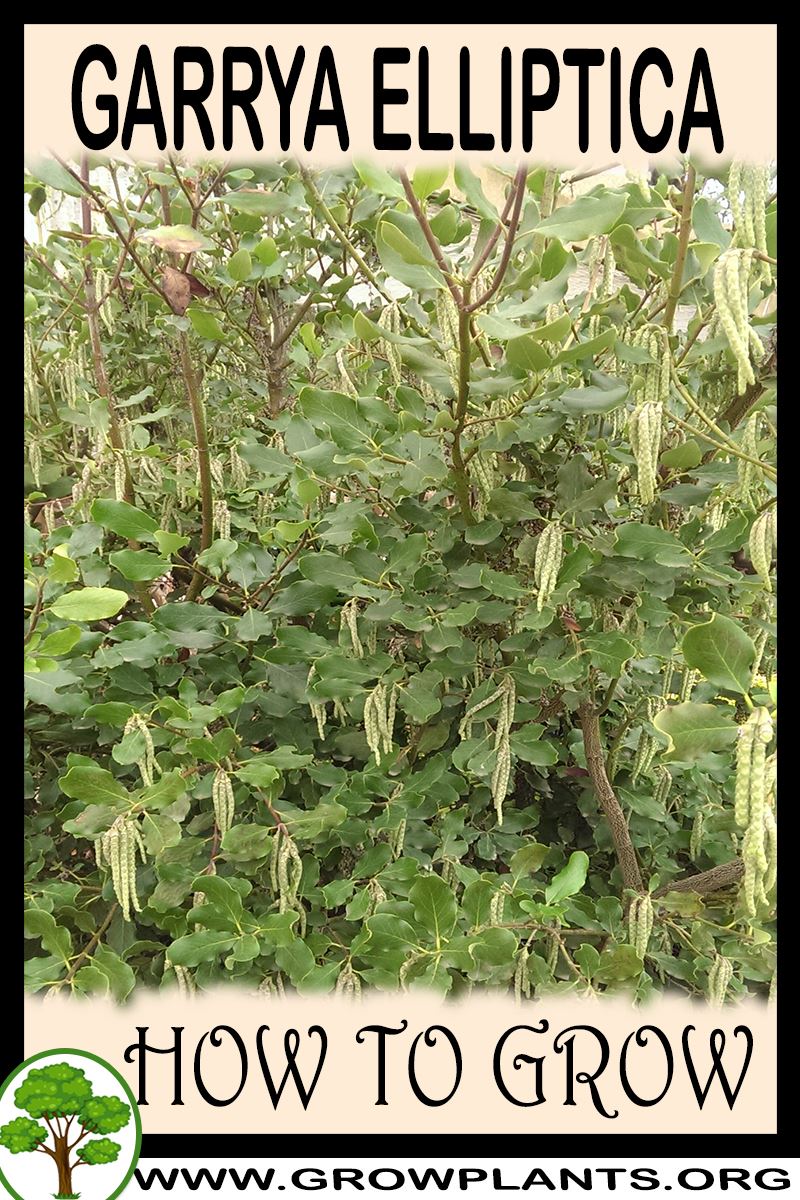
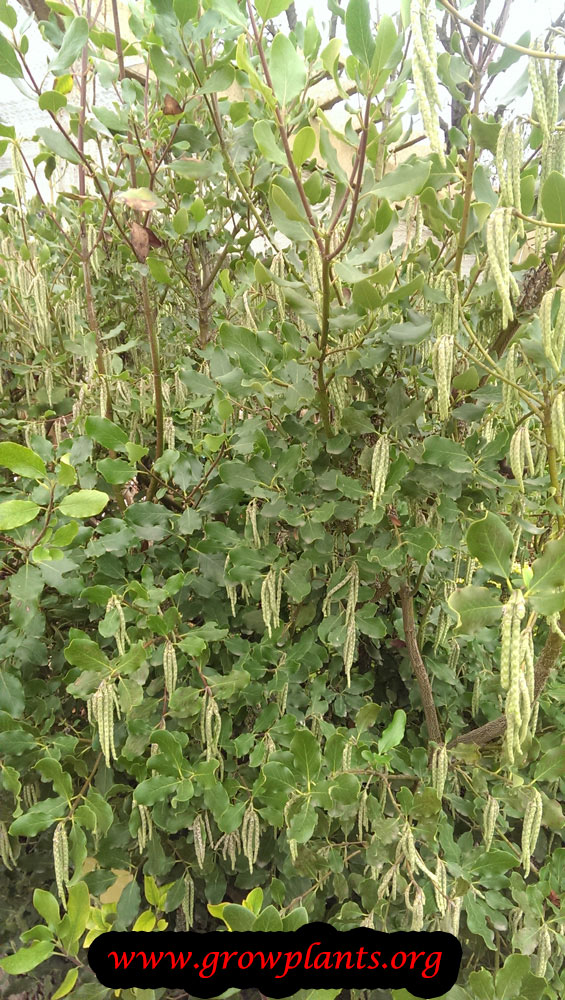
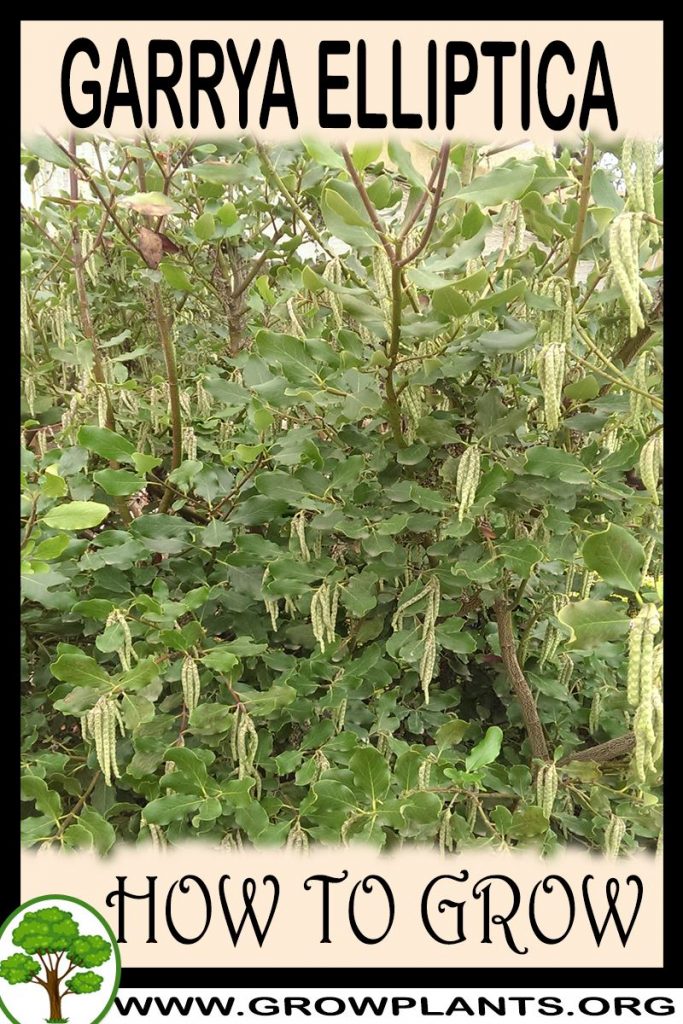
Silk tassel bush earns its name in the depths of winter, when it drapes itself in long, weeping catkins. Plants are dioecious – male and female on separate individuals – and it is the male plants, with tassels that can hang well over the length of a hand, that put on the real show. Because the display comes when little else is in flower, it is a valued winter shrub.
Flower Characteristics
- Flowers gathered into long, pendent, greyish-white catkins.
- Male and female flowers on separate plants; males carry the longest, showiest tassels.
- Peak interest in the middle of winter.
Bloom Care & Thinning
- Choosing plants: For the best winter display, select a named male form.
- Pruning: Trim lightly after flowering to keep the shape without sacrificing next year’s catkins.
- Pollination: Wind plays a large part in pollinating the catkins, with some insect visits.
Pests, Diseases & Troubleshooting
Overview: Garrya elliptica is a tough, wind- and salt-tolerant evergreen that is largely trouble-free, so problems are occasional rather than chronic. Its main enemies are cold, drying winds that scorch the evergreen foliage, and root rot in heavy, wet soil; insect pests are minor. Give it free-draining soil and shelter from the harshest frosty winds and it looks after itself.
Quick Troubleshooting Overview
| Issue / Pest | Main Symptom | Primary Solution |
|---|---|---|
| Aphids | Sticky new growth, distorted shoot tips | Hose off, encourage predators, insecticidal soap |
| Scale insects | Brown bumps on stems, honeydew, sooty mould | Wipe/scrape off, horticultural oil |
| Spider mites | Stippled, dull leaves in hot dry spells | Hose foliage, miticidal oil if severe |
| Wind/frost scorch | Blackened, browned leaf edges after cold winds | Shelter from cold drying wind; tolerate/trim |
| Root rot | Wilting, dieback in wet heavy soil | Improve drainage; avoid waterlogging |
| Honey fungus | Sudden dieback, white fungal sheets under bark | Remove infected roots/stumps; no cure |
Common Pests & Management
- Aphids (Aphididae):
- Symptoms: Small soft green or black insects clustering on soft new shoots in spring flushes, causing slight distortion, honeydew and sooty mould. Usually a minor, seasonal nuisance on this robust shrub.
- Prevention & Control: Tolerate light populations, which predators clear. Hose off colonies and encourage ladybirds, lacewings and hoverflies. Insecticidal soap or a neem spray handles heavy build-ups on soft growth.
- Scale insects (Coccidae / Diaspididae):
- Symptoms: Brown or grey limpet-like bumps on stems and leaf undersides, sometimes with honeydew and sooty mould where soft scales feed. Cause slow weakening rather than sudden damage.
- Prevention & Control: Scrape or wipe off light infestations and prune out badly encrusted twigs. Encourage parasitic wasps and predatory beetles. Coat with horticultural oil to smother crawlers, timing sprays for the young mobile stage.
- Spider mites (Tetranychus spp.):
- Symptoms: Fine pale stippling and a dull, bronzed look to leaves, with faint webbing on undersides during hot, dry spells or against warm walls.
- Prevention & Control: Hose down the foliage and keep the shrub unstressed and watered in drought. Rarely needs treatment; a miticidal horticultural oil clears persistent outbreaks.
- Caterpillars (Lepidoptera larvae):
- Symptoms: Occasional chewed notches and holes in leaves from wandering caterpillars; sporadic and cosmetic on an established bush.
- Prevention & Control: Hand-pick and let birds and predatory wasps do the work. Bacillus thuringiensis (Bt) is available for heavy leaf-eating outbreaks but is rarely needed.
Diseases & Fungal Issues
- Root rot & Phytophthora (Phytophthora spp.):
- Symptoms: Wilting, yellowing and branch dieback in heavy, waterlogged soil, with dark, decayed roots. The commonest way to kill an otherwise easy shrub.
- Treatment & Management: Plant in free-draining soil, on a slight mound if the ground is heavy, and never let the root zone stay saturated. Remove badly affected plants; there is no reliable spray cure once roots collapse – drainage is the fix.
- Honey fungus (Armillaria spp.):
- Symptoms: Sudden dieback of branches or the whole shrub, with white fan-shaped fungal sheets under the bark at the base and black bootlace rhizomorphs in the soil. Garrya is among the more susceptible shrubs.
- Treatment & Management: No chemical cure. Dig out and destroy infected roots and stumps to remove the food source, improve vigour of neighbouring plants, and replant the area with resistant species. Install a physical root barrier if a known infection is nearby.
- Leaf spot & powdery mildew (fungal leaf spots, Erysiphe):
- Symptoms: Occasional brown or purplish leaf spots, or white powdery patches on leaves in humid, crowded conditions. Both are minor and cosmetic on a healthy plant.
- Treatment & Management: Rake up fallen leaves, improve airflow by thinning, and avoid overhead watering. Sprays are seldom warranted; sulfur or potassium bicarbonate manages mildew if it becomes unsightly.
Growing Difficulties & Abiotic Problems
- Wind & frost scorch:
- Cause & Symptoms: The signature Garrya problem: cold, drying winds and hard frost brown and blacken the evergreen leaf margins and can spoil the winter catkins, especially on plants in exposed, non-coastal sites.
- Correction Strategy: Site it with shelter from the coldest, most desiccating winds (it is superb against a wall or in coastal exposure but resents inland frost pockets). Trim out scorched growth in spring; established plants regrow. Choose tough clones like ‘James Roof’ in colder gardens.
- Waterlogging & poor drainage:
- Cause & Symptoms: Roots in heavy, wet soil suffocate and rot, causing yellowing, wilting and dieback – the plant strongly prefers dry-ish, sharply drained ground.
- Correction Strategy: Improve drainage with grit and organic matter, plant high, and avoid overwatering established shrubs, which are notably drought-tolerant once settled.
- Transplant resentment & chlorosis:
- Cause & Symptoms: Garrya dislikes root disturbance once established and can sulk or yellow after moving; leaves may also yellow on very poor or thin soils.
- Correction Strategy: Plant young, pot-grown specimens in their final position and avoid moving them. Mulch, and feed lightly with a balanced fertiliser if foliage pales; it needs little pampering.
What Helps – Products & Tools
This shrub rarely needs spraying. Keep insecticidal soap, neem and horticultural oil for the odd aphid, scale or mite outbreak, and Bacillus thuringiensis (Bt) for stray caterpillars. Sulfur or potassium bicarbonate covers occasional powdery mildew. There is no product for honey fungus or root rot – the tools that matter are good drainage, a windbreak or sheltered wall, secateurs for scorched growth, and a physical root barrier where honey fungus is known. Follow the label and spray oils in the evening to protect pollinators.