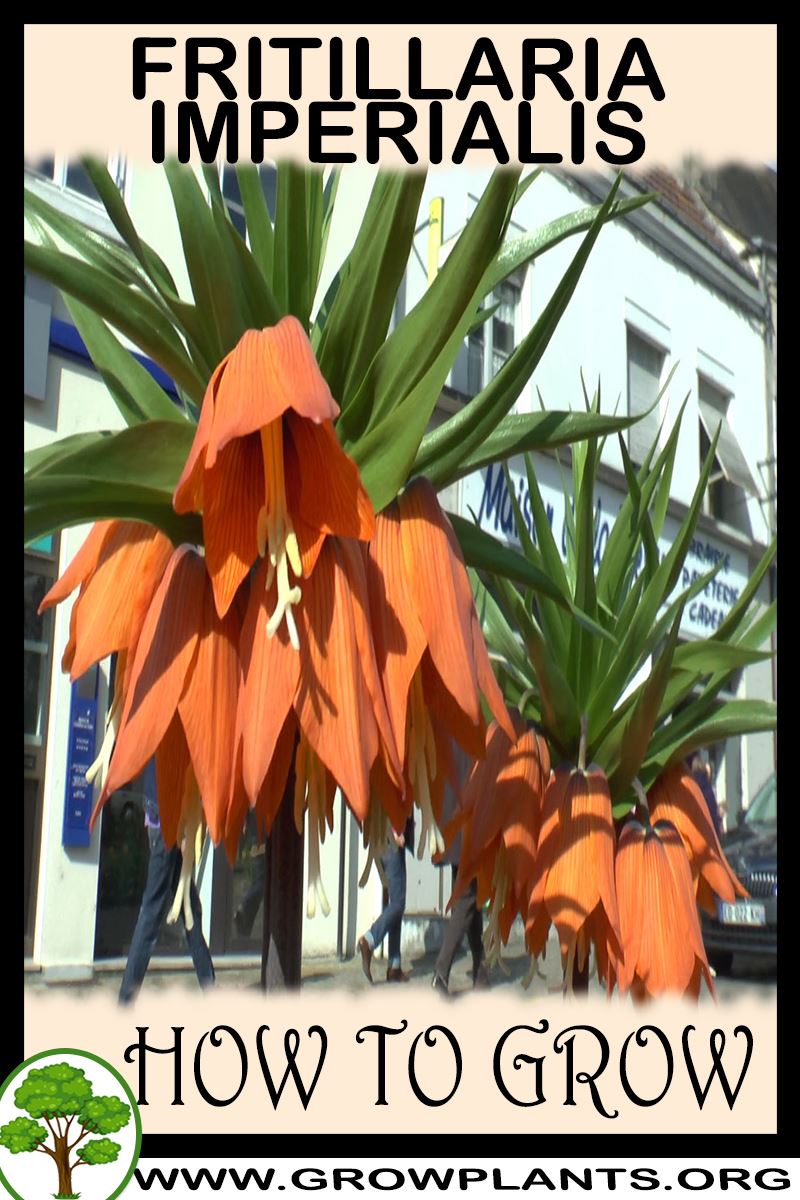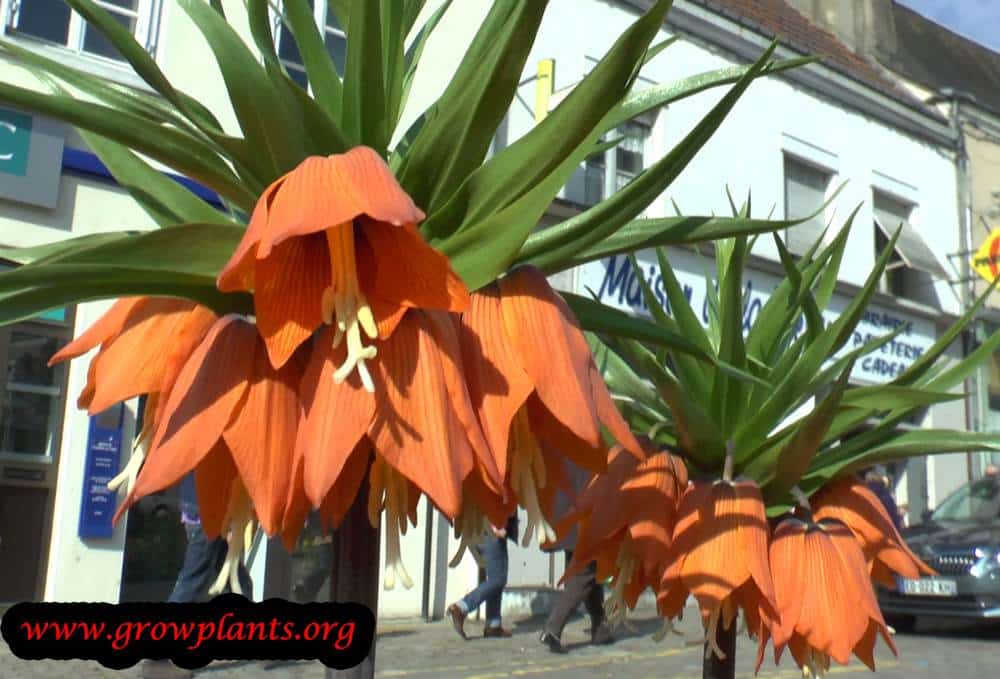
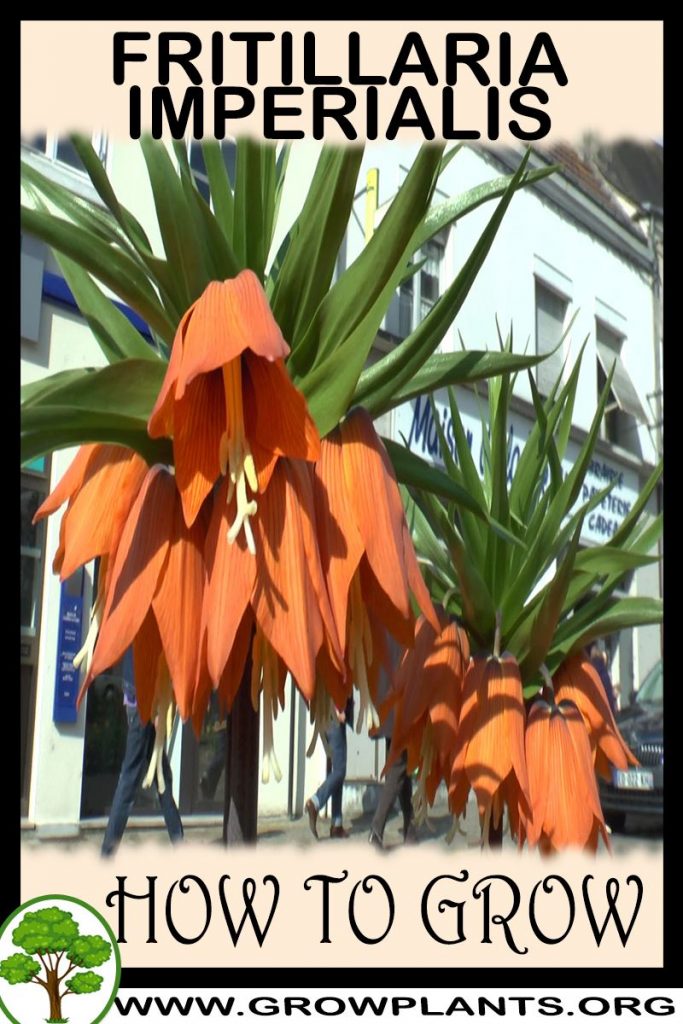
Plant Profile & Key Characteristics
Overview: Crown imperial is a bulbous perennial 0.6–1 m (24–40 in) tall, grown for its dramatic ring of pendent yellow, orange or red bell-flowers topped by a tuft of leaves. It is a striking ornamental and cut flower.
Quick Specifications
| Specification | Attribute |
|---|---|
| Plant Type / Life Cycle | Perennial (bulbous geophyte) |
| Foliage Type | Deciduous |
| Mature Size | 0.6–1 m (24–40 in) |
| Growth Rate | Moderate to fast |
| Root System | Bulbous geophyte (grows from a bulb) |
| Toxicity | Toxic if ingested – bulb and plant contain alkaloids |
| Hardiness | USDA 4–8 (needs winter chilling) |
Growth Form & Structure
- Height & Spread: Upright 0.6–1 m (24–40 in) stems; can also be grown in deep containers.
- Growth Habit & Form: A single stout stem rising from a large bulb, topped by a whorl of flowers and a crown of leaves.
- Lifespan & Maturity: Moderate to fast in spring; a long-lived bulb that needs winter chilling to flower well.
Anatomy & Physical Features
- Leaves & Foliage: Green lance-shaped leaves arranged in whorls, with a leafy tuft crowning the stem.
- Flower Characteristics: Yellow, orange or red trumpet-shaped flowers hanging in a crown-like ring beneath the leaf tuft.
Primary Uses & Landscape Value
- Functional & Ornamental Roles: Bold ornamental border bulb and cut flower; its musky scent is said to deter rodents.
Care Guide: Planting, Soil & Watering
Overview: Crown imperial is a large bulb that wants a rich, deep, well-drained soil in full sun to part shade and cold winters to trigger flowering. It likes moisture in growth but sharp drainage, as the big bulbs rot in wet ground.
Quick Care Requirements
| Requirement | Ideal Condition |
|---|---|
| Planting Season | Winter, spring or summer |
| Growth Rate | Moderate to fast |
| Soil Type | Rich, deep and well-draining |
| Water Need | Moderate to high in growth; drier and well-drained when dormant |
Planting & Establishment
- Best Planting Season: Plant the bulbs in winter, spring or summer into deep, rich, well-drained soil; the plant needs winter chilling hours to flower.
- How to Plant:
- Hole Preparation: Plant the large bulbs deep in loosened, richly amended soil – a hole about 15-20 cm (6-8 in) deep suits these big bulbs.
- Soil Amendments: Work plenty of organic matter and compost into the planting hole, plus grit if drainage is poor.
- Planting Depth: Set the bulb deep and, because its top is hollow, tilt it slightly on its side so water does not collect and rot the crown.
- Growth Speed & Expectations: Moderate to fast growth to 0.6-1 m (24-40 in), flowering in spring to summer.
Soil, Watering & Drainage Care
- Soil Mix & Drainage Needs: Rich but sharply drained soil is essential; the bulbs rot in heavy wet ground, so lighten and grit heavy soil. Container plants need deep pots with good drainage.
- Watering Schedule & Technique:
- Young / Newly Planted: Keep the soil moist while the bulb is in active growth after planting.
- Established: Water moderately to generously during growth, but never leave the bulb sitting in water.
- Seasonal Adjustments: Keep drier once the foliage dies back and the bulb is dormant; resume watering as growth restarts.
Climate, Light & Hardiness
Crown imperial fritillary is hardy in roughly zone 4–8 and, notably, needs a genuine winter chilling period for the bulb to flower well; it can be grown in warmer zones too, but only if that chilling requirement is met artificially.
Quick Climate Specifications
| Climate Zones | Temperate, subtropical |
|---|---|
| USDA Hardiness Zones | Approximately 4–8; can be grown in warmer zones with supplemental bulb chilling |
| Light Conditions | Full sun; half shade |
Temperature Extremes & Hardiness
USDA Hardiness & Regional Limits
Naturally hardy zone 4–8. In hotter zones the bulb can still be grown but needs winter chilling hours provided artificially (e.g., pre-chilled bulbs), since it won't reliably get enough cold locally.
Chilling Requirement
Requires a genuine winter chilling period to break dormancy and flower well - explicitly called out for this species, unlike most other ornamentals.
Growing in Pots, Balconies & Indoors
The crown imperial is a stately spring bulb of 0.6-1 m. The grower marks it No as a houseplant but Yes for containers – grow it in a deep pot outdoors, where it gets the winter cold it must have to flower.
Quick Details
- Container Size: A deep pot of 10-20 L – the large bulb needs depth and drainage
- Indoor Suitability: Not an indoor plant – it needs a real winter chill outdoors
- Best Spot: Full sun to part shade, outdoors
- Soil & Drainage: Deep, free-draining, gritty mix – the fat bulb rots in wet soil
- Watering in Pots: Moderate in growth, then keep dry when dormant; sharp drainage is essential
Indoors & On the Windowsill
- Not a houseplant: The grower marks it No – it needs a genuine cold winter to trigger flowering and cannot be kept warm indoors.
- Deep pots outdoors: Plant the large bulb deep in a tall pot with sharp drainage; it resents sitting wet.
- Safety: Crown imperial bulbs are toxic if eaten (and have a strong musky scent) – keep away from children and pets.
On a Balcony or Patio
- Light, wind & heat: Give it the sunniest spot you have. Walls and paving reflect heat so pots dry quickly – check moisture often in warm weather. On an exposed balcony, stake tall stems and shelter from strong wind.
- Practicalities: A full pot is heavy once watered – make sure the balcony can take the load and that drainage runoff has somewhere to go.
Choosing the Pot, Soil & Long-Term Care
- Pot & drainage: Use a pot with strong drainage holes and skip a standing-water saucer to avoid root rot. Terracotta breathes and dries faster; glazed or plastic pots hold moisture longer.
- Potting mix: A well-aerated, organic-rich mix – potting mix or peat/coir blended with perlite or vermiculite for free drainage.
- Feeding: Potted plants need feeding more often than those in open ground, as nutrients leach out with each watering – feed regularly through the growing season.
- Long-term care: As a perennial bulb, let the foliage die back after flowering; lift and divide crowded clumps and refresh the mix every couple of years.
Fertilizing & Feeding
A moderate feeder: this crown imperial forms its distinctive crown of trumpet flowers beneath a rosette of leaves, and its preference for rich, well-drained soil supports a more generous balanced feeding than many smaller bulbs.
Quick Fertilizing Specs
| Feeding Level | Moderate feeder |
|---|---|
| Main Nutrient Priority | Balanced feeding with adequate potassium to support the crown of trumpet flowers and help the bulb rebuild afterward |
| Best Feeding Period | While the crown-structured leaves are green and actively growing, from planting through bloom |
| Organic Options | Compost or well-rotted organic matter worked into rich, well-drained soil at planting |
| Reduce/Stop Feeding | Feeding stops as foliage dies back after bloom for the bulb’s summer rest |
| Micronutrients | Rarely an issue in rich, well-drained soil; correct only a diagnosed deficiency |
| Soil pH | Prefers rich, well-drained soil; tolerates a range of garden soils given good drainage |
Feeding by Growth Stage
Planting and root establishment
Support root development as this large bulb settles into rich, well-drained soil, noting it benefits from a period of winter chill.
| Nutrient direction | A balanced fertilizer worked into rich, well-drained soil at planting supports strong early root growth. |
|---|---|
| Timing | At planting, in the cooler part of the year appropriate to the local climate. |
| Frequency | A moderate feeding at planting helps this larger bulb establish well. |
| Fertilizer types | A balanced, complete fertilizer worked into the planting hole, Compost or well-rotted organic matter mixed into the soil at planting |
| Precautions | Plant where drainage is reliable, since rich soil that stays wet can encourage bulb rot. |
Crown foliage growth and trumpet bloom
Support the crown-like rosette of leaves and the yellow, orange or red trumpet flowers that form beneath them.
| Nutrient direction | Balanced feeding with adequate potassium while leaves are green helps the bulb build reserves for future flowering. |
|---|---|
| Timing | From leaf emergence through spring bloom. |
| Frequency | A moderate feeding while foliage is actively green supports this vigorous bulb. |
| Fertilizer types | A balanced complete fertilizer, potassium-forward to support bulb reserves, A bulb-specific fertilizer applied as leaves grow |
| Precautions | Let foliage die back naturally after bloom rather than removing it early, since it is still feeding the bulb, and watch this vigorous grower for self-seeding spread. |
Foliage dieback and summer rest
Let the bulb finish storing reserves and rest through its summer dormancy after bloom.
| Nutrient direction | None – withhold fertilizer once foliage yellows and dies back after bloom. |
|---|---|
| Timing | As leaves die back after bloom and through the summer rest period. |
| Frequency | No feeding during foliage dieback or dormancy. |
| Fertilizer types | No feeding at this stage; do not fertilize a dormant bulb. |
| Precautions | Withhold fertilizer until new growth resumes the following season. |
Nutrient Deficiency Signs & Corrections
Leaves emerge pale green and the crown of foliage looks sparse or weak.
| Possible causes | low available soil nitrogen, nutrients leached from a bed that drains very freely, a planting site that has not been enriched in several seasons |
|---|---|
| Appears first on | emerging leaves |
| What to check | soil fertility and amendment history, drainage and leaching, bulb size and vigor |
| Possible correction | Work a balanced fertilizer or compost into the bed at planting and during active leaf growth. |
Older leaves show yellowing between the veins while the veins themselves stay green.
| Possible causes | low soil magnesium, sometimes from heavy potassium fertilizer use, leaching in light, sandy, well-drained soil, root stress limiting nutrient uptake |
|---|---|
| Appears first on | older, lower leaves |
| What to check | soil nutrient balance and fertilizer history, soil type and leaching potential, root health and drainage |
| Possible correction | Correct the underlying soil nutrient balance and consider a chelated magnesium product per its label if a deficiency is confirmed. |
Leaf and root tips brown or scorch despite otherwise reasonable care.
| Possible causes | fertilizer salt buildup from over-application in rich, heavily fed soil, insufficient watering to move salts away from roots, fertilizer placed too close to or in direct contact with the bulb |
|---|---|
| Appears first on | leaf tips and root tips |
| What to check | how and where fertilizer was applied, watering after feeding, soil drainage |
| Possible correction | Reduce fertilizer amounts, keep it away from direct bulb contact, and water thoroughly after any feeding. |
Pruning, Training & Seasonal Maintenance
Crown imperial needs no structural pruning — it’s a single spring-blooming stalk from a bulb. The trigger for removing dead material is condition, not a calendar date: once the flower stalk and leaves have fully yellowed after their spring bloom (typically by early-mid summer), they can be cleared any time from then through the dormant season, right up until new shoots emerge the following late winter/spring. Cutting while any part is still green sacrifices next year’s bloom, since the bulb depends on that foliage to recharge.
Quick Pruning & Maintenance Specs
| Pruning Tolerance | Low (non-woody bulb; single seasonal stalk) |
| Primary Pruning Window | Any time after foliage fully yellows (from early-mid summer) through the dormant season, before new shoots emerge |
| Typical Frequency | Once per year, at natural dieback |
| Main Objective | Recharge the bulb for chilling and next spring’s bloom; tidy dead stalk before regrowth |
| Best Tool Type | Precision snips or bypass secateurs for the sturdy flower stalk |
| Avoid Heavy Pruning During | While any foliage or stalk tissue is still green |
Pruning by Plant Age & Size
Newly Established
Newly planted bulbs need chilling hours to establish and bloom well; leave all foliage completely undisturbed through the first full cycle, even after flowering.
Young / Formative
No structural training applies to a single-stalk bulb. The only formative habit is letting foliage die back fully each year before removal, which builds bulb size for a stronger crown-shaped flower head.
Mature / Established
Established bulbs (which can naturalize and spread) get the same annual routine: clear the dead stalk and leaves once fully yellowed, ideally before new growth pushes up the following spring.
Seasonal Pruning Schedule
Post-Flowering / Foliage Dieback
Objective: let the bulb finish recharging, then clear the spent material. Remove: the flower stalk and leaves only once fully yellowed and dry, cut or pulled cleanly at ground level. Do not remove: any tissue still green, even partially. Response: a well-recharged bulb for next year’s crown-shaped bloom; removing dead growth before winter also avoids a season of standing brown stalks in the border.
Special Growth to Remove
- Spent flower stalk and dead leaves — the only material to remove, once fully dried, at ground level.
No suckers, watersprouts, or basal shoots — this species grows as a single stalk per bulb, not a branching or clumping structure.
Container & Small-Space Pruning
Grows well in pots given rich, well-drained soil and its chilling requirement. Container specimens dry down and finish dieback slightly earlier than in-ground plantings, so check foliage color before cutting rather than working to a fixed date.
Tools
Precision snips or light bypass secateurs for the fibrous, moderately thick flower stalk; nothing heavier is needed on this single-stem bulb.
Tool Hygiene & Disease Risk
Routine. Reported problems are slugs, snails, and beetles — pests, not a cut-transmissible pathogen — so ordinary clean tools are sufficient.
Cut Placement & Technique
Cut the dead stalk near ground level, angled slightly rather than perfectly flat. This species’ stalk dies back leaving a hollow scar where it met the bulb; a flat-topped stub can collect rainwater and channel it down into the bulb, encouraging rot, so an angled cut (or simply letting the stalk detach on its own once fully dry) is the safer technique.
Heavy Pruning & Rejuvenation
Not applicable — a single-stalk bulb has no framework to rejuvenate by cutting. A bulb that stops flowering well is a chilling, depth, or overcrowding issue, not a pruning one.
Post-Pruning Care
Once the stalk and leaves are cleared, no extra watering or feeding is needed; the bulb is entering dormancy and relies on its own stored reserves plus winter chilling to rebloom.
Common Pruning Mistakes
- Cutting the stalk flat across the top, creating a hollow that collects water and invites bulb rot.
- Removing foliage while it’s still green to tidy the border, at the cost of next year’s flower.
- Disturbing the bulb’s root zone while clearing dead material, damaging next season’s growth point.
When NOT to Prune
Don’t cut any stalk or leaf tissue that is still green. Avoid disturbing the site while new shoots are emerging in late winter/spring, since the crown-shaped bud is easily damaged before it opens.
Recommended Tools (by task)
| Task | Tool Category | Why |
| Clearing the dead flower stalk and leaves once fully dried | bypass_secateurs | The stalk is sturdier than soft bulb foliage and benefits from a clean bypass cut rather than a pinch. |
Propagation Guide
Crown imperial is propagated mainly from the small bulb offsets that slowly form beside the mature bulb; this isn’t strictly necessary to reproduce the species, but it is the easier and more common route, and it’s the only way to keep a named color form true, since raising plants from seed also works but is far slower. Propagation is Moderate, mainly because the bulbs multiply slowly and are prone to rot if mishandled.
Quick Propagation Specs
| Best Propagation Method | Bulb offset division |
| Alternative Methods | Seed (slow to reach flowering size) |
| Propagation Difficulty | Moderate |
| Seed True-to-Type | Usually true for the species; cultivar-dependent for named color forms |
| Vegetative True-to-Type | Yes |
| Best Propagation Season | Bulbs are best lifted and divided in summer once foliage has died back; replant in winter, spring, or summer per the recommended planting window |
Growing from Seed
Dormancy & Pre-Sowing Treatment
As with this bulb’s own chilling-hours requirement, seed of this hardy Fritillaria likely germinates better after a period of cold.
Germination Time
Germination can be slow and uneven, and seedlings then take several years of bulb development before first flowering; named color forms will not come true from seed.
Rhizomes, Tubers, Bulbs & Corms
Bulb Offset Division
Offsets form slowly at the base of the bulb, so division is more a patience-testing than a fast way to multiply this plant. Lift dormant bulbs carefully in summer once the foliage has died back, taking care with the bulb’s natural hollow depression at the crown (which can hold water and encourage rot), separate any offset bulbs with a portion of basal plate attached, and replant promptly in rich, well-drained soil since the bulbs dislike prolonged drying out.
Bloom & Flower Guide
Quick Details
- Bloom Season: Spring
- Time to First Bloom: Plant bulbs in autumn for their first flowers the following spring
- Flower Appearance: A whorl of large, pendant bell-to-trumpet flowers in yellow, orange or red, topped by a leafy tuft – the “crown”
- Edibility: Toxic – do NOT eat; the bulb and plant contain toxic alkaloids and the bulb can also irritate skin
Detailed Blooming Overview
The crown imperial is one of spring’s boldest bulbs, holding a ring of big downward-facing bells beneath a jaunty topknot of leaves. The whole plant carries a strong, musky, foxy scent that many gardeners use to their advantage – it is widely said to help deter mice, moles and other rodents from the bulb bed.
Flower Characteristics
- Large pendant bell-shaped flowers in yellow, orange or red.
- Arranged in a crown-like whorl under a tuft of leafy bracts.
Bloom Care & Thinning
- Safety: All parts are toxic if eaten and the bulb can irritate skin – handle with care and keep away from children and pets.
- After flowering: Let the foliage die back to feed the bulb for next year.
Bloom Health & Protection
- Scarlet lily beetle: These bright red beetles and their grubs chew the leaves, buds and flowers – handpicking them off, or treating with neem oil, keeps damage down.
Pests, Diseases & Troubleshooting
Overview: The crown imperial is a stately bulbous perennial whose signature pest is the scarlet lily beetle, with slugs, aphids and bulb pests as lesser threats; its bulbs and roots rot readily in wet ground, and Botrytis ‘fire’ can blight the foliage. Its famously skunky, foxy scent actually deters deer, rabbits and rodents. Plant large firm bulbs in sharply drained soil (traditionally on their side) and it is otherwise long-lived and undemanding.
Quick Troubleshooting Overview
| Issue / Pest | Main Symptom | Primary Solution |
|---|---|---|
| Scarlet lily beetle | Bright red beetles and slimy grubs stripping leaves | Handpick beetles/grubs; neem/spinosad if severe |
| Slugs / snails | Holes and slime on emerging shoots and leaves | Traps, barriers, iron-phosphate pellets |
| Aphids | Colonies on shoots/buds; honeydew; virus risk | Blast off, beneficials, insecticidal soap |
| Bulb rot | Bulbs soft/rotten; plants fail to emerge | Sharp drainage, plant on side, firm bulbs |
| Botrytis ‘fire’ | Brown blotches and collapse of foliage in wet | Airflow, remove affected growth, avoid wet leaves |
| No flowers | Leaves but no bloom | Plant big bulbs deep in sun with sharp drainage |
Common Pests & Management
- Scarlet lily beetle (Lilioceris lilii):
- Symptoms: Bright red, shiny beetles about a centimetre long, and their soft orange grubs cloaked in their own black excrement, chew ragged holes and strip the leaves and buds of Fritillaria and lilies; damage can be rapid and severe.
- Prevention & Control: Handpick and destroy adults (catch them below, as they drop and hide), squash the egg rows on leaf undersides, and wipe off the disgusting grubs; be vigilant from the moment shoots appear. Neem or spinosad helps against larvae in bad infestations, applied in the evening to protect pollinators.
- Slugs and snails (Gastropoda):
- Symptoms: Ragged holes and silvery slime trails on the emerging shoots and lush young foliage in damp, cool spring weather.
- Prevention & Control: Protect emerging shoots with traps, copper barriers, grit or crushed shell, hunt at dusk, and use iron-phosphate pellets if needed. Keep the crown area free of damp debris.
- Aphids (Myzus persicae, Aphis spp.):
- Symptoms: Colonies of soft insects on shoots, buds and leaf axils with sticky honeydew and distortion; they can also transmit viruses between bulbous plants.
- Prevention & Control: Blast off or wipe out colonies, encourage natural enemies, and use insecticidal soap or a light oil on heavy infestations. Controlling aphids limits virus spread.
- Bulb pests (bulb fly, mites, rodents) (Merodon / Eumerus spp., Rhizoglyphus spp.):
- Symptoms: Narcissus/bulb-fly maggots and bulb mites tunnel and rot stored or planted bulbs; but the crown imperial’s strong scent actually deters the mice, voles and squirrels that eat other bulbs.
- Prevention & Control: Plant only firm, sound bulbs, handle them gently, and store cool, dry and airy; discard soft or holed bulbs. The plant’s own odour is a bonus deterrent to rodents and deer.
Diseases & Fungal Issues
- Botrytis blight (‘fire’) (Botrytis / Botrytis elliptica-type):
- Symptoms: Brown, water-soaked spots and blotches that enlarge and coalesce on leaves, stems and buds in cool, wet, humid weather, collapsing the foliage and disfiguring flowers.
- Treatment & Management: Improve air movement and spacing, avoid overhead watering, and remove and destroy affected foliage promptly; clear all dead leaves at season’s end. A protective fungicide helps in persistently wet springs, but drainage and airflow come first.
- Bulb and root rot (Fusarium / Penicillium / Phytophthora spp.):
- Symptoms: Bulbs turn soft, brown and rotten (Penicillium shows blue-green mould in storage), plants emerge weakly or not at all, and roots blacken – almost always tied to wet, poorly drained soil or damaged bulbs.
- Treatment & Management: Plant firm healthy bulbs in sharply drained soil or a raised bed, traditionally tilting the bulb on its side so water cannot sit in the hollow crown, and never in wet low spots. Discard rotten bulbs; there is no cure once rot sets in.
- Lily mosaic / viruses (Lily mosaic virus complex):
- Symptoms: Mottled, streaked foliage and reduced vigour, spread by aphids and through infected stock.
- Treatment & Management: Start with healthy bulbs, control aphids, and remove and destroy plants showing persistent mosaic symptoms. Do not propagate from virused stock.
Growing Difficulties & Abiotic Problems
- Bulb rot from wet soil (the main killer):
- Cause & Symptoms: The large bulb has a hollow crown that collects and holds water; in heavy or poorly drained soil this rots the bulb and roots.
- Correction Strategy: Plant in deep, sharply drained soil enriched with grit, on a slight mound or tilted on its side so the crown drains, and avoid wet winter positions. Container growing in gritty mix suits difficult sites.
- Failure to flower:
- Cause & Symptoms: Small or immature bulbs, shallow planting, insufficient sun, or disturbance can give leaves but no bloom, and clumps may skip a year after moving.
- Correction Strategy: Plant large, mature bulbs deeply in full sun with good drainage, feed after flowering, let the foliage die back naturally to build the bulb, and avoid unnecessary disturbance.
- Strong ‘foxy’ odour:
- Cause & Symptoms: The bulb and foliage emit a distinctive skunky, musky smell that some find unpleasant, especially when handled.
- Correction Strategy: This is natural and harmless – indeed it deters rodents and deer. Site away from doorways if the scent bothers you, and wash hands after handling the bulbs.
- Flopping tall stems:
- Cause & Symptoms: The tall flower stems can lean or flop in exposed, windy sites or rich shade.
- Correction Strategy: Grow in full sun in a sheltered spot, and stake the stems in windy gardens.
What Helps – Products & Tools
Culture is the key: firm bulbs, sharp drainage and full sun prevent the rot that kills most crown imperials, and the plant’s own scent deters rodents and deer. For pests, hand-picking the scarlet lily beetle is essential, backed by neem or spinosad for larvae, iron-phosphate pellets and barriers for slugs, and insecticidal soap for aphids. Against Botrytis, airflow and sanitation lead, with a protective fungicide in reserve for wet springs.