


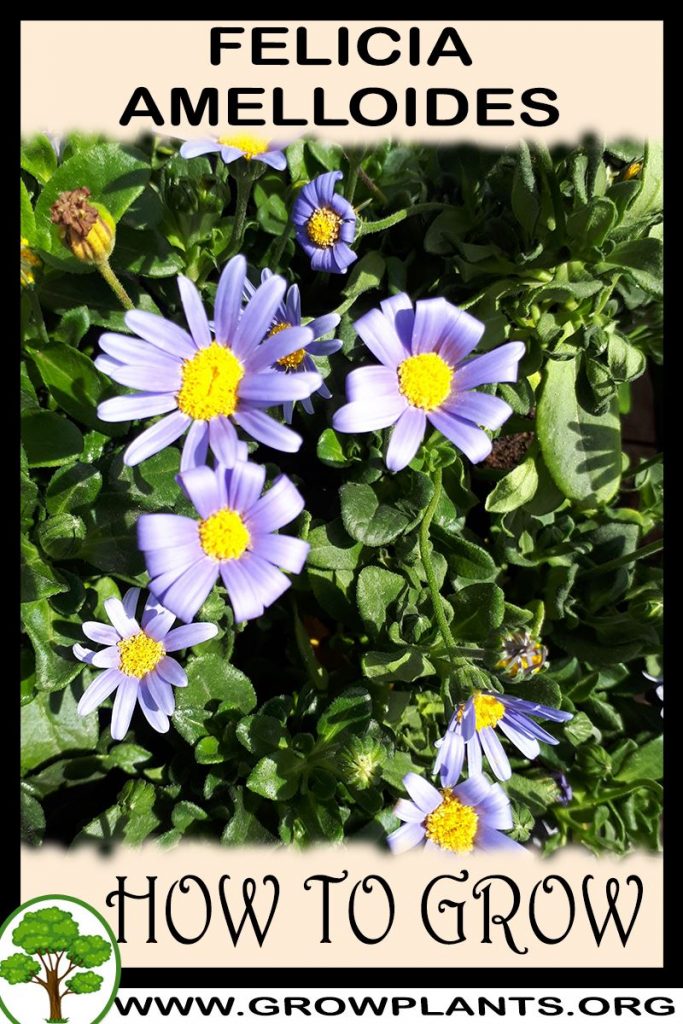
Plant Profile & Key Characteristics
Overview: A herbaceous plant 30-60 cm (12-24 in) tall grown for its sky-blue daisy flowers. A fast-growing perennial in mild climates (annual where winters are cold), useful as a cut flower and groundcover.
Quick Specifications
| Specification | Attribute |
|---|---|
| Plant Type / Life Cycle | Perennial (evergreen) or Annual in cold areas |
| Foliage Type | Evergreen |
| Mature Size | 30-60 cm tall (12-24 in / 1-2 ft) |
| Growth Rate | Moderate to Fast |
| Hardiness | Perennial in USDA zones 10b-12; grown as an annual from zone 5+ |
Growth Form & Structure
- Height & Spread: 30-60 cm (12-24 in); suits containers.
- Growth Habit & Form: Low, spreading, bushy herbaceous plant, also used as groundcover.
- Lifespan & Maturity: Fast-growing; flowers spring through autumn.
Anatomy & Physical Features
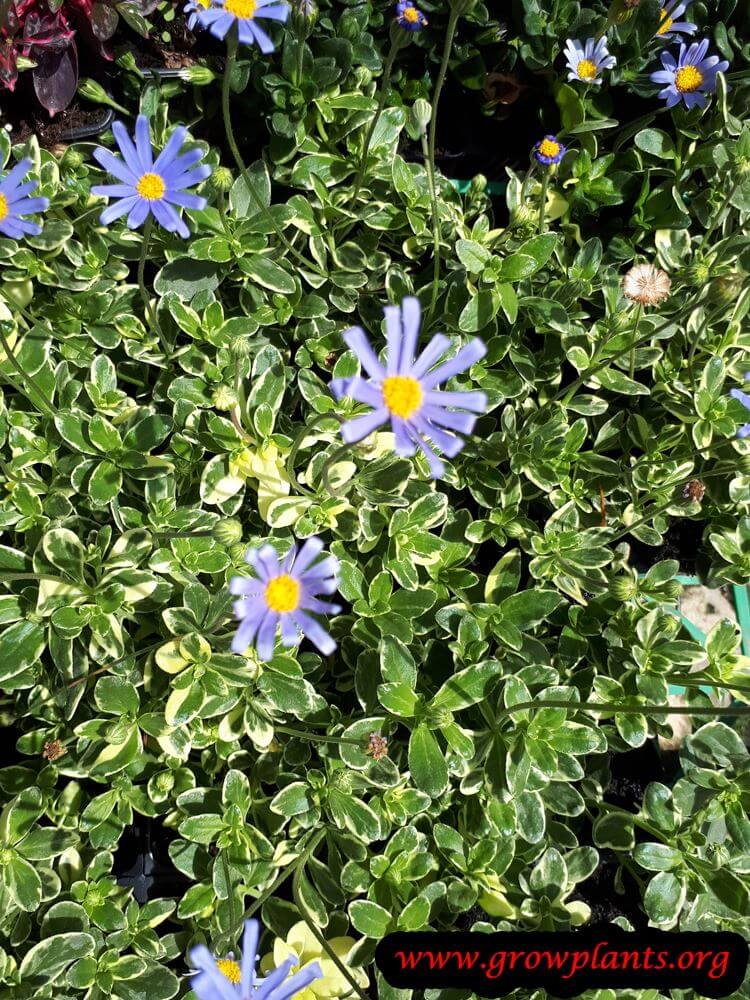
- Leaves & Foliage: Green, elliptic leaves.
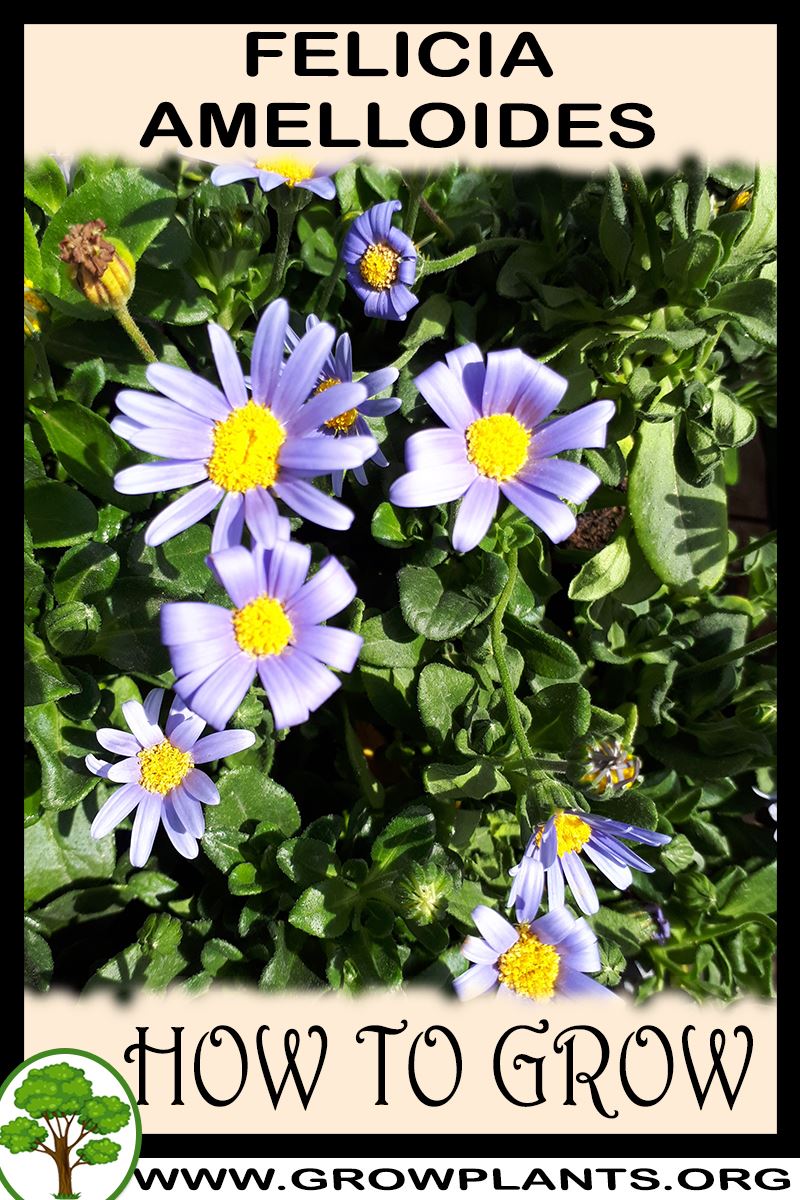
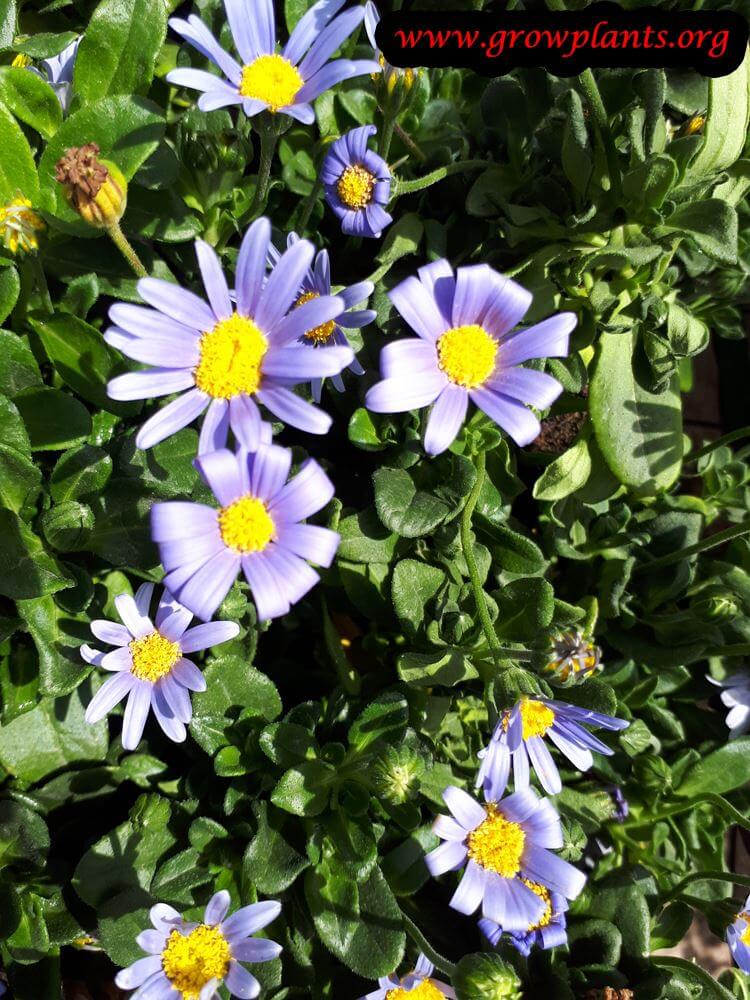
- Flower Characteristics: Blue daisy flowers with yellow centres (full detail in the Bloom guide).
Primary Uses & Landscape Value
- Functional & Ornamental Roles: Ornamental for borders, containers, groundcover and cut flowers; full sun, drought tolerant, not an indoor plant.
Care Guide: Planting, Soil & Watering
Overview: Felicia amelloides (blue daisy) is a free-flowering evergreen perennial – grown as an annual in cold areas – for subtropical, Mediterranean and temperate climates (hardiness zone 10b-12, or 5+ as an annual). It flowers best in full sun, in well-draining soil with only modest water.
Quick Care Requirements
| Requirement | Ideal Condition |
|---|---|
| Planting Season | Spring as an annual; spring to autumn as a perennial |
| Growth Rate | Moderate to Fast |
| Soil Type | Well-draining |
| Water Need | Low to Moderate – let soil dry between waterings |
Planting & Establishment
- Best Planting Season: Plant in spring where grown as an annual; as a perennial it can go in any time from spring to autumn in mild climates.
- How to Plant:
- Hole Preparation: Dig a hole about the depth of the root ball and a little wider, on freely draining ground.
- Soil Amendments: Improve heavy soil with compost and grit for drainage; it is not demanding about fertility.
- Planting Depth: Set the root ball level with the soil surface, without burying the crown.
- Growth Speed & Expectations: A moderate-to-fast grower forming a mound about 30-60 cm (12-24 in); flowers freely and works as a cut flower and ground cover.
Soil, Watering & Drainage Care
- Soil Mix & Drainage Needs: Grow in well-draining soil or a free-draining potting mix with drainage holes to keep the roots from staying wet.
- Watering Schedule & Technique:
- Young / Newly Planted: Water regularly while establishing, letting the top of the soil dry between waterings.
- Established: Once established it is drought tolerant – water moderately and deeply, allowing the soil to dry first.
- Seasonal Adjustments: A little more in summer heat, and cut back in cool, wet weather.
Climate, Light & Hardiness
Felicia amelloides, the blue daisy, is a sun-loving herbaceous perennial suited to subtropical, Mediterranean, or temperate climates, grown as a true perennial only where winters stay mild. In climates with freezing winters it is instead grown as a warm-season annual, planted fresh each year for its summer-through-autumn blue blooms.
Quick Climate Specifications
| Climate Zones | Subtropical, Mediterranean, temperate |
|---|---|
| USDA Hardiness Zones | 10b–12 as a perennial; commonly grown as an annual as far as zone 5 and colder |
| Frost Tolerance | Low |
| Light Conditions | Full Sun |
Sunlight & Light Exposure
Optimal Light Setup
Full sun gives the best, most abundant bloom.
Direct Sun Requirement
Yes - needs strong direct sun; flowering diminishes noticeably in shade.
Best Exposure/Orientation
An open, unobstructed sunny bed, border, or container position works best.
Temperature Extremes & Hardiness
USDA Hardiness & Regional Limits
Reliably perennial in zones 10b–12. Where winters bring hard freezes, it is commonly grown instead as a warm-season annual, set out after the last frost and replanted each year - frost is what forces this annual treatment, not any lack of vigor during the growing season.
Cold Damage & Winter Protection
Frost damages and can kill foliage and flowers; in marginal zones a light frost may cause only top-growth dieback with possible regrowth from the base, but a hard freeze ends the plant.
Frost Sensitivity
High - not a frost-hardy species despite its wide use as a summer bedding annual well outside its true perennial range.
Frost-Free Growing Season
In climates colder than its perennial range, it needs a full frost-free window to flower through its typical spring-to-autumn bloom season, since the display ends with the first autumn frost.
Wind, Humidity & Microclimate
Dry-Air Tolerance
Reasonably good, consistent with its modest, well-drained-soil water needs.
Rainfall & Seasonal Moisture
Prefers relatively dry, well-drained, Mediterranean-type rainfall patterns; avoid soggy or waterlogged sites.
Microclimate Recommendations
Open, sunny beds with sharp drainage suit it best; avoid low-lying spots that stay wet.
Growing in Pots, Balconies & Indoors
The blue daisy is a sun-loving flowering sub-shrub, not a true houseplant – the grower rates it a No indoors – but it is a superb pot plant for a sunny balcony or patio, and a compact plant can flower on a very bright, sunny windowsill.
Quick Details
- Container Size: A medium pot comfortably larger than the root ball
- Indoor Suitability: Not a deep-room houseplant; flowers on a very sunny sill
- Best Spot: Full sun – the brightest balcony, patio or sill
- Soil & Drainage: Free-draining organic mix; never waterlogged
- Watering in Pots: Small to average – keep lightly moist; let the surface dry between waterings
Indoors & On the Windowsill
- Not a deep-indoor plant: The grower rates it a No as a houseplant – it wants full sun that a normal room cannot supply, and it stretches and stops flowering in low light.
- Windowsill growing: A hot, sunny sill can keep a compact plant flowering; give it all the direct sun you can and turn it for even growth.
On a Balcony or Patio
- Light & wind: Give it the sunniest spot; it flowers best in full sun. Pots dry fast against warm walls, so check moisture in hot spells, and deadhead to keep the daisies coming.
- Practicalities: A tidy, free-flowering container plant; pinch it to keep it bushy.
Choosing the Pot, Soil & Long-Term Care
- Pot & drainage: Use a pot with strong drainage holes and skip a standing-water saucer (or empty it promptly) to avoid root rot; terracotta breathes and dries faster, while glazed or plastic pots hold moisture longer.
- Potting mix: Use a well-aerated organic mix – peat or coir with perlite or vermiculite – that drains freely.
- Feeding: Potted plants exhaust their mix faster than those in open ground – nutrients leach away with each watering – so feed lightly through the active growing season. A light feed through flowering keeps it blooming.
- Repotting: Refresh the mix and pot up about every couple of years; when you do, lightly prune the root ball and any leggy top growth.
Fertilizing & Feeding
A moderate feeder: balanced feeding through spring growth and its long summer-into-autumn bloom season keeps this blue daisy flowering, whether grown as a perennial in mild climates or as an annual bedding plant elsewhere.
Quick Fertilizing Specs
| Feeding Level | Moderate feeder |
|---|---|
| Main Nutrient Priority | Balanced feeding to support steady foliage and a long bloom season |
| Best Feeding Period | Spring through the extended summer-into-autumn bloom period |
| Organic Options | Compost or other organic matter worked into well-drained soil |
| Reduce/Stop Feeding | Stop feeding in autumn as bloom finishes and the plant is cut back for winter |
| Micronutrients | Usually met by a complete fertilizer in well-drained garden soil; correct only diagnosed issues |
| Soil pH | Tolerates a wide range in well-drained soil |
Feeding by Growth Stage
Spring growth flush
Support fresh foliage and the first flush of blue daisy flowers as growth resumes.
| Nutrient direction | A balanced complete fertilizer supports steady foliage and flower production without forcing lanky growth. |
|---|---|
| Timing | As new growth begins in spring. |
| Frequency | Regular light feedings through this early growth phase. |
| Fertilizer types | A balanced complete fertilizer, Compost or organic matter worked into well-drained soil |
| Precautions | Avoid excess nitrogen alone; balanced feeding keeps growth compact rather than sprawling and floppy. |
Repeat bloom through summer and autumn
Sustain the plant’s long bloom season, which can run from spring into autumn.
| Nutrient direction | Continued balanced feeding supports repeat flowering; heavy nitrogen alone will not extend bloom. |
|---|---|
| Timing | Through summer and into autumn while the plant continues flowering. |
| Frequency | Light, steady feeding continues through the extended bloom season, tapering off as flowering slows. |
| Fertilizer types | A balanced complete fertilizer, Deadheading paired with light feeding to encourage repeat flowers |
| Precautions | Do not push extra nitrogen for more flowers; balanced feeding plus deadheading and full sun drives repeat bloom. |
Cool-season rest
Let the plant rest through cool weather as a perennial, or finish its cycle where grown as an annual.
| Nutrient direction | None – withhold fertilizer as bloom finishes and cool weather sets in. |
|---|---|
| Timing | Autumn into winter, once flowering slows and the plant is cut back. |
| Frequency | No feeding during this rest; resume only once new spring growth begins on plants kept as perennials. |
| Fertilizer types | No feeding at this stage; hold off fertilizing through the cool-season rest. |
| Precautions | Withhold fertilizer now; feeding a plant that is finishing its bloom cycle or going dormant wastes nutrients. |
Nutrient Deficiency Signs & Corrections
Leaves look pale green to yellowish and the plant produces noticeably fewer flowers.
| Possible causes | low available nitrogen in the soil, nutrients leached out by heavy watering or rain, root competition from surrounding ground-cover growth |
|---|---|
| Appears first on | older, lower leaves |
| What to check | feeding history, soil organic matter, watering and drainage |
| Possible correction | Apply a balanced complete fertilizer during active growth and work in organic matter. |
Stems are weak and flower quality declines even though the plant keeps producing buds.
| Possible causes | low soil potassium, nitrogen-heavy feeding that outpaces other nutrients, leaching in light, sandy soils |
|---|---|
| Appears first on | flowering stems and outer foliage |
| What to check | recent feeding balance, soil texture and drainage, stem firmness compared with past seasons |
| Possible correction | Shift toward a more balanced fertilizer rather than a nitrogen-heavy one. |
New leaves emerge yellow between the veins while the veins themselves stay green.
| Possible causes | high soil pH tying up iron, common in mediterranean-climate garden soils, waterlogged or compacted soil limiting root function, cold, wet conditions slowing uptake |
|---|---|
| Appears first on | the newest leaves |
| What to check | soil pH, drainage, recent temperatures |
| Possible correction | Correct pH toward neutral, improve drainage, or apply a chelated iron product per its label. |
Pruning, Training & Seasonal Maintenance
Blue daisy is a soft, fast-growing flowering subshrub that blooms almost continuously from spring through autumn on new growth, so cutting it back encourages fresh flowering wood rather than sacrificing a season’s bloom. It tolerates a meaningful cutback in autumn or winter to keep it compact and floriferous, and light deadheading through the growing season keeps flowers coming; it does not, however, reliably resprout from completely bare, leafless old stems, so cuts should always leave some leafy growth behind.
Quick Pruning & Maintenance Specs
| Pruning Tolerance | Moderate – tolerates a meaningful cutback, but not into completely bare old wood |
| Primary Pruning Window | Autumn to winter, as flowering slows |
| Secondary Maintenance Window | Spring through autumn, for ongoing deadheading |
| Typical Frequency | One main cutback per year, plus periodic deadheading through bloom |
| Main Objective | Keep the plant compact and floriferous; remove dead leaves and spent flowers |
| Young Plant Priority | Pinch tips lightly to encourage a bushy base; avoid a hard cutback in the first year |
| Mature Plant Priority | Annual autumn/winter cutback to renew flowering growth and prevent legginess |
| Best Tool Type | Precision snips or bypass secateurs for the soft stems |
| Avoid Heavy Pruning During | Peak summer heat and peak bloom |
Pruning by Plant Age & Size
Newly Established
Pinch growing tips lightly to encourage branching from the base; avoid a hard cutback while the plant is still establishing its root system.
Young / Formative
No formal training system is used; light, repeated tip-pinching through the first growing season builds a bushier, more floriferous plant than leaving it unpinched.
Mature / Established
Give an annual autumn/winter cutback of roughly a third of the plant’s growth, always leaving leafy stem behind, to renew flowering wood and stop the base from becoming sparse and woody.
Flowering Wood
Blue daisy flowers on the current season’s new growth, not on old wood, which is why an autumn/winter cutback does not cost flowers – it instead stimulates the fresh growth that carries next season’s bloom.
Structural Pruning & Training
The main structural concern is renewal: without an annual cutback this subshrub tends to sprawl and become woody and sparse at the base with fewer flowers. Cut back to just above a set of leaves or a leafy side-shoot, never into completely bare stem.
Special Growth to Remove
- Spent flower heads – deadhead through the bloom season to keep new flowers coming and tidy the plant.
- Dead or yellowing leaves.
Container & Small-Space Pruning
Grown outdoors in pots (it is not suited as an indoor houseplant), container plants benefit from the same annual cutback but may need it slightly harder to compensate for the more limited root run, always leaving leafy growth behind rather than cutting to bare stem.
Tools
- Precision snips for deadheading individual flowers.
- Bypass secateurs for the annual cutback of stems.
Tool Hygiene & Disease Risk
Routine care is sufficient – clean, sharp tools. Aphids are the main pest noted for this species; if a plant is heavily infested, clean tools after working on it before moving to unaffected plants.
Cut Placement & Technique
Cut just above a leaf node or leafy side-shoot, angling the cut slightly so water runs off. Deadhead by cutting the flower stem back to the nearest set of leaves rather than just removing the flower head.
Heavy Pruning & Rejuvenation
A firm annual cutback (about a third of the plant) is tolerated and is the main tool for keeping this subshrub full and floriferous rather than sprawling and bare-based. Do not cut into leafless old wood expecting regrowth – this species does not reliably resprout from bare stems.
Post-Pruning Care
Water normally after a cutback; no special feeding is needed to trigger the new growth that follows a routine trim.
Common Pruning Mistakes
- Cutting into completely bare, leafless old stems expecting them to resprout – they generally will not.
- Skipping the annual cutback, which leads to a sprawling, woody-based plant with fewer flowers over time.
- Hard-pruning during peak summer heat, which stresses the plant when it can least recover quickly.
When NOT to Prune
Avoid a hard cutback during the hottest part of summer or at peak bloom; the ideal window is autumn to winter as flowering naturally slows.
Recommended Tools (by task)
- precision_snips – light, frequent deadheading through the bloom season.
- bypass_secateurs – the firmer annual cutback of soft stems.
Propagation Guide
Felicia amelloides grows readily from seed, which is usually representative enough of the plain species and is not difficult, while softwood tip cuttings are a quick alternative when a particular flower-color selection needs to be kept identical or increased fast. Overall propagation is Easy either way, and vegetative propagation is not required except to preserve a specific selection.
Quick Propagation Specs
| Best Propagation Method | Seed (species) or softwood tip cuttings (for selections) |
| Alternative Methods | The other of the two, depending on goal |
| Propagation Difficulty | Easy |
| Seed True-to-Type | Usually true-to-type (species); variable for named selections |
| Vegetative True-to-Type | Yes |
| Best Propagation Season | Spring (as annual) / spring to autumn (as perennial) |
| Cutting Rooting Time | Typically a few weeks |
| Seed Sowing Depth | Fine seed; surface-sow or barely cover |
Growing from Seed
Sowing Season
Spring as an annual, or spring through autumn where grown as a perennial.
Sowing Depth & Orientation
Seed is fine, typical of daisy-family plants; surface-sow or press in lightly rather than burying, as light generally aids germination in this family.
Germination Conditions
Warm, evenly moist, and bright.
Germination Time
Germination is usually fairly prompt under warm, bright conditions, though exact timing varies.
Seedling Care
Pot up once true leaves form; pinching the tips encourages a bushier plant, in keeping with the site’s own note that pruning is partly for design.
Stem Cuttings
Cutting Type
Short softwood tip cuttings.
Best Timing
Spring to early summer, during active growth.
Cutting Preparation
Remove the lower leaves and trim just below a node.
Rooting Setup
Insert into a well-drained potting mix and keep humid until rooted.
Rooting Hormone
Optional; generally not necessary, as this plant roots easily from cuttings.
Rooting Time
Typically a few weeks.
Bloom & Flower Guide
Quick Details
- Bloom Season: A long season, spring through autumn (nearly year-round in mild climates)
- Flower Appearance: Sky-blue daisy flowers with a bright yellow centre
- Edibility: Ornamental / cut flower
Detailed Blooming Overview
Blue daisy is loved for its clear, sky-blue daisies set against a sunny yellow eye – an unusual and cheerful colour combination that it produces over a very long season. The flowers close in dull weather and toward evening, then reopen with the light. They are a good draw for pollinators and stand well as cut flowers.
Flower Characteristics
- Blue ray petals around a yellow central disc, in classic daisy form.
- Open in sun and close in low light or overcast conditions.
Bloom Care & Thinning
- Deadheading: Removing faded flowers keeps this floriferous plant blooming for months.
- Pollinators & cutting: Attracts pollinators, and the long-stemmed flowers are good for cutting.
Pests, Diseases & Troubleshooting
Overview: Blue marguerite is a low, sun-loving evergreen sub-shrub daisy that is generally easy; watch mainly for aphids, whitefly, spider mites and thrips on soft growth, and for root rot and mildews if it is grown too wet or crowded. Full sun, sharp drainage and airflow, plus beneficials and gentle organic sprays, keep it healthy.
Quick Troubleshooting Overview
| Issue / Pest | Main Symptom | Primary Solution |
|---|---|---|
| Aphids | Sticky new shoots & buds, distortion | Water jet, beneficials, insecticidal soap |
| Whitefly | White flies rise when disturbed; honeydew | Sticky traps, oil/soap on leaf undersides |
| Spider mites | Stippling, bronzing, webbing in dry heat | Raise humidity, rinse, oil / predatory mites |
| Thrips | Silvered petals & leaves, black specks | Blue sticky traps, remove debris, spinosad |
| Root rot | Wilting/yellowing in wet, heavy soil | Improve drainage; water less |
| Downy / powdery mildew | Yellow blotches or white film on leaves | Airflow; copper or sulfur/bicarbonate |
Common Pests & Management
- Aphids (Aphis / Myzus spp.):
- Symptoms: Green or black soft-bodied insects clustering on soft new shoots and flower buds; sticky honeydew, sooty mould and distorted growth, especially in the flush of new spring growth.
- Prevention & Control: Knock off with a water jet and encourage ladybirds, lacewings and hoverflies. Avoid overfeeding with nitrogen, which drives soft aphid-prone growth. Treat persistent colonies with insecticidal soap or a light horticultural oil in the cool of the evening.
- Whitefly (Trialeurodes vaporariorum):
- Symptoms: Clouds of tiny white flies rising from the foliage when brushed; yellow flecking, honeydew and sooty mould, worst on soft growth and under cover.
- Prevention & Control: Monitor and reduce adults with yellow sticky traps, encourage Encarsia parasitoids and lacewings, and rinse and treat leaf undersides with insecticidal soap or horticultural oil, repeating weekly.
- Spider mites (Tetranychus urticae):
- Symptoms: Fine pale stippling, bronzing and a dull, dusty look with fine webbing under leaves during hot, dry, still spells.
- Prevention & Control: Raise humidity and airflow, rinse foliage to knock back numbers, and release predatory mites where practical. Spot-treat with horticultural oil or insecticidal soap and avoid broad-spectrum sprays that kill natural enemies.
- Thrips (Frankliniella / Thrips spp.):
- Symptoms: Silvery streaking and flecking on leaves and petals, distorted buds and tiny black frass specks; slender insects hide in flowers and growth tips.
- Prevention & Control: Use blue sticky traps to monitor, remove spent flowers and debris, and encourage predatory mites and minute pirate bugs. Spinosad or insecticidal soap helps in heavy infestations; rotate actives to avoid resistance.
- Leaf miner (Liriomyza spp.):
- Symptoms: Pale, winding or blotchy tunnels within the leaves; mostly cosmetic on established plants but disfiguring in heavy attacks.
- Prevention & Control: Pick off and destroy mined leaves, support parasitic wasps by avoiding broad-spectrum sprays, and keep plants vigorous. Chemical control is rarely warranted.
Diseases & Fungal Issues
- Downy mildew (Peronospora / Plasmopara spp.):
- Symptoms: Pale yellow blotches on the upper leaf surface with a greyish, downy mould beneath in cool, damp, humid weather; affected leaves brown and drop.
- Treatment & Management: Improve airflow and spacing, water at the base and keep foliage dry, and clear fallen leaves. Remove affected growth; a copper-based fungicide can protect valued plants when conditions stay wet.
- Powdery mildew (Golovinomyces / Podosphaera spp.):
- Symptoms: White powdery coating on leaves and stems, later yellowing and leaf drop; worst in crowded plants with warm days and cool nights.
- Treatment & Management: Space for airflow, avoid excess nitrogen, and remove affected leaves. Sulfur, potassium bicarbonate or a light horticultural oil checks spread.
- Root & crown rot (Phytophthora / Pythium / Rhizoctonia spp.):
- Symptoms: Wilting despite moist soil, yellowing and a browning, softening crown and roots; follows heavy, wet or poorly drained soil and overwatering.
- Treatment & Management: Grow in free-draining soil in full sun, water only when needed, and never let the crown sit wet. Remove badly affected plants; these Mediterranean-climate daisies resent waterlogging.
- Grey mould & flower blight (Botrytis cinerea):
- Symptoms: Fuzzy grey mould on faded flowers and soft damaged tissue in cool, damp, still weather; buds may brown and rot.
- Treatment & Management: Deadhead regularly, remove dead material, improve airflow and avoid overhead watering late in the day.
Growing Difficulties & Abiotic Problems
- Root rot from overwatering:
- Cause & Symptoms: Wilting, yellowing and collapse in heavy, wet or poorly drained soil; these sun-loving daisies dislike wet feet.
- Correction Strategy: Plant in full sun in free-draining soil or raised beds, water deeply but infrequently once established, and avoid waterlogging.
- Legginess & sparse bloom:
- Cause & Symptoms: Bare, woody, open growth with few flowers in shade, from lack of pruning or old age.
- Correction Strategy: Site in full sun, shear lightly after flushes to keep growth dense, and hard-prune leggy plants in the appropriate season to rejuvenate them.
- Chlorosis:
- Cause & Symptoms: Yellowing leaves with green veins in cold, wet or very alkaline soils.
- Correction Strategy: Improve drainage, feed a balanced fertiliser, and apply chelated iron on alkaline soils if needed.
- Frost & heat stress:
- Cause & Symptoms: Blackened soft growth after frost; scorched, wilting foliage in extreme heat and drying wind.
- Correction Strategy: Protect from hard frost in marginal climates, mulch to buffer roots, and water during prolonged heat; shelter from desiccating wind.
What Helps – Products & Tools
The workhorses here are insecticidal soap and horticultural (neem) oil for aphids, whitefly and mites; yellow and blue sticky traps for whitefly and thrips; spinosad for heavier thrips pressure; and, for disease, a copper fungicide for downy mildew plus sulfur or potassium bicarbonate for powdery mildew. Good drainage, full sun and airflow prevent most problems. Spray oils and soaps in the cool of the evening to protect bees on these nectar-rich daisies.