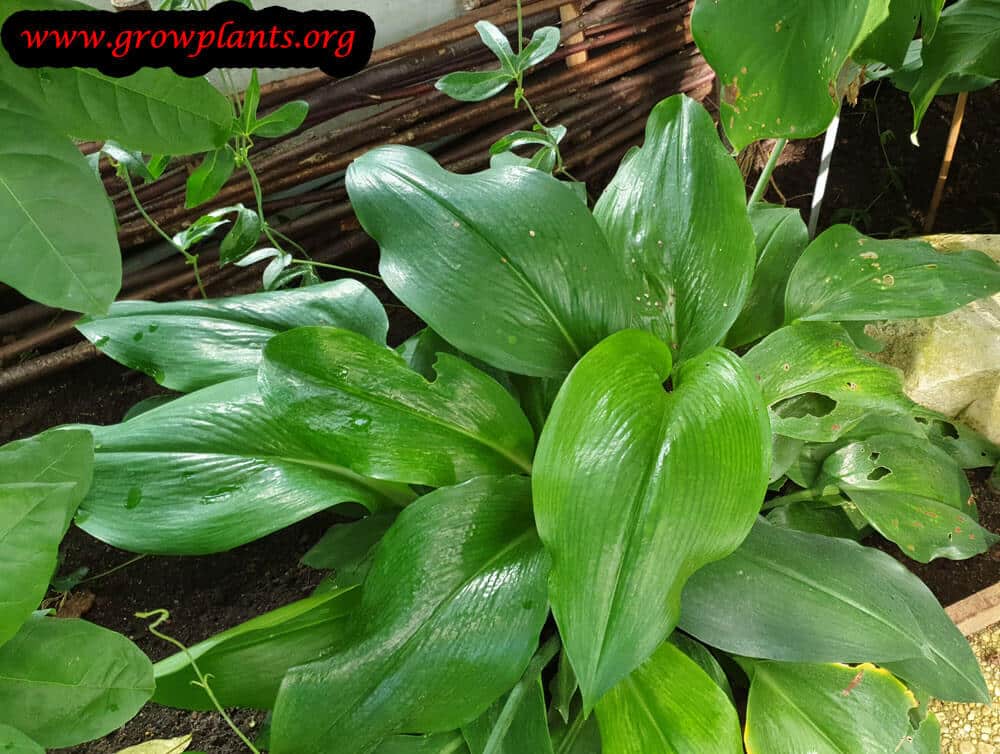
Plant Profile & Key Characteristics
Overview: An evergreen bulbous perennial reaching 30-60 cm, grown for its glossy broad leaves and fragrant white star-shaped flowers. It thrives in shade and makes an excellent houseplant.
Quick Specifications
| Specification | Attribute |
|---|---|
| Plant Type / Life Cycle | Perennial (bulbous geophyte) |
| Foliage Type | Evergreen |
| Mature Size | 30-60 cm (12-24 in) tall |
| Growth Rate | Moderate |
| Root System | Bulb (geophyte) |
| Toxicity | Toxic if ingested (Amaryllidaceae – contains lycorine alkaloids) |
| Hardiness | USDA zone 10b+ |
Growth Form & Structure
- Height & Spread: A clump 30-60 cm (1-2 ft) of broad leaves; well suited to shady containers and as a houseplant.
- Growth Habit & Form: Clumping bulbous perennial with broad basal foliage and upright flower scapes.
- Lifespan & Maturity: Long-lived; bulbs multiply into clumps over time.
Anatomy & Physical Features
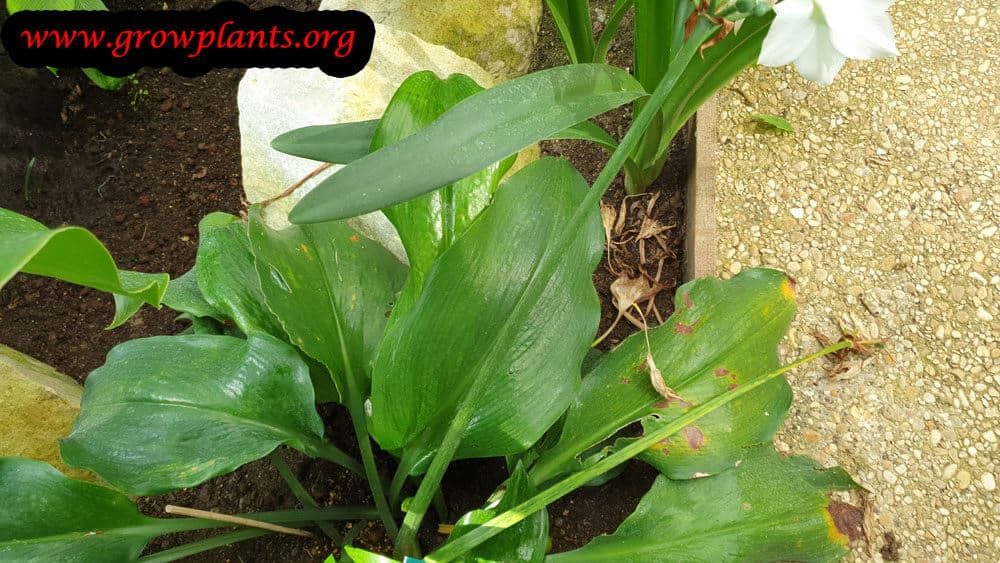
- Leaves & Foliage: Glossy green oval leaves borne on short stalks.
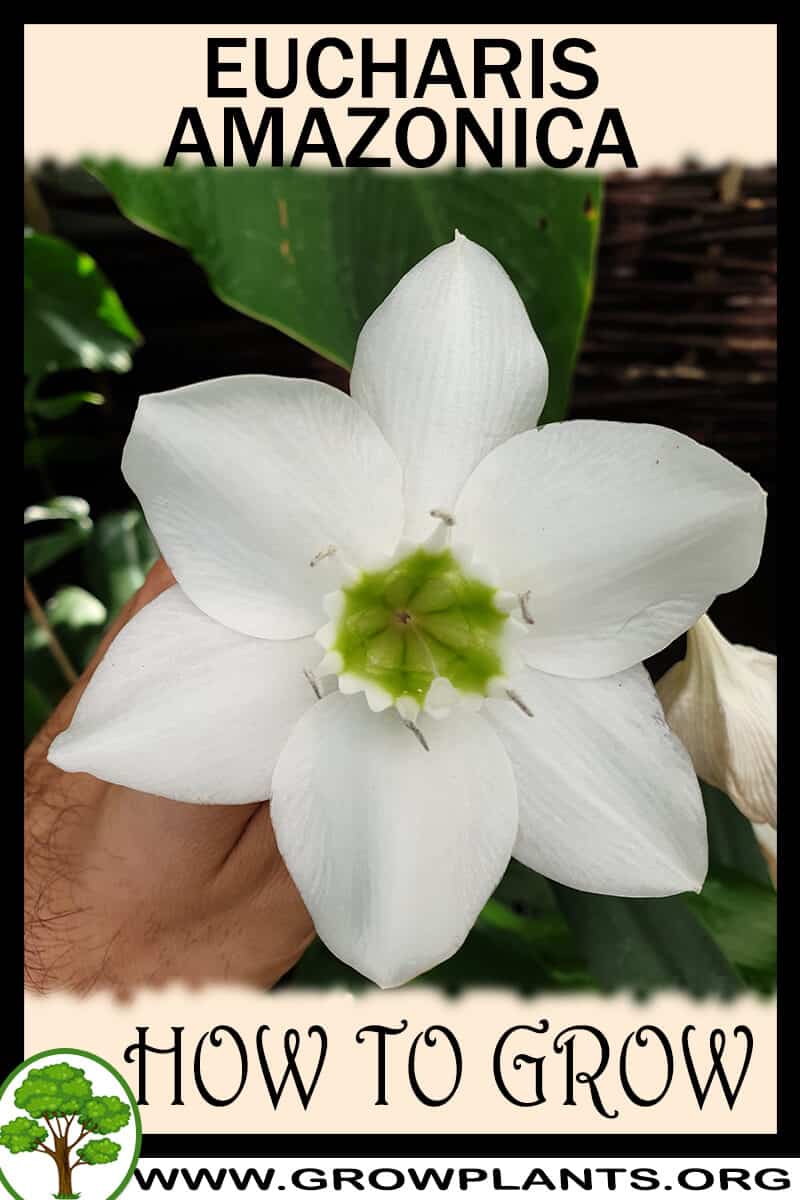
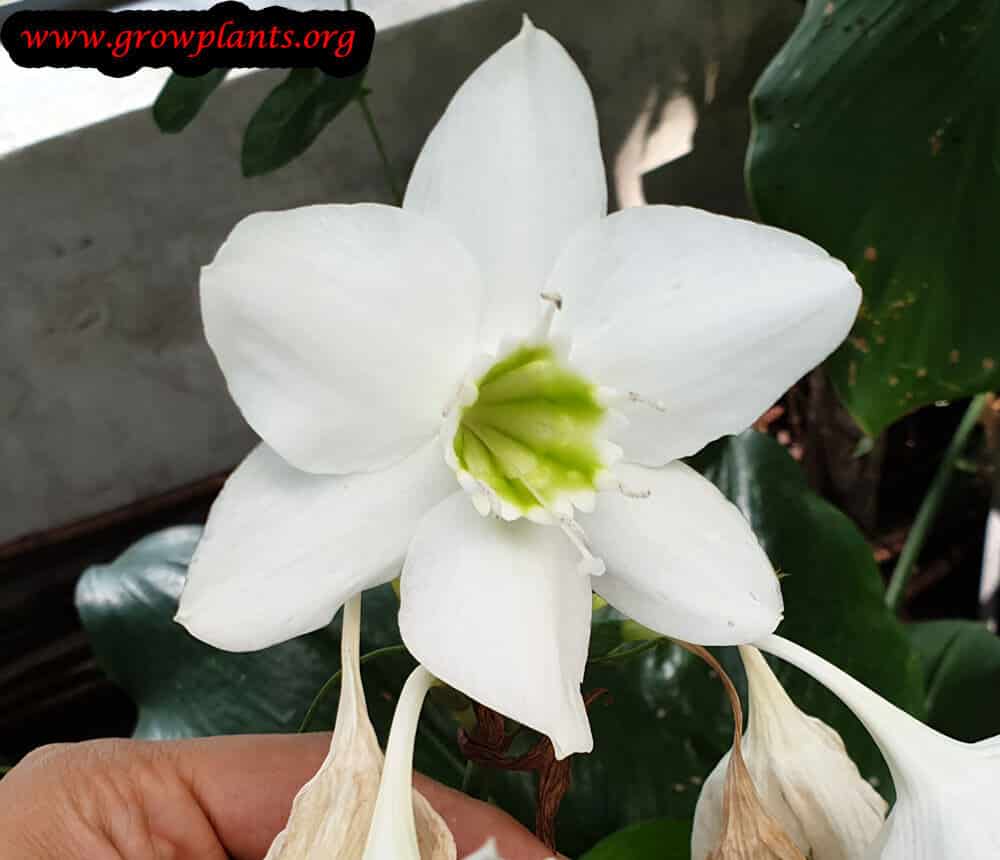
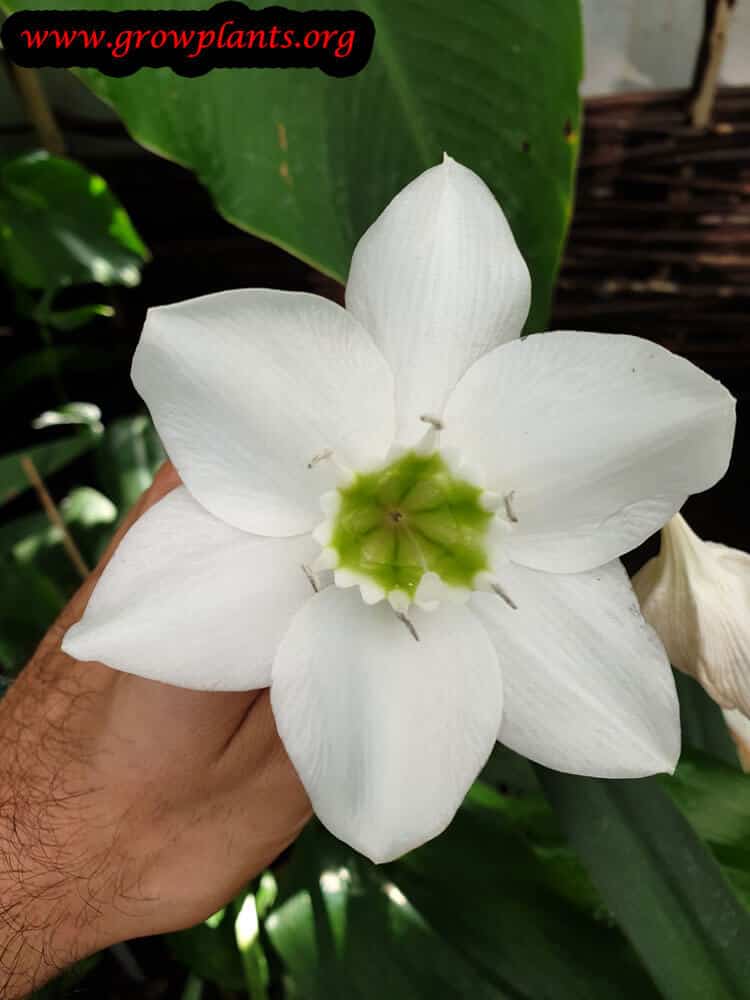
- Flower Characteristics: Fragrant white daffodil-like star flowers with a green-white centre and six petals, in spring and summer.
Primary Uses & Landscape Value
- Functional & Ornamental Roles: Shade ornamental and flowering houseplant for containers.
Care Guide: Planting, Soil & Watering
Overview: The Amazon lily is a shade-loving tropical bulb that grows best in rich, moisture-retentive but well-drained soil. It prefers warmth, filtered light, and steady moisture during active growth.
Quick Care Requirements
| Requirement | Ideal Condition |
|---|---|
| Planting Season | Warm season – spring through autumn |
| Growth Rate | Moderate |
| Soil Type | Rich, organic, moisture-retentive yet well-drained |
| Water Need | Moderate to High |
Planting & Establishment
- Best Planting Season: Plant bulbs in the warm season, spring through autumn, in a frost-free spot (roughly zone 10b and warmer).
- How to Plant:
- Hole Preparation: Dig a hole and set the bulb with its neck at or just below the surface.
- Soil Amendments: Enrich with compost and organic matter for fertility and moisture retention.
- Planting Depth: Plant bulbs shallowly, with the tip near the soil surface; avoid burying them too deep.
- Growth Speed & Expectations: Moderate; forms clumps that flower best when slightly crowded.
Soil, Watering & Drainage Care
- Soil Mix & Drainage Needs: Rich, free-draining soil or potting mix; grows well in containers with drainage holes, which also encourage flowering once roots fill the pot.
- Watering Schedule & Technique:
- Young / Newly Planted: Keep evenly moist as the roots and leaves establish.
- Established: Water regularly to keep the soil lightly moist; reduce slightly after flowering to allow a short rest.
- Seasonal Adjustments: More water in warm growth, less in cool weather.
Climate, Light & Hardiness
Eucharis amazonica is a shade-loving tropical bulb that thrives in consistently warm, humid conditions and needs half to full shade rather than direct sun. It is reliably hardy outdoors only in USDA zone 10b and warmer, and elsewhere it is grown as a houseplant.
Quick Climate Specifications
| Climate Zones | Tropical, subtropical, Mediterranean (as houseplant in cooler areas) |
|---|---|
| USDA Hardiness Zones | 10b+ |
| Approx. Survival Minimum | Not documented precisely, but as a zone 10b+ tropical bulb it is unlikely to tolerate any frost; treat 0°C (32°F) as an approximate outdoor danger threshold |
| Frost Tolerance | Very Low |
| Light Conditions | Half Shade to Full Shade |
Sunlight & Light Exposure
Optimal Light Setup
Bright, indirect or filtered light in half to full shade, similar to its native tropical forest understory habitat.
Shade & Heat Management
Keep out of direct midday sun, both indoors near a window and outdoors in hot subtropical climates; harsh direct sun can scorch the broad leaves.
Best Exposure / Orientation
An east-facing window or a shaded patio position suits it well as a houseplant, or outdoors in genuinely warm climates.
Temperature Extremes & Hardiness
USDA Hardiness & Regional Limits
Outdoor-hardy only in zone 10b and warmer per site data; elsewhere it is grown as a houseplant, kept in warm, frost-free conditions year-round.
Cold Damage & Winter Protection
As a tropical bulb, keep it well above freezing at all times; indoors, avoid cold drafts and cold window glass in winter.
Frost Sensitivity
Very low – any frost exposure is likely to be fatal; container plants must be brought indoors well before the first frost in marginal climates.
Extreme Heat Tolerance
Generally good given consistent moisture and humidity, reflecting its tropical origin.
Wind, Humidity & Microclimate
Humidity Preferences
High – a true tropical understory bulb that benefits from consistently humid air.
Dry-Air Tolerance
Low – dry indoor heating air or arid outdoor climates can stress the foliage; group with other plants or use a humidity tray or misting indoors.
Wind Tolerance
Low – the broad, soft leaves are easily damaged by strong wind, so grow in a sheltered spot.
Rainfall & Seasonal Moisture
Prefers consistently moist, humid conditions typical of tropical forest understories, without a pronounced dry season.
Microclimate Recommendations
A warm, humid, shaded, wind-sheltered spot – indoors or in genuinely frost-free climates – gives the best results.
Growing in Pots, Balconies & Indoors
The Amazon lily (Eucharis amazonica) is a shade-loving bulb (about 30-60 cm / 12-24 in) with fragrant white flowers. The grower does not list it as a houseplant, but because it thrives in half to full shade rather than sun, it can be kept indoors in a bright spot; outdoors it makes a fine shaded-patio container plant.
Quick Details
- Container Size: A pot sized to the bulbs – it flowers best slightly pot-bound, so don’t overpot
- Indoor Suitability: Not the grower’s pick as a houseplant, but its shade tolerance means a bright indoor spot can work
- Best Spot: Half shade to full shade – avoid strong direct sun
- Soil & Drainage: Rich, well-drained potting mix
- Watering in Pots: Average to plenty in growth; ease off after flowering, but do not let it dry out hard
Indoors & On the Windowsill
- Indoor reality: The grower does not rate it a houseplant, but unlike sun-loving bulbs it likes shade, so a bright room out of direct sun can suit it – keep it warm and out of cold drafts.
- Flowering: It blooms best when slightly pot-bound and with a short drier rest between flushes; too large a pot delays flowering.
- Overwintering: Tender – keep it warm and frost-free indoors through cold months.
- Safety: As an Amaryllis-family bulb, all parts are toxic if eaten – keep away from children and pets.
On a Balcony or Patio
- Light: A shaded or part-shaded, sheltered balcony or patio suits it – keep it out of hot direct sun that scorches the leaves.
- Practicalities: It can spread and become invasive in the ground, so a pot is a tidy way to keep it contained.
Choosing the Pot, Soil & Long-Term Care
- Pot & drainage: A pot only a little larger than the cluster of bulbs, with strong drainage holes and no standing-water saucer.
- Potting mix: Rich, free-draining mix – potting mix with some organic matter.
- Feeding: Potted plants exhaust and leach nutrients faster than those in the ground, so feed lightly during active growth – more often than you would in open soil.
- Repotting: Leave it undisturbed while flowering well; refresh the mix and divide only every few years when overcrowded.
Fertilizing & Feeding
A moderate feeder while its glossy leaves and fragrant white flowers are actively growing, with a brief rest from feeding after bloom that helps encourage the next flowering cycle.
Quick Fertilizing Specs
| Feeding Level | Moderate feeder during active growth |
|---|---|
| Main Nutrient Priority | Balanced feeding with adequate nitrogen for glossy foliage, shifting toward bloom support as flower stalks form |
| Best Feeding Period | Through active leaf growth and while flower stalks are developing |
| Organic Options | Rich, humus-amended soil worked in at planting |
Feeding by Growth Stage
Active leaf growth
Build the plant’s glossy, oval leaves and overall bulb strength between bloom cycles.
| Nutrient direction | A balanced fertilizer with adequate nitrogen supports strong, glossy leaf growth. |
|---|---|
| Timing | During the main growth periods in spring and summer. |
| Frequency | A light feeding through this stage keeps growth steady without forcing it. |
| Fertilizer types | A balanced complete fertilizer, Organic matter worked into rich soil |
| Precautions | Keep soil consistently moist and rich but well drained; this bulb dislikes both drying out and sitting in soggy soil. |
Flower stalk development and bloom
Support the tall stalks and star-shaped, fragrant white flowers as they develop and open.
| Nutrient direction | Shift toward a potassium-supportive, balanced feeding as flower stalks emerge to support strong stems and bloom quality. |
|---|---|
| Timing | As flower stalks emerge, typically in spring or summer. |
| Frequency | A light feeding at stalk emergence is usually enough to carry the plant through bloom. |
| Fertilizer types | A balanced fertilizer with a potassium-supportive formulation |
| Precautions | Avoid heavy nitrogen while stalks are forming, which favors leafy growth over strong flowering. |
Brief post-bloom rest
Give the bulb a short rest after flowering, which is commonly used to help encourage the next round of bloom.
| Nutrient direction | None – withhold fertilizer for this short rest period right after bloom finishes. |
|---|---|
| Timing | For a short period immediately after the flowers fade. |
| Frequency | No feeding during this brief rest. |
| Fertilizer types | No feeding at this stage; do not fertilize during the short post-bloom rest. |
| Precautions | Do not fertilize during this brief rest; resume feeding once fresh leaf growth signals the plant is active again. |
Nutrient Deficiency Signs & Corrections
Older leaves fade to pale green or yellow and new leaf growth is sparse.
| Possible causes | low available soil nitrogen, soil low in organic matter, root crowding in an overdue-for-dividing clump |
|---|---|
| Appears first on | older leaves |
| What to check | soil organic matter, recent feeding history, bulb crowding in the container or bed |
| Possible correction | Apply a balanced fertilizer and refresh organic matter in the soil, then watch for greener new growth. |
New leaves emerge yellow while the veins remain green.
| Possible causes | soil pH too high for good iron availability, waterlogged soil limiting root uptake, cool temperatures temporarily slowing nutrient uptake in this tropical bulb |
|---|---|
| Appears first on | newest leaves |
| What to check | soil pH and drainage, watering consistency, recent temperature conditions |
| Possible correction | Improve drainage, keep the plant warm, or apply a chelated iron product per its label. |
Leaf tips and margins brown or scorch despite regular watering.
| Possible causes | fertilizer salt buildup from overfeeding, inconsistent watering that concentrates salts, poor drainage in a container |
|---|---|
| Appears first on | leaf tips and margins |
| What to check | recent feeding amounts, container drainage, watering consistency |
| Possible correction | Ease off feeding, water thoroughly to flush accumulated salts, and return to lighter feeding afterward. |
Pruning, Training & Seasonal Maintenance
Eucharis amazonica (Amazon lily) is an evergreen bulb/geophyte, so it tolerates very little true pruning – there’s no woody framework to shape. The only real task, per the plant’s own care notes, is removing dead leaves and spent flowers, concentrated in the autumn/winter window. Because the bulb (not a woody structure) powers next season’s leaves and bloom, cutting healthy green leaves early only reduces what the bulb can store for its next flush.
Quick Pruning & Maintenance Specs
| Pruning Tolerance | Low – sanitary removal only |
| Primary Pruning Window | Autumn – Winter |
| Secondary Maintenance Window | Removing spent flower stalks soon after each spring/summer bloom flush |
| Typical Frequency | Ongoing light sanitary removal, concentrated in autumn/winter |
| Main Objective | Remove dead leaves and spent flowers |
| Young Plant Priority | Leave all foliage intact while the bulb establishes |
| Mature Plant Priority | Routine removal of yellowed leaves and finished flower stalks |
| Best Tool Type | Precision snips |
| Avoid Heavy Pruning During | Active growth, while leaves are still green and functioning |
Pruning by Plant Age & Size
Newly Established
No pruning beyond removing any leaves damaged during planting.
Young / Formative
No structural training applies – this is a clump-forming bulb that produces offsets naturally, with no stem framework to train.
Mature / Established
Clear dead leaves and spent flower stalks as they occur; thin an overcrowded offset clump only if congestion becomes a problem, given the plant’s noted spreading tendency.
Seasonal Pruning Schedule
Dormant/Winter
Objective: tidy the clump.
Remove: fully dead or yellow leaves, finished flower stalks.
Do not remove: green leaves.
Expected response: none – sanitary only.
Flowering/fruiting impact: promptly removing spent stalks prevents seed-set from draining the bulb and helps curb the plant’s noted invasive spreading tendency.
Post-Flowering (Spring/Summer)
Objective: remove spent flower stalks soon after each bloom finishes.
Do not remove: developing offsets or leaves.
Flowering/fruiting impact: none on the current cycle; helps the next cycle by redirecting energy back to the bulb.
Special Growth to Remove
- Dead leaves and spent flower stalks.
- Excess offsets, if clump congestion becomes an issue – consistent with the plant’s noted tendency to spread.
Container & Small-Space Pruning
This plant is commonly grown in containers. Remove spent leaves and flowers promptly to keep the pot tidy – its preferred half-shade to full-shade, humid conditions mean lingering debris can encourage rot faster than it would in an open bed.
Tools
Precision snips only – every cut is through soft leaf or flower-stalk tissue.
Tool Hygiene & Disease Risk
Routine. The plant’s known pests (slugs, caterpillars) are not spread by pruning tools, so clean sharp snips are sufficient.
Cut Placement & Technique
Cut spent flower stalks at their base near the bulb neck. Remove dead leaves at their base without nicking the bulb neck or nearby healthy leaves.
Heavy Pruning & Rejuvenation
Not applicable or tolerated in the woody sense – there’s no structure to rejuvenate by hard pruning. A tired-looking clump is better addressed by dividing overcrowded bulbs (a propagation task, not covered here) than by cutting back live foliage.
Post-Pruning Care
Keep soil evenly moist, matching this plant’s preference for rich, moist soil, after removing spent tissue. In humid, shaded conditions, watch cut bases for rot.
Common Pruning Mistakes
- Removing green leaves prematurely, weakening the bulb ahead of its next bloom.
- Leaving spent flower stalks to set seed and self-sow, feeding the plant’s invasive tendency.
- Nicking the bulb neck when trimming leaves too close to the base.
When NOT to Prune
Avoid cutting green leaves during active growth, and avoid pruning right after transplanting while the bulb is establishing.
Recommended Tools (by task)
- Precision snips – clean, low cuts on soft leaves and flower stalks near the bulb neck; the only tool this plant’s growth calls for.
Propagation Guide
Eucharis amazonica (Amazon lily) is most easily propagated by dividing the offset bulbs that cluster naturally around the parent bulb, which is faster and more reliable than seed. Seed is possible but is a slow route to a flowering-size plant, so overall difficulty is easy by division.
Quick Propagation Specs
| Best Propagation Method | Bulb (offset) division |
| Alternative Methods | Seed |
| Propagation Difficulty | Easy |
| Vegetative True-to-Type | Yes |
| Best Propagation Season | Spring to autumn |
Rhizomes, Tubers, Bulbs & Corms
Bulb Division
This species naturally forms clusters of offset bulbs around the main bulb. Separate offsets with their own roots when repotting or dividing a crowded clump, and replant promptly in rich, moist soil to re-establish. Eucharis often flowers best when left slightly pot-bound, so avoid dividing more often than needed.
Growing from Seed
Seed can be used to raise new plants but takes considerably longer to reach flowering size than division, and is not the practical choice for most growers.
Bloom & Flower Guide
Quick Details
- Bloom Season: Spring and summer
- Flower Appearance: Fragrant, daffodil-like white flowers with a green-tinged centre and six petals, on a tall stalk
- Edibility: Not edible. As an Amaryllid, the bulb and other parts contain toxic alkaloids.
Detailed Blooming Overview
The Amazon lily bears elegant, fragrant white flowers that recall a daffodil, each with six petals framing a green-flushed cup at the centre. They open on a slender stalk above broad, glossy leaves, mainly in spring and summer, and their scent makes them a favourite indoor bloom.
Flower Characteristics
- White, six-petalled, daffodil-like flowers with a green-tinged centre.
- Fragrant, carried on a tall stalk.
Bloom Care & Thinning
- Encouraging flowers: A short, drier rest period between growth cycles helps trigger reblooming, and clumps that are slightly pot-bound tend to flower best.
- Safety: The bulb and plant are toxic if eaten; keep away from children and pets.
Bloom Health & Protection
- Mealybugs and thrips: These can mar buds and open flowers; insecticidal soap or neem oil protects the blooms.
Pests, Diseases & Troubleshooting
Overview: Amazon lily (Eucharis amazonica) is a shade-loving amaryllid bulb whose key threats are bulb-boring narcissus-fly larvae and sap-suckers (mealybug, spider mite, thrips), plus the red-blotch fungus typical of the family and bulb rot from overwatering; slugs graze the broad leaves. It is grown for its fragrant white flowers, so management protects the bulb and foliage with sanitation and careful watering.
Quick Troubleshooting Overview
| Issue / Pest | Main Symptom | Primary Solution |
|---|---|---|
| Bulb fly / basal rot | Soft bulb, failure to sprout, hollowed base | Use firm bulbs, good drainage, discard soft ones |
| Red blotch (leaf scorch) | Red streaks and spots on leaves and flower scape | Remove infected parts, keep foliage dry, fungicide bulb dip |
| Mealybug | White cottony tufts at leaf bases and in the crown | Alcohol/oil, isolate plant |
| Spider mite | Fine stippling and dull leaves in dry air | Raise humidity, rinse foliage, horticultural oil |
| Slugs & snails | Ragged holes and slime on leaves | Traps, iron-phosphate bait, barriers |
| Thrips | Silvery streaks and deformed buds | Sticky traps, insecticidal soap, sanitation |
Common Pests & Management
- Narcissus / amaryllis bulb fly (Merodon equestris / Eumerus spp.):
- Symptoms: Fat maggots bore into the bulb from the base, hollowing and rotting it, so plants fail to emerge, produce weak distorted leaves, or collapse; the bulb feels soft and may smell.
- Prevention & Control: Buy and plant only firm, sound bulbs, discard any that are soft, keep the neck area free of gaps the flies lay into (mound soil or grit), and destroy infested bulbs; there is no cure for a bulb already tunnelled, so prevention and inspection are key.
- Mealybugs (Pseudococcus spp.):
- Symptoms: White cottony tufts collect at the leaf bases, in the crown and on roots, sucking sap, weakening the plant and leaving honeydew that blackens with sooty mould.
- Prevention & Control: Wipe off colonies with an alcohol-tipped swab, treat with horticultural oil or insecticidal soap, check the crown and roots (repot and rinse for root mealybug), and isolate affected plants.
- Spider mites (Tetranychus urticae):
- Symptoms: In dry indoor air the glossy leaves dull, show fine pale stippling and may bronze, with faint webbing on the undersides.
- Prevention & Control: Raise humidity and rinse or sponge the leaves, keep the plant unstressed, and use insecticidal soap or horticultural oil; wiping the broad leaves regularly both cleans them and removes mites.
- Thrips (Thysanoptera):
- Symptoms: Silvery streaks and flecks on leaves and deformed, discoloured flower buds, with tiny slender insects and black frass specks visible on close inspection.
- Prevention & Control: Hang blue or yellow sticky traps, remove affected buds, keep plants clean, and use insecticidal soap, neem or spinosad; good sanitation and airflow limit build-up.
- Slugs & snails (Gastropoda):
- Symptoms: Ragged holes and rasped patches on the large soft leaves, with slime trails, worst in damp, shady conditions where this plant is grown.
- Prevention & Control: Set traps and hand-collect at night, use grit or copper barriers around pots, scatter iron-phosphate bait, and keep the surface drier by watering in the morning.
Diseases & Fungal Issues
- Red blotch / leaf scorch (Stagonospora curtisii):
- Symptoms: The classic amaryllid disease: red streaks, spots and blotches on the emerging leaves, flower scape and bulb neck, sometimes distorting or scorching new growth, worst in cool, damp conditions.
- Treatment & Management: Remove and destroy infected leaves and scapes, keep foliage dry and the crown airy, avoid cold wet conditions during emergence, and dip or dust bulbs with fungicide before planting; use clean, healthy stock.
- Basal / bulb rot (Fusarium / Pythium / Sclerotium):
- Symptoms: The bulb base and roots turn soft, brown and rotten, often with fungal growth, following overwatering, cold wet soil or injury; the plant yellows, wilts and collapses.
- Treatment & Management: Grow in a free-draining mix, water carefully and never leave the bulb waterlogged, keep it warm, and discard badly rotted bulbs; salvage lightly affected bulbs by cutting out rot, dusting with fungicide and drying before repotting.
- Botrytis leaf & flower blight (Botrytis spp.):
- Symptoms: Grey mould and water-soaked spots on flowers and leaves in cool, damp, stagnant air, quickly ruining the blooms.
- Treatment & Management: Improve airflow, avoid wetting flowers and foliage, remove faded blooms and dead leaves promptly, and reduce humidity around plants; fungicide is rarely needed if conditions are corrected.
- Mosaic virus (potyvirus / mosaic complex):
- Symptoms: Yellow mottling, streaking and distortion of leaves, with gradual weakening; spread by sap and by aphids/thrips and through infected offsets.
- Treatment & Management: There is no cure – remove and destroy affected plants, control sap-sucking vectors, use clean stock, and disinfect tools between plants to prevent spread.
Growing Difficulties & Abiotic Problems
- Failure to bloom:
- Cause & Symptoms: Plenty of leaves but no flowers, usually because the plant is too comfortable – it flowers best pot-bound and after a distinct drier, cooler rest that triggers bud initiation.
- Correction Strategy: Grow it slightly pot-bound, feed and water well in growth, then give a few weeks of reduced water and cooler temperatures to force flowering; repeated cycles can give several flushes a year.
- Overwatering bulb rot:
- Cause & Symptoms: Constantly wet, cold or badly drained compost rots the bulb and roots, the leading cause of loss for this plant indoors.
- Correction Strategy: Use a free-draining mix, let the surface dry between waterings, cut back sharply during the rest period, and ensure pots drain freely; keep it warm, as cold plus wet is the dangerous combination.
- Cold & draught leaf damage; sunburn:
- Cause & Symptoms: Cold draughts and temperatures below its comfort range brown and mark the leaves, while harsh direct sun scorches the shade-adapted foliage.
- Correction Strategy: Keep it warm and out of cold draughts, and grow in bright indirect light or light shade rather than intense direct sun; move indoors before cold weather in temperate areas.
What Helps – Products & Tools
Amazon-lily care uses horticultural oil and insecticidal soap (mealybug, mites, thrips), a fungicide bulb dip or dust (red blotch, basal rot), blue/yellow sticky traps (thrips), and iron-phosphate slug bait. The real keys are sound firm bulbs, a free-draining mix and careful watering – most problems here trace back to a wet, cold bulb rather than to insects.