

Plant Profile & Key Characteristics
Overview: Cryptostegia grandiflora (Rubber Vine) is an evergreen woody vine or shrub reaching 1–3 m (3–10 ft), with glossy dark green leaves and a milky latex. It is grown as an ornamental flowering vine and hedge in warm climates.
Quick Specifications
| Specification | Attribute |
|---|---|
| Plant Type / Life Cycle | Perennial woody vine / shrub |
| Foliage Type | Evergreen |
| Mature Size | 1–3 m (3–10 ft) |
| Growth Rate | Fast to moderate |
| Toxicity | Highly toxic – all parts contain cardiac glycosides and a poisonous milky latex |
| Hardiness | USDA zone 10+ |
Growth Form & Structure
- Height & Spread: Reaches 1–3 m (3–10 ft) and climbs higher on support; trained on a trellis or clipped as a shrub or hedge, and can also be container-grown.
- Growth Habit & Form: Scrambling woody vine or arching shrub that exudes white latex when cut.
- Lifespan & Maturity: Vigorous, fast-establishing perennial.
Anatomy & Physical Features
- Leaves & Foliage: Glossy dark green oval leaves.
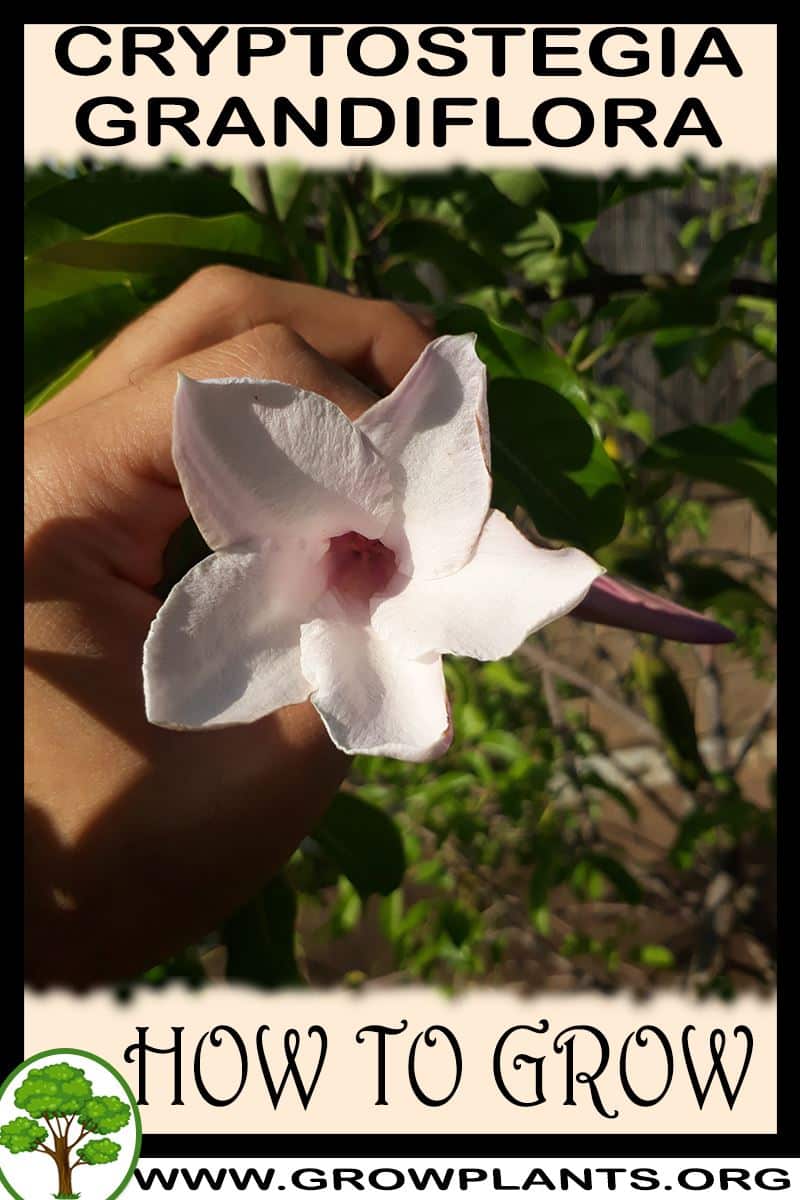
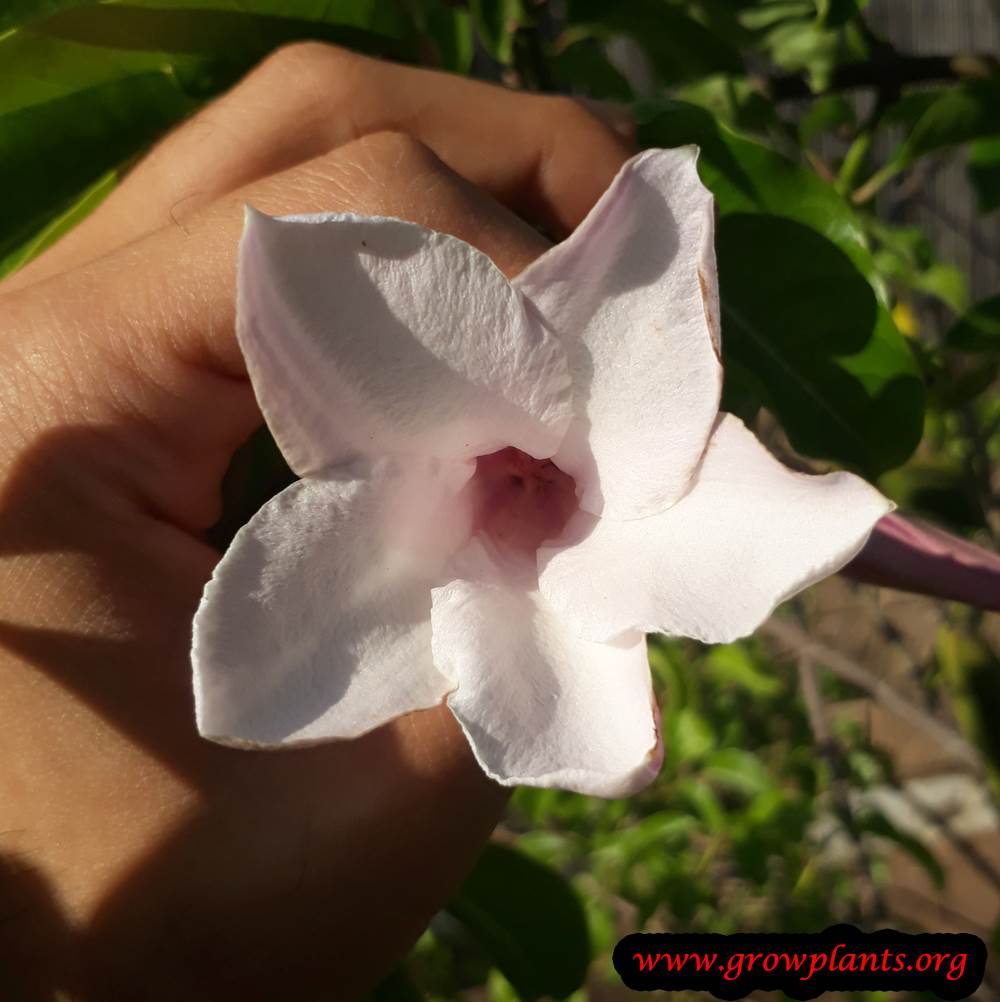
- Flower Characteristics: Large purple or white trumpet-shaped flowers in spring to autumn.
Primary Uses & Landscape Value
- Functional & Ornamental Roles: Ornamental flowering vine for trellises and fences, and as a hedge or screen.
Care Guide: Planting, Soil & Watering
Overview: Rubber vine (Cryptostegia grandiflora) is a vigorous evergreen vine or shrub that grows best in moist, well-drained soil in full sun to part shade, and benefits from a trellis or support. Keep the soil evenly moist while giving the roots good drainage.
Quick Care Requirements
| Requirement | Ideal Condition |
|---|---|
| Planting Season | During the warm season, from spring through autumn |
| Growth Rate | Fast to moderate |
| Soil Type | Moist but well-drained soil |
| Water Need | Moderate — keep the soil evenly moist |
Planting & Establishment
- Best Planting Season: Plant in the warm season, from spring through autumn, in a sunny to lightly shaded spot; provide a trellis or support at planting, as it climbs vigorously.
- How to Plant:
- Hole Preparation: Dig a hole a little wider than the root ball and set a support in place before planting.
- Soil Amendments: Work compost or organic matter into the backfill to hold moisture while keeping drainage open.
- Planting Depth: Set the plant at the same depth it grew in its pot, keeping the stem base at soil level.
- Growth Speed & Expectations: Growth is fast to moderate; it quickly covers a trellis or forms a dense hedge and needs regular pruning to stay in bounds.
Soil, Watering & Drainage Care
- Soil Mix & Drainage Needs: Give it moist but well-drained soil; it likes steady moisture without waterlogging. It also grows in containers of good potting mix with drainage.
- Watering Schedule & Technique:
- Young / Newly Planted: Keep the soil consistently moist while the plant establishes and starts to climb.
- Established: Water regularly to keep the soil evenly moist, letting the surface dry slightly between waterings.
- Seasonal Adjustments: Water more in warm, dry weather and reduce it in cool or wet periods.
Climate, Light & Hardiness
Cryptostegia grandiflora (Rubber vine) grows in tropical, mediterranean, or subtropical climates and prefers full sun to half shade. The site rates it to approximately zone 10 and above, indicating low cold tolerance typical of a fully tropical vine.
Quick Climate Specifications
| Climate Zones | Tropical, mediterranean, and subtropical climates |
|---|---|
| USDA Hardiness Zones | Approximately 10 and above |
| Frost Tolerance | Very Low |
| Light Conditions | Full Sun to Half Shade |
Sunlight & Light Exposure
Optimal Light Setup
Full sun to half shade both work; this is the extent of the light detail available for this plant on the site.
Temperature Extremes & Hardiness
USDA Hardiness & Regional Limits
Reliable outdoor culture is rated from approximately zone 10 upward; detailed cold-damage data is not available on this site, so treat this as an approximate guide reflecting general tropical-vine cold sensitivity.
Frost Sensitivity
Frost is likely to seriously damage or kill this fully tropical vine; site in the warmest available spot if growing near the cool edge of its likely range.
Wind, Humidity & Microclimate
Microclimate Recommendations
Given the limited climate detail available, a warm, sheltered site is a reasonable, cautious default at the cooler end of its rated range.
Growing in Pots, Balconies & Indoors
Rubber vine is listed by the grower as suitable both as a houseplant and in containers. It is a handsome large-flowered climber (1-3 m / 3-10 ft in a pot) for a bright indoor spot, patio or balcony. One important caution: every part is highly poisonous, so site it with real care.
Quick Details
- Container Size: A pot of about 20-30 L (5-8 gal) with a support
- Indoor Suitability: Suitable indoors in a bright spot – but toxic, so place out of reach
- Best Spot: Full sun to part shade; bright light indoors
- Soil & Drainage: Free-draining, organic-rich mix
- Watering in Pots: Average, steady watering; let the surface dry slightly between
Indoors & On the Windowsill
- Safety first: Rubber vine is highly toxic – the leaves and milky sap contain heart-affecting compounds. Keep it well away from children and pets, and wash hands after handling. Never let anyone chew any part.
- As a houseplant: The grower rates it suitable indoors – give it bright light near a window and a small trellis or hoop to climb.
- Overwintering: Frost-tender; a pot lets you keep it warm and bright indoors through the cold season.
On a Balcony or Patio
- Light & wind: Enjoys a warm, sunny balcony with a support to climb; shelter from cold wind.
- Practicalities: Prune with gloves to control size and contain the sap; site it away from seating and play areas.
Choosing the Pot, Soil & Long-Term Care
- Pot & drainage: A 20-30 L pot with strong drainage holes; skip a standing-water saucer to avoid root rot. Terracotta breathes and dries faster; glazed or plastic holds moisture longer.
- Potting mix: A light, aerated, organic-rich mix – potting compost or peat/coir with added perlite or vermiculite for drainage.
- Feeding: Nutrients wash out of pots faster than open ground, so feed potted the vine more often – a balanced liquid feed through the active growing season.
- Repotting: Refresh the top layer of mix each year and renew it or pot up every couple of years; lightly trim the roots and top growth when you do.
Fertilizing & Feeding
A vigorous, glossy-leaved vine that grows well with minimal feeding once established; keep nutrition light and let consistently moist, fertile soil do most of the work.
Quick Fertilizing Specs
| Feeding Level | Light feeder |
|---|---|
| Main Nutrient Priority | Balanced feeding with adequate nitrogen to support glossy leaf growth and trumpet flowering |
| Best Feeding Period | Spring through the warm growing season |
| Organic Options | Compost or well-rotted manure worked into moisture-retentive soil |
| Reduce/Stop Feeding | Ease off feeding once the vine has filled its trellis or support |
| Micronutrients | Usually unnecessary; correct only a diagnosed deficiency |
| Soil pH | Tolerates a wide range, doing best in fertile, moisture-retentive soil |
Feeding by Growth Stage
Establishing after planting
Get new roots settled into consistently moist soil and start the vine climbing its support.
| Nutrient direction | A balanced fertilizer with adequate nitrogen supports early root and stem development. |
|---|---|
| Timing | The first growing season after planting. |
| Frequency | A light feeding as new growth begins, repeated once roots take hold. |
| Fertilizer types | A balanced complete fertilizer, Compost worked into the planting area |
| Precautions | Keep soil evenly moist when feeding; fertilizer applied to dry soil can stress new roots rather than help them. |
Vigorous growth and trumpet-flower bloom
Maintain dense glossy foliage and support the purple or white trumpet-shaped flowers through the season.
| Nutrient direction | Light, balanced feeding is enough to keep growth and flowering steady on an established plant. |
|---|---|
| Timing | Spring and summer while the vine is actively growing and blooming. |
| Frequency | An occasional light feeding suits an established, well-mulched planting. |
| Fertilizer types | A balanced complete fertilizer, A top-dressing of compost |
| Precautions | Avoid overfeeding, which can push soft, sappy growth that is more prone to pest problems. |
Cool-season or indoor rest
Let the vine slow down without pushing new growth in cool weather or reduced indoor light.
| Nutrient direction | None – withhold fertilizer while growth is stalled by cool temperatures or low indoor light. |
|---|---|
| Timing | During cool weather outdoors, or the darker months when grown as a container or indoor vine. |
| Frequency | No feeding at this stage; resume once active growth clearly returns. |
| Fertilizer types | No feeding at this stage; hold off fertilizing until active growth resumes. |
| Precautions | Do not fertilize a plant that has stopped putting out new growth; unused nutrients can build up as salts in the soil. |
Nutrient Deficiency Signs & Corrections
Older leaves fade to pale green or yellow and new stem growth is thin.
| Possible causes | low available soil nitrogen, nitrogen leaching from frequent watering in moisture-retentive soil, root competition from surrounding plantings |
|---|---|
| Appears first on | older, lower leaves |
| What to check | recent feeding history, watering frequency and drainage, soil organic matter |
| Possible correction | Apply a balanced fertilizer with available nitrogen and refresh organic matter around the root zone. |
New leaves emerge yellow while the veins remain green.
| Possible causes | waterlogged or poorly drained soil limiting root uptake, high soil pH restricting iron availability, root stress from consistently saturated soil |
|---|---|
| Appears first on | newest growth at the shoot tips |
| What to check | drainage and how quickly soil dries between waterings, soil pH, root health |
| Possible correction | Improve drainage, correct soil pH toward the plant’s preference, and apply a chelated iron product per its label if needed. |
Interveinal yellowing appears on older leaves while the veins themselves stay green.
| Possible causes | low soil magnesium, heavy potassium feeding competing with magnesium uptake, leaching in light or sandy soils |
|---|---|
| Appears first on | older, lower leaves |
| What to check | soil magnesium status, how potassium-heavy recent feeding has been, soil texture and drainage |
| Possible correction | Apply a labeled magnesium source such as Epsom salt or a dolomitic amendment and rebalance overall feeding. |
Pruning, Training & Seasonal Maintenance
Rubber vine can be grown either as a self-supporting shrub or trained as a climber on a trellis, and it tolerates moderate to fairly hard pruning either way. The main objective is shaping and size control rather than fruit or heavy structural work; the safest window is autumn into winter, ahead of the spring–autumn growth and bloom period. The single most important consideration when pruning this species is not timing but safety: every cut leaks a milky latex sap that is documented as poisonous, so handling technique matters as much as when you cut.
Quick Pruning & Maintenance Specs
| Pruning Tolerance | Moderate–High |
| Primary Pruning Window | Autumn – winter |
| Secondary Maintenance Window | Light shaping through spring–summer growth |
| Typical Frequency | One shaping cutback per year plus spot maintenance |
| Main Objective | Size/shape control as a shrub or trained vine; safe sap handling |
| Young Plant Priority | Decide and commit early to shrub form or trellised vine form |
| Mature Plant Priority | Maintain chosen form; thin congested growth |
| Best Tool Type | Bypass secateurs / loppers for thicker stems |
| Avoid Heavy Pruning During | Peak flowering flush if uninterrupted bloom is the goal |
Pruning by Plant Age & Size
Newly Established
Remove only damaged growth. Decide early whether the plant will be grown free-standing (light shaping into a rounded shrub) or trained onto support (regular tying-in of twining stems) – this choice shapes all later pruning.
Young / Formative
As a trellised vine: tie in leading stems and remove any growth heading away from the support. As a free-standing shrub: pinch and lightly cut back to build a multi-stemmed, self-supporting framework, since without training the twining stems will otherwise sprawl.
Mature / Established
Thin congested interior growth on either form to keep the plant open and manageable, and cut back annually to control overall size – this species can otherwise put on substantial growth in a single warm season.
Seasonal Pruning Schedule
Autumn / Winter
- Objective: shape and control size ahead of the main growth period.
- Remove: overlong or wayward stems, congested interior growth.
- Do not remove: the full framework in one pass on a young plant – build it gradually.
- Expected response: renewed, vigorous growth once temperatures rise.
- Flowering impact: minimal – blooms are produced on the new growth that follows, across spring, summer and autumn.
Structural Pruning & Training
If trellised, keep tying in new leading growth and remove stems growing away from the support; if grown as a shrub, prune to an open, balanced framework and remove any stems reverting to a rangy, twining habit.
Special Growth to Remove
- Wayward twining shoots on shrub-form plants that try to climb onto neighbouring plants or structures.
- Spent seed pods, once formed, to limit self-seeding.
Container & Small-Space Pruning
This species can be grown indoors/in containers, but its naturally vigorous, sprawling habit means container specimens need more frequent, firmer trimming than an in-ground plant to stay compact – and indoors, the toxic latex sap makes it important to keep prunings and fallen material away from pets and children.
Tools
Bypass secateurs for routine shaping; loppers for thicker older stems on a mature specimen. Avoid shears for this plant – it needs selective cuts, not a sheared surface.
Tool Hygiene & Disease Risk
Increased risk – not from disease, but from the plant’s own sap: wipe blades after use, since the milky latex can gum up cutting edges, and always wash tools and hands after pruning given the sap’s documented toxicity.
Cut Placement & Technique
Use thinning cuts to remove whole stems at their point of origin; wear gloves and eye protection, since cuts on this species bleed a latex sap that can irritate skin and eyes on contact.
Heavy Pruning & Rejuvenation
Tolerates a fairly hard cutback to renew an overgrown or leggy specimen, with vigorous regrowth typical of this fast-to-medium growing species; spread any very hard reset over more than one season if the plant is being used as a screen or hedge, to avoid a prolonged bare period.
Post-Pruning Care
Water normally; avoid extra feeding on this already vigorous grower. Dispose of prunings and any seed pods responsibly rather than leaving them where cuttings could root or seed could spread, and keep pruning debris away from children, pets and livestock because of the plant’s toxicity.
Common Pruning Mistakes
- Pruning bare-handed and getting the latex sap on skin or in eyes.
- Leaving cut material where it can root or self-seed nearby.
- Letting a trellised specimen grow untied until it collapses under its own weight.
When Not to Prune
Hold off on major cutback during the main flowering flush if continuous bloom display is the priority; otherwise timing is flexible outside of that.
Recommended Tools (by task)
- bypass_secateurs – routine shaping cuts and tying-in.
- loppers – thicker stems on an established shrub or vine.
- blade_disinfectant – wiping latex residue from blades between cuts and after finishing, given the sap’s toxicity.
Propagation Guide
Rubber vine is most easily raised from seed, shed in wind-dispersed, silky-haired pods that germinate readily, with semi-hardwood stem cuttings as a reliable vegetative alternative. All parts of the plant exude a toxic milky latex – matching the site’s own “Poisonous” note – so seed and cutting material should be handled with care. Propagation is easy overall.
Quick Propagation Specs
| Best Propagation Method | Seed |
| Alternative Methods | Semi-hardwood stem cuttings |
| Propagation Difficulty | Easy |
| Seed True-to-Type | Yes (species) |
| Vegetative True-to-Type | Yes |
| Best Propagation Season | Warm season (spring to summer) |
| Seed Germination Time | Roughly 1–3 weeks under warmth |
| Cutting Rooting Time | A few weeks |
| Germination Temperature | Warm, roughly 21–29°C (70–85°F) |
| Seed Sowing Depth | Shallow, lightly covered |
Growing from Seed
Seed Handling & Viability
Seed is wind-dispersed on silky floss and is generally best sown reasonably fresh rather than stored long-term.
Dormancy & Pre-Sowing Treatment
Fresh seed typically needs no special pretreatment.
Sowing Season
Warm months, matching the site’s spring/summer/autumn planting window.
Sowing Depth & Orientation
Sow shallow and lightly covered; loosening the silky floss around the seed can help it sow more evenly.
Germination Conditions
Warm and humid.
Germination Time
Roughly one to three weeks, variable.
Seedling Care
Wear gloves when handling seedlings and cutting material, since the sap is toxic and can irritate skin and eyes; grow on until sturdy before transplanting.
Stem Cuttings
Cutting Type
Semi-hardwood tip cuttings.
Best Timing
Warm growing season.
Cutting Preparation
Wear gloves and eye protection when taking cuttings – the cut ends exude a toxic milky latex that can irritate skin and eyes – and rinse tools after use.
Rooting Setup
Well-drained mix kept warm and humid.
Rooting Hormone
Optional.
Rooting Time
A few weeks, moderately reliable.
Bloom & Flower Guide
Quick Details
- Bloom Season: Spring through autumn
- Flower Appearance: Large trumpet-shaped flowers in soft purple or white
- Edibility: None — the whole plant, flowers included, is highly poisonous; never eat any part
Detailed Blooming Overview
Rubber vine earns its place with big, funnel-shaped blooms in soft purple to white over a long warm-season stretch. It is a vigorous climber, and every part carries a milky, toxic sap — beautiful to look at, but strictly a hands-off ornamental.
Flower Characteristics
- Trumpet-shaped flowers in purple to white, borne in clusters on strong stems above glossy oval leaves.
Bloom Care & Thinning
- Encouraging bloom: Full sun and warmth bring the best flowering; it blooms on established growth.
- Managing the display: Cut back in the cool season to shape and renew growth.
- Safety when handling: Wear gloves when pruning — the milky sap is an irritant and the plant is toxic if eaten.
Pests, Diseases & Troubleshooting
Overview: Rubber vine (Cryptostegia grandiflora) is a vigorous, toxic Apocynaceae climber that is largely untroubled by pests thanks to its poisonous latex, so its problems mirror the milkweed/oleander family: sap-sucking oleander aphids, mealybugs, soft scale and, in dry conditions, spider mites, plus root rot in wet ground. Because it is studied mainly as an invasive weed rather than an ornamental, detailed cultivated-pest data is thin, so this profile is built at the family level — treat organically and verify any local pest before acting.
Quick Troubleshooting Overview
| Issue / Pest | Main Symptom | Primary Solution |
|---|---|---|
| Oleander aphid | Yellow-orange aphids on shoots; honeydew | Water jet, beneficials, soap/neem |
| Mealybugs / soft scale | White tufts or brown bumps; sooty mould | Alcohol swab or oil; control ants |
| Spider mites | Stippled bronzed leaves, webbing in dry heat | Hose down, horticultural oil |
| Root/stem rot | Wilting in wet soil, dark rotten base | Well-drained soil, water sparingly |
| Frost damage | Blackened growth after cold | Protect; tender to frost |
| Invasiveness / toxic latex | Escapes readily; sap toxic to people/stock | Contain, glove up, check local weed rules |
Common Pests & Management
- Oleander / Milkweed Aphid (Aphis nerii):
- Symptoms: Bright yellow-orange aphids with black legs massing on new shoots, buds and flower stalks — the classic aphid of toxic Apocynaceae — causing honeydew, sooty mould and distorted tender growth.
- Prevention & Control: Hose colonies off and encourage ladybirds, lacewings and parasitic wasps, which readily control them. Avoid excess nitrogen. Insecticidal soap or neem clears heavy outbreaks; spray in the cool of the day to protect beneficials.
- Mealybugs (Planococcus / Pseudococcus spp.):
- Symptoms: White cottony masses in leaf axils, stem joints and on shoot tips, sucking sap and secreting honeydew; growth stunts and sooty mould follows, and ants often tend them.
- Prevention & Control: Wipe colonies with an alcohol-dipped swab, hose the plant, and control attending ants. Horticultural oil or insecticidal soap helps for heavier infestations, reaching into the axils where they hide; repeat until clear.
- Soft Scale (Coccus / Saissetia spp.):
- Symptoms: Brown or blackish limpet-like bumps along stems and leaf veins, sucking sap; foliage yellows and honeydew feeds sooty mould. Common on woody Apocynaceae.
- Prevention & Control: Prune out and destroy heavily encrusted stems, encourage predatory beetles and parasitic wasps, and treat crawlers with horticultural oil, repeating for later hatches.
- Spider Mites (Tetranychus urticae):
- Symptoms: Fine stippling, bronzing and faint webbing on foliage in hot, dry, dusty conditions; heavy feeding dulls and drops leaves.
- Prevention & Control: Hose down foliage and avoid drought and dust stress. Insecticidal soap or horticultural oil on leaf undersides controls outbreaks; conserve predatory mites by avoiding broad-spectrum sprays.
- Whitefly (Bemisia / Trialeurodes spp.):
- Symptoms: Tiny white flies rising when the plant is disturbed, with nymphs on leaf undersides producing honeydew and sooty mould; mainly a warm-climate or sheltered-planting nuisance.
- Prevention & Control: Monitor with yellow sticky traps, keep airflow good, and remove infested lower leaves. Treat undersides with insecticidal soap, neem or horticultural oil, repeating for new hatches.
Diseases & Fungal Issues
- Root & Stem Rot (Phytophthora / Pythium spp.):
- Symptoms: Wilting despite moist soil, dark rotten roots and stem base, and decline in heavy, waterlogged ground; the main disease risk for a plant that otherwise thrives on neglect in the dry.
- Treatment & Management: Plant in free-draining soil, avoid waterlogging, and water sparingly once established. Remove and destroy collapsed plants; drainage is the only reliable control.
- Fungal Leaf Spot (Cercospora / Alternaria spp.):
- Symptoms: Occasional brown or dark spots on leaves in prolonged humid, wet-foliage weather; generally minor and cosmetic on such a vigorous vine.
- Treatment & Management: Water at the base, keep foliage airy and dry, and remove spotted leaves. A copper fungicide is warranted only in persistent wet spells.
Growing Difficulties & Abiotic Problems
- Overwatering & Poor Drainage:
- Cause & Symptoms: Yellowing and root rot in soggy soil — rubber vine is drought-adapted and resents wet feet.
- Correction Strategy: Grow in well-drained soil, water sparingly once established, and never let it stand in water. This prevents nearly all disease problems.
- Frost / Cold Sensitivity:
- Cause & Symptoms: Blackened, wilted growth after cold; a tropical/subtropical vine damaged by frost.
- Correction Strategy: Grow in frost-free conditions or protect/overwinter under cover, and prune out cold-damaged growth once warmth returns.
- Invasiveness & Toxicity (Handling Caution):
- Cause & Symptoms: Not a disease, but a real management issue: the vine is highly invasive in warm regions and all parts, including the milky latex, are toxic to people and livestock.
- Correction Strategy: Contain it, prevent seeding where it can escape, and check local regulations — it is a declared weed in some countries. Wear gloves when pruning and keep the sap away from skin, eyes and animals.
What Helps – Products & Tools
Rubber vine rarely needs more than insecticidal soap and neem or horticultural oil for aphids, mealybugs, scale, whitefly and mites, rubbing alcohol swabs for spot-treating mealybugs and scale, and yellow sticky traps for monitoring whitefly. Disease control is cultural — free-draining soil and restrained watering — with copper fungicide only for stubborn leaf spot. Wear gloves when handling this toxic, invasive vine.