
Plant Profile & Key Characteristics
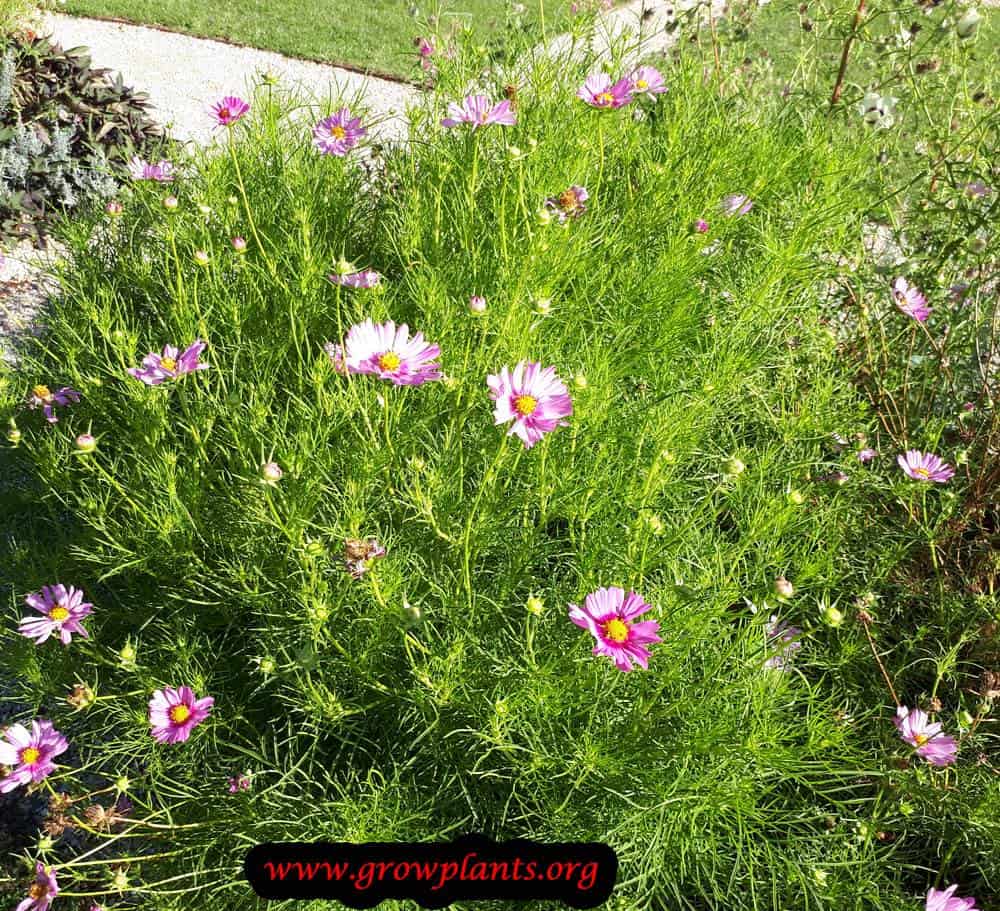
Overview: Cosmos bipinnatus (Garden cosmos / Mexican aster) is a fast-growing herbaceous plant reaching 30-150 cm (12-60 in) tall, with feathery green foliage and daisy-shaped flowers. It is grown as an annual or tender perennial for ornamental display, as a cut flower and to attract pollinators, and is also drought tolerant.
Quick Specifications
| Specification | Attribute |
|---|---|
| Plant Type / Life Cycle | Annual, or tender perennial in frost-free zones (10b+) |
| Foliage Type | Herbaceous; evergreen only where frost-free |
| Mature Size | 30-150 cm (12-60 in) tall |
| Growth Rate | Fast to moderate |
| Root System | Fibrous, shallow |
| Toxicity | Non-toxic to pets |
| Hardiness | USDA zone 10b+ as a perennial; grown as an annual from zone 4+ |
Growth Form & Structure
- Height & Spread: 30-150 cm (12-60 in) tall in the ground depending on cultivar; in a container use a 5-15 litre (1.5-4 gallon) pot with rich, free-draining potting mix
- Growth Habit & Form: Upright, airy herbaceous plant with slender branching stems
- Lifespan & Maturity: Fast to flower from seed, usually blooming the first season; short-lived, treated as an annual in most climates
Anatomy & Physical Features
- Leaves & Foliage: Green, finely divided (pinnate) needle-like foliage giving a feathery, fern-like texture
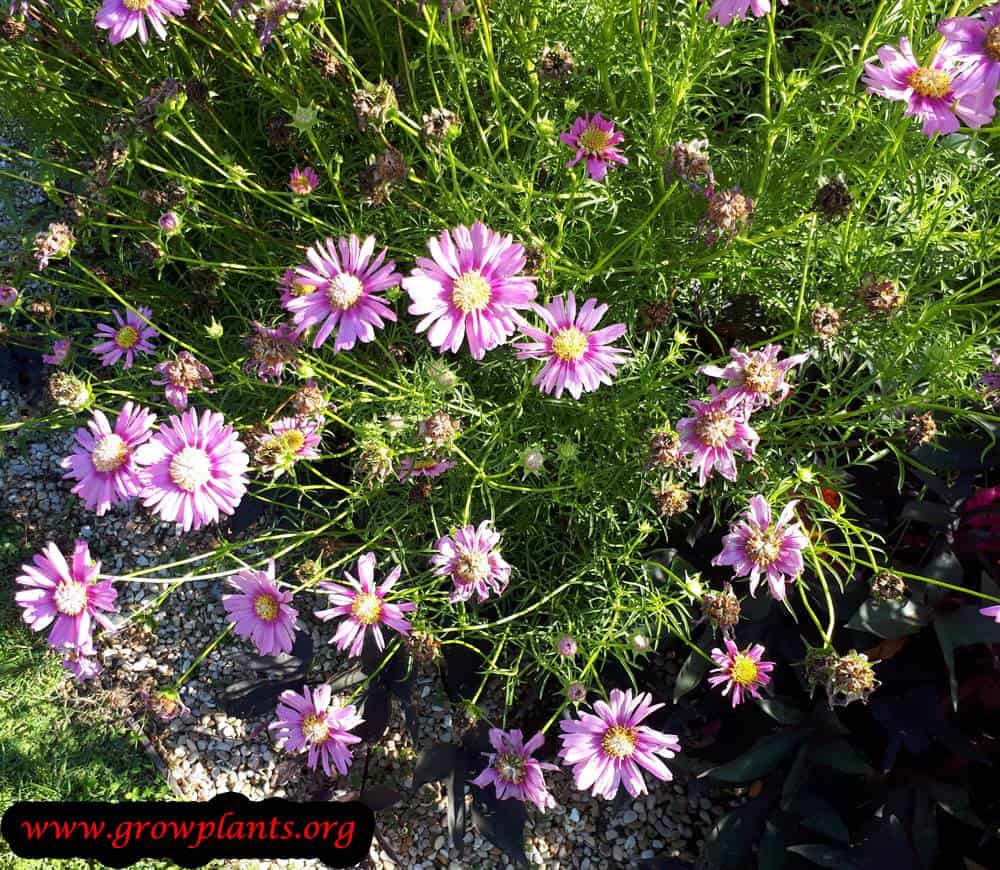
- Flower Characteristics: Daisy-shaped blooms in pink, yellow, orange, white, purple, bordeaux or bi-colours over a long season.
Primary Uses & Landscape Value
- Functional & Ornamental Roles: Ornamental bedding and border plant, excellent cut flower, and a strong pollinator attractant; also drought tolerant
Care Guide: Planting, Soil & Watering
Overview: Cosmos bipinnatus is a fast-growing, sun-loving plant — a warm-season annual in cold climates and a tender perennial in frost-free zones — that performs best in well-draining soil and full sun. It is drought tolerant once established and needs only low to moderate water, making it an easy, free-flowering choice for warm beds.
Quick Care Requirements
| Requirement | Ideal Condition |
|---|---|
| Planting Season | Spring, after the last frost (spring–summer in frost-free zones) |
| Growth Rate | Moderate to Fast |
| Soil Type | Well-draining; tolerates lean soil, benefits from some organic matter |
| Water Need | Low to Moderate — let the top of the soil dry between waterings |
Planting & Establishment
- Best Planting Season: Plant out in spring once the danger of frost has passed and the soil has warmed; in frost-free zones (about 10b and warmer) it can be planted from spring through summer, while in colder zones it is grown as a warm-season annual.
- How to Plant:
- Hole Preparation: Dig a hole a little wider than the root ball and to the same depth, loosening the surrounding soil so young roots spread easily.
- Soil Amendments: Work some compost or humus into the bed for structure and moisture, but avoid over-rich soil, which encourages leafy growth at the expense of flowers.
- Planting Depth: Set transplants at the same depth they grew in their pot, with the crown at soil level; do not bury the stem.
- Growth Speed & Expectations: Growth is fast to moderate — plants quickly reach 30-150cm (12-60 in) in a single warm season and begin blooming within a few months.
Soil, Watering & Drainage Care
- Soil Mix & Drainage Needs: Give it light, well-draining soil; a little mulch keeps roots cool and conserves moisture, while good drainage prevents root rot in wet spells. In containers use a free-draining potting mix.
- Watering Schedule & Technique:
- Young / Newly Planted: Keep the soil evenly moist while seedlings and transplants establish.
- Established: Water moderately, letting the top of the soil dry between waterings; established plants are quite drought tolerant.
- Seasonal Adjustments: Water more often during hot, dry spells and cut back in cool or rainy weather.
Climate, Light & Hardiness
Cosmos bipinnatus (garden cosmos) is a sun-loving, drought-tolerant flowering plant grown across an enormous climate range from desert and mediterranean to tropical and temperate zones. It is reliably perennial only where winters stay essentially frost-free (about USDA zone 10b and warmer), but as a fast, easy annual it is grown practically everywhere from about zone 4 upward.
Quick Climate Specifications
| Climate Zones | Mediterranean, desert, subtropical, temperate, or tropic |
|---|---|
| USDA Hardiness Zones | Approximately 10b and warmer as a perennial; commonly grown as an annual from about zone 4 upward |
| Frost Tolerance | Very low |
| Light Conditions | Full sun to half shade |
Sunlight & Light Exposure
Optimal Light Setup
Full sun brings the strongest, most floriferous growth; half shade is tolerated but flowering will be lighter.
Direct Sun Requirement
Grows and blooms best in a fully sunny site.
Temperature Extremes & Hardiness
USDA Hardiness & Regional Limits
The site data explicitly notes the plant needs frost-free conditions; it survives as a true perennial only from about USDA zone 10b upward, and is grown virtually everywhere else, down to about zone 4, as a warm-season annual sown after the last frost.
Cold Damage & Winter Protection
Frost kills the plant outright; there is no meaningful cold protection strategy beyond growing it as an annual outside its frost-free perennial range.
Frost Sensitivity
Very frost-sensitive – this is the defining limit on its cultivation as a perennial.
Frost-Free Growing Season
As an annual, needs a full frost-free growing season from spring planting through autumn bloom.
Growing in Pots, Balconies & Indoors
Cosmos are sun-loving annuals (grown as short-lived perennials in frost-free climates), not houseplants – indoors the light is far too weak for them to flower. In a free-draining pot, though, they are superb on a bright balcony or patio.
Quick Details
- Container Size: 5-15 L (1.5-4 gal), depending on the cultivar
- Indoor Suitability: Not a houseplant – needs strong, direct sun to bloom
- Best Spot: Full sun; a half-shaded balcony gives fewer flowers
- Soil & Drainage: Well-ventilated, organic-rich mix that drains freely
- Watering in Pots: Keep lightly moist; let excess drain away and avoid a water-filled saucer
Indoors & On the Windowsill
- Houseplant limits: Cosmos will not thrive as a houseplant – without full sun the stems stretch and flowering fails.
- Windowsill option: Only the sunniest, brightest sill has any chance, and even then blooms will be sparse – these plants really want the open sky.
On a Balcony or Patio
- Light & wind: Give the sunniest spot you have. Tall cultivars flop and snap in wind, so stake them and shelter exposed corners; walls and paving reflect heat, so check pots for moisture daily in warm weather.
Choosing the Pot, Soil & Long-Term Care
- Pot & drainage: A 5-15 L pot (by cultivar) with strong drainage holes; the grower advises against a saucer under the pot so water drains right through.
- Potting mix: Well-ventilated and rich in organic matter – potting mix or peat/coir with perlite or vermiculite.
- Potted plants exhaust and leach nutrients faster than those in the ground, so feed more often – a balanced feed through the growing season.
- Grown on as a perennial (frost-free climates): switch the soil about every two years and prune part of the roots and top growth.
Fertilizing & Feeding
A drought-tolerant, pollinator-friendly daisy-flowered garden plant grown for cut flowers; it blooms most freely on lean-to-moderate fertility, with heavy feeding tending to produce foliage instead of flowers.
Quick Fertilizing Specs
| Feeding Level | light |
|---|---|
| Main Nutrient Priority | A light, balanced fertilizer supports steady bloom; avoid heavy nitrogen feeding, which favors leafy, floppy growth over flowers |
| Best Feeding Period | Early in the growing season while plants establish, tapering off once flowering is underway |
| Organic Options | Working humus or organic matter into the soil at planting supports steady growth without overfeeding |
| Soil pH | Adaptable to a wide range of well-drained soils without special pH adjustment |
| Reduce/Stop Feeding | Reduce feeding once flowering begins, since lean conditions tend to produce the best, sturdiest bloom display |
Feeding by Growth Stage
Spring Growth
Support young plants as they establish and build the framework for the season’s flowers
| Nutrient direction | A light, balanced fertilizer to support steady establishment without excess vigor |
|---|---|
| Timing | Early in the growing season as plants are set out or germinate and begin active growth |
| Frequency | A single light feeding at or shortly after planting is usually enough |
| Fertilizer types | A light, balanced fertilizer, Humus or organic matter worked into the soil at planting |
| Precautions | Avoid rich, heavily fertilized soil, which tends to produce tall, floppy stems that need staking and fewer flowers |
Bloom
Sustain the long daisy-flowered bloom display, valued for cutting and for pollinators
| Nutrient direction | Feeding is rarely necessary once flowering is well underway; a high-phosphorus product is not needed to drive bloom |
|---|---|
| Timing | Through the main flowering period |
| Frequency | Light feeding is usually enough if growth looks weak; established plantings often need none at all during bloom |
| Fertilizer types | A light, balanced fertilizer only if flowering or vigor is notably weak |
| Precautions | Extra feeding during bloom tends to push foliage rather than more flowers, so keep any feeding minimal |
Dormancy or Season End
Let perennial plantings rest through their dormant period, or let annual plantings complete their cycle
| Nutrient direction | None – withhold fertilizer as growth stops for the season |
|---|---|
| Timing | Cooler months for perennial plantings, or the end of the growing cycle for annual plantings |
| Frequency | No feeding at this stage |
| Fertilizer types | No feeding at this stage – resume with spring growth for perennial plantings |
| Precautions | Do not fertilize once growth has stopped; wait for clear new growth before feeding perennial plantings again |
Nutrient Deficiency Signs & Corrections
Pale, yellowish-green foliage and stunted growth, most noticeable on older leaves
| Possible causes | Nitrogen deficiency in very poor or heavily leached soil, Waterlogged soil limiting root uptake, Root competition from densely planted neighbors |
|---|---|
| Appears first on | Older, lower leaves first |
| What to check | Soil fertility and organic matter content, Drainage in the planting bed, Plant spacing and competition |
| Possible correction | A light, balanced feeding is usually enough to restore normal color and growth |
Lush, dark green foliage with tall, floppy stems and few or no flowers
| Possible causes | Excess nitrogen from overly rich soil or heavy feeding, Too much shade reducing flower formation, Overcrowding limiting light to individual plants |
|---|---|
| Appears first on | Whole-plant pattern rather than a specific leaf symptom |
| What to check | Recent feeding history and soil richness, Light exposure, Plant spacing |
| Possible correction | Cut back or stop feeding and improve light exposure; flowering usually improves once fertility is reduced |
New leaves yellowing between the veins while the veins remain green
| Possible causes | High soil pH limiting iron availability, Waterlogged or compacted soil restricting root function, General micronutrient shortage in poor soil |
|---|---|
| Appears first on | Newest leaves at the growing tips |
| What to check | Soil pH, Drainage around the roots, Whether yellowing is interveinal on new growth |
| Possible correction | Correct soil pH toward a more favorable range and apply a chelated iron product per its label if chlorosis persists |
Pruning, Training & Seasonal Maintenance
Cosmos bipinnatus is the tall, species-type garden cosmos (to about 150cm), grown almost always as an annual and only persisting as a perennial in hardiness zone 10b+. Its height and open, airy growth habit make it prone to flopping in rich soil or part shade, so pruning here has two real jobs beyond general tidiness: pinching young plants to build a stronger, more self-supporting branch structure, and staking taller stems before they lean, alongside the deadheading that keeps this very free-flowering species blooming for months.
Quick Pruning & Maintenance Specs
| Pruning Tolerance | Moderate to High |
| Primary Pruning Window | Pinch young plants in spring before bloom; deadhead continuously through spring-autumn |
| Typical Frequency | Frequent deadheading; one early-season pinch; annual cutback only where perennial |
| Main Objective | Build a stockier, less floppy plant; prolong bloom via deadheading; limit self-seeding (flagged invasive) |
| Young Plant Priority | Pinch above a leaf node once several true leaves are present, before flower buds form |
| Mature Plant Priority | Deadhead regularly; stake tall stems in exposed or part-shade sites |
| Best Tool Type | Fingers/precision snips, plus stakes for tall stems |
Pruning by Plant Age & Size
Newly Established
Let the seedling put on some growth before intervening; avoid pinching before it has a few sets of true leaves.
Young / Formative
Pinch the growing tip just above a leaf node before flowering starts – propagation notes for this species specifically favour taking cuttings from stems with active growth buds, underscoring how readily this species branches from a pinch. This produces several flowering side stems instead of one tall, top-heavy stem, and reduces (though does not eliminate) the need for staking.
Mature / Established
Deadhead spent flowers continuously; stake or loosely tie taller stems, especially in part shade or richer soil where growth is lankier; where grown as a perennial in zone 10b+, cut back once a year.
Structural Pruning & Training
Because full-height species-type plants can reach 150cm and are notably airy/thin-stemmed, staking or light plant support (twiggy brush, a single stake with ties, or grow-through grid) placed early is more relevant here than for shorter, compact cultivars – retrofitting support after a plant has already flopped rarely restores a good shape.
Special Growth to Remove
- Spent flowerheads, removed regularly – the main driver of continued bloom in this species.
- Where grown as a perennial in mild climates, dead top growth at the annual cutback.
Container & Small-Space Pruning
In a container (5-15L depending on cultivar), pinch young plants more assertively than an in-ground planting to keep the tall species-type habit in proportion to the pot, and expect to renew soil and trim roots/top growth together roughly every two years for the perennial form.
Tools
Fingers or precision snips for pinching and deadheading; bypass secateurs for the thicker base of an established perennial’s annual cutback; stakes and soft ties for supporting tall stems. No loppers, saw or hedge shears are needed.
Tool Hygiene & Disease Risk
Routine; clean tools are enough given the pests noted (slugs, aphids, mealybugs) do not carry a notable tool-transmissible disease.
Cut Placement & Technique
Deadhead down to the next leaf node or side bud rather than mid-stem, to push a new flowering side shoot; when staking, tie loosely below a node to avoid girdling the stem as it thickens.
Post-Pruning Care
No extra feeding after deadheading or pinching; over-rich soil or feeding actually worsens this species’ tendency to flop, so keep growing conditions on the lean side rather than compensating with more pruning.
Common Pruning Mistakes
- Skipping the early pinch and then having to stake a already-leaning, single-stemmed plant later.
- Growing in rich, fertile soil or too much shade, which increases legginess that pruning alone cannot fully correct.
- Letting flowers go to seed, shortening bloom and adding to this species’ self-seeding tendency.
When NOT to Prune
Avoid pinching once a plant has already set flower buds for the season’s main flush – that removes the display rather than improving it; save hard cutbacks for the perennial form’s dormant reset in zone 10b+.
Recommended Tools (by task)
- precision_snips – pinching young growth and ongoing deadheading, the two core routine tasks.
- soft_ties_stakes – supporting the tall, thin stems typical of full-height species-type plants.
- bypass_secateurs – the annual cutback on established perennial plants (zone 10b+).
Propagation Guide
Cosmos bipinnatus is grown mainly from seed, which germinates quickly and reliably under warm conditions; stem cuttings work as an easy alternative, useful for preserving a specific named cultivar such as ‘Xxanthos’ or ‘Cupcakes’ whose seedlings can vary from the parent. Overall this is an easy plant to start from either seed or cuttings.
Quick Propagation Specs
| Best Propagation Method | Seed |
| Alternative Methods | Stem cuttings |
| Propagation Difficulty | Easy |
| Seed True-to-Type | Usually true-to-type for the species; named cultivars (e.g. Xxanthos, Cupcakes) may vary from seed |
| Vegetative True-to-Type | Yes |
| Best Propagation Season | Spring after the last frost through summer in hardiness zones 4–10a (better started indoors in late winter); spring to autumn in zones 10b–11a; all year in zone 11b+ |
| Seed Germination Time | 1–3 weeks |
| Cutting Rooting Time | Typically a couple of weeks under warm, humid conditions |
| Germination Temperature | 20–26°C (68–80°F), better around 25°C (77°F) |
| Seed Sowing Depth | 0.5–1cm (0.25–0.5 inch) |
Growing from Seed
Seed Handling & Viability
Store seed in a dry, dark place at room temperature until ready to sow.
Sowing Season
Sow in spring after the last frost through summer in hardiness zones 4–10a (indoor sowing in late winter gives a head start); spring to autumn in zones 10b–11a; all year in zone 11b+.
Sowing Depth & Orientation
Sow 0.5–1cm (0.25–0.5 inch) deep.
Germination Conditions
Keep soil moist in a full-sun spot at 20–26°C (68–80°F), ideally around 25°C (77°F), with average to generous watering.
Germination Time
Typically 1–3 weeks.
Seedling Care
Keep seedlings in full sun with moist soil, ideally above 20°C (68°F).
Stem Cuttings
Best Timing
Spring, before the plant begins to bloom.
Cutting Preparation
Cuttings root best when taken from stem sections that are actively producing buds/new growth — this is also the method to use to keep a specific named cultivar identical to its parent.
Rooting Time
Typically a couple of weeks under warm, humid conditions.
Bloom & Flower Guide
Quick Details
- Bloom Season: Spring through autumn (peaking in summer)
- Time to First Bloom: In its first summer, from a spring sowing
- Flower Appearance: Large, open daisy flowers in pink, yellow, orange, white, purple or bordeaux, often bicolored, around a golden center
- Edibility: Ornamental; attracts pollinators
Detailed Blooming Overview
Cosmos bipinnatus, the garden cosmos or Mexican aster, is the classic tall cosmos, prized for its large, open, daisy-shaped flowers on airy, finely cut foliage. From spring into autumn it produces a long succession of wide-faced blooms in pinks, whites, purples and bordeaux tones, all excellent for cutting and much loved by pollinators.
Flower Characteristics
- Large, open daisy heads with a golden central disc.
- Pink, yellow, orange, white, purple or bordeaux, sometimes bicolored.
- Held high on tall, airy stems.
Bloom Care & Thinning
- Managing the bloom: Deadhead often for continuous flowers and keep feeding light — rich soil favors foliage over flowers.
- Cut flower: First-rate for the vase; regular picking encourages more buds.
Bloom Health & Protection
- Aphids and thrips on buds: Watch soft buds for these — a water rinse or insecticidal soap / neem oil keeps them down.
- Powdery mildew and gray mold: Crowded, damp plantings can develop powdery mildew or gray mold (Botrytis) on flowers and foliage — good spacing and airflow, plus a sulfur-based fungicide if needed, help prevent it.
Fruit & Uses
Garden cosmos (Cosmos bipinnatus) is grown here as an ornamental cut flower, but like several other daisy-family flowers its petals are used as an edible garnish. This is a decorative, small-quantity culinary use rather than a food crop, and it is not part of the site’s own data for this plant.
Quick Edible Specs
| Edible Parts | Flower petals only |
|---|---|
| Main Use(s) | Decorative culinary garnish (salads, desserts, drinks) – not a food source |
| Eaten Raw or Cooked | Raw only, as a garnish |
| Preparation Required | Pull petals from the flower head, rinse, and discard the bitter green base/calyx |
| Harvest Season | Whenever flowers are open (see Blooming season) |
| Time to First Harvest | Once the plant is in bloom |
| Storage | Use the same day – petals wilt quickly once picked |
| Safety/Toxicity Caveat | Petals only, in small garnish amounts; Cosmos is in the daisy/Asteraceae family, so anyone with ragweed, daisy or other Asteraceae allergies should avoid eating it; leaves and stems are not a documented food part |
Flowers & Flower Buds
The pink, yellow, orange, white, purple or bordeaux petals (see the site’s own cultivar descriptions, including the yellow-flowered Xxanthos and the bowl-shaped white-to-pink Cupcakes) are the part used. Fresh, newly opened petals are pulled from the flower head and separated from the bitter green base before serving; the flavor is mild and faintly bitter, so the main value is color rather than taste.
Preparation, Uses & Safety
Use only fresh petals, raw, in small decorative amounts scattered over salads, desserts or drinks. This is a cosmetic garnish use, not a food source, and it should be avoided by anyone sensitive to ragweed, daisies or other Asteraceae-family plants. This edible use is not part of the site’s own data for the plant and is included here as a well-known, low-risk use of the flowers the site already describes.
Pests, Diseases & Troubleshooting
Overview: Cosmos are fast, easy annuals that generally shrug off pests, but they are prone to a few sap-suckers in warm weather and to powdery mildew and rots where air is stagnant or soil is rich and wet. The guiding principle is lean growing and good spacing: avoid over-feeding (which brings soft, floppy, flower-poor growth), give them sun and airflow, and intervene organically only when a problem actually establishes.
Quick Troubleshooting Overview
| Issue / Pest | Main Symptom | Primary Solution |
|---|---|---|
| Aphids | Curled, sticky new shoots with clusters of green/black insects | Blast off with water, encourage ladybirds, use insecticidal soap |
| Powdery mildew | White powdery coating on leaves in late season | Improve spacing/airflow; potassium bicarbonate or sulfur spray |
| Thrips | Silvery streaks and distorted petals; scarred buds | Sticky traps, remove damaged buds, insecticidal soap |
| Aster yellows | Green, deformed, witches’-broom flowers; yellowed foliage | No cure – remove and destroy plants; control leafhoppers |
| Botrytis / stem rot | Grey fuzzy mould or blackened rotting stem bases | Improve airflow, remove affected tissue, avoid wet crowns |
| Slugs & snails | Seedlings and soft growth shredded overnight | Traps, barriers, hand-pick at night, iron-phosphate pellets |
Common Pests & Management
- Aphids (Aphis & Myzus spp.):
- Symptoms: Dense colonies of green, grey or black soft-bodied insects on new shoots, flower buds and leaf undersides; growth curls and yellows, sticky honeydew attracts ants and sooty mould, and they can spread aster yellows and viruses.
- Prevention & Control: Encourage natural enemies (ladybirds, lacewings, hoverflies, parasitic wasps) and dislodge colonies with a firm jet of water. Pinch out badly infested tips. If needed, use insecticidal soap or neem on the undersides, and avoid over-feeding with nitrogen, which fuels soft aphid-prone growth.
- Thrips (Frankliniella spp.):
- Symptoms: Tiny slender insects that rasp petals and leaves, leaving silvery streaks, pale flecking and distorted, browning buds and flowers; they also vector tospoviruses.
- Prevention & Control: Use blue/yellow sticky traps to monitor, remove spent and damaged blooms, and keep plants unstressed. Insecticidal soap or spinosad helps in bad outbreaks; encourage predatory mites and minute pirate bugs.
- Spider mites (Tetranychus urticae):
- Symptoms: Fine pale stippling on leaves, a dull bronzed look and faint webbing in hot, dry spells; heavy infestations cause leaf drop.
- Prevention & Control: Raise humidity and hose the foliage, especially undersides; avoid drought stress. Introduce predatory mites, or apply horticultural oil / insecticidal soap. Avoid broad-spectrum insecticides that kill mite predators.
- Japanese beetle & flea beetles (Popillia japonica; Phyllotreta spp.):
- Symptoms: Japanese beetles skeletonise leaves and chew flowers in swarms; flea beetles pit young leaves with tiny shot-holes and jump when disturbed.
- Prevention & Control: Hand-pick beetles into soapy water in the cool morning and avoid lure traps that draw more in. Protect seedlings with fine mesh; encourage a diverse garden. Spot-treat heavy pressure with neem or a targeted botanical insecticide, sparing pollinators.
- Slugs & snails (Gastropoda):
- Symptoms: Ragged holes and stripped seedlings overnight, with slime trails; most damaging to young transplants and soft basal growth.
- Prevention & Control: Hand-pick after dark, set beer traps, and use grit, copper tape or crushed-shell barriers. Iron-phosphate pellets are the pet-safe pellet choice; encourage ground beetles and frogs.
Diseases & Fungal Issues
- Powdery mildew (Golovinomyces / Erysiphe cichoracearum):
- Symptoms: A white to grey powdery film on upper leaf surfaces and stems, usually late in the season or in crowded, humid, shaded conditions; leaves yellow and drop but plants rarely die.
- Treatment & Management: Space and thin plants for airflow, site in full sun, and avoid overhead watering late in the day. Remove affected leaves. Spray potassium bicarbonate, sulfur or a milk/biofungicide at first signs; grow in less crowded blocks next season.
- Aster yellows (Aster yellows phytoplasma):
- Symptoms: Bizarre distorted flowers that stay green and leafy (phyllody/witches’-broom), yellowed foliage and stunting; the disease is systemic and incurable, spread by leafhoppers.
- Treatment & Management: There is no treatment – promptly dig and destroy affected plants so they can’t seed the infection. Control leafhoppers, remove nearby weedy hosts, and float row cover over vulnerable plantings.
- Botrytis grey mould (Botrytis cinerea):
- Symptoms: Fuzzy grey mould on faded flowers, buds and damp foliage in cool, wet, crowded conditions, with browning and collapse of soft tissue.
- Treatment & Management: Deadhead spent blooms, improve spacing and airflow, and clear debris. Avoid overhead watering; remove infected parts promptly. A biofungicide or targeted fungicide helps only under persistent wet pressure.
- Stem rot / wilt (Sclerotinia & Fusarium spp.; also damping-off (Pythium/Rhizoctonia)):
- Symptoms: Sudden wilting with a rotted, sometimes water-soaked or cottony stem base; seedlings keel over at the soil line (damping-off).
- Treatment & Management: Grow in well-drained soil, don’t overwater, and rotate planting sites. Sow into clean, airy, not-too-wet media and don’t sow too densely. Remove and destroy collapsed plants; drenches rarely rescue an established rot.
Growing Difficulties & Abiotic Problems
- Floppy, leggy, flower-poor growth:
- Cause & Symptoms: Rich soil and nitrogen feeding, or too much shade, produce tall soft foliage that flops and blooms poorly.
- Correction Strategy: Grow lean – no supplemental feeding – in full sun; pinch young plants to bush out, and stake tall varieties. Poor soil genuinely gives better flowering in cosmos.
- Poor flowering:
- Cause & Symptoms: Too much shade, excess nitrogen, or over-watering pushes leaves at the expense of blooms; late sowing also delays flowering.
- Correction Strategy: Site in full sun, withhold feed, and deadhead regularly to prolong bloom. Choose day-length-neutral cultivars for reliable earlier flowering.
- Root rot from wet soil:
- Cause & Symptoms: Heavy, waterlogged soil rots the roots and collapses plants, especially in containers left standing wet.
- Correction Strategy: Improve drainage, water only as needed, and never let pots sit in water. Establish plants can tolerate dry spells better than sodden soil.
What Helps – Products & Tools
Keep the response gentle and organic-first: a strong water jet and insecticidal soap or neem for aphids, thrips and mites; blue/yellow sticky traps for monitoring; hand-picking and iron-phosphate pellets for beetles and slugs; and potassium bicarbonate or sulfur for powdery mildew, alongside good spacing. There is no spray for aster yellows – removal is the only remedy.
Varieties & Cultivars
- Cosmos bipinnatus Xxanthos: Yellow flower. Can grow up to 60cm (24 inches) height. — Learn more about Cosmos bipinnatus Xxanthos
- Cosmos bipinnatus cupcakes: Bowl-shaped flower in white, shades of pink color. Can grow up to 90cm (35 inches) height. — Shop Cosmos bipinnatus cupcakes on Amazon