

Plant Profile & Key Characteristics
Overview: A vigorous twining legume vine climbing 2-6 m, grown for its fragrant flowers coiled in a distinctive snail spiral. It is a perennial in frost-free climates and grown as an annual where cold.
Quick Specifications
| Specification | Attribute |
|---|---|
| Plant Type / Life Cycle | Perennial vine (grown as annual in cold climates) |
| Foliage Type | Evergreen in frost-free climates; grown as an annual where cold |
| Mature Size | 2-6 m (6-20 ft) climbing |
| Growth Rate | Fast to moderate |
| Root System | Nitrogen-fixing (legume family) |
| Hardiness | USDA zone 10b+ as perennial; 6-10a grown as an annual |
Growth Form & Structure
- Height & Spread: Twines 2-6 m (6-20 ft) on a support; also container-growable
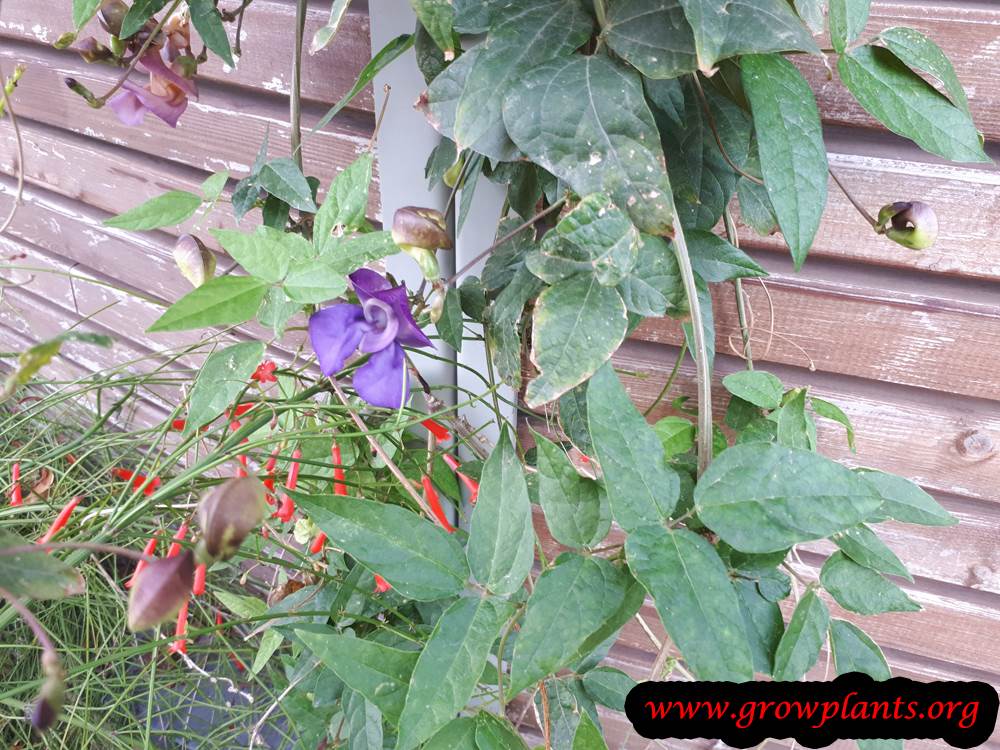
- Growth Habit & Form: Vigorous twining legume vine that needs a trellis
- Lifespan & Maturity: Fast-growing; flowers within the season
Anatomy & Physical Features
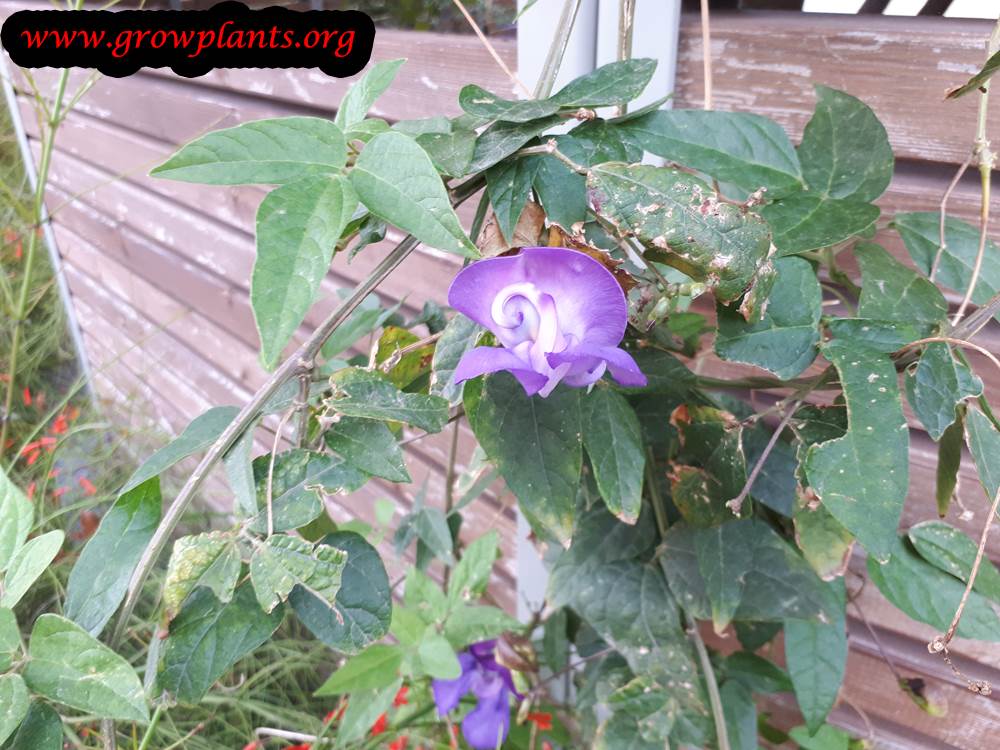
- Leaves & Foliage: Green trifoliate leaves of three deltoid leaflets, bean-like
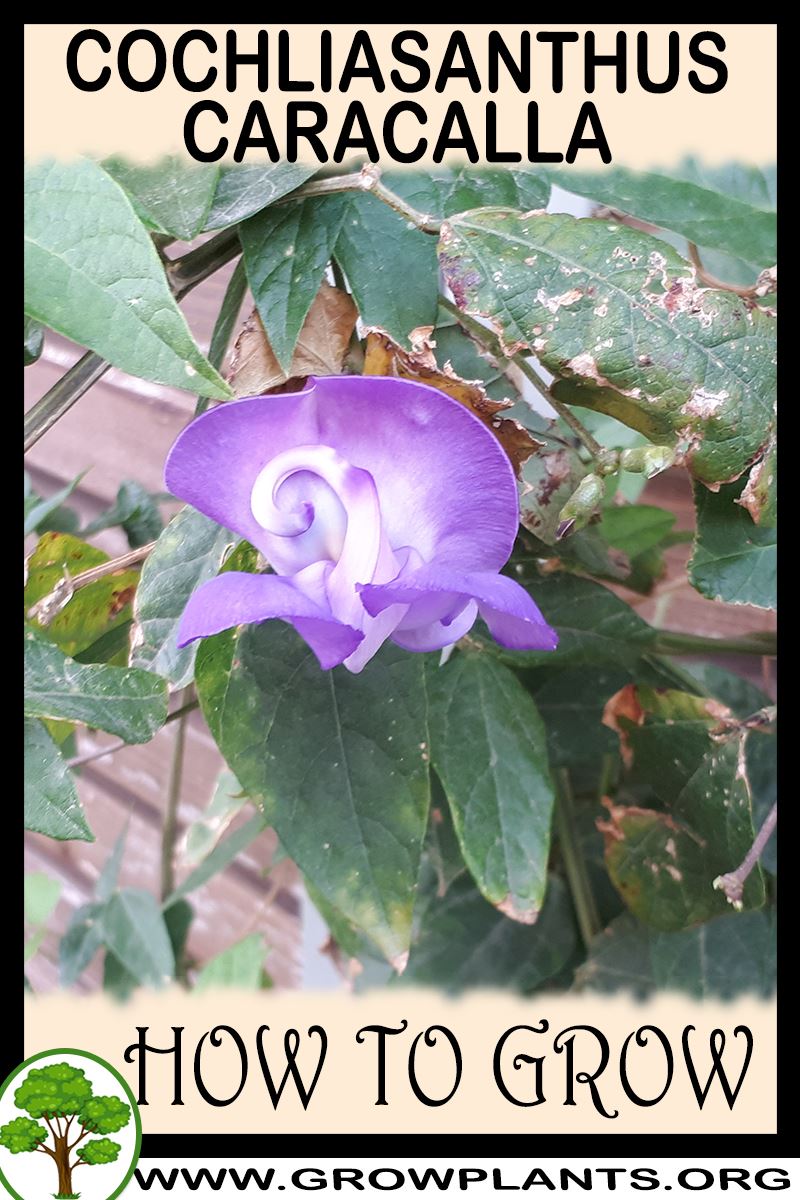
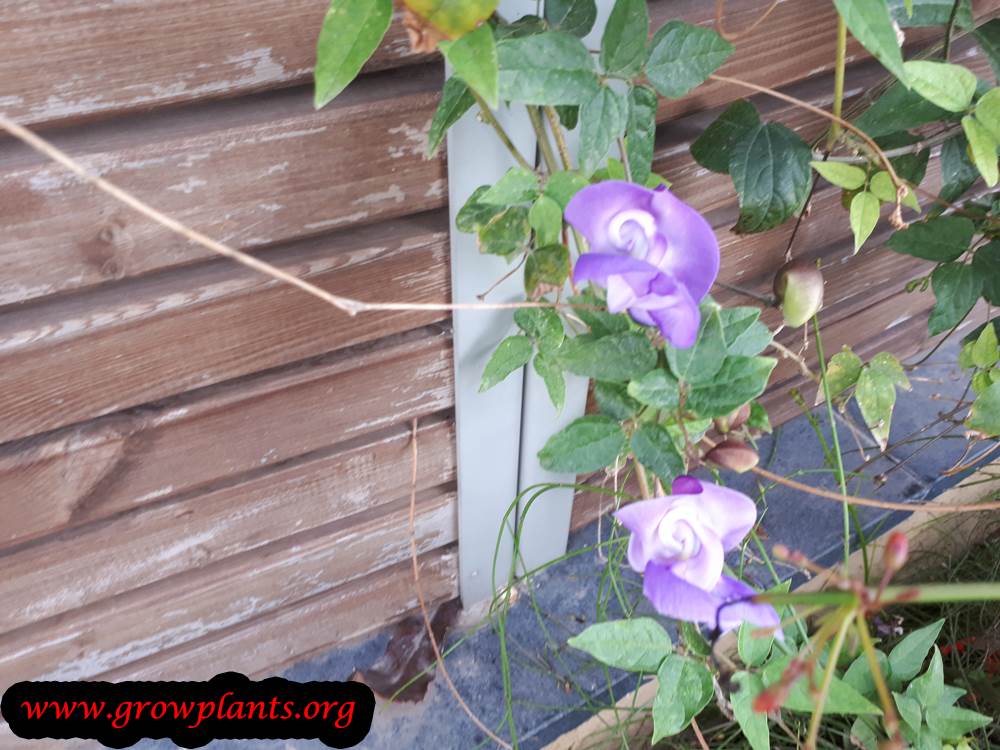
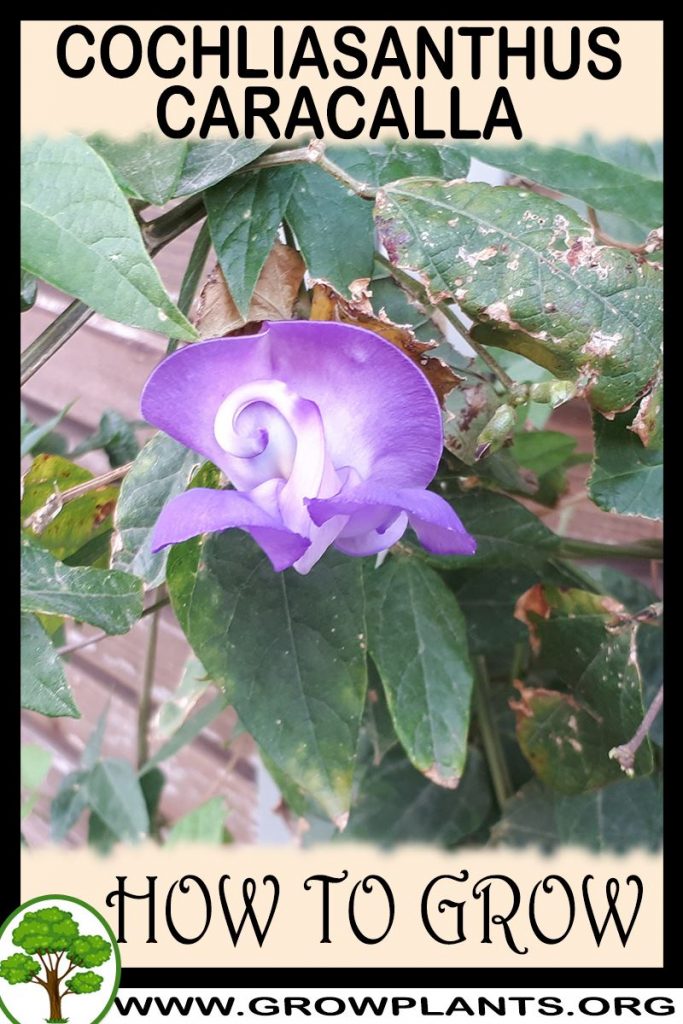
- Flower Characteristics: Fragrant flowers coiled in a distinctive snail / corkscrew spiral, in yellow, purple, white, pink or a blend
Primary Uses & Landscape Value
- Functional & Ornamental Roles: Fragrant ornamental climber for trellises, arbours, screens and hedges; nitrogen-fixing
Care Guide: Planting, Soil & Watering
Overview: Cochliasanthus caracalla (snail vine) is a vigorous, fast-growing climber — perennial in zone 10b+ and grown as an annual in zones 6–10a — that flowers in full sun. It likes rich, moisture-retentive soil and generous watering, with a sturdy trellis to climb.
Quick Care Requirements
| Requirement | Ideal Condition |
|---|---|
| Planting Season | Spring as an annual; spring–autumn as a perennial; year-round in the tropics |
| Growth Rate | Moderate to Fast |
| Soil Type | Rich, moisture-retentive |
| Water Need | Moderate to High – keep the soil moist |
Planting & Establishment
- Best Planting Season: Plant in spring where grown as an annual; spring through autumn as a perennial, and year-round in tropical climates.
- How to Plant:
- Hole Preparation: Dig a hole wider than the root ball and set a trellis or support in place at planting.
- Soil Amendments: Work in plenty of compost and organic matter for a rich, moisture-holding soil.
- Planting Depth: Set the root collar at soil level and firm gently.
- Growth Speed & Expectations: A fast climber reaching 2–6 m (6–20 ft) in a season; guide it onto its support as it grows.
Soil, Watering & Drainage Care
- Soil Mix & Drainage Needs: Rich soil that holds moisture suits it, but ensure excess water drains away; in pots use a moisture-retentive yet well-aerated mix.
- Watering Schedule & Technique:
- Young / Newly Planted: Keep newly planted vines consistently moist while they establish.
- Established: Water regularly and generously so the soil stays moist, especially during active growth and flowering.
- Seasonal Adjustments: More in summer heat; reduce in cool weather or winter dormancy.
Climate, Light & Hardiness
Cochliasanthus caracalla (snail vine) grows best in full sun across a broad range of warm-to-temperate climates, from mediterranean and desert to subtropical, temperate, and tropical. It is reliably perennial to about USDA zone 10b, and further into cooler zones, down to about 6–10a, it is grown as a warm-season annual.
Quick Climate Specifications
| Climate Zones | Mediterranean, desert, subtropical, temperate, or tropic |
|---|---|
| USDA Hardiness Zones | Approximately 10b and warmer as a perennial; commonly grown as an annual from about zone 6 upward |
| Frost Tolerance | Low |
| Light Conditions | Full sun |
Sunlight & Light Exposure
Optimal Light Setup
Needs full sun to flower well.
Direct Sun Requirement
Grows and blooms best in a fully sunny position.
Temperature Extremes & Hardiness
USDA Hardiness & Regional Limits
Grows as a true perennial only where winters stay largely frost-free (about USDA zone 10b and warmer); in colder regions, roughly zone 6 through 10a, it is grown as a fast-climbing annual vine each season.
Cold Damage & Winter Protection
Frost kills the top growth; where grown near its perennial limit, a heavy mulch over the root crown can help it survive a mild winter and resprout.
Frost Sensitivity
Frost-sensitive, which is what confines it to annual culture across most of its wider growing range.
Wind, Humidity & Microclimate
Humidity Preferences
Appreciates humidity and consistently moist, rich soil to support its vigorous vining growth.
Growing in Pots, Balconies & Indoors
Cochliasanthus caracalla, the snail vine, is a vigorous twining climber (2-6 m) grown for its curled, fragrant flowers. The grower does not rate it as a houseplant – it needs full sun – but it grows well in a large container with a sturdy trellis on a sunny balcony or patio.
Quick Details
- Container Size: A large pot with a strong trellis or arch – the vine climbs several metres
- Indoor Suitability: Not a houseplant – it needs full sun to grow and flower
- Best Spot: Full sun
- Soil & Drainage: Rich, free-draining potting mix
- Watering in Pots: Average to generous in growth, with free drainage
Indoors & On the Windowsill
- Not a houseplant: The grower marks it unsuitable indoors; this sun-loving climber will not perform in a room.
- Bright sun-room: Only a very sunny conservatory with room to climb comes close.
On a Balcony or Patio
- Sun & support: Give the sunniest spot and a robust trellis or arch; it is vigorous, so a big pot and regular watering keep it going. Shelter from strong wind and cut it back to control size.
Choosing the Pot, Soil & Long-Term Care
- Pot & drainage: A large, heavy-based pot with strong drainage holes, no standing saucer, and a firmly anchored trellis.
- Use a well-aerated, organic-rich mix – potting compost or peat/coir with perlite or vermiculite for free drainage.
- Potted plants exhaust and leach nutrients faster than those in the ground, so feed more often – a balanced feed through the growing season.
- Refresh the mix and pot on about every two years, lightly root-pruning and top-pruning to keep it vigorous.
Fertilizing & Feeding
A fast-climbing, full-sun vine that grows and blooms most freely with steady feeding through its active season; where it is grown as an annual, feeding stops naturally with the plant’s life cycle.
Quick Fertilizing Specs
| Feeding Level | moderate |
|---|---|
| Main Nutrient Priority | Balanced feeding with a nitrogen lean while the vine is putting on new growth and climbing, easing toward balanced as the spiral blooms open |
| Best Feeding Period | Warm active-growth months through the flowering display |
| Organic Options | Rich soil amended with compost or well-rotted organic matter at planting supports the vigorous growth this vine is known for |
| Soil pH | Grows best in rich, moisture-retentive soil and tolerates a fairly wide pH range |
| Reduce/Stop Feeding | Taper off as growth slows heading into cooler weather, or simply let feeding end with the season where grown as an annual |
Feeding by Growth Stage
Establishment
Help the young vine root in and begin climbing before pushing heavy top growth
| Nutrient direction | Light, balanced feeding that favors root establishment |
|---|---|
| Timing | Early in the growing season, right after planting or as new growth begins |
| Frequency | A light feeding or two through the establishment period is usually sufficient |
| Fertilizer types | Balanced, complete fertilizer at a gentle rate, Rich organic matter worked into the planting area |
| Precautions | Avoid heavy feeding right at planting, which can stress establishing roots |
Active Growth and Bloom
Fuel the vine’s fast climbing habit and support its fragrant, spiral-shaped flower clusters
| Nutrient direction | A nitrogen-forward complete fertilizer while the vine is climbing vigorously, shifting toward a balanced blend as flowering ramps up |
|---|---|
| Timing | Through the warm months of active growth and continuing across the bloom period |
| Frequency | Several light feedings spread across the active growing season support steady growth and bloom |
| Fertilizer types | Balanced or nitrogen-forward complete fertilizer, Periodic topdressing with compost or aged organic matter |
| Routine trace nutrients | iron, manganese |
| Precautions | Too much nitrogen relative to other nutrients can favor foliage over the spiral blooms this vine is grown for |
Cool-Season Pause
Respect the natural pause in growth where cooler temperatures slow or end the vine’s cycle
| Nutrient direction | None – withhold fertilizer while growth is inactive |
|---|---|
| Timing | Cooler months where the vine slows as a perennial, or the end of the growing cycle where grown as an annual |
| Frequency | No feeding at this stage |
| Fertilizer types | No feeding at this stage – resume with the return of active spring growth for perennial plantings |
| Precautions | Do not fertilize once growth has slowed or the plant has finished its cycle; wait for clear new growth before feeding again |
Nutrient Deficiency Signs & Corrections
Pale green foliage and slower vine extension, most noticeable on older leaves
| Possible causes | Nitrogen deficiency from light or infrequent feeding, Waterlogged soil limiting root uptake, Root crowding if grown in a container |
|---|---|
| Appears first on | Older, lower leaves first |
| What to check | Recent feeding history, Soil drainage around the roots, Container size relative to root mass |
| Possible correction | Resume regular balanced feeding during active growth and correct any drainage or crowding issue |
New leaves yellow between the veins while the veins stay green
| Possible causes | Iron unavailability in alkaline or waterlogged soil, High soil pH limiting micronutrient uptake, Root stress from overwatering |
|---|---|
| Appears first on | Newest leaves at the growing tips |
| What to check | Soil pH and drainage, Whether yellowing is confined to new growth, Recent watering pattern |
| Possible correction | Correct pH toward a more favorable range and apply a chelated iron product per its label if chlorosis persists |
Scorched or browning margins on older leaves along with fewer or shorter-lived blooms
| Possible causes | Potassium deficiency from an unbalanced feeding routine, Drought stress limiting nutrient movement, Salt buildup interfering with uptake in container culture |
|---|---|
| Appears first on | Margins of older leaves |
| What to check | Balance of the fertilizer used, Watering consistency through the bloom period, Salt crust on the soil surface in containers |
| Possible correction | Switch to a balanced fertilizer supplying adequate potassium and keep watering consistent through bloom |
Pruning, Training & Seasonal Maintenance
Cochliasanthus caracalla (snail vine, corkscrew vine) is a vigorous twining vine, grown as a perennial in hardiness zone 10b+ or as a root-hardy/annual climber further north. It tolerates pruning well and needs regular attention mainly to guide its twining stems onto a support and to keep growth from becoming a tangled mat. Because it flowers on new growth through a long season, cutting back does not sacrifice bloom – it simply resets the plant to produce fresh flowering shoots.
Quick Pruning & Maintenance Specs
| Pruning Tolerance | High |
| Primary Pruning Window | Late winter/early spring, before the new twining flush, in perennial locations |
| Secondary Maintenance Window | Ongoing through the growing season to redirect or thin stems |
| Typical Frequency | Continuous light training plus one seasonal cutback |
| Main Objective | Train onto support, control spread/density, encourage continued flowering |
| Young Plant Priority | Get stems twining onto the support early; pinch to branch low |
| Mature Plant Priority | Thin congested stems for airflow; cut back hard where root-hardy |
| Best Tool Type | Bypass secateurs, with soft ties for training |
| Avoid Heavy Pruning During | While stems are actively grasping a new support, and in cold-marginal zones, before the vine has died back naturally for winter |
Pruning by Plant Age & Size
Newly Established
Remove only damaged growth; otherwise leave the young vine to put its energy into reaching and twining around its support.
Young / Formative
This is a true twiner (it wraps its own stems around a narrow support rather than climbing with tendrils or adhesive pads), so provide wires, strings or a narrow trellis from the start and guide the leading shoots onto it by hand. Pinch a young plant’s growing tips once to encourage low branching and a fuller base rather than a single bare runner.
Mature / Established
In warm zones the base can become semi-woody with age; thin overcrowded twining stems each year for airflow, and redirect or remove growth straying off the intended support.
Structural Pruning & Training
Because it twines rather than clings, ongoing hand-training is part of routine maintenance, not a one-off job – wayward shoots must be wound back onto the support or cut out. Thin dense mats of stems where the vine has covered its support solidly; crowded, humid foliage in this legume vine is a real risk factor for powdery mildew, so opening up the canopy is a genuine disease-prevention measure, not just tidiness.
Special Growth to Remove
- Wayward twining shoots growing away from the support onto nearby plants, fences or gutters.
- Spent flower racemes, mainly for tidiness rather than necessity.
- In cold-marginal zones (6-10a), frost-damaged top growth in spring once new growth confirms which stems survived.
Container & Small-Space Pruning
In a container this vigorous climber needs a sturdy support built in from planting and more frequent pinching/tip removal than an in-ground plant, since its natural size (2-6m) will quickly outgrow a small support if left unchecked.
Tools
- Bypass secateurs for routine stem cuts and thinning.
- Precision snips for pinching tips on young growth.
- Soft ties or plant twine for guiding new leaders onto the support.
No saw is needed – stems stay thin even at a semi-woody base.
Tool Hygiene & Disease Risk
Routine hygiene is enough; aphids and slugs are the noted pests here rather than a serious tool-transmissible disease, so no special disinfection routine is warranted.
Cut Placement & Technique
Cut back to just above a leaf node or bud rather than mid-internode, since regrowth comes from nodal buds; when removing a whole stem, cut it back to its point of origin on the support or crown rather than leaving a long dead runner tangled in the support.
Heavy Pruning & Rejuvenation
Where grown as a root-hardy perennial, an old, tangled specimen can be cut back hard at the base in late winter and will resprout vigorously from the semi-woody crown; where grown as an annual in cooler zones, the whole top simply dies at frost and is cleared away, with new growth starting fresh from seed or root the following year.
Post-Pruning Care
Water normally after cutting back; because regrowth is vigorous on its own, avoid extra feeding beyond the plant’s normal rich-soil requirement. Re-tie or redirect the flush of new twining shoots onto the support promptly, before it grabs onto neighbouring plants or structures instead.
Common Pruning Mistakes
- Treating it like a tendril or clinging climber and expecting it to self-attach – without hand-training onto the support it will simply sprawl or twine onto whatever is nearest.
- Letting stems mat solidly over the support without any thinning, inviting powdery mildew in humid conditions.
- Cutting back to ground in autumn in marginal zones instead of leaving top growth as some winter insulation for the crown.
When NOT to Prune
Avoid heavy cutting back in cold-marginal zones (6-10a) in autumn – let dieback happen naturally and prune in early spring instead, so the crown has some winter protection. Avoid disturbing a newly planted vine before it has properly grasped its support.
Recommended Tools (by task)
- bypass_secateurs – routine thinning and seasonal cutback of stems.
- precision_snips – pinching young tips to encourage branching.
- soft_ties_stakes – guiding and securing new twining growth onto the trellis or wires.
Propagation Guide
Cochliasanthus caracalla (snail vine) is most easily started from seed, though scarifying the hard seed coat first speeds up otherwise slow, uneven germination; softwood or semi-hardwood cuttings also root without difficulty. Vegetative propagation is not required to keep the species true, and overall this vine is easy to propagate by either method.
Quick Propagation Specs
| Best Propagation Method | Seed |
| Alternative Methods | Stem cuttings |
| Propagation Difficulty | Easy |
| Seed True-to-Type | Usually true-to-type |
| Vegetative True-to-Type | Yes |
| Best Propagation Season | Spring into summer (warm season) |
| Germination Temperature | Warm, generally above 20°C (68°F), as is typical for tropical/subtropical legume vines |
Growing from Seed
Dormancy & Pre-Sowing Treatment
Like many members of the bean family, the seed has a hard outer coat; nicking (scarifying) or soaking the seed before sowing typically improves and speeds up germination.
Sowing Season
Sow in spring through summer while temperatures are reliably warm; in frost-free, tropical hardiness zones sowing can be done over a longer season.
Germination Conditions
Warm, consistently moist, well-draining soil in a sunny position suits germination best; expect timing to be somewhat irregular before and after scarification.
Stem Cuttings
Best Timing
Take cuttings during the warm growing season (spring to summer).
Rooting Setup
Root cuttings in a moist, humid, well-draining medium, similar to conditions used for other warm-climate vines.
Rooting Hormone
Optional — cuttings of this vine are not difficult to root, though hormone can help speed and even out results.
Bloom & Flower Guide
Quick Details
- Bloom Season: Spring, summer and autumn
- Flower Appearance: Curled, snail-shell-shaped flowers in yellow, purple, white or pink, often several colors at once
- Edibility: Not eaten – grown as a fragrant ornamental climber
Detailed Blooming Overview
Cochliasanthus caracalla (snail vine or corkscrew vine) is a twining climber grown for its curiously coiled, sweetly scented flowers. It blooms over a long season from spring into autumn in Mediterranean, desert, subtropical, temperate and tropical gardens – roughly zone 10b and warmer as a perennial, or from zone 6 as an annual. It is also known as corkscrew vine, snail creeper, snailflower and snail bean.
Flower Characteristics
- Spiraled, snail-shell-shaped flowers, typical of the pea family.
- Colors blend yellow, purple, white and pink, frequently on the same bloom.
- Strongly and sweetly fragrant – one of this vine’s main attractions.
Bloom Care & Thinning
- Training: Give it a trellis or arch to climb, where the fragrant flowers can be enjoyed at nose height.
- Position: Full sun and warmth bring on the most generous, longest-lasting bloom.
- Pollination: The scented flowers attract bees and other insects.
Pests, Diseases & Troubleshooting
Overview: The snail (corkscrew) vine – formerly Vigna caracalla – is a vigorous tropical legume that carries the standard bean-family pest profile: aphids and spider mites on soft growth and slug grazing on young shoots. It is generally easy and pest-tolerant, and good airflow with restrained watering prevents most fungal issues.
Quick Troubleshooting Overview
| Issue / Pest | Main Symptom | Primary Solution |
|---|---|---|
| Aphids | Sticky, curled shoot tips; ants | Water jet, insecticidal soap |
| Spider mites | Stippling and webbing in heat/drought | Hose foliage, raise humidity, oil |
| Slugs & snails | Young shoots grazed in spring | Hand-pick, barriers, iron-phosphate bait |
| Whitefly | White flies under leaves; honeydew | Yellow sticky traps, insecticidal soap |
| Powdery mildew | White coating in humid, crowded growth | Airflow, sulfur/bicarbonate |
| Leaf spot | Brown spots and yellowing | Avoid overhead watering |
Common Pests & Management
- Cowpea aphid (Aphis craccivora):
- Symptoms: Dark clusters on shoot tips and buds with curling, honeydew and ants; can spread legume viruses.
- Prevention & Control: Hose off, insecticidal soap or neem oil on heavy colonies; conserve ladybirds and parasitic wasps.
- Two-spotted spider mite (Tetranychus urticae):
- Symptoms: Fine stippling, bronzing and webbing on undersides in hot, dry conditions.
- Prevention & Control: Raise humidity and hose foliage; horticultural or neem oil; avoid drought stress.
- Slugs & snails (Deroceras / Cornu spp.):
- Symptoms: Tender young shoots grazed in spring with slime trails.
- Prevention & Control: Hand-pick after dark, use grit/copper barriers, and scatter iron-phosphate bait around new growth.
- Whitefly (Bemisia / Trialeurodes):
- Symptoms: Tiny white flies and nymphs under leaves with honeydew and sooty mold; potential virus vector.
- Prevention & Control: Yellow sticky traps, insecticidal soap or oil in the evening; encourage parasitic wasps.
Diseases & Fungal Issues
- Powdery mildew (Erysiphe / Podosphaera):
- Symptoms: White powdery film on leaves in humid, crowded, still growth.
- Treatment & Management: Improve airflow and spacing, avoid overhead watering; sulfur or potassium-bicarbonate spray if needed.
- Leaf spot (Cercospora / Colletotrichum):
- Symptoms: Brown spots that enlarge and yellow the leaves in warm, wet weather.
- Treatment & Management: Water at the base, remove affected leaves, improve airflow; copper fungicide if persistent.
- Root rot / root-knot nematode (Pythium / Meloidogyne):
- Symptoms: Wilting and collapse from waterlogged soil, or stunting with galled roots in warm sandy soils.
- Treatment & Management: Improve drainage and rotate; add organic matter and use clean stock; solarize badly infested soil.
Growing Difficulties & Abiotic Problems
- Chlorosis:
- Cause & Symptoms: Yellowing from high pH or waterlogging locking up iron; as a legume it fixes its own nitrogen.
- Correction Strategy: Correct drainage and pH, use chelated iron if needed, and avoid heavy nitrogen feeding.
- Poor bloom:
- Cause & Symptoms: Too much shade or excess nitrogen gives lush vine but few of the fragrant corkscrew flowers.
- Correction Strategy: Grow in full sun on a warm support, keep nitrogen low, and provide plenty of heat.
- Root rot from waterlogging:
- Cause & Symptoms: Soggy soil rots roots, causing wilting.
- Correction Strategy: Plant in free-draining soil and water only when the surface dries.
What Helps – Products & Tools
Lead with cultural control – full sun, airflow and restrained watering. When needed, insecticidal soap or neem/horticultural oil handles aphids, mites and whitefly, iron-phosphate bait manages slugs, and a sulfur or copper fungicide addresses mildew and leaf spot.