Plant Profile & Key Characteristics
Overview: A fast-growing herbaceous plant reaching 0.3-2 m, topped with airy clusters of fragrant spidery flowers. It is usually grown as an annual (perennial only in frost-free climates) for bedding and cutting.
Quick Specifications
| Specification | Attribute |
|---|---|
| Plant Type / Life Cycle | Annual or short-lived perennial (herbaceous) |
| Foliage Type | Herbaceous — evergreen in frost-free climates, otherwise grown as an annual |
| Mature Size | 0.3-2 m (1-6 ft) |
| Growth Rate | Fast |
| Root System | Taproot |
| Hardiness | USDA zone 5+ |
Growth Form & Structure
- Height & Spread: 0.3-2 m (1-6 ft); can be grown in containers and may need light support
- Growth Habit & Form: Upright branching herbaceous plant topped with airy flower clusters
- Lifespan & Maturity: Fast-growing; flowers in its first season and is usually grown as an annual
Anatomy & Physical Features
- Leaves & Foliage: Green palmately compound leaves with elliptic leaflets joined at the base like a hand with about seven fingers
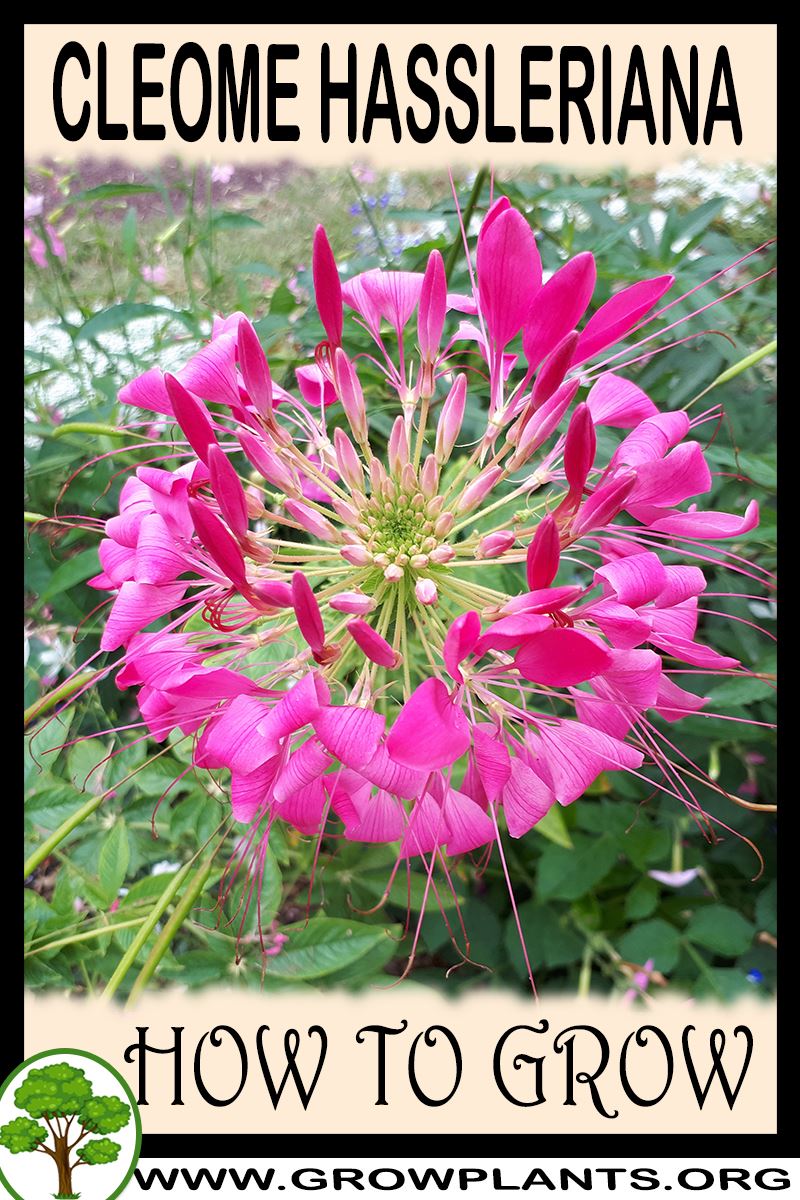
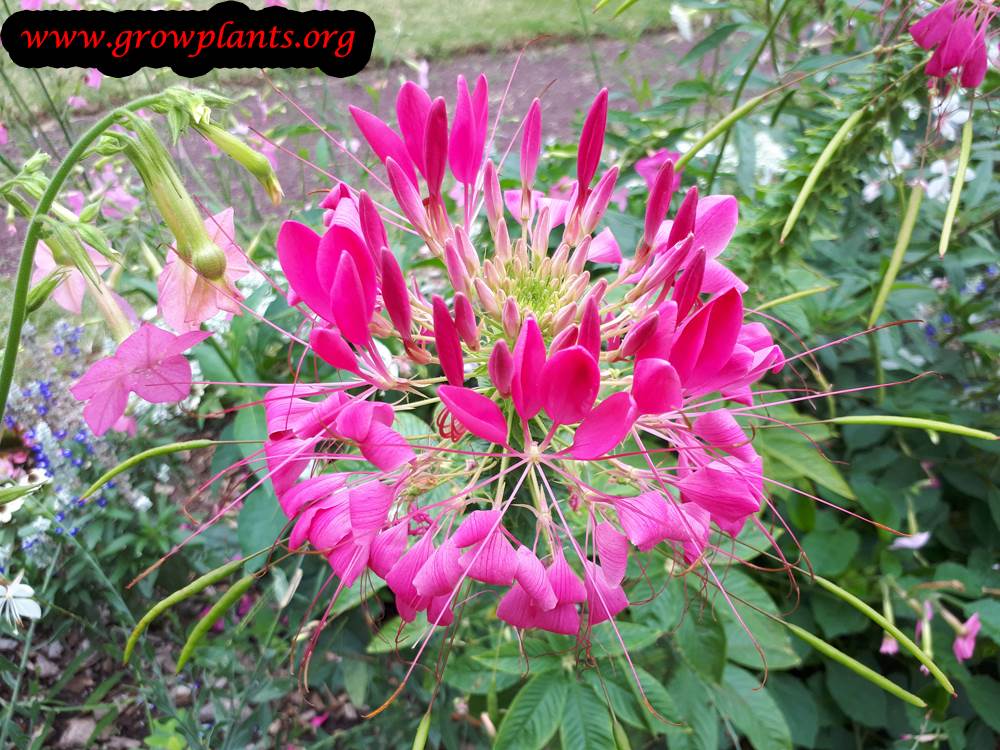
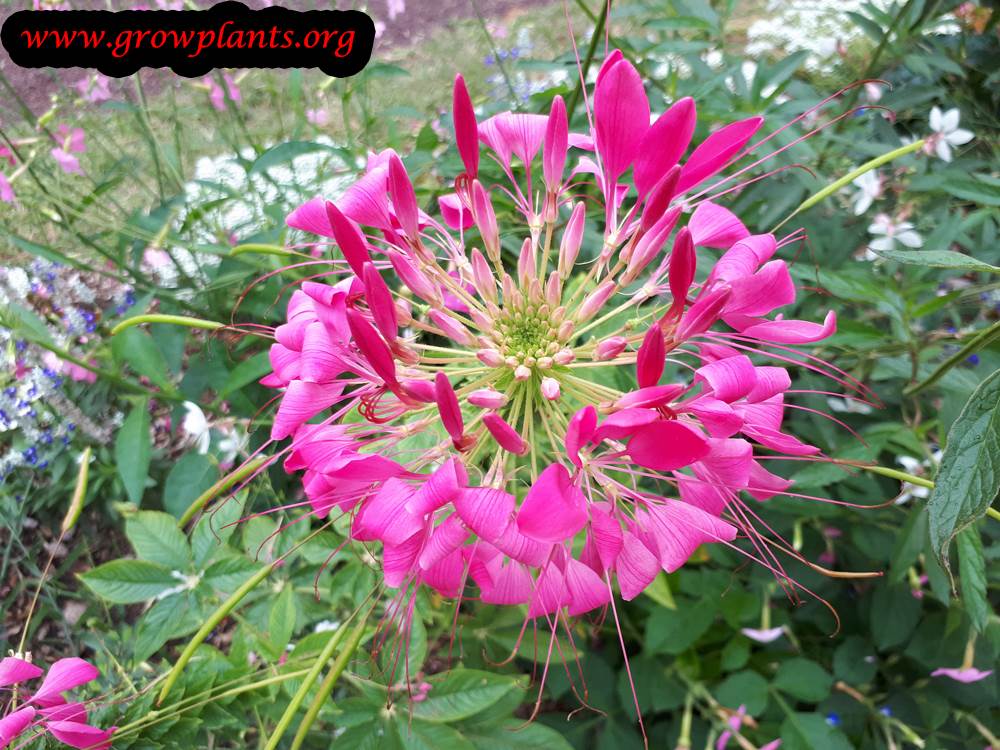
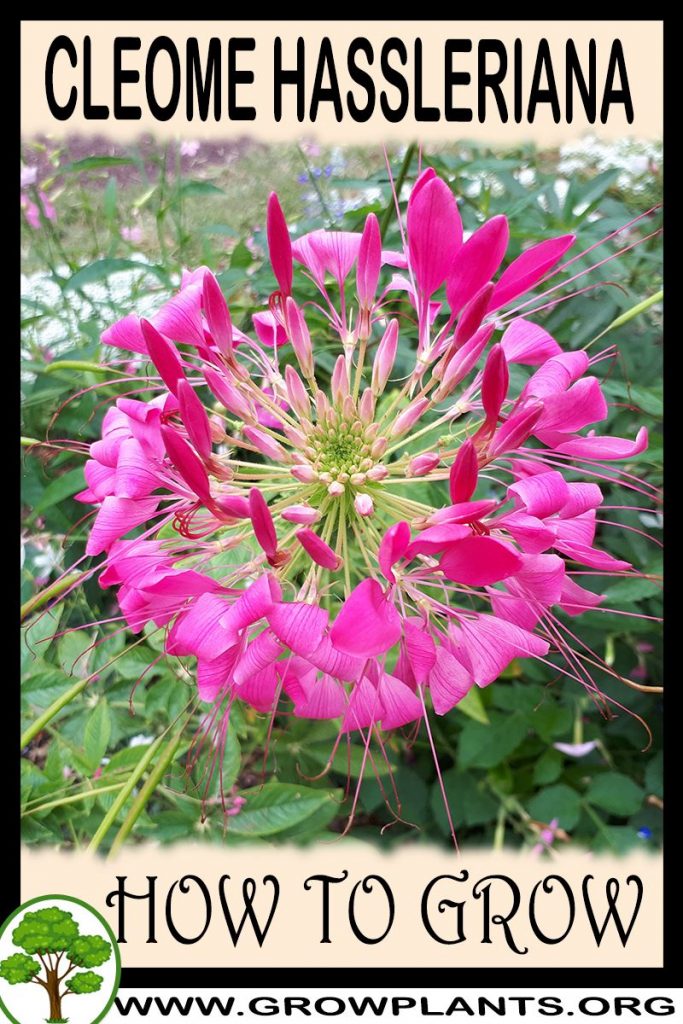
- Flower Characteristics: Fragrant spidery flowers in pink, white, purple or yellow, with long protruding stamens
Primary Uses & Landscape Value
- Functional & Ornamental Roles: Ornamental bedding and cut flower; fragrant and attracts pollinators (can self-seed freely)
Care Guide: Planting, Soil & Watering
Overview: Cleome hassleriana is a fast-growing warm-season annual (short-lived perennial in frost-free zones, hardy from about zone 5) that thrives in full sun to light shade. It performs best in average, well-draining garden soil and needs only moderate moisture, tolerating short dry spells once its deep roots establish.
Quick Care Requirements
| Requirement | Ideal Condition |
|---|---|
| Planting Season | In spring after the last frost (spring through autumn in warm zones) |
| Growth Rate | Fast |
| Soil Type | Average, well-draining garden soil; tolerates lean soil |
| Water Need | Moderate – let the top few cm dry between waterings |
Planting & Establishment
- Best Planting Season: Sow or transplant in spring once the soil has warmed and frost has passed; in frost-free areas it can also go in through summer and autumn.
- How to Plant:
- Hole Preparation: Dig a hole a little wider than the root ball so the loosened roots spread easily.
- Soil Amendments: Work a little compost into average soil; cleome is not fussy and over-rich ground encourages floppy growth.
- Planting Depth: Set the plant at the same depth it grew in its pot, keeping the root collar at soil level.
- Growth Speed & Expectations: A fast grower that reaches its 0.3–2 m (1–6 ft) height in a single warm season; tall plants may need a discreet support to lean on.
Soil, Watering & Drainage Care
- Soil Mix & Drainage Needs: Any free-draining soil suits it, and sharp drainage prevents root rot; in containers use a standard well-aerated potting mix.
- Watering Schedule & Technique:
- Young / Newly Planted: Keep newly sown or transplanted cleome evenly moist until it establishes over the first few weeks.
- Established: Water established plants deeply but infrequently, letting the top few cm dry out first — they are quite drought-tolerant.
- Seasonal Adjustments: Water more in peak summer heat and back off in cool, wet weather.
Climate, Light & Hardiness
Cleome hassleriana (Spider flower) suits Mediterranean, subtropical, temperate, and tropical climates, growing best in full sun to half shade. Cold winters limit it to annual culture, while frost-free climates allow it to persist as a short-lived perennial.
Quick Climate Specifications
| Climate Zones | Mediterranean, subtropics, temperate, tropics |
|---|---|
| USDA Hardiness Zones | 5+ |
| Light Conditions | Full sun to half shade |
Sunlight & Light Exposure
Optimal Light Setup
Full sun to half shade both work well; full sun gives the strongest flowering and fragrance.
Temperature Extremes & Hardiness
USDA Hardiness & Regional Limits
USDA zone 5+ reflects that it is commonly grown as an annual in colder climates and can behave as a short-lived perennial in frost-free zones. Cold is what limits year-round outdoor persistence, not an inability of the plant to grow beyond a single season where it stays frost-free.
Frost Sensitivity
Frost sensitive; top growth is killed by freezing weather.
Wind, Humidity & Microclimate
Microclimate Recommendations
An open, sunny bed suits it well; it often self-sows freely in mild climates.
Growing in Pots, Balconies & Indoors
Spider flower (Cleome) (Cleome hassleriana) is a sun-loving annual and, as the grower notes, not a houseplant – indoor light is far too weak for it. It grows well, though, in a container on a sunny balcony or patio.
Quick Details
- Container Size: A roomy pot suited to its size (about 0.3-2 m (1-6 ft))
- Indoor Suitability: Not a houseplant – grow it outdoors in good light
- Best Spot: Full sun to half shade
- Soil & Drainage: Well-aerated organic mix – peat or coir with perlite/vermiculite; strong drainage holes
- Watering in Pots: Keep evenly moist – pots dry faster than open ground; avoid waterlogging
Indoors & On the Windowsill
- Not a houseplant: The grower confirms it will not grow indoors – it needs more light than a room provides.
- Windowsill: Even a bright sill is generally too weak for a good display; grow it outside.
On a Balcony or Patio
- Light & wind: Give it the sunniest spot; on exposed balconies stake or shelter taller growth from wind.
- Watering: Walls and paving reflect heat, so the pot dries quickly – check moisture regularly and make sure it drains freely.
Choosing the Pot, Soil & Long-Term Care
- Pot & drainage: A pot with strong drainage holes to match its size; skip a standing-water saucer to avoid root rot.
- Potting mix: A well-aerated organic mix – peat or coir with perlite or vermiculite.
- Feeding: Feed potted plants more often than those in the ground, as watering leaches nutrients away.
- Life cycle: As an annual, replant each season rather than potting on.
Fertilizing & Feeding
A fast-growing warm-season plant grown for its fragrant, spidery flower clusters, this species is a moderate feeder through establishment and its long summer-to-autumn bloom, tapering off as the planting completes its cycle at season’s end.
Quick Fertilizing Specs
| Feeding Level | Moderate feeder |
|---|---|
| Main Nutrient Priority | Balanced feeding with adequate nitrogen to support fast growth and a long bloom period |
| Best Feeding Period | From planting in warm weather through the summer-to-autumn flowering display |
| Organic Options | Compost or well-rotted organic matter worked into the soil at planting |
| Reduce/Stop Feeding | Ease off feeding as the season winds down and flowering declines |
| Micronutrients | Usually met by a complete fertilizer and organic-matter soil; correct only a diagnosed problem |
| Soil pH | Grows well in ordinary garden soil without needing a particular pH |
Feeding by Growth Stage
Establishment in warm weather
Help young plants root in and begin their naturally fast growth once warm weather arrives.
| Nutrient direction | A balanced, complete fertilizer at planting supports strong establishment in warm soil. |
|---|---|
| Timing | At planting in spring or summer, once the weather has warmed. |
| Frequency | A starter feeding at planting is usually enough to launch this fast-growing plant. |
| Fertilizer types | A balanced, complete starter fertilizer, Compost or organic matter worked into the soil |
| Precautions | Wait until the weather is reliably warm before feeding; this plant is a warm-season grower that does not establish well in cold, wet soil. |
Summer-to-autumn bloom
Sustain the tall, fast-growing stems and their fragrant, spidery flower clusters through a long bloom season.
| Nutrient direction | Continued balanced feeding with adequate nitrogen supports both ongoing growth and the extended flower display. |
|---|---|
| Timing | Through summer and into autumn as flower clusters continue to open at the tops of the stems. |
| Frequency | Regular feeding through this long bloom period keeps the naturally fast-growing plant flowering well. |
| Fertilizer types | A balanced, complete fertilizer, Organic matter renewed as a top-dressing |
| Precautions | Do not switch to a high-phosphorus “bloom booster”; balanced feeding with adequate nitrogen supports this plant’s long flowering season better. |
Season’s end
Let the planting wind down naturally as its cycle ends, whether that means the plant’s natural death as an annual or a dormant rest where it survives as a perennial in warm climates.
| Nutrient direction | None – withhold fertilizer as the planting completes its growth cycle for the season. |
|---|---|
| Timing | As flowering declines toward the end of the growing season, into any dormant period in warmer climates. |
| Frequency | No feeding at this stage. |
| Fertilizer types | No feeding at this stage; the planting is winding down for the season rather than actively growing. |
| Precautions | Do not fertilize a planting that is no longer in active growth; it cannot make use of the nutrients at this point in its cycle. |
Nutrient Deficiency Signs & Corrections
Lower leaves fade to pale green or yellow and stem growth slows.
| Possible causes | low available soil nitrogen, nitrogen leaching from watering or rain, thin, low-organic-matter soil |
|---|---|
| Appears first on | older, lower leaves |
| What to check | recent feeding history, soil organic matter, watering and drainage |
| Possible correction | Apply a balanced, nitrogen-containing complete fertilizer and build soil organic matter. |
Plants grow tall and leafy but produce few flower clusters.
| Possible causes | too much shade for a plant that flowers best in fuller sun, overfeeding with a nitrogen-heavy fertilizer that favors leafy growth over flowers, crowded planting reducing light and airflow to individual plants |
|---|---|
| Appears first on | whole-planting effect rather than a single stem |
| What to check | light exposure, recent fertilizer type and amount, plant spacing |
| Possible correction | Improve light exposure, moderate feeding to a balanced fertilizer, and thin crowded plantings. |
Leaf margins brown or scorch and growth stalls despite adequate watering.
| Possible causes | fertilizer salt buildup in the root zone, under-watering that concentrates salts, excessive or too-frequent feeding |
|---|---|
| Appears first on | leaf margins and tips |
| What to check | recent fertilizer amounts, watering consistency, soil drainage |
| Possible correction | Ease off feeding, water thoroughly to flush accumulated salts, then return to lighter balanced feeding. |
Pruning, Training & Seasonal Maintenance
Spider flower is a fast, tall, soft-stemmed annual (or short-lived tender perennial) that needs no structural pruning, only pinching when young, deadheading through summer, staking on taller stems, and a final cutback at season’s end. Because it flowers continuously on new growth through the season, removing spent flower spikes encourages further bloom rather than risking next year’s flowers, and since it self-seeds readily, deadheading also doubles as spread control.
Quick Pruning & Maintenance Specs
| Pruning Tolerance | High for grooming (pinching/deadheading); no structural wood to prune |
| Primary Pruning Window | Ongoing through summer–autumn bloom (deadheading) |
| Secondary Maintenance Window | Autumn/winter, cutting the spent plant back at season’s end |
| Typical Frequency | Pinch once when young; deadhead every week or two in bloom; one final cutback |
| Main Objective | Encourage bushiness and repeat bloom; keep tall stems supported; limit self-seeding |
| Young Plant Priority | Pinch the growing tip once established to encourage branching |
| Mature Plant Priority | Deadhead spent flower spikes; stake or support tall stems |
| Best Tool Type | Precision snips or bypass secateurs; stakes/ties for tall stems |
| Avoid Heavy Pruning During | Early establishment, before the plant has a few sets of true leaves |
Pruning by Plant Age & Size
Newly Established
Leave undisturbed until several sets of true leaves are present; avoid pinching a seedling that hasn’t yet rooted in.
Young / Formative
Pinch the main growing tip once the plant is established to encourage a bushier, more floriferous habit – this is the only “training” this species needs, since it has no framework to build.
Mature / Established
Deadhead spent flower spikes regularly to keep the plant blooming and tidy; provide a stake or support for tall stems, which this species is noted to need in exposed or windy spots.
Structural Pruning & Training
No branch-selection or framework training applies to this soft-stemmed annual. The only structural need is staking or otherwise supporting tall stems so they don’t flop or snap, as noted for this species.
Special Growth to Remove
Deadhead spent flower spikes through the bloom season to keep the plant tidy and flowering. Because Cleome self-seeds and is noted as invasive in some situations, leave only as many spent seed pods as you want new seedlings from, and remove the rest before they scatter seed.
Container & Small-Space Pruning
In containers, pinch young plants a little harder to keep growth compact for the pot’s size, and stake or support tall stems early since a container has less anchorage than open ground.
Tools
Precision snips or bypass secateurs for pinching and deadheading soft stems; soft ties or stakes for supporting taller growth.
Tool Hygiene & Disease Risk
Routine: clean, sharp tools are sufficient for this annual; no elevated disease-transmission risk is documented for this species.
Cut Placement & Technique
Pinch the growing tip just above a leaf node to promote branching; deadhead spent spikes back to the nearest set of healthy leaves or side shoot.
Post-Pruning Care
No feeding is needed after routine deadheading; water as normal. At the end-of-season cutback, simply clear the spent plant – it will not regrow from old stems as an annual.
Common Pruning Mistakes
Skipping deadheading, which lets the plant put its energy into seed instead of continued bloom and increases unwanted self-seeding. Leaving tall stems unsupported in wind, risking snapped stems. Pinching or cutting back a seedling before it has established.
When NOT to Prune
Avoid pinching or cutting back very young, still-establishing seedlings.
Recommended Tools (by task)
- precision_snips – pinching young tips and deadheading spent spikes on this soft-stemmed annual.
- soft_ties_stakes – this species is specifically noted to need something to lean on once it reaches its full 1–2m height.
Propagation Guide
Spider Flower is grown from seed; the site does not list any vegetative method and explicitly notes grafting or vegetative reproduction is not necessary. Seed comes reasonably true for the species, and established plants often self-seed. Overall this is an Easy plant to propagate from seed.
Quick Propagation Specs
| Best Propagation Method | Seed |
| Propagation Difficulty | Easy |
| Seed True-to-Type | Usually true-to-type for the species; open-pollinated plantings may show some variation in flower color |
| Best Propagation Season | Spring for starting as an annual; can also be planted through summer and autumn per the site’s planting-season data |
Growing from Seed
Dormancy & Pre-Sowing Treatment
Germination can be slow or uneven. A short period of chilling (for example, refrigerating seed for about a week before sowing) is a commonly used way to improve and even out germination for this species, though this is not confirmed in the site’s own data.
Sowing Season
Spring is standard for starting this warm-season annual; the site also lists summer and autumn as possible planting times.
Sowing Depth & Orientation
Cleome seed is commonly sown on or just barely below the surface, since it may benefit from light to germinate well; the site does not give a specific depth for this species.
Germination Conditions
Warm conditions are typical for germination; the site gives no specific temperature or timing figures for this species.
Seedling Care
Established plants often self-sow readily in the garden; thin seedlings as needed.
Bloom & Flower Guide
Quick Details
- Bloom Season: Summer to autumn
- Time to First Bloom: From an early sowing it flowers within its first season, roughly two to three months from sowing
- Flower Appearance: Fragrant flowers in pink, white, purple or yellow, each with six petals – four broad ovals above and two narrower ones – and long, whiskery stamens
- Edibility: Ornamental only – grown as a fragrant cut flower, not for eating
Detailed Blooming Overview
Cleome hassleriana, the Spider Flower, carries airy, spidery heads on tall stems all through the warm months. Each fragrant flower has six petals and very long, projecting stamens that give the plant its whiskery, weightless look, and fresh buds keep opening at the top as the head lengthens. The scent is strongest towards evening, when it draws in night-flying pollinators.
Flower Characteristics
- Fragrant flowers in pink, white, purple or yellow.
- Six petals – four broad ovals up top and two narrower ones – with long, whiskery stamens standing well clear of the flower.
Bloom Care & Thinning
- Encouraging bloom: Full sun and warmth keep it flowering; the plants bloom over a long season with little fuss.
- After flowering: Removing spent heads before they set seed keeps the display going and limits self-seeding.
- Pollination: The evening-scented flowers are worked by bees, moths and hummingbirds.
Pests, Diseases & Troubleshooting
Overview: Cleome is a tough, fast-growing annual that most pests leave alone – its spiny stems and pungent, mustard-scented foliage deter browsers and many insects. Trouble is usually limited to sap-suckers in crowded, stressed plantings and a few foliar fungi where air is still and humid, so good spacing and airflow do most of the work.
Quick Troubleshooting Overview
| Issue / Pest | Main Symptom | Primary Solution |
|---|---|---|
| Aphids | Sticky, distorted new growth and flower stalks; clustered insects | Water jet, insecticidal soap |
| Spider mites | Stippled, dull leaves with webbing in heat and drought | Hose foliage, raise humidity, horticultural oil |
| Whitefly | Clouds of tiny white flies under leaves; sooty mold | Yellow sticky traps, insecticidal soap |
| Caterpillars | Chewed leaves; Cleome is a Brassicales relative and hosts cabbage-family larvae | Hand-pick, Bt (Bacillus thuringiensis) |
| Rust | Orange-brown pustules on leaf undersides | Remove affected leaves, improve airflow, sulfur |
| Leaf spot | Dark spots and yellowing on lower leaves | Space plants, avoid overhead watering |
Common Pests & Management
- Aphids (Aphis / Myzus spp.):
- Symptoms: Soft-bodied insects clustering on flower stalks and shoot tips, causing sticky honeydew, curled growth and attendant ants; can spread viruses.
- Prevention & Control: Hose off with water, repeat as needed; insecticidal soap or neem oil for heavy colonies; encourage ladybirds and hoverflies.
- Two-spotted spider mite (Tetranychus urticae):
- Symptoms: Fine pale stippling and a dusty, bronzed look, with delicate webbing beneath leaves in hot, dry conditions.
- Prevention & Control: Raise humidity and hose foliage; horticultural or neem oil and insecticidal soap; avoid drought-stressing plants.
- Whitefly (Trialeurodes vaporariorum):
- Symptoms: Tiny white flies rising in clouds when disturbed; nymphs on leaf undersides excrete honeydew that fosters sooty mold.
- Prevention & Control: Yellow sticky traps to monitor and trap; insecticidal soap or oil on undersides in the evening; encourage parasitic wasps.
- Cabbage-family caterpillars (Pieris / Trichoplusia / harlequin bug):
- Symptoms: Chewed, holed leaves; Cleome sits in the Brassicales and can host cabbage whites, loopers and harlequin bugs (it is even used as a trap crop).
- Prevention & Control: Hand-pick larvae and eggs, use Bt for caterpillars, and knock harlequin bugs into soapy water; row cover on young plants.
Diseases & Fungal Issues
- Rust (Puccinia spp.):
- Symptoms: Orange to reddish-brown powdery pustules, mainly on leaf undersides, with yellowing above.
- Treatment & Management: Remove affected leaves promptly, water at the base, improve spacing and airflow; sulfur spray if persistent.
- Leaf spot (Cercospora / Alternaria):
- Symptoms: Dark brown spots that enlarge and merge, yellowing and dropping lower leaves in humid weather.
- Treatment & Management: Avoid overhead watering, clear fallen debris, space plants for airflow; copper fungicide only if severe.
- Damping off (Pythium / Rhizoctonia):
- Symptoms: Seedlings collapse at the soil line and topple, roots thin and brown.
- Treatment & Management: Sow in sterile, free-draining mix, avoid overwatering and crowding, and ensure good light and airflow for seedlings.
Growing Difficulties & Abiotic Problems
- Leggy, floppy growth:
- Cause & Symptoms: Over-rich soil, too much shade or crowding produces tall weak stems that flop and need staking.
- Correction Strategy: Grow in full sun in lean-to-average soil, space adequately, and avoid heavy nitrogen feeding.
- Reduced bloom:
- Cause & Symptoms: Insufficient sun or excess nitrogen gives lush foliage but few of the airy flower heads.
- Correction Strategy: Site in full sun and use a balanced-to-low-nitrogen feed; deadhead lightly to prolong bloom.
- Root rot:
- Cause & Symptoms: Wet, heavy soil rots the roots, causing wilting and collapse.
- Correction Strategy: Plant in well-drained soil, water only when the top few centimetres dry, and avoid waterlogged sites.
What Helps – Products & Tools
Cultural steps – full sun, good spacing and airflow, base watering – prevent most issues. When needed, insecticidal soap or neem/horticultural oil handle aphids, mites and whitefly, Bt targets caterpillars, yellow sticky traps catch whitefly, and a sulfur fungicide checks rust.