


Plant Profile & Key Characteristics
Overview: Chayote (Sechium edule) is a vigorous herbaceous perennial climbing vine, 5-10 m (15-30 ft), grown mainly for its edible pear-shaped fruit, with edible young leaves and an edible tuber as well. Fast-growing (perennial in the tropics, grown as an annual in cooler zones), it needs a trellis and warm conditions (hardiness zone 8-10 as an annual, 11+ as a perennial).
Quick Specifications
| Specification | Attribute |
|---|---|
| Plant Type / Life Cycle | Perennial (often grown as an annual) |
| Mature Size | 5-10 m (15-30 ft) vine |
| Growth Rate | Fast |
| Root System | Tuberous (produces an edible underground tuber) |
| Toxicity | Non-toxic; fruit, leaves and tuber are edible |
| Hardiness | USDA zone 8-10 as annual, 11+ as perennial |
Growth Form & Structure
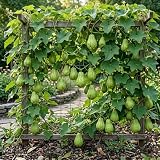
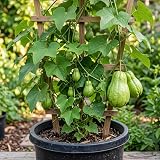
- Height & Spread: A vigorous vine reaching 5-10 m (15-30 ft) that needs a trellis; can also be grown in a large container of at least 20 L (5 gal).
- Growth Habit & Form: Herbaceous perennial climbing vine (grown as an annual in cooler zones); aggressive and trellis-dependent.
- Lifespan & Maturity: Bears fruit roughly 120-150 days (4-5 months) from planting.
Anatomy & Physical Features
- Leaves & Foliage: Maple-leaf-shaped, light-green leaves; the young, tender leaves are edible before they become hairy.
- Flower Characteristics: Small white five-lobed flowers; separate male and female flowers on the same plant.
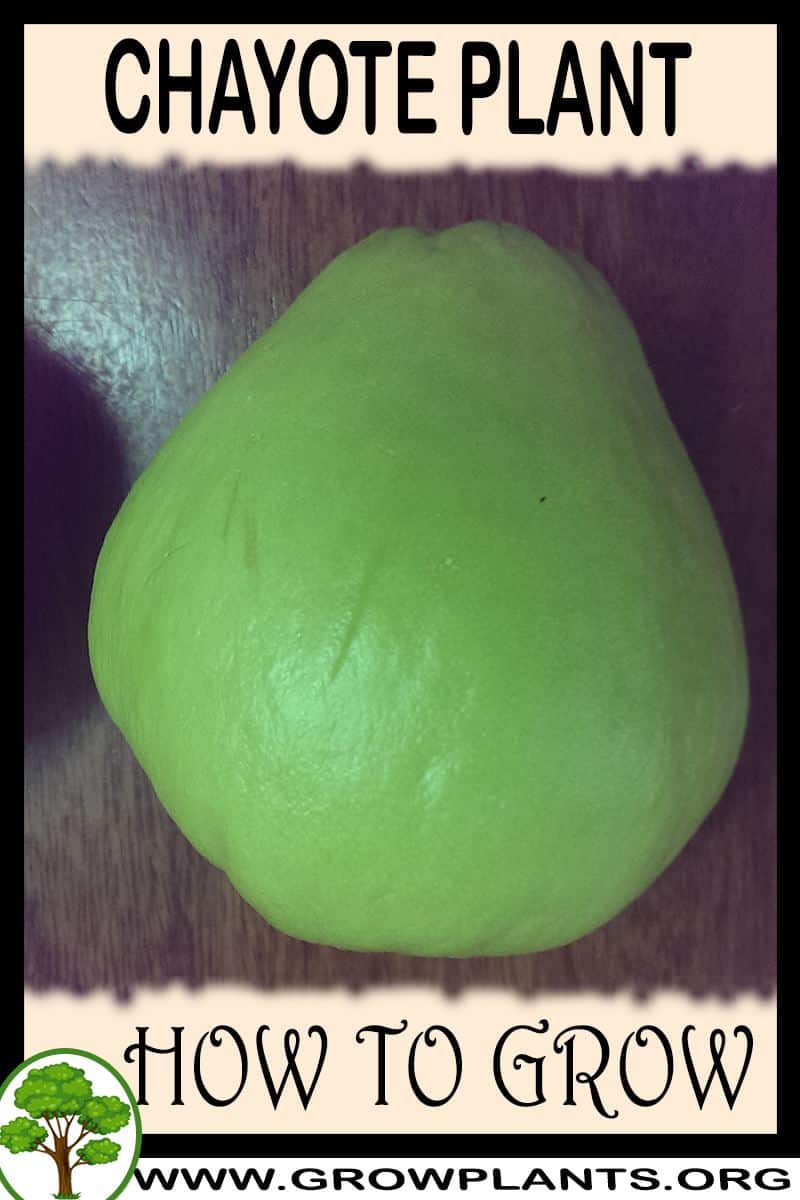
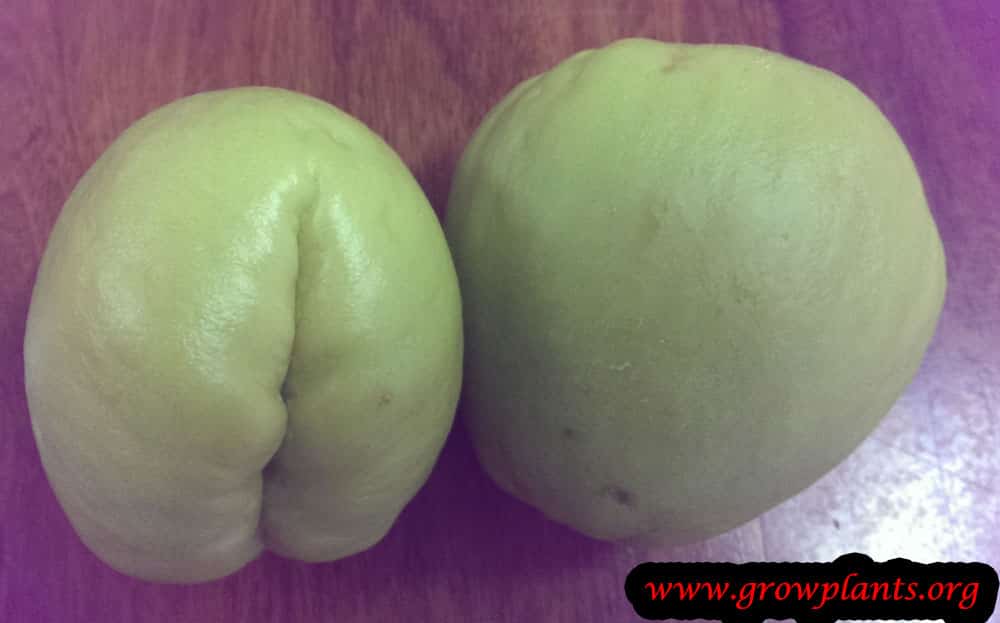
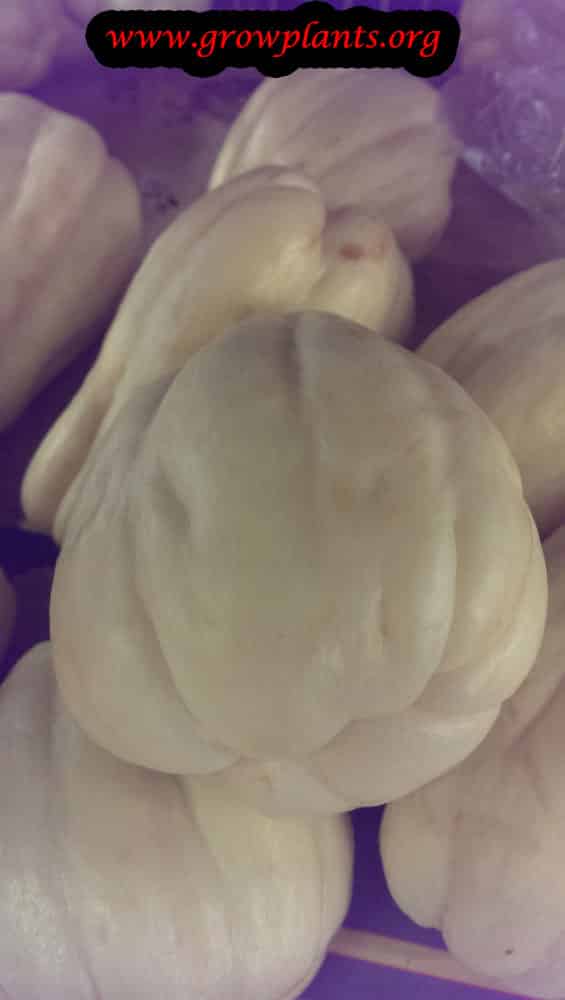
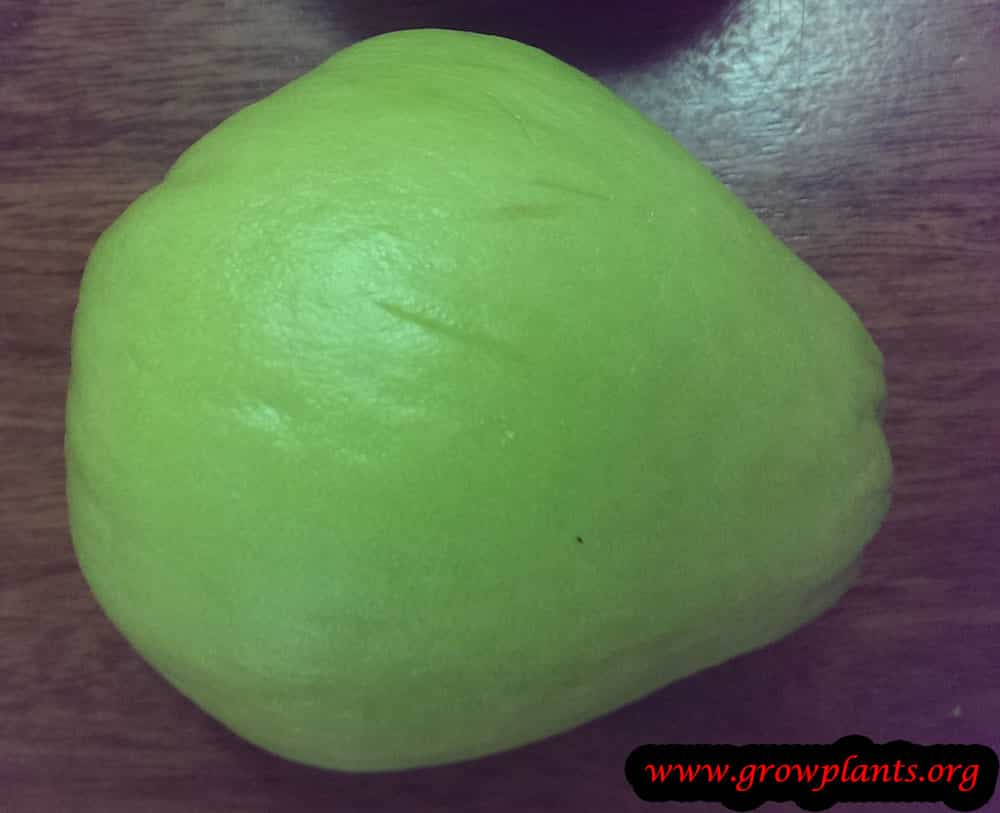
- Fruit Profile: Pear-shaped green or yellow fruit, 7-20 cm and 100-900 g, with crisp flesh tasting like kohlrabi; the skin and single seed are also edible.
Primary Uses & Landscape Value
- Edible Uses: Fruit is cooked, baked, grilled, fried or eaten raw; the young leaves and the underground tuber are also eaten cooked.
- Functional & Ornamental Roles: Edible vine crop (fruit, leaves and tuber); can also screen or cover a trellis.
Care Guide: Planting, Soil & Watering
Overview: Chayote is a vigorous, frost-tender vining squash that needs a warm, sunny, frost-free spot and rich, well-drained soil. It grows fast and aggressively on a sturdy trellis and likes plenty of water in the heat, provided the soil never stays waterlogged.
Quick Care Requirements
| Requirement | Ideal Condition |
|---|---|
| Planting Season | Spring in zones 8–10; spring to summer in zone 11; year-round in zones 12+ |
| Growth Rate | Fast |
| Soil Type | Rich, well-drained, well-aerated soil |
| Soil pH | Slightly acidic |
| Water Need | Moderate to High — water generously in warm weather, but never let the soil stay waterlogged |
Planting & Establishment
- Best Planting Season: Plant in spring once frost has passed in zones 8–10; in warmer zones the season stretches from spring into summer, and in the tropics (zone 12+) it can be planted year-round.
- How to Plant:
- Hole Preparation: Dig a hole larger than the sprouting fruit in well-ventilated soil, and set up a strong trellis at planting time for this aggressive climber.
- Soil Amendments: Work organic matter, humus and dead leaves into the soil and mulch after planting; feed a couple of times a year to support its fast, heavy growth.
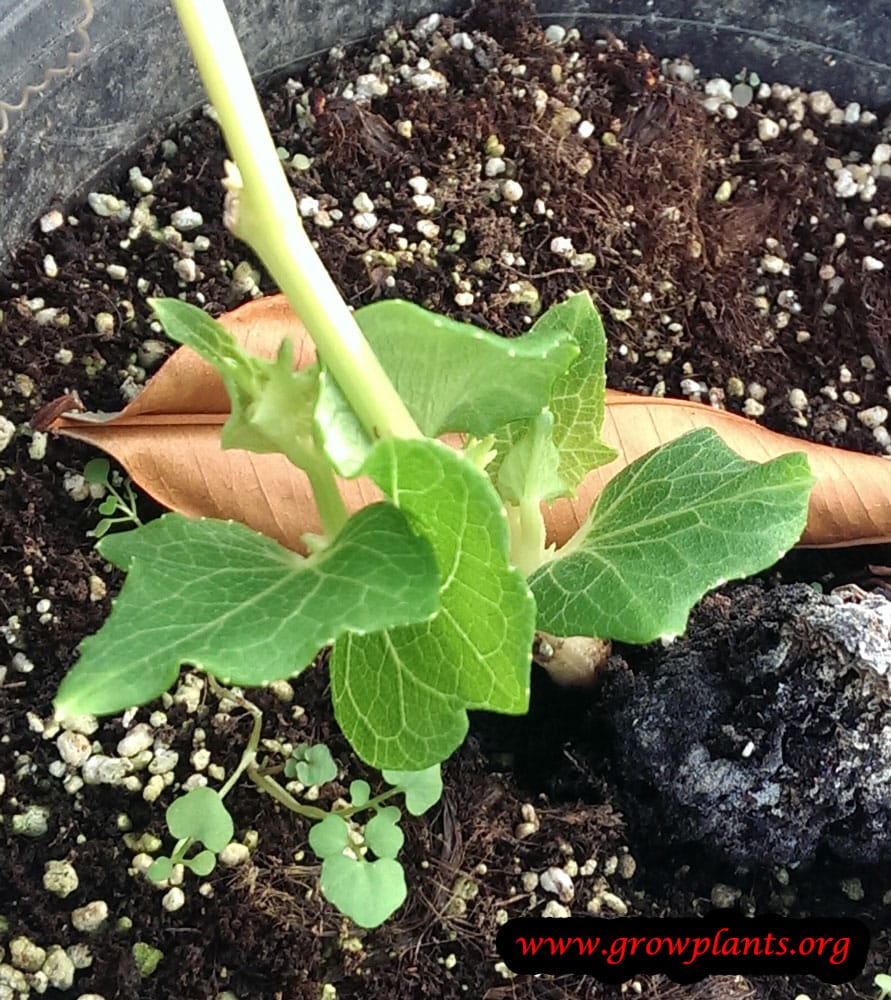
- Planting Depth: The whole fruit is planted — lay it at an angle and half-bury it (about 5 cm), leaving the sprouting end exposed rather than covering it completely.
- Growth Speed & Expectations: Growth is fast; a single plant can cover a large trellis in one season and become quite aggressive.
Soil, Watering & Drainage Care
- Soil Mix & Drainage Needs: Give it rich but sharply drained, well-aerated soil; in containers use at least a 20 L pot with plenty of drainage holes, as the plant reacts badly to overwatering and standing water.
- Watering Schedule & Technique:
- Young / Newly Planted: Keep the soil consistently moist while the plant establishes and starts to climb.
- Established: Water generously and regularly through the warm growing season, but always let excess water drain away freely.
- Seasonal Adjustments: Increase watering in summer heat and reduce it in cooler weather, never letting the roots sit in water.
Climate, Light & Hardiness
Chayote is a vigorous tropical/subtropical climbing cucurbit that needs heat, full sun, and a long frost-free season. It is a perennial where winters stay frost-free (about zone 11+) and is grown as an annual where frost occurs.
Quick Climate Specifications
| Climate Zones | Mediterranean, subtropical, and tropical |
| USDA Hardiness Zones | Site lists zone 8–10 as an annual and zone 11 upward as a perennial |
| Optimal Temp Range | Approximately 18–30 °C (65–86 °F) |
| Cold Damage Begins | Chilling stress below roughly 10–13 °C (50–55 °F) |
| Approx. Survival Minimum | No frost tolerance - killed at or near 0 °C (32 °F) |
| Frost Tolerance | None |
| Light Conditions | Full sun |
| Wind Tolerance | Low |
Sunlight & Light Exposure
Optimal Light Setup
Full sun - give at least 6–8 hours of direct light a day for strong growth, good flowering, and well-ripened fruit. Shade reduces yield and delays or prevents ripening.
Direct Sun Requirement
Yes - a genuinely sun-demanding crop. Too little direct sun gives leggy growth, weak fruit set, and fruit that fails to ripen.
Best Exposure & Orientation
In cool-summer regions a warm, sheltered south- or west-facing aspect that stores heat gives the best ripening; open, sunny ground is ideal elsewhere.
Temperature Extremes & Hardiness
USDA Hardiness & Regional Limits
The site lists Chayote at about USDA zone 8–10 grown as an annual and zone 11 and warmer as a perennial. It is a vigorous tropical/subtropical vine: where the ground stays frost-free it persists and fruits year after year, while in cooler zones it is grown as a single-season annual. Hardiness and habit are separate - the top growth is frost-tender, but a well-mulched crown or tuber can survive light frost in borderline (about zone 8) areas and resprout.
Cold Damage & Winter Protection
Top growth is chilling- and frost-sensitive; growth slows in cool weather. In frost-free zones (about 11+) it stays evergreen and perennial, while in about zone 8–10 a heavily mulched crown or tuber can survive light frost and resprout, though the vine is cut down by hard freezes.
Frost Sensitivity
Foliage and vine are frost-tender and killed at or near 0 °C (32 °F). A mulched crown/tuber may survive brief light frost in mild-winter areas and regrow, but hard freezes kill the plant outright.
Extreme Heat Tolerance
High - thrives in summer heat and full sun. Very high temperatures above about 35 °C (95 °F) can still cause blossom drop and poorer fruit set, particularly under moisture stress.
Frost-Free Growing Season
Needs about 120–150 days (4–5 months) of frost-free warmth, and it fruits as days shorten into autumn, so a long season matters. In borderline areas plant early and mulch the crown heavily; frost kills the top growth.
Wind, Humidity & Microclimate
Humidity Preferences
Tolerates a range of summer humidity but does best in warm, airy conditions. High humidity with wet foliage encourages powdery mildew.
Dry-Air Tolerance
Tolerates moderately dry air well as long as soil moisture is kept up in the watering routine.
Wind Tolerance
Low - large soft leaves and brittle vines tear in strong wind, and wind knocks off flowers and deters pollinators. Give a sheltered site and support long vines.
Rainfall & Seasonal Moisture
As a thirsty, fast-growing warm-season crop it wants a steadily moist, warm growing period, but keep foliage and fruit dry - wet leaves in humid weather invite fungal disease. This describes its seasonal climate need, not a watering schedule.
Microclimate Recommendations
A warm, sheltered, sun-facing spot - for example a south-facing wall or slope in cooler climates - traps heat and lengthens the effective warm season, and dark mulch or plastic warms the soil early. Container root-zones heat, dry, and chill faster and are more wind- and frost-exposed, so shelter pots in extreme weather.
Growing in Pots, Balconies & Indoors
Chayote is a vigorous, climbing sun-loving vine that thrives in full sun, so it is not a houseplant – but grown in a large, free-draining pot it does well on a sunny balcony, patio or terrace. It is a vigorous, space-hungry climber, so give it a large, deep container and sturdy support.
Quick Details
- Container Size: 20 L (5 gal)
- Indoor Suitability: Not an indoor houseplant – it needs full sun; at most a compact cultivar on the very sunniest windowsill
- Best Spot: Full sun – the brightest, warmest spot on a balcony or patio
- Soil & Drainage: Well-drained, well-ventilated mix (potting mix, or peat/coir with perlite) with plenty of drainage holes
- Watering in Pots: Keep evenly moist but never waterlogged – it dislikes overwatering, and pots dry fast in the sun
Indoors & On the Windowsill
- Not a houseplant: The grower keeps it out of the house – indoor light is far too weak for this sun-loving crop.
- Windowsill limits: Only the very sunniest windowsill could support a compact cultivar; most plants of this size are better off outdoors.
- Annual, so no overwintering: This is a warm-season annual – rather than overwintering it, simply resow when the weather warms.
On a Balcony or Patio
- Light & wind: Give it the sunniest, most sheltered spot; train the vine up a strong trellis or pergola and shelter it from wind; walls and paving reflect a lot of heat, so containers dry quickly – check moisture daily in warm weather.
- Practicalities: A full, wet pot is heavy, so make sure the balcony can take the weight, and manage drainage runoff.
Choosing the Pot, Soil & Long-Term Care
- Pot & drainage: Use a 20 L (5 gal) pot with plenty of drainage holes; the grower stresses this crop does not tolerate overwatering, so never leave it standing in water (root rot). Terracotta breathes and dries faster; glazed or plastic holds moisture longer.
- Potting mix: A well-aerated, well-ventilated mix – potting mix, or peat/coir with perlite – as the grower recommends.
- Feeding: Potted plants need feeding more often than those in the ground, since watering leaches nutrients from the mix – feed regularly through the growing season.
Grower’s Container Tip
- Watch the saucer: If you stand the pot on a tray or saucer, make sure it dries out the same day – never let the roots sit in collected water.
Growing this plant in a greenhouse
A greenhouse can give chayote plant frost protection, cold protection, a longer growing season and controlled production. Under warm enough conditions it can keep growing well beyond the normal outdoor season and potentially be maintained year-round - though continuous cropping is not guaranteed and depends on temperature and light.
Greenhouse at a glance
| Greenhouse suitability | Excellent - a major practical advantage |
|---|---|
| Main benefits | frost protection, cold protection, a longer growing season, controlled production |
| Season extension | potentially year-round |
| Outdoor protection advisable below | about 13°C |
| Maintain greenhouse minimum | around 15°C for active growth |
| Suitable types | heated greenhouse, polycarbonate greenhouse, lean-to |
| Heating | Heating is recommended in cold climates for continuous growth. |
Related greenhouse guides
- Greenhouses: How to Choose the Right Greenhouse
- Best Greenhouse Heaters
- Greenhouse Climate Control: Temperature, Ventilation and Humidity
- Best Lean-To Greenhouses
Fertilizing & Feeding
This is a productive, appreciably hungry crop that responds to steady, balanced feeding and generous organic matter, leaning on nitrogen while the vines grow and favoring potassium as fruit develops.
Quick Fertilizing Specs
| Feeding Level | Moderate |
|---|---|
| Main Nutrient Priority | Balanced overall, nitrogen for the vines and potassium as fruit forms |
| Best Feeding Period | Through the warm active growing season |
| Organic Options | Compost, well-rotted manure, and general organic vegetable fertilizers |
| Soil pH | Slightly acidic to near neutral |
| Micronutrients | Usually supplied by compost and a complete fertilizer, and corrected only if a deficiency shows |
Feeding by Growth Stage
Establishment of young plants
Settle young plants and build a healthy root system and first true leaves.
| Nutrient direction | A balanced, complete feeding that supports steady root and early leaf growth without pushing soft, excessive top growth. |
|---|---|
| Timing | From transplanting or seedling establishment through the first flush of vine growth. |
| Frequency | Light, regular feeding while young plants establish. |
| Fertilizer types | A balanced complete vegetable fertilizer, Compost or other organic matter worked into the bed |
| Precautions | Avoid heavy nitrogen early, which encourages lush foliage at the expense of sturdy establishment. |
Vegetative vine growth
Build ample leaf area and strong vines ahead of flowering.
| Nutrient direction | A nitrogen-forward complete feeding to drive vigorous leaf and vine expansion. |
|---|---|
| Timing | During active spreading of the vines before heavy flowering. |
| Frequency | Steady feeding through the main growth phase. |
| Fertilizer types | A nitrogen-leaning complete fertilizer, Well-rotted compost as a supplement |
| Precautions | Keep feeding balanced overall, since runaway nitrogen can delay flowering and fruit set. |
Flowering and fruit development
Support abundant flowers, good fruit set, and quality fruit development.
| Nutrient direction | Shift toward a balanced feeding with strong potassium to support flowering, fruit set, and fruit filling. |
|---|---|
| Timing | From first flowering through fruit sizing and ripening. |
| Frequency | Regular feeding that continues through fruit development. |
| Fertilizer types | A balanced fertilizer with good potassium, Compost or a vegetable fertilizer suited to fruiting crops |
| Precautions | Keep watering even and consistent during fruiting to help calcium reach developing fruit and reduce blossom-end problems. |
Nutrient Deficiency Signs & Corrections
Older, lower leaves turn pale green to yellow and overall growth slows.
| Possible causes | Low soil nitrogen, Cold, wet soil that limits nitrogen uptake, Nitrogen leaching from sandy soil or heavy watering |
|---|---|
| Appears first on | Older, lower leaves |
| What to check | The color gradient from old to new leaves, Recent watering and rainfall, Whether any nitrogen has been applied during rapid growth |
| Possible correction | Apply a nitrogen-containing complete fertilizer and improve organic matter, and make sure soil is warm and well-drained so roots can take up nitrogen. |
Yellowing between the veins of older leaves while the veins themselves stay green.
| Possible causes | Low soil magnesium, High potassium levels competing with magnesium uptake, Acidic or heavily leached, sandy soil |
|---|---|
| Appears first on | Older, lower leaves |
| What to check | The pattern of interveinal yellowing versus whole-leaf yellowing, Soil acidity and recent high-potassium feeding, Drainage and leaching history |
| Possible correction | Correct soil acidity if needed and apply a magnesium source such as a soluble or chelated magnesium product per its label. |
A sunken, dark, leathery patch forms at the blossom end of developing fruit.
| Possible causes | Disrupted calcium movement into the fruit, Uneven or irregular watering, Excess nitrogen driving fast leafy growth |
|---|---|
| Appears first on | Blossom end of young, developing fruit |
| What to check | Consistency of soil moisture, Recent high-nitrogen feeding, Mulch and watering routine |
| Possible correction | Keep soil moisture even, mulch to buffer drying, and avoid excess nitrogen so calcium can reach developing fruit. |
Pruning, Training & Seasonal Maintenance
Chayote is the one plant in this group that is genuinely perennial (in hardiness zone 11+, going dormant and regrowing from its underground tuber in colder zones), and it is also the most vigorous, reaching 5–10 m along an arbor or trellis. Pruning here is described as not strictly needed, but it is commonly done anyway – mainly to keep the mass of vine manageable on its support and to keep the fruit within easy reach for picking, alongside routine removal of diseased leaves. Where the plant is treated as a perennial and comes back from its tuber each spring, pruning also becomes an annual renewal task rather than a one-off.
Quick Pruning & Maintenance Specs
| Pruning Tolerance | Moderate – optional but well tolerated |
| Primary Pruning Window | Through the growing season (all season, per source); heavier renewal cutback at the start of spring regrowth where perennial |
| Main Objective | Manage vine mass on the arbor, keep fruit accessible, remove diseased leaves |
| Young Plant Priority | Establish a strong leader onto a sturdy arbor able to support a 5–10 m vine |
| Mature Plant Priority | Ongoing shaping for access and airflow; spring renewal cutback where the plant regrows from its tuber each year |
| Best Tool Type | Bypass secateurs for vine, precision snips for leaves/tips |
| Avoid Heavy Pruning During | Active flowering (late spring–autumn) if fruit set from that flush is wanted |
Pruning by Plant Age & Size
Newly Established
Minimal pruning; train the leader onto a sturdy arbor or trellis, sized for eventual growth to 5–10 m.
Young / Formative
Vine training onto the support, similar in principle to training a grape onto an arbor, though chayote is soft-stemmed rather than woody. No hard structural framework is needed – just coverage of the support.
Mature / Established
Shape for design and easy pickup: thin overly congested growth so fruit (which hangs through the canopy) is reachable, and remove diseased leaves as they appear. Where grown as a perennial, cut the vine back at the end of the season/start of dormancy and let it regrow fresh from the tuber.
Seasonal Pruning Schedule
Ongoing Sanitary & Access (spring through autumn)
Objective: disease control and fruit access. Remove: diseased leaves; excess congested growth blocking access to fruit. Do not remove: healthy vine needed to reach full 5–10 m coverage on a young plant. Expected response: easier harvesting, cleaner canopy. Flowering/fruiting impact: minimal if kept light through the season.
Dormant / Renewal (where grown as a perennial, cool season)
Objective: renew the vine from the overwintering tuber. Remove: old top growth once it dies back or before lifting/protecting the tuber for winter. Do not remove: the tuber itself. Expected response: fresh regrowth the following spring. Flowering/fruiting impact: resets the plant for a new fruiting season.
Structural Pruning & Training
Arbor or heavy trellis training is essential given the mature size. Thinning dense growth benefits this plant – it improves both airflow (relevant given its noted disease susceptibility) and access to the pear-shaped fruit hanging in the canopy.
Special Growth to Remove
- Diseased leaves, on an ongoing basis.
- Congested growth blocking fruit access.
- Old top growth at the end of the season where the plant is being carried over as a perennial via its tuber.
Young leaves are also harvested for food, which functions as light tip pruning and does not need separate treatment here.
Container & Small-Space Pruning
Chayote can be grown in a container of at least 20L, but its eventual 5–10 m size means container culture requires much more assertive, regular cutback than the smaller cucurbits in this batch to keep it manageable on a modest support.
Tools
- Bypass secateurs – for routine vine cutback.
- Precision snips – for leaf removal and tip work.
- Loppers – for thick basal growth on an established perennial plant.
Tool Hygiene & Disease Risk
Increased risk: chayote is noted as easily attacked at the base if not treated well, and is susceptible to powdery mildew, moths, virus and beetles; disinfect tools between cuts on diseased material.
Cut Placement & Technique
Cut vine sections back to a strong node rather than leaving long bare stubs; remove diseased leaves at the base of the leaf stalk.
Heavy Pruning & Rejuvenation
Well tolerated – as a fast-growing perennial vine, chayote can be cut back hard, especially at the end of a growing season where it is being carried over via its tuber, and it regrows vigorously from that tuber the following spring.
Post-Pruning Care
After a seasonal cutback, add organic matter/mulch and fertilize as the plant resumes growth (the source recommends feeding twice a year as routine care, not specifically triggered by pruning). Keep soil moist as new growth emerges from the tuber.
Common Pruning Mistakes
- Using a support too light for a vine that can reach 5–10 m.
- Letting the canopy get so congested that fruit becomes hard to find and pick.
- Damaging or removing the tuber when cutting back top growth at season’s end.
When NOT to Prune
- Avoid heavy cutback during active flowering if fruit from that flush is wanted.
- Avoid disturbing the underground tuber when cutting back top growth.
Recommended Tools (by task)
- bypass_secateurs – for routine vine management.
- precision_snips – for leaf and tip work.
- loppers – for thicker growth on an established perennial plant.
- soft_ties_stakes – for training onto an arbor.
Pruning Troubleshooting
| Problem | Possible Cause | What to Check | Corrective Action |
| Fruit is hard to find and harvest | Overcrowded, unthinned canopy | Check density of growth over the arbor | Thin congested vine to open access to hanging fruit |
| Plant fails to return the following spring (in perennial climates) | Tuber damaged or removed during end-of-season cutback | Check whether the tuber was disturbed when cutting back top growth | Cut back only top growth, leaving the tuber undisturbed in the ground |
Propagation Guide
Chayote has an unusual seed habit: its single large seed germinates while still sealed inside the mature fruit and cannot be removed or sown separately, so the standard and most practical method is to plant the whole ripe fruit. Stem cuttings from an established, known-productive vine are also easy to root and are useful for preserving a particular plant’s traits, since seedlings raised from fruit will vary somewhat.
Quick Propagation Specs
| Best Propagation Method | Planting the whole mature fruit (its single seed germinates inside) |
| Alternative Methods | Stem cuttings |
| Propagation Difficulty | Easy |
| Seed True-to-Type | Not applicable in the usual sense – the seed cannot be separated from the fruit, and seedlings grown this way can vary somewhat in vigor and fruiting habit |
| Vegetative True-to-Type | Yes – cuttings reproduce the parent plant’s traits |
| Best Propagation Season | Spring in hardiness zones 8–10; spring to summer in zone 11; year-round in zone 12+ |
| Seed Germination Time | 10–20 days |
| Germination Temperature | Warm, frost-free conditions in full sun |
| Seed Sowing Depth | Plant is buried inside the fruit; cover roughly half the fruit with about 5 cm (2 in) of soil, or leave it uncovered on the soil surface |
Growing from Seed
Seed Handling & Viability
The seed is short-lived and cannot be dried, stored, or sown on its own – it stays viable only as long as the mature fruit it is enclosed in stays alive, so propagation is really a matter of planting the intact fruit rather than extracted seed.
Sowing Season
Plant in spring in hardiness zones 8–10, spring through summer in zone 11, or any time of year in zone 12 and warmer.
Sowing Depth & Orientation
Lay the whole ripe fruit on (or partly in) well-drained, slightly acidic soil, covering about half of it with roughly 5 cm (2 in) of soil – covering is optional, and the fruit does not need to be buried. Space plants about 20–30 cm apart, allowing for the vigorous vine to be trained onto a trellis.
Germination Conditions
Keep the soil moist in full sun with average to generous water; the plant needs frost-free, warm conditions.
Germination Time
The shoot typically emerges from the fruit in about 10–20 days.
Seedling Care
Provide warm weather, full sun, plenty of water, and a trellis or support in place early, since chayote is a fast-growing, vigorous vine reaching 5–10 m (15–30 ft).
Stem Cuttings
Cutting Type
Stem cuttings taken from an established, healthy, fruiting vine root easily and are a straightforward way to propagate a plant with known good traits without waiting on fruit-based propagation.
Best Timing
Take cuttings during the plant’s active growing season (spring through summer).
Bloom & Flower Guide
Quick Details
- Bloom Season: Late spring through summer and autumn; year-round in the tropics
- Flower Appearance: Small white flowers with five lobes, borne as separate male and female flowers on the same vine
- Edibility: The flower is not eaten – chayote is grown for its fruit, tuber and leaves rather than its blooms
Detailed Blooming Overview
Chayote is a monoecious vine, meaning it carries separate male and female flowers on the same plant, and getting both to open and be visited is the key to a good set. The little white five-lobed flowers appear from late spring onward, and in warm tropical conditions the vine can flower and fruit almost continuously.
Flower Characteristics
- White flowers with five lobes.
- Separate male and female flowers on the same vine.
Bloom Care & Thinning
- Pollination: Carried out by bees and other pollinators; hand-pollination helps where insect visits are few.
- Flower drop: Blooms are sometimes shed because of disease or a shortage of water – steady moisture and healthy foliage reduce the loss.
Fruit & Uses
Chayote is grown mainly for its fruit – skin, flesh and single soft seed all edible – and also produces edible young leaves and a starchy edible tuberous root. Most parts are cooked, though the young fruit can also be eaten raw.
Quick Edible Specs
| Edible Parts | Fruit (skin, flesh & single seed), young leaves, tuberous root |
|---|---|
| Main Use(s) | Culinary – fruit as a vegetable, leaves as cooked greens, tuber as a root vegetable |
| Eaten Raw or Cooked | Fruit: raw (young) or cooked. Leaves: cooked. Tuber: cooked |
| Preparation Required | None for young fruit (skin and seed both eaten); leaves must be picked young and tender, before they turn hairy; tuber is peeled and cooked |
| Harvest Season | Fruit: summer to autumn (year-round in the tropics). Leaves: all year. Tuber: from about 10 months after planting, year-round in warm climates or autumn where winters are cool |
| Time to First Harvest | Fruit within a few months of planting; the tuber takes considerably longer, at least the better part of a year (see Propagation) |
| Storage | Fruit doesn’t keep long and is best used fresh; the tuber can be left in the ground and lifted as needed in frost-free climates |
| Safety/Toxicity Caveat | None noted |
Fruit
Pear-shaped, with green or yellow skin, roughly 100–900g and 7–20cm long. The whole fruit – skin, flesh and its single soft seed – is edible, with a taste likened to kohlrabi when eaten raw. Harvest while still soft, young and fully grown, before the skin toughens; use raw or cooked (boiled, baked, grilled, stir-fried, fried).
Leaves & Greens
Young, tender leaves are edible; once mature they become hairy and are no longer eaten. Harvest by cutting from the base of the leaf. Used cooked – stuffed, stir-fried, or worked into salads.
Roots & Tubers
The plant forms an edible tuberous root with brown skin and white flesh. It can be lifted from roughly 10 months after planting onward – year-round in warm climates, or in autumn where winters are cool. It’s prepared cooked, in the same general styles as the fruit (stuffed, stir-fried, etc.). Because harvesting the tuber means digging up the root system, it’s typically taken as an end-of-season harvest rather than alongside ongoing fruit picking.
Preparation, Uses & Safety
Fruit (skin, flesh and seed together) can be eaten raw or cooked in a wide range of styles. Leaves and tuber are eaten cooked. No safety caveats are noted for this species.
Pests, Diseases & Troubleshooting
Overview: Chayote is a vigorous, sprawling cucurbit vine and shares the pests and diseases of its family-aphids, cucumber beetles, spider mites, whitefly and squash bugs among the pests, and powdery and downy mildew, anthracnose and aphid- or whitefly-borne mosaic viruses among the diseases. It is generally robust once established; manage it with good airflow on a sturdy support, vigilance for the virus-spreading sap-suckers, and organic controls first.
Quick Troubleshooting Overview
| Issue / Pest | Main Symptom | Primary Solution |
|---|---|---|
| Aphids | Colonies on shoot tips and leaf undersides, curling, honeydew, virus spread | Water blast, insecticidal soap, encourage predators |
| Cucumber beetles | Chewed leaves and flowers; spread of bacterial wilt and mosaic | Hand-pick, row cover young plants, sticky traps |
| Spider mites | Stippling, bronzing and webbing in hot, dry weather | Rinse, raise humidity, neem or soap |
| Powdery mildew | White powdery patches on leaves, yellowing and dieback | Airflow, resistant siting, sulphur/bicarbonate spray |
| Downy mildew | Angular yellow leaf patches, grey-purple mould beneath | Airflow, avoid wet foliage, copper if severe |
| Poor fruit set | Flowers drop, few fruit despite healthy vine | Encourage pollinators; hand-pollinate; ease heat stress |
Common Pests & Management
- Aphids (Aphis gossypii, Myzus persicae):
- Symptoms: Dense colonies of soft insects on shoot tips and leaf undersides, curling and yellowing the foliage and coating it with honeydew and sooty mould; most importantly, they transmit the mosaic viruses that stunt cucurbits.
- Prevention & Control: Blast them off with water, encourage ladybirds, lacewings and hoverflies, and use reflective mulch to deter them early. Insecticidal soap or neem controls heavy colonies; act promptly because of the virus risk, and treat in the evening to spare bees.
- Cucumber beetles (Diabrotica, Acalymma spp.):
- Symptoms: Yellow-and-black striped or spotted beetles that chew leaves, flowers and young fruit, and-more seriously-spread bacterial wilt and mosaic viruses as they feed; their larvae attack roots.
- Prevention & Control: Protect young plants with floating row cover (removing it at flowering for pollination), hand-pick beetles, use yellow sticky traps, and clear crop debris. Kaolin clay deters feeding; reserve targeted sprays for severe pressure to protect pollinators.
- Squash bugs & whitefly (Anasa tristis, Bemisia tabaci):
- Symptoms: Squash bugs are shield-shaped sap-suckers that wilt and blacken runners; whiteflies rise in white clouds from leaf undersides, yellow the foliage with honeydew and spread viruses.
- Prevention & Control: Hand-pick squash bugs and crush their bronze egg clusters on leaf undersides, and clear debris where they overwinter. For whitefly use yellow sticky traps and insecticidal soap or neem to the undersides, encouraging natural parasitoids.
- Pickleworm & spider mites (Diaphania nitidalis, Tetranychus urticae):
- Symptoms: Pickleworm caterpillars bore into buds, flowers and fruit leaving frass-filled holes; spider mites cause fine stippling, bronzing and webbing on the leaves in hot, dry spells.
- Prevention & Control: Remove and destroy bored buds and fruit and use Bacillus thuringiensis (Bt) against the caterpillars; for mites, rinse the foliage, raise humidity, and spray insecticidal soap or neem to the undersides until controlled.
Diseases & Fungal Issues
- Powdery mildew (Podosphaera xanthii, Erysiphe cichoracearum):
- Symptoms: White, powdery patches spreading over leaves and stems, typically later in the season, yellowing and killing the foliage and reducing vigour and fruiting.
- Treatment & Management: Space and train the vine for airflow and sun, water at the base, and remove badly affected leaves. Treat early with a sulphur, potassium-bicarbonate or milk-based spray, and choose airy, sunny planting positions.
- Downy mildew (Pseudoperonospora cubensis):
- Symptoms: Angular yellow patches bounded by the leaf veins on the upper surface, with a greyish-purple downy mould beneath in cool, wet, humid weather; leaves brown and die from the base up.
- Treatment & Management: Improve airflow and drainage, avoid overhead watering and prolonged leaf wetness, and remove affected leaves. Where the disease is common, protect with a copper fungicide applied preventively.
- Anthracnose & gummy stem blight (Colletotrichum orbiculare, Stagonosporopsis cucurbitacearum):
- Symptoms: Anthracnose makes dark, sunken, spreading spots on leaves, stems and fruit; gummy stem blight causes stem cankers that ooze gum and cause dieback and fruit rot in warm, wet conditions.
- Treatment & Management: Use clean seed and a long rotation, keep foliage dry, prune out and destroy affected tissue, and improve airflow. Copper or a broad-spectrum organic fungicide protects in prolonged wet weather.
- Mosaic viruses (CMV, ZYMV, WMV):
- Symptoms: Mottled yellow-and-green, distorted, blistered leaves, stunted vines and misshapen, mottled fruit; incurable and spread by aphids, whiteflies and cucumber beetles.
- Treatment & Management: There is no cure-control the insect vectors, keep the area weed-free, handle plants with clean hands, and promptly remove and destroy infected plants to protect the rest.
Growing Difficulties & Abiotic Problems
- Poor fruit set & flower drop:
- Cause & Symptoms: The vine may grow lush yet set little fruit if pollination is poor (it needs insects to move pollen between male and female flowers) or if high heat, drought or heavy shade cause the flowers to drop.
- Correction Strategy: Encourage bees and other pollinators, and hand-pollinate by transferring pollen from male to female flowers when set is poor. Relieve heat and drought stress with mulching and steady watering, and grow in full sun on a strong support.
- Premature sprouting & fruit cracking:
- Cause & Symptoms: The single large seed can germinate while still inside a stored or over-mature fruit, and fruit may crack or split from irregular watering or over-maturity on the vine.
- Correction Strategy: Harvest fruit young and tender before it sprouts, store it cool, and keep soil moisture even to prevent cracking; use whole sprouting fruit to start new plants.
- Nutrient chlorosis & overwatering:
- Cause & Symptoms: Yellowing between the veins can signal nitrogen or micronutrient shortage in this hungry vine, while waterlogged soil rots the roots and yellows the whole plant.
- Correction Strategy: Feed a vigorous plant with balanced nutrients and mulch with compost, correct micronutrient lock-out on alkaline soils, and ensure free-draining soil with deep but not constant watering.
What Helps – Products & Tools
For chayote the cucurbit toolkit applies: insecticidal soap and neem oil for aphids, whitefly and mites, floating row cover, yellow sticky traps and kaolin clay against cucumber beetles, and Bacillus thuringiensis (Bt) for pickleworm and other caterpillars. Against the mildews, anthracnose and gummy stem blight, lead with airflow and sanitation and use sulphur, potassium-bicarbonate or copper fungicides preventively in wet weather; reflective mulch and vector control are the best defence against the incurable mosaic viruses.