
Plant Profile & Key Characteristics
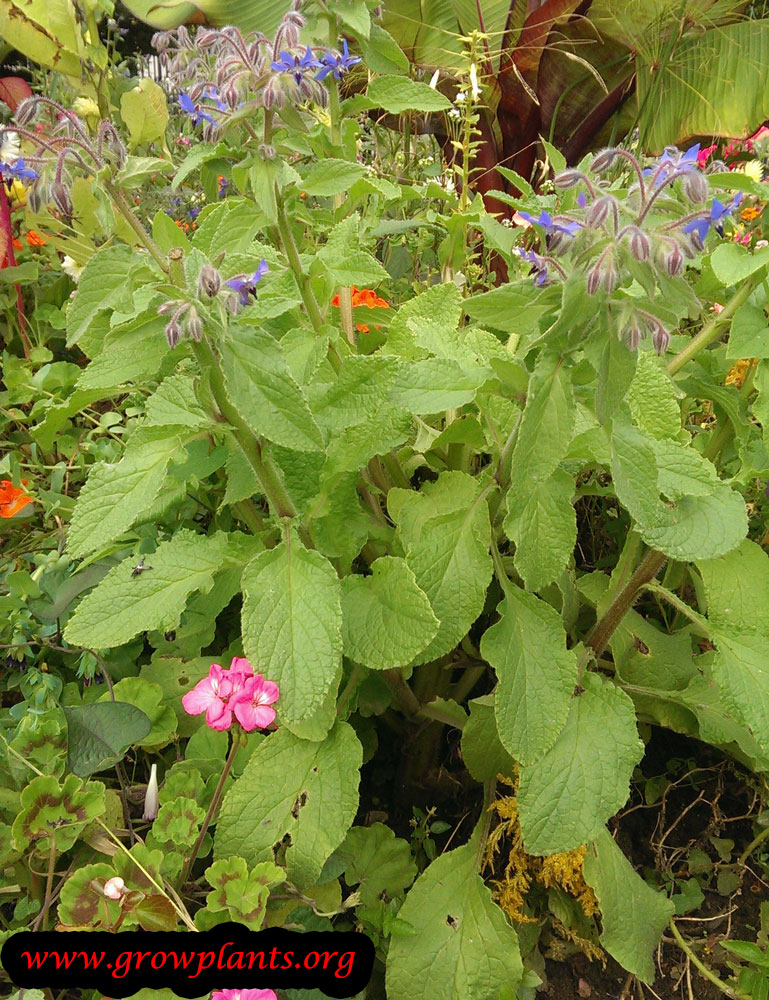
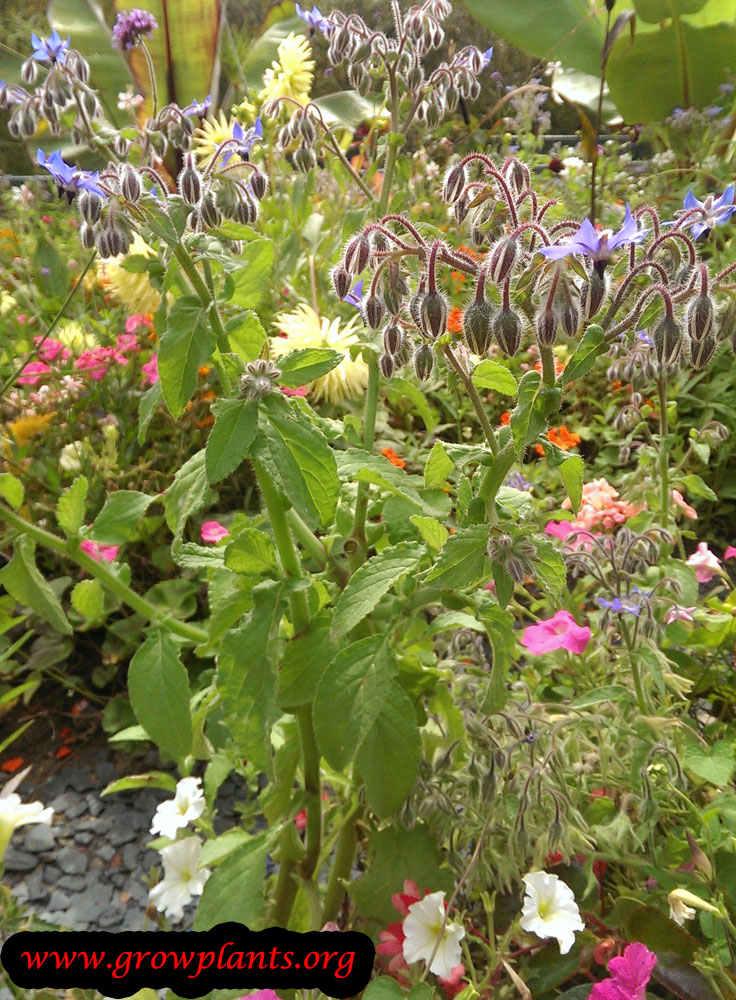
Overview: Borage is a fast-growing annual herb reaching 40-90 cm (16-36 in) tall, forming a bushy, bristly-haired plant that completes its life cycle in a single season. It is grown as a culinary and medicinal herb for its cucumber-flavoured edible leaves and star-shaped blue flowers, and as a bee-friendly ornamental.
Quick Specifications
| Specification | Attribute |
|---|---|
| Plant Type / Life Cycle | Annual (readily self-seeding herbaceous herb) |
| Mature Size | 40-90 cm (16-36 in) tall |
| Growth Rate | Fast to moderate |
| Root System | Taproot |
| Toxicity | Edible in culinary amounts, but the leaves and stems contain pyrrolizidine alkaloids — not recommended for large or prolonged consumption |
| Hardiness | USDA zones 2-10a (grown as a spring annual; can overwinter in zone 10b) |
Growth Form & Structure
- Height & Spread: In the ground 40-90 cm (16-36 in) tall and roughly half as wide; grows well in a 5-10 L (1.3-2.5 gal) container, where it stays more compact.
- Growth Habit & Form: Upright, branching herbaceous plant with hollow, bristly stems forming a loose bushy mound.
- Lifespan & Maturity: Completes its life cycle in one season, flowering within a few months of sowing and self-seeding for the following year.
Anatomy & Physical Features
- Leaves & Foliage: Green, oval leaves covered in coarse hair-like bristles, with a fresh cucumber-like flavour and scent; young leaves are the tender ones for eating.
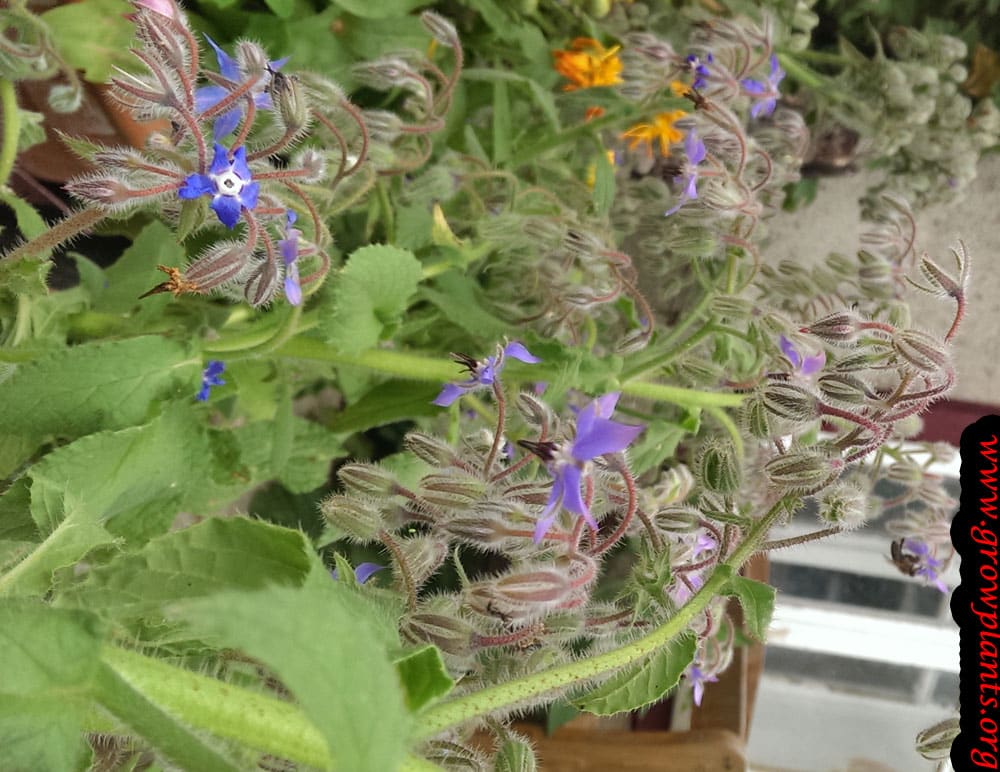
- Flower Characteristics: Star-shaped, five-petalled flowers in blue, pink or blue-purple that are highly attractive to bees.
Primary Uses & Landscape Value
- Edible Uses: Young leaves and the flowers are eaten fresh in salads, cooked as a pot-herb, used in beverages, and the flowers as an edible garnish.
- Functional & Ornamental Roles: A cottage- and herb-garden ornamental, an excellent pollinator and companion plant, and a source of edible cut flowers.
Care Guide: Planting, Soil & Watering
Overview: Borage is a fast-growing annual herb for full sun (light shade in hot climates) that grows best in rich, well-draining soil. Keep the soil evenly moist with moderate watering and good drainage so it develops fully instead of blooming prematurely and staying dwarf.
Quick Care Requirements
| Requirement | Ideal Condition |
|---|---|
| Planting Season | Spring; in mild zone 10b also from summer or autumn into winter |
| Growth Rate | Moderate to Fast |
| Soil Type | Rich, well-aerated, well-draining soil with organic matter |
| Soil pH | Neutral (about 6.0–7.0) |
| Water Need | Moderate — keep evenly moist with good drainage |
Planting & Establishment
- Best Planting Season: Sow or plant in spring; in mild climates (zone 10b) it can also go in from summer through autumn into winter.
- How to Plant:
- Soil Amendments: Add humus and organic matter at the start of the season, and make sure the soil drains freely.
- Planting Depth: Plant into moist soil, setting the seedling at the depth it grew in its pot with the stem base at soil level.
- Growth Speed & Expectations: Fast to moderate; give it room and steady conditions so it develops fully rather than flowering early while still small.
Soil, Watering & Drainage Care
- Soil Mix & Drainage Needs: Well-aerated, freely draining soil rich in organic matter; in containers (5–10L) use a potting or peat mix with perlite or vermiculite and let water drain right through — better without a saucer under the pot.
- Watering Schedule & Technique:
- Young / Newly Planted: Keep the soil moist while seedlings establish.
- Established: Water moderately to keep the soil evenly moist, allowing good drainage between waterings.
- Seasonal Adjustments: A little more in warm, dry spells and less in cool, wet weather.
Climate, Light & Hardiness
Borage is a fast, adaptable annual herb for Mediterranean, subtropical and temperate gardens, grown in full sun to half shade and readily self-seeding. Per site data it succeeds across zones 2–10a (and into 10b with care), a wide range that reflects how easily it fits a single growing season; frost is what forces its annual habit.
Quick Climate Specifications
| Climate Zones | Mediterranean, subtropical and temperate |
|---|---|
| USDA Hardiness Zones | 2–10a, and 10b with the right care (site data) |
| Optimal Temp Range | Around 20–25 °C (68–77 °F) for growth and germination (site data) |
| Cold Damage Begins | Hard frost kills top growth; seedlings tolerate light cold |
| Frost Tolerance | Low overall (young plants take light frost; hard frost is fatal) |
| Light Conditions | Full sun to half shade |
| Wind Tolerance | Low to moderate (tall, brittle, hollow stems) |
Sunlight & Light Exposure
Optimal Light Setup
Full sun for the sturdiest plants and heaviest flowering. In the warmest zones the site data advises half shade, since strong heat makes it bolt and flower before it develops fully.
Direct Sun Requirement
It performs best in full sun through the cooler part of the season; only in hot climates (about zone 10b) is part shade preferable.
Best Exposure / Orientation
An open, sunny site suits most climates; a cooler, lightly shaded aspect extends its season where summers are hot.
Temperature Extremes & Hardiness
USDA Hardiness & Regional Limits
Site data spans zones 2–10a (10b with care). Because it completes its cycle in one season, borage is grown as an annual almost everywhere; the zone range describes when and where it can be sown and grown rather than a woody plant overwintering. In frost-prone climates it is a warm-season annual, while in frost-free zones it can be grown through the cooler months and often self-sows to persist from year to year.
Cold Damage & Winter Protection
Young plants tolerate light frost, but a hard freeze kills the soft, hollow-stemmed growth. Where winters are mild (zone 10b) it can instead be grown over autumn and winter, sidestepping summer heat.
Frost Sensitivity
Low overall - seedlings take a light touch of cold, but the mature plant is frost-tender and hard frost ends it.
Extreme Heat Tolerance
Limited; strong heat makes it bolt, flower prematurely and stay dwarf, which is why part shade or a cool-season sowing is advised in the hottest zones.
Wind, Humidity & Microclimate
Wind Tolerance
Low to moderate; the tall, brittle, hollow stems can snap in strong wind, so a sheltered spot or light support helps.
Rainfall & Seasonal Moisture
Grows well with average, steady moisture through the season; it favours a mild, not-too-hot growing window.
Microclimate Recommendations
Match the sowing to the climate - a warm-season crop where winters freeze, an autumn-to-winter crop in frost-free zones - and give it a spot sheltered from strong wind.
Growing in Pots, Balconies & Indoors
Borage is a fast-growing annual herb with edible, cucumber-flavoured leaves and starry blue flowers loved by bees. The grower does not class it as a houseplant, but it grows readily in containers, and a compact plant can be raised on a sunny windowsill where it gets enough light.
Quick Details
- Container Size: 5-10 L (1.3-2.5 gal) per plant (grower’s guidance)
- Indoor Suitability: Not a deep-room houseplant, but a sunny windowsill can grow it – it needs strong, direct light
- Best Spot: Full sun to half shade; in very hot climates part shade keeps it from bolting
- Soil & Drainage: Well-aerated, organic-rich mix with sharp drainage – potting mix or peat with perlite or vermiculite (grower’s mix)
- Watering in Pots: Average – keep the soil moist with free drainage; water when the top dries and let excess drain right out
Indoors & On the Windowsill
- Not a houseplant: The grower marks it unsuitable as a room houseplant – it needs full sun that indoor corners lack.
- Sunny windowsill: On the brightest, sunniest sill a young or compact plant will grow and even flower; give it as much direct light as possible.
- Short-lived annual: It grows fast, flowers and sets seed within a season, so sow afresh rather than keeping it long-term.
On a Balcony or Patio
- A bee-friendly herb pot: A sunny balcony suits it well; the flowers draw pollinators and are edible in salads and drinks.
- Water & wind: Tall, soft growth can flop in wind – shelter it, and check moisture often as pots dry fast in sun.
Choosing the Pot, Soil & Long-Term Care
- Pot & drainage: A 5-10 L pot with strong drainage holes; the grower advises against a saucer or bottom tray so water drains freely out and roots never sit wet.
- Potting mix: Well-ventilated, organic-rich mix with good drainage – potting mix or peat with perlite or vermiculite (grower’s mix).
- Feeding: A light feed through growth is enough for this quick annual; pot nutrients leach, so little and often beats a heavy dose.
- Growing on: As an annual there is no repotting – sow into its final pot, or pot up seedlings once, then let it run its season.
Fertilizing & Feeding
A light feeder: rich soil with humus at the start of the season plus occasional light feeding is plenty for this easy annual herb, which often self-seeds.
Quick Fertilizing Specs
| Feeding Level | Light feeder |
|---|---|
| Main Nutrient Priority | Balanced feeding with adequate nitrogen for leafy growth |
| Best Feeding Period | From planting through the growing season |
| Organic Options | Humus and compost |
| Reduce/Stop Feeding | Ease off as the plant finishes flowering and sets seed |
| Micronutrients | Usually supplied by rich organic soil; correct only diagnosed problems |
| Soil pH | Slightly acidic to near neutral |
Feeding by Growth Stage
Establishment of young plants
Give young plants a healthy start in rich, well-drained soil.
| Nutrient direction | Work humus and a balanced complete fertilizer into the bed at the start of the season. |
|---|---|
| Timing | At planting and early growth at the start of the season. |
| Frequency | An initial feeding worked into rich soil. |
| Fertilizer types | A balanced complete fertilizer, Humus or compost worked in |
| Precautions | Rich, well-drained soil at the start is usually enough for this easy annual herb. |
Leafy growth and flowering
Support leafy growth and steady flowering for harvest.
| Nutrient direction | Light balanced feeding sustains tender leaves and edible flowers. |
|---|---|
| Timing | Through the growing season as the plant leafs out and blooms. |
| Frequency | Light, occasional feeding is usually enough. |
| Fertilizer types | A balanced complete fertilizer, Compost as a top-dressing |
| Precautions | Feed sparingly; over-rich feeding gives soft growth and less flavor, and this herb often self-seeds and carries on with little help. |
Nutrient Deficiency Signs & Corrections
Older, lower leaves fade to pale green or uniform yellow and overall growth slows.
| Possible causes | low available soil nitrogen, nitrogen leaching from heavy watering or rain, thin soil low in organic matter |
|---|---|
| Appears first on | older, lower leaves |
| What to check | recent feeding history, soil organic matter, watering and drainage |
| Possible correction | Apply a nitrogen-containing complete fertilizer and build soil organic matter, then water evenly. |
Youngest leaves yellow between the veins while the veins themselves stay green.
| Possible causes | high soil pH reducing iron and manganese availability, waterlogged or poorly drained roots, genuinely low micronutrient supply |
|---|---|
| Appears first on | new, young leaves |
| What to check | soil pH and drainage, watering habits, whether symptoms are on the newest growth |
| Possible correction | Correct soil pH if high, improve drainage, and apply a chelated iron or manganese product per its label. |
Leaf margins brown or scorch and growth stalls despite adequate watering.
| Possible causes | fertilizer salt buildup in the root zone, under-watering that concentrates salts, excessive or too-frequent feeding |
|---|---|
| Appears first on | leaf margins and tips |
| What to check | recent fertilizer amounts, watering consistency, drainage, especially in containers |
| Possible correction | Ease off feeding, water thoroughly to flush accumulated salts, then return to lighter feeding. |
Pruning, Training & Seasonal Maintenance
Borage (Borago officinalis) is a fast annual herb, so pruning is really pinching and deadheading rather than shaping woody growth. Pinch young tips to make a bushier, less leggy plant; deadhead spent star-flowers to prolong blooming and curb its prolific self-seeding; and strip tatty lower leaves. It is short-lived and self-sows freely, so end-of-life removal and seed control matter more than structure. (Harvesting the leaves and flowers for use is covered separately.)
Quick Pruning & Maintenance Specs
| Pruning Tolerance | High – soft herb; pinches freely |
| Primary Pruning Window | Through the growing season as it grows and flowers |
| Secondary Maintenance Window | End of season (remove plant / control seeding) |
| Typical Frequency | Ongoing pinching and deadheading |
| Main Objective | Encourage bushiness, prolong bloom, limit self-seeding, tidy |
| Young Plant Priority | Pinch tips to branch and prevent early leggy bolting |
| Mature Plant Priority | Deadhead, remove tatty leaves, cut down when spent |
| Best Tool Type | Precision snips or fingertips |
| Avoid Heavy Pruning During | Never cut into wood – it is an annual |
Pruning by Plant Age & Size
Newly Established
Once the seedling has a few leaf pairs, pinch the growing tip to encourage branching and a sturdier, bushier plant — it can otherwise bolt up thin and even flower while still dwarf.
Young / Formative
No structural training — it is an annual herb; simply keep pinching soft tips for form.
Mature / Established
Deadhead spent flowers to keep it blooming and reduce self-sown seedlings, remove yellowing lower leaves, and cut the whole plant down once it collapses at season’s end.
Seasonal Pruning Schedule
Growing Season
Pinch and deadhead continuously, and remove flopped or tatty stems.
End of Season
Pull or cut down the spent plant; if you do not want a carpet of seedlings, deadhead before seed drops — or leave a few heads if you want it to return.
Ongoing Sanitary
Remove mildewed or mealybug-affected growth.
Structural Pruning & Training
None — a single soft-stemmed annual with hollow, bristly stems. Support a tall, floppy plant with a stake rather than trying to prune it into shape.
Special Growth to Remove
Spent flower stems (to prolong bloom and limit seeding) and dead lower leaves. There are no suckers, runners or woody growth. Self-sown seedlings are the plant’s succession — thin them rather than treating them all as weeds if you want more borage.
Container & Small-Space Pruning
Pinch to keep a pot plant compact (it can grow tall and floppy), deadhead to prolong flowering, and stake it if it leans.
Tools
Precision snips, or simply fingertips, for pinching and deadheading the soft, bristly stems. No secateurs, loppers or saw are needed.
Tool Hygiene & Disease Risk
Routine — clean snips. Occasional powdery mildew or mealybugs are cultural or pest issues, not pruning-borne; remove affected material rather than sterilising between cuts.
Cut Placement & Technique
Pinch just above a leaf pair to force side branching; cut spent flower stems back into the plant rather than leaving long bare stubs.
Heavy Pruning & Rejuvenation
Not applicable — as an annual it is not cut back to regrow from wood. A tired midsummer plant is better refreshed by pinching and deadheading, or simply replaced by the next self-sown flush.
Post-Pruning Care
Keep it evenly watered after pinching to support fresh growth; in hot spots some afternoon shade prevents premature bolting. No special feeding is needed after pinching.
Common Pruning Mistakes
- Never pinching, so it grows tall, thin and flops.
- Letting every flower set seed and being overrun by seedlings.
- Leaving collapsed plants in place.
- Treating it as a plant to shape structurally rather than a soft herb.
When NOT to Prune
Do not cut back a young plant hard — it can respond by blooming prematurely and staying dwarf — and avoid cutting during heat stress that already threatens bolting.
Recommended Tools (by task)
- precision_snips — the only tool needed, for pinching tips and deadheading the soft, bristly stems.
Propagation Guide
Borage is grown from seed only — it is an annual that self-sows freely, so no vegetative method is used. Because it makes a deep taproot and resents being moved, it is best sown straight where it is to grow. It is easy and comes true from seed.
Quick Propagation Specs
| Best Propagation Method | Seed – direct-sown where it is to grow |
| Alternative Methods | Self-seeding (volunteer seedlings) |
| Propagation Difficulty | Easy |
| Seed True-to-Type | Yes |
| Best Propagation Season | Spring (or autumn in mild zone 10b) |
| Seed Germination Time | About 2–4 weeks |
| Germination Temperature | About 20–25°C (68–77°F) |
| Seed Sowing Depth | About 0.5–1 cm (roughly ¼ inch) |
Growing from Seed
Seed Handling & Viability
Store the seed dry and dark — the site keeps it in the refrigerator — until sowing.
Dormancy & Pre-Sowing Treatment
Borage germinates best in darkness, so the seed should be covered rather than surface-sown (the site notes the seed requires burying). The site also records a cold requirement — kept below about 5°C (41°F) for at least a month; an autumn sowing in mild areas exposes the seed to this natural cold.
Sowing Season
Sow in spring, or in autumn in mild zone 10b.
Sowing Depth & Spacing
Sow about 0.5–1 cm (roughly ¼ inch) deep, spacing plants about 20×30 cm (8×12 inches). Sowing at the final spacing avoids transplanting the taproot.
Germination Conditions
Keep the soil moist with some humidity in a sunny position, at about 20–25°C (68–77°F).
Germination Time
Seedlings usually appear in about 2–4 weeks.
Seedling Care
Grow the seedlings on in rich, moist soil with at least half sun. If seedlings must be moved, do so while very small so the taproot is least disturbed; otherwise thin direct-sown seedlings to the spacing above.
Bloom & Edible Flower Guide
Quick Details
- Bloom Season: Spring and summer
- Time to First Bloom: The same season it is sown – often within about eight weeks
- Flower Appearance: Star-shaped, five-petalled flowers in blue, pink or blue-purple
- Edibility: Edible – the flowers are used in salads, cooked dishes and drinks
Detailed Blooming Overview
Borage is an easy annual that flowers generously from spring through summer, usually within a couple of months of sowing. Its nodding, star-shaped blooms open blue, pink or blue-purple and hum with bees all day. Both leaves and flowers are edible, with a mild cucumber flavour that has long made the blooms a favourite for garnishing food and drinks.
Flower Characteristics
- Star-shaped flowers with five pointed petals, in blue, pink or blue-purple
- Carried in nodding clusters and rich in nectar
- Strongly attractive to bees and other pollinators
Bloom Care & Thinning
- Using the flowers: pick them fresh for salads and cooked dishes, or freeze them into ice cubes for drinks
- Keeping it blooming: regular picking and light deadheading extend the flowering season
- Self-seeding: leave a few flowers to set seed and borage will happily return the next year
- Pollination: pollinated by bees, which the open flowers draw in numbers
Bloom Health & Protection
- Powdery mildew can film the leaves and stems in warm, dry, crowded conditions – better airflow and spacing help, and a sulfur-based or neem treatment can check it
- Black bean aphids sometimes cluster on flowering stems – a strong water spray or an insecticidal soap usually clears them
Fruit & Uses
Borage is grown as an edible herb: both the young leaves and the blue star-shaped flowers are eaten. The leaves have a fresh, cucumber-like taste used in salads, cooked as a green or in drinks, while the flowers are used as an edible garnish and in beverages.
Quick Edible Specs
| Edible Parts | Leaves and flowers |
|---|---|
| Main Use(s) | Culinary — salad, cooked greens, beverages; flowers as garnish. Traditionally also used medicinally |
| Eaten Raw or Cooked | Raw or cooked |
| Preparation Required | Use young, tender leaves (harvest without the stems); cooking softens the bristly hairs on mature leaves |
| Harvest Season | Leaves and flowers: spring–summer |
| Storage | Best used fresh; flowers can be candied |
| Safety/Toxicity Caveat | Contains pyrrolizidine alkaloids — eat in moderation and avoid large or prolonged consumption |
Leaves & Greens
The green, oval leaves are picked young and tender, trimmed without the stems. They have a cucumber-like flavour and are used raw in salads, cooked as a leafy green, or steeped for a beverage. Fully mature leaves develop coarse hairs, so cook them or choose younger foliage for raw use.
Flowers & Flower Buds
The star-shaped flowers (blue, pink or blue-purple, with five petals) are edible and are used as a garnish, in salads, cooked, and in beverages; they can also be candied. The flowers attract pollinators, so plants left to bloom will feed bees as well.
Preparation, Uses & Safety
Use young tender leaves and fresh flowers; cook older leaves to soften their hairs. Borage contains pyrrolizidine alkaloids, so it is best eaten in moderation and not consumed in large amounts or over long periods. It has also traditionally been used medicinally, but no health claims are made here.
Pests, Diseases & Troubleshooting
Overview: Borage is a vigorous, fast-growing, bee-friendly annual herb that is largely trouble-free and even acts as a companion/insectary plant. Its few real problems are aphids – especially blackfly – on the soft stems, and powdery mildew on crowded, ageing plants late in the season. Because it self-sows freely and grows quickly, cultural care (spacing, airflow, not overfeeding) handles almost everything; save sprays for genuine infestations.
Quick Troubleshooting Overview
| Issue / Pest | Main Symptom | Primary Solution |
|---|---|---|
| Blackfly / aphids | Dense black or green colonies on stems and shoot tips; honeydew | Blast with water; insecticidal soap |
| Powdery mildew | White powdery coating on older leaves in late season | Space plants, improve airflow; remove old leaves |
| Leaf-eating caterpillars | Chewed holes in the large leaves | Hand-pick; Bt if needed |
| Spider mites | Fine stippling in hot, dry spells | Hose foliage; oil/soap if severe |
| Root rot | Wilting, collapse in waterlogged soil | Improve drainage; avoid overwatering |
| Self-seeding spread | Seedlings popping up everywhere | Deadhead before seed set; pull volunteers |
Common Pests & Management
- Blackfly (black bean aphid) & other aphids (Aphis fabae):
- Symptoms: Dense colonies of black (or sometimes green) aphids crowding the succulent stems, growing tips and flower stalks, causing distortion, sticky honeydew, sooty mould and ant activity. Borage’s soft, fast growth is very attractive to blackfly, and it is sometimes deliberately used as a ‘trap’ plant.
- Prevention & Control: Squash small colonies or blast them off with a jet of water; borage’s own flowers draw in ladybirds, hoverflies and lacewings that clean up aphids. For heavy infestations spray insecticidal soap or a light horticultural oil onto the affected stems and tips. Avoid excess nitrogen, which fuels soft, aphid-magnet growth.
- Leaf-eating caterpillars (Noctuidae / Pieridae):
- Symptoms: Irregular chewed holes and notches in the large, coarse leaves, with caterpillars and dark frass present. Cosmetic on a vigorous plant but can disfigure young ones.
- Prevention & Control: Hand-pick caterpillars, especially in the evening, and encourage birds and predatory insects. For persistent feeding on young plants, spray Bacillus thuringiensis (Bt) in the evening; established borage simply grows past minor damage.
- Spider mites (Tetranychus urticae):
- Symptoms: Fine pale stippling and a dull, dusty look to the foliage with faint webbing, appearing only in hot, dry, stressed conditions.
- Prevention & Control: Keep plants well watered and hose down the foliage in hot spells to deter mites and remove dust. Rarely needs more, but insecticidal soap or a miticidal oil will knock back a real outbreak.
- Whitefly (Trialeurodes vaporariorum):
- Symptoms: Tiny white flies that rise in a cloud when the plant is disturbed, clustering on leaf undersides and leaving honeydew; occasional, mainly under cover or in sheltered plantings.
- Prevention & Control: Hang yellow sticky traps and encourage parasitic wasps and predators. Hose off and, if needed, treat with insecticidal soap or horticultural oil to the leaf undersides. Usually a minor issue on outdoor borage.
Diseases & Fungal Issues
- Powdery mildew (Erysiphe / Golovinomyces spp.):
- Symptoms: A white to greyish powdery coating on the upper surfaces of older leaves, most common on crowded, ageing or drought-stressed plants late in the season, causing yellowing and early leaf death.
- Treatment & Management: Space plants for good airflow, water at the base rather than overhead, and avoid drought stress. Remove and dispose of badly affected leaves. Since borage is short-lived and self-renewing, simply replacing tired plants often solves it; a sulfur or potassium-bicarbonate spray helps if you want to save a planting.
- Root / crown rot (Pythium / Rhizoctonia spp.):
- Symptoms: Wilting, blackening at the stem base and collapse in wet, poorly drained soil, especially with overwatering or heavy clay.
- Treatment & Management: Grow in free-draining soil and avoid overwatering; do not crowd plants. Remove and destroy collapsed plants. Prevention through drainage is the whole game, as there is no practical cure once the crown rots.
- Fungal leaf spot (Cercospora / Alternaria spp.):
- Symptoms: Brown or tan spots and blotches on the leaves in prolonged wet, humid weather; largely cosmetic on this vigorous herb.
- Treatment & Management: Improve airflow, avoid overhead watering, and remove spotted lower leaves. No spray is usually needed; the plant grows away from minor spotting.
Growing Difficulties & Abiotic Problems
- Flopping / legginess:
- Cause & Symptoms: Borage grows large, soft and top-heavy, and mature plants often flop or sprawl, especially in rich soil, shade or wind.
- Correction Strategy: Grow in full sun in lean-to-moderate soil, give it room, and stake or surround with companions if needed. Avoid over-feeding, which makes growth even softer and floppier.
- Bolting & short life:
- Cause & Symptoms: As a fast annual, borage runs quickly to flower and seed and then declines; growers wanting continuous fresh leaves find it ‘goes over’ fast.
- Correction Strategy: Sow in succession every few weeks for a steady supply of young leaves, and let some plants flower for the bees and beneficial insects. Harvest young foliage regularly.
- Prolific self-seeding:
- Cause & Symptoms: Borage sets abundant seed and reappears as volunteers throughout the garden, which can become weedy.
- Correction Strategy: Deadhead spent flowers before seed drops if you want to limit spread, and simply hoe or pull unwanted seedlings, which are shallow-rooted and easy to remove.
- Root rot from overwatering:
- Cause & Symptoms: In heavy or waterlogged soil the roots suffocate and rot, causing sudden wilting despite wet ground.
- Correction Strategy: Plant in free-draining soil, water only when the surface dries, and avoid saucers or low spots. Borage tolerates some dryness far better than sogginess.
What Helps – Products & Tools
Borage rarely needs much: keep insecticidal soap or horticultural / neem oil on hand for blackfly and aphid flare-ups, Bt (Bacillus thuringiensis) for caterpillars, and a sulfur or potassium-bicarbonate spray for late-season powdery mildew if a planting is worth saving. Yellow sticky traps handle occasional whitefly. Good spacing and free-draining soil do most of the work. Because borage is a magnet for bees, spray oils only in the evening and avoid treating plants in flower where possible.