Plant Profile & Key Characteristics
Overview: A clump-forming evergreen perennial about 30-40 cm (12-16 in) tall, spreading by rhizomes to form a bold-leaved groundcover. It is grown as an ornamental for its large glossy leaves that redden in autumn and its spring flower clusters.
Quick Specifications
| Specification | Attribute |
|---|---|
| Plant Type / Life Cycle | Perennial |
| Foliage Type | Evergreen |
| Mature Size | 30-40 cm (12-16 in) tall |
| Growth Rate | Fast to moderate |
| Root System | Rhizomatous |
| Toxicity | Non-toxic |
| Hardiness | USDA zone 4-10 |
Growth Form & Structure
- Height & Spread: 30-40 cm (12-16 in) tall, spreading into clumps; also suited to containers.
- Growth Habit & Form: Low, spreading rhizomatous clump of large leathery leaves (groundcover habit).
- Lifespan & Maturity: Long-lived perennial; fast to moderate to establish a spreading clump.
Anatomy & Physical Features
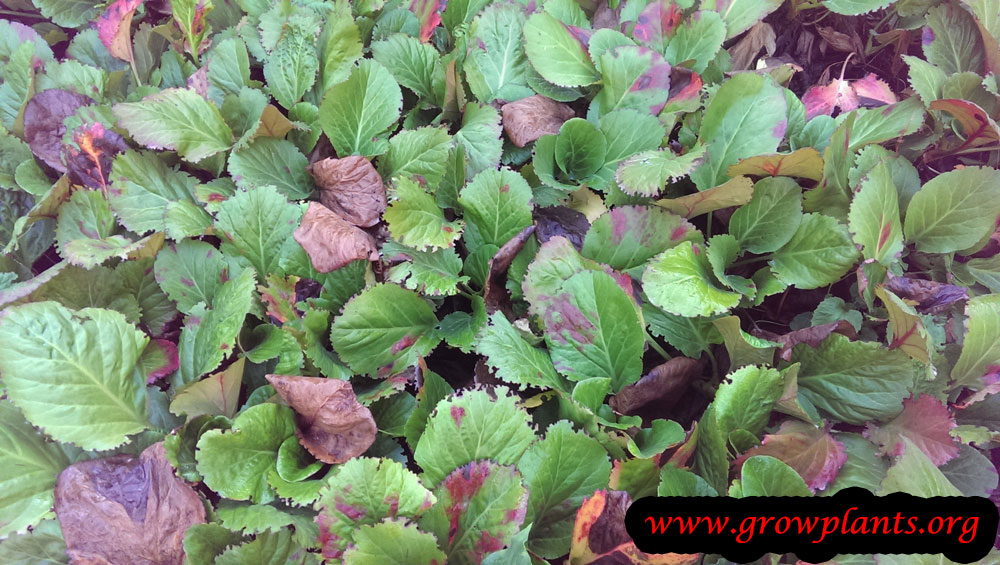
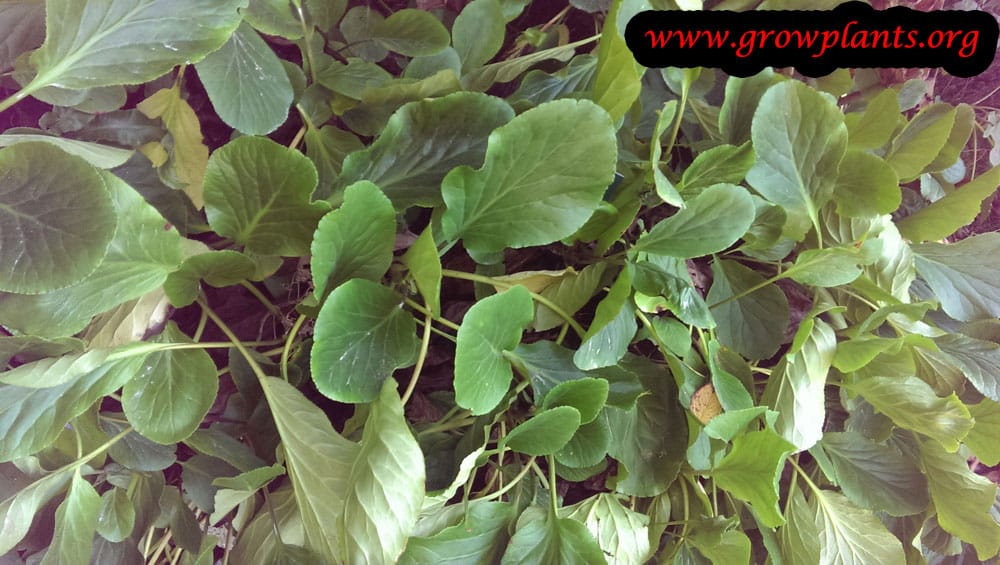
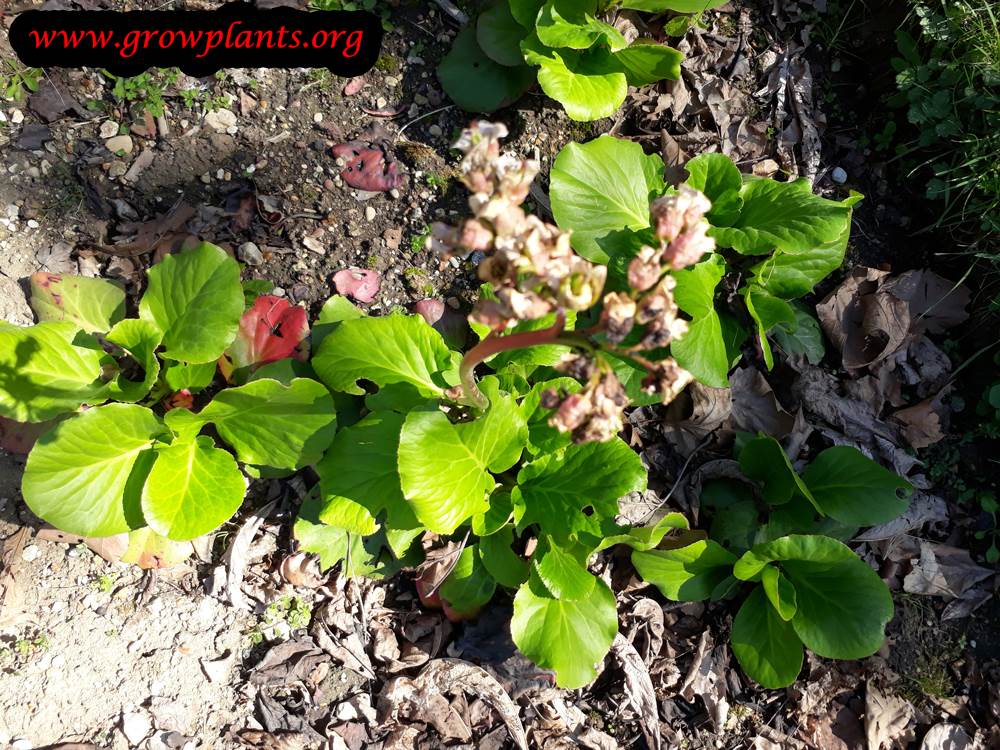
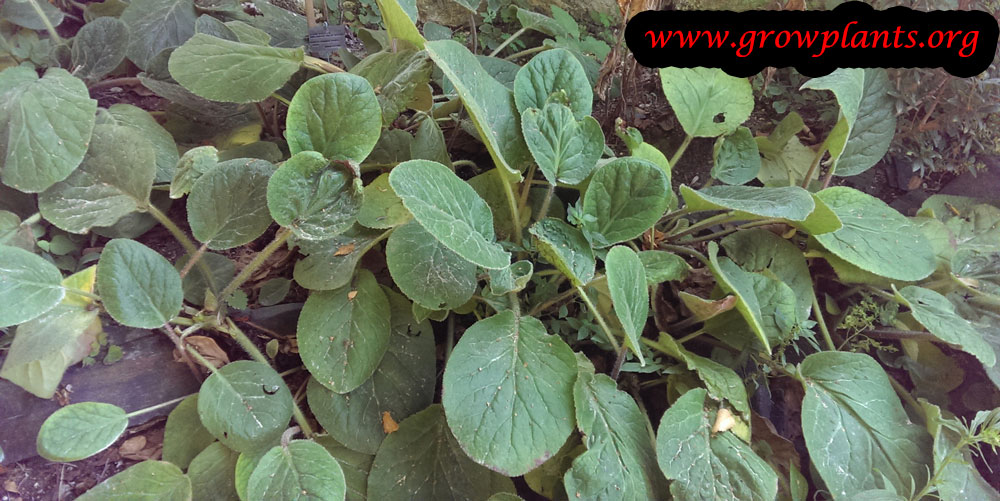
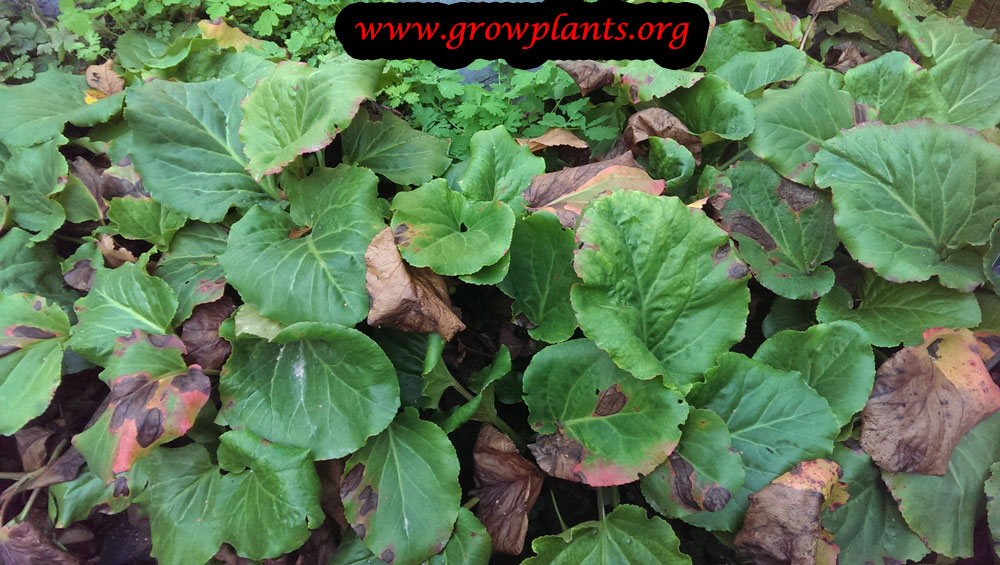
- Leaves & Foliage: Large green spatula-shaped leaves with wavy margins that turn red in autumn.
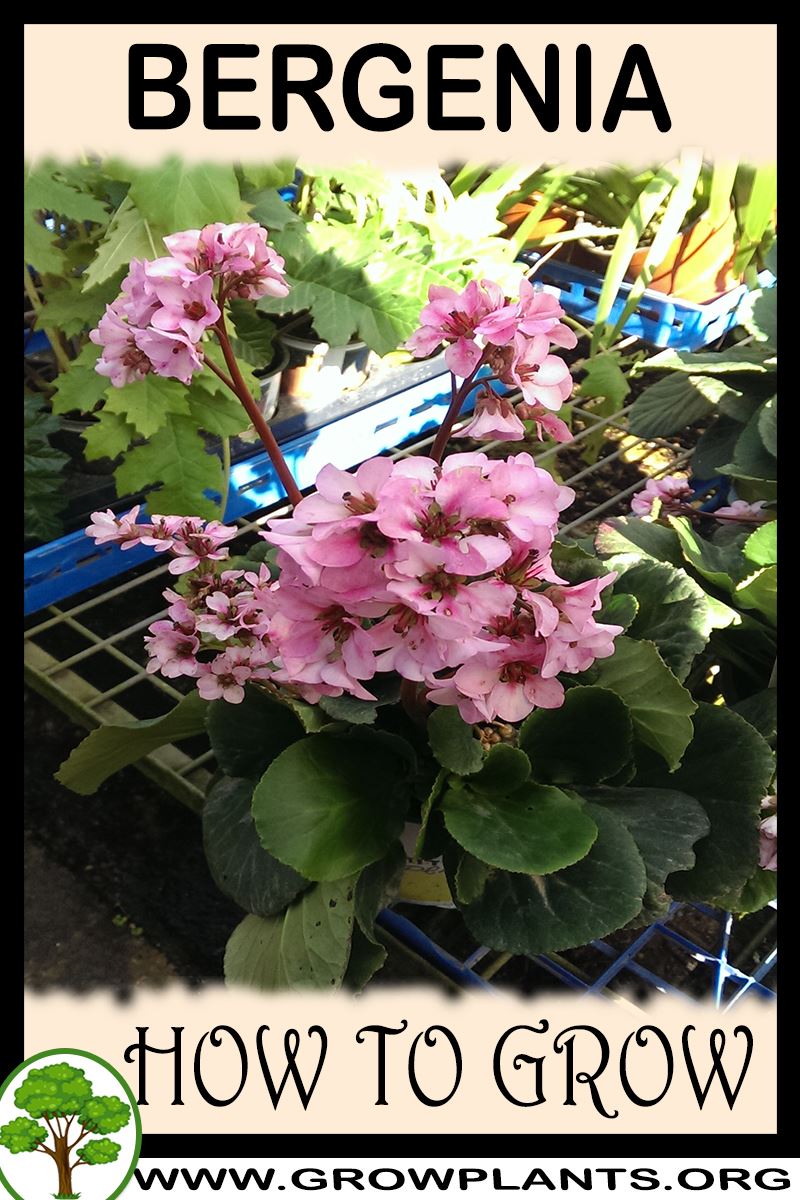
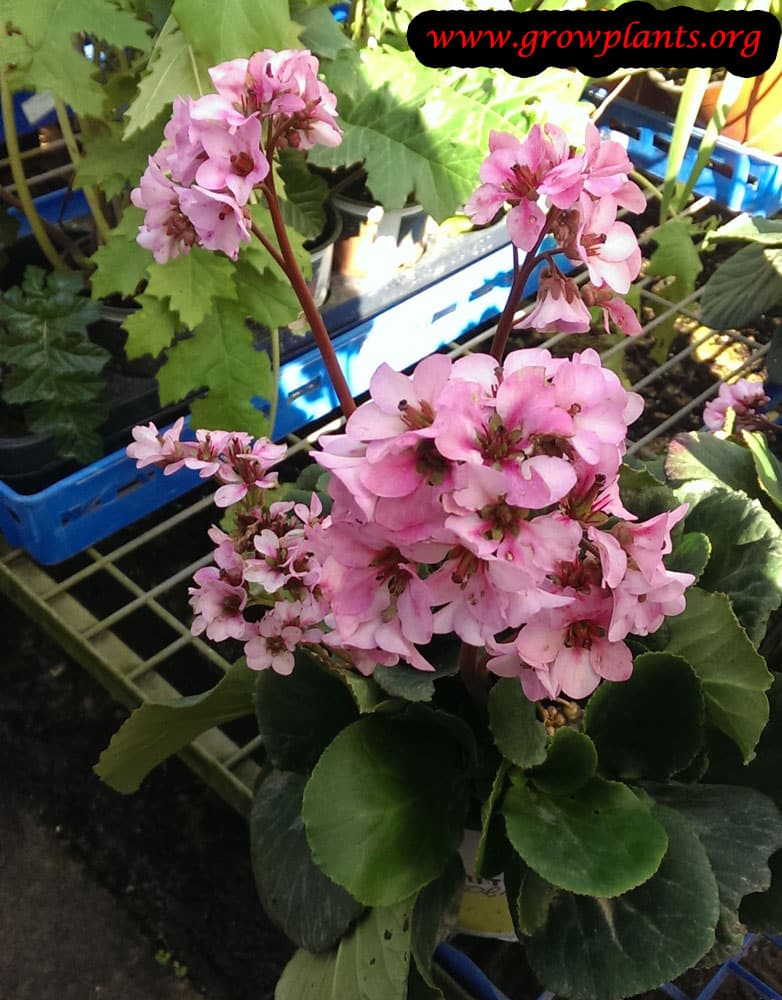
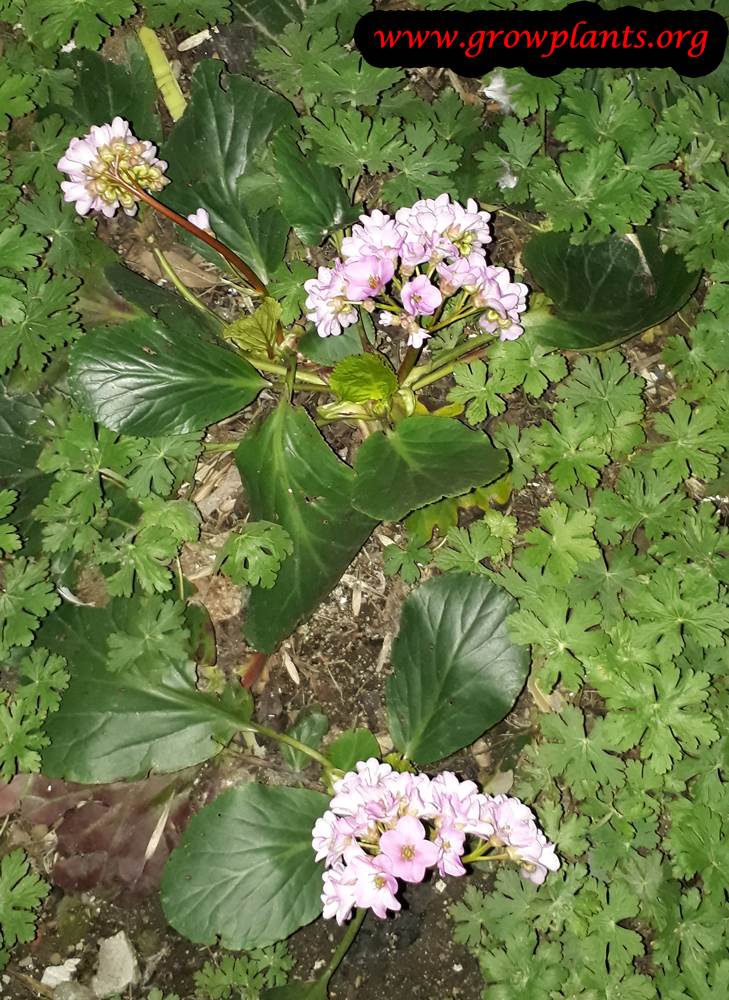
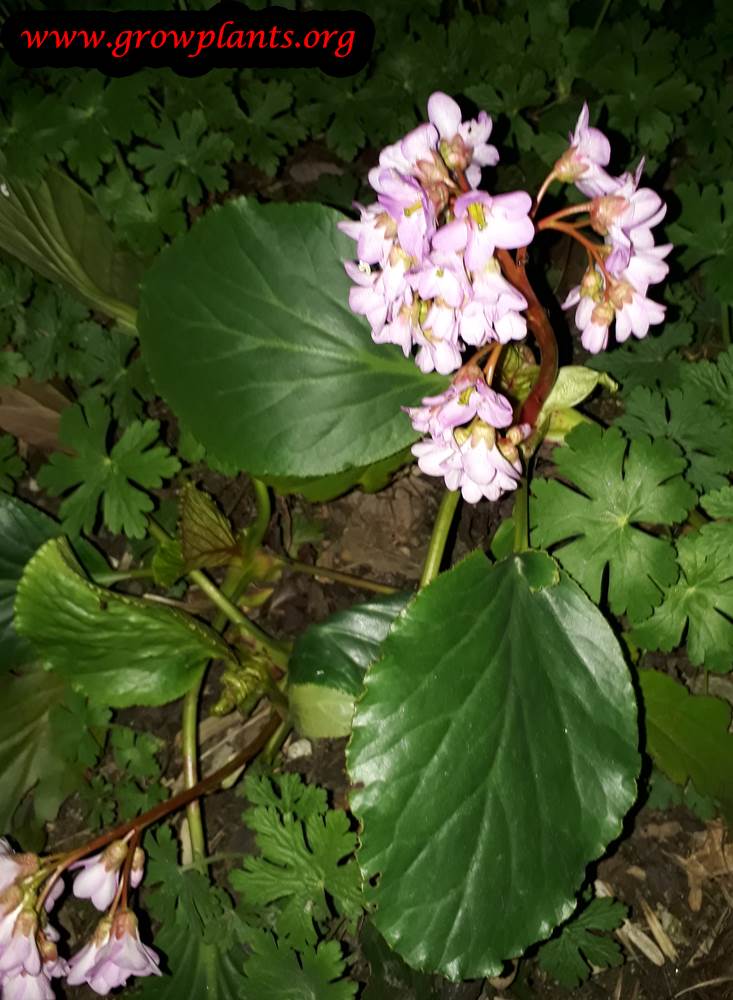
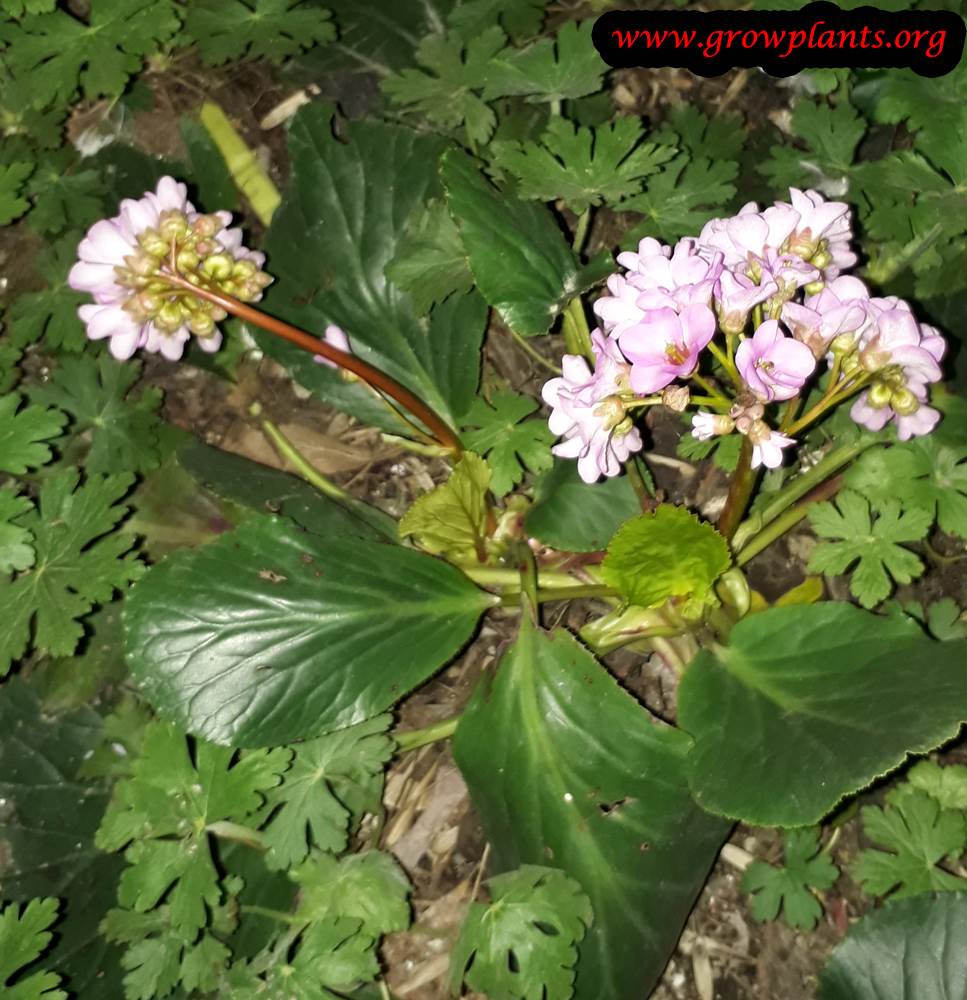
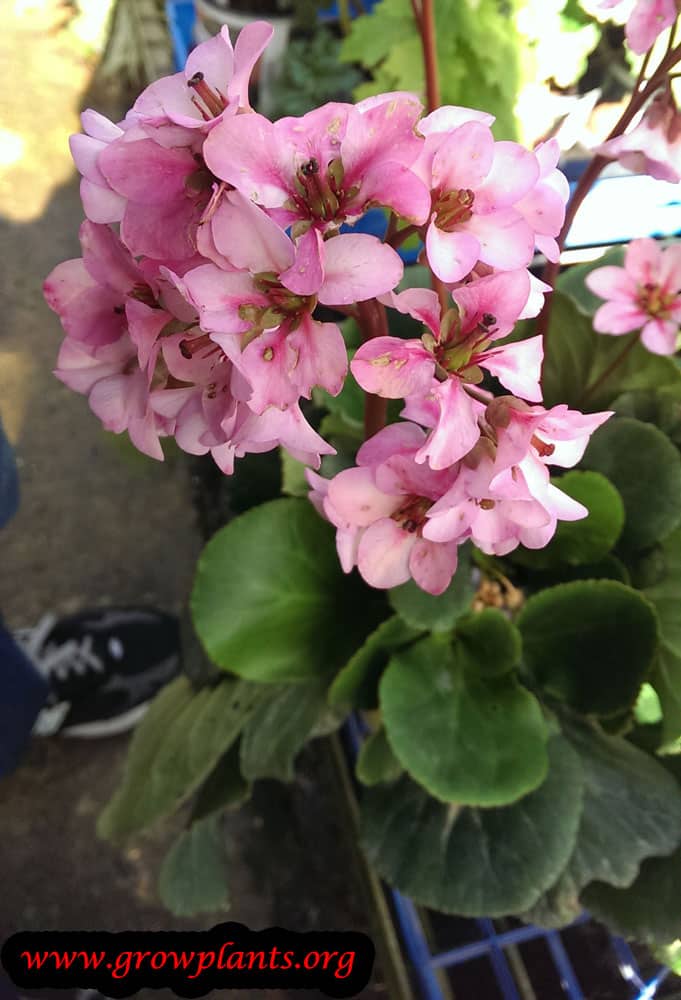
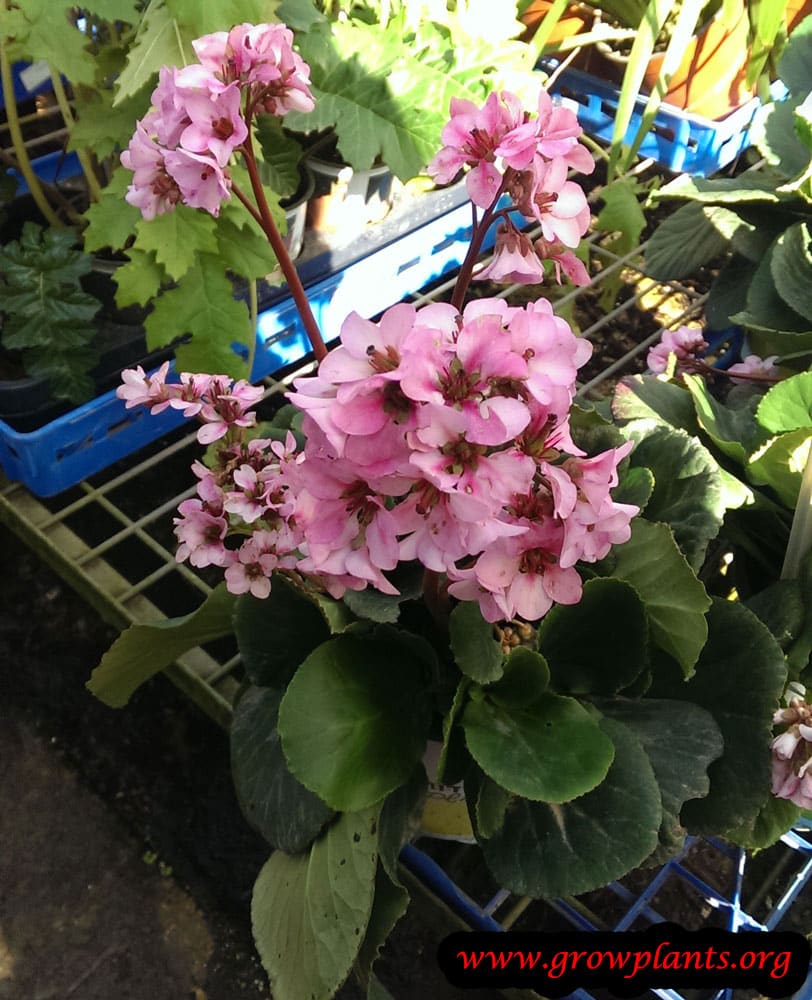
- Flower Characteristics: Small trumpet-shaped flowers in pink, red, white or purple, borne in clusters on stalks (full detail in the Bloom section).
Primary Uses & Landscape Value
- Functional & Ornamental Roles: Evergreen groundcover, edging, shade and border planting, and containers.
Care Guide: Planting, Soil & Watering
Overview: Bergenia (Bergenia, elephant-eared saxifrage) is a tough evergreen rhizomatous perennial that grows in full sun to part shade and prefers a moist yet well-drained, humus-rich soil. It appreciates steady moisture and stable conditions – sudden swings in weather can weaken it.
Quick Care Requirements
| Requirement | Ideal Condition |
|---|---|
| Planting Season | In spring and summer, during the growing season |
| Growth Rate | Moderate to fast |
| Soil Type | Moist, humus-rich and well-draining |
| Water Need | Moderate to high – keep the soil evenly moist |
Planting & Establishment
- Best Planting Season: Plant in spring or summer so the rhizome establishes during the warm season.
- How to Plant:
- Hole Preparation: Dig a shallow, wide hole a little larger than the root and rhizome spread.
- Soil Amendments: Work in compost and organic matter to enrich the soil and hold moisture while keeping it free-draining.
- Planting Depth: Set the rhizome just at or barely below the soil surface, with the crown at ground level; do not bury it deeply.
- Growth Speed & Expectations: Moderate to fast; spreads by rhizomes into a 30–40 cm (12–16 in) evergreen clump.
Soil, Watering & Drainage Care
- Soil Mix & Drainage Needs: Wants a moisture-retentive but well-drained soil; add grit or compost to heavy ground so the rhizome does not sit wet and rot.
- Watering Schedule & Technique:
- Young / Newly Planted: Keep consistently moist while establishing.
- Established: Water regularly to maintain even moisture, letting just the surface dry between waterings; it is tolerant once settled but performs best with steady moisture.
- Seasonal Adjustments: More in summer heat; less in cold winter weather.
Climate, Light & Hardiness
Bergenia is a tough, evergreen, rhizomatous groundcover for temperate to subtropical gardens, very cold hardy and with leathery leaves that redden through autumn and cold weather. It takes full sun in cool climates but wants part or afternoon shade where summers are hot, in moist but well-drained soil.
Quick Climate Specifications
| Climate Zones | Temperate, mediterranean, subtropical |
|---|---|
| USDA Hardiness Zones | 4–10 (site data) |
| Optimal Temp Range | Cool, roughly 15–24 °C (59–75 °F) |
| Cold Damage Begins | Evergreen foliage bronzes and scorches under hard freeze and cold, drying wind; the rhizome is far hardier |
| Approx. Survival Minimum | Dormant rhizome survives cold typical of its zone, around −34 °C (−29 °F) in zone 4 |
| Frost Tolerance | High |
| Light Conditions | Full sun (cool climates) to part shade |
| Wind Tolerance | Moderate (cold, drying winds bronze the leaves) |
Sunlight & Light Exposure
Optimal Light Setup
Full sun to part shade. In cool climates full sun deepens the autumn and winter leaf colour; in hot regions part shade is safer.
Direct Sun Requirement
It tolerates full sun in cool climates, but foliage can scorch in hot, dry, full sun.
Shade & Heat Management
Afternoon or dappled shade in warm climates prevents leaf scorch and moisture stress.
Best Exposure / Orientation
An open cool border or a light woodland edge suits it; it also makes a durable front-of-border or path-side groundcover.
Temperature Extremes & Hardiness
USDA Hardiness & Regional Limits
Hardy across zones 4–10. The warm end of the range is limited more by summer heat and humidity than by winter cold.
Cold Damage & Winter Protection
The evergreen leaves persist through winter; a hard freeze combined with cold, desiccating wind bronzes or burns the foliage, but the rhizome survives and pushes fresh growth in spring, when tattered leaves can be trimmed away. Erratic winters with repeated freeze–thaw or unstable weather weaken the plant (site data), so a steady, sheltered position is best.
Frost Sensitivity
High frost tolerance - the foliage is cold-hardy and the crown very much so.
Extreme Heat Tolerance
Moderate to low. Hot, dry conditions scorch the leaves; give shade and steady soil moisture where summers are hot.
Wind, Humidity & Microclimate
Humidity Preferences
Adaptable across a range of humidity levels.
Dry-Air Tolerance
Moderate - the thick, leathery leaves are fairly resistant, though hot, dry wind bronzes them.
Wind Tolerance
Cold, dry winter winds desiccate and discolour the evergreen foliage, so shelter it in exposed cold sites.
Rainfall & Seasonal Moisture
Prefers consistently moist but well-drained conditions; steady moisture and even conditions serve it far better than fluctuating extremes.
Microclimate Recommendations
An even, sheltered position that avoids both freeze–thaw extremes and hot, dry sun gives the best year-round foliage.
Growing in Pots, Balconies & Indoors
Bergenia (elephant’s ears) is a tough, low evergreen perennial that the grower does not recommend as a houseplant – it is a hardy outdoor plant that wants a winter chill. It does make an excellent container and edging plant for a patio or balcony, where its bold, leathery leaves look good year-round.
Quick Details
- Container Size: A medium pot (about 5-15 L / 1.3-4 gal) suits a clump; it spreads slowly by rhizome
- Indoor Suitability: Not a houseplant – grow it outdoors in a pot; at most a bright, cool porch for short spells
- Best Spot: Full sun to half shade; some afternoon shade where summers are hot
- Soil & Drainage: Organic-rich but free-draining mix; it tolerates a range of soils
- Watering in Pots: Likes steady moisture – water when the top starts to dry, more in heat, but never waterlogged
Indoors & On the Windowsill
- Not a houseplant: The grower marks it unsuitable indoors. It needs the cool and seasonal chill of outdoor life to stay healthy, so keep it outside.
- Cool spot only: At most it tolerates a bright, cool, unheated porch or entry for a short display; a warm living room does not suit it.
On a Balcony or Patio
- Hardy and handsome: Its evergreen leaves earn their place on a patio or balcony all year; give it sun to part shade.
- Watering & exposure: Pots dry faster than the ground and reflected heat adds to it – keep the mix evenly moist and shelter from the fiercest afternoon sun in hot spots.
Choosing the Pot, Soil & Long-Term Care
- Pot & drainage: Strong drainage holes and no standing-water saucer to avoid root rot; terracotta breathes and dries faster, glazed or plastic holds moisture longer.
- Potting mix: Organic-rich but free-draining – a peat- or coir-based mix with perlite or vermiculite.
- Feeding: Pot nutrients leach with watering, so feed lightly and regularly through the growing season.
- Repotting & dividing: Refresh the mix or pot up every couple of years; lift and divide congested clumps at the same time to keep them vigorous.
Fertilizing & Feeding
Bergenia is a tough, low-maintenance evergreen groundcover that needs only modest feeding; light balanced nutrition as growth resumes in spring is plenty.
Quick Fertilizing Specs
| Feeding Level | Light – an undemanding evergreen perennial |
|---|---|
| Main Nutrient Priority | Balanced nutrition with adequate nitrogen; high-phosphorus ‘bloom’ feeds are not needed |
| Best Feeding Period | As new growth resumes in spring |
| Organic Options | Compost or leaf mould topdressed around the crowns |
| Soil pH | Adapts to a wide range, from slightly acidic to near neutral |
| Reduce/Stop Feeding | Stop feeding through winter dormancy |
| Micronutrients | Iron only if new leaves show interveinal yellowing |
Feeding by Growth Stage
Spring growth and flower emergence
Fuel the fresh flush of leaves and emerging flower stalks as growth resumes.
| Nutrient direction | Balanced nutrition with adequate nitrogen to support leaves and bloom together. |
|---|---|
| Timing | As growth restarts in early spring. |
| Frequency | A single light feeding as growth resumes is usually enough. |
| Fertilizer types | A balanced complete fertilizer, Compost or well-rotted organic matter |
| Precautions | Avoid overfeeding; excess nitrogen gives lush leaves and weaker flowering. |
Spring bloom
Carry the plant through flowering without pushing soft, floppy growth.
| Nutrient direction | Steady balanced nutrition; a special high-phosphorus bloom feed is not needed. |
|---|---|
| Timing | Through the spring flowering period. |
| Frequency | Minimal additional feeding beyond the spring application. |
| Fertilizer types | A balanced complete fertilizer, if not already applied in spring |
| Precautions | Do not chase bigger blooms with high-phosphorus products; balanced feeding and good light drive flowering. |
Winter dormancy and rest
Allow the evergreen clumps to rest through cold winter dormancy.
| Nutrient direction | None – withhold fertilizer during dormancy. |
|---|---|
| Timing | Through the cold winter rest period. |
| Frequency | No feeding at this stage. |
| Fertilizer types | No feeding at this stage; resume in spring. |
| Precautions | Do not fertilize dormant plants; wait for spring growth. |
Nutrient Deficiency Signs & Corrections
Older leaves turn pale green to yellow and growth is sluggish.
| Possible causes | Nitrogen shortage in a poor soil, Cold, waterlogged soil slowing uptake, Roots stressed by unstable weather |
|---|---|
| Appears first on | Older, outer leaves |
| What to check | Soil fertility and drainage, Recent weather and watering |
| Possible correction | Improve drainage; as growth resumes apply a balanced complete fertilizer at a modest rate and topdress with compost. |
New leaves yellow between the veins while the veins stay green.
| Possible causes | Iron tied up by alkaline or wet soil, Poor drainage limiting root uptake, Genuine iron shortage |
|---|---|
| Appears first on | Youngest leaves |
| What to check | Soil pH and drainage |
| Possible correction | Correct soil pH and drainage; if needed apply a chelated iron product as directed on its label. |
Healthy leaves but few flowers.
| Possible causes | Too much shade, Excess nitrogen favouring foliage, Clumps too young or overcrowded |
|---|---|
| Appears first on | Flowering stalks |
| What to check | Light exposure, Recent high-nitrogen feeding, Whether clumps need dividing |
| Possible correction | Give more light, keep nitrogen moderate with balanced feeding, and divide crowded clumps. |
Pruning, Training & Seasonal Maintenance
Bergenia (Elephant-eared saxifrage) is a low, clump-forming evergreen perennial that grows from a stout surface rhizome, not from woody stems, so it needs no structural pruning and tolerates only light grooming. The work is simple: deadhead the spent spring flower stalks, lift out leaves that winter has scorched, and divide congested clumps every few years to renew vigour and flowering. Winter foliage turns bronze-red and is a deliberate ornamental feature, so leaf removal is kept to genuinely dead or tattered blades — never a blanket shear. At 30–40 cm and hardy to zone 4–10, its cut-and-come-again needs are minimal.
Quick Pruning & Maintenance Specs
| Pruning Tolerance | Low — grooming and division only; no structural or renewal cutting |
| Primary Pruning Window | Early spring — remove winter-damaged evergreen leaves as new growth starts |
| Secondary Maintenance Window | After flowering (late spring) — cut spent bloom stalks to the base |
| Typical Frequency | Light grooming a few times per season; lift-and-divide every 3–5 years |
| Main Objective | Tidy the evergreen mat, remove spent flower stalks, rejuvenate old rhizomes |
| Young Plant Priority | Let the clump root in — remove only damaged leaves |
| Mature Plant Priority | Deadhead, groom tatty leaves, divide congested rhizomes |
| Best Tool Type | Precision snips or bypass secateurs for soft stalks; a spade or knife for division |
| Avoid Heavy Pruning During | Autumn and winter — healthy foliage protects the crown and colours up |
Pruning by Plant Age & Size
Newly Established
Plant and leave it alone. Remove only leaves damaged in planting; the clump needs a full season of foliage to build the rhizome before any grooming matters.
Young / Formative
No structural training applies — Bergenia has no framework of branches, only a spreading rhizome and a rosette of leaves. Simply let the crown widen; pinching, staking and leader selection are irrelevant.
Mature / Established
Now maintenance settles into a rhythm: deadhead after the spring flush, pull or cut away winter-burnt leaves in early spring, and every 3–5 years lift and divide the clump. Old central rhizomes go bare and woody with age — division is how Elephant-eared saxifrage is renewed, not cutting back.
Seasonal Pruning Schedule
Early Spring (Pre-Growth)
Objective: refresh the evergreen mat before new leaves and flower stalks emerge. Remove: leaves browned or scorched by winter, and any slug-chewed blades. Do NOT remove: healthy green or bronzed leaves — they are still feeding the crown. Response: fresh leaves and flower stalks push up quickly. Flowering impact: none — buds form fresh each spring, so this clean-up does not cost bloom.
After Flowering (Late Spring / Early Summer)
Objective: tidy and stop seed set. Remove: spent flower stalks, cut low at the base. Do NOT remove: the surrounding leaves. Response: energy returns to the rhizome and foliage. Flowering impact: deadheading has no bearing on next year’s display, which comes from new spring growth.
Ongoing Sanitary
Objective: keep the clump presentable. Remove: yellowing, torn or slug-damaged leaves as they appear. Do NOT shear the whole plant — spot-remove individual blades. Autumn note: leave the foliage intact into winter; it colours red and shelters the crown.
Structural Pruning & Training
There is no branch structure to shape and canopy thinning does not apply — a Bergenia is a ground-hugging rosette. Its only form of ‘renewal pruning’ is division: lifting a congested, hollow-centred clump, cutting the rhizome into sections that each carry a growing point and roots, and replanting the vigorous outer pieces while discarding the worn woody core.
Special Growth to Remove
- Spent flower stalks: cut to the base once the pink, red, white or purple blooms fade — improves looks and stops seeding.
- Dead and winter-scorched leaves: snip or gently pull the whole leaf at the petiole base; do not tear the crown.
- Old bare rhizome sections: removed only at division — trim away the leafless woody centre and keep the fresh outer growth.
There are no suckers, runners or watersprouts to manage — Bergenia is a tight clumper, not a spreader, so every leaf and stalk is either kept or removed on its own merits.
Container & Small-Space Pruning
Bergenia is a reliable edging and container plant, and grooming is identical to the ground: deadhead and remove tatty leaves. The one container-specific job is division on a shorter cycle — a pot fills with rhizome faster, so lift, split and repot into fresh soil once the clump crowds its container or flowering thins.
Tools
Everything cut here is soft: flower stalks and fleshy leaf petioles. Precision snips or bypass secateurs handle all of it cleanly. For division use a sharp spade or knife to slice the rhizome. Loppers, a saw and hedge shears have no role — there is no woody material and shearing would ruin the natural rosette.
Tool Hygiene & Disease Risk
Routine. Bergenia carries no notable transmissible pruning-borne disease; its main enemies are slugs and snails feeding on the leaves. Clean, sharp blades are enough. Wipe the blade if you have just cut obviously rotting tissue, but there is no need to disinfect between every cut.
Cut Placement & Technique
- Cut flower stalks low, close to the crown, so no stub is left to rot.
- Remove a leaf by severing or easing off the whole petiole at its base — never leave half a leaf.
- When dividing, cut the rhizome cleanly into sections that each keep a bud and healthy roots.
Heavy Pruning & Rejuvenation
Bergenia does not respond to hard cutting-back the way a shrub does — there is no woody framework to regrow from. Rejuvenation is achieved by dividing the clump in early spring or early autumn: discard the old woody centre, replant the fresh outer rhizome pieces, and the planting returns to full vigour and flowering within a season.
Post-Pruning Care
Grooming needs no aftercare and no feeding. After division, water the new sections in well and keep the soil moist — Bergenia likes reliable moisture — and give freshly split pieces a little shade until they root. Do not force feeding: it is not recovering from a hard prune, only re-rooting.
Common Pruning Mistakes
- Shearing off the evergreen foliage in autumn — you lose the winter red colour and expose the crown to cold.
- Never dividing — old clumps develop bare, woody centres and flower less.
- Cutting into the rhizome unnecessarily instead of just removing leaves and stalks.
- Removing healthy leaves to ‘neaten’ the plant — they feed the crown and will not regrow like a hedge.
When NOT to Prune
- Not through autumn and winter — leave the evergreen foliage to protect the crown and provide seasonal colour.
- Not in summer heat or during flowering for division — divide in early spring or autumn instead.
- Not right after transplanting, and not during drought stress — groom only when the plant is settled and adequately watered.
Recommended Tools (by task)
- precision_snips — deadheading soft flower stalks and trimming individual leaves cleanly at the base.
- bypass_secateurs — for tougher, thicker petioles when grooming a mature clump.
- garden_spade — lifting and slicing the rhizome when dividing every few years.
Propagation Guide
Bergenia spreads by a thick surface rhizome and is increased most reliably by dividing that rhizome or lifting and splitting the clump, which keeps a chosen plant identical. Seed is possible but variable and slow. It is an easy plant to propagate vegetatively.
Quick Propagation Specs
| Best Propagation Method | Rhizome / crown division |
| Alternative Methods | Rhizome-piece cuttings; seed |
| Propagation Difficulty | Easy |
| Seed True-to-Type | Variable – seedlings differ (garden plants are often hybrids); divide to keep a form |
| Vegetative True-to-Type | Yes |
| Best Propagation Season | After flowering, or in early autumn or spring |
| Seed Sowing Depth | Surface-sow – do not cover; light aids germination |
Growing from Seed
Seed Handling & Viability
The seed is small; sow it while reasonably fresh for the best results.
Sowing Season
Sow in late winter or spring; a spell of cold before germination can help even it up.
Sowing Depth & Orientation
Surface-sow and do not cover — the fine seed needs light to germinate; press it onto moist compost.
Germination Conditions
Keep cool, bright and evenly moist; avoid high heat.
Germination Time
Germination is slow and often uneven, so keep trays for an extended period.
Seedling Care
Prick out the small seedlings once they can be handled and grow them on before planting out; seed-raised plants take a season or two to reach flowering size and may vary.
Division, Offsets, Pups & Suckers
Clump division is the standard and easiest method. Lift an established plant after flowering, or in early autumn or spring, and split the crown into pieces that each carry a leafy rosette and its own roots. Trim off tired outer leaves to cut water loss, replant at the same depth in moisture-retentive soil, and keep the divisions watered until they take hold. Old woody clumps are best rejuvenated this way every few years.
Rhizomes, Tubers, Bulbs & Corms
Rhizome Division
The plant can also be increased from sections of the thick surface rhizome. Cut the rhizome into pieces a few centimetres long, each with at least one growth bud or a small rosette and some roots. Firm the sections into gritty, moist compost with the buds at the surface, keep them shaded and just moist, and new shoots develop from the buds. Discard any soft or rotten lengths of old rhizome.
Bloom & Flower Guide
Quick Details
- Bloom Season: Early to mid spring, among the first perennials to flower
- Time to First Bloom: Divisions typically flower from their second spring once the clump is settled
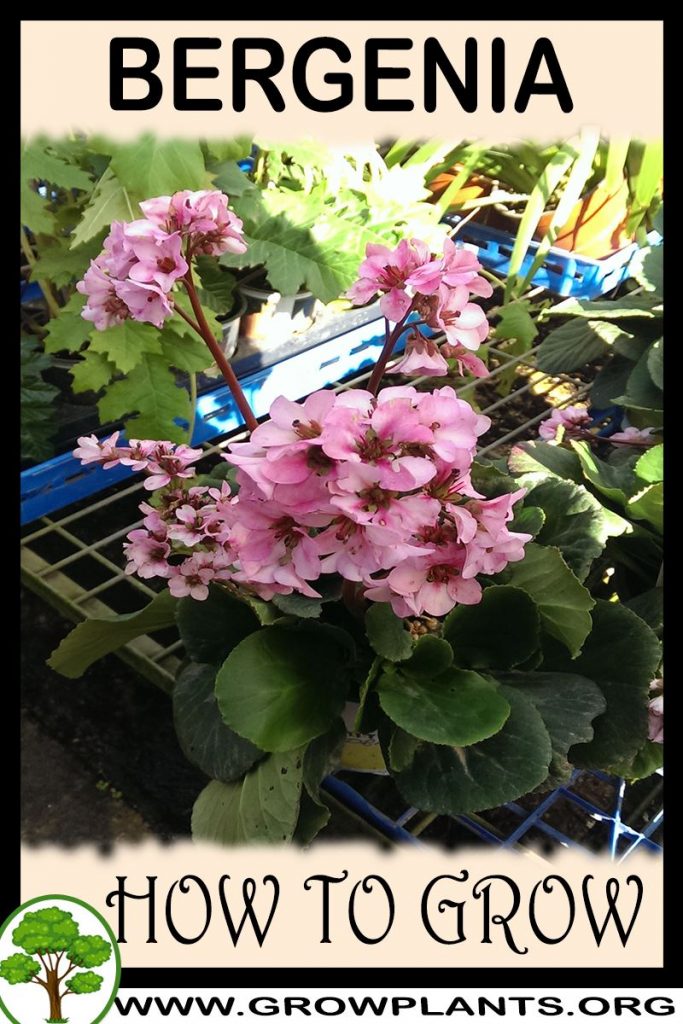
- Flower Appearance: Small bell or trumpet-shaped flowers in pink, red, white or purple, clustered on a stout stalk above the leaves
- Edibility: Ornamental – grown for its flowers and foliage, which are not eaten
Detailed Blooming Overview
Bergenia, or elephant-eared saxifrage, is an evergreen ground-cover perennial that flowers very early in the season. Sturdy reddish stalks push up above the big leathery leaves and open into rounded clusters of little bell flowers, providing colour when much of the garden is still bare. The bold leaves themselves often flush red in cold weather, setting off the blooms.
Flower Characteristics
- Small trumpet- or bell-shaped flowers in pink, red, white or purple.
- Flowers gathered in a cluster held on an upright stalk above the foliage.
Bloom Care & Thinning
- Site for best bloom: Sun to part shade in most soils; a little sun encourages the strongest flowering and leaf colour.
- After flowering: Remove spent flower stalks at the base to keep the clump tidy and channel energy into next year’s crowns.
- Pollination: An early nectar source worked by bees emerging in spring.
Fruit & Uses
Bergenia (elephant-eared saxifrage) is grown mainly as an evergreen ornamental groundcover. The part with a genuine traditional use is the leaf: mature, weathered leaves are dried and steeped as a caffeine-free herbal tea, most famously the Siberian / Mongolian “Badan” tea associated with Bergenia crassifolia. The fresh leaves are astringent and tannin-rich and are not eaten raw – only well-dried (and traditionally aged / part-fermented) leaves are brewed, and only in moderation.
Quick Edible Specs
| Edible Parts | Mature / weathered leaves (dried, for herbal tea) |
| Main Use(s) | Culinary herbal infusion (“Siberian tea”); traditionally used medicinally |
| Eaten Raw or Cooked | Not eaten raw – leaves are dried and brewed as tea |
| Preparation Required | Dry (traditionally age / part-ferment) the leaves, then steep in hot water |
| Harvest Season | Collect old, over-wintered lower leaves in late winter to early spring |
| Storage | Store thoroughly dried leaves airtight, in a dry, dark place |
| Safety/Toxicity Caveat | High in tannins and arbutin; use only well-dried, aged leaves and in moderation. Not a raw food. Fresh leaves and the rhizome are astringent. |
Leaves & Greens
The traditional “tea” is made from the thick, leathery leaves once they are old – the lower, over-wintered leaves that have gone brown or blackened on the plant and partly fermented through the cold season are the ones gathered. Young, bright-green leaves are too astringent and are not used. The picked leaves are dried fully; steeping them in just-off-the-boil water (about 90–100°C / 194–212°F) gives a dark, tannic, earthy infusion. It is a beverage only – the leaves themselves are not eaten.
Harvesting
Take only the old, weathered outer leaves after winter – this both supplies the part that is actually used and tidies the clump (see Pruning for reshaping). Leave the fresh central rosette to keep growing. Dry the harvested leaves before use; there is no fruit or seed crop to gather here.
Preparation, Uses & Safety
Safety first: Bergenia is not a salad or pot-herb. Every part is astringent and rich in tannins and arbutin, so nothing should be eaten raw. Only fully dried, aged leaves are brewed, and the tea is best taken in moderation. People who are pregnant, nursing, or on medication, and anyone unsure, should avoid it. The leaves (and, in some species, the rhizome) are traditionally used medicinally as an astringent; this is noted for background only and is not a health claim or dosing advice. If in any doubt about identification or safety, do not consume it.
Pests, Diseases & Troubleshooting
Overview: Bergenias (elephant’s ears) are tough, leathery-leaved evergreen perennials that shrug off most trouble. Their two standout pests are vine weevil – whose grubs sever roots and cause sudden collapse – and slugs and snails grazing the foliage. Fungal leaf spots appear in damp, crowded conditions, and the crown rots in cold, waterlogged soil. Good drainage, airflow and tidy sanitation prevent nearly all of it.
Quick Troubleshooting Overview
| Issue / Pest | Main Symptom | Primary Solution |
|---|---|---|
| Vine weevil | Notched leaf edges (adults); sudden wilt/collapse (grubs) | Parasitic nematodes, handpick adults at night |
| Slugs & snails | Holes and slime trails on the leathery leaves | Handpick, grit/copper barriers, iron-phosphate bait |
| Leaf spot | Brown or purple blotches on leaves | Remove affected leaves, improve airflow, sanitation |
| Crown / root rot | Blackened, mushy crown in wet soil | Improve drainage; avoid winter wet and deep planting |
Common Pests & Management
- Vine weevil (Otiorhynchus sulcatus):
- Symptoms: Adults chew characteristic notches from leaf margins at night; the far more damaging C-shaped white grubs feed on roots and the crown, causing sudden wilting and collapse of apparently healthy plants, especially in containers.
- Prevention & Control: Drench the soil with parasitic nematodes (Steinernema / Heterorhabditis) in warm, moist conditions, hunt adults by torchlight and drop them in soapy water, and use sticky barriers or trap boards; check roots of container plants.
- Slugs and snails (Deroceras / Cornu spp.):
- Symptoms: Irregular holes chewed in the leaves and grazed young growth, with silvery slime trails, worst in shade and damp mulch.
- Prevention & Control: Handpick after dark, set beer traps, encircle clumps with grit or copper tape, keep mulch off the crown, and use iron-phosphate pellets where necessary.
- Caterpillars / cutworms (Noctuidae):
- Symptoms: Ragged chewing of leaves and, with cutworms, severed young shoots at soil level.
- Prevention & Control: Handpick, clear weedy hiding places, and use Bacillus thuringiensis on young caterpillars where numbers warrant.
- Aphids (Aphididae):
- Symptoms: Occasional clusters on flower stalks and new growth, with honeydew, usually minor on bergenia.
- Prevention & Control: Hose off, spray insecticidal soap if needed, and encourage predators.
Diseases & Fungal Issues
- Bergenia leaf spot (Ramularia / Colletotrichum / Heterosporium spp.):
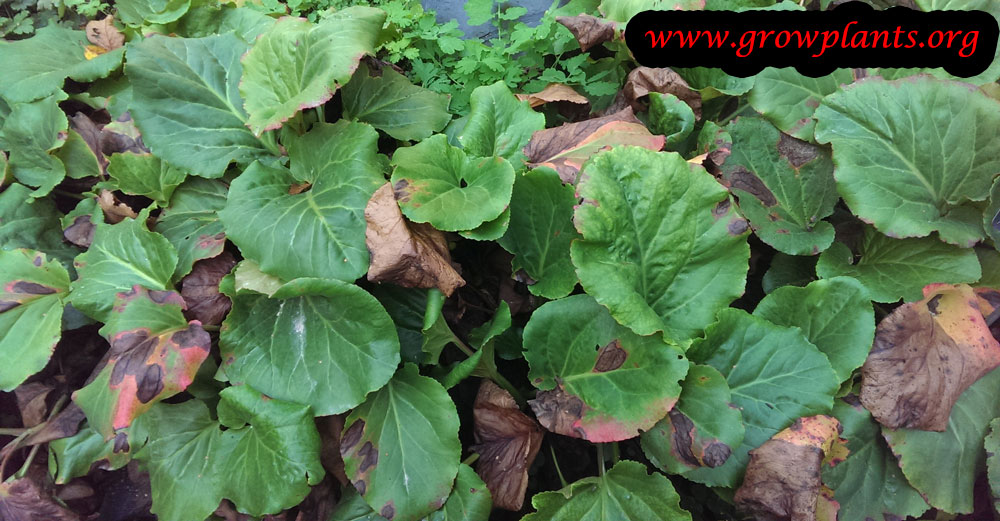
- Symptoms: Rounded brown to purple spots, sometimes with pale centres and dark margins, spreading on the large leaves in humid or splashed conditions.
- Treatment & Management: Remove and destroy spotted leaves, cut back tatty foliage, improve airflow and drainage, avoid overhead watering, and apply copper only in persistent cases; the plant flushes fresh leaves.
- Botrytis (grey mould) (Botrytis cinerea):
- Symptoms: Grey fuzzy mould on damaged leaves and old flower stalks in cool, wet, still air.
- Treatment & Management: Remove dead and damaged tissue, deadhead, and improve ventilation and drainage.
- Crown / root rot (Phytophthora / Pythium / Sclerotium spp.):
- Symptoms: Blackened, soft, foul crown and rotted roots in cold, waterlogged soil, leading to collapse.
- Treatment & Management: Plant proud in free-draining soil, avoid winter wet and deep planting, remove rotted plants, and never let containers stand in water.
Growing Difficulties & Abiotic Problems
- Winter leaf scorch:
- Cause & Symptoms: Cold, drying winds and hard frost brown and bronze the exposed evergreen leaves (in many types a decorative winter colour, but browning to the point of dieback is stress).
- Correction Strategy: Site out of the harshest wind, mulch the roots, and simply trim off badly scorched leaves in spring.
- Wet-soil root rot:
- Cause & Symptoms: Heavy, waterlogged soil rots roots and crown.
- Correction Strategy: Improve drainage and raise the planting; keep the crown at the surface.
- Chlorosis:
- Cause & Symptoms: Poor or waterlogged soil yellows the foliage.
- Correction Strategy: Improve soil, feed lightly with a balanced fertiliser, and correct drainage.
What Helps – Products & Tools
For bergenia the key tools are parasitic nematodes and night handpicking for vine weevil, iron-phosphate bait with grit or copper barriers for slugs and snails, and a copper or sulphur fungicide for leaf spot when it recurs. Above all, give it free-draining soil and airflow – most problems trace back to wet, stagnant conditions.