Plant Profile & Key Characteristics
Overview: Albizia julibrissin (Persian silk tree) is a fast-growing deciduous legume tree reaching 4-12 m (12-40 ft), with fine, fern-like bipinnate foliage and a broad, spreading crown. It is grown as an ornamental and as bonsai for its fragrant, pink powder-puff flowers, fixes nitrogen and tolerates drought.
Quick Specifications
| Specification | Attribute |
|---|---|
| Plant Type / Life Cycle | Perennial (deciduous tree) |
| Foliage Type | Deciduous |
| Mature Size | 4-12 m (12-40 ft) tall |
| Growth Rate | Moderate to fast |
| Root System | Spreading lateral roots that fix nitrogen (root nodules); can produce suckers |
| Toxicity | Seeds and pods are reported toxic if ingested (contain a neurotoxic alkaloid) |
| Hardiness | USDA zones 6-11 |
Growth Form & Structure
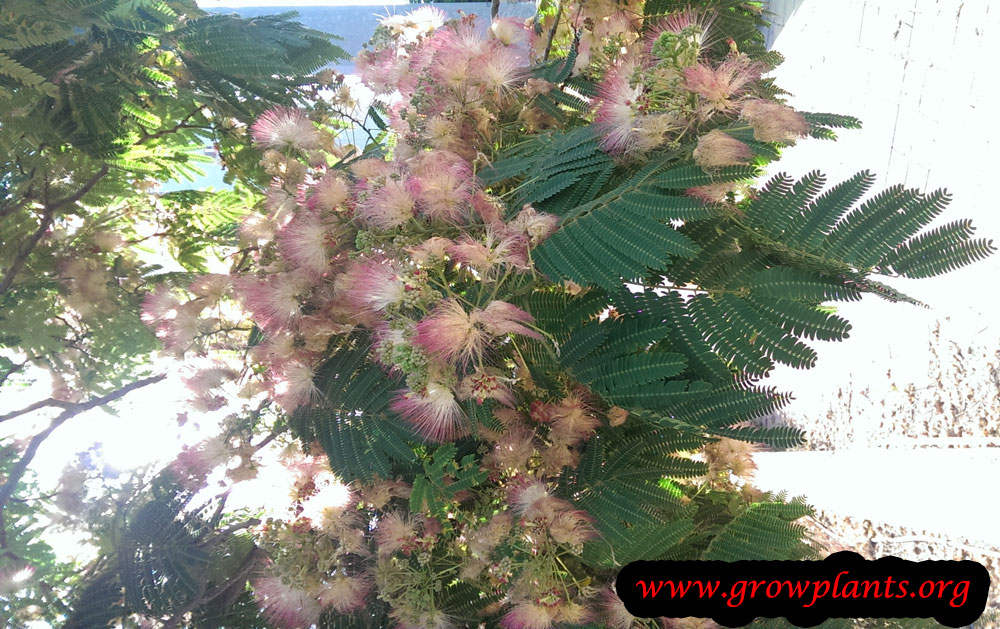
- Height & Spread: Reaches 4-12 m (12-40 ft) tall with a wide, spreading umbrella-like crown; can also be grown in containers or trained as bonsai.
- Growth Habit & Form: Small deciduous tree with a broad, flat-topped, spreading canopy.
- Lifespan & Maturity: Fast-growing but relatively short-lived tree.
Anatomy & Physical Features
- Trunk & Bark: Smooth, greenish-grey bark.
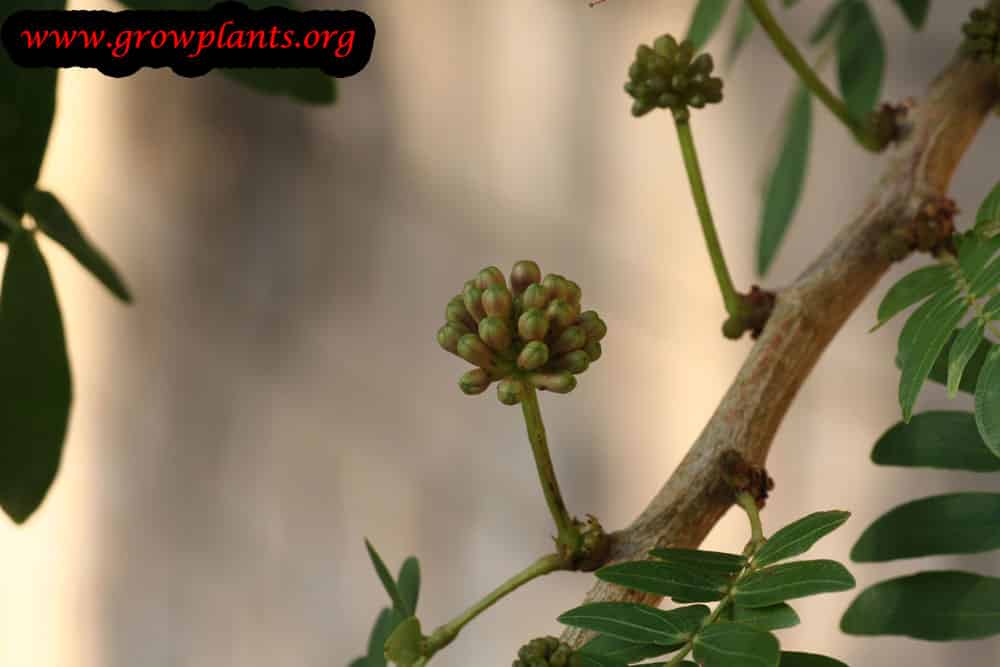
- Leaves & Foliage: Fine, fern-like bipinnate leaves with tiny 1-2 mm leaflets that fold at night.
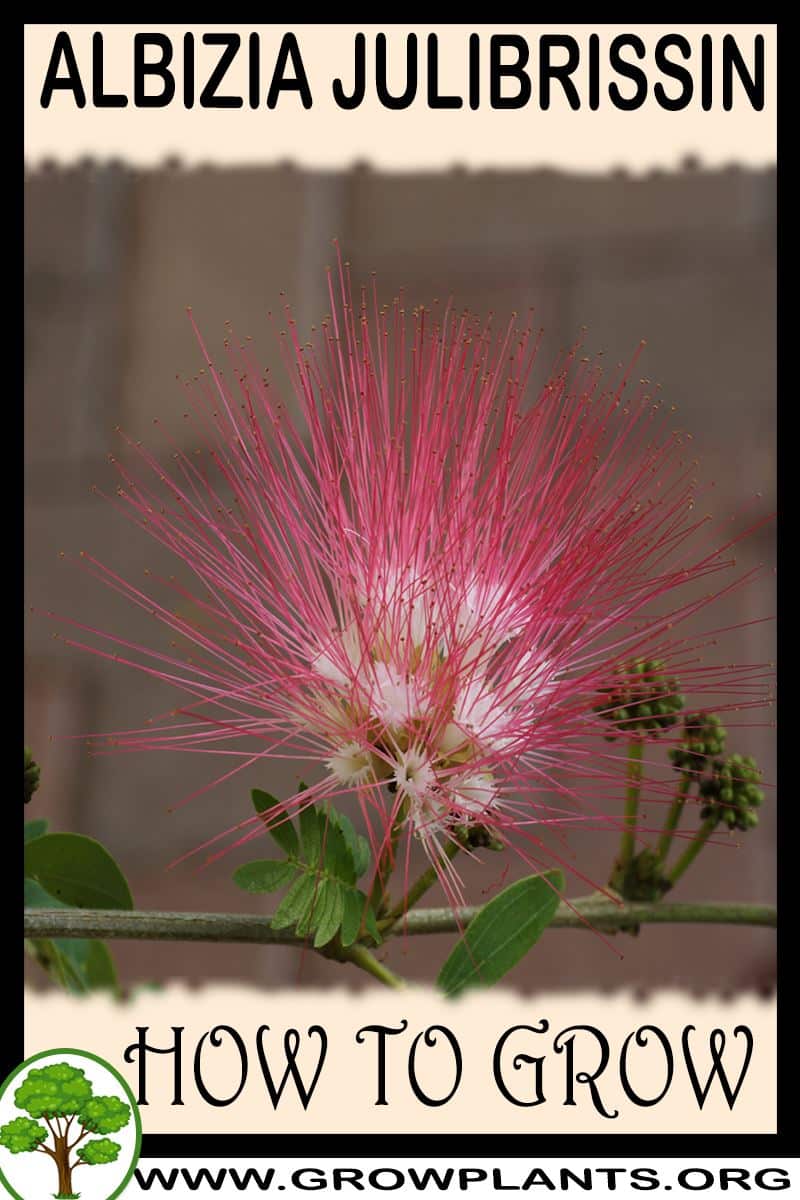
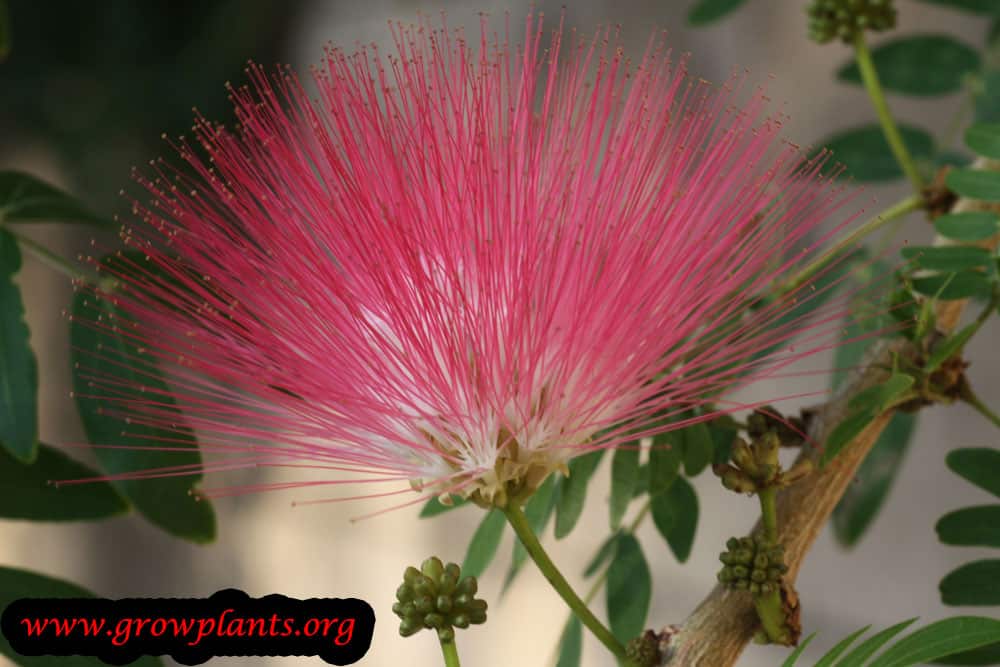
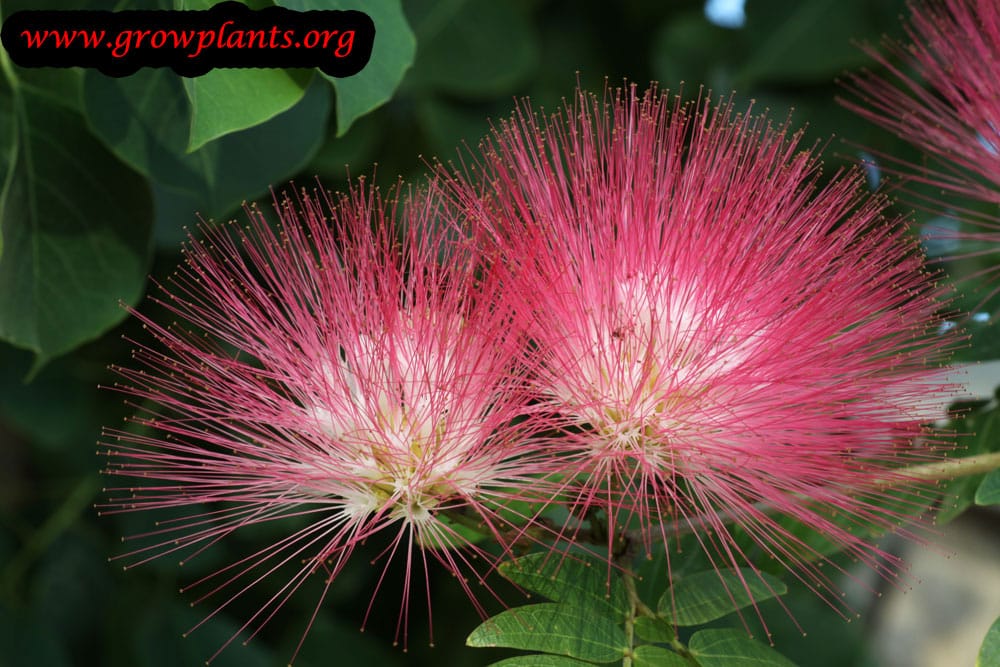
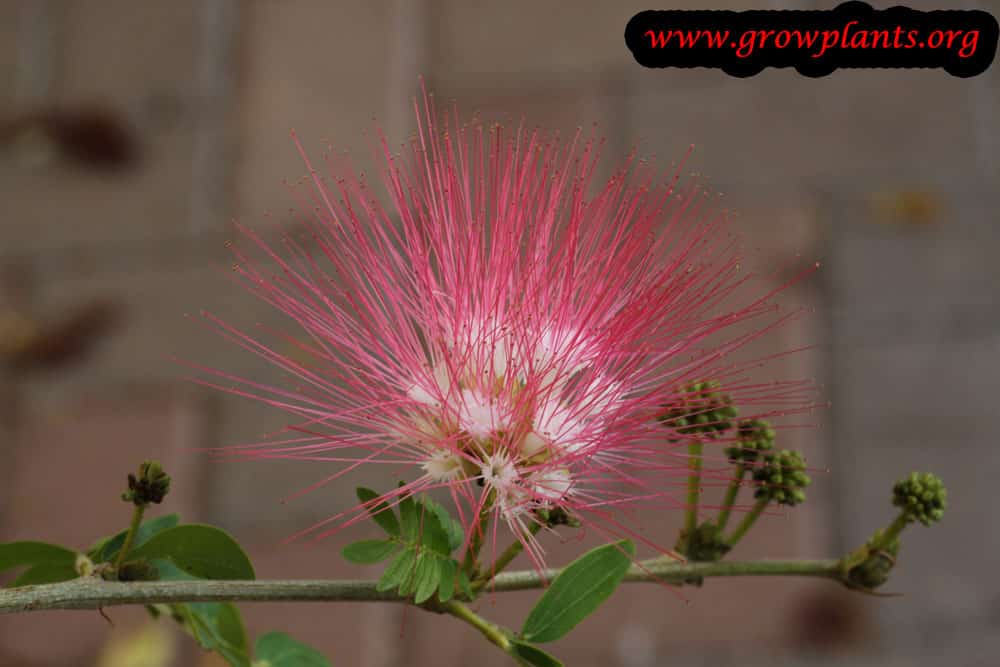
- Flower Characteristics: Fragrant, pink-and-white powder-puff flowers made of thread-like stamens (full detail in the Bloom accordion).
Primary Uses & Landscape Value
- Functional & Ornamental Roles: Ornamental shade and specimen tree, bonsai subject, pollinator plant, nitrogen-fixer, and drought-tolerant landscape tree.
Care Guide: Planting, Soil & Watering
Overview: This fast, drought-tolerant nitrogen-fixing tree suits warm-temperate to Mediterranean climates in full sun. It is undemanding, thriving in well-drained soil and tolerating poor ground.
Quick Care Requirements
| Requirement | Ideal Condition |
|---|---|
| Planting Season | In spring |
| Growth Rate | Moderate to Fast |
| Soil Type | Well-draining; tolerates poor soil |
| Water Need | Low to Moderate — drought tolerant once established |
Planting & Establishment
- Best Planting Season: Plant in spring so the tree establishes over the warm season.
- How to Plant:
- Hole Preparation: Dig a hole roughly twice the width of the root ball but no deeper, in a sunny, well-drained spot.
- Soil Amendments: It tolerates poor soil and fixes its own nitrogen, so heavy feeding is unnecessary; a little compost helps young trees.
- Planting Depth: Set the root collar level with the surrounding soil; do not bury the base of the trunk.
- Growth Speed & Expectations: Fast to moderate, quickly forming a broad, spreading canopy.
Soil, Watering & Drainage Care
- Soil Mix & Drainage Needs: Well-drained soil is the main requirement; it dislikes waterlogging.
- Watering Schedule & Technique:
- Young / Newly Planted: Water regularly through the first season to establish the roots.
- Established: Drought tolerant — needs only occasional deep watering; a small to average amount suffices.
- Seasonal Adjustments: Water during prolonged summer drought, and little to none in winter.
Climate, Light & Hardiness
The Persian silk tree is an adaptable deciduous legume tree that flowers in full sun to half shade, takes heat well and is drought-tolerant once established. It is comparatively cold-hardy - the site data spans roughly USDA zone 6–11 - overwintering bare and leafing out again in spring.
Quick Climate Specifications
| Climate Zones | Temperate, mediterranean, subtropical, desert |
|---|---|
| USDA Hardiness Zones | Approximately 6–11 (site data) |
| Optimal Temp Range | Approximately 20–32°C (68–90°F) |
| Cold Damage Begins | Deciduous and hardy through its range; late spring frost can nip new growth |
| Frost Tolerance | Moderate to high (dormant, deciduous tree) |
| Light Conditions | Full sun to half shade |
| Wind Tolerance | Moderate |
Sunlight & Light Exposure
Optimal Light Setup
Full sun gives the best canopy and the fluffy pink flowers; it also grows in half shade.
Shade & Heat Management
Its light, feathery canopy casts dappled shade and copes with strong summer sun and heat.
Best Exposure / Orientation
A warm, open, sunny site suits it and supports free flowering.
Temperature Extremes & Hardiness
USDA Hardiness & Regional Limits
The site places it around zone 6–11, so it grows across temperate, mediterranean, desert and subtropical regions - unusually wide for a legume tree. As a deciduous tree it overwinters dormant and tolerates real winter cold at the lower end.
Cold Damage & Winter Protection
Established trees are hardy through their range; the main cold risk is a late spring frost on emerging growth. Young trees benefit from shelter at the cold edge.
Frost Sensitivity
The dormant tree is frost-hardy; soft new growth can be nipped by late frost but recovers.
Extreme Heat Tolerance
Very good - it thrives in heat and, being drought-tolerant, handles hot, dry summers.
Wind, Humidity & Microclimate
Dry-Air Tolerance
Good - comfortable in dry as well as humid climates.
Wind Tolerance
Moderately wind-firm; the wide, somewhat brittle crown can shed limbs in storms, so give it a reasonably sheltered site.
Microclimate Recommendations
A warm, sunny position with room to spread suits it; at the cold edge, shelter reduces late-frost damage to young growth.
Growing in Pots, Balconies & Indoors
The silk tree, or mimosa, is a graceful spreading tree with fluffy pink flowers – not a houseplant, but the grower says it grows in containers. A young tree flowers in a large pot on a sunny patio before it outgrows one.
Quick Details
- Container Size: A large, deep pot while young – a 4-12 m (12-36 ft) tree eventually wants the ground
- Indoor Suitability: No – it needs full sun and space
- Best Spot: Full sun to half shade
- Soil & Drainage: Free-draining mix
- Watering in Pots: Small to average; pots dry fast in heat
Indoors & On the Windowsill
- Not a houseplant: It needs full sun and room to spread – grow it outdoors.
- Overwintering: Deciduous and fairly hardy; a potted young tree rests in winter – shelter the exposed pot from a hard freeze.
On a Balcony or Patio
- Sun & spreading canopy: Give it full sun and room, as the canopy spreads wide; a young tree suits a big pot, staked against wind, but plan to plant it out as it grows.
- Weight & wind: A filled pot is heavy and the airy canopy catches wind – site it securely.
Choosing the Pot, Soil & Long-Term Care
- Large deep pot: A big, deep pot with a free-draining mix and strong drainage.
- Feeding: Potted plants exhaust their soil faster as nutrients leach with each watering – feed a little more often than plants in the ground, at reduced strength.
- Repotting: Pot up or refresh every couple of years; root- and top-prune in dormancy to hold its size.
Fertilizing & Feeding
A light to moderate feeder. As a nitrogen-fixing legume it supplies much of its own nitrogen, so it needs only modest, balanced feeding through spring and the flowering season; heavy nitrogen produces leaves at the expense of flowers.
Quick Fertilizing Specs
| Feeding Level | Light to moderate |
|---|---|
| Main Nutrient Priority | Balanced nutrition; go easy on nitrogen |
| Best Feeding Period | Spring through the flowering season |
| Organic Options | Compost, aged manure or leaf mulch |
| Soil pH | Adapts to a wide range; needs well-drained soil |
| Reduce/Stop Feeding | Ease off as growth slows into dormancy |
Feeding by Growth Stage
Spring flush and canopy growth
Support the new season’s shoot and leaf growth so the plant enters bloom in good health.
| Nutrient direction | A balanced complete fertilizer; because this is a nitrogen-fixing legume it needs only gentle nitrogen, so favour a light balanced feed over a heavy nitrogen push. |
|---|---|
| Timing | As growth resumes in spring. |
| Frequency | A few light feedings spread through the active growing season. |
| Fertilizer types | A balanced granular or slow-release complete fertilizer, Compost or other organic matter worked into the surface |
| Precautions | Keep fertilizer off the trunk and avoid overfeeding nitrogen, which pushes foliage at the expense of flowers. |
Flowering
Sustain flowering without forcing excessive leafy growth.
| Nutrient direction | Continue a balanced complete fertilizer; adequate overall nutrition, not high phosphorus, drives good bloom. |
|---|---|
| Timing | Through the flowering period. |
| Frequency | Light, steady feeding during bloom. |
| Fertilizer types | A balanced complete fertilizer |
| Precautions | Avoid high-phosphorus bloom-booster products; balanced, light nutrition suits this plant better. |
Dormancy or winter rest
Let the plant rest as growth and nutrient demand fall away in the cool season.
| Nutrient direction | None – withhold fertilizer while the plant is dormant. |
|---|---|
| Timing | Autumn into winter, as growth slows. |
| Frequency | No feeding at this stage. |
| Fertilizer types | No feeding at this stage while the plant is dormant. |
| Precautions | Do not fertilize until active growth resumes in spring. |
Nutrient Deficiency Signs & Corrections
Older, lower leaves turn uniformly pale or yellow and overall growth is weak.
| Possible causes | Low soil nitrogen or poor root-nodule activity on this legume, Waterlogged or compacted roots limiting uptake, Very sandy, low-fertility soil |
|---|---|
| Appears first on | Older, lower leaves |
| What to check | How wet the root zone stays and whether the soil drains freely, Whether the plant has been fed at all this season, General soil fertility and organic matter |
| Possible correction | Improve drainage, work in organic matter, and apply a balanced complete fertilizer at a modest rate. |
New leaves are pale or yellow between green veins while the veins stay green.
| Possible causes | High (alkaline) soil pH locking up iron, Waterlogged or cold soil reducing root uptake, A genuine iron shortage in the soil |
|---|---|
| Appears first on | Youngest leaves at the shoot tips |
| What to check | Soil pH and whether the soil is chalky or alkaline, How well the soil drains and whether symptoms follow wet spells, Whether only the new growth is affected |
| Possible correction | Correct soil pH where possible and apply a chelated iron product according to its label; improve drainage. |
Older leaves develop browning, scorched margins.
| Possible causes | Potassium shortage in the soil, Fertilizer or soil salt build-up in the root zone, Drought stress between waterings |
|---|---|
| Appears first on | Margins of older leaves |
| What to check | Recent fertilizer use and any salt crust on the soil surface, Soil moisture and the watering pattern, Whether only leaf edges, not whole leaves, are affected |
| Possible correction | Water thoroughly to rinse excess salts through, even out watering, and use a balanced fertilizer with adequate potassium at a modest rate. |
Pruning, Training & Seasonal Maintenance
Pruning & the Edible Harvest
If the fragrant summer flowers or young leaves are gathered they arise on new growth, so light cool-season structural pruning does not remove them; edible use is uncommon and pruning has little effect on it.
Persian silk tree is a fast-growing, umbrella-crowned deciduous tree whose pruning priority is corrective structure while young: it characteristically forms weak, narrow co-dominant forks with included bark that split in wind, so a dominant leader and well-attached scaffolds must be established early. It flowers in summer on the current season’s shoots, so dormant-season structural pruning does not cost the bloom. One constraint overrides the rest — the species is highly susceptible to mimosa (Fusarium) vascular wilt, which makes pruning hygiene and timing genuinely important.
Quick Pruning & Maintenance Specs
| Pruning Tolerance | Moderate; vigorous, but large wounds invite wilt/decay |
| Primary Pruning Window | Autumn–Winter (dormant), in dry weather |
| Typical Frequency | Regularly when young for structure; occasional once mature |
| Main Objective | A dominant leader and strong scaffolds; remove weak forks and deadwood |
| Young Plant Priority | Eliminate co-dominant stems and included-bark unions early |
| Mature Plant Priority | Deadwood/dieback removal, clearance, prompt removal of wilt-killed limbs |
| Best Tool Type | Secateurs, loppers and saw — disinfected between trees |
| Avoid Heavy Pruning During | Warm, wet weather (wilt infection) and heat/drought stress |
Pruning by Plant Age & Size
Newly Established
Remove damaged growth only, but begin watching branch structure — this tree forks weakly and fast, so early attention pays off.
Young / Formative
Train a dominant leader and remove co-dominant stems and any union showing included bark, while the cuts are still small. Space the scaffolds with wide, strong angles. This early corrective work is the single best defence against the weak, split-prone crown this species is known for.
Mature / Established
Limit work to deadwood (dieback is common), crossing limbs and clearance, plus prompt removal of any wilt-killed limb. Keep wounds small.
Seasonal Pruning Schedule
Autumn–Winter (Dormant, dry, main window)
Objective: structural correction and deadwood, done when infection pressure is low. Remove weak forks, co-dominant stems, dead and crossing wood in dry dormant weather. Do NOT make large wounds in warm, humid conditions. Expected response: strong summer regrowth; because flowers form on new growth, bloom is not sacrificed.
Ongoing Sanitary
Remove dieback and, critically, any wilt-flagging limb as soon as it appears — and dispose of it rather than chipping it into mulch.
Flowering & Fruiting Wood
Albizia julibrissin flowers in summer, in terminal, powderpuff corymbs on the current season’s shoots. Because bloom is on new growth, dormant structural pruning removes little or no flower potential — a real advantage, since it lets you do the necessary structural work in the safest (dry, dormant) season. The abundant seed pods make it weedy where invasive.
Structural Pruning & Training
Weak forks and included bark are the defining problem — correct them young. Manage height and spread of the wide, flat crown, and expect watersprouts after any heavy cut.
Special Growth to Remove
Remove root suckers, which contribute to its spread and invasiveness, and thin watersprouts after big cuts. Deadhead/remove seed pods to limit self-seeding.
Container & Small-Space Pruning
Grown as a bonsai subject. Bonsai work centres on trunk development and fine ramification by pinching, plus root-pruning at repotting — a refinement task quite different from the structural corrective pruning a landscape tree needs.
Tools
Bypass secateurs and loppers for formative cuts, and a pruning saw for scaffold limbs and weak forks. Because of wilt, blades should be cleaned and disinfected between trees (and between cuts on a suspect tree). Hedge shears have no role.
Tool Hygiene & Disease Risk
High-risk. Mimosa (Fusarium) wilt is a vascular disease that can be introduced through pruning wounds and moved on contaminated tools. Disinfect blades between trees and between cuts on any tree showing wilt, prune only in dry weather to reduce infection, and remove and destroy — do not mulch — wilt-killed wood. This is a species where the blanket “clean tools” advice genuinely rises to deliberate disinfection.
Cut Placement & Technique
Cut just outside the branch collar and use the three-cut method on any weighty limb to avoid bark tear. Keep wounds as small as possible — large cuts are entry points for wilt and decay on this species.
Heavy Pruning & Rejuvenation
Crown reduction is possible but provokes watersprouts and leaves large wounds that invite wilt and decay, so it is a poor strategy here. Correct structure early instead, so heavy reduction is never required.
Post-Pruning Care
Disinfect tools after working the tree. Do not push high-nitrogen feeding after pruning. Monitor for wilt symptoms — sudden flagging, yellowing and one-sided dieback — and act quickly if they appear.
Common Pruning Mistakes
- Leaving co-dominant, included-bark forks — the classic cause of split crowns in this species.
- Pruning in warm, wet weather and opening the door to Fusarium wilt.
- Not disinfecting tools between trees, spreading vascular wilt.
- Topping the tree and generating weak watersprout regrowth over large wounds.
When NOT to Prune
Avoid pruning in warm, humid, disease-prone weather, and during heat or drought stress; keep large-wound work out of the growing season.
Recommended Tools (by task)
- bypass_secateurs — formative cuts and shoot selection on young wood.
- loppers — removing co-dominant stems and branches a few centimetres thick.
- pruning_saw — taking out weak forks and scaffold limbs; keep wounds clean and minimal.
Pruning Troubleshooting
| Problem | Possible Cause | What to Check | Corrective Action |
| Sudden wilting, yellowing, one-sided dieback | Mimosa (Fusarium) vascular wilt, possibly tool-spread | Vascular staining under bark; tool hygiene; pruning weather | Remove and destroy affected wood; disinfect tools; prune dry/dormant only |
| Split fork or torn limb in wind | Co-dominant stems with included bark left uncorrected | Union angles and bark inclusion on main forks | Remove/reduce the weaker leader early while cuts are small |
| Clusters of upright watersprouts | Heavy heading/topping on a vigorous tree | Sites of large recent cuts | Thin sprouts to one leader; avoid topping, use structural cuts |
| Large wounds decaying / slow to close | Oversized or flush cuts, or cuts in the wrong season | Cut position vs collar; timing and size | Cut to the collar, keep cuts small, work in dry dormant weather |
Propagation Guide
Persian silk tree grows easily from its hard-coated seed — the site's listed method — which germinates readily once soaked or scarified, and the species is fairly uniform. It also regenerates freely from root cuttings (one reason it self-spreads), and dark-leaved cultivars such as 'Summer Chocolate' must be propagated vegetatively to keep their colour. Easy.
Quick Propagation Specs
| Best Propagation Method | Seed |
| Alternative Methods | Root cuttings |
| Propagation Difficulty | Easy |
| Seed True-to-Type | Mostly uniform (species); Cultivar-dependent for coloured selections |
| Vegetative True-to-Type | Yes |
| Best Propagation Season | Spring (site) |
Growing from Seed
Dormancy & Pre-Sowing Treatment
The hard, impermeable coat responds to a hot-water soak, or nicking followed by a soak, which greatly improves germination.
Sowing Season
Spring (site).
Germination Conditions
Warm, moist soil; scarified seed germinates readily within a few weeks, and the tree is fast-growing.
Leaf & Root Cuttings
Albizia sprouts from root pieces: sections of pencil-thick root lifted in the dormant season and laid shallowly in a moist medium will form shoots. This same root-regeneration is why cut or disturbed roots sucker and let the tree spread — the site notes it as invasive.
Bloom & Flower Guide
Quick Details
- Bloom Season: Spring to summer (mostly summer)
- Flower Appearance: Fluffy pink powderpuff flowers – long, silky pink-and-white stamens gathered like a brush; fragrant
- Edibility: Ornamental – the flowers are not a common food; treat as ornamental
Detailed Blooming Overview
The Persian silk tree carries showy pink brushes of silky stamens through the warm months. The flowers are fragrant and rich in nectar, making them a magnet for bees, butterflies and hummingbirds.
Flower Characteristics
- Pink-and-white brush-like flowers.
- Made of many long, silky, needle-like stamens; fragrant.
Bloom Care & Thinning
- Pollination: By bees, butterflies and hummingbirds.
- Enjoying the bloom: Fragrant and nectar-rich – a lively pollinator tree.
Pests, Diseases & Troubleshooting
Overview: The silk tree’s defining problem is vascular disease, not insects: mimosa (Fusarium) wilt is a widespread, often lethal soil-borne killer of this species. On the pest side the mimosa webworm, the Albizia psyllid and scale are the notable players. Because there is no cure for the wilt, management centres on avoiding stress, buying resistant selections, and cultural care rather than spraying. It is also a brittle, short-lived, weedy tree that seeds prolifically.
Quick Troubleshooting Overview
| Issue / Pest | Main Symptom | Primary Solution |
|---|---|---|
| Mimosa (Fusarium) wilt | Sudden yellowing/wilting of branches, brown-streaked wood, dieback and death | No cure; remove tree, plant resistant stock, avoid stress |
| Mimosa webworm | Webbed, browned, skeletonised leaflets in nests on the canopy | Prune out nests; Bt spray on young larvae |
| Albizia psyllid | Sticky honeydew, sooty mould, distorted new growth | Hose off; horticultural oil/soap; beneficials |
| Scale | Bumps on twigs, honeydew, sooty mould, branch decline | Dormant/horticultural oil; prune infested wood |
| Spider mites | Stippled, bronzed leaflets in hot, dry summers | Rinse foliage; insecticidal soap/miticide |
| Brittle wood / storm breakage | Limbs snap in wind/ice; short-lived weak-wooded tree | Prune for structure; site out of high-traffic areas |
Common Pests & Management
- Mimosa webworm (Homadaula anisocentra):
- Symptoms: The signature caterpillar pest. Larvae web leaflets together into nests and skeletonise them, so patches of the canopy turn brown and untidy as if scorched; there are usually two overlapping generations in warm summers, worsening through the season.
- Prevention & Control: Prune out and destroy webbed nests where reachable. Spray Bacillus thuringiensis (Bt) or spinosad onto young larvae before nests get dense; a strong hose can break up small webs. Rake and remove fallen webbed leaves where pupae overwinter.
- Albizia (silktree) psyllid (Acizzia jamatonica):
- Symptoms: Tiny jumping psyllids and their nymphs feed on the foliage, producing abundant sticky honeydew, sooty mould, and distorted or prematurely dropping leaves; heavy infestations make the tree and everything beneath it sticky.
- Prevention & Control: Hose off colonies and tolerate light infestations, which natural enemies (lady beetles, lacewings, parasitic wasps) usually check. For heavy attacks on young trees use horticultural oil or insecticidal soap; avoid broad-spectrum sprays that kill the predators.
- Scale insects (Coccidae / Diaspididae):
- Symptoms: Brown, waxy or cottony bumps on twigs and branches, with honeydew, sooty mould and gradual twig dieback where numbers build. Cottony cushion and soft scales are among those seen.
- Prevention & Control: Apply horticultural oil (including a dormant-season oil) to smother scale on twigs; prune out heavily encrusted wood. Conserve the parasitic wasps and lady beetles that attack scale.
- Spider mites (Tetranychus / Eotetranychus spp.):
- Symptoms: In hot, dry summers the fine leaflets stipple, dull and bronze, with light webbing when severe, and can drop early.
- Prevention & Control: Rinse the foliage and keep the tree watered in drought. Horticultural oil or insecticidal soap where accessible; predatory mites help. Avoid dusty, drought-stressed conditions.
- Mimosa seed & pod weevils / bruchids (Bruchidae):
- Symptoms: Beetle larvae bore into the abundant seeds within the flat pods; mostly a curiosity, though it reduces the (already excessive) seeding.
- Prevention & Control: No control needed — the tree seeds prolifically regardless. Rake up and remove pods if reducing self-seeding is the goal.
Diseases & Fungal Issues
- Mimosa (Fusarium) wilt (Fusarium oxysporum f. sp. perniciosum):
- Symptoms: The classic, often fatal disease of silk tree. Leaves on one or more branches suddenly yellow, wilt and brown in mid-season while still attached; the wilt progresses through the crown over weeks to a year or two, and a cut branch shows brown streaking in the sapwood. A pinkish spore mass may appear on the dying trunk. Soil-borne and long-lived in the ground.
- Treatment & Management: There is no cure. Remove and destroy dead and dying trees, and do not replant a susceptible silk tree in the same soil. The only real defence is prevention: plant wilt-resistant selections (such as ‘Charlotte’ and ‘Tryon’), keep trees unstressed and well-watered, and avoid wounding the roots and trunk.
- Root & collar rot (Phytophthora / Armillaria spp.):
- Symptoms: General decline, sparse yellow canopy and dieback where trees stand in wet or compacted soil, with rotted roots or collar.
- Treatment & Management: A drainage and siting problem: plant in well-drained soil, avoid waterlogging and trunk injury, and remove trees killed at the root. No effective chemical cure.
- Fungal leaf spot & canker (various fungi):
- Symptoms: Minor brown leaf spots and occasional twig cankers, mostly cosmetic and secondary to stress.
- Treatment & Management: Prune out cankered twigs, rake up fallen leaves, and keep the tree vigorous. Rarely warrants fungicide.
Growing Difficulties & Abiotic Problems
- Brittle wood & storm damage:
- Cause & Symptoms: Silk tree has weak, brittle wood and often multiple co-dominant leaders, so limbs break readily in wind, snow or ice.
- Correction Strategy: Prune young trees to a strong central structure, remove narrow weak crotches, and site away from where falling limbs matter. Accept it as a short-lived tree.
- Prolific self-seeding & suckering:
- Cause & Symptoms: The tree produces masses of long-viable seed and root suckers, seeding aggressively into gardens and wild land (it is invasive in many warm regions), and drops messy pods, leaves and flowers.
- Correction Strategy: Remove seed pods before they shed, pull seedlings while young, and consider it a maintenance tree; avoid planting where it can escape.
- Chlorosis & short life:
- Cause & Symptoms: Interveinal yellowing on alkaline or poor soils, and a naturally short lifespan often cut shorter by wilt and borers.
- Correction Strategy: Mulch and feed lightly, apply chelated iron for chlorosis, and keep the tree unstressed to prolong its life.
- Cold & frost dieback:
- Cause & Symptoms: At the cold edge of its range, twig and branch dieback follows hard winters.
- Correction Strategy: Site in a warm, sheltered spot and prune out cold-killed wood in spring.
What Helps — Products & Tools
Because the headline disease has no cure, the key ‘tools’ for silk tree are cultural: resistant cultivars, good drainage, and stress-free care. For pests, use Bacillus thuringiensis (Bt) or spinosad for webworm, horticultural and dormant oil plus insecticidal soap for psyllid and scale, and a miticide or oil for spider mite. Pruning tools for structure and for removing nests, cankers and dead wood do much of the work. Follow the label and protect pollinators.