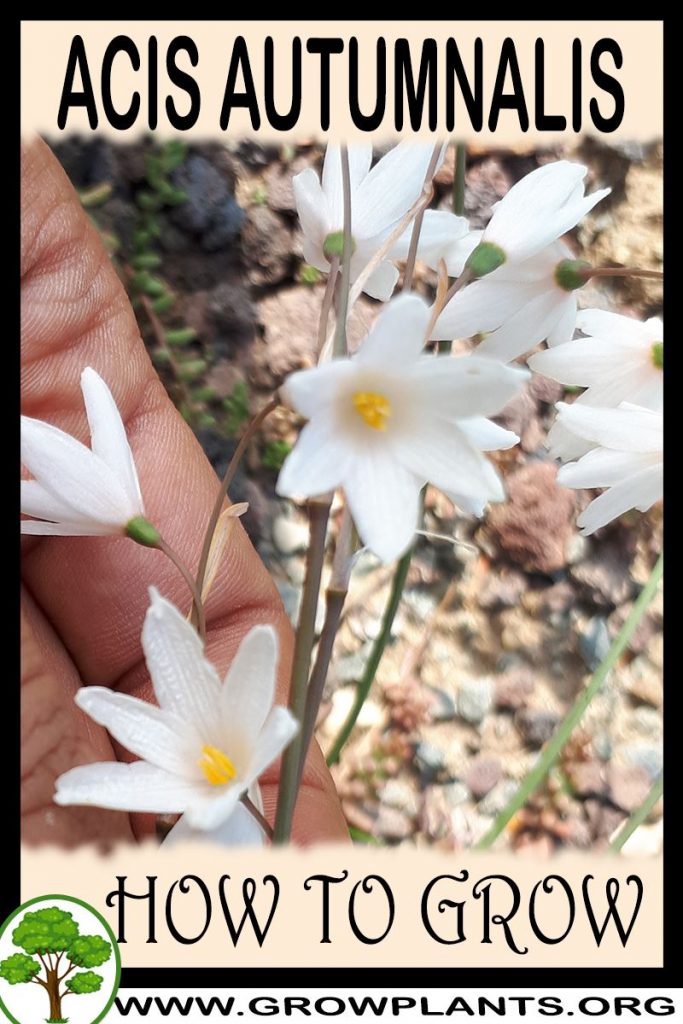
Plant Profile & Key Characteristics
Overview: Acis autumnalis (autumn snowflake) is a small deciduous bulb of 10–20 cm, grown as an ornamental for its delicate white bell-shaped autumn flowers. It suits subtropical, Mediterranean and desert climates and makes a dainty cut flower.
Quick Specifications
| Specification | Attribute |
|---|---|
| Plant Type / Life Cycle | Perennial bulb (deciduous) |
| Foliage Type | Deciduous (dies back after flowering) |
| Mature Size | H: 10–20 cm (4–8 in) |
| Growth Rate | Moderate |
| Root System | Bulb |
| Toxicity | Bulbs are toxic if eaten (Amaryllidaceae, contains lycorine) |
| Hardiness | USDA zone 9–11 |
Growth Form & Structure
- Height & Spread: A small plant only 10–20 cm tall, forming little clumps from bulbs; ideal for pots and the front of borders.
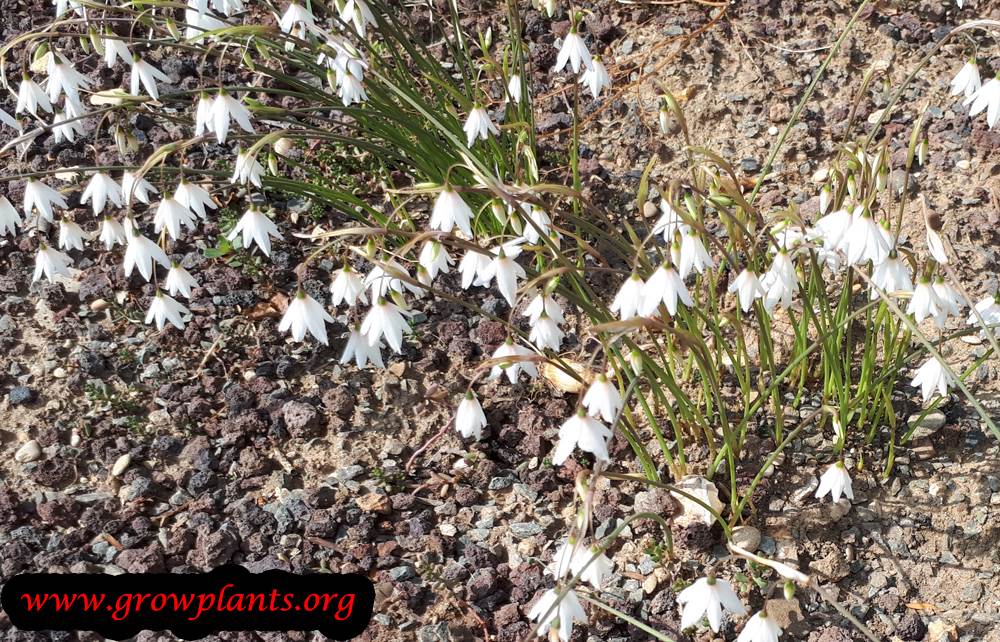
- Growth Habit & Form: Low, tufted bulbous perennial with slender leaves and thin flower stems.
- Lifespan & Maturity: Perennial bulb that naturalises slowly into clumps over the years.
Anatomy & Physical Features
- Leaves & Foliage: Narrow, linear green leaves.
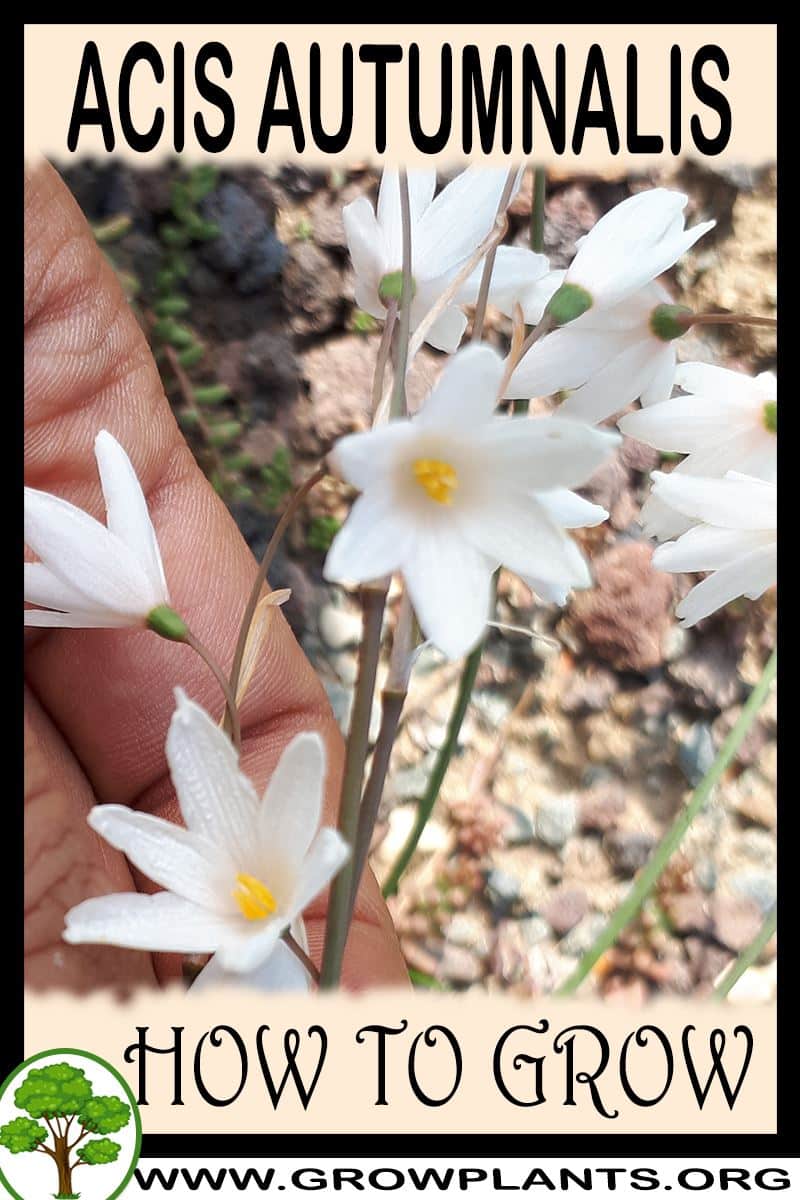
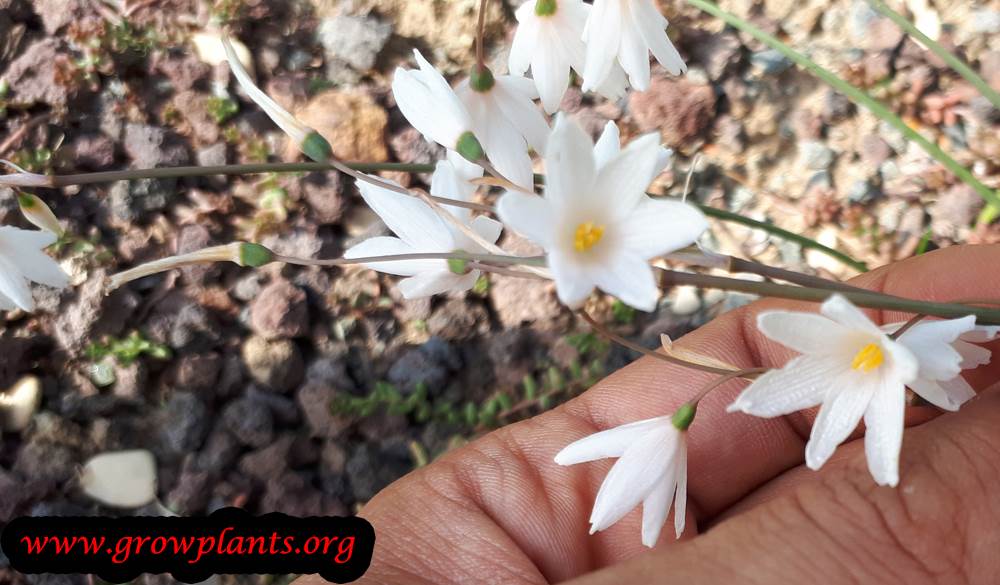
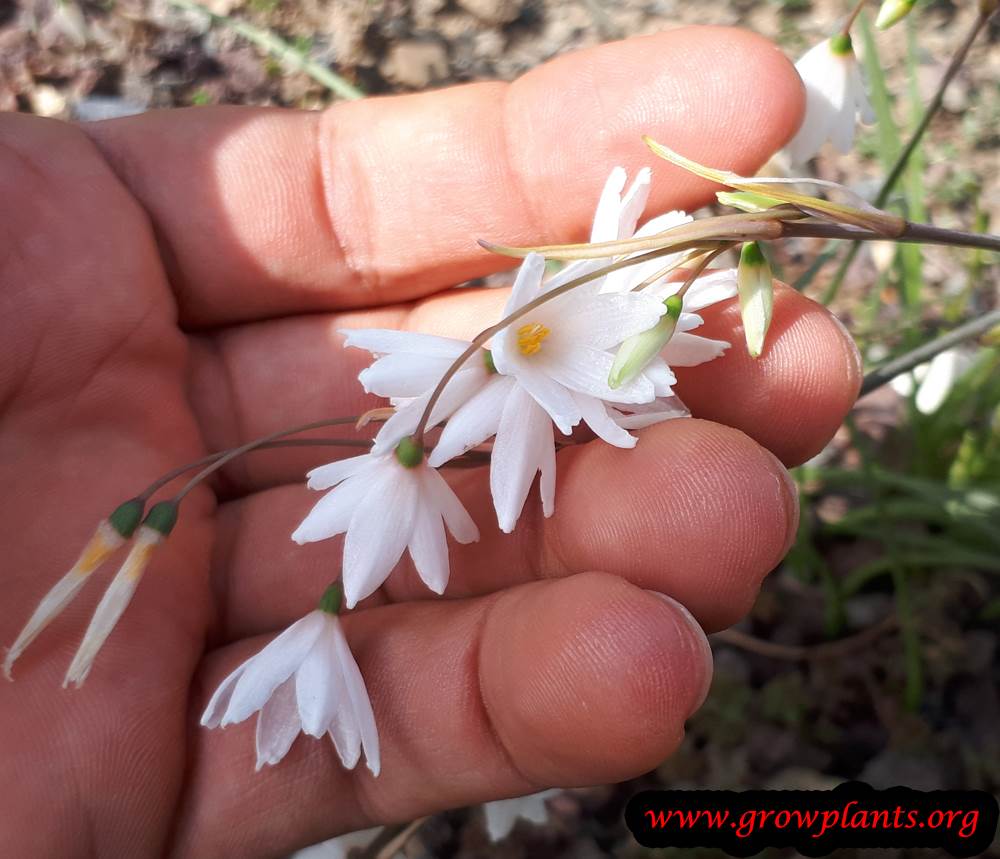
- Flower Characteristics: Small white bell-shaped flowers borne nodding in clusters on slender stems in late summer to autumn.
Primary Uses & Landscape Value
- Functional & Ornamental Roles: Ornamental bulb for rock gardens, pots and the front of borders, and a dainty cut flower.
Care Guide: Planting, Soil & Watering
Overview: Autumn snowflake (Acis autumnalis) is a small, moderate-growing bulb for full sun that thrives in moist but sharply drained soil. It needs only modest water — moisture while in growth and much drier conditions during its summer dormancy — and above all soil that never stays wet around the bulbs.
Quick Care Requirements
| Requirement | Ideal Condition |
|---|---|
| Planting Season | Late summer to autumn (into winter), as the bulbs come into growth |
| Growth Rate | Moderate |
| Soil Type | Moist but sharply drained, gritty soil |
| Water Need | Low to moderate — moist in growth, dry when dormant |
Planting & Establishment
- Best Planting Season: Plant the bulbs in late summer to autumn as they begin their growth cycle; growth and flowering carry on into winter in mild areas.
- How to Plant:
- Hole Preparation: Set the bulbs in a hole a few times their own depth in free-draining soil.
- Soil Amendments: Work grit or coarse sand into heavy soil to sharpen drainage; these bulbs rot in cold, wet ground.
- Planting Depth: Plant each bulb at roughly two to three times its own height deep, nose upward.
- Growth Speed & Expectations: Moderate, forming a small clump 10–20 cm tall that slowly increases over the years.
Soil, Watering & Drainage Care
- Soil Mix & Drainage Needs: Needs moist but very free-draining soil; in containers use a gritty, well-draining mix and never let the bulbs sit in water.
- Watering Schedule & Technique:
- Young / Newly Planted: Water lightly to settle newly planted bulbs, keeping the soil just moist as they root and sprout.
- Established: Keep the soil lightly moist while the bulbs are in leaf and flower, then let it dry out during summer dormancy.
- Seasonal Adjustments: A little water through the autumn-to-winter growing season; keep dry over the summer rest to prevent rot.
Climate, Light & Hardiness
Acis autumnalis (autumn snowflake) is a compact, sun-loving bulb for subtropical, mediterranean, and desert gardens, flowering in late summer and autumn before going dormant. Per the site data it is hardy outdoors in USDA zone 9–11.
Quick Climate Specifications
| Climate Zones | Subtropical, mediterranean, desert |
|---|---|
| USDA Hardiness Zones | 9–11 |
| Frost Tolerance | Low to Moderate |
| Light Conditions | Full Sun |
Sunlight & Light Exposure
Optimal Light Setup
Full sun is needed for healthy growth and reliable flowering of this small bulb.
Direct Sun Requirement
Needs direct sun for most of the day.
Best Exposure / Orientation
An open, sunny spot in a bulb bed or rock garden suits its small stature (10–20 cm).
Temperature Extremes & Hardiness
USDA Hardiness & Regional Limits
Reliable outdoors within USDA zone 9–11, consistent with a mediterranean-climate bulb; the foliage naturally dies back (it is deciduous) after flowering, so winter dormancy is part of its normal cycle rather than cold damage.
Cold Damage & Winter Protection
The bulb is planted in summer through winter and is dormant through the heat of summer; within its zone range no special winter protection is needed.
Frost Sensitivity
Moderate frost sensitivity is implied by its zone 9–11 rating; it is best suited to mild-winter climates.
Extreme Heat Tolerance
Good during its summer dormancy when it needs only small to average water; active growth occurs in the cooler part of the year.
Wind, Humidity & Microclimate
Rainfall & Seasonal Moisture
Prefers moist soil during its autumn-to-spring growth and flowering period, with a drier summer dormancy typical of mediterranean-climate bulbs.
Microclimate Recommendations
A sunny, well-drained bulb bed suits it best, mimicking the mediterranean climate pattern of moist cool seasons and dry summers.
Growing in Pots, Balconies & Indoors
Acis autumnalis (autumn snowflake) is a small autumn-flowering bulb the grower does not treat as a houseplant – it is happiest in a sunny outdoor pot. Grown in a container it needs full sun and a dry summer rest, so it belongs on a bright balcony or patio rather than indoors.
Quick Details
- Container Size: A shallow pot or bulb pan; plant several bulbs together for a good show
- Indoor Suitability: Not a houseplant – it needs full sun and a proper dry dormant period
- Best Spot: Full sun
- Soil & Drainage: Sharply drained, gritty mix – bulbs rot in wet compost
- Watering in Pots: Small to average while growing; keep dry through its summer rest
Indoors & On the Windowsill
- Houseplant limits: Not suited to living indoors – it needs strong sun and a seasonal dry rest to flower and rebuild the bulb.
- Windowsill note: Only the very sunniest sill would tempt it, and it still resents a warm, dry room – far better outdoors.
On a Balcony or Patio
- Light & drainage: Give it the sunniest spot on the balcony; small pots and pans dry fast, so water while in growth but keep it dry once the leaves fade.
- Practicalities: Move the pot under cover for its dry dormant rest, then start watering again as growth returns.
Choosing the Pot, Soil & Long-Term Care
- Pot & drainage: A shallow, free-draining pot with plenty of holes and no standing saucer; add grit to sharpen drainage.
- Potting mix: A gritty, free-draining bulb mix – loam or coir opened up with grit or perlite.
- Feeding: A light feed as leaves grow helps build next season’s bulb; stop once it dies back.
- Repotting: Repot or divide when the pan becomes congested with offsets.
Fertilizing & Feeding
A light feeder overall: this small bulb draws on its own stored reserves for much of its cycle, so feeding is only needed lightly while the leaves are green and actively photosynthesizing.
Quick Fertilizing Specs
| Feeding Level | Light feeder |
|---|---|
| Main Nutrient Priority | A light, balanced feeding while foliage is green, to help the bulb rebuild its reserves |
| Best Feeding Period | While the strap-like leaves are up and green, around and after bloom |
| Organic Options | A light top-dressing of compost worked in at planting |
| Reduce/Stop Feeding | Stop feeding once the foliage begins to yellow and die back |
| Micronutrients | Rarely an issue for this small bulb; correct only a diagnosed deficiency |
| Soil pH | Not particular about soil pH; ordinary well-drained garden soil suits it |
Feeding by Growth Stage
Active foliage growth and bloom
Support the narrow green leaves and the white, bell-shaped flower clusters while the bulb is in active growth.
| Nutrient direction | A light, balanced feeding helps the bulb build reserves for next season while the leaves are green. |
|---|---|
| Timing | While the foliage is up and green, spanning the bloom period. |
| Frequency | A light feeding is enough; this small bulb does not need heavy or frequent feeding. |
| Fertilizer types | A balanced complete fertilizer at a light rate, A light top-dressing of compost |
| Precautions | Keep feeding minimal; overfeeding a small bulb can encourage soft growth and rot more than it helps flowering. |
Post-bloom foliage dieback and dormancy
Let the leaves finish yellowing and dying back naturally so the bulb can go dormant undisturbed.
| Nutrient direction | None – withhold fertilizer once the foliage begins to yellow and through the dormant period. |
|---|---|
| Timing | As the leaves yellow after bloom, continuing through the bulb’s dormant period. |
| Frequency | No feeding during dieback or dormancy; resume only when fresh foliage reappears. |
| Fertilizer types | No feeding at this stage; do not fertilize yellowing or dormant bulbs. |
| Precautions | Let the foliage die back naturally without cutting it green or feeding it; the bulb is still drawing nutrients from those leaves. |
Nutrient Deficiency Signs & Corrections
Foliage looks pale or yellow-green even early in the growing period, and flowering is weak.
| Possible causes | low available soil nitrogen, bulbs planted in poor, unamended soil, nutrient leaching in fast-draining soil |
|---|---|
| Appears first on | the strap-like foliage overall |
| What to check | soil quality at planting, recent feeding history, how many seasons since the bulbs were last fed or top-dressed |
| Possible correction | Apply a light, balanced fertilizer while foliage is green and work a little compost into the bed. |
Healthy-looking foliage but few or no flowers appear in season.
| Possible causes | foliage cut back too early in a previous season, limiting reserve buildup, bulbs overcrowded and competing for nutrients, insufficient light during the foliage period |
|---|---|
| Appears first on | whole-clump flowering pattern rather than a single leaf |
| What to check | whether foliage was allowed to fully yellow before removal last season, clump density and whether division is overdue, sun exposure during active growth |
| Possible correction | Let foliage die back fully each year, divide overcrowded clumps, and ensure adequate sun during the growing period. |
Pruning, Training & Seasonal Maintenance
Acis autumnalis (autumn snowflake) is a tiny true bulb, and there is essentially no pruning in the shrub/tree sense – maintenance is limited to removing spent flower stems and, once the narrow foliage yellows and dies back naturally in spring, clearing that dead leaf litter. The safest time to remove foliage is spring, after it has fully died back on its own; cutting green leaves earlier would cut off the plant’s ability to recharge the bulb for next season’s autumn bloom.
Quick Pruning & Maintenance Specs
| Pruning Tolerance | Low (minimal maintenance only, not structural pruning) |
| Primary Pruning Window | Spring (removal of fully dead foliage only) |
| Typical Frequency | Once yearly |
| Main Objective | Tidy dead leaves and spent flower stems without disturbing the bulb’s foliage cycle |
| Best Tool Type | Precision snips |
| Avoid Heavy Pruning During | While foliage is still green, from bloom (summer/autumn) through winter |
Special Growth to Remove
- Spent flower stems after bloom
- Dead, fully yellowed foliage in spring – never cut it back while still green, since the leaves feed the bulb for the following season
Tools
Precision snips for the light, occasional cuts this bulb needs – nothing heavier is ever appropriate.
Tool Hygiene & Disease Risk
Routine – clean tools are sufficient; no notable disease risk documented for this species.
Cut Placement & Technique
Cut spent flower stems down near the base; remove dead foliage only once it has fully yellowed and pulls away easily, rather than tugging on green leaves still attached to the bulb.
When NOT to Prune
Do not cut back green foliage after flowering – it needs to remain and photosynthesize until it dies back naturally in spring, or next season’s bloom will suffer.
Recommended Tools (by task)
- precision_snips – the only tool this small bulb realistically needs, for spent flower stems and fully dead foliage
Propagation Guide
Acis autumnalis is most easily increased by lifting and separating the offset bulbs it produces around the parent bulb; growing from seed also works but is slower to establish. Propagation is easy.
Quick Propagation Specs
| Best Propagation Method | Bulb Division (Offsets) |
| Alternative Methods | Seed |
| Propagation Difficulty | Easy |
| Seed True-to-Type | Usually true-to-type for the species |
| Vegetative True-to-Type | Yes |
| Best Propagation Season | Late summer to autumn, when the site indicates bulbs are typically planted and dormant bulbs can be lifted and divided |
Growing from Seed
Seed Handling & Viability
Not detailed by the site; bulb seed of this type is generally best sown fresh rather than stored for long periods.
Sowing Season
Sow after seed ripens, aligned with the plant’s summer-to-autumn planting season.
Germination Time
Not documented by the site; germination timing can be irregular and take several weeks.
Rhizomes, Tubers, Bulbs & Corms
Bulb Division
Lift dormant bulbs and separate the small offset bulbs that form attached at the base of the parent bulb, then replant at a similar depth.
Bloom & Flower Guide
Quick Details
- Bloom Season: Late summer into autumn
- Time to First Bloom: In its first autumn once the bulb is established
- Flower Appearance: Dainty white, nodding bell-shaped flowers on slender stems, carried in small clusters
- Edibility: Ornamental — the bulbs and plant are toxic, not edible
Detailed Blooming Overview
Acis autumnalis, the autumn snowflake, is a delicate little bulb that flowers late in the season, sending up wiry stems topped with nodding white bells just as summer turns to autumn. The flowers often appear before the narrow leaves, giving a fine, airy display that also lasts well as a cut flower.
Flower Characteristics
- Small, nodding, bell-shaped white flowers, sometimes faintly pink-tinged.
- Borne in small clusters on slender, weeping stems.
- Delicate and good for cutting.
Bloom Care & Thinning
- Managing the bloom: Let the foliage die back naturally after flowering to feed the bulb for next year; clumps naturalize over time.
- Safety: Like other Amaryllidaceae bulbs, all parts are toxic if eaten — grow for beauty only and keep bulbs away from children and pets.
Pests, Diseases & Troubleshooting
Overview: Autumn snowflake (Acis autumnalis, formerly Leucojum autumnale, family Amaryllidaceae) is a small, delicate autumn-flowering bulb that is largely pest-free; its handful of real risks are the classic Amaryllidaceae bulb troubles – narcissus bulb fly and bulb mites, slugs on emerging growth, and, above all, bulb rot when the summer-dormant bulbs are kept too wet. Grow it in sharp-draining soil with a dry summer rest and problems rarely arise.
Quick Troubleshooting Overview
| Issue / Pest | Main Symptom | Primary Solution |
|---|---|---|
| Narcissus bulb fly | Soft, hollowed, non-sprouting bulbs; ‘blindness’ and rot | Firm soil over necks after flowering, cull soft bulbs, keep foliage healthy |
| Bulb mites | Rusty, crumbling, rotting bulb tissue (usually secondary) | Plant only firm, clean bulbs; discard damaged/rotting ones |
| Slugs & snails | Grazed, holed emerging leaves and flowers in damp weather | Grit/barriers, iron-phosphate bait, hand-pick |
| Basal / bulb rot | Yellowing, collapse, soft brown basal plate; wet summer soil | Sharp drainage, dry summer dormancy, cull rotten bulbs |
| Non-flowering | Leaves but no flowers (‘blindness’); overcrowding/shallow planting | Lift and divide congested clumps, plant at proper depth, feed foliage |
Common Pests & Management
- Narcissus bulb fly (Merodon equestris):
- Symptoms: A single fat maggot tunnels into the bulb through the neck/basal plate, hollowing and rotting it; affected bulbs are soft, fail to sprout, or produce only thin grassy ‘blind’ leaves.
- Prevention & Control: Encourage the leaves to die down naturally and firm or hoe soil over the bulb necks after flowering to deny egg-laying access; lift and destroy soft, infested bulbs. A layer of grit or mulch and healthy, undisturbed foliage reduce attack.
- Bulb mites (Rhizoglyphus spp.):
- Symptoms: Tiny pale mites feed on already-damaged or diseased bulb tissue, which turns rusty-brown, crumbly and rotten; they are usually a secondary problem following fly, rot or injury.
- Prevention & Control: Plant only firm, healthy, unblemished bulbs, discard any that are soft or rotting, and avoid mechanical damage at lifting. Good drainage and dry summer storage limit the rot that mites exploit.
- Slugs & snails (Deroceras / Cornu spp.):
- Symptoms: Grazed, holed and shredded emerging leaves and flowers, with slime trails, in damp autumn weather.
- Prevention & Control: Surround clumps with grit or barriers, scatter iron-phosphate pellets, and hand-pick after dark; keep the surrounding area clear of daytime hiding places.
- Aphids (various):
- Symptoms: Colonies on emerging foliage and flower stems, with distortion and honeydew; their main importance is spreading viruses between bulbs.
- Prevention & Control: Rub off or hose off small colonies and use insecticidal soap if needed; controlling aphids reduces virus spread between plants.
Diseases & Fungal Issues
- Basal rot (Fusarium oxysporum):
- Symptoms: Yellowing, wilting foliage and a soft, brown, rotting basal plate; the bulb decays from the base, typically in warm, wet summer soil.
- Treatment & Management: Prevent by planting firm bulbs in free-draining soil, ensuring a dry summer dormancy, and avoiding waterlogging and mechanical injury. Lift and destroy affected bulbs and do not replant Amaryllidaceae in the same spot immediately.
- Grey mould / Botrytis (Botrytis spp.):
- Symptoms: Grey mould and brown spotting on leaves and flowers in cool, wet, crowded conditions.
- Treatment & Management: Improve airflow and drainage, remove faded and mouldy tissue, and avoid overhead watering; rarely serious on this small bulb.
- Virus (various mosaic viruses):
- Symptoms: Yellow streaking, mottling or distortion of the leaves, and gradual weakening, spread mainly by aphids.
- Treatment & Management: There is no cure: remove and destroy affected plants, control aphid vectors, and start with clean, healthy stock; keep tools clean when dividing.
Growing Difficulties & Abiotic Problems
- Summer-wet bulb rot:
- Cause & Symptoms: The bulbs rot if kept wet during their summer dormancy, as this Mediterranean-climate plant needs a dry, warm summer rest.
- Correction Strategy: Plant in sharp-draining soil or a raised/gritty spot that bakes and dries in summer; withhold water during dormancy and avoid irrigated beds.
- Blindness (non-flowering):
- Cause & Symptoms: Healthy leaves but no flowers, usually from overcrowded, congested clumps, too-shallow planting, or loss of foliage before it feeds the bulb.
- Correction Strategy: Lift and divide congested clumps after flowering as the leaves fade, replant at the proper depth in fresh gritty soil, and always let the foliage die down naturally to build up the bulb.
- Poor establishment:
- Cause & Symptoms: Small delicate bulbs that fail to settle in cold, wet or heavy soils.
- Correction Strategy: Give a warm, sunny, sharply drained position, plant promptly while bulbs are fresh, and protect from excessive winter wet.
What Helps – Products & Tools
This is a low-input little bulb: the best ‘products’ are sharp drainage, a dry summer rest and firm, healthy planting stock. Use iron-phosphate slug pellets or grit barriers for slugs on emerging growth, insecticidal soap for the occasional aphid (to limit virus spread), and simply cull and destroy any soft, fly- or rot-damaged bulbs rather than treating them. No routine spraying is warranted.