Plant Profile & Key Characteristics
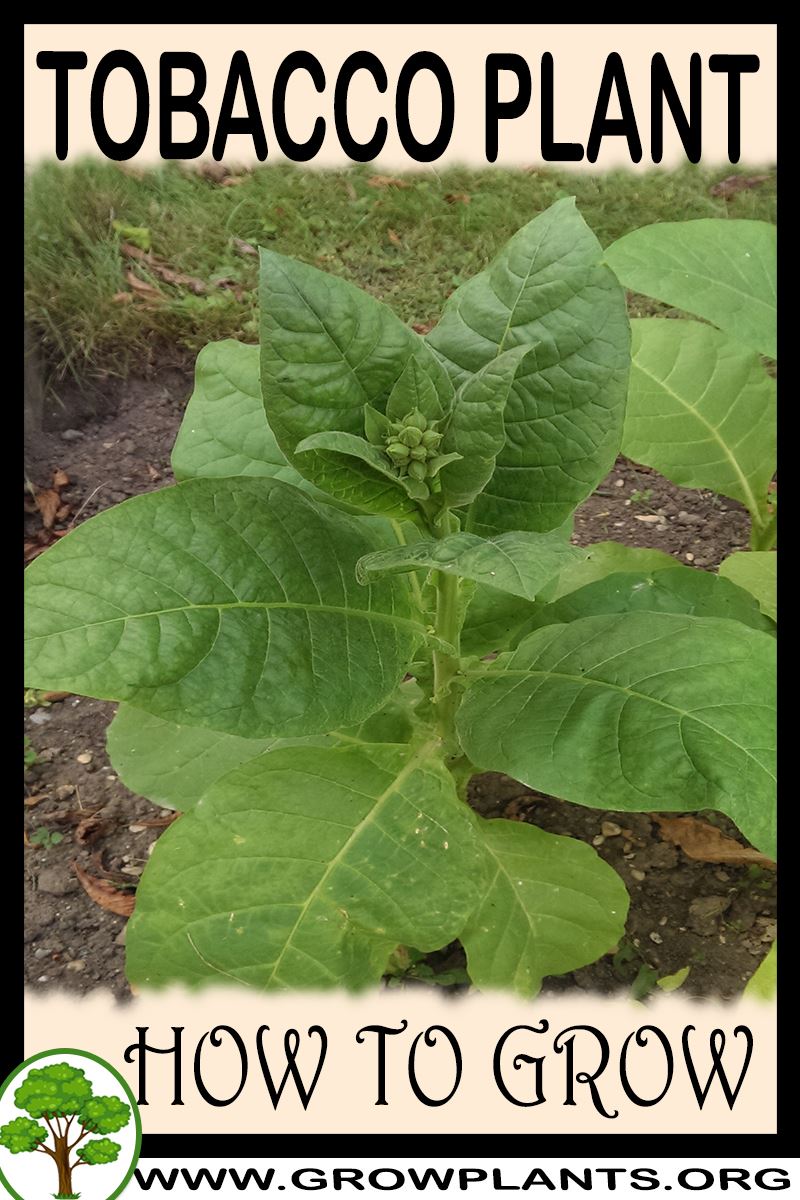
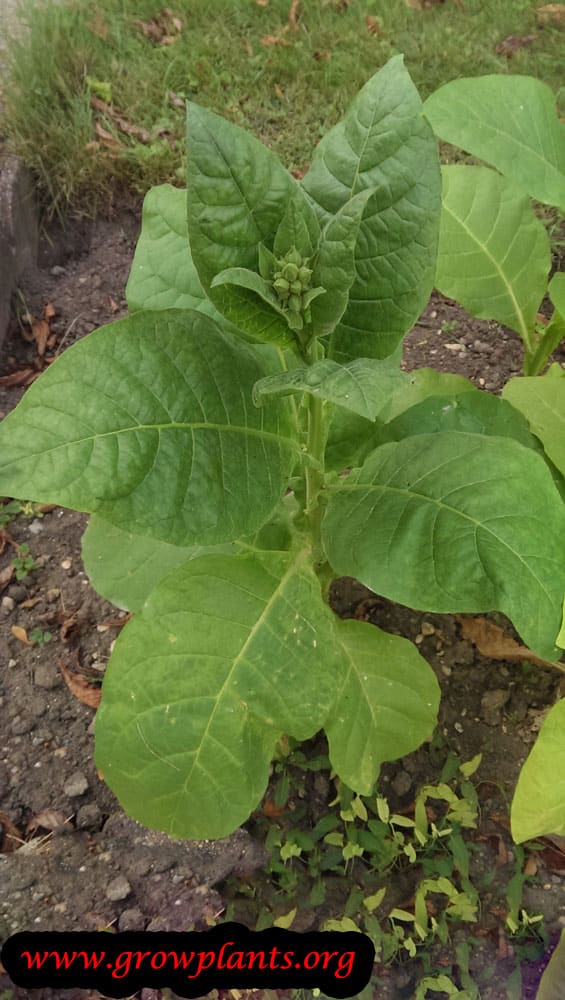
Overview: The Tobacco plant (Nicotiana tabacum) is a tall annual herb 1-2 m (40-80 in) high, grown here as an ornamental for its foliage and clustered flowers. It adapts to Mediterranean, desert, subtropical, temperate and tropical climates.
Quick Specifications
| Specification | Attribute |
|---|---|
| Plant Type / Life Cycle | Annual |
| Mature Size | 1-2 m (40-80 in) tall |
| Growth Rate | Fast |
| Root System | Taproot with fibrous roots |
| Toxicity | Toxic – contains nicotine (Solanaceae); all parts poisonous if eaten |
| Hardiness | USDA zones 5+ |
Growth Form & Structure
- Height & Spread: Upright, reaching 1-2 m (40-80 in) tall in a single season; also grown in large containers.
- Growth Habit & Form: Tall, erect annual herb with very large leaves and a terminal flower cluster.
- Lifespan & Maturity: Fast-growing single-season annual.
Anatomy & Physical Features
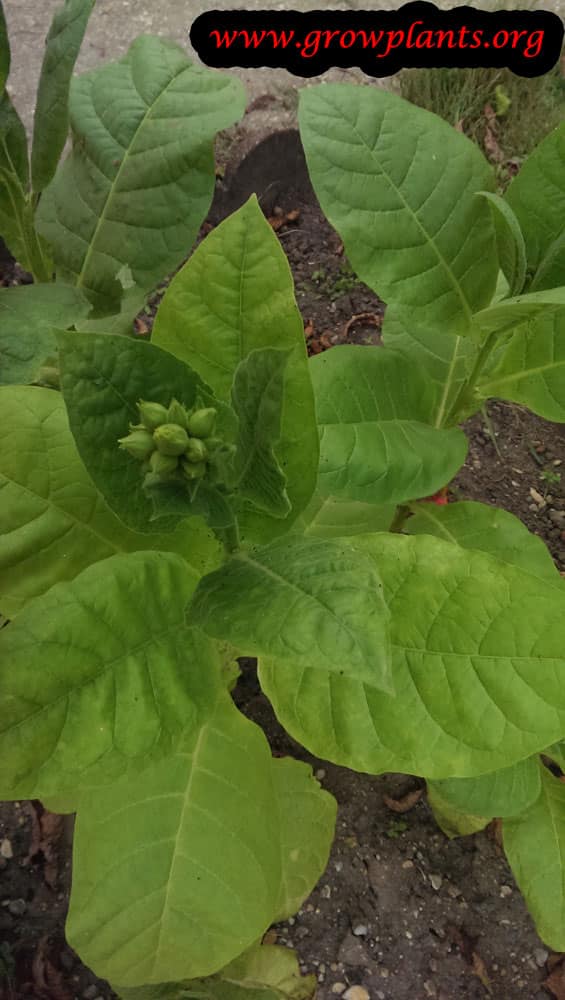
- Leaves & Foliage: Very large, elliptic green leaves (the source of commercial tobacco).
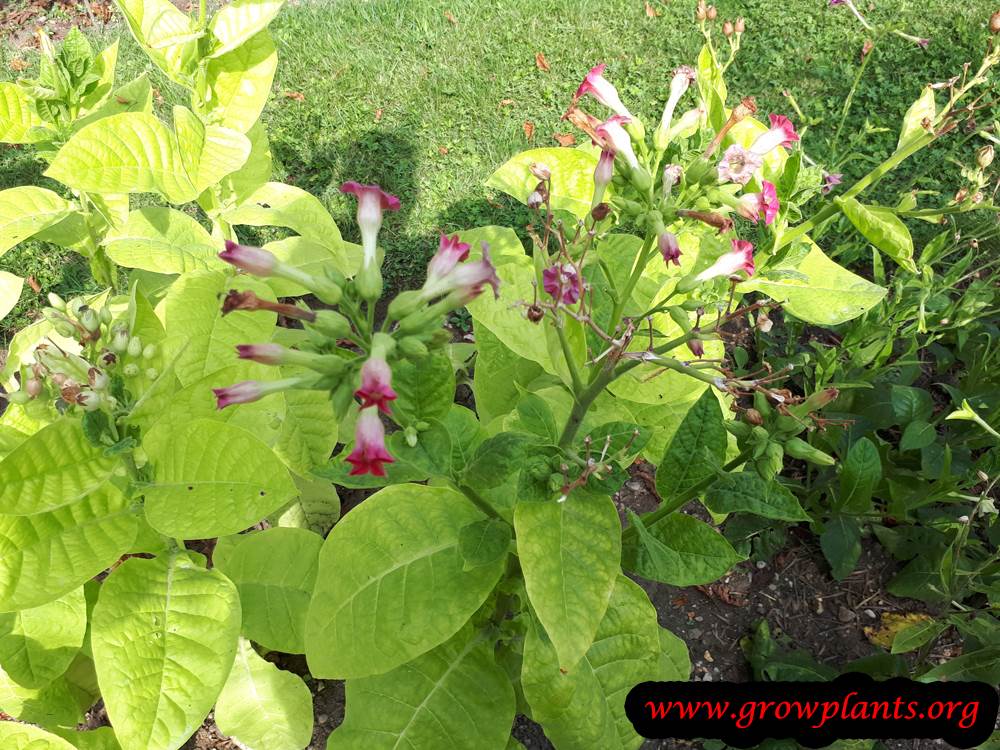
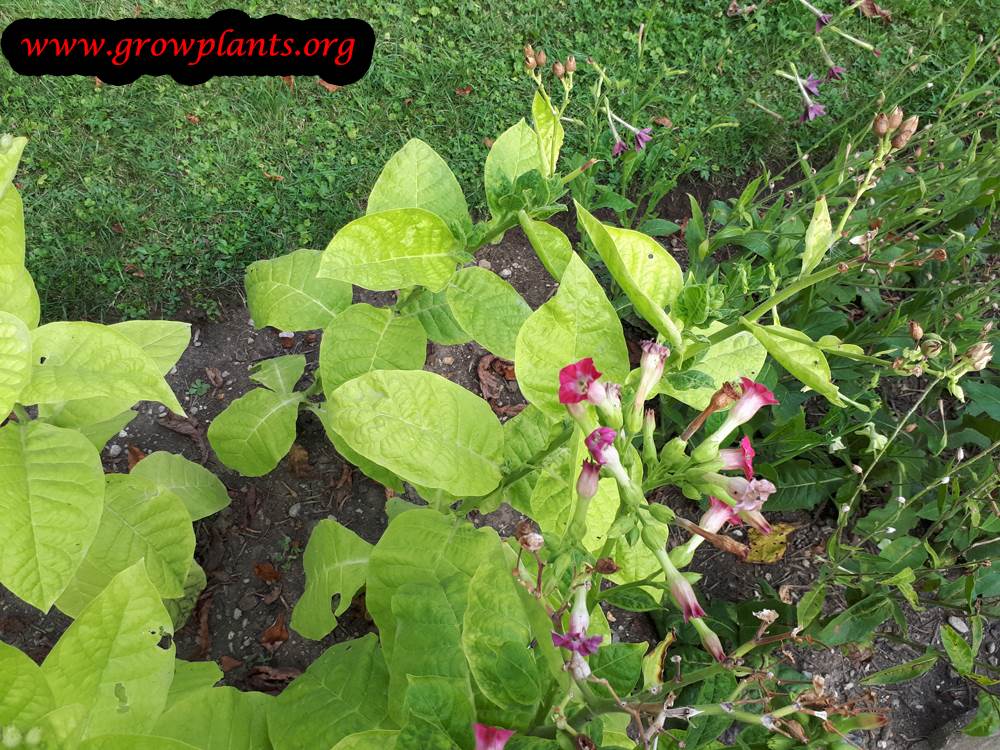
- Flower Characteristics: Pink-white tubular flowers borne in clusters at the stem top.
Primary Uses & Landscape Value
- Functional & Ornamental Roles: Grown ornamentally for its bold foliage and flowers; also the plant cultivated commercially for tobacco.
Care Guide: Planting, Soil & Watering
Overview: The tobacco plant (Nicotiana tabacum) is a fast-growing annual that wants fertile, well-drained soil in full sun. It needs only low-to-moderate water and reaches full size in one season.
Quick Care Requirements
| Requirement | Ideal Condition |
|---|---|
| Planting Season | Spring (warm season) |
| Growth Rate | Fast |
| Soil Type | Fertile, well-drained |
| Water Need | Low to moderate |
Planting & Establishment
- Best Planting Season: Plant in spring, once the warm season begins.
- How to Plant:
- Hole Preparation: Dig a hole as wide as the root ball.
- Soil Amendments: Work in compost or organic matter for fertility, keeping the soil well-drained.
- Planting Depth: Set the crown at soil level.
- Growth Speed & Expectations: Fast – reaches 1–2 m in a single season.
Soil, Watering & Drainage Care
- Soil Mix & Drainage Needs: Fertile, well-drained soil; it tolerates moderate dryness.
- Watering Schedule & Technique:
- Young / Newly Planted: Keep moist to establish.
- Established: Water moderately when the top of the soil dries; avoid waterlogging.
- Seasonal Adjustments: More water in heat; less in cool weather.
Climate, Light & Hardiness
Tobacco plant (Nicotiana tabacum) adapts to a very wide range of climates - Mediterranean, desert, subtropical, temperate, and tropical - and can be grown as a warm-season annual from USDA zone 5 upward. It needs full sun for the strongest growth.
Quick Climate Specifications
| Climate Zones | Mediterranean, desert, subtropical, temperate, tropical |
|---|---|
| USDA Hardiness Zones | 5+ (grown as a warm-season annual) |
| Frost Tolerance | None |
| Light Conditions | Full Sun |
Sunlight & Light Exposure
Optimal Light Setup
Grow in full sun for the fastest, most vigorous growth and best flowering.
Temperature Extremes & Hardiness
USDA Hardiness & Regional Limits
Commonly grown as an annual, since it is killed by frost; USDA zone 5 and above describes where it can be grown as a summer annual after the last frost, not winter survival. In frost-free tropical and subtropical climates it can persist and grow beyond a single season.
Frost Sensitivity
Frost-sensitive; plant out only after the danger of frost has passed and expect it to be killed by the first freeze of autumn.
Wind, Humidity & Microclimate
Wind Tolerance
The tall stems benefit from a reasonably sheltered position to avoid wind damage as the plant matures.
Growing in Pots, Balconies & Indoors
The tobacco plant (Nicotiana tabacum) is a tall, full-sun annual reaching 1-2 m (40-80 in). The grower does not rate it as a houseplant – it grows too large and needs full sun – but it can be raised in a big container on a sunny balcony, terrace or patio.
Quick Details
- Container Size: A large, deep pot to support its height (general guidance)
- Indoor Suitability: Not a houseplant – too large and too light-hungry for indoors
- Best Spot: Full sun
- Soil & Drainage: Aerated, organic-rich mix that drains freely
- Watering in Pots: Small to average – keep lightly moist; large leaves lose water fast in heat, so check pots often
Indoors & On the Windowsill
- Not for indoors: The grower does not recommend it as a houseplant; at 1-2 m in full sun it belongs outside. Only very young seedlings sit briefly on a bright sill before going out.
- Safety: Every part of the plant contains nicotine and is toxic if eaten – keep it well away from children and pets.
On a Balcony or Patio
- Light & wind: Give it the sunniest spot; the tall stems catch the wind, so stake them and shelter the pot. Reflected heat from walls dries pots fast – check moisture daily in hot weather.
Choosing the Pot, Soil & Long-Term Care
- Pot & drainage: A large, heavy-based pot with strong drainage holes for stability; skip a standing saucer to avoid root rot.
- Potting mix: Use a well-aerated, organic-rich mix – potting compost with perlite or vermiculite (or peat/coir blended with grit) so water drains freely.
- Feeding: Potted plants are fed more often than those in the ground because nutrients wash out with each watering – a balanced liquid feed through the growing season keeps them going.
Fertilizing & Feeding
A moderate feeder: this fast-growing ornamental annual is grown for its clustered pink-white flowers, so balanced feeding through its single growing season supports steady growth and bloom, with no need to feed once the season ends since the plant does not persist as a perennial.
Quick Fertilizing Specs
| Feeding Level | Moderate feeder |
|---|---|
| Main Nutrient Priority | Balanced feeding that supports steady growth and flowering over a single fast-growing season |
| Best Feeding Period | Spring through summer and into autumn while the plant is actively growing and blooming |
| Organic Options | Compost or well-rotted organic matter worked into well-drained soil |
| Reduce/Stop Feeding | Feeding stops as the plant completes its single growing season |
| Micronutrients | Usually adequate from a complete fertilizer in well-drained soil |
| Soil pH | Tolerates a range of well-drained soil |
Feeding by Growth Stage
Spring establishment and rapid growth
Support the elliptic-leaved foliage of this fast-growing annual as it establishes and builds size before flowering.
| Nutrient direction | A balanced fertilizer supports the rapid vegetative growth typical of this fast-growing annual. |
|---|---|
| Timing | In spring, at or shortly after planting. |
| Frequency | Regular light feeding through establishment supports steady, rapid growth. |
| Fertilizer types | A balanced complete fertilizer, Compost or organic matter worked into the soil |
| Precautions | Prune off infected or dead leaves as they appear, and watch for aphids, which favor lush new growth. |
Summer to autumn bloom
Sustain the clustered pink-white flower display through summer and into autumn.
| Nutrient direction | Continued balanced feeding supports strong flowering through this plant’s extended bloom season. |
|---|---|
| Timing | Through summer and into autumn while the plant is in flower. |
| Frequency | Light, regular feeding through the bloom season is usually enough. |
| Fertilizer types | A balanced complete fertilizer, An organic feed worked lightly into the surface soil |
| Precautions | Avoid heavy nitrogen feeding, which can push leafy growth over flowering, and continue removing infected or dead leaves. |
End of season
Recognize the end of this annual’s single growing season as growth naturally winds down.
| Nutrient direction | None – withhold fertilizer once the season ends. |
|---|---|
| Timing | As cold weather ends the growing season for this annual. |
| Frequency | No feeding at this stage. |
| Fertilizer types | No feeding at this stage – this annual completes its life cycle at season’s end |
| Precautions | Do not fertilize once the season ends; this annual does not persist to benefit from further feeding. |
Nutrient Deficiency Signs & Corrections
Pale, thin foliage and slowed growth despite this plant’s typically fast growth habit.
| Possible causes | low available soil nitrogen, leaching from watering in well-drained soil, aphid pressure reducing plant vigor |
|---|---|
| Appears first on | older, lower leaves |
| What to check | recent feeding history, soil organic matter, signs of aphids |
| Possible correction | Apply a balanced fertilizer during the growing season and manage aphids if present. |
New leaves appear pale or yellowish while veins stay greener.
| Possible causes | high soil pH limiting iron availability, waterlogged or poorly drained soil, root stress from compacted soil |
|---|---|
| Appears first on | newest leaves |
| What to check | soil pH and drainage, standing water after watering, root health |
| Possible correction | Improve drainage and soil pH balance; apply a chelated iron product per its label if symptoms persist. |
Vigorous foliage but few flowers through summer.
| Possible causes | excess nitrogen favoring leafy growth over flowering, insufficient light, aphid pressure diverting plant energy |
|---|---|
| Appears first on | whole-plant flowering pattern |
| What to check | recent fertilizer balance, light exposure, signs of aphids |
| Possible correction | Favor balanced over nitrogen-heavy feeding, ensure full sun exposure, and manage aphids if present. |
Pruning, Training & Seasonal Maintenance
Tobacco plant is a fast-growing annual, so there is no multi-year framework to build – pruning here means an optional early pinch to encourage a bushier, more floriferous plant, ongoing removal of infected or dead leaves, and deadheading to prolong bloom and limit self-seeding. Because it completes its life cycle in a single season, no rejuvenation or hard structural pruning applies.
Quick Pruning & Maintenance Specs
| Pruning Tolerance | Moderate |
| Primary Pruning Window | Ongoing through the growing season |
| Typical Frequency | Frequent light sanitary removal; one early pinch if a bushier habit is wanted |
| Main Objective | Sanitation, shape/bushiness, and prolonging bloom |
| Young Plant Priority | Optional single pinch of the growing tip once several leaf sets have formed |
| Mature Plant Priority | Remove infected/dead leaves; deadhead spent flower clusters |
| Best Tool Type | Precision snips |
| Avoid Heavy Pruning During | Seedling establishment, before the plant is growing vigorously |
Pruning by Plant Age & Size
Newly Established
Leave seedlings unpinched until they have several sets of true leaves and are growing vigorously.
Young / Formative
An optional single pinch of the central growing tip encourages side branching, giving a bushier plant with more, smaller flower clusters instead of one large terminal cluster.
Mature / Established
No further structural work is needed; continue removing infected or dead leaves and deadheading spent flower clusters through the season.
Seasonal Pruning Schedule
Ongoing Sanitary
Objective: keep the plant healthy through its single growing season. Remove: infected, aphid-damaged, or dead leaves as they appear. Do not remove: healthy green leaves, which the plant needs for its one season of growth. Expected response: reduced disease spread and a tidier plant.
Post-Flowering (ongoing deadhead)
Objective: prolong flowering and limit self-seeding. Remove: spent flower clusters, cut back to the nearest leaf node or side shoot. Do not remove: unopened buds. Expected response: continued blooming later into the season; less volunteer seedling spread the following year.
Special Growth to Remove
- Infected or dead leaves – remove promptly as they appear.
- Spent flower clusters – deadhead to prolong bloom and reduce self-seeding, since tobacco plant readily sets and drops seed.
Container & Small-Space Pruning
Since this species can reach 1–2 m in the ground, pinching the growing tip is especially useful for container-grown plants to keep the height manageable and the habit bushier and less top-heavy in a pot.
Tools
- Precision snips for pinching, deadheading, and removing damaged leaves – stems and foliage are soft and herbaceous, not woody.
Tool Hygiene & Disease Risk
High-risk: Nicotiana species are classically susceptible to tobacco mosaic virus, which spreads very easily on sap-contaminated tools and hands, including between unrelated plants such as tomatoes and peppers. Disinfect blades between plants (and between cuts on visibly infected material), and wash hands after handling this plant before touching other susceptible species.
Cut Placement & Technique
Pinch the growing tip just above a leaf node to encourage branching from below the cut. Deadhead spent flower clusters back to the nearest leaf node or side shoot rather than leaving a bare stub.
Heavy Pruning & Rejuvenation
Not applicable – as an annual, tobacco plant completes its life cycle in one season, so there is no framework to rejuvenate and no hard pruning practice is used.
Post-Pruning Care
Disinfect tools and wash hands after pruning, given the virus risk; watch for returning aphids on fresh pinched growth, since aphids are the noted pest and can also spread viruses.
Common Pruning Mistakes
- Not disinfecting tools between plants, risking the spread of tobacco mosaic virus to this and other susceptible species.
- Letting all flower clusters go to seed, leading to heavy volunteer self-seeding the following year.
- Pinching the growing tip too late, after the main flower bud has already formed, which reduces the benefit of branching.
When NOT to Prune
Avoid handling or pruning the plant while foliage is wet, since sap-transmitted viruses spread more readily on damp leaves; also avoid pinching seedlings before they are well established.
Recommended Tools (by task)
- Pinching, deadheading, and leaf removal (any age): precision_snips – all cuts on this plant are on soft, herbaceous tissue.
- Between-plant tool cleaning (any age): blade_disinfectant – Nicotiana’s well-documented susceptibility to tobacco mosaic virus makes sap-transmitted spread a real risk, unlike most ornamentals in this dataset.
Propagation Guide
Tobacco plant is grown from seed or purchased seedlings, which the site lists as the only route to start it, and vegetative propagation is not needed. It is an easy annual to raise from seed, though the seed itself is extremely fine and needs a little care in handling.
Quick Propagation Specs
| Best Propagation Method | Seed (or transplanted seedlings) |
| Propagation Difficulty | Easy |
| Seed True-to-Type | Usually true-to-type for the species; cultivar-dependent for named varieties |
| Best Propagation Season | Spring, matching this plant’s planting season |
| Seed Germination Time | Typically one to a few weeks |
| Germination Temperature | Warm, roughly 21-27°C (70-81°F) |
| Seed Sowing Depth | Surface-sown, not covered; light helps germination |
Growing from Seed
Seed Handling & Viability
The seed is extremely fine and dust-like, so handle it carefully and sow thinly; a small pinch contains a great many seeds.
Sowing Season
Spring, commonly started a number of weeks ahead under cover and then moved out once conditions are warm, following this plant’s own spring planting season.
Sowing Depth & Orientation
Press the seed onto the surface of the growing medium without covering it, since it benefits from light to germinate.
Germination Conditions
Warm temperatures, roughly 21-27°C (70-81°F), with consistently moist soil and bright light.
Germination Time
Usually one to a few weeks.
Seedling Care
Once seedlings carry a couple of true leaves, thin or transplant them, and grow on in full sun with a light to average amount of water.
Bloom & Flower Guide
Quick Details
- Bloom Season: Summer into autumn
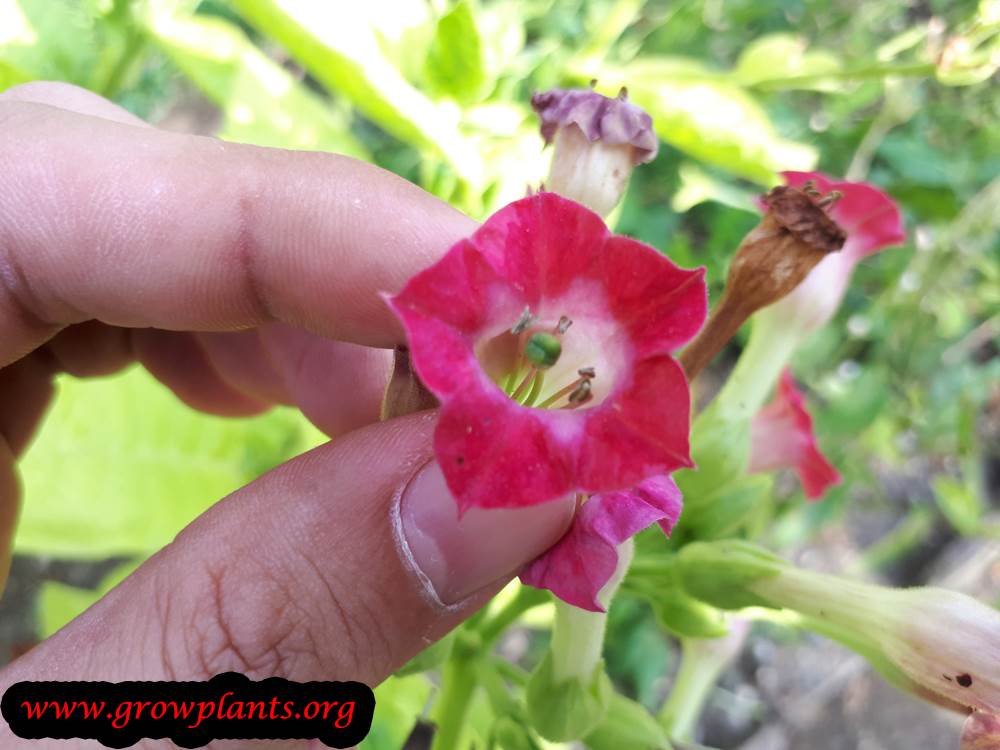
- Flower Appearance: Slim, tubular pink-and-white flowers flaring into a star at the mouth, carried in branched clusters (panicles) at the top of tall stems
- Edibility: Not edible – all parts of the tobacco plant contain nicotine and are toxic
Detailed Blooming Overview
Nicotiana tabacum (tobacco) sends up tall flowering stems in summer topped with airy clusters of tubular flowers. Each bloom is a slender trumpet, pale pink to white, opening into a five-pointed star. Grown here as an ornamental, it flowers freely from summer into autumn.
Flower Characteristics
- Tubular, trumpet-shaped flowers in pink and white, held in branched clusters
- Tall, upright flowering stems above broad leaves
- Visited by long-tongued pollinators such as moths, and by hummingbirds where they occur
Bloom Care & Thinning
- Managing the bloom: deadheading spent clusters keeps the display going; some growers pinch out the top flower shoots to steer energy elsewhere
- Site: full sun, rich soil and steady moisture support the tallest, most floriferous plants
- Safety: every part is toxic if eaten – keep away from children, pets and grazing animals
Bloom Health & Protection
- Budworms and hornworms: caterpillars can chew buds and flowers; hand-picking and, where needed, a targeted biological control such as Bt help keep them off the blooms
Pests, Diseases & Troubleshooting
Overview: Tobacco (Nicotiana tabacum) is a member of the nightshade family (Solanaceae) and shares that family’s pests and diseases: aphids and hornworms, plus tobacco mosaic virus and downy mildew (blue mold). As the commercial tobacco plant it is the classic host of tobacco hornworm, tobacco mosaic virus and blue mold, all of which can be severe in a crop. Manage with hygiene, resistant stock where available, and organic controls, watching especially for virus spread.
Quick Troubleshooting Overview
| Issue / Pest | Main Symptom | Primary Solution |
|---|---|---|
| Aphids | Clusters on shoots/undersides; virus spread | Water jet; soap; control for virus |
| Tobacco hornworm | Large green caterpillars stripping leaves | Handpick; Bt; encourage parasitic wasps |
| Flea beetles | Shot-hole damage on leaves | Fleece; keep vigorous; sanitation |
| Whiteflies / thrips | Sticky or silvered leaves; virus risk | Sticky traps; soap/neem |
| Tobacco mosaic virus | Mottled, distorted leaves | Rogue plants; strict hygiene; no tobacco handling |
| Blue mold (downy mildew) | Yellow blotches, gray-blue fuzz beneath | Airflow; remove plants; fungicide if severe |
| Black shank / wilt | Sudden wilt, blackened stem base | Rotate; drainage; resistant lines |
Common Pests & Management
- Aphids (Myzus persicae):
- Symptoms: Dense green or pink colonies on shoot tips and leaf undersides, distorting growth, fouling with honeydew and – most importantly – spreading viruses.
- Prevention & Control: Hose off, encourage ladybirds, lacewings and parasitic wasps, and use insecticidal soap or neem; controlling aphids is central to limiting virus in nightshades.
- Tobacco / tomato hornworm (Manduca sexta):
- Symptoms: Large green caterpillars with a tail horn that rapidly strip leaves and leave dark droppings.
- Prevention & Control: Handpick (they are big and easy to spot), encourage parasitic braconid wasps (leave caterpillars carrying white cocoons), and use Bt (Bacillus thuringiensis) on younger larvae.
- Flea beetles (Epitrix spp.):
- Symptoms: Numerous tiny shot-holes in leaves, worst on young plants and seedlings.
- Prevention & Control: Protect seedlings with fine mesh or fleece, keep plants growing strongly, clear crop debris, and use kaolin clay or targeted controls where pressure is high.
- Whiteflies (Trialeurodes / Bemisia):
- Symptoms: Tiny white flies rising from disturbed foliage, with honeydew and virus transmission.
- Prevention & Control: Hang yellow sticky traps, rinse leaf undersides, and apply insecticidal soap or neem; whiteflies also vector viruses, so keep numbers down.
- Thrips (Frankliniella spp.):
- Symptoms: Silvery scarring and distorted growth; vectors of spotted-wilt viruses.
- Prevention & Control: Use blue sticky cards, remove badly affected growth, and treat with spinosad, soap or neem if needed.
- Budworm (Heliothis / Helicoverpa spp.):
- Symptoms: Caterpillars boring into buds and flowers.
- Prevention & Control: Handpick, encourage predators, and use Bt or spinosad on young larvae.
Diseases & Fungal Issues
- Tobacco mosaic virus (Tobacco mosaic virus (TMV)):
- Symptoms: Light-and-dark green mosaic mottling, leaf distortion, blistering and stunting; extremely contagious and very stable.
- Treatment & Management: There is no cure – rogue out and destroy infected plants, wash hands and tools with soap, and (critically for these plants) never handle them after handling tobacco products; control aphid vectors and use resistant lines where available.
- Blue mold (downy mildew) (Peronospora tabacina):
- Symptoms: Yellow blotches on upper leaves with gray-blue downy growth beneath in cool, damp weather, spreading fast and defoliating plants.
- Treatment & Management: Space and ventilate plants, avoid overhead watering and prolonged leaf wetness, remove affected plants, and use a suitable fungicide preventively where the disease is known.
- Black shank & Fusarium/bacterial wilt (Phytophthora nicotianae / Fusarium / Ralstonia):
- Symptoms: Sudden wilting with a blackened, rotting stem base (black shank) or vascular browning and collapse in warm, wet soils.
- Treatment & Management: Rotate away from nightshades, plant in well-drained soil, avoid waterlogging and root injury, and use resistant varieties; remove and destroy affected plants.
- Target spot / leaf spots (Alternaria / Cercospora):
- Symptoms: Concentric-ringed brown spots on leaves in warm humid weather.
- Treatment & Management: Improve airflow, remove affected leaves and debris, avoid overhead watering, and apply a protectant fungicide only where severe.
Growing Difficulties & Abiotic Problems
- Leaf scorch / sunscald:
- Cause & Symptoms: Intense sun and heat, or transplant shock, scorch and pale the large soft leaves.
- Correction Strategy: Harden off transplants, keep evenly watered, and provide some relief in extreme heat.
- Nutrient issues:
- Cause & Symptoms: Heavy feeders, these plants yellow and stunt in poor soil; excess nitrogen makes soft, pest-prone growth.
- Correction Strategy: Feed with balanced fertilizer and adequate potassium and magnesium; avoid over-fertilizing with nitrogen.
- Note on toxicity:
- Cause & Symptoms: All parts are toxic (nicotine and related alkaloids) to people and pets if eaten. It is grown as a crop plant.
- Correction Strategy: Handle as an ornamental/crop only, keep away from children and pets, and wash hands after handling.
What Helps – Products & Tools
Manage organically: insecticidal soap or neem for aphids, whitefly and thrips, Bt for hornworms and budworm, sticky traps and fleece for monitoring and flea beetles, and cultural control plus resistant lines for TMV, blue mold and wilts – strict hygiene is the main defense against the viruses.
Frequently Asked Questions
How do you grow tobacco plant (Nicotiana tabacum)?
Tobacco plant is a fast-growing annual that wants fertile, well-drained soil in full sun. It needs only low-to-moderate water, and it reaches full size in a single growing season.
How do you plant tobacco from seed?
Press the seed onto the surface of the growing medium without covering it, since it needs light to germinate, and keep it warm – roughly 21-27°C (70-81°F) – with consistently moist soil; it usually germinates in one to a few weeks. Once seedlings have a couple of true leaves, thin or transplant them and grow them on in full sun with a light to average amount of water. When transplanting, dig a hole as wide as the root ball, work in compost or organic matter for fertility, and set the crown at soil level.
When should you plant tobacco?
Plant tobacco in spring, once the warm season begins. Seed is commonly started a number of weeks ahead under cover and then moved outside once conditions are warm.
Is tobacco plant toxic?
Yes – every part of the tobacco plant contains nicotine and is toxic if eaten, so keep it well away from children and pets.