
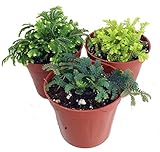


Plant Profile & Key Characteristics
Overview: A low, mat-forming evergreen spikemoss reaching only 5-15 cm (2-6 in) high but spreading to form a mossy, fern-like carpet. This spore-bearing lycophyte is grown purely as an ornamental foliage plant for shady, humid spots, terrariums and as an indoor groundcover.
Quick Specifications
| Specification | Attribute |
|---|---|
| Plant Type / Life Cycle | Herbaceous perennial (spore-bearing lycophyte / fern ally) |
| Foliage Type | Evergreen (can be semi-deciduous in cold) |
| Mature Size | 5-15 cm (2-6 in) tall, spreading indefinitely as a mat |
| Growth Rate | Moderate to fast |
| Root System | Shallow and fibrous, produced from creeping stems (rhizophores) that root as they spread |
| Hardiness | USDA zone 11+ (to 10b with extra care and frost protection) |
Growth Form & Structure
- Height & Spread: Stays 5-15 cm (2-6 in) tall in the ground yet creeps outward to cover a wide area; in a pot it trails over the rim and stays more contained, and is potted up 40-50% larger than the root ball as it fills in.
- Growth Habit & Form: Low, creeping mat-former with slender branching stems clothed in tiny scale-like leaves, giving a soft moss-and-fern texture; it can become invasive in warm, damp sites.
- Lifespan & Maturity: Long-lived perennial that roots freely along its stems and reaches spreading size within a season or two in warm, humid conditions.
Anatomy & Physical Features
- Leaves & Foliage: Green, scale-like leaves, in some forms edged white, yellow, brown or red, clothing branching stems. It bears no true flowers, reproducing by spores.
Primary Uses & Landscape Value
- Functional & Ornamental Roles: Shade- and moisture-loving groundcover, terrarium and bottle-garden filler, and an easy indoor foliage houseplant where humidity is kept high.
Care Guide: Planting, Soil & Watering
Overview: Selaginella (spikemoss) is a low, shade-loving foliage plant that thrives in warm, humid conditions and rich, organic soil kept consistently moist. It wants steady moisture and high humidity, yet still needs good drainage so the roots never sit in stagnant water.
Quick Care Requirements
| Requirement | Ideal Condition |
|---|---|
| Planting Season | Warm season, avoiding the hottest days (spring to summer in zone 10b; spring to autumn in 11; year-round in 12+) |
| Growth Rate | Moderate to Fast |
| Soil Type | Rich, organic, moisture-retentive soil (peat-based) with good drainage |
| Water Need | Moderate to High — keep consistently moist, never let it dry out |
Planting & Establishment
- Best Planting Season: Plant in the warm part of the season but avoid the hottest summer days; in frost-free zones (11 to 12+) it can be planted through much of the year, and it grows best above 15°C.
- How to Plant:
- Soil Amendments: Use rich soil generously amended with organic matter; a peat-based mix with perlite suits it well.
- Planting Depth: Set the plant so the base of the foliage sits at soil level, keeping the moist mix in firm contact with the roots.
- Growth Speed & Expectations: Moderate to fast in warm, humid, shaded conditions.
Soil, Watering & Drainage Care
- Soil Mix & Drainage Needs: Use a rich, moisture-retentive potting or peat mix with perlite for aeration; drainage must still be good so water doesn’t stagnate at the roots. Grown indoors, pair it with high humidity.
- Watering Schedule & Technique:
- Young / Newly Planted: Keep the soil moist and humidity high as it roots in.
- Established: Water regularly so the mix stays evenly moist — never let it dry out fully.
- Seasonal Adjustments: In dry Mediterranean summers add extra water and humidity; ease off a little in cooler months, but still keep the soil from drying.
Climate, Light & Hardiness
Selaginella is a tropical and subtropical foliage plant that needs consistent warmth, high humidity, and full shade to thrive; in Mediterranean climates it needs extra summer moisture, and elsewhere it is usually grown indoors as a houseplant. It has essentially no frost tolerance and is only reliably hardy outdoors in the warmest zones.
Quick Climate Specifications
| Climate Zones | Tropical, subtropical; grown with supplemental summer moisture in Mediterranean climates, or as a houseplant elsewhere |
|---|---|
| USDA Hardiness Zones | 11+; possible in zone 10b with attentive care |
| Optimal Temp Range | Generally above about 15°C (59°F) |
| Approx. Survival Minimum | Can continue growing down to around 7°C (45°F) |
| Frost Tolerance | None to Very Low |
| Light Conditions | Full Shade |
Sunlight & Light Exposure
Optimal Light Setup
Full shade is ideal; this is a shade-loving foliage plant, not one suited to direct sun.
Shade & Heat Management
Keep it in consistently shaded, humid conditions; direct sun will scorch the delicate foliage.
Best Exposure / Orientation
Indoors, a spot away from direct sun with good ambient humidity – such as a bathroom, terrarium, or a humidity tray – suits it well.
Temperature Extremes & Hardiness
USDA Hardiness & Regional Limits
Reliably grows outdoors year-round only in zone 11+; it may survive outdoors in the marginal zone 10b with attentive winter care, including protection from cold and consistent moisture. Outside these zones it is best grown indoors as a houseplant.
Cold Damage & Winter Protection
Growth is best kept above about 15°C (59°F); temperatures colder than this stress the plant, though it can continue growing down to around 7°C (45°F).
Frost Sensitivity
Has essentially no frost tolerance – a tropical/subtropical foliage plant that should be protected from any freezing temperatures.
Extreme Heat Tolerance
Tolerates warm, tropical heat well provided humidity and shade are maintained; without adequate humidity, heat combined with dry air will stress and scorch the foliage.
Wind, Humidity & Microclimate
Humidity Preferences
Needs consistently high humidity to thrive; indoors this often means grouping plants, a pebble tray, a humidifier, or a terrarium-style enclosure.
Dry-Air Tolerance
Poor – dry air, such as near heating or air-conditioning vents, causes browning and crisping fronds; regular misting or ambient humidity is important, especially indoors.
Rainfall & Seasonal Moisture
In Mediterranean climates with dry summers, supplemental moisture through summer is necessary since its native tropical/subtropical range lacks a pronounced dry season.
Growing in Pots, Balconies & Indoors
Selaginella (spikemoss) is a low, creeping foliage plant (5-15 cm). The grower confirms it as a houseplant as long as humidity is kept high – it is a superb moisture-loving choice for a terrarium or shady indoor corner, and it must never be allowed to dry out.
Quick Details
- Container Size: A shallow pot about 40-50% bigger than the root ball
- Indoor Suitability: An excellent houseplant in a humid, shaded spot
- Best Spot: Full shade to bright indirect light; no direct sun
- Soil & Drainage: Rich, moisture-retentive organic mix – potting or peat with perlite
- Watering in Pots: Keep constantly moist; never let it dry out
Indoors & On the Windowsill
- As a houseplant: The grower grows it indoors, with the key being humidity. A bathroom, a terrarium, a grouping of plants, or a pebble/humidity tray all help; keep it out of direct sun and in bright indirect light or full shade.
- Moisture: This plant will not forgive drying out – keep the mix reliably damp at all times.
On a Balcony or Patio
- Shade & humidity only: Outdoors it needs deep shade, high humidity and shelter; it is not for sunny or dry, windy balconies. Keep it constantly moist.
Choosing the Pot, Soil & Long-Term Care
- Pot & drainage: A shallow pot about 40-50% bigger than the root ball, with drainage holes but a moisture-holding mix; move it up when the roots fill the pot.
- Potting mix: Rich, organic and moisture-retentive – potting or peat with perlite, plus humus and a mulch to hold moisture.
- Feeding & refreshing: Feed only lightly; every few years refresh the soil and trim some roots and leaves.
Fertilizing & Feeding
A light feeding program, since this low, humidity-loving foliage plant is a naturally light feeder and sensitive to fertilizer buildup.
Quick Fertilizing Specs
| Feeding Level | Light – this is a naturally light-feeding foliage plant. |
|---|---|
| young_feeding | Newly potted or freshly rooted divisions need little to no feeding until established. |
| mature_feeding | Established plants do best with a light, balanced feeding during active growth. |
| Main Nutrient Priority | Balanced feeding with restrained nitrogen; this plant is grown for compact, healthy foliage rather than rapid growth. |
| Best Feeding Period | During the warmer, actively growing months. |
| Organic Options | A light dressing of well-aged organic matter or compost worked into a rich, humus-based mix. |
| Soil pH | Prefers a rich, humus-heavy, evenly moist growing mix. |
| Reduce/Stop Feeding | Reduce or stop feeding during cooler, low-light periods when growth slows. |
Feeding by Growth Stage
Establishment After Potting or Division
Let newly potted or divided plants settle in and root out before introducing fertilizer.
| Nutrient direction | None – hold off on fertilizer while roots are establishing. |
|---|---|
| Timing | Immediately after potting, dividing, or propagating. |
| Frequency | No feeding at this stage. |
| Fertilizer types | No feeding at this stage – allow roots to establish in fresh, rich growing mix before fertilizing. |
| Precautions | Do not fertilize freshly potted or divided plants; wait for clear signs of new growth first. |
Active Growth
Support steady, compact foliage growth once the plant is established and actively growing.
| Nutrient direction | A light, balanced feeding with restrained nitrogen to keep growth healthy without pushing weak, leggy stems. |
|---|---|
| Timing | During the warmer months when the plant is putting out new growth. |
| Frequency | Light feeding on an infrequent schedule is usually enough for this naturally light feeder. |
| Fertilizer types | A balanced, complete fertilizer diluted well below full strength and formulated for foliage houseplants., A light dressing of well-aged organic matter worked into the surface of the mix. |
| Routine trace nutrients | iron, manganese |
| Precautions | This plant is sensitive to fertilizer buildup, so keep applications light and avoid feeding onto dry mix. |
Low-Light or Cool-Season Slowdown
Let the plant rest as growth naturally slows during cooler, lower-light periods.
| Nutrient direction | None – withhold fertilizer while growth is slow or stalled. |
|---|---|
| Timing | Cooler months or periods of reduced indoor light. |
| Frequency | No feeding at this stage. |
| Fertilizer types | No feeding at this stage – resume only once active new growth is clearly visible again. |
| Precautions | Do not fertilize during slow growth, since unused nutrients can build up in the mix and stress the roots. |
Nutrient Deficiency Signs & Corrections
Browning, crisping leaf tips or edges on an otherwise healthy plant.
| Possible causes | Fertilizer salt buildup in the growing mix, Low humidity or dry air around the foliage, Inconsistent watering allowing the mix to dry out |
|---|---|
| Appears first on | Tips and edges of the finer foliage. |
| What to check | Feeding frequency and strength relative to this plant’s light needs, Humidity levels around the plant, Consistency of the watering schedule |
| Possible correction | Flush the growing mix thoroughly with plain water to clear excess salts, raise humidity, and scale back feeding strength. |
Pale, faded green foliage and weak, sparse new growth.
| Possible causes | Insufficient feeding for the plant’s active growth stage, A depleted or very old growing mix, Root stress from an overly root-bound container |
|---|---|
| Appears first on | Older foliage first, spreading to new growth if uncorrected. |
| What to check | Recent feeding history and mix age, Container size relative to root mass, Overall root health |
| Possible correction | Resume a light, balanced feeding during active growth and consider refreshing the growing mix. |
Mushy, collapsing stems and a sour smell from the growing mix.
| Possible causes | Waterlogged, poorly drained growing mix, Fungal or bacterial rot organisms favored by excess moisture, A container without adequate drainage |
|---|---|
| Appears first on | Stem bases and roots, then wilting foliage above. |
| What to check | Drainage of the growing mix and container, Recent watering frequency, Root and stem base condition when checked |
| Possible correction | Improve drainage, let the mix dry appropriately between waterings, and trim away any rotten tissue. |
Pruning, Training & Seasonal Maintenance
Selaginella has essentially no structural pruning need — it is a low, spreading, non-flowering foliage plant with no wood and no bloom cycle to protect, so light trimming is safe at any time of year, matching its fast growth rate. The two real tasks are removing dead or browned foliage and, where the plant creeps and roots at its nodes, trimming back trailing growth to keep it contained, since this species is documented as capable of becoming invasive under the right (warm, humid, moist) conditions.
Quick Pruning & Maintenance Specs
| Pruning Tolerance | High for light trims, but there is no woody framework to rejuvenate — cutting is cosmetic/containment only |
| Primary Pruning Window | Any time, year-round |
| Typical Frequency | As needed, whenever fronds brown or growth spreads past its space |
| Main Objective | Shape/size control, remove dead foliage, contain creeping spread |
| Young Plant Priority | None — let newly propagated plants establish before any trim |
| Mature Plant Priority | Trim trailing growth to control spread; remove dead sections |
| Best Tool Type | Precision snips |
| Avoid Heavy Pruning During | Cold spells below its roughly 7°C tolerance floor, or dry/low-humidity stress — it has no reserve wood to recover from stress plus a hard cut at once |
Pruning by Plant Age & Size
Newly Established
No pruning while rooting in; this species is typically propagated from leaf-and-root cuttings and needs to finish establishing first.
Young / Formative
No formal training system. Occasional tip-pinching can encourage a slightly bushier mound instead of its natural creeping habit, if desired.
Mature / Established
Routine trims to control spread and height and remove dead sections, particularly where creeping stems root at nodes and risk escaping their intended area.
Seasonal Pruning Schedule
Ongoing Sanitary (non-seasonal)
- Objective: remove dead/browning foliage and contain spreading growth
- Remove: browned, dead, or straggly leaf sections and stems creeping beyond the intended area
- Do not remove: healthy green growth beyond what is needed for shape — there is no reserve wood, so over-cutting abruptly reduces the plant’s photosynthetic mass
- Expected response: quick fresh regrowth, given the fast-to-medium growth rate
- Flowering impact: none — this plant does not flower
Special Growth to Remove
- Dead or browned leaf tips and fronds — routine
- Trailing/creeping stems rooting at nodes beyond the desired planting area — a containment measure given this plant’s documented invasive tendency in favorable conditions; rooted node segments can simply be potted up as new plants rather than discarded, since this is exactly how the species is propagated
Container & Small-Space Pruning
For container/houseplant specimens, repotting is needed once the plant is root-bound or a 40-50% larger pot is warranted; at that point trim some roots and some top leaves together, rather than trimming foliage alone on its own separate schedule. Keep humidity elevated after any trim, since this plant depends on high humidity and cut foliage can desiccate quickly in dry indoor air.
Tools
- Precision snips — the only appropriate tool; growth is small, soft, and non-woody throughout
Tool Hygiene & Disease Risk
Routine: clean tools are sufficient. No tool-transmissible disease risk is documented for this species; its known pests (mealybugs, whitefly, spider mites) are not spread via pruning cuts.
Cut Placement & Technique
- Snip trailing stems at a node, at the point where containment is wanted
- Remove dead leaf or frond material at its point of attachment rather than partway along, given the plant’s fine, low-growing texture
Heavy Pruning & Rejuvenation
Not applicable in the shrub-rejuvenation sense. If a planting becomes thin or leggy, the practical fix is dividing or repropagating healthy sections from cuttings — its own normal propagation method — rather than hard-cutting the existing planting back.
Post-Pruning Care
Keep humidity elevated after trimming, since this is a moisture- and humidity-dependent plant and freshly cut ends can desiccate quickly in dry air. No extra fertilizer is needed after a routine trim.
Common Pruning Mistakes
- Letting spreading growth go unchecked, given this plant’s documented potential to become invasive in favorable conditions, instead of routine containment trims
- Removing most of the green foliage at once — unlike a shrub, there is no woody reserve to regrow from as reliably
- Leaving trimmed foliage in low humidity without misting, causing browning at the fresh cut edges
When NOT to Prune
- Avoid a hard cutback when the plant is already stressed by cold (below roughly 7°C) or by low humidity/dry air, since it has no dormancy-driven reserve to recover from stress and defoliation at the same time
Recommended Tools (by task)
| Task | Tool Category | Why |
| Shape/size control, dead-frond removal, containing creeping spread | precision_snips | The only cut size this plant ever presents — small, soft, non-woody growth throughout |
Propagation Guide
Selaginella is best increased vegetatively, either from stem/leaf-node cuttings or by layering a trailing stem while it is still attached to the parent plant, since starting new plants from spores is difficult and not a practical home method. Vegetative propagation is easy given warm, humid conditions.
Quick Propagation Specs
| Best Propagation Method | Stem/leaf-node cuttings |
| Alternative Methods | Layering a trailing stem while attached to the parent; division of rooted mat sections |
| Propagation Difficulty | Easy (vegetative); Specialist (from spore) |
| Vegetative True-to-Type | Yes |
Stem Cuttings
Cutting Type
Stem/leaf-node cuttings – roots naturally form at the base of the leaves along the stem.
Cutting Preparation
Two approaches: cut a stem section directly, or – the more reliable option – pin the trailing stem onto soil while it is still attached to the mother plant so it roots in place, then sever it from the parent only after the new section is established.
Rooting Setup
Either root the cut piece in water, changing the water every few days, or plant directly into rich, well-drained soil (peat soil is preferred), keeping it consistently moist without letting it dry out.
Rooting Hormone
Not addressed by site data; this plant roots readily at its leaf nodes, so hormone is not typically necessary.
Division, Offsets, Pups & Suckers
Because Selaginella spreads as a low mat and roots naturally at nodes along its trailing stems, an established clump can also be divided into already-rooted sections and transplanted directly.
Spores
Selaginella reproduces naturally by spores, but starting new plants from spore is difficult and rarely practical for home growers – vegetative propagation is the recommended and necessary route for reliable results.
Pests, Diseases & Troubleshooting
Overview: Spikemosses are moisture- and humidity-loving fern allies with delicate, scale-like foliage that is largely trouble-free when its cultural needs are met; most problems trace back to dry air, stagnant soil moisture, or the sap-sucking insects that colonise soft indoor foliage. Manage it culturally first — steady humidity, gentle airflow, and clean plants — and reach for treatments only when pests are confirmed.
Quick Troubleshooting Overview
| Issue / Pest | Main Symptom | Primary Solution |
|---|---|---|
| Mealybugs | White cottony tufts in leaf junctions; sticky honeydew | Dab with alcohol; insecticidal soap or neem |
| Spider mites | Fine stippling, faint webbing, bronzed dry foliage | Raise humidity; rinse; insecticidal soap or oil |
| Whitefly | Tiny white flies rising when disturbed; sooty mould | Yellow sticky traps; insecticidal soap |
| Fungus gnats | Small black flies at the soil; larvae in wet mix | Let surface dry; sticky traps; Bti drench |
| Leaf browning / crisping | Fronds dry, brown at the edges or tips | Raise humidity, keep evenly moist, shade from sun |
| Root & crown rot | Blackened stems, collapse, sour wet soil | Improve drainage; ease off water; remove rotted parts |
Common Pests & Management
- Mealybugs (Pseudococcus spp.):
- Symptoms: White, cottony, waxy clusters tucked into the crown and where the tiny leaves meet the stems; they excrete sticky honeydew that can turn black with sooty mould. Slow-moving and easily missed on congested, mat-forming foliage.
- Prevention & Control: Isolate the plant and wipe or spot-treat colonies with a cotton bud dipped in diluted rubbing alcohol. Follow with insecticidal soap or a light neem-oil solution, repeating every 7–10 days to catch newly hatched crawlers. Keep new plants quarantined and inspect the crown regularly, as dense growth hides infestations.
- Spider mites (Tetranychus urticae):
- Symptoms: Fine pale stippling on the fronds, a dull bronzed cast, and in bad cases gossamer webbing over the tips — almost always a symptom of air that is too dry. Confirm by tapping foliage over white paper and watching for moving specks.
- Prevention & Control: Prevention is humidity: mist, group plants, or use a pebble tray so the air never dries out. Rinse foliage to dislodge mites, then treat with insecticidal soap or a fine horticultural oil, covering the undersides and repeating twice at weekly intervals. Predatory mites work well in enclosed terrariums.
- Whitefly (Trialeurodes vaporariorum):
- Symptoms: Clouds of tiny white flies lift off when the plant is disturbed; nymphs on the leaf undersides suck sap and produce honeydew and sooty mould, leaving foliage weak and dull.
- Prevention & Control: Hang yellow sticky traps to monitor and thin the adults. Spray insecticidal soap or neem to the undersides in the evening, repeating every few days to break the cycle. Encourage airflow and avoid over-feeding, which produces the soft growth whitefly prefer.
- Fungus gnats (Bradysia spp.):
- Symptoms: Small dark flies running over the soil surface and around the pot; their larvae live in the top layer of permanently wet mix and can nibble tender roots of young plants.
- Prevention & Control: Let the surface dry slightly between waterings even though the plant likes moisture, cover the mix with a thin grit layer, and set yellow sticky traps. For persistent problems drench with Bacillus thuringiensis israelensis (Bti) or use beneficial nematodes.
Diseases & Fungal Issues
- Root & crown/stem rot (Pythium / Phytophthora / Rhizoctonia spp.):
- Symptoms: Stems blacken and collapse at the base, foliage yellows and goes limp, and the mix smells sour — the classic result of soil kept saturated in poor light or cold, stagnant conditions.
- Treatment & Management: Prevention is everything: use a free-draining, organic-rich mix, keep it evenly moist but never waterlogged, and ensure gentle air movement. Remove rotted sections back to healthy tissue, repot into fresh mix, and reduce watering while it recovers. Avoid cold water and cold, still rooms.
- Grey mould (Botrytis cinerea):
- Symptoms: Fuzzy grey-brown mould on soft, congested foliage and dead frond tips, usually in cool, damp, still air with poor drying between waterings.
- Treatment & Management: Increase airflow and reduce leaf wetness in cool spells, remove affected and dead material promptly, and thin overcrowded growth. Sanitation and drier air usually suffice; a copper-based or biological fungicide can be used if it spreads.
Growing Difficulties & Abiotic Problems
- Leaf browning & crisping (low humidity):
- Cause & Symptoms: Fronds dry out, brown at the margins and tips, and the mat looks scorched — caused by dry indoor air, draughts, or letting the mix dry out. This is the single most common complaint with spikemoss.
- Correction Strategy: Keep humidity high and consistent with a pebble tray, grouping, a humidifier, or a terrarium/enclosed case. Maintain even soil moisture, keep it out of hot draughts and heating vents, and mist with soft water in dry spells.
- Sun scorch & bleaching:
- Cause & Symptoms: Direct sun bleaches the colour and burns patches brown; spikemosses are woodland-floor plants adapted to shade and dappled light.
- Correction Strategy: Grow in bright indirect light or light shade, well back from hot windows. Introduce any new light levels gradually and shade from midday sun outdoors.
- Overwatering vs. drying out:
- Cause & Symptoms: Both extremes cause browning: soggy stagnant soil rots the base, while any drying-out of this shallow-rooted plant crisps the foliage almost irreversibly.
- Correction Strategy: Aim for constantly moist but well-aerated mix; water when the surface just begins to feel less wet, and never let the root ball dry completely. Good drainage plus steady humidity is the balance point.
What Helps – Products & Tools
For pest work on spikemoss, the gentle organic staples do the job: insecticidal soap and light horticultural or neem oil for mealybugs, mites and whitefly, rubbing alcohol on a cotton bud for spot-treating mealybugs, yellow sticky traps for whitefly and fungus gnats, and a Bti drench for gnat larvae. On the disease side a copper-based fungicide handles grey mould if sanitation alone falls short. The best ‘tools’, though, are a humidifier or pebble tray and a free-draining, organic-rich mix — keep the air moist and the roots aerated and this plant rarely needs sprays.


