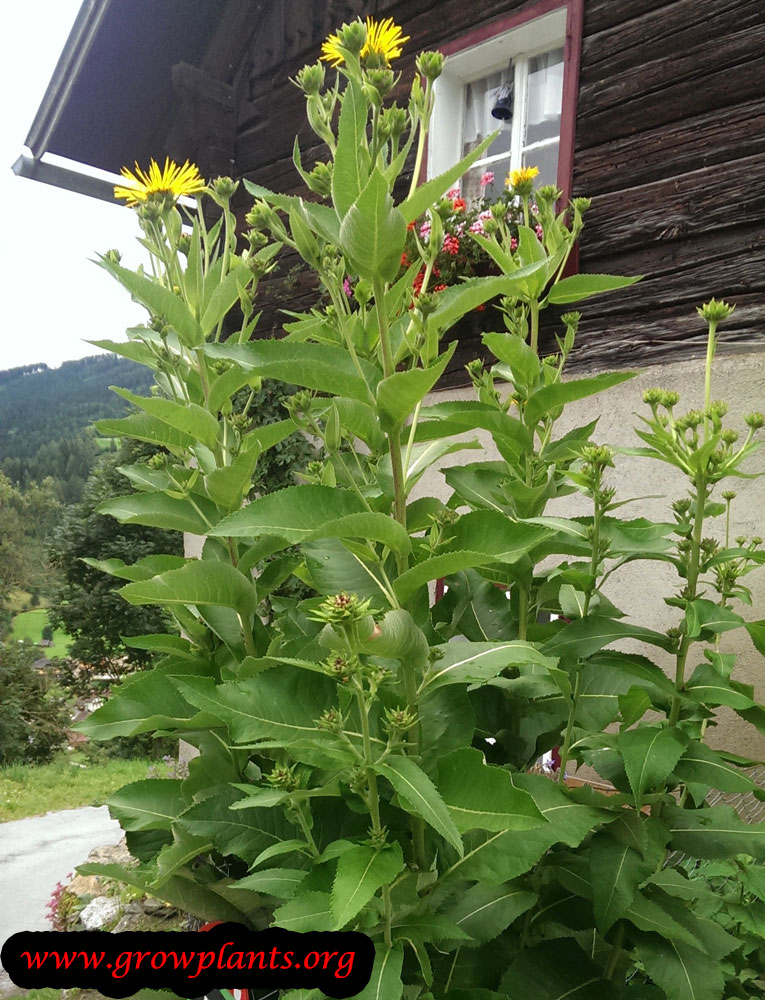
Plant Profile & Key Characteristics
Overview: A tall, robust herbaceous perennial (Elecampane, Inula helenium) reaching about 0.5-1.5 m, with large coarse leaves and bright yellow daisy-like flowers. It is grown as an ornamental and, long-established, as a medicinal herb.
Quick Specifications
| Specification | Attribute |
|---|---|
| Plant Type / Life Cycle | Perennial (herbaceous) |
| Foliage Type | Deciduous (dies back in winter) |
| Mature Size | 0.5-1.5 m tall (20-60 in) |
| Growth Rate | Moderate to fast |
| Root System | Thick, fleshy taproot/rhizome (the part used medicinally) |
| Hardiness | USDA 4-9 |
Growth Form & Structure
- Height & Spread: Upright, statuesque clumps 0.5-1.5 m (20-60 in) tall; can also be grown in a large container.
- Growth Habit & Form: Clump-forming herbaceous perennial with tall, branching flower stems above large basal leaves.
- Lifespan & Maturity: Reaches full size within a season or two and returns each year from its stout rootstock.
Anatomy & Physical Features
- Leaves & Foliage: Large green leaves, elliptic to ovate with a serrated margin, the lower ones stalked and spoon-shaped.
- Flower Characteristics: Bright yellow, daisy-like flower heads with numerous narrow ray petals around a disc.
Primary Uses & Landscape Value
- Edible Uses: Long grown as a medicinal herb; the thick aromatic root is the traditionally used part.
- Functional & Ornamental Roles: Ornamental back-of-border perennial and a classic medicinal/herb-garden plant.
Care Guide: Planting, Soil & Watering
Overview: Elecampane is a tall, hardy perennial for cool climates that grows in full sun to part shade in fertile, moisture-retentive soil. It likes steady moisture and dislikes drying out.
Quick Care Requirements
| Requirement | Ideal Condition |
|---|---|
| Planting Season | In the cool season — from winter (in mild zones) through spring into summer |
| Growth Rate | Moderate to Fast |
| Soil Type | Fertile, moisture-retentive, well-draining soil |
| Water Need | Moderate to High — likes consistently moist soil |
Planting & Establishment
- Best Planting Season: Plant from winter in mild areas through spring and into summer, while the soil is workable.
- How to Plant:
- Hole Preparation: Dig a hole a little wider than the root ball in a sunny to lightly shaded spot, allowing room as it can reach about 1.5 m.
- Soil Amendments: Enrich with compost or organic matter to boost fertility and hold moisture.
- Planting Depth: Set the crown at the soil surface — don’t bury it.
- Growth Speed & Expectations: Fast to moderate; it makes a large clump quickly.
Soil, Watering & Drainage Care
- Soil Mix & Drainage Needs: Prefers deep, fertile soil that stays moist yet drains freely; a mulch helps retain moisture.
- Watering Schedule & Technique:
- Young / Newly Planted: Keep the soil evenly moist while establishing.
- Established: Water regularly to keep the soil moist; it doesn’t like to dry out.
- Seasonal Adjustments: Water more in summer heat; reduce in cool, wet weather and winter dormancy.
Climate, Light & Hardiness
Elecampane is a robust, cold-climate perennial suited to temperate and subtropical gardens, grown in full sun to half shade. It is a genuinely cold-hardy plant that dies back to the ground each winter and regrows from its rootstock.
Quick Climate Specifications
| Climate Zones | Temperate, subtropics |
|---|---|
| USDA Hardiness Zones | Zones 4–9 |
| Frost Tolerance | High (deciduous, dies back to the crown in winter) |
| Light Conditions | Full sun / half shade |
Sunlight & Light Exposure
Optimal Light Setup
Grows well in full sun or half shade; in hotter parts of its range, some afternoon shade can reduce heat stress.
Temperature Extremes & Hardiness
USDA Hardiness & Regional Limits
Well suited to cold-winter climates (zones 4–9); it needs winter cold as part of its normal deciduous cycle rather than merely tolerating it.
Cold Damage & Winter Protection
Foliage dies back naturally with the onset of winter cold - this is normal dormancy, not damage, and the rootstock resprouts in spring.
Growing in Pots, Balconies & Indoors
Elecampane is a tall, bold herb reaching up to 1.5 m – it is an outdoor border and large-container plant, not a houseplant; young plants can spend a season in a big pot before they really want the open ground.
Quick Details
- Container Size: A large, deep pot, at least 25-40 L (6-10 gal), for a plant of 0.5-1.5 m (20-60 in); it has a strong taproot
- Indoor Suitability: Not a houseplant (the grower marks it “No”) – it is a large, sun-loving herb for outdoors
- Best Spot: Full sun to half shade
- Soil & Drainage: Deep, rich, moisture-retentive but free-draining mix
- Watering in Pots: Moderate to high – it likes steady moisture; do not let a pot dry out
Indoors & On the Windowsill
- Houseplant limits: The grower marks it as not suitable indoors. It is simply too large and light-hungry for a windowsill, and its deep taproot resents confinement.
- Overwintering: Hardy – it dies back and reshoots each spring; a potted plant can stay outdoors, sheltered in the hardest frost.
On a Balcony or Patio
- Light & wind: A dramatic accent for a large, sunny balcony pot; its tall stems catch the wind, so place it in shelter or stake it. A deep pot dries and stresses fast, so water generously in summer.
- Practicalities: A big, heavy pot is best – factor in weight and drainage runoff.
Choosing the Pot, Soil & Long-Term Care
- Pot & drainage: A deep 25-40 L pot with strong drainage holes; skip a standing water saucer, though it does like to stay moist.
- Potting mix: Rich, moisture-retentive organic mix that still drains.
- Feeding: A hungry plant in a pot – feed regularly through the growing season, as nutrients leach with the frequent watering it needs.
- Repotting: Pot on or refresh the mix each year while young; it is happiest moved to the open ground long-term.
Fertilizing & Feeding
Elecampane is a robust, cold-hardy perennial herb grown for its ornamental yellow flowers and medicinal root – it is a light feeder that thrives on rich soil built up with organic matter rather than frequent fertilizing.
Quick Fertilizing Specs
| Feeding Level | Light |
|---|---|
| Main Nutrient Priority | Balanced feeding with organic matter to support strong root and leaf growth |
| Best Feeding Period | Spring through summer during active growth ahead of its summer bloom |
| Organic Options | Compost or well-rotted organic matter worked into the bed, well suited to a plant grown partly for its root |
| Soil pH | Adaptable to a range of garden soils |
Feeding by Growth Stage
Establishment
Support root and early foliage development after planting
| Nutrient direction | Balanced feeding to build the plant’s substantial root system and early leaf canopy |
|---|---|
| Timing | From winter or spring planting through early growth |
| Frequency | Light, infrequent feeding while the plant establishes |
| Fertilizer types | Balanced complete fertilizer at a light rate, Compost or well-rotted organic matter worked into the planting bed |
| Precautions | Favor organic matter over concentrated fertilizer, especially if the root will later be harvested for medicinal use |
Active growth through summer bloom
Sustain the plant’s tall foliage growth and support its summer bloom
| Nutrient direction | Balanced feeding kept light, as this is a robust perennial that does not need heavy nutrition to perform well |
|---|---|
| Timing | Through spring and summer active growth into bloom |
| Frequency | Feed sparingly through the growing season |
| Fertilizer types | Balanced complete fertilizer applied lightly, or a light organic feed |
| Precautions | Avoid heavy nitrogen feeding, which can produce excess leafy growth rather than a well-developed root |
Winter dieback
Let the plant rest through its deciduous winter dormancy
| Nutrient direction | None – withhold fertilizer while the plant is dormant through winter |
|---|---|
| Timing | Winter, once the foliage has died back |
| Frequency | No feeding at this stage |
| Fertilizer types | No feeding at this stage – resume once spring growth resumes |
| Precautions | Do not fertilize dormant, dieback growth; wait for new spring shoots before feeding again |
Nutrient Deficiency Signs & Corrections
Pale green, undersized leaves and weaker overall growth than expected for this normally vigorous plant
| Possible causes | Nitrogen deficiency, Poor soil low in organic matter, Root competition or overcrowding |
|---|---|
| Appears first on | Older, lower leaves |
| What to check | Soil organic matter and fertility, Spacing and competition from nearby plants, Recent feeding history |
| Possible correction | Work in compost or organic matter and resume light balanced feeding |
Yellowing between the veins of new leaves while the veins remain green
| Possible causes | Iron deficiency, Alkaline soil reducing iron availability, Waterlogged soil restricting root function |
|---|---|
| Appears first on | Newest leaves |
| What to check | Soil pH, Drainage in the planting area, Whether only new growth is affected |
| Possible correction | Improve drainage, correct soil pH where testing confirms an issue, and apply a chelated iron product per its label if needed |
Pruning, Training & Seasonal Maintenance
Elecampane is a tall (0.5–1.5 m), fast-to-medium growing herbaceous perennial that dies back to the ground each year, so it tolerates a hard annual cutback but carries no persistent woody framework to train. The main jobs are deadheading spent flower heads during the summer bloom to tidy the clump, and cutting the whole plant to the base once its foliage collapses after frost. Because flowers form fresh each year on that season’s new growth, pruning timing has no effect on next year’s bloom – it is purely about seasonal tidiness.
Quick Pruning & Maintenance Specs
| Pruning Tolerance | High – dies back annually, safe to cut hard |
| Primary Pruning Window | Winter, after foliage collapses |
| Secondary Maintenance Window | Summer, deadheading during and after bloom |
| Typical Frequency | 1–2 times per year |
| Main Objective | Tidy foliage and limit self-seeding |
| Young Plant Priority | Minimal – let the clump establish |
| Mature Plant Priority | Deadhead through summer, cut to base in winter |
| Best Tool Type | Bypass secateurs |
| Avoid Heavy Pruning During | Active summer bloom, unless deadheading |
Pruning by Plant Age & Size
Newly Established
No pruning beyond removing any damaged or yellowing leaves while the clump establishes.
Young / Formative
No structural training – this is a herbaceous clump-former, not a plant with a trainable framework.
Mature / Established
Deadhead spent flower heads through summer; once top growth browns and collapses in winter, cut it back to a few centimetres above ground.
Seasonal Pruning Schedule
Post-Flowering
Objective: control seed-set and tidy the plant. Remove: spent flower stalks, cut down to a healthy leaf junction. Avoid removing: healthy green foliage still photosynthesising. Response: may trigger a few secondary flowers; no crop or bloom-cycle impact since this is not a woody or fruiting plant.
Dormant / Winter
Objective: clear collapsed top growth for a tidy bed and reduced disease/pest overwintering sites. Remove: all blackened, collapsed stems and leaves down to the base. Avoid removing: don’t cut into the crown or roots. Response: fresh basal shoots emerge from the crown in spring; no impact on next year’s bloom.
Special Growth to Remove
- Dead or yellowing lower leaves through the growing season
- Spent flower stems after bloom
Container & Small-Space Pruning
Container growth is possible; given the plant’s mature size, use a large pot and expect to deadhead slightly more often since spent stems are more visually obvious in a small-space setting. The winter cutback is the same as for in-ground plants.
Tools
- Precision snips – for light deadheading of soft flower stalks
- Bypass secateurs – for the firmer basal stems at winter cutback
Tool Hygiene & Disease Risk
Routine – clean, sharp tools are sufficient. No specific transmissible disease is flagged for this plant; aphids are the noted pest, not a pruning-borne pathogen.
Cut Placement & Technique
Deadhead just above a leaf node or side bud. At winter cutback, cut close to the ground but not into the crown itself, to avoid creating a rot entry point.
Heavy Pruning & Rejuvenation
The annual winter cutback effectively is the rejuvenation cut for this species – full regrowth comes from the crown each spring with no long-term harm, as is normal for a dieback herbaceous perennial.
Post-Pruning Care
No feeding is needed after the winter cutback. In wet, cold winters, clear cut debris away from the crown promptly to reduce rot risk; watch new spring shoots for aphids.
Common Pruning Mistakes
- Cutting the clump back too early in autumn while leaves are still green, before the plant has finished building root reserves for winter
- Leaving old flower stalks up too long, allowing heavy self-seeding
When NOT to Prune
Avoid a hard cutback while stems and leaves are still green and actively photosynthesising in autumn. Avoid removing all flowers during peak summer bloom if the display is wanted for pollinators – deadhead selectively instead.
Recommended Tools (by task)
- bypass_secateurs – winter base cutback of firm, collapsed stems
- precision_snips – deadheading soft flower stalks through summer
Propagation Guide
Elecampane (Inula helenium) is most often increased by dividing its thick, fleshy root crown, which gives a faster-establishing plant, though it also grows readily from seed since it is a true species rather than a hybrid or named cultivar. Both methods are straightforward for most home gardeners.
Quick Propagation Specs
| Best Propagation Method | Root crown division |
| Alternative Methods | Seed |
| Propagation Difficulty | Easy |
| Seed True-to-Type | Yes (species plant) |
| Vegetative True-to-Type | Yes |
| Best Propagation Season | Spring (seed and division); division is also possible in autumn |
Growing from Seed
Seed Handling & Viability
Use fresh seed where possible. Elecampane self-sows readily in garden settings, which suggests the seed does not need special drying or long storage treatment before sowing.
Sowing Season
Sow outdoors in spring after the last frost, or in autumn.
Germination Conditions & Time
Germinates at normal outdoor spring or autumn temperatures, typically within a few weeks; exact timing varies with soil temperature and moisture.
Division, Offsets, Pups & Suckers
Root Crown Division
In spring or autumn, lift the clump and cut the thick root crown into sections, making sure each division carries at least one growth bud (eye). Replant promptly, since the fleshy roots can dry out and lose vigor if left exposed for long. Divisions establish quickly and typically flower within a season or two.
Bloom & Flower Guide
Quick Details
- Bloom Season: Summer
- Time to First Bloom: As a perennial it typically flowers from the second year, once the clump is well established
- Flower Appearance: Large yellow daisy-like heads with narrow, thread-fine ray petals around a central disc
- Edibility: The flowers are not eaten – in this herb it is the root that is used medicinally
Detailed Blooming Overview
Elecampane is a tall, architectural herb crowned in summer with shaggy, sunlit-yellow flower heads. It is a fine back-of-border plant that bees work eagerly, though it has long been grown for its aromatic root rather than its blooms.
Flower Characteristics
- Big, rayed yellow heads with very slender, almost thread-like petals, borne on stout stems.
Bloom Care & Thinning
- Managing the bloom: Deadhead to keep the plant tidy, or leave a few heads to set seed if you would like it to self-sow.
- Pollination: Pollinated by bees.
Fruit & Uses
Elecampane is grown mainly as an ornamental and traditional medicinal herb, and the site itself notes it is used as an ornamental or medical plant; the large aromatic root is the part used, historically dried for herbal teas/decoctions or occasionally candied as a sweet. It is a prepared-root use only – not a raw vegetable or everyday food crop.
Quick Edible Specs
| Edible Parts | Root (rhizome) |
|---|---|
| Main Use(s) | Medicinal-note (traditional herbal remedy, historically for coughs/chest complaints) / minor culinary flavouring (candied root, liqueur flavouring) |
| Eaten Raw or Cooked | Cooked/processed only – not eaten raw |
| Preparation Required | Peel, slice and cook, dry, or candy the root (raw root is fibrous, bitter and pungent) |
| Harvest Season | Autumn, once the plant has died back after flowering, in a well-established (multi-year) planting |
| Time to First Harvest | Not in the first year – roots are lifted only once well established over multiple growing seasons |
| Storage | Dried root stores well in a cool, dry place; fresh root should be processed promptly |
| Safety/Toxicity Caveat | Contains alantolactone and related compounds that can cause allergic or contact reactions in sensitive individuals, particularly those sensitive to Asteraceae/daisy-family plants; raw or excessive amounts can cause digestive upset, so only prepared root in modest amounts should be used, never raw as a ready-to-eat food |
Roots & Tubers
The thick, fibrous rhizome is dug once the plant is well established and has finished its summer bloom. It is washed, peeled and sliced, then either dried for later use in teas and decoctions, or historically cooked down and candied into a spiced sweet; it has also historically been used to flavour bitters and liqueurs. It is not used as an everyday vegetable.
Harvesting
Lift roots in autumn after the foliage has died back for the season, once the plant has had at least one full growing season to bulk up; dig carefully, as the root system is large and can run deep. Wash soil off promptly and process (dry, cook, or candy) rather than storing the root fresh for long.
Preparation, Uses & Safety
Clean and peel the root before drying for tea/decoction or cooking/candying – it should never be eaten raw in any quantity. Traditional use has been mainly medicinal, valued as a soothing remedy for coughs; this is noted here only as a traditional-use fact, with no dosing or health claims implied. Anyone sensitive to Asteraceae-family plants (ragweed, chrysanthemum, daisies) should avoid handling or eating the root due to a real risk of allergic skin or digestive reactions.
Pests, Diseases & Troubleshooting
Overview: Elecampane is a robust, large-leaved perennial daisy that is largely trouble-free in moist, well-drained soil and full sun. Its main weaknesses are foliar fungal diseases in crowded, humid plantings and root rot in waterlogged ground; give it space and airflow and it rarely needs intervention.
Quick Troubleshooting Overview
| Issue / Pest | Main Symptom | Primary Solution |
|---|---|---|
| Aphids | Colonies on shoots/buds, sticky honeydew, distorted growth | Water jet; insecticidal soap; encourage predators |
| Powdery mildew | White powdery film on leaves late season | Improve spacing/airflow; sulphur fungicide if severe |
| Rust | Orange-brown pustules on leaf undersides | Remove affected leaves; avoid overhead watering |
| Leaf spot | Brown/black blotches on the big lower leaves | Sanitation; clear debris; base-water |
| Root rot | Wilting, base blackening in wet soil | Improve drainage; ease off watering |
Common Pests & Management
- Aphids (Aphis spp. / Uroleucon spp.):
- Symptoms: Dense colonies on soft shoot tips, flower stalks and buds; honeydew, sooty mould and puckered new growth. Often ant-tended.
- Prevention & Control: Knock colonies off with a water jet and rely on ladybirds, lacewings and hoverflies, which favour daisy-family plants. Treat stubborn infestations with insecticidal soap; avoid feeding too much nitrogen, which drives soft, aphid-prone growth.
- Spider mites (Tetranychus urticae):
- Symptoms: Pale stippling and a dull, dusty look on foliage in hot, dry spells, with fine webbing on leaf undersides.
- Prevention & Control: Keep the root zone moist and hose down foliage in heat; encourage predatory mites. Insecticidal soap or a light horticultural oil clears heavier outbreaks.
- Leaf miners (Agromyzidae):
- Symptoms: Pale winding or blotchy tunnels within the leaf tissue; mostly cosmetic on such a vigorous plant.
- Prevention & Control: Pick off and destroy mined leaves, clear plant debris in autumn to break the cycle, and tolerate minor damage – vigorous elecampane easily outgrows it.
Diseases & Fungal Issues
- Powdery mildew (Erysiphe / Golovinomyces spp.):
- Symptoms: A white to greyish powdery coating on upper leaf surfaces, usually from mid- to late season, with yellowing and early die-back of affected foliage.
- Treatment & Management: Space plants and thin surrounding growth for airflow, water at the base, and remove badly affected leaves. A sulphur or potassium-bicarbonate fungicide helps in persistent cases; some airy sites never need it.
- Rust (Coleosporium / Puccinia spp.):
- Symptoms: Orange, yellow or brown powdery pustules on leaf undersides, with pale spots above and premature leaf fall.
- Treatment & Management: Remove and destroy infected leaves promptly, avoid overhead watering, and improve air movement. Clear all foliage at season’s end to reduce overwintering spores; sulphur fungicide is a last resort.
- Leaf spot (Septoria / Alternaria spp.):
- Symptoms: Brown to black spots and blotches, especially on the large lower leaves, sometimes merging in wet weather.
- Treatment & Management: Practise good sanitation – clear fallen and infected leaves – water at soil level, and give plants room. Rarely needs fungicide.
- Sclerotinia / root and crown rot (Sclerotinia sclerotiorum / Pythium spp.):
- Symptoms: Wilting, a soft or blackened base, sometimes white cottony mould at the crown in cool wet conditions.
- Treatment & Management: Improve drainage, avoid overwatering and overcrowding, and remove and destroy affected crowns with the surrounding soil. Do not compost infected material.
Growing Difficulties & Abiotic Problems
- Waterlogging / root rot:
- Cause & Symptoms: Elecampane likes moisture but not stagnant water; heavy, poorly drained soil causes wilting despite wet ground and rots the fleshy roots.
- Correction Strategy: Improve drainage with organic matter, water deeply but let the surface dry between soakings, and divide congested clumps every few years.
- Drought scorch:
- Cause & Symptoms: In prolonged dry heat the big soft leaves wilt and brown at the edges.
- Correction Strategy: Mulch to conserve moisture and water deeply in dry spells; the plant recovers quickly once rehydrated.
- Overcrowding:
- Cause & Symptoms: This tall, spreading perennial shades and crowds itself and neighbours, trapping humidity and encouraging mildew.
- Correction Strategy: Space generously, divide clumps periodically, and thin stems to keep air moving through the planting.
What Helps – Products & Tools
Elecampane rarely needs more than good siting. Keep insecticidal soap for aphids and mites, and a sulphur or potassium-bicarbonate fungicide on hand for powdery mildew or rust in humid seasons. Autumn sanitation – clearing all old foliage – prevents most disease carry-over.